Brown trout
Fish · Last reviewed 2026-08-10
A single, extraordinarily plastic species that appears as a tiny hill-stream fish, a deep-bodied loch trout and a silver sea-run migrant — all the same animal.
Safety: moving water and currents — can cause serious injury or death. 6 more points apply here.
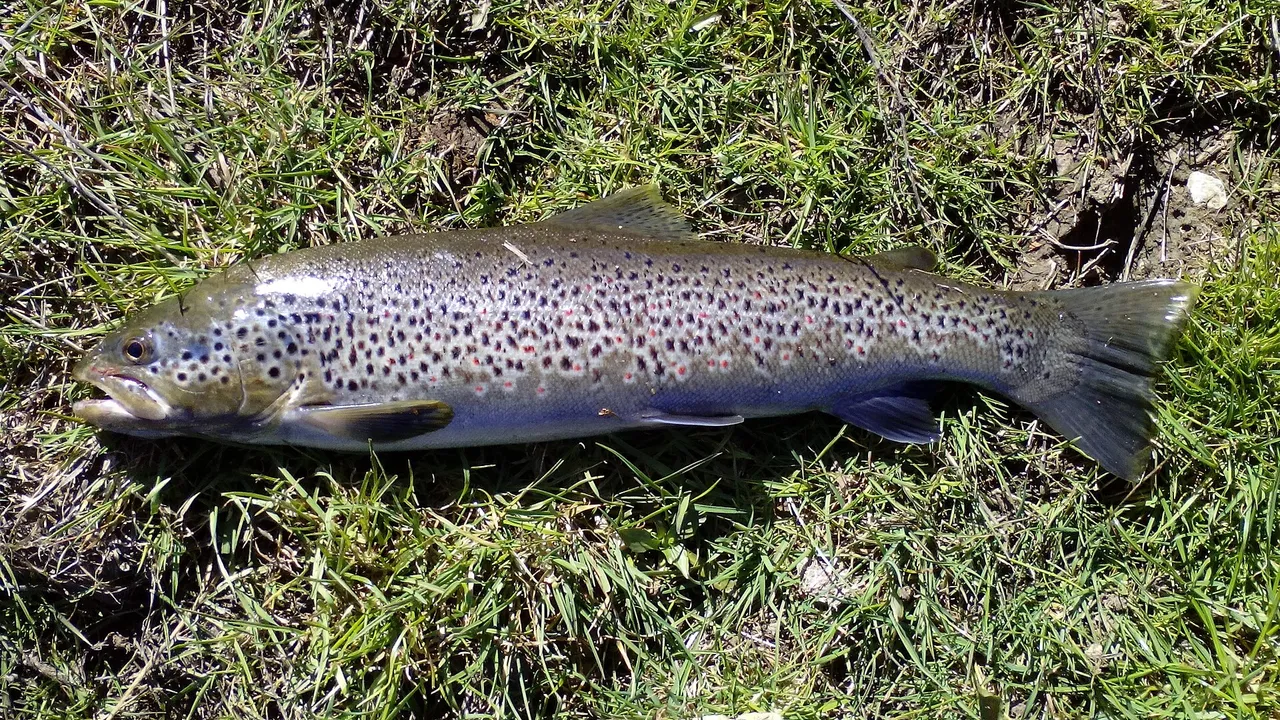
How this was identified, and who took it
Identified by: Both black and red spots, many ringed with pale haloes, spotting extending onto the gill cover, an adipose fin, and a thick caudal wrist — together separating it from Atlantic salmon, which lacks red spots and has a slimmer wrist.Robermix, CC0, via Wikimedia Commons — source, licence
Catching Brown trout
Everything here on fishing for it. Each entry opens the page behind it.
- When
- Feb–Oct — months recorded at the places that document it, not a season for the whole range.
- Where
- 97 places FishingHQ documents — strongest claim anywhere: characteristic of this water · From the shore, Fly fishing, From a boat
Brown trout are the clearest illustration in European fresh water of how far one species can vary. A hill burn trout of fifteen centimetres, a heavy loch ferox, and a silver sea trout returning from the ocean are all Salmo trutta, and the differences between them are largely environmental rather than genetic. That plasticity is the interesting thing about the species and the reason so much fly-fishing tradition attaches to it.
Brown trout are territorial, drift-feeding fish in running water: they hold a station where the current delivers food, expend as little energy as possible holding it, and intercept items as they pass. That single behaviour explains why fly fishing works, why presentation matters more than pattern, and why trout in rivers are found in specific, readable places rather than distributed evenly.
They are also demanding of water quality — cool, well-oxygenated and clean — which makes them a sensitive indicator species and ties their fortunes closely to river management.
Straight answers
For somebody who is already standing on the mark. Everything below this expands on it.
- Where is the fish?
- In moving water, at the front edge of something that breaks the current — a boulder, a seam, a crease, the head of a pool — where it can hold still and still see food coming. In a lake, moving along a feature rather than holding on one.
- What is the one thing that matters?
- Not being seen. On a small stream that is the whole game: a trout that knows you are there has stopped feeding, and no fly fixes it. Approach from downstream, stay low, and keep off the skyline.
- What do I put on?
- Whatever is on the water, at the stage the fish are eating it. Look at the surface, look at the bankside vegetation, and look at what the rise form is telling you — the answer is usually in front of you rather than in a fly box.
- Do I need a licence?
- In England from the age of thirteen, and it is free for under-sixteens. In Scotland there is no rod licence at all, but you still need permission from whoever holds the fishing rights. Both are separate from any fishery's own rules.
- When can I fish?
- Scotland has one national brown trout close time, 7 October to 14 March. England does NOT have a national one — close seasons for trout are set by byelaw area, and you have to check yours.
- When should I stop?
- When the water is warm. Trout grow best in the teens and are in real trouble in the low twenties, and a released fish from warm water frequently does not survive. High temperature is a reason to go home rather than to fish more carefully.
Where you are fishing from
The same fish, and genuinely different fishing. Open the one you are standing on.
Small stream and brook
Water you can step across, and fish that see you first
Small streams and burns — where the fish are small and the craft is total
- At the surface
- Upper water
Methods: Dry fly fishing, Nymphing, Tenkara
How this mark actually fishes
Why fish are here
Almost every hill burn, moorland stream and overgrown lowland brook in Britain and Ireland holds wild brown trout, and a great many of them are barely fished. The fish are small because the water is food-poor, they are territorial from the moment they emerge from the gravel, and every fish has its own lie — which means the water reads like a map once you learn it.
How to fish it
Work upstream, one lie at a time, casting to the head of each pocket before the fish in the tail sees you. Casting room is the constraint rather than distance: roll casts, side casts and bow-and-arrow casts under branches, with a short rod and a few metres of line. Fish the pool heads, the pocket in front of every boulder, and the undercut bank on the outside of every bend, and expect to move constantly.
What to look at on arrival
- The undercut bank on the outside of a bend, which is where the best fish in a small stream almost always lives.
- Pocket water — the slack in front of and behind each boulder — which holds fish where the open channel does not.
- Your own shadow reaching the pool before your fly does.
What goes wrong here
- Walking up the bank rather than fishing from below, which empties the next three pools before you reach them.
- Expecting numbers or size. The Wild Trout Trust's own advice is to expect one or two beautifully marked small fish, and enjoyment follows from expecting that.
- Standing up straight on a high bank in bright light, which is visible to every fish in the pool.
Steep-sided burns are slippery and remote, and a twisted ankle two miles up a hill in poor phone signal is the realistic hazard rather than drowning.
Official guidance — why, and the sources (1)
Stated by a fisheries authority, scientific institute or recognised angling body. Authoritative, but summarising rather than demonstrating.
How small stream and brook marks fish for this species, from the evidence named here.
- Wild trout fishing — where to find it and what it asks of an angler — The Wild Trout Trust, 2026 (Conservation authority)Relied on for: Wild trout in many rivers urban and rural, casting constrained by bushes and trees requiring roll and side casts, and the expectation of one or two small well-marked fish.States this directlyPassage read and verified
River
Moving water, and the seams fish hold on
Rivers — reading current, and the fishing most of the tradition was written about
- At the surface
- Upper water
- Mid water
- On or near the bottom
Methods: Dry fly fishing, Nymphing, Trotting, Spinning
How this mark actually fishes
Why fish are here
A river gives a trout what it needs in one place: current to deliver food, a slack pocket to hold in beside it, and cover to retreat to. Richer rivers grow much larger fish than streams do, and the best fish take the best lies — so a river is not evenly stocked with trout, it is a small number of addresses with a queue for each.
How to fish it
Read the water before wading into it. Fish the seams, the pool heads, the creases beside boulders and the foam lines that mark where the surface drift concentrates. Where fish are rising, work out which current lane the fish is auditing and put the fly in that lane with no drag on it. Where nothing is showing, fish nymphs through the same water at the depth the food is travelling.
What to look at on arrival
- Foam lines, which show you where the drift concentrates and therefore where a feeding fish will be.
- The gauge, and whether the river is rising or falling. A falling, clearing river after a spate is the best of it.
- Drag — the fly moving at a different speed from the water it sits on, which is the commonest reason a good cast is refused.
What goes wrong here
- Wading through the water you should have fished. The first cast on a river is usually made from further back than feels natural.
- Fishing the pretty open middle of a pool rather than the seams and the head where the food actually goes.
- Changing fly after fly when the problem is drag or depth.
Wading a river you do not know, in water above the knee, with a rising level, is the specific combination that drowns people. A wading staff and a willingness to get out are both cheap.
Official guidance — why, and the sources (2)
Stated by a fisheries authority, scientific institute or recognised angling body. Authoritative, but summarising rather than demonstrating.
How river marks fish for this species, from the evidence named here.
- Freshwater Fishes of the British Isles — HarperCollins (New Naturalist 75), 1992 (Reference work)Relied on for: Trout holding feeding stations in running water and intercepting drift, with far larger fish in richer rivers.States this directlyCitation checked — the work exists and is described correctly
- Freshwater Fishing — Macdonald & Jane's, 1975 (Specialist angling publication)Relied on for: Reading river water for lies, and the practice of fishing seams and pool heads.States this directlyCitation checked — the work exists and is described correctly
Lake and loch
Natural stillwater, and fish that move rather than hold
Lochs and lakes — no current, so the fish move and you intercept
- At the surface
- Upper water
- Mid water
Methods: Stillwater fly fishing, Nymphing, Spinning
How this mark actually fishes
Why fish are here
Take the current away and the whole feeding model changes. There is nothing to deliver food to a stationary fish, so trout in stillwater patrol — along drop-offs, around weed beds, over shallow feeding areas, along the wind lanes where surface food collects. Loch trout are often numerous and small in acid upland water and much larger and fewer in richer lowland lochs, and a few deep cold lakes hold the piscivorous ferox form.
How to fish it
Fish the features rather than the open water: the shoreline drop-off, the mouth of a burn, the edge of a weed bed, the downwind shore where food piles up. From a boat, drift with the wind and fish a team of wet flies as the boat moves — the traditional loch-style approach, which covers water and searches depth in a way casting from a fixed point cannot. Vary the speed and depth of the retrieve until something answers.
What to look at on arrival
- Wind lanes — the smoother streaks running downwind — where surface food and therefore fish concentrate.
- The drop-off, which is the single most reliable feature on most stillwaters.
- Fish moving in a direction rather than holding: you are intercepting a patrol, so cast ahead of it.
What goes wrong here
- Fishing the middle. On most lochs the fish are within casting range of the bank for most of the season.
- Retrieving at one speed and one depth all day, which tests one hypothesis out of dozens.
- Ignoring the wind. The downwind shore is usually where the food is, however unpleasant it is to stand on.
Small boats on large exposed lochs get into trouble quickly when the wind rises, and the shore that was five minutes away downwind is an hour away back.
Official guidance — why, and the sources (2)
Stated by a fisheries authority, scientific institute or recognised angling body. Authoritative, but summarising rather than demonstrating.
How lake and loch marks fish for this species, from the evidence named here.
- Freshwater Fishes of the British Isles — HarperCollins (New Naturalist 75), 1992 (Reference work)Relied on for: Trout patrolling rather than holding station in stillwater, and the much larger sizes reached in rich lakes.States this directlyCitation checked — the work exists and is described correctly
- Still Water Fly-Fishing — Andre Deutsch, 1952 (Specialist angling publication)Relied on for: Stillwater trout behaviour and the searching approach it requires.States this directlyCitation checked — the work exists and is described correctly
Reservoir
A made lake with a drawdown line and a dam
Reservoirs — big stocked water, wind, and boats worth taking
- At the surface
- Upper water
- Mid water
- Deep water
Methods: Stillwater fly fishing, Nymphing, Dry fly fishing
How this mark actually fishes
Why fish are here
A large supply reservoir is an artificial lake with a natural food web laid over it, usually stocked with trout and often holding coarse fish and pike as well. The fish behave like stillwater trout — patrolling, following food, moving with the wind — over ground that includes a dam wall, a drawdown zone that changes shape through the season, and submerged features from before the valley was flooded.
How to fish it
Boat or bank, but the boat covers water the bank cannot and most large reservoir fisheries are built around one. Drift and fish a team, or anchor on a known feature. From the bank, fish the points, the dam wall where it is permitted, and the downwind shore. Many of these waters run under fly-only rules and several publish bag limits and welfare conditions of their own, so read the fishery's rules before choosing a method.
What to look at on arrival
- The drawdown line, which tells you how far the water has fallen and therefore where the old margins are.
- Which way the wind has been blowing for the last day or two, because that is where the food has gone.
- The fishery's own rules on method, bag and hooks, which differ between two waters run by the same operator.
What goes wrong here
- Assuming a big water needs big distance. Reservoir trout are frequently in the first ten metres.
- Assuming the rules are the same as the last reservoir you fished. Two lakes eight miles apart under one operator differ on whether you may fish for pike at all.
Reservoir banks shelve steeply below the drawdown line and the exposed mud is often deeper and softer than it looks. Boat anglers on these waters are usually required to wear a lifejacket, and the requirement exists for a reason.
Official guidance — why, and the sources (1)
Stated by a fisheries authority, scientific institute or recognised angling body. Authoritative, but summarising rather than demonstrating.
How reservoir marks fish for this species, from the evidence named here.
- Managed-fishery operator information, read on 29 August 2026 — The named fisheries themselves — eight managed waters and access schemes across Britain, each read on its own website and on its published rules page where one exists, 2026 (Credible secondary source)Relied on for: Reservoir trout fisheries running under fly-only rules with published bag limits, permit systems and boat lifejacket requirements, and differing between waters under one operator.States this directlyPassage read and verified
Stocked stillwater fishery
A managed water where the fish were put there
Stocked fisheries — the way most people start, and a different animal
- At the surface
- Upper water
- Mid water
- Deep water
Methods: Stillwater fly fishing, Nymphing, Dry fly fishing
How this mark actually fishes
Why fish are here
Because somebody put them there. A put-and-take stillwater is a managed water stocked to a density that makes catching a fish likely, which is exactly the point: it is how a very large share of British fly anglers learn, and it is the only trout fishing many people can reach on a Saturday morning.
How to fish it
Search rather than match. Recently stocked fish frequently hold near where they were introduced and take larger, brighter patterns that no wild trout would look at; fish that have been in a while behave progressively more like wild fish and become correspondingly harder. Work depths methodically, and treat the fishery's own rules as the first constraint — barbless hooks, single flies, no keepnets and catch-and-release-only are all conditions particular waters impose.
What to look at on arrival
- Where the stocking point is, and how recently the water was stocked. Both are usually posted and both change the day.
- Whether the water is catch-and-release only, which changes how you fish rather than only what you take home.
- The rule sheet at the hut. It is the operator's, not the law's, and it is enforced by them.
What goes wrong here
- Bringing wild-water expectations, or wild-water tactics, and concluding the water is empty.
- Bringing stocked-water tactics to a wild river afterwards and wondering why nothing looks at a size 10 lure.
- Assuming a fly-only water is fly-only throughout. Some sites run a fly loch and a bait pond on the same ticket.
Managed stillwater banks are the safest trout fishing in this profile, which is a real part of why they matter for beginners and for anybody fishing alone.
Official guidance — why, and the sources (1)
Stated by a fisheries authority, scientific institute or recognised angling body. Authoritative, but summarising rather than demonstrating.
How stocked stillwater fishery marks fish for this species, from the evidence named here.
- Managed-fishery operator information, read on 29 August 2026 — The named fisheries themselves — eight managed waters and access schemes across Britain, each read on its own website and on its published rules page where one exists, 2026 (Credible secondary source)Relied on for: Managed stillwater fisheries imposing barbless or debarbed hooks, single flies, catch-and-release-only fishing and mixed fly and bait waters on one site.States this directlyPassage read and verified
Why a trout is where it is, and why it takes what it takes
Each of these is a piece of biology or hydrography, what it looks like from where you are standing, and what you can try as a result.
It holds a station and audits the current, and everything follows
- What you may see
- Current seams — the visible line where fast water runs alongside slow. The tongue at the head of a pool. The pillow of slack in front of a boulder and the tail of quiet water behind it. Foam lines, which mark where the surface drift concentrates.
- What to try
- Fish the seams and the front edges of obstructions rather than the open middle, and cover the head of a pool before the body of it. Where you can see a fish rising, work out which lane of current it is auditing and put the fly in that lane rather than near it.
- Where this breaks down
- This describes running water. In a lake or a reservoir there is no current to deliver food, so trout patrol instead of holding — which is why stillwater fishing is about intercepting a moving fish rather than about finding a stationary one.
Why this happens
A trout in running water does not hunt. It takes up a feeding station where the flow is slow enough to hold in and fast enough to deliver food, and it intercepts drifting invertebrates as they come past — nymphs, emerging insects, adults in the film, terrestrials blown in. That is an energy transaction and the fish is good at it: the cost of moving to an item scales with distance and current speed, the return scales with the size of the item, and the fish will not move far for something small and will move a long way for something large. The consequence is that trout are not distributed evenly through a river. They are concentrated at the small number of places where the arithmetic works, the best fish hold the best of those places, and everything else is water you can walk past.
Official guidance — why, and the sources (1)
Stated by a fisheries authority, scientific institute or recognised angling body. Authoritative, but summarising rather than demonstrating.
The mechanism above, and what it rests on.
- Freshwater Fishes of the British Isles — HarperCollins (New Naturalist 75), 1992 (Reference work)Relied on for: Trout in running water holding a feeding station and intercepting drifting invertebrates for minimum energy expenditure, with movement scaled to the size of the item.States this directlyCitation checked — the work exists and is described correctly
It sees you before you see it, and that is usually the whole session
- What you may see
- Fish bolting upstream ahead of you, or a rise form that was happening steadily and has stopped. Your own shadow on the water. The bank you are walking on being higher than the fish.
- What to try
- Approach from downstream, because a feeding trout faces into the current and is looking away from you. Stay low, move slowly, keep back from the edge, and cast to the water in front of you before you wade into it.
- Where this breaks down
- Coloured water and broken water both relax this enormously, and a trout feeding hard in a fast riffle is far less careful than one sipping in a flat glide. The rule is at its most absolute on a small clear stream in bright light.
Why this happens
Vision dominates a trout's world. In clear water its close-range acuity is excellent, it views the world above the surface through a restricted cone — the angler's 'window' — and it is acutely sensitive to movement and to a shadow crossing the bank. A trout that detects a person does not swim away in a manner you would notice; it stops feeding, drops down in the water, and holds still. From the bank that looks exactly like a river with no fish in it, which is why beginners conclude a stretch is empty when what has actually happened is that they walked up it. Everything the tradition teaches about approach — coming from downstream, keeping low, staying off the skyline, wearing drab colours, not lining the fish — is one mechanism restated.
Official guidance — why, and the sources (2)
Stated by a fisheries authority, scientific institute or recognised angling body. Authoritative, but summarising rather than demonstrating.
The mechanism above, and what it rests on.
- Freshwater Fishes of the British Isles — HarperCollins (New Naturalist 75), 1992 (Reference work)Relied on for: Trout visual acuity in clear water, the restricted surface window, and extreme sensitivity to movement and shadow on the bank.States this directlyCitation checked — the work exists and is described correctly
- Wild trout fishing — where to find it and what it asks of an angler — The Wild Trout Trust, 2026 (Conservation authority)Relied on for: Reading water and recognising the habitat features that hold adult fish as the essential skill in wild trout fishing.States this directlyPassage read and verified
The hatch is the menu, and the stage matters more than the species
- What you may see
- What is actually on the water — look at the surface, at the bankside vegetation, at spider webs, and at what is landing on your sleeve. Then look at the rise form: a confident head-and-tail roll, a sipping dimple with no splash, a slashing swirl and a bulge that never breaks the surface are four different meals.
- What to try
- Match the stage first and the species second. A bulge with no break means fish taking something below the film — go subsurface. A dimple with a bubble left behind means something taken off the top. If confident fish refuse a good imitation, change the depth before you change the fly.
- Where this breaks down
- Not every day has a hatch, and for a great deal of the season on a great many waters there is nothing coming off at all. Fishing a hatch is a set of days, not a technique for all of them.
Why this happens
Aquatic insects spend most of their lives underwater and then emerge, in numbers, over a short window. During an emergence a drift-feeding trout is presented with the same item repeatedly and settles into taking it, which is why a fly that matches gets taken and one that does not is ignored while naturals go past on either side of it. The part beginners get wrong is not the insect but the STAGE: an upwinged fly is available to the fish as a nymph on the bottom, as a nymph rising through the water, as an emerger stuck in the surface film, as a winged adult on the surface, and as a spent adult lying flat after mating. A trout locked onto emergers in the film will refuse a perfectly good dry fly sitting on top of it, and the angler concludes the pattern is wrong when the depth is wrong by two centimetres.
Official guidance — why, and the sources (2)
Stated by a fisheries authority, scientific institute or recognised angling body. Authoritative, but summarising rather than demonstrating.
The mechanism above, and what it rests on.
- Freshwater Fishes of the British Isles — HarperCollins (New Naturalist 75), 1992 (Reference work)Relied on for: Trout feeding tracking invertebrate availability, with the seasonal pattern of insect emergence more useful than the calendar.States this directlyCitation checked — the work exists and is described correctly
- Freshwater Fishing — Macdonald & Jane's, 1975 (Specialist angling publication)Relied on for: Rise forms as evidence of what a trout is taking and at what depth.States this directlyCitation checked — the work exists and is described correctly
Water level moves the fish, and a falling spate is the window
- What you may see
- The gauge or the marks on a bridge pier: is the river higher or lower than yesterday, and is it rising or falling. The colour of the water against your boots. Debris moving downstream means still rising.
- What to try
- On a falling, clearing river fish the edges and the slacker water first, and fish larger or heavier than you would in low clear conditions. In low clear water do the opposite: finer, smaller, and much more attention to approach.
- Where this breaks down
- A river still rising and full of debris is a river to leave alone, and not only because the fishing is poor. Wading a rising spate is one of the ways freshwater angling actually kills people.
Why this happens
Trout choose lies for a particular flow, and when the flow changes the lies move. Rising, coloured water washes food off the banks and out of the gravel, and the fish move to the edges and into slacker water to feed on it while spending less energy holding position. Very high water pushes them out of the main current altogether. As the river drops and clears, the fish return to their normal stations, and there is a period — a river falling and beginning to clear, with a tinge of colour still in it — where they are feeding hard and cannot see the angler well. That combination is why experienced river anglers watch a gauge rather than a weather forecast.
What experienced anglers do — why, and the sources
Widely and independently recommended by experienced anglers and specialist sources. This is real angling knowledge, not proof: controlled evidence for it is limited, and FishingHQ records it as convention rather than as a demonstrated effect.
The mechanism above, and what it rests on.
Warm water is not a difficult day, it is a reason to stop
- What you may see
- A thermometer, which costs very little and is the only honest way to know. Failing that: low, clear, slow water in a heatwave, fish lying inert in the deepest part of a pool, and any trout that takes an unusually long time to recover before swimming off.
- What to try
- Carry a thermometer and use it. In the high teens fish early and late and shorten every fight. Approaching the low twenties, stop — this is a day to go and do something else, and no amount of careful handling substitutes for not catching the fish.
- Where this breaks down
- The published spread is wide and the review itself calls for professional judgement, so no single number in this block is a threshold to fish right up to. It is a shape: comfortable in the teens, stressed above them, and in serious difficulty in the low twenties.
Why this happens
Brown trout are cold-water fish with a narrow comfortable band. A review of twenty-six studies puts laboratory optimal growth between about 13 and 19 degrees Celsius, average temperature preferences between about 12 and 18, and the acute upper tolerance at around 24 — with the recommended chronic threshold set at 17. The gap between comfortable and lethal is therefore not large. Warm water also holds less dissolved oxygen at exactly the point the fish needs more of it, so a trout played to exhaustion in warm water is being asked to recover from an oxygen debt in water that cannot repay it. The fish frequently swims away and dies later, which is the worst possible outcome because nobody sees it happen.
Backed by research — why, and the sources (2)
Supported by peer-reviewed research or fisheries science. The sources are listed and can be checked.
The mechanism above, and what it rests on.
- Brown trout (Salmo trutta) thermal tolerance analyses — juvenile and adult, summer — Nevada Division of Environmental Protection, Bureau of Water Quality Planning, 2017 (Conservation authority)Relied on for: Laboratory optimal growth of 12.8–19.0 °C, average temperature preferences of 11.7–18.5 °C, a recommended chronic threshold of 17 °C and an acute threshold around 24 °C, from a review of twenty-six studies.States this directlyPassage read and verified
- Freshwater Fishes of the British Isles — HarperCollins (New Naturalist 75), 1992 (Reference work)Relied on for: Trout being considerably less tolerant of warm water than coarse fish, and high water temperature being itself a reason to stop fishing.States this directlyCitation checked — the work exists and is described correctly
A wild trout and a stocked trout are two different animals to fish for
- What you may see
- The fish itself: wild trout are usually smaller, more heavily and individually marked, with perfect fins. A stocked fish is often uniform in size with the others, more silvery, and may have worn or rounded fins from a raceway.
- What to try
- Read which fishery you are on before you read the advice. On a stocked water, expect to search rather than to match a hatch, and expect the fish to be near where they went in early on. On a wild water, expect fewer fish, smaller fish and a session decided by approach.
- Where this breaks down
- The line is not clean. Many wild rivers have been stocked for a century and many stocked waters hold a wild population as well, and telling which fish is which by eye is unreliable on anything but the clearest cases.
Why this happens
The same species produces radically different fish depending on where it grew up, and stocking adds a third case. A wild trout in a food-poor upland stream matures small, stays small, is territorial from the moment it emerges from the gravel, and has spent every day of its life avoiding predators. A stocked fish reared in a raceway and released last week has been fed pellets from above by a person, has no territory, and frequently behaves in ways no wild trout would — shoaling near the stocking point, taking large gaudy flies, and being catchable at midday. Neither is better. But advice written for one is frequently useless for the other, and a beginner told that trout are difficult, spooky and selective who then catches five stocked rainbows in an hour has learned nothing transferable.
Official guidance — why, and the sources (2)
Stated by a fisheries authority, scientific institute or recognised angling body. Authoritative, but summarising rather than demonstrating.
The mechanism above, and what it rests on.
- Freshwater Fishes of the British Isles — HarperCollins (New Naturalist 75), 1992 (Reference work)Relied on for: Population-dependent growth and maturation in brown trout: small in food-poor upland streams, far larger in rich rivers and lakes.States this directlyCitation checked — the work exists and is described correctly
- Wild trout fishing — where to find it and what it asks of an angler — The Wild Trout Trust, 2026 (Conservation authority)Relied on for: Wild trout fishing asking different skills from stocked stillwater fishing, and the honest expectation of one or two small, well-marked fish.States this directlyPassage read and verified
The largest fish feed when you cannot see them
- What you may see
- Rises appearing in flat water as the light goes, in places nothing was showing an hour earlier. Fish moving into shallower water at dusk. A sudden change in the size of rise form.
- What to try
- Stay for the last of the light rather than leaving at teatime, and have the fly you intend to finish on already tied. In near-darkness a larger, more visible or more disturbing pattern is easier for both of you.
- Where this breaks down
- Night fishing for trout is prohibited on many fisheries and restricted on others, and it is genuinely dangerous on unfamiliar water with a wading depth you cannot see. Check the water's own rules first: several managed waters forbid it outright.
Why this happens
Trout are broadly crepuscular, and the pattern gets stronger as the fish gets larger. A big trout in clear water has survived by being cautious, and caution is expensive in daylight; low light removes most of the risk and much of the advantage its prey has. Large individuals also become substantially piscivorous, which shifts feeding away from drifting insects and towards small fish that are themselves easier to ambush at dusk. The practical result is that the best fish in a river or a loch are frequently unavailable during the hours most people fish, and become available in the last half hour of light and after it.
Official guidance — why, and the sources (2)
Stated by a fisheries authority, scientific institute or recognised angling body. Authoritative, but summarising rather than demonstrating.
The mechanism above, and what it rests on.
- Freshwater Fishes of the British Isles — HarperCollins (New Naturalist 75), 1992 (Reference work)Relied on for: Crepuscular and diurnal activity varying seasonally, and large individuals feeding far more confidently at night; larger fish becoming substantially piscivorous.States this directlyCitation checked — the work exists and is described correctly
- Managed-fishery operator information, read on 29 August 2026 — The named fisheries themselves — eight managed waters and access schemes across Britain, each read on its own website and on its published rules page where one exists, 2026 (Credible secondary source)Relied on for: Fisheries that prohibit night fishing outright as a condition of the water.States this directlyPassage read and verified
Finding them
What to look for, what it means, and how much it is worth. None of these guarantees a fish — the third column says how far each one is worth trusting.
8 things to look for
A steady, repeating rise in the same spot
Usually worth acting onA fish on a feeding station taking something arriving reliably in one current lane. This is the most useful sign in trout fishing because it tells you where the fish is, that it is eating, and roughly what it is eating.
What to do: Watch two or three more rises before casting. Establish the lane and the rhythm, then present into the lane far enough above the fish that the fly arrives drag-free.
What experienced anglers do — why, and the sources
Widely and independently recommended by experienced anglers and specialist sources. This is real angling knowledge, not proof: controlled evidence for it is limited, and FishingHQ records it as convention rather than as a demonstrated effect.
What this sign rests on.
A bulge or swirl that never breaks the surface
Usually worth acting onFish taking below the film — usually nymphs rising to emerge, or emergers stuck in the surface. A dry fly floating on top of this is above the food.
What to do: Fish an emerger in the film or a nymph just under it rather than changing dry fly patterns.
What experienced anglers do — why, and the sources
Widely and independently recommended by experienced anglers and specialist sources. This is real angling knowledge, not proof: controlled evidence for it is limited, and FishingHQ records it as convention rather than as a demonstrated effect.
What this sign rests on.
Insects on your sleeve, in the bankside vegetation or in a spider web
Often worth acting onWhat has been hatching, including things that came off before you arrived. Bankside webs are a record of the last few days rather than the last few minutes.
What to do: Look, then match the size and silhouette first. Getting the size right matters more than getting the species right.
What experienced anglers do — why, and the sources
Widely and independently recommended by experienced anglers and specialist sources. This is real angling knowledge, not proof: controlled evidence for it is limited, and FishingHQ records it as convention rather than as a demonstrated effect.
What this sign rests on.
A river falling and beginning to clear after a spate
Usually worth acting onFood has been washed into the system, the fish are feeding hard, and the residual colour is hiding you. This is the best combination a river angler gets.
What to do: Go. Fish the edges and the slacker water first, and fish heavier and larger than in low clear conditions.
What experienced anglers do — why, and the sources
Widely and independently recommended by experienced anglers and specialist sources. This is real angling knowledge, not proof: controlled evidence for it is limited, and FishingHQ records it as convention rather than as a demonstrated effect.
What this sign rests on.
Swallows and martins working low over the water
Often worth acting onInsects are in the air above the surface. It is indirect evidence about a hatch rather than direct evidence about the fish, and it is frequently the first thing you notice.
What to do: Look at the water. If birds are working and nothing is rising, the hatch may not have reached the surface yet or the fish may be on the stage below it.
What experienced anglers do — why, and the sources
Widely and independently recommended by experienced anglers and specialist sources. This is real angling knowledge, not proof: controlled evidence for it is limited, and FishingHQ records it as convention rather than as a demonstrated effect.
What this sign rests on.
A wind lane on a loch or reservoir — a smoother streak running downwind
Often worth acting onSurface food is being concentrated along that line, and trout follow it. On a big stillwater it is often the difference between water with fish in it and water without.
What to do: Fish along the lane rather than across it, and drift down it if you are in a boat.
Official guidance — why, and the sources (1)
Stated by a fisheries authority, scientific institute or recognised angling body. Authoritative, but summarising rather than demonstrating.
What this sign rests on.
- Still Water Fly-Fishing — Andre Deutsch, 1952 (Specialist angling publication)Relied on for: Wind lanes concentrating surface food on stillwaters.States this directlyCitation checked — the work exists and is described correctly
Rises stopping suddenly in water that was busy
Often worth acting onUsually you. A trout that has detected a person stops feeding and holds still rather than fleeing conspicuously, so an emptying pool is the commonest evidence of a bad approach.
What to do: Stop, drop back, wait several minutes, and come at it lower and from further downstream. Waiting works more often than moving on does.
Official guidance — why, and the sources (1)
Stated by a fisheries authority, scientific institute or recognised angling body. Authoritative, but summarising rather than demonstrating.
What this sign rests on.
- Freshwater Fishes of the British Isles — HarperCollins (New Naturalist 75), 1992 (Reference work)Relied on for: Trout sensitivity to movement and shadow on the bank in clear water.States this directlyCitation checked — the work exists and is described correctly
Fish lying inert in the deepest, shadiest part of a pool in hot weather
Usually worth acting onThermal stress. They are seeking the coolest water available and are not feeding, and a fish caught in that state is much less likely to survive release.
What to do: Take a water temperature. In the high teens fish only at the ends of the day; approaching the low twenties, stop.
Backed by research — why, and the sources (1)
Supported by peer-reviewed research or fisheries science. The sources are listed and can be checked.
What this sign rests on.
- Brown trout (Salmo trutta) thermal tolerance analyses — juvenile and adult, summer — Nevada Division of Environmental Protection, Bureau of Water Quality Planning, 2017 (Conservation authority)Relied on for: Chronic thermal threshold of 17 °C and acute tolerance around 24 °C for adult and juvenile brown trout.States this directlyPassage read and verified
How to fish for them
Dry fly
When: Whenever fish are taking food off or in the surface, which on many rivers means a window of an hour or two during a hatch rather than the whole day.
- Small stream and brook
- River
- Lake and loch
- Reservoir
- Stocked stillwater fishery
- At the surface
Why it works, how to do it, and what it will not do
Why it works
A drift-feeding trout taking adults off the top is committed to the surface and can be presented to precisely, and the take is visible — which makes it the most instructive way to fish for trout as well as the most enjoyable. It is also the method the whole imitative tradition was built around.
How to fish it
Identify the fish and its current lane. Cast far enough upstream that the fly lands well above it and arrives with no drag, mending line as required to keep the drift dead. Strike on sight, but not instantly: a trout takes and turns down, and lifting into the rise itself pulls the fly out of an open mouth.
Tackle
A light line rod — three to five weight depending on water size — a floating line, a tapered leader long enough to keep the line off the fish, and a fine tippet. Small water means a shorter rod for casting room; open water means a longer one for line control.
What it will not do
- It only works when fish are looking up, which on many days and many waters they are not.
- It is the most demanding method for drag, and a fly dragging even slightly is refused by fish that would take a nymph fished badly.
- On coloured or broken water the fish cannot see it well and something subsurface will do better.
What experienced anglers do — why, and the sources
Widely and independently recommended by experienced anglers and specialist sources. This is real angling knowledge, not proof: controlled evidence for it is limited, and FishingHQ records it as convention rather than as a demonstrated effect.
What this account of the method rests on.
Nymph
When: Most of the time, on most rivers, because most of what a trout eats is eaten below the surface.
- Small stream and brook
- River
- Lake and loch
- Reservoir
- Stocked stillwater fishery
- Upper water
- Mid water
- On or near the bottom
Why it works, how to do it, and what it will not do
Why it works
Aquatic insects spend the overwhelming majority of their lives underwater, and a trout on a feeding station is auditing the subsurface drift for far more hours than it spends looking at the top. Fishing a weighted nymph at the depth the food is travelling puts the fly in the part of the water column the fish is actually watching.
How to fish it
Get the weight right for the depth and speed of the water: too light and the fly never reaches the fish, too heavy and it is on the bottom in front of it. Fish it upstream or up-and-across, keep in touch with it as it comes back, and watch the leader or an indicator for a hesitation — a nymph take is frequently nothing more than a pause.
Tackle
The same rod will do, with a longer leader and either a weighted fly or a small amount of added weight. Close-range techniques use a long rod, a very light tippet and no fly line outside the tip ring at all.
What it will not do
- Detecting the take is genuinely hard and is the whole difficulty of the method — a great many nymph takes are never noticed.
- It is easy to spend an afternoon fishing at the wrong depth and conclude there are no fish.
- Some fisheries restrict weighted flies, added weight or the number of flies. That is the fishery's rule, not the law's, and it varies water to water.
Official guidance — why, and the sources (1)
Stated by a fisheries authority, scientific institute or recognised angling body. Authoritative, but summarising rather than demonstrating.
What this account of the method rests on.
- Freshwater Fishes of the British Isles — HarperCollins (New Naturalist 75), 1992 (Reference work)Relied on for: Trout intercepting drifting nymphs as the dominant part of the running-water diet.States this directlyCitation checked — the work exists and is described correctly
Wet fly and loch style
When: On lochs and reservoirs, particularly from a drifting boat, and on rivers as a searching method when nothing is showing.
- Lake and loch
- Reservoir
- Stocked stillwater fishery
- River
- At the surface
- Upper water
- Mid water
Why it works, how to do it, and what it will not do
Why it works
A team of wet flies fished on a drift covers a great deal of water at several depths at once, which is exactly what a stillwater — where the fish are patrolling rather than holding — requires. It is a search rather than a presentation, and it is the traditional answer to a large water with no visible fish in it.
How to fish it
From a boat, drift broadside to the wind and fish the team ahead of you as the boat comes down on it, working the top dropper through the surface at the end of the retrieve. From the bank, fan casts across the wind and vary the retrieve speed until something responds, then repeat exactly what produced it.
Tackle
A longer rod than a river outfit for working the top dropper, a floating or intermediate line depending on the depth wanted, and a leader carrying two or three flies where the fishery permits it.
What it will not do
- Several fisheries restrict anglers to a single fly, which removes the method's central advantage entirely.
- It searches broadly and presents imprecisely, so it is poor at a visible fish feeding selectively.
- In flat calm it loses most of its effectiveness, because the drift and the wave are half of what makes it work.
Official guidance — why, and the sources (2)
Stated by a fisheries authority, scientific institute or recognised angling body. Authoritative, but summarising rather than demonstrating.
What this account of the method rests on.
- Still Water Fly-Fishing — Andre Deutsch, 1952 (Specialist angling publication)Relied on for: Team-of-wets fishing on a drift as the searching method for stillwater trout.States this directlyCitation checked — the work exists and is described correctly
- Managed-fishery operator information, read on 29 August 2026 — The named fisheries themselves — eight managed waters and access schemes across Britain, each read on its own website and on its published rules page where one exists, 2026 (Credible secondary source)Relied on for: Fisheries restricting anglers to single flies as a condition of the water.States this directlyPassage read and verified
Streamer and lure
When: For large fish, in coloured or high water, in low light, and on stocked stillwaters where the fish will chase.
- River
- Lake and loch
- Reservoir
- Stocked stillwater fishery
- Upper water
- Mid water
- Deep water
Why it works, how to do it, and what it will not do
Why it works
Large trout become substantially piscivorous, and a fly imitating a small fish addresses a completely different appetite from an imitation of an insect. It also works when visibility is poor, because it is large enough and moves enough to be found by a fish that cannot see a size 18 dry.
How to fish it
Fish it across and down in a river so it swings and hangs in the current, or strip it back through likely water in a stillwater with pauses — the take frequently comes on the pause. Vary the speed hard rather than settling into a rhythm.
Tackle
A heavier line than dry fly work — five to seven weight — a leader stout enough not to break on a fast take, and a sinking or sink-tip line where depth is wanted.
What it will not do
- It selects for larger fish and catches fewer of them, so it is a poor way to have a busy day.
- It is easy to move fish without hooking them, and a large trout pulled at once and missed is frequently done with you.
- Several fly fisheries restrict pattern size or ban particular buoyant lure styles outright.
Official guidance — why, and the sources (2)
Stated by a fisheries authority, scientific institute or recognised angling body. Authoritative, but summarising rather than demonstrating.
What this account of the method rests on.
- Freshwater Fishes of the British Isles — HarperCollins (New Naturalist 75), 1992 (Reference work)Relied on for: Large brown trout becoming substantially piscivorous.States this directlyCitation checked — the work exists and is described correctly
- Managed-fishery operator information, read on 29 August 2026 — The named fisheries themselves — eight managed waters and access schemes across Britain, each read on its own website and on its published rules page where one exists, 2026 (Credible secondary source)Relied on for: Fly fisheries prohibiting particular buoyant lure styles and capping fly size and weight.States this directlyPassage read and verified
Spinning
When: In coloured or high water, on larger rivers and lochs, and only where the water permits it.
- River
- Lake and loch
- Reservoir
- Upper water
- Mid water
- Deep water
Why it works, how to do it, and what it will not do
Why it works
A small spinner or plug is visible and audible in water where a fly is neither, covers ground quickly, and is a practical way to fish a big river in a spate. On many waters it is also a traditional method for exactly those conditions rather than a lesser one.
How to fish it
Work it across and slightly downstream so it swings through the likely water, varying the speed to keep it just off the bottom rather than hanging in mid-water. In stillwater, count it down and retrieve at varied speeds.
Tackle
A light spinning rod and a fixed spool with fine line: trout lures are small, and heavy gear casts them badly and detects nothing. Barbless or debarbed trebles, or a single hook, if the fish are going back.
What it will not do
- IT IS PROHIBITED ON A GREAT MANY TROUT WATERS, and that is a condition of the fishery rather than the law. Two of the fisheries described here ban bait, spinning, trolling and trailing outright.
- Treble hooks do more damage than a single fly, which matters if the fish is being returned.
- It is a poor method at a rising fish and a poor way to learn anything about what the trout are eating.
Official guidance — why, and the sources (1)
Stated by a fisheries authority, scientific institute or recognised angling body. Authoritative, but summarising rather than demonstrating.
What this account of the method rests on.
- Managed-fishery operator information, read on 29 August 2026 — The named fisheries themselves — eight managed waters and access schemes across Britain, each read on its own website and on its published rules page where one exists, 2026 (Credible secondary source)Relied on for: Two reservoir trout fisheries permitting only fly fishing and prohibiting bait, spinning, trolling and trailing.States this directlyPassage read and verified
Worm and bait
When: Traditionally in high coloured water on rivers where it is permitted, and on the small number of trout waters that run a bait ticket.
- River
- Small stream and brook
- Stocked stillwater fishery
- Mid water
- On or near the bottom
Why it works, how to do it, and what it will not do
Why it works
In a spate a worm washed down the edge is exactly what the fish are already eating, and it reaches fish that cannot see anything else. It is also, on the waters that allow it, the way a great many people were taught as children.
How to fish it
Fish it on as little weight as will hold in the current, letting it trundle along the bottom at the pace of the water down the slacker edges rather than the main flow. Takes are decisive and unmissable.
Tackle
A light rod, a fixed spool, and a hook small enough to sit inside the bait. A single barbless hook if fish are going back.
What it will not do
- IT IS PROHIBITED ON MOST TROUT FISHERIES and on many rivers, and the prohibition is usually the water's rule rather than a national one — check before you go rather than after.
- Deep hooking is a real risk with bait and a returned trout that has swallowed a hook is in serious trouble. If the fish are going back, this is the wrong method.
- Where live bait fish are involved, English rules require that they may only be used in the water they came from.
Official guidance — why, and the sources (2)
Stated by a fisheries authority, scientific institute or recognised angling body. Authoritative, but summarising rather than demonstrating.
What this account of the method rests on.
- National rod fishing byelaws for England: freshwater fishing with a rod and line — Environment Agency, published on GOV.UK, 2026 (Government fisheries body)Relied on for: Live bait permitted only in the water the bait fish were taken from, in the English national byelaws.States this directlyPassage read and verified
- Managed-fishery operator information, read on 29 August 2026 — The named fisheries themselves — eight managed waters and access schemes across Britain, each read on its own website and on its published rules page where one exists, 2026 (Credible secondary source)Relied on for: Trout fisheries prohibiting bait entirely, and one running a separate bait pond alongside its fly waters.States this directlyPassage read and verified
Lures
Chosen by weight, sink rate, depth and retrieve, because those are what decide whether a lure is in front of a fish. There is no best one, and no best colour.
Small bar spinner
A rotating blade on a wire shaft with a weighted body, producing flash and vibration on a slow retrieve.
- Weight
- 2–7 g for river trout; heavier only on big water in high flow
- Depth it fishes
- Just under the surface to a metre or so down, depending on speed and weight
- Retrieve
- Slow and steady across and downstream, just fast enough to keep the blade turning. Slowing it drops it deeper; the take often comes as it swings.
When it works, and when it does not
In coloured or high water, where flash and vibration reach fish that cannot see a fly, and on larger rivers where covering ground quickly matters more than precision.
Limitation: Banned on a great many trout waters. Trebles do more harm than a fly to a fish that is going back, and it teaches an angler nothing about what the fish are eating.
- River
- Lake and loch
- Reservoir
What experienced anglers do — why, and the sources
Widely and independently recommended by experienced anglers and specialist sources. This is real angling knowledge, not proof: controlled evidence for it is limited, and FishingHQ records it as convention rather than as a demonstrated effect.
What this lure guidance rests on.
Small sinking minnow plug
A small jointed or solid minnow imitation with a diving lip, working a defined depth on the retrieve.
- Weight
- 3–10 g, in bodies of roughly 4–7 cm
- Depth it fishes
- Held at a working depth by the lip; the pause is what changes it
- Sink rate
- Sinking or slow-sinking, so that a pause takes it down rather than to the surface
- Retrieve
- Steady with regular pauses. Large trout are ambush feeders on small fish and a change of pace is frequently what triggers the take.
When it works, and when it does not
Where large piscivorous trout are the target rather than numbers — big rivers, deep lochs, and the last of the light. A trout that has switched from insects to small fish is a different animal from the one rising in the shallows, and it is frequently in different water: deeper, slower, and near whatever cover a fish that eats other fish wants to ambush from.
Limitation: Selects hard for larger fish and produces very few of them, and is prohibited outright on fly-only waters.
- River
- Lake and loch
- Reservoir
Official guidance — why, and the sources (1)
Stated by a fisheries authority, scientific institute or recognised angling body. Authoritative, but summarising rather than demonstrating.
What this lure guidance rests on.
- Freshwater Fishes of the British Isles — HarperCollins (New Naturalist 75), 1992 (Reference work)Relied on for: Large brown trout becoming substantially piscivorous.States this directlyCitation checked — the work exists and is described correctly
Small soft plastic on a light jig head
A soft shad or worm body of a few centimetres on a light jig head.
- Weight
- 1.5–5 g heads
- Depth it fishes
- Anywhere from just under the surface to the bottom, by count
- Sink rate
- Sinks at a rate set by the head, so the countdown chooses the depth
- Retrieve
- Cast, count down, and retrieve in short lifts with pauses so the lure falls between them. Takes usually come on the drop.
When it works, and when it does not
In deeper or slower water where a spinner rides too high, and wherever a precise depth is wanted rather than the swept arc a blade gives. The countdown is the whole advantage: it turns depth from a guess into a number you can repeat once one of them produces a fish.
Limitation: Prohibited on fly-only waters. Soft plastics are readily swallowed, so a single barbless hook matters if the fish are going back.
- River
- Lake and loch
- Reservoir
What experienced anglers do — why, and the sources
Widely and independently recommended by experienced anglers and specialist sources. This is real angling knowledge, not proof: controlled evidence for it is limited, and FishingHQ records it as convention rather than as a demonstrated effect.
What this lure guidance rests on.
Baits
Worm
Why it works, and how to present it
In a spate, earthworms are washed off the banks and into the river in numbers, and trout feed on them heavily while it lasts. A worm trundled down the edge in coloured water is not a substitute for the natural food — it is the natural food.
Presentation: On the lightest weight that will hold, allowed to roll along the bottom at the speed of the current, fished down the slacker edges rather than through the main flow. Takes are unmistakable and there is no need to strike hard.
Limitation: Prohibited on most trout fisheries. Deep hooking is common and a returned trout that has swallowed a hook is frequently killed by it, so this is not a catch-and-release method.
- River
- Small stream and brook
What experienced anglers do — why, and the sources
Widely and independently recommended by experienced anglers and specialist sources. This is real angling knowledge, not proof: controlled evidence for it is limited, and FishingHQ records it as convention rather than as a demonstrated effect.
What this bait guidance rests on.
Maggot
Why it works, and how to present it
Small, pale, mobile and about the size of a great deal of what trout eat anyway, and readily taken on waters where fish have seen it before. It is a coarse bait that works on trout rather than a trout bait.
Presentation: One or two on a small hook, trotted through at the pace of the current under a float or fished on a light leger in stillwater.
Limitation: Prohibited on most trout fisheries and specifically banned for particular anglers on some coarse waters. Small hooks and a swallowing fish are a bad combination for release.
- River
- Stocked stillwater fishery
Official guidance — why, and the sources (1)
Stated by a fisheries authority, scientific institute or recognised angling body. Authoritative, but summarising rather than demonstrating.
What this bait guidance rests on.
- Managed-fishery operator information, read on 29 August 2026 — The named fisheries themselves — eight managed waters and access schemes across Britain, each read on its own website and on its published rules page where one exists, 2026 (Credible secondary source)Relied on for: A specimen fishery prohibiting maggots for carp anglers on any of its lakes.States this directlyPassage read and verified
Conditions
What each of these changes, why that matters to the fish, and what it is worth trying. None of it is a rule — fishing does not have any.
7 conditions, and what each one changes
Flow and water level
How much water is coming down and how fast, which moves every fish in the river from one lie to another and changes what they are eating.
Why it matters, and what to try
A trout picks a lie for a particular current speed. Rising water washes food in and pushes fish to the edges; falling, clearing water returns them to their stations while they are still feeding hard and while the residual colour still hides the angler. That last combination is the single best set of conditions a river trout angler gets, and it is short.
What to try: Check a gauge or a bridge marker before travelling, and check whether the level is rising or falling as well as how high it is. On the drop, fish the edges first and go heavier and larger than in low water.
What experienced anglers do — why, and the sources
Widely and independently recommended by experienced anglers and specialist sources. This is real angling knowledge, not proof: controlled evidence for it is limited, and FishingHQ records it as convention rather than as a demonstrated effect.
What this rests on.
Water temperature
The water temperature, which sets both how actively the fish feed and — at the top of the range — whether they survive being caught at all.
Why it matters, and what to try
Brown trout are cold-water fish. Reviewed laboratory work puts optimal growth roughly between 13 and 19 degrees and acute tolerance around 24, with a recommended chronic threshold of 17. Warm water also carries less oxygen, so a fish played hard in it has to recover from an oxygen debt in water that cannot repay it.
What to try: Carry a thermometer. In the high teens, fish the ends of the day and shorten every fight. Approaching the low twenties, stop fishing rather than fishing carefully.
Backed by research — why, and the sources (1)
Supported by peer-reviewed research or fisheries science. The sources are listed and can be checked.
What this rests on.
- Brown trout (Salmo trutta) thermal tolerance analyses — juvenile and adult, summer — Nevada Division of Environmental Protection, Bureau of Water Quality Planning, 2017 (Conservation authority)Relied on for: Optimal growth 12.8–19.0 °C, chronic threshold 17 °C and acute threshold around 24 °C for juvenile and adult brown trout.States this directlyPassage read and verified
Water clarity
How far the fish can see, which changes both what it can find and how easily it can find you.
Why it matters, and what to try
Clarity works on both parties at once and in opposite directions. Gin-clear low water is when the fish feed most selectively and detect an angler at the greatest distance; a tinge of colour relaxes both, which is why a slightly coloured river is often much easier than a clear one and a chalk stream in summer is the hardest fishing in Britain.
What to try: In clear water, go finer, smaller and much more careful about approach. In colour, go larger and more visible and worry less about being seen.
Official guidance — why, and the sources (1)
Stated by a fisheries authority, scientific institute or recognised angling body. Authoritative, but summarising rather than demonstrating.
What this rests on.
- Freshwater Fishes of the British Isles — HarperCollins (New Naturalist 75), 1992 (Reference work)Relied on for: Excellent close-range visual acuity in clear water and reliance on vision.States this directlyCitation checked — the work exists and is described correctly
Light
How much light is on the water, which shifts both when the fish feed and which fish feed.
Why it matters, and what to try
Trout are broadly crepuscular and the tendency strengthens with size, so the last half hour of daylight regularly produces both more fish and larger ones than the previous four hours. Bright overhead sun in clear shallow water is the hardest combination.
What to try: Fish the ends of the day, particularly in summer. In bright midday conditions move to broken or shaded water rather than persisting on the flats.
Official guidance — why, and the sources (1)
Stated by a fisheries authority, scientific institute or recognised angling body. Authoritative, but summarising rather than demonstrating.
What this rests on.
- Freshwater Fishes of the British Isles — HarperCollins (New Naturalist 75), 1992 (Reference work)Relied on for: Crepuscular and diurnal activity varying seasonally, with large trout feeding far more confidently at night.States this directlyCitation checked — the work exists and is described correctly
What the fish are feeding on
What is hatching, drifting or blowing onto the water, which is the entire question of what to put on.
Why it matters, and what to try
A drift-feeding trout settles onto whatever is arriving repeatedly, and during a good hatch that lock is close to absolute. The stage matters more than the species: fish taking emergers in the film will refuse a dry fly sitting on top of them, and the angler changes patterns for an hour while the depth stays wrong.
What to try: Look at the water, the vegetation and your own sleeve before opening a fly box. Match the size and the stage first. If confident fish refuse a good imitation, change depth before pattern.
Official guidance — why, and the sources (1)
Stated by a fisheries authority, scientific institute or recognised angling body. Authoritative, but summarising rather than demonstrating.
What this rests on.
- Freshwater Fishes of the British Isles — HarperCollins (New Naturalist 75), 1992 (Reference work)Relied on for: Feeding tracking invertebrate availability, with the pattern of insect emergence more useful than the calendar.States this directlyCitation checked — the work exists and is described correctly
Wind
Where surface food goes on a stillwater, and how far and how accurately anybody can cast anywhere.
Why it matters, and what to try
On a lake or reservoir the wind is the current: it pushes surface food downwind, concentrates it in lanes, and piles it against the downwind shore, and trout follow. It also puts a ripple on the surface that makes fish substantially less cautious. A flat calm loch is usually harder than a choppy one.
What to try: Fish the downwind shore and along the wind lanes, however uncomfortable the casting. In a boat, drift with the wind rather than anchoring against it.
Official guidance — why, and the sources (1)
Stated by a fisheries authority, scientific institute or recognised angling body. Authoritative, but summarising rather than demonstrating.
What this rests on.
- Still Water Fly-Fishing — Andre Deutsch, 1952 (Specialist angling publication)Relied on for: Wind lanes and downwind shores concentrating stillwater trout food.States this directlyCitation checked — the work exists and is described correctly
Season
Which insects are available, how warm the water is, and — separately from either — whether the law and the fishery permit fishing at all.
Why it matters, and what to try
The insect calendar rather than the human one is what a trout responds to, and it differs enormously between a chalk stream and an upland burn at the same latitude. The regulatory calendar is a different thing again and does not track it: Scotland closes brown trout fishing nationally from 7 October to 14 March, while England sets its trout close seasons regionally.
What to try: Learn the emergence pattern of the specific water rather than a general season, and check the close season for your own byelaw area separately.
Official guidance — why, and the sources (2)
Stated by a fisheries authority, scientific institute or recognised angling body. Authoritative, but summarising rather than demonstrating.
What this rests on.
- Recreational fishing — salmon and recreational fisheries policy — The Scottish Government, 2026 (Government fisheries body)Relied on for: The Scottish brown trout annual close time of 7 October to 14 March.States this directlyPassage read and verified
- National rod fishing byelaws for England: freshwater fishing with a rod and line — Environment Agency, published on GOV.UK, 2026 (Government fisheries body)Relied on for: English close seasons for salmon, sea trout, brown trout, rainbow trout and char being set by byelaw area rather than nationally.States this directlyPassage read and verified
Tackle
Each of these says why it is the size it is. Where a heavier outfit is suggested it is almost always about casting range or holding bottom, not about the strength needed to land the fish.
4 outfits, and why each is the size it is
Small stream outfit
- Small stream and brook
- Rod
- A short light fly rod — around seven feet, two or three weight — or a fixed-line tenkara rod of similar length
- Reel
- Whatever balances it. On a stream the reel is line storage and nothing else
- Line
- A floating line, weight-forward or double taper, matched to the rod
- Leader
- Short — often shorter than the rod — tapered to a fine point
- Terminal
- One small fly. Dropper rigs foul in overhanging cover and are rarely worth it here
Short because there is nowhere to cast, not because the fish are small. A nine-foot rod under a hawthorn is the single commonest reason people give up on stream fishing, and the fish in a burn are four ounces on tackle that would land twenty times that.
Official guidance — why, and the sources (1)
Stated by a fisheries authority, scientific institute or recognised angling body. Authoritative, but summarising rather than demonstrating.
What this tackle guidance rests on.
- Wild trout fishing — where to find it and what it asks of an angler — The Wild Trout Trust, 2026 (Conservation authority)Relied on for: Wild river casting constrained by bushes and trees, requiring roll and side casts.States this directlyPassage read and verified
General river outfit
- River
- Rod
- Nine to ten feet, four or five weight — long enough for line control and mending
- Reel
- A simple reel with a smooth drag; on a big-river fish the drag occasionally matters
- Line
- A floating line for dry fly and most nymphing, with a sink tip available for deeper water
- Leader
- Nine to twelve feet, tapered, with a tippet fine enough to allow a drag-free drift
- Terminal
- One dry fly, or a nymph with the weight matched to the depth and speed of the water being fished
The length is for mending line rather than for casting distance, and mending is what keeps a fly drifting at the speed of the water. On a river, control beats reach almost every time, which is why the rod is longer here than on a stream and lighter than on a reservoir.
What experienced anglers do — why, and the sources
Widely and independently recommended by experienced anglers and specialist sources. This is real angling knowledge, not proof: controlled evidence for it is limited, and FishingHQ records it as convention rather than as a demonstrated effect.
What this tackle guidance rests on.
Loch and reservoir outfit
- Lake and loch
- Reservoir
- Rod
- Ten feet, six or seven weight, for working a team of flies and casting into wind
- Reel
- A reel with a reliable drag and enough backing for a fish that runs
- Line
- Floating, intermediate and sinking lines are all worth having; the depth being searched is the main variable
- Leader
- Long, with two or three flies where the fishery permits it and a single fly where it does not
- Terminal
- Barbless or debarbed hooks where the fishery requires them, which several managed waters do
Longer and heavier than a river outfit because the job is different: covering water in wind, working a top dropper through the wave, and handling a fish that has open water to run into. Anything lighter is unpleasant to fish all day in a breeze, which is most days on a big stillwater.
Official guidance — why, and the sources (1)
Stated by a fisheries authority, scientific institute or recognised angling body. Authoritative, but summarising rather than demonstrating.
What this tackle guidance rests on.
- Managed-fishery operator information, read on 29 August 2026 — The named fisheries themselves — eight managed waters and access schemes across Britain, each read on its own website and on its published rules page where one exists, 2026 (Credible secondary source)Relied on for: Stillwater trout fisheries requiring barbless or debarbed hooks and restricting anglers to single flies.States this directlyPassage read and verified
Handling and release kit
- Small stream and brook
- River
- Lake and loch
- Reservoir
- Stocked stillwater fishery
- Rod
- Not applicable — this is the equipment that decides whether the fish lives
- Reel
- Not applicable
- Line
- Tippet heavy enough to land the fish quickly rather than to play it beautifully
- Leader
- As above: a long fight in warm water is the thing that kills trout
- Terminal
- Barbless hooks, a knotless or rubber-mesh net, forceps or a hook release tool, and a thermometer
A thermometer belongs in this list as much as the forceps do, because the decision it informs — whether to fish at all — matters more than anything the net does. Trout are less tolerant of warm water than coarse fish and a released fish frequently dies unseen.
Official guidance — why, and the sources (2)
Stated by a fisheries authority, scientific institute or recognised angling body. Authoritative, but summarising rather than demonstrating.
What this tackle guidance rests on.
- Freshwater Fishes of the British Isles — HarperCollins (New Naturalist 75), 1992 (Reference work)Relied on for: Trout fragility relative to coarse fish, barbless hooks, wet hands, keeping the fish in the water, and high temperature as a reason to stop fishing.States this directlyCitation checked — the work exists and is described correctly
- Brown trout (Salmo trutta) thermal tolerance analyses — juvenile and adult, summer — Nevada Division of Environmental Protection, Bureau of Water Quality Planning, 2017 (Conservation authority)Relied on for: The thermal thresholds that make the temperature decision the important one.States this directlyPassage read and verified
Things that actually help
10 things that actually help
Fish the first twenty metres before you wade into them
The water immediately in front of you holds fish and is the water you are about to stand in. Almost every angler walks into a river and starts casting at the far bank, which empties the near water first and produces nothing from the far bank either, because the fish there watched it happen.
What experienced anglers do — why, and the sources
Widely and independently recommended by experienced anglers and specialist sources. This is real angling knowledge, not proof: controlled evidence for it is limited, and FishingHQ records it as convention rather than as a demonstrated effect.
What this rests on.
Watch a rising fish for three rises before casting to it
You learn three things you cannot learn any other way: which current lane it is holding in, its rhythm, and whether it is taking off the top or in the film. Casting immediately usually means casting into the wrong lane, at the wrong moment, with the wrong fly.
What experienced anglers do — why, and the sources
Widely and independently recommended by experienced anglers and specialist sources. This is real angling knowledge, not proof: controlled evidence for it is limited, and FishingHQ records it as convention rather than as a demonstrated effect.
What this rests on.
When a confident fish refuses a good imitation, change the depth before the fly
The commonest reason a good pattern is refused is that the fish is feeding two centimetres lower than the fly is fishing. An emerger in the film and a dry fly on top of it look identical from the bank and are completely different meals to the trout.
What experienced anglers do — why, and the sources
Widely and independently recommended by experienced anglers and specialist sources. This is real angling knowledge, not proof: controlled evidence for it is limited, and FishingHQ records it as convention rather than as a demonstrated effect.
What this rests on.
Get the size right before you worry about the species
Trout reject on silhouette and size long before they reject on entomological accuracy, and a roughly right pattern of the right size beats an exactly right pattern two sizes too big. This is also the reason a small fly box fished well outperforms a large one fished hopefully.
What experienced anglers do — why, and the sources
Widely and independently recommended by experienced anglers and specialist sources. This is real angling knowledge, not proof: controlled evidence for it is limited, and FishingHQ records it as convention rather than as a demonstrated effect.
What this rests on.
Carry a thermometer and be willing to use what it tells you
It is the only piece of equipment that can tell you to go home, and going home is sometimes the correct outcome. Trout stressed by warm water frequently die after release, out of sight, which is precisely why anglers underestimate how often it happens.
Backed by research — why, and the sources (1)
Supported by peer-reviewed research or fisheries science. The sources are listed and can be checked.
What this rests on.
- Brown trout (Salmo trutta) thermal tolerance analyses — juvenile and adult, summer — Nevada Division of Environmental Protection, Bureau of Water Quality Planning, 2017 (Conservation authority)Relied on for: Chronic threshold of 17 °C and acute tolerance around 24 °C for brown trout.States this directlyPassage read and verified
Read the fishery's own rules before you choose a method
On managed water the constraint is usually not the law but the fishery: fly-only, single fly, barbless, no bait, no night fishing, a bag limit, no brown trout to be taken. Two reservoirs eight miles apart under one operator differ on whether you may fish for pike at all.
Official guidance — why, and the sources (1)
Stated by a fisheries authority, scientific institute or recognised angling body. Authoritative, but summarising rather than demonstrating.
What this rests on.
- Managed-fishery operator information, read on 29 August 2026 — The named fisheries themselves — eight managed waters and access schemes across Britain, each read on its own website and on its published rules page where one exists, 2026 (Credible secondary source)Relied on for: Method, hook, fly-count, bag and species restrictions imposed as conditions by individual fisheries.States this directlyPassage read and verified
In Scotland, no licence still means you need permission
The absence of a rod licence is routinely misread as an absence of rules. What Scotland requires instead is permission from the owner of the fishing rights, usually as a permit; the obligation is a property one rather than a state one and the practical effect is identical.
Official guidance — why, and the sources (1)
Stated by a fisheries authority, scientific institute or recognised angling body. Authoritative, but summarising rather than demonstrating.
What this rests on.
- Recreational fishing — salmon and recreational fisheries policy — The Scottish Government, 2026 (Government fisheries body)Relied on for: No recreational fishing licences in Scotland, and the requirement to hold permission from the owner of the fishing rights.States this directlyPassage read and verified
Do not assume a trout season date you read somewhere applies where you are
In England the close seasons for trout are set by byelaw area rather than nationally, and they genuinely differ — one region's river trout close season runs from the end of October to the end of March, which is nothing like the traditional dates most writing implies.
Official guidance — why, and the sources (1)
Stated by a fisheries authority, scientific institute or recognised angling body. Authoritative, but summarising rather than demonstrating.
What this rests on.
- National rod fishing byelaws for England: freshwater fishing with a rod and line — Environment Agency, published on GOV.UK, 2026 (Government fisheries body)Relied on for: English trout close seasons set by byelaw area, with the regulator directing anglers to check their own area.States this directlyPassage read and verified
Stay for the last half hour
The largest fish in most trout water feed at the margins of the day and become progressively more piscivorous as they grow. Leaving at teatime consistently means leaving before the best fish in the pool starts eating.
Official guidance — why, and the sources (1)
Stated by a fisheries authority, scientific institute or recognised angling body. Authoritative, but summarising rather than demonstrating.
What this rests on.
- Freshwater Fishes of the British Isles — HarperCollins (New Naturalist 75), 1992 (Reference work)Relied on for: Crepuscular activity and large trout feeding far more confidently at night.States this directlyCitation checked — the work exists and is described correctly
A pool that has stopped rising has usually noticed you, and waiting works
A disturbed trout does not leave; it stops feeding and holds still. Sitting back from the bank for five or ten minutes restores far more sessions than walking on to the next pool does, and it costs nothing.
What experienced anglers do — why, and the sources
Widely and independently recommended by experienced anglers and specialist sources. This is real angling knowledge, not proof: controlled evidence for it is limited, and FishingHQ records it as convention rather than as a demonstrated effect.
What this rests on.
What they are feeding on
What the evidence says they eat, and — separately — what that does or does not imply for what you tie on. Some of the most important prey has no angling consequence at all.
8 prey items, and what each implies
Upwinged flies — mayflies, olives and their relatives
Aquatic insects whose nymphs live in the gravel and weed and which emerge as winged adults over a defined window, then return to the water to mate and die. They are available to trout at five separate stages, which is why they dominate the imitative tradition out of all proportion to their share of the diet.
What that means for fishing: Match the stage before the species. Nymph, ascending nymph, emerger in the film, dun on the surface and spent spinner flat in the water are five different presentations and a trout locked on one will refuse the other four.
Official guidance — why, and the sources (1)
Stated by a fisheries authority, scientific institute or recognised angling body. Authoritative, but summarising rather than demonstrating.
What this rests on.
- Freshwater Fishes of the British Isles — HarperCollins (New Naturalist 75), 1992 (Reference work)Relied on for: Trout feeding on nymphs, emerging insects and adults in the drift.States this directlyCitation checked — the work exists and is described correctly
Caddis flies
Sedge flies whose larvae build cases from gravel or vegetation on the bottom and whose adults emerge and skitter across the surface, often at dusk and often in numbers.
What that means for fishing: The adult moves, which is the exception to the drag-free rule: a caddis pattern given deliberate movement in the surface late in the evening imitates what the natural is actually doing.
What experienced anglers do — why, and the sources
Widely and independently recommended by experienced anglers and specialist sources. This is real angling knowledge, not proof: controlled evidence for it is limited, and FishingHQ records it as convention rather than as a demonstrated effect.
What this rests on.
Midges and buzzers
Chironomid larvae and pupae, abundant in stillwater to the point of being the dominant food of many lake and reservoir trout for much of the year. The pupa hangs vertically in the surface film before emerging.
What that means for fishing: On stillwater this is the single most important food item, and the fish are usually taking the pupa in or just under the film rather than the adult on top of it. It is the classic case where a dry fly is fished two centimetres too high.
Official guidance — why, and the sources (1)
Stated by a fisheries authority, scientific institute or recognised angling body. Authoritative, but summarising rather than demonstrating.
What this rests on.
- Still Water Fly-Fishing — Andre Deutsch, 1952 (Specialist angling publication)Relied on for: Midge pupae as the dominant stillwater trout food.States this directlyCitation checked — the work exists and is described correctly
Stoneflies
Nymphs of fast, cold, well-oxygenated stony water, which crawl to the margins to emerge rather than drifting up through the water column. Their presence is itself an indicator of good water quality.
What that means for fishing: Because they crawl rather than swim to emerge, they are most available as nymphs on and near the bottom, and the imitation is usually a heavy pattern fished deep rather than anything in the film.
What experienced anglers do — why, and the sources
Widely and independently recommended by experienced anglers and specialist sources. This is real angling knowledge, not proof: controlled evidence for it is limited, and FishingHQ records it as convention rather than as a demonstrated effect.
What this rests on.
Freshwater shrimp
Gammarus, abundant in weedy, alkaline and chalk-influenced water, present all year rather than seasonally and taken constantly rather than during a window.
What that means for fishing: One of the few items available every day of the season, which makes a shrimp pattern a reasonable searching fly when nothing is hatching — particularly on rich weedy rivers.
What experienced anglers do — why, and the sources
Widely and independently recommended by experienced anglers and specialist sources. This is real angling knowledge, not proof: controlled evidence for it is limited, and FishingHQ records it as convention rather than as a demonstrated effect.
What this rests on.
Terrestrial insects
Beetles, ants, aphids, hawthorn flies, daddy-long-legs and anything else blown or fallen onto the water from the bank. Availability depends on wind and on what is happening in the fields rather than in the river.
What that means for fishing: Explains days with no hatch and rising fish, and explains why the bank a strong wind is blowing off is worth fishing. A large terrestrial is a big meal for little effort, which is exactly what the trout's arithmetic favours.
What experienced anglers do — why, and the sources
Widely and independently recommended by experienced anglers and specialist sources. This is real angling knowledge, not proof: controlled evidence for it is limited, and FishingHQ records it as convention rather than as a demonstrated effect.
What this rests on.
Small fish — minnows, sticklebacks, fry and small trout
Large brown trout become substantially piscivorous, and in deep cold lakes this produces the ferox form that reaches sizes an insect-eating trout never approaches.
What that means for fishing: The reason a streamer or a small plug catches larger fish and fewer of them, and the reason a big trout is often somewhere quite different from where the rising fish are.
Official guidance — why, and the sources (1)
Stated by a fisheries authority, scientific institute or recognised angling body. Authoritative, but summarising rather than demonstrating.
What this rests on.
- Freshwater Fishes of the British Isles — HarperCollins (New Naturalist 75), 1992 (Reference work)Relied on for: Large brown trout becoming substantially piscivorous, and the ferox form exceeding 10 kg in deep cold northern lakes.States this directlyCitation checked — the work exists and is described correctly
Snails and other bottom invertebrates
Freshwater snails, hoglice and similar bottom-dwelling invertebrates, taken steadily in weedy stillwater and occasionally in large quantity when snails come to the surface in warm calm conditions.
What that means for fishing: Mostly explains why trout are grubbing in weed rather than rising, and is one reason a fish moving confidently in the shallows will ignore everything presented in the film.
What experienced anglers do — why, and the sources
Widely and independently recommended by experienced anglers and specialist sources. This is real angling knowledge, not proof: controlled evidence for it is limited, and FishingHQ records it as convention rather than as a demonstrated effect.
What this rests on.
When, and where
Not one season. These are different coasts with genuinely different windows, and the boundaries move between years — they follow water temperature rather than the calendar.
| Where | JJan | FFeb | MMar | AApr | MMay | JJun | JJul | AAug | SSep | OOct | NNov | DDec |
|---|---|---|---|---|---|---|---|---|---|---|---|---|
| Scotland | Jan: not expected | Feb: not expected | Mar: present inshore | Apr: present inshore | May: present inshore | Jun: present inshore | Jul: present inshore | Aug: present inshore | Sep: present inshore | Oct: present inshore | Nov: not expected | Dec: not expected |
| England and Wales | Jan: not expected | Feb: not expected | Mar: not expected | Apr: present inshore | May: present inshore | Jun: present inshore | Jul: present inshore | Aug: present inshore | Sep: present inshore | Oct: not expected | Nov: not expected | Dec: not expected |
| Enclosed stillwater fisheries | Jan: present inshore | Feb: present inshore | Mar: present inshore | Apr: present inshore | May: present inshore | Jun: present inshore | Jul: present inshore | Aug: present inshore | Sep: present inshore | Oct: present inshore | Nov: present inshore | Dec: present inshore |
| Upland streams and burns | Jan: not expected | Feb: not expected | Mar: not expected | Apr: present inshore | May: present inshore | Jun: present inshore | Jul: present inshore | Aug: present inshore | Sep: present inshore | Oct: not expected | Nov: not expected | Dec: not expected |
| Chalk streams and rich lowland rivers | Jan: not expected | Feb: not expected | Mar: not expected | Apr: present inshore | May: present inshore | Jun: present inshore | Jul: present inshore | Aug: present inshore | Sep: present inshore | Oct: not expected | Nov: not expected | Dec: not expected |
What each of these 5 regions actually looks like
Scotland
The one place in Britain where a trout season can be stated as a single national fact. The annual close time runs from 7 October to 14 March throughout Scotland, so the open season is 15 March to 6 October. There is no rod licence, and permission from the owner of the fishing rights is required instead.
Peak: The best of the wild loch and river fishing is usually from the mayfly period through to early autumn, but the water and the weather differ enormously between the Borders and the far north-west.
Official guidance — why, and the sources (1)
Stated by a fisheries authority, scientific institute or recognised angling body. Authoritative, but summarising rather than demonstrating.
What this seasonal window rests on.
- Recreational fishing — salmon and recreational fisheries policy — The Scottish Government, 2026 (Government fisheries body)Relied on for: The brown trout annual close time of 7 October to 14 March applying throughout Scotland, and the absence of recreational fishing licences.States this directlyPassage read and verified
England and Wales
THERE IS NO NATIONAL ENGLISH TROUT CLOSE SEASON. The Environment Agency sets close seasons for brown trout by byelaw area and directs anglers to check their own, and the areas genuinely differ from one another. A rod licence is required from the age of thirteen and is free for under-sixteens. The national close season that does exist — 15 March to 15 June on rivers, streams and drains — is for COARSE fish, not trout.
Peak: The months given here are the ones most English and Welsh trout fishing actually falls in. THEY ARE NOT A CLOSE SEASON and must not be read as one.
Official guidance — why, and the sources (1)
Stated by a fisheries authority, scientific institute or recognised angling body. Authoritative, but summarising rather than demonstrating.
What this seasonal window rests on.
- National rod fishing byelaws for England: freshwater fishing with a rod and line — Environment Agency, published on GOV.UK, 2026 (Government fisheries body)Relied on for: Trout close seasons set by byelaw area rather than nationally; the rod licence requirement from age thirteen; and the national coarse close season of 15 March to 15 June on rivers, streams and drains.States this directlyPassage read and verified
Enclosed stillwater fisheries
Many fully enclosed stocked stillwaters operate all year, and the fisheries that do so say so themselves. That is the fishery's arrangement rather than a statement about the law, and where an enclosed water is exempt from a statutory close season the fishery's own rules still apply on top.
Peak: Spring and autumn are the comfortable months at both ends. High summer is frequently too warm to fish responsibly on a shallow stillwater whatever the fishery permits.
Official guidance — why, and the sources (1)
Stated by a fisheries authority, scientific institute or recognised angling body. Authoritative, but summarising rather than demonstrating.
What this seasonal window rests on.
- Managed-fishery operator information, read on 29 August 2026 — The named fisheries themselves — eight managed waters and access schemes across Britain, each read on its own website and on its published rules page where one exists, 2026 (Credible secondary source)Relied on for: Managed stillwater fisheries stating that they are open all year on their own account.States this directlyPassage read and verified
Upland streams and burns
Small acid upland water warms and cools fast and is entirely dependent on rain. The fishable window is narrower than a big river's at the same latitude, and a dry August can shut a burn completely regardless of what the season permits.
Peak: Late spring once the water has warmed, and again in early autumn. Midsummer low water is hard and frequently too warm.
What experienced anglers do — why, and the sources
Widely and independently recommended by experienced anglers and specialist sources. This is real angling knowledge, not proof: controlled evidence for it is limited, and FishingHQ records it as convention rather than as a demonstrated effect.
What this seasonal window rests on.
Chalk streams and rich lowland rivers
Spring-fed rivers run at a far steadier temperature and level than rain-fed ones, so their season is defined by insect emergence rather than by rainfall. That makes them fishable in conditions that shut a spate river, and correspondingly harder in bright low water because the clarity never breaks.
Peak: The mayfly period in late spring is the best-known window on this kind of water and is short — a matter of weeks, and different weeks on different rivers.
What experienced anglers do — why, and the sources
Widely and independently recommended by experienced anglers and specialist sources. This is real angling knowledge, not proof: controlled evidence for it is limited, and FishingHQ records it as convention rather than as a demonstrated effect.
What this seasonal window rests on.
Why people blank
8 common mistakes, and what to do instead
Walking up the bank before fishing the water
A trout that detects a person stops feeding and holds still rather than fleeing visibly, so an angler who has spooked a pool sees a river with no fish in it and concludes the stretch is barren. On a small stream this single error accounts for most blank sessions.
Instead: Approach from downstream, keep low and back from the edge, and fish the near water before wading through it.
Official guidance — why, and the sources (1)
Stated by a fisheries authority, scientific institute or recognised angling body. Authoritative, but summarising rather than demonstrating.
What this rests on.
- Freshwater Fishes of the British Isles — HarperCollins (New Naturalist 75), 1992 (Reference work)Relied on for: Trout sensitivity to movement and shadow, and reliance on vision in clear water.States this directlyCitation checked — the work exists and is described correctly
Changing fly after fly when the problem is drag
A drift-feeding trout is auditing items that move at exactly the speed of the current, and a fly moving even slightly differently is rejected. No pattern fixes it, and an angler who does not see drag will work through a whole box.
Instead: Watch the fly and the water it sits on. If they are moving at different speeds, mend the line, cast from a different angle, or use a longer finer tippet.
What experienced anglers do — why, and the sources
Widely and independently recommended by experienced anglers and specialist sources. This is real angling knowledge, not proof: controlled evidence for it is limited, and FishingHQ records it as convention rather than as a demonstrated effect.
What this rests on.
Fishing a dry fly at fish taking emergers
The two look almost identical from the bank and are two centimetres apart in the water. A fish locked onto pupae or emergers in the film will take naturals on either side of a perfect dry fly all afternoon.
Instead: Read the rise form. A bulge or a swirl with no break means subsurface; go into or under the film rather than changing what is sitting on top of it.
What experienced anglers do — why, and the sources
Widely and independently recommended by experienced anglers and specialist sources. This is real angling knowledge, not proof: controlled evidence for it is limited, and FishingHQ records it as convention rather than as a demonstrated effect.
What this rests on.
Fishing on through warm weather because the fish are still taking
Trout are less tolerant of warm water than coarse fish, and warm water holds less oxygen at exactly the moment a played fish needs more. The fish frequently swims off strongly and dies later, which is why anglers systematically underestimate the harm.
Instead: Take a temperature. In the high teens fish only at the ends of the day and land fish fast; in the low twenties stop.
Backed by research — why, and the sources (1)
Supported by peer-reviewed research or fisheries science. The sources are listed and can be checked.
What this rests on.
- Brown trout (Salmo trutta) thermal tolerance analyses — juvenile and adult, summer — Nevada Division of Environmental Protection, Bureau of Water Quality Planning, 2017 (Conservation authority)Relied on for: A recommended chronic threshold of 17 °C and an acute threshold of around 24 °C for adult and juvenile brown trout.States this directlyPassage read and verified
Taking a season date from one part of Britain and applying it elsewhere
Scotland has a single national brown trout close time; England has none, and sets trout close seasons regionally. An angler who arrives on the wrong side of either arrangement is fishing illegally while believing they checked.
Instead: Check the actual regime for the actual water: your byelaw area in England and Wales, the national close time in Scotland, and the fishery's own season on top of both.
Official guidance — why, and the sources (2)
Stated by a fisheries authority, scientific institute or recognised angling body. Authoritative, but summarising rather than demonstrating.
What this rests on.
- Recreational fishing — salmon and recreational fisheries policy — The Scottish Government, 2026 (Government fisheries body)Relied on for: The Scottish national brown trout close time.States this directlyPassage read and verified
- National rod fishing byelaws for England: freshwater fishing with a rod and line — Environment Agency, published on GOV.UK, 2026 (Government fisheries body)Relied on for: English trout close seasons set by byelaw area rather than nationally.States this directlyPassage read and verified
Assuming no rod licence means no rules
Scotland has no recreational rod licence and this is widely reported as freedom to fish. What it actually requires is permission from whoever owns the fishing rights, which is a different mechanism with the same practical effect: you cannot simply turn up at a loch and fish it.
Instead: Buy the permit for the water, from the club, estate or fishery that controls it, before you start fishing rather than when somebody asks.
Official guidance — why, and the sources (1)
Stated by a fisheries authority, scientific institute or recognised angling body. Authoritative, but summarising rather than demonstrating.
What this rests on.
- Recreational fishing — salmon and recreational fisheries policy — The Scottish Government, 2026 (Government fisheries body)Relied on for: No recreational fishing licences in Scotland, and the requirement for permission from the owner of the fishing rights.States this directlyPassage read and verified
Bringing stocked-fishery expectations to a wild river
The two fisheries share a species and very little else. A beginner who has caught five stocked fish in an hour and then blanks on a wild stream concludes they have got worse, when what has actually changed is that the fish are now wild, few, small and watching them.
Instead: Expect one or two good small fish on a wild water, and treat catching any of them as the point. The Wild Trout Trust says the same thing in its own guidance for the same reason.
Official guidance — why, and the sources (1)
Stated by a fisheries authority, scientific institute or recognised angling body. Authoritative, but summarising rather than demonstrating.
What this rests on.
- Wild trout fishing — where to find it and what it asks of an angler — The Wild Trout Trust, 2026 (Conservation authority)Relied on for: Expecting one or two beautifully marked small trout, and wild trout fishing requiring different skills from stocked stillwater fishing.States this directlyPassage read and verified
Playing a fish for as long as possible because it is enjoyable
The length of the fight is the main thing under the angler's control that decides whether a released trout survives, and it matters most in exactly the warm conditions when the fight feels longest and best.
Instead: Use tippet strong enough to land the fish quickly, keep it in the water, unhook it with forceps and let it go facing into the current until it swims off on its own.
Official guidance — why, and the sources (1)
Stated by a fisheries authority, scientific institute or recognised angling body. Authoritative, but summarising rather than demonstrating.
What this rests on.
- Freshwater Fishes of the British Isles — HarperCollins (New Naturalist 75), 1992 (Reference work)Relied on for: Keeping trout in the water, barbless hooks, wet hands and supporting the fish into the current until it swims off strongly.States this directlyCitation checked — the work exists and is described correctly
How it is caught
- Dry fly fishingDrift feeding is what makes a dry fly work at all — a trout holding station and judging drifting items is a trout that can be deceived by one.
- Float-tube fishingOn small lochs and lakes where bank access is limited by trees or by depth, a float tube is often the only way to fish the water at all, and the angler sits at eye level with the surface.
- Salmon fly fishingCarries the sea trout, which runs the same rivers and is fished with the same swung fly — most distinctively at night.
- TenkaraThe method's own catch in translation: developed for yamame, iwana and amago in Japanese mountain streams, and applied to brown trout on comparable water everywhere it has travelled.
Gear for this fish
- Dry fliesThe dry fly exists because brown trout in rivers feed on emerging and egg-laying adult insects at the surface in numbers, in daylight, and visibly. The whole method is built on the fact that a feeding trout returns to a station and can be watched.
- NymphsTrout take the overwhelming majority of their invertebrate food below the surface, and a weighted nymph fished at the fish's depth answers the ordinary condition rather than the visible one.
- SpinnersThe traditional non-fly answer on spate rivers, and it works for the same reason a streamer does — a trout that has switched to fish prey responds to something the size and speed of a minnow.
- StreamersLarge brown trout become substantially piscivorous, and a streamer is the acknowledgement of that: it targets the minority of the population that has stopped eating insects, which is also the minority worth targeting deliberately.
- Terrestrial fly patternsTerrestrial patterns are fished for brown trout through the late summer, when land insects blown or washed in make up a larger share of what is available at the surface.
- Wet fliesThe oldest form of the method, and the answer to trout feeding on drifting and swimming subsurface items across a whole pool rather than at a station. A team of wets fished across and down covers water no dry fly can.
Where Brown trout is documented
Places where public sources describe this species as fished, with how it is fished and how strongly the evidence supports it. This is not a range map and it is not a recommendation — it is what has been written down about a fishery rather than a record of any individual catch, and being listed is never permission to fish.
Scotland
7 documented places
Loch
Regular local target
From the shore · From a boat · Fly fishing
Around Mar, Apr, May, Jun, Jul, Aug, Sept, Oct
Loch Leven
Loch
Characteristic of this water
From a boat · Fly fishing
Around Apr, May, Jun, Jul, Aug, Sept, Oct
Loch
Regular local target
From a boat · From the shore · Fly fishing
Around Mar, Apr, May, Jun, Jul, Aug, Sept, Oct
Loch
Regular local target
From the shore · Fly fishing
Around Mar, Apr, May, Jun, Jul, Aug, Sept, Oct
Loch
Recorded here
Fly fishing
Loch
Regular local target
From a boat · Fly fishing
The Thurso
River reach
Regular local target
From the shore
England and Wales
2 documented places
Lake
Seasonal
From the shore · From a boat · Fly fishing
Around Mar, Apr, May, Jun, Jul, Aug, Sept
Reservoir
Characteristic of this water
From the shore · From a boat · Fly fishing
Lough Erne
2 documented places
Lough
Characteristic of this water
From a boat · Fly fishing
Around Mar, Apr, May, Jun, Jul, Aug, Sept
Lough
Recorded here
Fly fishing
Loch Lomond
2 documented places
Sandbank
Characteristic of this water
From a boat
The mouth of the Endrick Water
Confluence
Characteristic of this water
From a boat
The Hampshire chalk streams
1 documented place
River reach
Characteristic of this water
Fly fishing
Around Apr, May, Jun, Jul, Aug, Sept, Oct
Lough Corrib
1 documented place
Lough
Characteristic of this water
From a boat · Fly fishing
Around Apr, May, Jun, Jul, Aug
The Moy and Lough Conn
1 documented place
Lough
Characteristic of this water
From a boat · Fly fishing
Around Apr, May, Jun, Jul, Aug
Shetland
32 documented places
Loch of Spiggie
Loch
Regular local target
From the shore · Fly fishing
Around Mar, Apr, May, Jun, Jul, Aug, Sept, Oct
Loch of Tingwall
Loch
Regular local target
From the shore · Fly fishing
Around Mar, Apr, May, Jun, Jul, Aug, Sept, Oct
Loch of Asta
Loch
Regular local target
From the shore · Fly fishing
Around Mar, Apr, May, Jun, Jul, Aug, Sept, Oct
Loch of Girlsta
Loch
Regular local target
From the shore · Fly fishing
Around Mar, Apr, May, Jun, Jul, Aug, Sept, Oct
Loch of Benston
Loch
Regular local target
From the shore · Fly fishing
Around Mar, Apr, May, Jun, Jul, Aug, Sept, Oct
Loch of Clousta
Loch
Regular local target
From the shore · Fly fishing
Around Mar, Apr, May, Jun, Jul, Aug, Sept, Oct
Loch of Vaara
Loch
Regular local target
From the shore · Fly fishing
Around Mar, Apr, May, Jun, Jul, Aug, Sept, Oct
The Upper Loch of Brouster
Loch
Regular local target
From the shore · Fly fishing
Around Mar, Apr, May, Jun, Jul, Aug, Sept, Oct
Eela Water
Loch
Regular local target
From the shore · Fly fishing
Around Mar, Apr, May, Jun, Jul, Aug, Sept, Oct
Also documented on 25 more coasts
Fewer places each, or less strongly supported. Each one names its own marks.
The English trout reservoirs (7) · The Lake District lakes (6) · The Donegal coast and its sea loughs (4) · Northern Ireland (3) · The River Tay (2) · West Cork (2) · The Waterford coast (2) · Clew Bay and Achill (2) · The Louth and Meath coast (2) · The River Tweed (2) · The River Spey (1) · The Causeway and Antrim coast (1) · Cork Harbour and the east Cork coast (1) · The Clare coast and the Shannon estuary (1) · The Sligo and Leitrim coast (1) · The Wexford coast (1) · The Wash and the Lincolnshire coast (1) · The Severn Estuary (2) · The Moray Firth (1) · Strangford Lough and the Ards coast (1) · Caithness and the north coast (1) · The Shannon system (1) · Lough Foyle and its rivers (1) · The Kerry coast (2) · Dublin Bay and the Wicklow coast (1)
What these strengths mean
- Recorded here
- At least one credible public account of this species being caught here. That is all it means.
- Characteristic of this water
- This water is strongly identified with this species by the sources that cover it.
- Regular local target
- Fishing sources describe this as a normal local target here, not merely as caught.
- Seasonal
- Well supported, and concentrated in part of the year rather than spread through it.
- Repeatedly reported
- Several independent public accounts. Enough to say it happens more than once; not enough to call it a fishery.
- Occasional
- Caught here, and described as unusual rather than normal. Do not plan a session around it.
Managed fisheries for brown trout
These are private businesses rather than public water: you pay for a day, and the fishery sets its own rules on top of whatever the law requires. That is the opposite of the section above, where the places are public geography and being listed is never permission to fish. Nothing here is a recommendation, the order is alphabetical, and no price or opening hour is carried because both change faster than this page does.
Blagdon Lake
Stocked trout stillwater · Blagdon, Somerset
A stillwater stocked with trout, fished on a ticket
The older and smaller of the two Somerset trout reservoirs, fly only, where carrying pike fly tackle is grounds for an immediate ban.
Stocked with this species. Also named here: Rainbow trout.
How you get a day: Day tickets on arrival, Book in advance.
The fishery’s own conditions: Fly only, No night fishing, Limited take, on the fishery's own terms.
Season: Open through the fly season, with the lodge issuing permits in the mornings.
The rules this fishery sets, in its own terms
- Only fly fishing, using traditional fly tackle, with one rod in use at a time. Bait, spinning, trolling and trailing are prohibited.
- Flies no larger than two inches, and no fly heavier than five grams.
- Leader strength must not exceed twenty-five pounds, and wire traces and armoured tippet are not permitted.
- Pike fly fishing is not permitted, and the operator states that carrying pike fly tackle here will result in an immediate ban.
- No brown trout may be taken, and all coarse fish must be returned.
- The dam, the bywash, the stream mouths at Butcombe and Ubley and the water in front of the top end bird hide are closed to fishing.
Checked against the operator's own information. Last checked 2026-08-29.
Chew Valley Lake
Stocked trout stillwater · Chew Stoke, Somerset
A stillwater stocked with trout, fished on a ticket
A large Somerset supply reservoir run as a fly-only trout fishery, and the one water in its operator's system where fishing for pike is permitted.
Stocked with this species. Also named here: Northern pike, Rainbow trout.
How you get a day: Book in advance, Day tickets on arrival.
The fishery’s own conditions: Fly fishing permitted, Lure fishing permitted, Bait fishing permitted, No night fishing, Limited take, on the fishery's own terms.
Season: Trout through the fly season; deadbait and lure pike fishing on published dates in February and from October to early December only.
The rules this fishery sets, in its own terms
- Only fly fishing, using traditional fly tackle, with one rod in use at a time. Bait, spinning, trolling and trailing are prohibited.
- No brown trout may be taken, and all coarse fish must be returned.
- Pike fly fishing is permitted here and at no other water the operator runs, on a ten-inch wire trace of forty-pound breaking strain.
- Deadbait and lure pike fishing runs only on published dates, booked as a boat for two anglers or a pair of bank permits.
- For pike: only one prong of a deadbait treble may carry a barb, all other hooks barbless, minimum twenty-pound mono or forty-pound braid, and a means of unhooking carried.
- Anglers must not wade deeper than the tops of thigh waders, and several stretches including the dam and the nature reserve are closed to fishing.
Checked against the operator's own information. Last checked 2026-08-29.
Lake of Menteith Fisheries
Stocked trout stillwater · Port of Menteith, Stirlingshire
A stillwater stocked with trout, fished on a ticket
Seven hundred acres of natural lake below the Trossachs, fished entirely from boats with the fly, stocked with trout reared on the fishery's own farm.
Stocked with this species. Also named here: Northern pike, Rainbow trout.
How you get a day: Book in advance.
The fishery’s own conditions: Fly only, Barbless hooks only, No night fishing, Limited take, on the fishery's own terms.
Season: Open through the fishing season seven days a week, with boats booked in advance for a session.
The rules this fishery sets, in its own terms
- Fly fishing only. No trolling, hand lining or bait.
- Barbless or debarbed hooks must be used when fishing catch and release.
- All fish under eleven inches to be returned.
- Above twenty degrees water temperature, the fishery asks anglers to limit catch and release to protect trout welfare.
- Pike fishing requires debarbed single hooks to a maximum size 6, and all pike are returned unharmed.
- Boat fishing only — a maximum of three people per boat, fifty metres between boats, no anchoring or mooring, and lifejackets or buoyancy aids worn.
Checked against the operator's own information. Last checked 2026-08-29.
Loch Insch Fishery
Stocked trout stillwater · Aberdeenshire
A stillwater stocked with trout, fished on a ticket
Two stocked fly lochs and a bait pond in thirty acres of Aberdeenshire countryside below Bennachie, open all year and run entirely as catch and release.
Stocked with this species. Also named here: Rainbow trout.
How you get a day: Day tickets on arrival.
The fishery’s own conditions: Fly fishing permitted, Bait fishing permitted, Barbless hooks only, Catch and release only.
Season: Open all year on the fishery's own account, from early morning until dusk.
The rules this fishery sets, in its own terms
- Barbless or de-barbed hooks only.
- Single flies only — boobies are not permitted.
- All fishing is catch and release.
- Fly on the two lochs; the pond is the bait water.
Checked against the operator's own information. Last checked 2026-08-29.
The Fishing Passport
River or beat · Wales, the Welsh Marches and Scotland
A stretch of river fished under a permit or a rod let
A not-for-profit online day-ticket scheme run by a river trust, giving access to more than two hundred river and stillwater fisheries across Wales, the Marches and Scotland.
Named by the fishery as a species you can fish for. Also named here: Atlantic salmon, Common carp, Grayling.
How you get a day: Book in advance, Membership or syndicate.
The fishery’s own conditions: Fly fishing permitted.
Season: Seasons are set per river and per beat by the fishery that owns it, and the scheme's search is organised by date for that reason.
The rules this fishery sets, in its own terms
- Rules, seasons and any catch-and-release conditions are set by each individual beat or fishery, not by the scheme, and must be read on the beat's own listing.
- Wild Streams beats are available either on a season permit or on a day ticket.
- Anglers are asked to submit a catch return after fishing, and previous returns are published against each beat.
Checked against the operator's own information. Last checked 2026-08-29.
A fishery’s own conditions — barbless hooks, no keepnets, no night fishing — are conditions of that water and not law. The licences and close seasons a jurisdiction requires are a separate matter and are set out by the fisheries authority, never here. Telephone before travelling, and see every fishing business FishingHQ lists.
When to fish for brown trout
Where the places here state a season for brown trout, it clusters through most of the year. This is a count of how many documented places name each month — evidence about when people fish for it, not a prediction of what any particular day will produce.
| Jan | Feb | Mar | Apr | May | Jun | Jul | Aug | Sep | Oct | Nov | Dec |
|---|---|---|---|---|---|---|---|---|---|---|---|
| January: no place here names this month — no place names it. | February: 16 places name this month — some places. | March: 38 places name this month — most places. | April: 42 places name this month — most places. | May: 42 places name this month — most places. | June: 42 places name this month — most places. | July: 42 places name this month — most places. | August: 42 places name this month — most places. | September: 41 places name this month — most places. | October: 38 places name this month — most places. | November: no place here names this month — no place names it. | December: no place here names this month — no place names it. |
43 of the 97 places that record catches of brown trout state which months. The other 54 name no season, so they are counted in neither direction: the shape above is what the dated records say, not the whole picture. The dated records span 9 separate areas.
Identification
- Scientific name
- Salmo trutta
- Family
- Salmonidae
- Water
- Freshwater, Moves between fresh and salt water
- Conservation status
- Least Concern
- Regions
- Britain & Ireland, Northern Europe, Western Europe, Central & Eastern Europe, Mediterranean, North Africa, Global
- Black and red spots, usually with pale haloes, over a brown-gold flank; spotting patterns vary enormously between populations.
- A small fleshy adipose fin between the dorsal and the tail — shared with salmon and characteristic of salmonids.
- The upper jaw extends behind the rear edge of the eye, which separates it from Atlantic salmon where it does not.
- Squarer tail than a salmon's, and a thicker wrist in front of it — a brown trout cannot usually be 'tailed' by hand where a salmon can.
- Sea-run individuals are silver and heavily spotted and can be very hard to tell from salmon without checking jaw and tail.
Size
- Typical
- 15–35 cm in small streams; 30–50 cm in richer rivers and lochs; sea trout commonly 40–60 cm.
- Large
- Over 60 cm and 3 kg for a river or loch fish.
Exceptional: Large piscivorous lake trout — the ferox form — exceed 10 kg in a small number of deep, cold northern lakes, and sea trout of comparable weight are recorded.
Small fish, warm water, and the handling that actually costs them
Read this in full
Brown trout carry nothing that will hurt a person. The entire handling question is about what a person does to the fish, and the variable that dominates it is water temperature.
A trout fought in warm low water accumulates lactate faster and clears it more slowly than the same fish in cold water. Add air exposure for a photograph and the mortality of an apparently healthy release climbs sharply. In a summer drought the honest answer is frequently to stop fishing for them.
The mechanics are small and specific. Wet hands before touching. Keep the fish in the net in the water while unhooking. Support it upright in the flow, facing upstream, until it swims off under its own power rather than being let go. Barbless hooks shorten the unhooking, which is where most of the time out of water is spent.
And handle the fish as little as possible rather than as gently as possible. A trout that never leaves the water has not had its slime coat disturbed, has not been lifted against gravity and has not been exposed to air, which is three of the four things that kill released fish.
Backed by research — why, and the sources (2)
Supported by peer-reviewed research or fisheries science. The sources are listed and can be checked.
- Understanding the Complexity of Catch-and-Release in Recreational Fishing — Reviews in Fisheries Science 15:75–167, 2007 (Scientific literature)Relied on for: Water temperature, air exposure and handling as determinants of post-release mortality in salmonids.States this directlyCitation checked — the work exists and is described correctly
- Trout & Salmon — Bauer Media (Specialist angling publication)Relied on for: Game angling practice on handling and releasing trout in warm water.States this directlyCitation checked — the work exists and is described correctly
The brown trout lifecycle, and why one species looks like several
Read this in full
ESTABLISHED. Brown trout spawn in autumn and winter in gravel, cutting redds into clean, well-oxygenated substrate where eggs incubate over winter. The species is exceptionally plastic: the same species produces small dark stream fish, large deep-bodied lake fish, and sea trout that migrate to salt water and return — and these are life-history strategies within one species rather than separate species.
WHAT DRIVES THE DIFFERENCE is largely food availability and opportunity rather than genetics alone. A stream trout with access to a lake or the sea grows differently, which is why the same river can hold fish of wildly different size and appearance.
TERRITORY AND POSITION. Stream trout hold feeding stations, defend them, and select positions that maximise food delivered per unit of energy spent — sitting in slower water immediately beside faster water carrying food. That trade-off is well established and it is the single most useful thing to understand about where they will be.
WHAT IS UNRESOLVED. The extent to which individual fish become selective about particular prey items — the basis of matching the hatch — is widely believed among anglers and only partly supported. Selectivity is real in some conditions; the confidence with which it is asserted exceeds the evidence.
Backed by research — why, and the sources (2)
Supported by peer-reviewed research or fisheries science. The sources are listed and can be checked.
- FishBase: a global information system on fishes — Froese, R. and D. Pauly, eds. — FishBase Consortium (Scientific institute)Relied on for: Life history, spawning biology, habitat association and feeding ecology for the species.States this directlyPassage read and verified
- Freshwater Fishes of the British Isles — HarperCollins (New Naturalist 75), 1992 (Reference work)Relied on for: Life history and behaviour of European freshwater fishes, independently of the angling literature.Background and mechanism onlyCitation checked — the work exists and is described correctly
Why the hatch chart beats the calendar, and why it differs between two rivers a mile apart
Read this in full
Brown trout are the species where the standard seasonal question — what month is best — is least answerable and most misleading, because the thing that actually drives their feeding is generated by the river rather than by the year.
TROUT FEEDING TRACKS INVERTEBRATE EMERGENCE. For most of a river trout's life the food is aquatic insects, and those insects emerge in species-specific waves determined by water temperature, day length and their own life cycles. A trout is not feeding harder in May because it is May; it is feeding harder because a particular hatch is coming off, and the fish has switched onto it to the exclusion of nearly everything else. That switching behaviour is why matching the hatch works at all and why a fly that took fish yesterday is refused today.
WHICH MEANS THE USEFUL SEASONAL DOCUMENT IS A HATCH CHART, NOT A CALENDAR — and hatch charts are local in a way that surprises people. A chalk stream, fed by groundwater at a nearly constant temperature, has a stable, early and predictable emergence pattern. An upland burn fed by rain and snowmelt swings twenty degrees through a summer and has a compressed, late, weather-dependent one. Two rivers within sight of each other can be a month apart, and the same river is weeks apart between years. Any statement of the form 'the best time is April' is a statement about one river in one year.
THE BROAD SHAPE IS STILL REAL. Warming water in spring brings the major emergences and the most concentrated surface feeding. High summer compresses activity into the cool margins of the day and drives fish to oxygenated water — riffles, necks, shade — because warm water supplies less oxygen while demanding more. Autumn shifts fish toward spawning and, for the larger and more piscivorous individuals, toward hunting fish rather than insects. Cold water reduces feeding without stopping it and moves the fish deep and slow.
AUTUMN SPAWNING IS WHERE BIOLOGY AND LAW MEET. Brown trout cut redds in gravel in autumn and winter, and fish on redds are vulnerable and doing the thing that matters. That is the reason close seasons of this shape exist almost everywhere the fish does; the dates, the waters and the exceptions are current local matters and are not stated here.
Backed by research — why, and the sources (2)
Supported by peer-reviewed research or fisheries science. The sources are listed and can be checked.
- Freshwater Fishes of the British Isles — HarperCollins (New Naturalist 75), 1992 (Reference work)Relied on for: Seasonal behaviour, spawning timing and temperature response of European freshwater fishes.States this directlyCitation checked — the work exists and is described correctly
- FishBase: a global information system on fishes — Froese, R. and D. Pauly, eds. — FishBase Consortium (Scientific institute)Relied on for: Temperature tolerance, depth range, spawning season and migratory behaviour recorded for the species.States this directlyPassage read and verified
One species, three completely different lives, and the water that decides which
Read this in full
Brown trout occupy a wider range of habitats than almost any fish on FishingHQ, and the striking thing is that the same species expresses itself as three quite different animals depending on where it happens to be.
THE RIVER RESIDENT. In a stream or river, a brown trout holds a station: a specific position offering cover, a break from the main current, and a view of the drift line where food is delivered. The whole economy is that the fish sits in slow water immediately beside fast water and intercepts what the fast water brings. Better stations hold bigger fish and are defended, which is why trout populations are structured by position rather than distributed evenly. Headwater fish in small streams stay small; the water simply does not deliver enough.
THE LAKE FISH. In a still water there is no drift line and no station to hold. Trout become cruisers, patrolling for food, and their habitat is defined by temperature and oxygen instead of by current — in summer they concentrate at the thermocline where cool water and adequate oxygen coincide, and near inflows and springs. Upland lakes and hill lochs are nutrient-poor and produce slow-growing small fish; richer lowland lakes and reservoirs produce fast growth and, eventually, piscivory.
THE SEA TROUT. The same species, going to sea and returning to spawn. Marine feeding is far richer than fresh water, so a sea-run fish grows much larger than its resident siblings — and the two forms interbreed and produce each other, so a river holds one population expressing two strategies. Which strategy an individual takes appears to depend substantially on how much food it can get where it is.
THE CHALK STREAM IS THE SPECIAL CASE and worth naming because FishingHQ joins them to it. Groundwater-fed, so nearly constant in temperature and flow, alkaline, exceptionally clear, weed-rich and invertebrate-rich. That stability produces the most predictable trout habitat there is and the most demanding fishing, because everything is visible in both directions.
WHAT NEVER CHANGES IS THE REQUIREMENT: cool, well-oxygenated water and clean gravel to spawn on. Warm summer water pushes river trout into riffles, necks and shade for oxygen, and a river that silts up its gravel loses the population regardless of how good the adult habitat looks.
Backed by research — why, and the sources (2)
Supported by peer-reviewed research or fisheries science. The sources are listed and can be checked.
- Freshwater Fishes of the British Isles — HarperCollins (New Naturalist 75), 1992 (Reference work)Relied on for: Habitat association, distribution and ecology of European freshwater fishes, including position within a water body.States this directlyCitation checked — the work exists and is described correctly
- FishBase: a global information system on fishes — Froese, R. and D. Pauly, eds. — FishBase Consortium (Scientific institute)Relied on for: Habitat association, depth range and water-type tolerance recorded for the species.States this directlyPassage read and verified
One species with four size ceilings, set by which life it is living
Read this in full
Brown trout have the widest size range of any fish on FishingHQ relative to their body plan, and the range is not variation around a mean — it is four distinct outcomes with four different mechanisms.
THE HEADWATER RESIDENT IS SMALL AND WILL ALWAYS BE SMALL. A trout holding station in a small acidic stream is limited by the drift that stream delivers. Those fish are frequently mature at a hand's length and spend their whole lives there, and a population of small fish in a hill burn is not a stunted population — it is a population living within its energy budget. Fish there are often several years old at a size a stocked reservoir fish reaches in one.
THE RICH-RIVER OR LOCH FISH IS THE FAMILIAR ONE, sitting in the middle of the range on this page, and its size tracks the productivity of the water almost exactly. Alkaline, weed-rich, invertebrate-heavy water produces fast growth; peat-stained, acidic, nutrient-poor water does not.
THE FEROX FORM IS A DIFFERENT ANIMAL AND IT IS A DIET EFFECT. In deep, cold, northern lakes containing char or other prey fish, a minority of brown trout switch to piscivory later in life, grow slowly for years and then keep growing for a very long time. Ferox are old fish — decades — and the exceptional weights on this page largely belong to them. They are rare, localised, and not a scaled-up version of an ordinary loch trout.
THE SEA TROUT IS THE OTHER LARGE FORM AND ITS MECHANISM IS SIMPLER: it went where the food is. Marine feeding is far richer than fresh water, so a sea-run fish outgrows its resident siblings substantially, and the two are the same species from the same river producing each other.
WHICH MEANS 'HOW BIG DO BROWN TROUT GET' HAS NO SINGLE ANSWER and any figure needs the life history attached. It also means an angler judging their own fish should judge it against the water it came from: a one-pound trout from a small upland stream is a bigger achievement, biologically speaking, than a three-pound stocked rainbow-water fish.
AND STOCKED FISH ARE A SEPARATE CATEGORY ENTIRELY. Reared brown trout are grown on pellet at densities and temperatures no wild fish experiences, and their weights say nothing about what the water can produce. Comparing the two is comparing a fishery to a farm.
Backed by research — why, and the sources (2)
Supported by peer-reviewed research or fisheries science. The sources are listed and can be checked.
- Freshwater Fishes of the British Isles — HarperCollins (New Naturalist 75), 1992 (Reference work)Relied on for: Growth, age structure, maximum sizes and regional variation in British and European freshwater fishes.States this directlyCitation checked — the work exists and is described correctly
- FishBase: a global information system on fishes — Froese, R. and D. Pauly, eds. — FishBase Consortium (Scientific institute)Relied on for: Maximum recorded length and weight and reported longevity for the species.Background and mechanism onlyPassage read and verified
The redd: how a trout builds a gravel nest, and everything that can go wrong in it
Read this in full
Brown trout reproduction is the best-understood spawning process in fresh water, and the detail is worth having because almost every threat to the species acts on one specific step of it.
THE FEMALE CUTS THE REDD WITH HER BODY. Turning on her side and flexing hard against the gravel, she lifts and displaces stones to excavate a depression. Eggs are deposited into it and fertilised by an attending male, and she then cuts again just upstream so the displaced gravel covers them. The result is a mound of clean loose gravel with eggs buried inside it, several centimetres down.
THE DESIGN IS ENTIRELY ABOUT WATER MOVING THROUGH GRAVEL. Eggs buried in the substrate need a continuous flow of oxygenated water percolating down through the interstitial spaces and carrying waste away. Everything the female does — the site selection, the excavation, the covering — is in service of that. Sites with upwelling groundwater are particularly favoured because the flow is reliable and thermally buffered.
SO THE THREATS ARE ALL THREATS TO PERCOLATION. Fine sediment clogging the gravel is the principal one and it is chronic. Scouring floods that excavate the redd are the acute one. Compaction from trampling, vehicles or livestock is a third. Dewatering from abstraction or flow regulation is a fourth. In every case the river still looks like a river.
DEVELOPMENT IS SLOW AND TEMPERATURE-DEPENDENT, running through the winter, and the alevins remain in the gravel absorbing the yolk sac before emerging as fry. That is months spent inside the substrate — a very long exposure to anything that goes wrong in it.
TIMING IS AUTUMN TO EARLY WINTER AND IT VARIES WITH ALTITUDE AND LATITUDE. Colder waters generally spawn earlier. Sea trout and resident brown trout spawn in the same waters at the same time and interbreed, which is why a river holds one population expressing two life histories.
SMALL MALES CAN SUCCEED WITHOUT MIGRATING. Precocious parr — small males mature in fresh water — participate in spawning by darting in, and they contribute a real share of the fertilisations. Reproductive success in this species is not a simple function of size.
AND CLOSED SEASONS EXIST IN MOST TROUT JURISDICTIONS but their dates are statutory and vary; they are not derivable from the spawning period and FishingHQ does not state them.
Backed by research — why, and the sources (2)
Supported by peer-reviewed research or fisheries science. The sources are listed and can be checked.
- Freshwater Fishes of the British Isles — HarperCollins (New Naturalist 75), 1992 (Reference work)Relied on for: Spawning behaviour, substrate requirements, timing and recruitment of European freshwater fishes.States this directlyCitation checked — the work exists and is described correctly
- FishBase: a global information system on fishes — Froese, R. and D. Pauly, eds. — FishBase Consortium (Scientific institute)Relied on for: Reproductive mode, spawning season, fecundity and maturity for the species.States this directlyPassage read and verified
Line weight, rod length and the size of the water: matching tackle to a cast rather than to a fish
Read this in full
Trout tackle is almost entirely determined by the water rather than by the fish, which is why the same species is fished with outfits differing by a factor of several in every dimension.
IN FLY FISHING, THE LINE IS THE WEIGHT AND THE ROD IS MATCHED TO IT. Unlike every other kind of angling, the mass being cast is the line itself, so the whole system is specified around the line weight required to carry the fly and cut the wind. A small stream with tiny flies and short casts needs a light line; a large loch or a reservoir in a wind needs a heavier one to turn over a bigger fly at distance. The trout in both may be identical.
ROD LENGTH IS ABOUT LINE CONTROL, NOT DISTANCE. On a small overgrown stream a short rod is what fits between the trees and allows a short accurate cast. On a big river a longer rod holds line off conflicting currents and mends it — which is the actual problem in moving water, because a fly dragging across current is refused. On a stillwater from a bank, length helps with distance and with keeping the line clear of the margin.
LEADER AND TIPPET ARE WHERE THE PRESENTATION IS WON OR LOST. Fine tippet is not about the fish's breaking strain; it is about how the fly behaves. A heavy tippet stiffens the connection and drags the fly, which a trout in clear water refuses. That is why chalk stream fishing uses tippet that seems absurdly fine for the size of fish — the constraint is drag, not strength.
SPINNING AND BAIT TACKLE ANSWER A DIFFERENT PROBLEM, and both are legitimate where permitted: a light rod, fine line and small lure or bait covering water efficiently in a river or loch. The tackle is light because the presentation requires it.
WHAT IS PERMITTED IS FREQUENTLY THE BINDING CONSTRAINT and it is a local matter. Fly-only rules, barbless requirements, restrictions on bait and on lure type are common on trout waters, and they are set by the fishery or the competent authority. FishingHQ does not state what any of them are.
AND HOOK CHOICE IS A SURVIVAL VARIABLE where fish are returned: barbless and micro-barbed hooks shorten unhooking, and unhooking time in warm water is what decides whether a released trout lives.
What experienced anglers do — why, and the sources (2)
Widely and independently recommended by experienced anglers and specialist sources. This is real angling knowledge, not proof: controlled evidence for it is limited, and FishingHQ records it as convention rather than as a demonstrated effect.
- Freshwater Fishing — Macdonald & Jane's, 1975 (Specialist angling publication)Relied on for: Game angling technique and tackle, including the relationship between tackle choice and the water being fished.States this directlyCitation checked — the work exists and is described correctly
- Trout & Salmon — Bauer Media (Specialist angling publication)Relied on for: Contemporary game angling practice, tackle and presentation.Background and mechanism onlyCitation checked — the work exists and is described correctly
Imitating drift or provoking a predator: two different lure logics for one species
Read this in full
Lure fishing for brown trout divides cleanly into two approaches with different reasoning, and confusing them produces the frustration most anglers experience.
THE FIRST LOGIC IS IMITATION OF DRIFT, and it applies to a river trout holding station. That fish is intercepting invertebrates carried past it on the current, and what it will take is something arriving at the speed of the current and behaving as the current dictates. Anything moving under its own power at a different speed is unnatural. This is why a fly fished dead-drift outperforms almost anything else in a river, and why a spinner worked fast across the flow catches the aggressive minority rather than the feeding majority.
THE SECOND LOGIC IS PROVOCATION OF A PREDATOR, and it applies to larger trout that have shifted to eating fish. A big loch or reservoir trout, a ferox, or a large river fish holding in a deep pool will take a moving lure because it is prey, and here speed, flash and profile are doing the work rather than drift imitation. The two kinds of fish may be in the same water.
SO THE FIRST QUESTION IS WHICH FISH IS BEING TARGETED, and it determines everything. A small spinner or a spoon worked across a stream targets opportunistic fish. A larger lure worked deep in a loch targets a piscivore. Neither is a general-purpose answer.
IN STILLWATER THERE IS NO DRIFT TO IMITATE, so retrieve becomes everything: the angler supplies the movement and the trout judges it. Varying speed, adding pauses and changing depth are the levers, and consistency of depth is usually more important than the lure.
SIZE AND FLASH SHOULD SCALE WITH WATER CLARITY AND HEIGHT. In coloured or high water a larger, more visible, more strongly vibrating lure is findable; in low clear water it frightens fish that would take something small.
AND WHAT IS PERMITTED IS THE BINDING CONSTRAINT ON MANY TROUT WATERS. Fly-only rules, spinning bans, barbless hook requirements and closed seasons are common and are set by the fishery or the competent authority. Where trout are returned, single barbless hooks reduce damage substantially, and treble-hooked lures are restricted on many waters for exactly that reason.
What experienced anglers do — why, and the sources (2)
Widely and independently recommended by experienced anglers and specialist sources. This is real angling knowledge, not proof: controlled evidence for it is limited, and FishingHQ records it as convention rather than as a demonstrated effect.
- Freshwater Fishing — Macdonald & Jane's, 1975 (Specialist angling publication)Relied on for: Game angling technique and tackle, including the relationship between tackle choice and the water being fished.States this directlyCitation checked — the work exists and is described correctly
- Trout & Salmon — Bauer Media (Specialist angling publication)Relied on for: Contemporary game angling practice, tackle and presentation.Background and mechanism onlyCitation checked — the work exists and is described correctly
Four ways to catch one fish, and the water decides which is honest
Read this in full
Brown trout are caught by more distinct methods than any freshwater fish on FishingHQ, and the useful framing is not which is best but which the water actually permits.
DRY FLY IS THE METHOD WITH THE STRONGEST CLAIM WHERE FISH ARE FEEDING AT THE SURFACE, and it is a visual, targeted discipline: locate a rising fish, work out what it is taking, present a fly that arrives at the speed of the current without drag. Its limits are honest ones — it depends on surface activity, and on many waters most of the year there is none.
NYMPHING TAKES FAR MORE TROUT AND IS WHERE MOST FISH ACTUALLY FEED. Trout take the large majority of their food below the surface, and a weighted nymph fished on or near the bed, at the speed of the current, is the most consistently productive fly method there is. The European short-line techniques are simply that principle executed with maximum contact and minimum drag.
WET FLY AND STREAMER FISHING COVER WATER RATHER THAN TARGETING FISH, and they come into their own in high or coloured water, on lochs and reservoirs, and for the larger piscivorous trout the record's size section describes.
SPINNING AND BAIT FISHING ARE LEGITIMATE WHERE PERMITTED and are frequently how people learn. A small spinner worked across current, or a worm trotted down a flooded river, catches trout efficiently and in conditions that defeat fly tackle. The honest caveat is that bait fishing produces more deep hooking, which matters where fish are returned.
LOCH-STYLE FROM A DRIFTING BOAT is a discipline of its own on large stillwaters — a team of flies fished on a controlled drift, covering water systematically — and it has almost nothing in common with river fishing beyond the tackle.
WHAT DECIDES THE METHOD MOST OFTEN IS THE FISHERY RULE rather than the angler's judgement. Fly-only water, spinning bans, bait prohibitions, barbless requirements and close seasons are common and are set by the fishery or the competent authority.
AND THE SUMMER TEMPERATURE CONSTRAINT APPLIES TO ALL FOUR: in warm low water, the method that matters is the decision to stop.
Official guidance — why, and the sources (2)
Stated by a fisheries authority, scientific institute or recognised angling body. Authoritative, but summarising rather than demonstrating.
- Freshwater Fishing — Macdonald & Jane's, 1975 (Specialist angling publication)Relied on for: Game angling technique, including the relationship between method choice and the water being fished.States this directlyCitation checked — the work exists and is described correctly
- Trout & Salmon — Bauer Media (Specialist angling publication)Relied on for: Contemporary game angling practice, method and presentation.States this directlyCitation checked — the work exists and is described correctly
Lifecycle and reproduction
Brown trout hatch in gravel and emerge as fry that immediately establish and defend territory. What happens next depends entirely on the water: fish in food-poor upland streams mature small and stay small; fish in rich rivers or lakes grow far larger; and some individuals migrate to sea, growing rapidly on marine feeding before returning to fresh water to spawn. Migratory and resident forms interbreed and produce both, which is why they cannot be treated as separate species. Lifespans are typically five to ten years, longer in cold water.
Brown trout spawn in late autumn and winter in clean gravel in flowing water. The female cuts a depression — a redd — with her tail, eggs are deposited and fertilised, and she covers them with gravel. Eggs then develop through the winter in the gravel, requiring clean, oxygenated water throughout, which makes siltation the single greatest threat to natural recruitment. Fish migrate upstream, sometimes far upstream into small tributaries, to reach suitable gravel.
Feeding and senses
In running water, trout hold a feeding station and intercept drifting invertebrates — nymphs, emerging and adult insects, terrestrials fallen onto the surface — expending minimum energy for maximum return. That economics is precise: a trout will not move far for a small item and will move a long way for a large one. In stillwater they patrol rather than hold. Large individuals become substantially piscivorous, which is the origin of the ferox form.
Vision dominates. Trout in clear water have excellent close-range visual acuity and see through a restricted cone of the surface — the phenomenon anglers call the window — which is why approach angle and drag-free drift matter so much. They are extremely sensitive to movement and shadow on the bank. Lateral-line sensitivity matters more in coloured or fast water and at night, when large trout feed far more confidently.
Through the year
Feeding tracks invertebrate availability and water temperature: spring and early summer bring the major hatches, high summer pushes feeding to the margins of the day, and autumn sees fish shift towards spawning. Cold water reduces but does not stop feeding. The seasonal pattern of insect emergence is more useful to an angler than the calendar is, and it varies enormously between a chalk stream and an upland burn.
Distribution
Native across Europe, north Africa and western Asia, and introduced worldwide — in several regions with serious consequences for native fish. In its native range it occupies everything from tiny headwater streams to large lakes and, in its migratory form, the coastal sea.
This is a biological range — where the species occurs, not a prediction that you will catch one. To browse the fishing geography FishingHQ holds, start at fishing places.
Why anglers care
The foundation species of fly fishing and the fish around which the entire tradition of imitative angling was built. Its drift-feeding behaviour is the reason a dry fly works at all, and the sheer variation between populations means brown trout fishing is really a family of quite different pursuits.
Handling and returning
Trout are more fragile than coarse fish and considerably less tolerant of warm water. Keep them in the water where possible, use barbless hooks, wet hands, and support the fish facing into the current until it swims off strongly. Never hold a trout by the gills. In warm, low water, high water temperature is itself a reason to stop fishing rather than to fish more carefully.
Where a trout stands in a river, and why it is not where the water looks best
Where a trout stands in a river, and why it is not where the water looks best
Reading the ground · Draft — not yet checked against an external reference
This drawing has not been checked against any reference outside FishingHQ. It is a schematic of what the surrounding text describes, and the text is what carries the detail.
Describe this diagram in words
A plan view of a short stretch of river, seen from above, with the current running from left to right. The far bank is a straight line along the top and the near bank runs along the bottom with a shallow point pushing out into the flow around the middle. An arrow along the upper third marks the main flow: fast water, carrying the drifting food. A boulder stands in mid-river, and a second arrow curves downstream from its edge marking the seam — the line where the fast water meets the slack behind the obstruction. One trout is drawn in that slack, immediately beside the seam and facing upstream into it. A second trout sits in the eddy downstream of the point on the near bank, in exactly the same relationship to the flow. The wide open middle of the pool, which is the easiest water to cast to, is labelled as almost empty. The figure publishes no depths, no distances and no current speeds, because all three differ by river and by day.
How this drawing was produced
Drawn from coordinates written by hand for this figure and rendered by the site's own diagram component, using the shared element vocabulary rather than any per-diagram styling. Nothing is traced from a photograph or a chart of any real river; the shapes are schematic and the proportions were chosen so the seam and the two lies read clearly at the width the figure is displayed at. It carries no numbers of any kind, and no fly, cast or angler, so that it cannot be read as a tip.
Going further
- What does brown trout eat? — feeding biology, kept separate from what anglers infer from it.
- Brown trout vs Atlantic salmon — how to tell them apart.
- Brown trout vs Grayling — how to tell them apart.
- Brown trout vs Rainbow trout — how to tell them apart.
Safety
Moving water and currents — Can cause serious injury or death
Trout fishing means wading, and wading in moving water is the most dangerous thing most anglers routinely do. Knee-deep fast water can take a person off their feet; waders full of water make swimming to a bank extremely difficult; and a fall in cold water triggers cold water shock before any of that matters.
What reduces it: Wear a buoyancy aid and a wading belt, use a wading staff, do not wade alone, move one foot at a time and never cross your feet, and turn back at the point where it starts to feel committing rather than at the point where it becomes committing. Read the water from the bank before entering it.
Worse when:
- Rising or coloured water, which hides the bed and increases the force
- Cold water, where an immersion becomes a survival problem within a minute
- Alone, and out of sight of anyone
Precautions that always apply here
- Wear a buoyancy aid or lifejacket. Cold water incapacitates strong swimmers within a minute, long before swimming ability matters.
- Do not wade alone. Judge depth and flow from the bank first, and turn back sooner than feels necessary.
- Tell somebody where you are going and when you expect to be back.
- Carry a charged phone in a waterproof case, or another means of calling for help.
- Wet your hands before touching a fish. Dry hands strip the protective mucus layer that keeps infection out.
- Support the fish's weight along its body, keep it out of the water for as short a time as possible, and hold it over something soft.
Further safety reading
- Wading safely — Trout fishing means wading, and wading is the most dangerous thing most anglers routinely do.
Where to go next
Similar and related fish
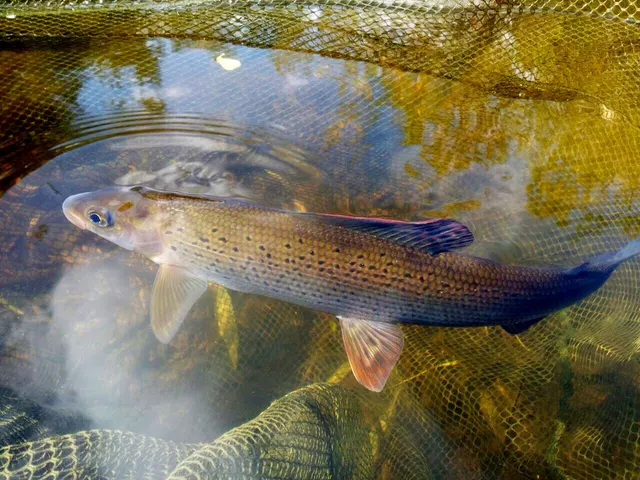 GraylingGrayling are salmonids — the same family as trout and salmon — which surprises people who meet them as a coarse-season fish, and it is why they share so much water with trout.
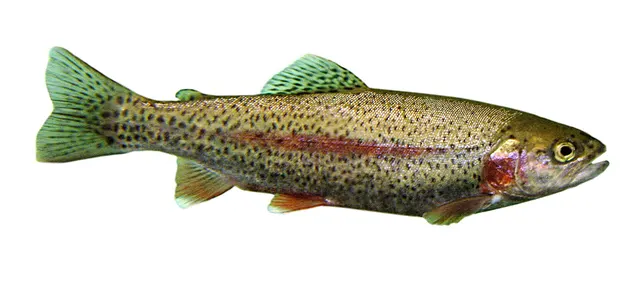 Rainbow troutBoth are salmonids of the same broad group and are constantly confused. The separation is simple once known: rainbows are spotted on the tail and have no red spots; brown trout have red spots and a clean tail.
Where it lives
- Chalk streamsThe combination of stable temperature, alkalinity and clean gravel is close to ideal for trout, which is why chalk streams support the densities they do.
- ReservoirsStocked and in some waters naturally recruiting, generally taking a wider range of food and holding deeper than stocked rainbows.
- Spate riversResident brown trout populate spate rivers throughout their range, typically numerous and small because the water is nutrient-poor; the sea-run form uses the same rivers and the same flood cycle as salmon.
- Tailwaters below damsBrown trout occupy coldwater dam releases in the same way and for the same reason, and in several regions the tailwater population is self-sustaining where the river above and below is too warm.
- Upland lakes and hill lochsWild brown trout in enormous numbers of small acid waters, growing slowly and staying small in a food-limited system — the fish these waters are.
Where you will find it
- AustriaThe fish of the Alpine limestone rivers, on beats where rod numbers are limited and the water is managed intensively by whoever holds the fishing right.
- Cardigan Bay and the sarnauAs sewin — sea trout — in the Dyfi, Mawddach and Teifi and along the coastal margin around their mouths. Sea trout stay close to home at sea, so this bay is their marine habitat rather than a corridor.
- Czechia and SlovakiaThe fish the legal water classification is built around: water designated trout water is managed for this species before any other consideration applies.
- DenmarkIn its sea-run form this is what Denmark is known for: fish feeding along a shallow brackish coast through the colder months, fished from the shore by wading.
- FranceThe species the first-category classification exists for, from Normandy chalk streams to Pyrenean and Alpine torrents — four very different fisheries under one legal label.
- GermanyIn its sea-run form this is the fish the German Baltic coast is known for, feeding along shallow brackish shoreline through the colder months within reach of a waded shore cast.
- IcelandReaching a size class in some glacial lakes that the same species does not approach across most of its European range, on a piscivorous life history in cold, food-rich water.
- Lake GenevaLake-dwelling brown trout growing large on a fish diet: the same species a British angler knows from a stream, living an entirely different life.
27 more
- Lough Corrib Fishing regions
- Lough Erne Fishing regions
- Lough Neagh Fishing regions
- Moroccan mountain and reservoir fresh water Fishing regions
- Patagonia Fishing regions
- Scotland Fishing regions
- Scottish sea lochs Fishing regions
- Shetland Fishing regions
- Skye and the Inner Hebrides Fishing regions
- The Atlantic coast of Ireland Fishing regions
- The Baltic Sea Fishing regions
- The Baltic states Fishing regions
- The English trout reservoirs Fishing regions
- The Finnish lake district Fishing regions
- The Hampshire chalk streams Fishing regions
- The Himalayan mahseer rivers Fishing regions
- The Lake District lakes Fishing regions
- The Moray Firth Fishing regions
- The Moy and Lough Conn Fishing regions
- The Republic of Ireland Fishing regions
- The River Spey Fishing regions
- The River Tay Fishing regions
- The River Tweed Fishing regions
- The Shannon system Fishing regions
- The Soča and Slovenia's Adriatic rivers Fishing regions
- The Welsh sewin rivers Fishing regions
- The Western Balkans Fishing regions
Understanding this fish
- Amphipods and mysids as preyGammarus is one of the most abundant invertebrates in clean stony rivers and a staple of trout diets, particularly in winter when insect larvae are less available.
- Aquatic insect larvae as preyAquatic insect larvae are the staple of the brown trout diet in running water for most of its life, and surface feeding on adults is a minority of the total feeding effort.
- Crustacean imitation in saltwater fly fishingSea trout feeding along a brackish coast take shrimp and amphipods in quantity, which is the ecological basis of the shrimp patterns that dominate the Danish and Swedish coastal fishery.
- Dry fly, nymph, wet fly and streamer: the four approachesThe fish the four approaches were developed against and the reason they are not ranked. A trout may be taken on all four in one day at different depths and different times, and an angler committed to one of them is fishing a preference rather than the water.
- Matching the hatch: what it means and when it is wrongSelectivity is a property of this fish under specific conditions rather than a general rule about it, which is the record's argument. A trout locked onto one item in a heavy hatch is genuinely difficult and a trout feeding opportunistically in coloured water is not, and the same fish does both in the same week.
- Presentation and dragThe fish that makes drag the central problem. A trout holding in current judges a drifting item partly by whether it moves at the speed of the water, and a fly dragged across the flow is rejected by fish that would have taken the same fly drifting freely — which is why presentation, not pattern, is where most of the difficulty lives.
- Redds, spawning, and what happens afterTrout cut redds in the same way and face the same sediment problem, which is why a river managed for one is usually being managed for both.
- The four fly types, and what each imitatesThe fish whose diet spans all four categories in one season, which is why the four exist. Adult insects on the surface, nymphs on the bed, emergers in the film, and small fish taken by larger trout — the same species eats all of it, and the four fly types are that diet sorted into what an angler can imitate.
3 more
Told apart from
Sources and evidence
- Freshwater Fishes of the British Isles — HarperCollins (New Naturalist 75), 1992 (Reference work)Relied on for: The plasticity of Salmo trutta across resident and migratory forms, spawning in redds, and identification against Atlantic salmon.States this directlyCitation checked — the work exists and is described correctly
- FishBase: a global information system on fishes — Froese, R. and D. Pauly, eds. — FishBase Consortium (Scientific institute)Relied on for: Taxonomy, family and size range.States this directlyPassage read and verified
- The IUCN Red List of Threatened Species — International Union for Conservation of Nature (Conservation authority)Relied on for: The global conservation assessment. Re-checked via FishBase's republication of the current category, because the Red List's own pages could not be read.States this directlyCitation checked — the work exists and is described correctly
- RNLI water safety guidance: cold water shock and Float to Live — Royal National Lifeboat Institution (Water-safety or diver-training authority)Relied on for: The physiology and timescale of cold water shock following sudden immersion.States this directlyPassage read and verified
Why the 65 connections on this page are here, and the sources
Similar and related fish
Backed by research — 2 connections
Supported by peer-reviewed research or fisheries science. The sources are listed and can be checked.
Grayling
A taxonomic claim held to a scientific standard, and one that matters practically because it explains both the habitat overlap and the regulatory oddity of a salmonid fished in the coarse season.
- The Fishes of the British Isles and North-West Europe — Macmillan, 1969 (Reference work)Relied on for: The placement of Thymallus thymallus within the Salmonidae alongside Salmo trutta and Salmo salar.States this directlyCitation checked — the work exists and is described correctly
- FishBase: a global information system on fishes — Froese, R. and D. Pauly, eds. — FishBase Consortium (Scientific institute)Relied on for: Family placement for Thymallus thymallus.States this directlyPassage read and verified
Rainbow trout
A taxonomic and identification comparison, naming both scientific names so there is no ambiguity about which animals are being compared.
- FishBase: a global information system on fishes — Froese, R. and D. Pauly, eds. — FishBase Consortium (Scientific institute)Relied on for: That Oncorhynchus mykiss is a Salmonidae native to Pacific drainages of North America and eastern Asia and introduced worldwide.States this directlyPassage read and verified
- The Fishes of the British Isles and North-West Europe — Macmillan, 1969 (Reference work)Relied on for: The morphological separation of Salmo trutta from introduced Oncorhynchus mykiss by spotting pattern and tail markings.States this directlyCitation checked — the work exists and is described correctly
How it is caught
What experienced anglers do — 3 connections
Widely and independently recommended by experienced anglers and specialist sources. This is real angling knowledge, not proof: controlled evidence for it is limited, and FishingHQ records it as convention rather than as a demonstrated effect.
Dry fly fishing
The foundational method for the species, described independently across the game literature.
- Still Water Fly-Fishing — Andre Deutsch, 1952 (Specialist angling publication)Relied on for: Fly fishing method and fly selection for trout.Citation checked — the work exists and is described correctly
- Trout & Salmon — Bauer Media (Specialist angling publication)Relied on for: Contemporary dry fly practice from independent contributors.Citation checked — the work exists and is described correctly
Float-tube fishing
Established angling practice for this species, recorded as convention. The note states the property of the animal or its water that makes the method the answer.
- Still Water Fly-Fishing — Andre Deutsch, 1952 (Specialist angling publication)Relied on for: Still-water fly technique and the feeding behaviour it is built on.States this directlyCitation checked — the work exists and is described correctly
- Trout & Salmon — Bauer Media (Specialist angling publication)Relied on for: Contemporary still-water fly practice.Background and mechanism onlyCitation checked — the work exists and is described correctly
Tenkara
An established way this species is taken on small streams.
- General angling website restatements of established technique — Various (Credible secondary source)Relied on for: Widely restated practice connecting this species, method or place, recorded as practitioner consensus rather than as tested fact.Background and mechanism onlyCitation checked — the work exists and is described correctly
- Fishers' Craft and Lettered Art: Tracts on Fishing from the End of the Middle Ages — University of Toronto Press, 1997 (Scientific literature)Relied on for: That fishing traditions develop around the water and fish available to them, and the historical method of reading such traditions.Background and mechanism onlyCitation checked — the work exists and is described correctly
Official guidance — 1 connection
Stated by a fisheries authority, scientific institute or recognised angling body. Authoritative, but summarising rather than demonstrating.
Salmon fly fishing
Sea trout are the anadromous form of the brown trout and are regulated alongside salmon across the salmon fishery districts. They run the same rivers and are fished with the same swung fly, most distinctively after dark.
- Trout & Salmon — Bauer Media (Specialist angling publication)Relied on for: Long-running published description of British and Irish game angling practice by river, beat and season, including the technique, tackle and seasonal decisions of salmon fly fishing.FishingHQ's interpretation of what it saysCitation checked — the work exists and is described correctly
- General angling website restatements of established technique — Various (Credible secondary source)Relied on for: Widely restated public descriptions of salmon fly technique — the down-and-across swing, Spey casting, and the water-temperature convention for fly size and line density — recorded as practitioner consensus rather than as scholarship, including where that consensus is openly disputed.Background and mechanism onlyCitation checked — the work exists and is described correctly
Gear for this fish
What experienced anglers do — 6 connections
Widely and independently recommended by experienced anglers and specialist sources. This is real angling knowledge, not proof: controlled evidence for it is limited, and FishingHQ records it as convention rather than as a demonstrated effect.
Dry flies
A practitioner claim about which lure family answers this species' feeding or holding behaviour.
- Trout & Salmon — Bauer Media (Specialist angling publication)Relied on for: Fly categories and their application to river salmonids.States this directlyCitation checked — the work exists and is described correctly
- The Compleat Angler, or the Contemplative Man's Recreation — Richard Marriot, 1653 (Reference work)Relied on for: The long documentary record of artificial-fly fishing for trout and grayling in English rivers.Background and mechanism onlyPassage read and verified
Nymphs
A practitioner claim about which lure family answers this species' feeding or holding behaviour.
- Trout & Salmon — Bauer Media (Specialist angling publication)Relied on for: Fly categories and their application to river salmonids.States this directlyCitation checked — the work exists and is described correctly
- The Compleat Angler, or the Contemplative Man's Recreation — Richard Marriot, 1653 (Reference work)Relied on for: The long documentary record of artificial-fly fishing for trout and grayling in English rivers.Background and mechanism onlyPassage read and verified
Spinners
A practitioner claim about which lure family answers this species' feeding or holding behaviour.
- Freshwater Fishing — Macdonald & Jane's, 1975 (Specialist angling publication)Relied on for: Lure and spinning practice for freshwater predators in Britain and northern Europe.States this directlyCitation checked — the work exists and is described correctly
- Angling Times — Bauer Media (Specialist angling publication)Relied on for: Contemporary British and European lure practice for this species in the weekly angling press.Background and mechanism onlyCitation checked — the work exists and is described correctly
Streamers
A practitioner claim about which lure family answers this species' feeding or holding behaviour.
- Trout & Salmon — Bauer Media (Specialist angling publication)Relied on for: Fly categories and their application to salmonids in running and still water.States this directlyCitation checked — the work exists and is described correctly
- Still Water Fly-Fishing — Andre Deutsch, 1952 (Specialist angling publication)Relied on for: Still-water fly categories, and the feeding observations they are chosen from.Background and mechanism onlyCitation checked — the work exists and is described correctly
Terrestrial fly patterns
Late-season terrestrial fishing for brown trout is long-established practice in the game angling literature.
- Still Water Fly-Fishing — Andre Deutsch, 1952 (Specialist angling publication)Relied on for: Game angling reasoning on presentation and terminal tackle.Background and mechanism onlyCitation checked — the work exists and is described correctly
- Trout & Salmon — Bauer Media (Specialist angling publication)Relied on for: Contemporary game angling practice.States this directlyCitation checked — the work exists and is described correctly
Wet flies
A practitioner claim about which lure family answers this species' feeding or holding behaviour.
- Trout & Salmon — Bauer Media (Specialist angling publication)Relied on for: Fly categories and their application to river salmonids.States this directlyCitation checked — the work exists and is described correctly
- The Compleat Angler, or the Contemplative Man's Recreation — Richard Marriot, 1653 (Reference work)Relied on for: The long documentary record of artificial-fly fishing for trout and grayling in English rivers.Background and mechanism onlyPassage read and verified
Where it lives
Backed by research — 5 connections
Supported by peer-reviewed research or fisheries science. The sources are listed and can be checked.
Chalk streams
Habitat association and the ecological basis for it are documented.
- FishBase: a global information system on fishes — Froese, R. and D. Pauly, eds. — FishBase Consortium (Scientific institute)Relied on for: Habitat and water quality requirements for Salmo trutta.States this directlyPassage read and verified
- JNCC species and habitat conservation advice — Joint Nature Conservation Committee (Conservation authority)Relied on for: The characterisation of chalk rivers and their associated species.FishingHQ's interpretation of what it saysCitation checked — the work exists and is described correctly
Reservoirs
Habitat association recorded for the species, in an environment FishingHQ describes on its own page.
- Freshwater Fishes of the British Isles — HarperCollins (New Naturalist 75), 1992 (Reference work)Relied on for: Habitat association and distribution of European freshwater fishes, including occurrence in artificial and modified waters.States this directlyCitation checked — the work exists and is described correctly
- FishBase: a global information system on fishes — Froese, R. and D. Pauly, eds. — FishBase Consortium (Scientific institute)Relied on for: Habitat association, depth range and water-type tolerance recorded for the species.States this directlyPassage read and verified
Spate rivers
A claim that the species uses rain-fed rivers on impermeable geology, resting on documented distribution and spawning habitat rather than on angling report.
- Freshwater Fishes of the British Isles — HarperCollins (New Naturalist 75), 1992 (Reference work)Relied on for: Distribution, habitat association, thermal requirements and life history of the freshwater fishes of the British Isles and north-west Europe.States this directlyCitation checked — the work exists and is described correctly
- FishBase: a global information system on fishes — Froese, R. and D. Pauly, eds. — FishBase Consortium (Scientific institute)Relied on for: Recorded depth range, temperature tolerance and habitat association for the species.States this directlyPassage read and verified
Tailwaters below dams
A claim that a species occupies an engineered habitat outside its natural thermal range, resting on documented distribution rather than on angling report.
- FishBase: a global information system on fishes — Froese, R. and D. Pauly, eds. — FishBase Consortium (Scientific institute)Relied on for: Recorded depth range, temperature tolerance and habitat association for the species outside north-west Europe.States this directlyPassage read and verified
- The IUCN Red List of Threatened Species — International Union for Conservation of Nature (Conservation authority)Relied on for: Global conservation assessment, range and recorded threats for the species.States this directlyCitation checked — the work exists and is described correctly
Upland lakes and hill lochs
Habitat association recorded for the species, in an environment FishingHQ describes on its own page.
- Freshwater Fishes of the British Isles — HarperCollins (New Naturalist 75), 1992 (Reference work)Relied on for: Habitat association and distribution of European freshwater fishes, including occurrence in artificial and modified waters.States this directlyCitation checked — the work exists and is described correctly
- FishBase: a global information system on fishes — Froese, R. and D. Pauly, eds. — FishBase Consortium (Scientific institute)Relied on for: Habitat association, depth range and water-type tolerance recorded for the species.States this directlyPassage read and verified
Where you will find it
Backed by research — 35 connections
Supported by peer-reviewed research or fisheries science. The sources are listed and can be checked.
Austria
That a species occurs in these waters, drawn from distribution science and stock assessment. It is a statement about where the animal lives and is not a statement that anybody will catch one, still less where.
- Freshwater Fishes of the British Isles — HarperCollins (New Naturalist 75), 1992 (Reference work)Relied on for: Distribution, habitat requirement and life history of European freshwater fishes, including their occurrence across the continental range named.States this directlyCitation checked — the work exists and is described correctly
- FishBase: a global information system on fishes — Froese, R. and D. Pauly, eds. — FishBase Consortium (Scientific institute)Relied on for: Recorded distribution and habitat association of the freshwater and migratory species named.States this directlyPassage read and verified
Cardigan Bay and the sarnau
A claim that a place contains the ground, water and seasonal conditions the species is associated with. It is a distributional statement about the world, it rests on the regional reference literature, and it deliberately asserts nothing about access, permission or catch.
- Freshwater Fishes of the British Isles — HarperCollins (New Naturalist 75), 1992 (Reference work)Relied on for: Distribution, ecology and conservation status of the freshwater fishes of the British Isles, including in artificial and modified waters.States this directlyCitation checked — the work exists and is described correctly
- Environment Agency fisheries management, byelaws and rod licensing information — Environment Agency (Government fisheries body)Relied on for: Fisheries monitoring, water quality and species distribution in English rivers, canals and still waters.States this directlyCitation checked — the work exists and is described correctly
Czechia and Slovakia
That a species occurs in these waters, drawn from distribution science and stock assessment. It is a statement about where the animal lives and is not a statement that anybody will catch one, still less where.
- Freshwater Fishes of the British Isles — HarperCollins (New Naturalist 75), 1992 (Reference work)Relied on for: Distribution, habitat requirement and life history of European freshwater fishes, including their occurrence across the continental range named.States this directlyCitation checked — the work exists and is described correctly
- FishBase: a global information system on fishes — Froese, R. and D. Pauly, eds. — FishBase Consortium (Scientific institute)Relied on for: Recorded distribution and habitat association of the freshwater and migratory species named.States this directlyPassage read and verified
Denmark
That a species occurs in these waters, drawn from distribution science and stock assessment. It is a statement about where the animal lives and is not a statement that anybody will catch one, still less where.
- Freshwater Fishes of the British Isles — HarperCollins (New Naturalist 75), 1992 (Reference work)Relied on for: Distribution, habitat requirement and life history of European freshwater fishes, including their occurrence across the continental range named.States this directlyCitation checked — the work exists and is described correctly
- FishBase: a global information system on fishes — Froese, R. and D. Pauly, eds. — FishBase Consortium (Scientific institute)Relied on for: Recorded distribution and habitat association of the freshwater and migratory species named.States this directlyPassage read and verified
France
That a species occurs in these waters, drawn from distribution science and stock assessment. It is a statement about where the animal lives and is not a statement that anybody will catch one, still less where.
- Freshwater Fishes of the British Isles — HarperCollins (New Naturalist 75), 1992 (Reference work)Relied on for: Distribution, habitat requirement and life history of European freshwater fishes, including their occurrence across the continental range named.States this directlyCitation checked — the work exists and is described correctly
- FishBase: a global information system on fishes — Froese, R. and D. Pauly, eds. — FishBase Consortium (Scientific institute)Relied on for: Recorded distribution and habitat association of the freshwater and migratory species named.States this directlyPassage read and verified
Germany
That a species occurs in these waters, drawn from distribution science and stock assessment. It is a statement about where the animal lives and is not a statement that anybody will catch one, still less where.
- Freshwater Fishes of the British Isles — HarperCollins (New Naturalist 75), 1992 (Reference work)Relied on for: Distribution, habitat requirement and life history of European freshwater fishes, including their occurrence across the continental range named.States this directlyCitation checked — the work exists and is described correctly
- FishBase: a global information system on fishes — Froese, R. and D. Pauly, eds. — FishBase Consortium (Scientific institute)Relied on for: Recorded distribution and habitat association of the freshwater and migratory species named.States this directlyPassage read and verified
Iceland
That a species occurs in these waters, drawn from distribution science and stock assessment. It is a statement about where the animal lives and is not a statement that anybody will catch one, still less where.
- Freshwater Fishes of the British Isles — HarperCollins (New Naturalist 75), 1992 (Reference work)Relied on for: Distribution, habitat requirement and life history of European freshwater fishes, including their occurrence across the continental range named.States this directlyCitation checked — the work exists and is described correctly
- FishBase: a global information system on fishes — Froese, R. and D. Pauly, eds. — FishBase Consortium (Scientific institute)Relied on for: Recorded distribution and habitat association of the freshwater and migratory species named.States this directlyPassage read and verified
Lake Geneva
A distributional claim taken from reference works and databases on the fishes of the region rather than from angling report. It states presence and asserts nothing about a fishery.
- FishBase: a global information system on fishes — Froese, R. and D. Pauly, eds. — FishBase Consortium (Scientific institute)Relied on for: Distribution, habitat association, life history and size recorded for the species concerned.States this directlyPassage read and verified
- Freshwater Fishes of the British Isles — HarperCollins (New Naturalist 75), 1992 (Reference work)Relied on for: Biology, distribution, life history and conservation status of northern European freshwater and diadromous fishes.States this directlyCitation checked — the work exists and is described correctly
Lough Corrib
A distribution association between an animal and a kind of water, rather than a claim about any named mark.
- Freshwater Fishes of the British Isles — HarperCollins (New Naturalist 75), 1992 (Reference work)Relied on for: Distribution, habitat association and ecology of British and Irish freshwater fishes, including occurrence in the water body concerned.States this directlyCitation checked — the work exists and is described correctly
- FishBase: a global information system on fishes — Froese, R. and D. Pauly, eds. — FishBase Consortium (Scientific institute)Relied on for: Distribution, habitat association and life history recorded for the species.Background and mechanism onlyPassage read and verified
Lough Erne
A claim that a place contains the ground, water and seasonal conditions the species is associated with. It is a distributional statement about the world, it rests on the regional reference literature, and it deliberately asserts nothing about access, permission or catch.
- Freshwater Fishes of the British Isles — HarperCollins (New Naturalist 75), 1992 (Reference work)Relied on for: Distribution, ecology and conservation status of the freshwater fishes of the British Isles, including in artificial and modified waters.States this directlyCitation checked — the work exists and is described correctly
- Environment Agency fisheries management, byelaws and rod licensing information — Environment Agency (Government fisheries body)Relied on for: Fisheries monitoring, water quality and species distribution in English rivers, canals and still waters.States this directlyCitation checked — the work exists and is described correctly
Lough Neagh
A distributional claim taken from reference works on the fishes of the region rather than from angling report. It states presence and asserts nothing about a fishery.
- FishBase: a global information system on fishes — Froese, R. and D. Pauly, eds. — FishBase Consortium (Scientific institute)Relied on for: Distribution, habitat association, life history and depth range recorded for the species concerned.States this directlyPassage read and verified
- Freshwater Fishes of the British Isles — HarperCollins (New Naturalist 75), 1992 (Reference work)Relied on for: Biology, distribution and conservation status of British and Irish freshwater and diadromous fishes.States this directlyCitation checked — the work exists and is described correctly
- The Fishes of the British Isles and North-West Europe — Macmillan, 1969 (Reference work)Relied on for: Distribution, habitat and biology of the fishes of the British Isles and north-west Europe.States this directlyCitation checked — the work exists and is described correctly
Moroccan mountain and reservoir fresh water
A distribution claim about the world, so it rests on the reference datasets rather than on angling report. FishingHQ's evidence policy requires it.
- FishBase: a global information system on fishes — Froese, R. and D. Pauly, eds. — FishBase Consortium (Scientific institute)Relied on for: Distribution, habitat association and depth range recorded for the species, including its occurrence in the water body concerned.States this directlyPassage read and verified
- FAO Species Identification Guides for Fishery Purposes and the FAO Species Catalogues — Food and Agriculture Organization of the United Nations (Scientific institute)Relied on for: Distribution, habitat, depth and fishery accounts for the species of the eastern central Atlantic and Mediterranean.States this directlyCitation checked — the work exists and is described correctly
Patagonia
A distribution association between an animal and a kind of water, rather than a claim about any named mark.
- The IUCN Red List of Threatened Species — International Union for Conservation of Nature (Conservation authority)Relied on for: Assessment and habitat account for the species, including the river or lake system it occupies and the pressures acting on it.States this directlyCitation checked — the work exists and is described correctly
- FishBase: a global information system on fishes — Froese, R. and D. Pauly, eds. — FishBase Consortium (Scientific institute)Relied on for: Distribution, habitat association, size and life history recorded for the species in the system concerned.States this directlyPassage read and verified
Scotland
A distribution claim about the world, so it rests on the reference works rather than on angling report. FishingHQ's evidence policy requires it.
- FishBase: a global information system on fishes — Froese, R. and D. Pauly, eds. — FishBase Consortium (Scientific institute)Relied on for: Distribution, habitat association, water-type tolerance and occurrence records for the species, including its presence in the countries concerned.States this directlyPassage read and verified
- The IUCN Red List of Threatened Species — International Union for Conservation of Nature (Conservation authority)Relied on for: Assessment and range account for the species, including the countries and systems it occupies and its population trend within them.States this directlyCitation checked — the work exists and is described correctly
Scottish sea lochs
A claim that a place contains the ground and conditions the species is associated with. It is a distributional statement about the world, it rests on the regional reference literature, and it deliberately asserts nothing about access, permission or catch.
- The Fishes of the British Isles and North-West Europe — Macmillan, 1969 (Reference work)Relied on for: Distribution and habitat association of the marine and estuarine fishes of the British Isles, including which coasts and ground types a species occupies.States this directlyCitation checked — the work exists and is described correctly
- FishBase: a global information system on fishes — Froese, R. and D. Pauly, eds. — FishBase Consortium (Scientific institute)Relied on for: Recorded distribution, depth range and habitat association for the species named.States this directlyPassage read and verified
Shetland
A distribution association between an animal and a kind of water, rather than a claim about any named mark.
- The Fishes of the British Isles and North-West Europe — Macmillan, 1969 (Reference work)Relied on for: Distribution, habitat association, depth and ground preference of fishes in British and north-west European waters.States this directlyCitation checked — the work exists and is described correctly
- FishBase: a global information system on fishes — Froese, R. and D. Pauly, eds. — FishBase Consortium (Scientific institute)Relied on for: Distribution, habitat association and depth range recorded for the species.Background and mechanism onlyPassage read and verified
Skye and the Inner Hebrides
A distribution association between an animal and a kind of water, rather than a claim about any named mark.
- The Fishes of the British Isles and North-West Europe — Macmillan, 1969 (Reference work)Relied on for: Distribution, habitat association and ground type of fishes in British and north-west European waters.States this directlyCitation checked — the work exists and is described correctly
- FishBase: a global information system on fishes — Froese, R. and D. Pauly, eds. — FishBase Consortium (Scientific institute)Relied on for: Distribution, habitat association and depth range recorded for the species.Background and mechanism onlyPassage read and verified
The Atlantic coast of Ireland
A claim that a place contains the ground and conditions the species is associated with. It is a distributional statement about the world, it rests on the regional reference literature, and it deliberately asserts nothing about access, permission or catch.
- The Fishes of the British Isles and North-West Europe — Macmillan, 1969 (Reference work)Relied on for: Distribution and habitat association of the marine and estuarine fishes of the British Isles, including which coasts and ground types a species occupies.States this directlyCitation checked — the work exists and is described correctly
- FishBase: a global information system on fishes — Froese, R. and D. Pauly, eds. — FishBase Consortium (Scientific institute)Relied on for: Recorded distribution, depth range and habitat association for the species named.States this directlyPassage read and verified
The Baltic Sea
Occurrence of the species in this system or along this coast: a statement about the animal's distribution, not a venue recommendation.
- Freshwater Fishes of the British Isles — HarperCollins (New Naturalist 75), 1992 (Reference work)Relied on for: Distribution and habitat association of European freshwater fishes, including their occurrence in brackish and coastal waters.States this directlyCitation checked — the work exists and is described correctly
- FishBase: a global information system on fishes — Froese, R. and D. Pauly, eds. — FishBase Consortium (Scientific institute)Relied on for: Salinity tolerance and distribution recorded for the species.States this directlyPassage read and verified
The Baltic states
That a species occurs in these waters, drawn from distribution science and stock assessment. It is a statement about where the animal lives and is not a statement that anybody will catch one, still less where.
- Freshwater Fishes of the British Isles — HarperCollins (New Naturalist 75), 1992 (Reference work)Relied on for: Distribution, habitat requirement and life history of European freshwater fishes, including their occurrence across the continental range named.States this directlyCitation checked — the work exists and is described correctly
- FishBase: a global information system on fishes — Froese, R. and D. Pauly, eds. — FishBase Consortium (Scientific institute)Relied on for: Recorded distribution and habitat association of the freshwater and migratory species named.States this directlyPassage read and verified
The English trout reservoirs
A claim that a place contains the ground, water and seasonal conditions the species is associated with. It is a distributional statement about the world, it rests on the regional reference literature, and it deliberately asserts nothing about access, permission or catch.
- Freshwater Fishes of the British Isles — HarperCollins (New Naturalist 75), 1992 (Reference work)Relied on for: Distribution, ecology and conservation status of the freshwater fishes of the British Isles, including in artificial and modified waters.States this directlyCitation checked — the work exists and is described correctly
- Environment Agency fisheries management, byelaws and rod licensing information — Environment Agency (Government fisheries body)Relied on for: Fisheries monitoring, water quality and species distribution in English rivers, canals and still waters.States this directlyCitation checked — the work exists and is described correctly
The Finnish lake district
A claim that a place contains the ground, water and seasonal conditions the species is associated with. It is a distributional statement about the world, it rests on the regional reference literature, and it deliberately asserts nothing about access, permission or catch.
- Freshwater Fishes of the British Isles — HarperCollins (New Naturalist 75), 1992 (Reference work)Relied on for: Distribution, ecology and conservation status of European freshwater and migratory fishes, including in modified and artificial waters.States this directlyCitation checked — the work exists and is described correctly
- FishBase: a global information system on fishes — Froese, R. and D. Pauly, eds. — FishBase Consortium (Scientific institute)Relied on for: Recorded distribution, habitat association and life history for the freshwater and migratory species named.States this directlyPassage read and verified
The Hampshire chalk streams
A distributional claim taken from reference works on the fishes of the region rather than from angling report. It states presence and asserts nothing about a fishery.
- FishBase: a global information system on fishes — Froese, R. and D. Pauly, eds. — FishBase Consortium (Scientific institute)Relied on for: Distribution, habitat association, life history and depth range recorded for the species concerned.States this directlyPassage read and verified
- Freshwater Fishes of the British Isles — HarperCollins (New Naturalist 75), 1992 (Reference work)Relied on for: Biology, distribution and conservation status of British and Irish freshwater and diadromous fishes.States this directlyCitation checked — the work exists and is described correctly
- The Fishes of the British Isles and North-West Europe — Macmillan, 1969 (Reference work)Relied on for: Distribution, habitat and biology of the fishes of the British Isles and north-west Europe.States this directlyCitation checked — the work exists and is described correctly
The Himalayan mahseer rivers
A distribution association between an animal and a kind of water, rather than a claim about any named mark.
- The IUCN Red List of Threatened Species — International Union for Conservation of Nature (Conservation authority)Relied on for: Assessment and habitat account for the species, including the river or lake system it occupies and the pressures acting on it.States this directlyCitation checked — the work exists and is described correctly
- FishBase: a global information system on fishes — Froese, R. and D. Pauly, eds. — FishBase Consortium (Scientific institute)Relied on for: Distribution, habitat association, size and life history recorded for the species in the system concerned.States this directlyPassage read and verified
The Lake District lakes
A claim that a place contains the ground, water and seasonal conditions the species is associated with. It is a distributional statement about the world, it rests on the regional reference literature, and it deliberately asserts nothing about access, permission or catch.
- Freshwater Fishes of the British Isles — HarperCollins (New Naturalist 75), 1992 (Reference work)Relied on for: Distribution, habitat and conservation status of British freshwater fishes, including the isolated glacial-relict populations of northern England.States this directlyCitation checked — the work exists and is described correctly
- Environment Agency fisheries management, byelaws and rod licensing information — Environment Agency (Government fisheries body)Relied on for: Fisheries monitoring, water quality and species distribution in English rivers and still waters.States this directlyCitation checked — the work exists and is described correctly
The Moray Firth
A claim that a place contains the ground, water and seasonal conditions the species is associated with. It is a distributional statement about the world, it rests on the regional reference literature, and it deliberately asserts nothing about access, permission or catch.
- The Fishes of the British Isles and North-West Europe — Macmillan, 1969 (Reference work)Relied on for: Distribution and habitat association of the marine, estuarine and freshwater fishes of the British Isles, including which coasts, estuaries and ground types a species occupies.States this directlyCitation checked — the work exists and is described correctly
- FishBase: a global information system on fishes — Froese, R. and D. Pauly, eds. — FishBase Consortium (Scientific institute)Relied on for: Recorded distribution, depth range and habitat association for the species named.States this directlyPassage read and verified
The Moy and Lough Conn
A claim that a coast contains the ground and conditions the species is associated with. It is a distributional statement about the world, it rests on the regional reference literature, and it deliberately asserts nothing about access, permission or catch.
- The Fishes of the British Isles and North-West Europe — Macmillan, 1969 (Reference work)Relied on for: Distribution and habitat association of the marine and estuarine fishes of the British Isles and north-west Europe, including which coasts and ground types a species occupies.States this directlyCitation checked — the work exists and is described correctly
- FishBase: a global information system on fishes — Froese, R. and D. Pauly, eds. — FishBase Consortium (Scientific institute)Relied on for: Recorded distribution, depth range and habitat association for the species named.States this directlyPassage read and verified
The Republic of Ireland
A distribution claim about the world, so it rests on the reference works rather than on angling report. FishingHQ's evidence policy requires it.
- FishBase: a global information system on fishes — Froese, R. and D. Pauly, eds. — FishBase Consortium (Scientific institute)Relied on for: Distribution, habitat association, water-type tolerance and occurrence records for the species, including its presence in the countries concerned.States this directlyPassage read and verified
- The IUCN Red List of Threatened Species — International Union for Conservation of Nature (Conservation authority)Relied on for: Assessment and range account for the species, including the countries and systems it occupies and its population trend within them.States this directlyCitation checked — the work exists and is described correctly
The River Spey
A distributional claim about where a species occurs, which is a claim about the world and rests on the reference literature rather than on angling report.
- Freshwater Fishes of the British Isles — HarperCollins (New Naturalist 75), 1992 (Reference work)Relied on for: Distribution, habitat association and ecology of the freshwater fishes of the British Isles.States this directlyCitation checked — the work exists and is described correctly
- FishBase: a global information system on fishes — Froese, R. and D. Pauly, eds. — FishBase Consortium (Scientific institute)Relied on for: Distribution, habitat association and life history recorded for the species.States this directlyPassage read and verified
The River Tay
A claim that a place contains the ground, water and seasonal conditions the species is associated with. It is a distributional statement about the world, it rests on the regional reference literature, and it deliberately asserts nothing about access, permission or catch.
- Freshwater Fishes of the British Isles — HarperCollins (New Naturalist 75), 1992 (Reference work)Relied on for: Distribution, ecology and conservation status of the freshwater fishes of the British Isles, including in artificial and modified waters.States this directlyCitation checked — the work exists and is described correctly
- Environment Agency fisheries management, byelaws and rod licensing information — Environment Agency (Government fisheries body)Relied on for: Fisheries monitoring, water quality and species distribution in English rivers, canals and still waters.States this directlyCitation checked — the work exists and is described correctly
The River Tweed
A distribution association between an animal and a kind of water, rather than a claim about any named mark.
- Freshwater Fishes of the British Isles — HarperCollins (New Naturalist 75), 1992 (Reference work)Relied on for: Distribution, habitat association and ecology of British and Irish freshwater fishes, including occurrence in the water body concerned.States this directlyCitation checked — the work exists and is described correctly
- FishBase: a global information system on fishes — Froese, R. and D. Pauly, eds. — FishBase Consortium (Scientific institute)Relied on for: Distribution, habitat association and life history recorded for the species.Background and mechanism onlyPassage read and verified
The Shannon system
A claim that a place contains the ground, water and seasonal conditions the species is associated with. It is a distributional statement about the world, it rests on the regional reference literature, and it deliberately asserts nothing about access, permission or catch.
- Freshwater Fishes of the British Isles — HarperCollins (New Naturalist 75), 1992 (Reference work)Relied on for: Distribution, ecology and conservation status of the freshwater fishes of the British Isles, including in artificial and modified waters.States this directlyCitation checked — the work exists and is described correctly
- Environment Agency fisheries management, byelaws and rod licensing information — Environment Agency (Government fisheries body)Relied on for: Fisheries monitoring, water quality and species distribution in English rivers, canals and still waters.States this directlyCitation checked — the work exists and is described correctly
The Soča and Slovenia's Adriatic rivers
A distributional claim about where a species occurs, which is a claim about the world and rests on the reference literature rather than on angling report.
- FishBase: a global information system on fishes — Froese, R. and D. Pauly, eds. — FishBase Consortium (Scientific institute)Relied on for: Distribution, habitat association and life history recorded for the species.States this directlyPassage read and verified
- The IUCN Red List of Threatened Species — International Union for Conservation of Nature (Conservation authority)Relied on for: Global conservation assessment, range and recorded threats for the species.States this directlyCitation checked — the work exists and is described correctly
The Welsh sewin rivers
A claim that a place contains the ground, water and seasonal conditions the species is associated with. It is a distributional statement about the world, it rests on the regional reference literature, and it deliberately asserts nothing about access, permission or catch.
- Freshwater Fishes of the British Isles — HarperCollins (New Naturalist 75), 1992 (Reference work)Relied on for: Distribution, ecology and conservation status of the freshwater fishes of the British Isles, including in artificial and modified waters.States this directlyCitation checked — the work exists and is described correctly
- Environment Agency fisheries management, byelaws and rod licensing information — Environment Agency (Government fisheries body)Relied on for: Fisheries monitoring, water quality and species distribution in English rivers, canals and still waters.States this directlyCitation checked — the work exists and is described correctly
The Western Balkans
That a species occurs in these waters, drawn from distribution science and stock assessment. It is a statement about where the animal lives and is not a statement that anybody will catch one, still less where.
- Freshwater Fishes of the British Isles — HarperCollins (New Naturalist 75), 1992 (Reference work)Relied on for: Distribution, habitat requirement and life history of European freshwater fishes, including their occurrence across the continental range named.States this directlyCitation checked — the work exists and is described correctly
- FishBase: a global information system on fishes — Froese, R. and D. Pauly, eds. — FishBase Consortium (Scientific institute)Relied on for: Recorded distribution and habitat association of the freshwater and migratory species named.States this directlyPassage read and verified
Understanding this fish
Backed by research — 5 connections
Supported by peer-reviewed research or fisheries science. The sources are listed and can be checked.
Amphipods and mysids as prey
Recorded diet evidence identifies gammarid amphipods as a food item of this predator at group level rather than to species. The edge points at the taxon record for that reason, and encoding it as a species-level claim would assert something the source does not.
- FishBase: a global information system on fishes — Froese, R. and D. Pauly, eds. — FishBase Consortium (Scientific institute)Relied on for: Food items recorded for this predator, given as gammarid amphipods.States this directlyPassage read and verified
- FAO Species Identification Guides for Fishery Purposes and the FAO Species Catalogues — Food and Agriculture Organization of the United Nations (Scientific institute)Relied on for: Species account describing this predator's diet, recorded at the level of gammarid amphipods.Background and mechanism onlyCitation checked — the work exists and is described correctly
Aquatic insect larvae as prey
Recorded diet evidence identifies mayfly, caddis, stonefly and chironomid larvae as a food item of this predator at group level rather than to species. The edge points at the taxon record for that reason, and encoding it as a species-level claim would assert something the source does not.
- FishBase: a global information system on fishes — Froese, R. and D. Pauly, eds. — FishBase Consortium (Scientific institute)Relied on for: Food items recorded for this predator, given as mayfly, caddis, stonefly and chironomid larvae.States this directlyPassage read and verified
- FAO Species Identification Guides for Fishery Purposes and the FAO Species Catalogues — Food and Agriculture Organization of the United Nations (Scientific institute)Relied on for: Species account describing this predator's diet, recorded at the level of mayfly, caddis, stonefly and chironomid larvae.Background and mechanism onlyCitation checked — the work exists and is described correctly
Crustacean imitation in saltwater fly fishing
A link from a species to the mechanism explaining a substantial part of its coastal feeding, resting on published diet description.
- FishBase: a global information system on fishes — Froese, R. and D. Pauly, eds. — FishBase Consortium (Scientific institute)Relied on for: Recorded diet, habitat association and feeding behaviour of the species named, including the invertebrate components of it.States this directlyPassage read and verified
- The Fishes of the British Isles and North-West Europe — Macmillan, 1969 (Reference work)Relied on for: Distribution, habitat association, diet and biology of the fishes of the British Isles and north-west Europe named here.States this directlyCitation checked — the work exists and is described correctly
Redds, spawning, and what happens after
Why it works, and what that rests on. The underlying claims are documented in the fisheries science and reference literature cited rather than restated from practice.
- NASCO conservation and management of North Atlantic salmon — North Atlantic Salmon Conservation Organization (Government fisheries body)Relied on for: The conservation and management of North Atlantic salmon, including life history, run timing, marine survival and identified drivers.States this directlyCitation checked — the work exists and is described correctly
- Freshwater Fishes of the British Isles — HarperCollins (New Naturalist 75), 1992 (Reference work)Relied on for: Biology and life history of British and Irish salmonids, including spawning, juvenile stages and migration.States this directlyCitation checked — the work exists and is described correctly
Trout, char and salmon: what the words actually mean
The word trout spans two genera and this is one of them.
- FishBase: a global information system on fishes — Froese, R. and D. Pauly, eds. — FishBase Consortium (Scientific institute)Relied on for: Genus placement within Salmonidae for Salmo, Oncorhynchus and Salvelinus, and the species assigned to each.States this directlyPassage read and verified
What experienced anglers do — 5 connections
Widely and independently recommended by experienced anglers and specialist sources. This is real angling knowledge, not proof: controlled evidence for it is limited, and FishingHQ records it as convention rather than as a demonstrated effect.
Dry fly, nymph, wet fly and streamer: the four approaches
A fish or a water joined to the fly-fishing mechanism it is a worked example of, written only where the subject's own behaviour or physical character is what this page explains. The direction is the one FishingHQ writes this kind of connection in, and the one it already uses 176 times, and it is also the semantically correct one: the mechanism explains the fish, not the reverse.
- Still Water Fly-Fishing — Andre Deutsch, 1952 (Specialist angling publication)Relied on for: Stillwater fly practice: line density and depth, leader construction, fly selection against the food present, and the behaviour of stocked and wild trout in still water.States this directlyCitation checked — the work exists and is described correctly
- Trout & Salmon — Bauer Media (Specialist angling publication)Relied on for: Long-running published description of British game angling practice: river and stillwater trout, grayling and salmon fishing, and the presentation each demands.States this directlyCitation checked — the work exists and is described correctly
Matching the hatch: what it means and when it is wrong
A fish or a water joined to the fly-fishing mechanism it is a worked example of, written only where the subject's own behaviour or physical character is what this page explains. The direction is the one FishingHQ writes this kind of connection in, and the one it already uses 176 times, and it is also the semantically correct one: the mechanism explains the fish, not the reverse.
- Still Water Fly-Fishing — Andre Deutsch, 1952 (Specialist angling publication)Relied on for: Stillwater fly practice: line density and depth, leader construction, fly selection against the food present, and the behaviour of stocked and wild trout in still water.States this directlyCitation checked — the work exists and is described correctly
- Trout & Salmon — Bauer Media (Specialist angling publication)Relied on for: Long-running published description of British game angling practice: river and stillwater trout, grayling and salmon fishing, and the presentation each demands.States this directlyCitation checked — the work exists and is described correctly
- Freshwater Fishes of the British Isles — HarperCollins (New Naturalist 75), 1992 (Reference work)Relied on for: Life history, feeding biology, habitat requirement and seasonal behaviour of the freshwater fishes of the British Isles.States this directlyCitation checked — the work exists and is described correctly
- FishBase: a global information system on fishes — Froese, R. and D. Pauly, eds. — FishBase Consortium (Scientific institute)Relied on for: Recorded environment, depth range, feeding biology and distribution of the species named.States this directlyPassage read and verified
Presentation and drag
A fish or a water joined to the fly-fishing mechanism it is a worked example of, written only where the subject's own behaviour or physical character is what this page explains. The direction is the one FishingHQ writes this kind of connection in, and the one it already uses 176 times, and it is also the semantically correct one: the mechanism explains the fish, not the reverse.
- Still Water Fly-Fishing — Andre Deutsch, 1952 (Specialist angling publication)Relied on for: Stillwater fly practice: line density and depth, leader construction, fly selection against the food present, and the behaviour of stocked and wild trout in still water.States this directlyCitation checked — the work exists and is described correctly
- Trout & Salmon — Bauer Media (Specialist angling publication)Relied on for: Long-running published description of British game angling practice: river and stillwater trout, grayling and salmon fishing, and the presentation each demands.States this directlyCitation checked — the work exists and is described correctly
- Freshwater Fishes of the British Isles — HarperCollins (New Naturalist 75), 1992 (Reference work)Relied on for: Life history, feeding biology, habitat requirement and seasonal behaviour of the freshwater fishes of the British Isles.States this directlyCitation checked — the work exists and is described correctly
- FishBase: a global information system on fishes — Froese, R. and D. Pauly, eds. — FishBase Consortium (Scientific institute)Relied on for: Recorded environment, depth range, feeding biology and distribution of the species named.States this directlyPassage read and verified
The four fly types, and what each imitates
A fish or a water joined to the fly-fishing mechanism it is a worked example of, written only where the subject's own behaviour or physical character is what this page explains. The direction is the one FishingHQ writes this kind of connection in, and the one it already uses 176 times, and it is also the semantically correct one: the mechanism explains the fish, not the reverse.
- Freshwater Fishes of the British Isles — HarperCollins (New Naturalist 75), 1992 (Reference work)Relied on for: Life history, feeding biology, habitat requirement and seasonal behaviour of the freshwater fishes of the British Isles.States this directlyCitation checked — the work exists and is described correctly
- FishBase: a global information system on fishes — Froese, R. and D. Pauly, eds. — FishBase Consortium (Scientific institute)Relied on for: Recorded environment, depth range, feeding biology and distribution of the species named.States this directlyPassage read and verified
- Still Water Fly-Fishing — Andre Deutsch, 1952 (Specialist angling publication)Relied on for: Stillwater fly practice: line density and depth, leader construction, fly selection against the food present, and the behaviour of stocked and wild trout in still water.States this directlyCitation checked — the work exists and is described correctly
- Trout & Salmon — Bauer Media (Specialist angling publication)Relied on for: Long-running published description of British game angling practice: river and stillwater trout, grayling and salmon fishing, and the presentation each demands.States this directlyCitation checked — the work exists and is described correctly
The insects fly fishing imitates
A fish or a water joined to the fly-fishing mechanism it is a worked example of, written only where the subject's own behaviour or physical character is what this page explains. The direction is the one FishingHQ writes this kind of connection in, and the one it already uses 176 times, and it is also the semantically correct one: the mechanism explains the fish, not the reverse.
- Freshwater Fishes of the British Isles — HarperCollins (New Naturalist 75), 1992 (Reference work)Relied on for: Life history, feeding biology, habitat requirement and seasonal behaviour of the freshwater fishes of the British Isles.States this directlyCitation checked — the work exists and is described correctly
- FishBase: a global information system on fishes — Froese, R. and D. Pauly, eds. — FishBase Consortium (Scientific institute)Relied on for: Recorded environment, depth range, feeding biology and distribution of the species named.States this directlyPassage read and verified
- Still Water Fly-Fishing — Andre Deutsch, 1952 (Specialist angling publication)Relied on for: Stillwater fly practice: line density and depth, leader construction, fly selection against the food present, and the behaviour of stocked and wild trout in still water.States this directlyCitation checked — the work exists and is described correctly
- Trout & Salmon — Bauer Media (Specialist angling publication)Relied on for: Long-running published description of British game angling practice: river and stillwater trout, grayling and salmon fishing, and the presentation each demands.States this directlyCitation checked — the work exists and is described correctly
Official guidance — 1 connection
Stated by a fisheries authority, scientific institute or recognised angling body. Authoritative, but summarising rather than demonstrating.
Water temperature and what it does to a fish
The reason it behaves as it does, explained rather than merely listed.
- FishBase: a global information system on fishes — Froese, R. and D. Pauly, eds. — FishBase Consortium (Scientific institute)Relied on for: Temperature tolerance, oxygen requirement, activity pattern and habitat association recorded for the species concerned.Background and mechanism onlyPassage read and verified
- Understanding the Complexity of Catch-and-Release in Recreational Fishing — Reviews in Fisheries Science 15:75–167, 2007 (Scientific literature)Relied on for: The factors determining post-release survival in recreational fishing, including water temperature, fight duration, air exposure and handling.States this directlyCitation checked — the work exists and is described correctly
Told apart from
Backed by research — 1 connection
Supported by peer-reviewed research or fisheries science. The sources are listed and can be checked.
Atlantic salmon
Both are members of the genus Salmo and the distinguishing morphology is documented.
- FishBase: a global information system on fishes — Froese, R. and D. Pauly, eds. — FishBase Consortium (Scientific institute)Relied on for: Taxonomic placement of Salmo trutta and Salmo salar.States this directlyPassage read and verified
- The Fishes of the British Isles and North-West Europe — Macmillan, 1969 (Reference work)Relied on for: Morphological separation of brown trout and Atlantic salmon.States this directlyCitation checked — the work exists and is described correctly
The inverse relationship, recorded separately.
- FishBase: a global information system on fishes — Froese, R. and D. Pauly, eds. — FishBase Consortium (Scientific institute)Relied on for: Taxonomic placement of Salmo salar and Salmo trutta.States this directlyPassage read and verified
What experienced anglers do — 1 connection
Widely and independently recommended by experienced anglers and specialist sources. This is real angling knowledge, not proof: controlled evidence for it is limited, and FishingHQ records it as convention rather than as a demonstrated effect.
Atlantic salmon
The comparison and the identification difficulty are documented across the game literature.
- Trout & Salmon — Bauer Media (Specialist angling publication)Relied on for: Identification and method differences between salmon and sea trout.Citation checked — the work exists and is described correctly
- Freshwater Fishing — Macdonald & Jane's, 1975 (Specialist angling publication)Relied on for: Salmonid identification in British practice.Citation checked — the work exists and is described correctly
Safety reading
Official guidance — 1 connection
Stated by a fisheries authority, scientific institute or recognised angling body. Authoritative, but summarising rather than demonstrating.
Wading safely
Water safety guidance for inland water users.
- RNLI water safety guidance: cold water shock and Float to Live — Royal National Lifeboat Institution (Water-safety or diver-training authority)Relied on for: Water safety guidance and the risks of immersion in moving water.FishingHQ's interpretation of what it saysPassage read and verified
How FishingHQ labels evidence is explained in the evidence policy.