Brown trout vs Rainbow trout
How to tell them apart, and what follows from getting it right.
Why they get confused
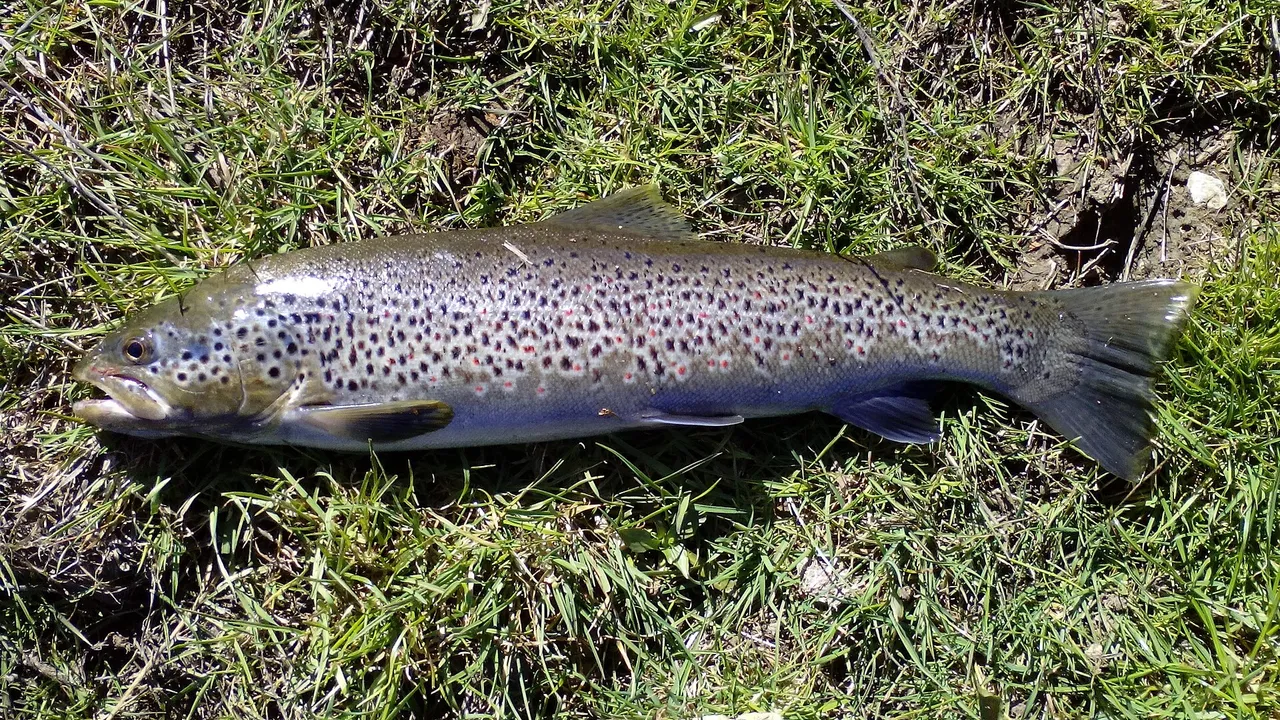
The commonest trout confusion in the world, because rainbows have been stocked into brown trout water on every continent and the two now share an enormous number of rivers and stillwaters. Both are spotted, adipose-finned salmonids of similar size and shape. The characters anglers reach for first — the pink stripe, the general colour — are exactly the ones that fade in fresh-run, sea-going or recently stocked fish, so the pair has to be settled on something more stable.

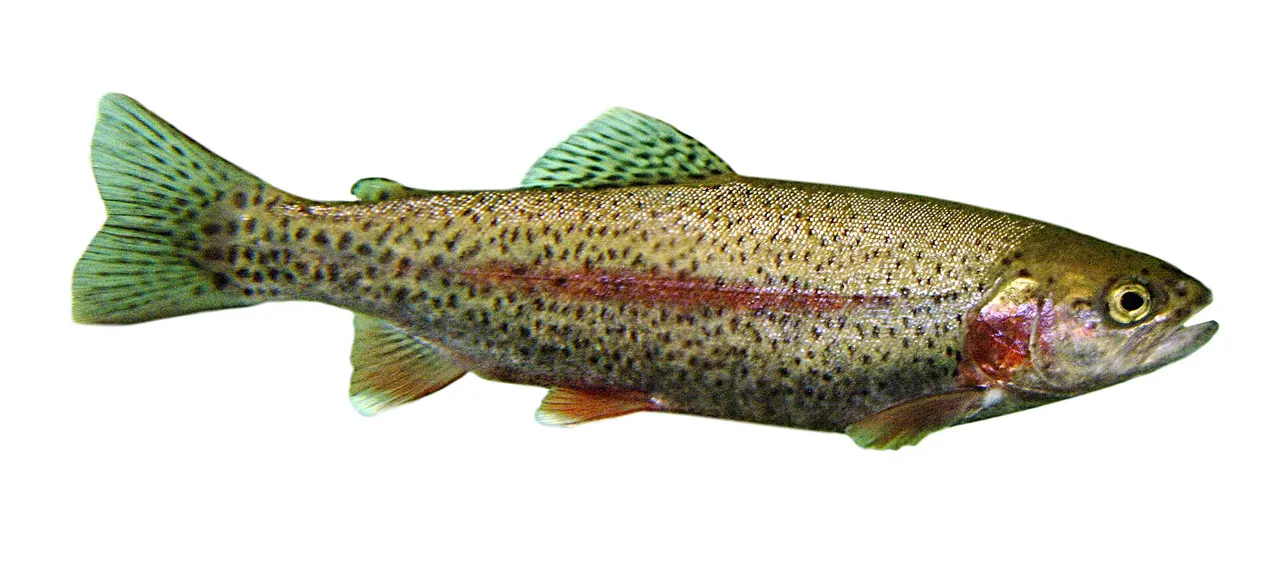
Rainbow trout
Oncorhynchus mykiss — Salmonidae

The differences
Each difference is marked with how far it can be trusted on its own. A single diagnostic character settles the identification; suggestive ones only narrow it.
| Character | Brown trout | Rainbow trout | Reliability |
|---|---|---|---|
| Spotting on the tailIdentification | Tail essentially unspotted, whatever the body carries. | Small black spots scattered across the tail as well as the back and flanks. This holds on silver sea-run fish where the flank colour has gone. | Diagnostic on its own |
| Presence of red spotsIdentification | Red or orange spots, usually with pale haloes, on the flank of most populations. | No red spots anywhere at any stage. | Supporting — use with others |
| The flank bandIdentification | No longitudinal band; the flank is brown-gold to silver depending on the water. | A broad pink to red band along the flank, strong in freshwater residents and suppressed in sea-run fish. | Suggestive only — varies |
| Which fish the water is likely to holdRange | Native across Europe and western Asia and introduced very widely; a self-sustaining population in a European river is usually this. | Native to the Pacific drainages of North America and north-east Asia; a rainbow in a European stillwater is almost always stocked and frequently recent. | Suggestive only — varies |
| When it spawnsSpawning | Autumn and early winter, on gravel. | Generally the cooler part of the year but varying with strain, and many stocked fish are triploid and do not reproduce at all. | Supporting — use with others |
| Behaviour in daylightFeeding | More cautious in bright conditions, feeding harder at dusk and in coloured water. | Feeds actively in daylight more readily, which is a real behavioural difference and part of why they are easier to catch. | Suggestive only — varies |
Why it matters
In a great many fisheries the two are managed in opposite directions: wild brown trout are protected by size limits, catch-and-release rules or full closure, while stocked rainbows are intended to be taken. In some countries the position reverses, with rainbows treated as an invasive species that must not be returned. Either way the rule attaches to the species, not to the fish's size or appearance, and a misidentification produces the wrong action in both directions. Wild brown trout populations are also far slower to replace than a stocked rainbow, which is the biological reason behind most of those rules. What applies is a matter for the fishery and the competent authority.
The full records
This page compares two species. Each of them has a complete record covering biology, behaviour, handling and the evidence behind all of it.
More about brown trout
Where it lives, how it is caught, and what else it is confused with.
Similar and related fish
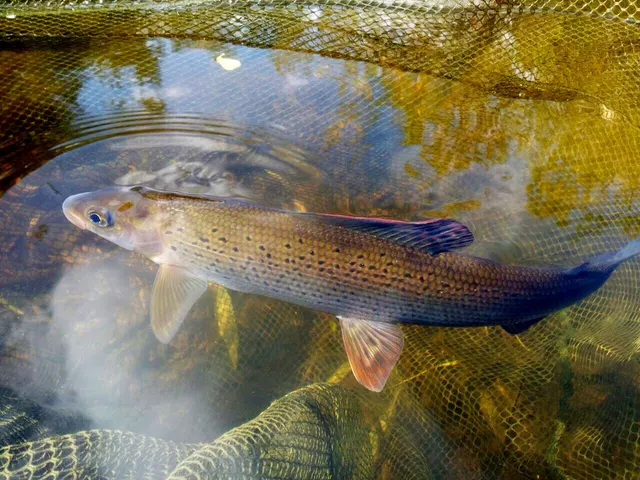 GraylingGrayling are salmonids — the same family as trout and salmon — which surprises people who meet them as a coarse-season fish, and it is why they share so much water with trout.
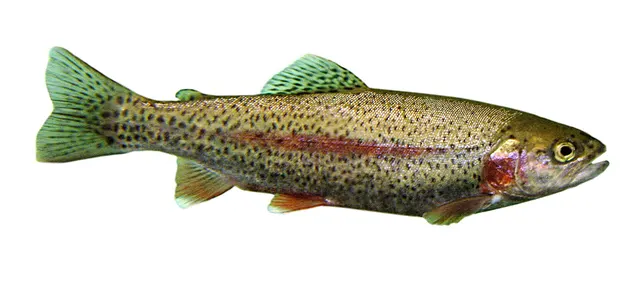 Rainbow troutBoth are salmonids of the same broad group and are constantly confused. The separation is simple once known: rainbows are spotted on the tail and have no red spots; brown trout have red spots and a clean tail.
How it is caught
- Dry fly fishingDrift feeding is what makes a dry fly work at all — a trout holding station and judging drifting items is a trout that can be deceived by one.
- Float-tube fishingOn small lochs and lakes where bank access is limited by trees or by depth, a float tube is often the only way to fish the water at all, and the angler sits at eye level with the surface.
- Salmon fly fishingCarries the sea trout, which runs the same rivers and is fished with the same swung fly — most distinctively at night.
- TenkaraThe method's own catch in translation: developed for yamame, iwana and amago in Japanese mountain streams, and applied to brown trout on comparable water everywhere it has travelled.
Gear for this fish
- Dry fliesThe dry fly exists because brown trout in rivers feed on emerging and egg-laying adult insects at the surface in numbers, in daylight, and visibly. The whole method is built on the fact that a feeding trout returns to a station and can be watched.
- NymphsTrout take the overwhelming majority of their invertebrate food below the surface, and a weighted nymph fished at the fish's depth answers the ordinary condition rather than the visible one.
- SpinnersThe traditional non-fly answer on spate rivers, and it works for the same reason a streamer does — a trout that has switched to fish prey responds to something the size and speed of a minnow.
- StreamersLarge brown trout become substantially piscivorous, and a streamer is the acknowledgement of that: it targets the minority of the population that has stopped eating insects, which is also the minority worth targeting deliberately.
- Terrestrial fly patternsTerrestrial patterns are fished for brown trout through the late summer, when land insects blown or washed in make up a larger share of what is available at the surface.
- Wet fliesThe oldest form of the method, and the answer to trout feeding on drifting and swimming subsurface items across a whole pool rather than at a station. A team of wets fished across and down covers water no dry fly can.
Where it lives
- Chalk streamsThe combination of stable temperature, alkalinity and clean gravel is close to ideal for trout, which is why chalk streams support the densities they do.
- ReservoirsStocked and in some waters naturally recruiting, generally taking a wider range of food and holding deeper than stocked rainbows.
- Spate riversResident brown trout populate spate rivers throughout their range, typically numerous and small because the water is nutrient-poor; the sea-run form uses the same rivers and the same flood cycle as salmon.
- Tailwaters below damsBrown trout occupy coldwater dam releases in the same way and for the same reason, and in several regions the tailwater population is self-sustaining where the river above and below is too warm.
- Upland lakes and hill lochsWild brown trout in enormous numbers of small acid waters, growing slowly and staying small in a food-limited system — the fish these waters are.
Why the 17 connections on this page are here, and the sources
Similar and related fish
Backed by research — 2 connections
Supported by peer-reviewed research or fisheries science. The sources are listed and can be checked.
Grayling
A taxonomic claim held to a scientific standard, and one that matters practically because it explains both the habitat overlap and the regulatory oddity of a salmonid fished in the coarse season.
- The Fishes of the British Isles and North-West Europe — Macmillan, 1969 (Reference work)Relied on for: The placement of Thymallus thymallus within the Salmonidae alongside Salmo trutta and Salmo salar.States this directlyCitation checked — the work exists and is described correctly
- FishBase: a global information system on fishes — Froese, R. and D. Pauly, eds. — FishBase Consortium (Scientific institute)Relied on for: Family placement for Thymallus thymallus.States this directlyPassage read and verified
Rainbow trout
A taxonomic and identification comparison, naming both scientific names so there is no ambiguity about which animals are being compared.
- FishBase: a global information system on fishes — Froese, R. and D. Pauly, eds. — FishBase Consortium (Scientific institute)Relied on for: That Oncorhynchus mykiss is a Salmonidae native to Pacific drainages of North America and eastern Asia and introduced worldwide.States this directlyPassage read and verified
- The Fishes of the British Isles and North-West Europe — Macmillan, 1969 (Reference work)Relied on for: The morphological separation of Salmo trutta from introduced Oncorhynchus mykiss by spotting pattern and tail markings.States this directlyCitation checked — the work exists and is described correctly
How it is caught
What experienced anglers do — 3 connections
Widely and independently recommended by experienced anglers and specialist sources. This is real angling knowledge, not proof: controlled evidence for it is limited, and FishingHQ records it as convention rather than as a demonstrated effect.
Dry fly fishing
The foundational method for the species, described independently across the game literature.
- Still Water Fly-Fishing — Andre Deutsch, 1952 (Specialist angling publication)Relied on for: Fly fishing method and fly selection for trout.Citation checked — the work exists and is described correctly
- Trout & Salmon — Bauer Media (Specialist angling publication)Relied on for: Contemporary dry fly practice from independent contributors.Citation checked — the work exists and is described correctly
Float-tube fishing
Established angling practice for this species, recorded as convention. The note states the property of the animal or its water that makes the method the answer.
- Still Water Fly-Fishing — Andre Deutsch, 1952 (Specialist angling publication)Relied on for: Still-water fly technique and the feeding behaviour it is built on.States this directlyCitation checked — the work exists and is described correctly
- Trout & Salmon — Bauer Media (Specialist angling publication)Relied on for: Contemporary still-water fly practice.Background and mechanism onlyCitation checked — the work exists and is described correctly
Tenkara
An established way this species is taken on small streams.
- General angling website restatements of established technique — Various (Credible secondary source)Relied on for: Widely restated practice connecting this species, method or place, recorded as practitioner consensus rather than as tested fact.Background and mechanism onlyCitation checked — the work exists and is described correctly
- Fishers' Craft and Lettered Art: Tracts on Fishing from the End of the Middle Ages — University of Toronto Press, 1997 (Scientific literature)Relied on for: That fishing traditions develop around the water and fish available to them, and the historical method of reading such traditions.Background and mechanism onlyCitation checked — the work exists and is described correctly
Official guidance — 1 connection
Stated by a fisheries authority, scientific institute or recognised angling body. Authoritative, but summarising rather than demonstrating.
Salmon fly fishing
Sea trout are the anadromous form of the brown trout and are regulated alongside salmon across the salmon fishery districts. They run the same rivers and are fished with the same swung fly, most distinctively after dark.
- Trout & Salmon — Bauer Media (Specialist angling publication)Relied on for: Long-running published description of British and Irish game angling practice by river, beat and season, including the technique, tackle and seasonal decisions of salmon fly fishing.FishingHQ's interpretation of what it saysCitation checked — the work exists and is described correctly
- General angling website restatements of established technique — Various (Credible secondary source)Relied on for: Widely restated public descriptions of salmon fly technique — the down-and-across swing, Spey casting, and the water-temperature convention for fly size and line density — recorded as practitioner consensus rather than as scholarship, including where that consensus is openly disputed.Background and mechanism onlyCitation checked — the work exists and is described correctly
Gear for this fish
What experienced anglers do — 6 connections
Widely and independently recommended by experienced anglers and specialist sources. This is real angling knowledge, not proof: controlled evidence for it is limited, and FishingHQ records it as convention rather than as a demonstrated effect.
Dry flies
A practitioner claim about which lure family answers this species' feeding or holding behaviour.
- Trout & Salmon — Bauer Media (Specialist angling publication)Relied on for: Fly categories and their application to river salmonids.States this directlyCitation checked — the work exists and is described correctly
- The Compleat Angler, or the Contemplative Man's Recreation — Richard Marriot, 1653 (Reference work)Relied on for: The long documentary record of artificial-fly fishing for trout and grayling in English rivers.Background and mechanism onlyPassage read and verified
Nymphs
A practitioner claim about which lure family answers this species' feeding or holding behaviour.
- Trout & Salmon — Bauer Media (Specialist angling publication)Relied on for: Fly categories and their application to river salmonids.States this directlyCitation checked — the work exists and is described correctly
- The Compleat Angler, or the Contemplative Man's Recreation — Richard Marriot, 1653 (Reference work)Relied on for: The long documentary record of artificial-fly fishing for trout and grayling in English rivers.Background and mechanism onlyPassage read and verified
Spinners
A practitioner claim about which lure family answers this species' feeding or holding behaviour.
- Freshwater Fishing — Macdonald & Jane's, 1975 (Specialist angling publication)Relied on for: Lure and spinning practice for freshwater predators in Britain and northern Europe.States this directlyCitation checked — the work exists and is described correctly
- Angling Times — Bauer Media (Specialist angling publication)Relied on for: Contemporary British and European lure practice for this species in the weekly angling press.Background and mechanism onlyCitation checked — the work exists and is described correctly
Streamers
A practitioner claim about which lure family answers this species' feeding or holding behaviour.
- Trout & Salmon — Bauer Media (Specialist angling publication)Relied on for: Fly categories and their application to salmonids in running and still water.States this directlyCitation checked — the work exists and is described correctly
- Still Water Fly-Fishing — Andre Deutsch, 1952 (Specialist angling publication)Relied on for: Still-water fly categories, and the feeding observations they are chosen from.Background and mechanism onlyCitation checked — the work exists and is described correctly
Terrestrial fly patterns
Late-season terrestrial fishing for brown trout is long-established practice in the game angling literature.
- Still Water Fly-Fishing — Andre Deutsch, 1952 (Specialist angling publication)Relied on for: Game angling reasoning on presentation and terminal tackle.Background and mechanism onlyCitation checked — the work exists and is described correctly
- Trout & Salmon — Bauer Media (Specialist angling publication)Relied on for: Contemporary game angling practice.States this directlyCitation checked — the work exists and is described correctly
Wet flies
A practitioner claim about which lure family answers this species' feeding or holding behaviour.
- Trout & Salmon — Bauer Media (Specialist angling publication)Relied on for: Fly categories and their application to river salmonids.States this directlyCitation checked — the work exists and is described correctly
- The Compleat Angler, or the Contemplative Man's Recreation — Richard Marriot, 1653 (Reference work)Relied on for: The long documentary record of artificial-fly fishing for trout and grayling in English rivers.Background and mechanism onlyPassage read and verified
Where it lives
Backed by research — 5 connections
Supported by peer-reviewed research or fisheries science. The sources are listed and can be checked.
Chalk streams
Habitat association and the ecological basis for it are documented.
- FishBase: a global information system on fishes — Froese, R. and D. Pauly, eds. — FishBase Consortium (Scientific institute)Relied on for: Habitat and water quality requirements for Salmo trutta.States this directlyPassage read and verified
- JNCC species and habitat conservation advice — Joint Nature Conservation Committee (Conservation authority)Relied on for: The characterisation of chalk rivers and their associated species.FishingHQ's interpretation of what it saysCitation checked — the work exists and is described correctly
Reservoirs
Habitat association recorded for the species, in an environment FishingHQ describes on its own page.
- Freshwater Fishes of the British Isles — HarperCollins (New Naturalist 75), 1992 (Reference work)Relied on for: Habitat association and distribution of European freshwater fishes, including occurrence in artificial and modified waters.States this directlyCitation checked — the work exists and is described correctly
- FishBase: a global information system on fishes — Froese, R. and D. Pauly, eds. — FishBase Consortium (Scientific institute)Relied on for: Habitat association, depth range and water-type tolerance recorded for the species.States this directlyPassage read and verified
Spate rivers
A claim that the species uses rain-fed rivers on impermeable geology, resting on documented distribution and spawning habitat rather than on angling report.
- Freshwater Fishes of the British Isles — HarperCollins (New Naturalist 75), 1992 (Reference work)Relied on for: Distribution, habitat association, thermal requirements and life history of the freshwater fishes of the British Isles and north-west Europe.States this directlyCitation checked — the work exists and is described correctly
- FishBase: a global information system on fishes — Froese, R. and D. Pauly, eds. — FishBase Consortium (Scientific institute)Relied on for: Recorded depth range, temperature tolerance and habitat association for the species.States this directlyPassage read and verified
Tailwaters below dams
A claim that a species occupies an engineered habitat outside its natural thermal range, resting on documented distribution rather than on angling report.
- FishBase: a global information system on fishes — Froese, R. and D. Pauly, eds. — FishBase Consortium (Scientific institute)Relied on for: Recorded depth range, temperature tolerance and habitat association for the species outside north-west Europe.States this directlyPassage read and verified
- The IUCN Red List of Threatened Species — International Union for Conservation of Nature (Conservation authority)Relied on for: Global conservation assessment, range and recorded threats for the species.States this directlyCitation checked — the work exists and is described correctly
Upland lakes and hill lochs
Habitat association recorded for the species, in an environment FishingHQ describes on its own page.
- Freshwater Fishes of the British Isles — HarperCollins (New Naturalist 75), 1992 (Reference work)Relied on for: Habitat association and distribution of European freshwater fishes, including occurrence in artificial and modified waters.States this directlyCitation checked — the work exists and is described correctly
- FishBase: a global information system on fishes — Froese, R. and D. Pauly, eds. — FishBase Consortium (Scientific institute)Relied on for: Habitat association, depth range and water-type tolerance recorded for the species.States this directlyPassage read and verified
Reviewed 2026-08-13. FishingHQ does not state what any rule is or where any rule applies. Where this page says the two species are managed differently, that is a reason to check the authority for the water you are on — not a statement of what it requires.