Tenkara
Method · Last reviewed 2026-08-13
A long rod, a fixed line, one fly and no reel — a Japanese mountain-stream method whose whole design argument is that removing equipment removes problems.
Safety: moving water and currents — can cause injury needing treatment. 5 more points apply here.
Overhead power lines — Can cause injury needing treatment
A three-to-four-metre carbon rod held high is a substantial conductor, and the habit the method teaches is precisely to hold the rod up.
What reduces it: Look up before extending the rod, every time. Never fish beneath or near overhead lines with a long rod held high.
Tenkara is fly fishing with a fixed line tied to the rod tip and no reel. The rod is long — typically three to four metres — telescopic, and extremely light in the tip, and the line is a level or tapered length roughly matched to the rod, ending in a short tippet and a single fly.
It is neither of the things FishingHQ already models. It is not fly fishing as the Western tradition understands it, because there is no running line, no shooting, no mending line off a reel and no distance beyond the rod-plus-line reach. And it is not pole fishing, because the line is cast rather than shipped and the whole mechanic depends on the rod loading against a very light line.
What it is for is small, steep, brushy mountain streams — the water it was developed on. In that environment the things a reel gives you are worthless: you cannot cast far because there is nowhere to cast to, you do not need line capacity because a stream trout does not run, and you do need extremely precise short-range presentation and instant line control, which a fixed line gives better than a running one. A long rod holding all the line off the water produces a drag-free drift that a Western setup achieves only with constant mending.
The philosophy that came with it — one rod, one line, a small number of fly patterns, and attention spent on presentation rather than selection — is a genuine argument rather than a marketing position, and it is a large part of why the method acquired a following far outside Japan.
What it is
Fly fishing with a fixed line attached to the tip of a long telescopic rod, with no reel and no running line. Developed on the mountain streams of Japan for yamame, iwana and amago, and now practised internationally on comparable water.
What it is for
It solves close-range presentation on small, steep, obstructed water better than any running-line system, with less equipment. On a brushy mountain stream where casts are a few metres, the current is broken and the fish are small and numerous, everything a reel provides is dead weight and the fixed line is strictly better.
Setting it up
- Match the line length roughly to the rod length; longer gives reach and costs control, shorter gives control and costs reach.
- Fish the lightest tippet the water justifies — it is the only shock absorber in the system beyond the rod itself.
- Hold the rod high and keep line off the water. That is the entire drag-management technique and it is why the rod is long.
- Carry few patterns. The method's own tradition argues that presentation dominates selection on this water, and the fishing supports it.
- Know the rod's limit before hooking something beyond it. There is no reel and no line to give.
What it catches
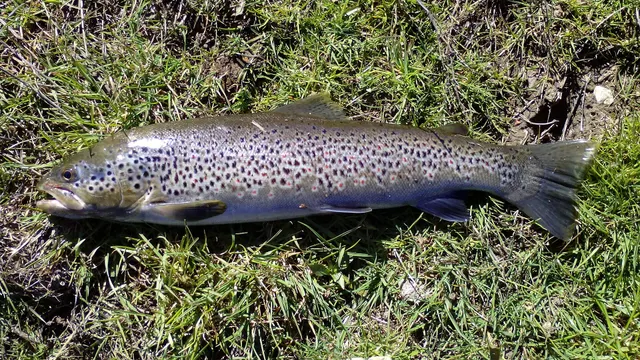 Brown troutThe method's own catch in translation: developed for yamame, iwana and amago in Japanese mountain streams, and applied to brown trout on comparable water everywhere it has travelled.
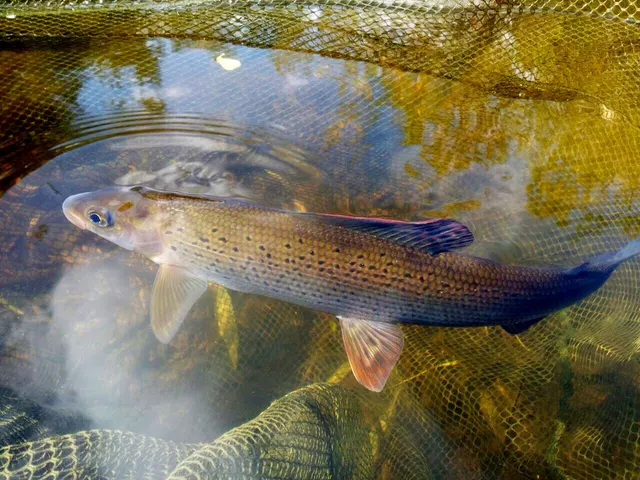 GraylingShort-range drag-free presentation on broken water is exactly what grayling fishing demands, and the method transferred to European grayling rivers quickly.
What you fish it with
How it works
The rod does everything a reel would otherwise do. It is long, light in the tip and soft enough to load against a line far lighter than any Western fly line, and the cast is a compact stop-and-load rather than the extended stroke of a fly rod.
The advantage appears after the cast. Because the line is short and attached at the tip, a long rod held up keeps almost all of it off the water, so the fly drifts on a nearly slack tippet with very little of anything touching the current. That is a drag-free drift obtained by geometry rather than by mending, and on broken pocket water it is genuinely better than what a running line achieves.
The limitations follow from the same geometry. Reach is rod length plus line length and no more. There is no way to give line to a fish, so tippet strength and rod softness are the entire fight-management system, and a fish larger than the water usually holds will be lost.
Conditions
Suits small to medium streams with broken water, overhead cover and short casting distances, and the small resident trout and char that live in them. Unsuited to stillwater, to large rivers, to windy exposed conditions and to any catch capable of a serious run.
Common mistakes
- Treating it as a pole. The line is cast and the rod loads; shipping it out and lowering a fly misses the entire mechanic.
- Using too heavy a tippet. With no reel, the tippet is the shock absorber, and a heavy one transfers everything to the rod tip.
- Letting line lie on the water. The reason for a long rod is to hold it off; a low rod gives away the method's only real advantage.
- Fishing water that needs distance. This is not a limitation to be overcome — it is a statement about which water the method is for.
- Hooking catch beyond the rod's capacity and playing it as though there were a reel. There is not.
Advantages
- Exceptional drag-free presentation at short range, achieved by geometry rather than by technique.
- Very little equipment: a telescopic rod collapses to a walkable length, which matters on water reached on foot.
- A low skill floor for competent short-range fishing — it is markedly easier to learn than Western fly casting.
Limitations
- Reach is fixed at rod plus line. There is no way to fish beyond it and no way to shoot line.
- No capacity to give line to a running fish, which puts a hard ceiling on the size of species it suits.
- It is poor in wind, on open water and anywhere distance matters — which is most stillwater and most large rivers.
Terms you will meet
- Tenkara
- Commonly rendered as 'from heaven' or 'from the skies', describing a fly arriving on the water from above. The name is Japanese and the method travelled under it.
- Kebari
- The fly. Traditional patterns are simple and few, frequently with a soft reversed hackle, and the tradition argues that how it is fished matters more than which one it is.
- Level line
- An untapered line, usually fluorocarbon, of the same diameter throughout. Lighter and more wind-affected than a tapered line and preferred for keeping line off the water.
Safety
Overhead power lines is set out at the top of this page, where it cannot be missed.
Moving water and currents — Can cause injury needing treatment
Tenkara is a mountain-stream method, which means wading in cold, fast, broken water over unstable rock, frequently alone and frequently a long way from a road.
What reduces it: Wade defensively, use a staff on unfamiliar water, and do not cross above anything you would not want to be swept into. Tell somebody the route and expected return, and treat a long walk in as a long walk out.
Precautions that always apply here
- Do not wade alone. Judge depth and flow from the bank first, and turn back sooner than feels necessary.
- Tell somebody where you are going and when you expect to be back.
- Look up before you cast. Carbon rods conduct, and contact with overhead lines is regularly fatal.
- Check, clean and dry your kit between different waters — the published guidance is 48 hours’ drying, in sunlight where possible, because a number of invasive species survive over two weeks in damp conditions. Nets, boots and wet mats move invasive species and disease more effectively than anything else anglers do.
Check the rules before you fish
Fishing laws, bylaws, access rules, seasons, bait restrictions and permitted methods vary by location and can change. Check the current rules from the relevant authority and the water you intend to fish before fishing.
Check with:
- Current national or regional law for where you are fishing
- Current local bylaws
- The relevant fisheries authority
- The landowner, club or fishery whose water it is
- Any restrictions specific to the species or the method you intend to use
Where to go next
Compared with
More methods
Not related to this page — just the rest of the section. There is little else joined to this subject yet, and a short page should still lead somewhere.
Sources and evidence
- General angling website restatements of established technique — Various (Credible secondary source)Relied on for: Widely restated practice and regional fishing character, recorded as practitioner consensus rather than as tested fact.Background and mechanism onlyCitation checked — the work exists and is described correctly
- Fishers' Craft and Lettered Art: Tracts on Fishing from the End of the Middle Ages — University of Toronto Press, 1997 (Scientific literature)Relied on for: That regional fishing traditions develop around the water and fish available to them, and the historical method of reading such traditions.Background and mechanism onlyCitation checked — the work exists and is described correctly
Why the 4 connections on this page are here, and the sources
What it catches
What experienced anglers do — 2 connections
Widely and independently recommended by experienced anglers and specialist sources. This is real angling knowledge, not proof: controlled evidence for it is limited, and FishingHQ records it as convention rather than as a demonstrated effect.
Brown trout
An established way this species is taken on small streams.
- General angling website restatements of established technique — Various (Credible secondary source)Relied on for: Widely restated practice connecting this species, method or place, recorded as practitioner consensus rather than as tested fact.Background and mechanism onlyCitation checked — the work exists and is described correctly
- Fishers' Craft and Lettered Art: Tracts on Fishing from the End of the Middle Ages — University of Toronto Press, 1997 (Scientific literature)Relied on for: That fishing traditions develop around the water and fish available to them, and the historical method of reading such traditions.Background and mechanism onlyCitation checked — the work exists and is described correctly
Grayling
An established way this species is taken on small rivers.
- General angling website restatements of established technique — Various (Credible secondary source)Relied on for: Widely restated practice connecting this species, method or place, recorded as practitioner consensus rather than as tested fact.Background and mechanism onlyCitation checked — the work exists and is described correctly
- Fishers' Craft and Lettered Art: Tracts on Fishing from the End of the Middle Ages — University of Toronto Press, 1997 (Scientific literature)Relied on for: That fishing traditions develop around the water and fish available to them, and the historical method of reading such traditions.Background and mechanism onlyCitation checked — the work exists and is described correctly
What you fish it with
What experienced anglers do — 1 connection
Widely and independently recommended by experienced anglers and specialist sources. This is real angling knowledge, not proof: controlled evidence for it is limited, and FishingHQ records it as convention rather than as a demonstrated effect.
Wet flies
The wet-fly page describes soft-hackled flies fished under the surface on a swing and calls it the oldest fly fishing there is. Tenkara's kebari is that fly, arrived at independently, and the method has no floating tradition to set against it.
- Still Water Fly-Fishing — Andre Deutsch, 1952 (Specialist angling publication)Relied on for: Specialist treatment of which bait or lure family this technique is fished with.States this directlyCitation checked — the work exists and is described correctly
- Trout & Salmon — Bauer Media (Specialist angling publication)Relied on for: The independently restated practitioner pairing of this technique with this family.Background and mechanism onlyCitation checked — the work exists and is described correctly
Compared with
What experienced anglers do — 1 connection
Widely and independently recommended by experienced anglers and specialist sources. This is real angling knowledge, not proof: controlled evidence for it is limited, and FishingHQ records it as convention rather than as a demonstrated effect.
Dry fly fishing
Two methods addressing the same presentation problem by different means.
- General angling website restatements of established technique — Various (Credible secondary source)Relied on for: Widely restated practice connecting this species, method or place, recorded as practitioner consensus rather than as tested fact.Background and mechanism onlyCitation checked — the work exists and is described correctly
- Fishers' Craft and Lettered Art: Tracts on Fishing from the End of the Middle Ages — University of Toronto Press, 1997 (Scientific literature)Relied on for: That fishing traditions develop around the water and fish available to them, and the historical method of reading such traditions.Background and mechanism onlyCitation checked — the work exists and is described correctly
How FishingHQ labels evidence is explained in the evidence policy.