Wet flies
Lure · Last reviewed 2026-08-10
Soft-hackled flies fished under the surface on a swing, imitating drowned insects and emergers — the oldest fly fishing method there is.
Wet flies predate dry flies by centuries. They are tied with soft, mobile materials — hen hackle, fur, soft feather fibre — that come alive in moving water without any input from the angler, and they are fished sunk, usually swinging across the current on a tightening line.
What they imitate is deliberately ambiguous, and that is a feature. A soft-hackled wet fly swinging across a river can read as a drowned adult, an emerging insect ascending through the water, or a small fish. The fish decides. That ambiguity is why a team of two or three wet flies fished across and down remains an effective way to search unfamiliar water quickly.
The method fell out of fashion as dry fly acquired social prestige in the nineteenth century and as nymphing acquired technical prestige in the twentieth. It never stopped working.
At a glance
- Depth range
- Just beneath the surface to a metre or so, controlled by line density, cast angle and how much the swing is checked.
What it does in the water
Generated by the current acting on soft mobile materials. Hen hackle fibres pulse open and closed as water flows past, which is movement the angler never has to supply and cannot easily imitate with stiffer materials. On the swing the fly also rises through the water column as the line tightens, which is itself a trigger.
How it is worked
Cast across and slightly down, then allowed to swing round on a controlled line until it hangs directly downstream. The take usually comes as the fly turns across the current or at the end of the swing. In stillwater, a slow retrieve on a team of flies replaces the current.
Fish it catches
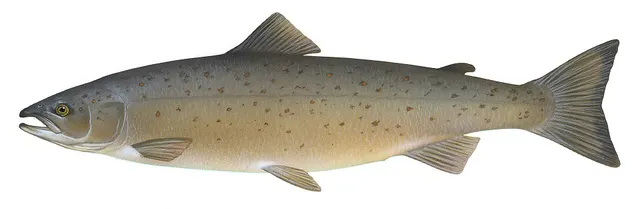 Atlantic salmonAtlantic salmon do not feed in fresh water, so the wet fly is not imitating food — it is provoking a response from a fish holding in a lie, and the whole apparatus of fly size, depth and swing speed is about presenting it at the pace the fish will react to.
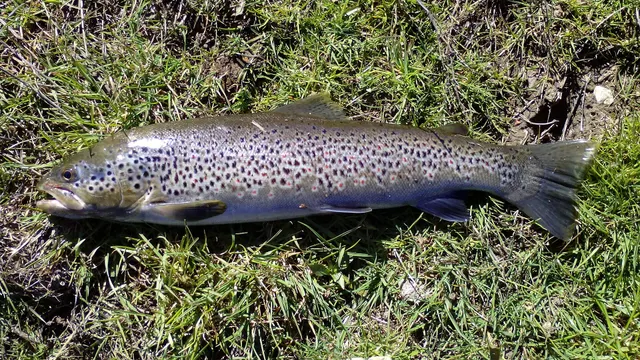 Brown troutThe oldest form of the method, and the answer to trout feeding on drifting and swimming subsurface items across a whole pool rather than at a station. A team of wets fished across and down covers water no dry fly can.
What it imitates
Deliberately unspecific: drowned adults, ascending emergers and small fish all read as plausible. The ambiguity is the point — a fly that could be several things is taken by fish looking for any of them.
Where it stops working
- Requires current to work properly; in still water the angler must supply the movement.
- Swinging flies hook fish in the scissors reliably but pull out of soft-mouthed fish taken at the hang.
- A team of flies tangles, and tangles in a way that costs the whole cast.
- Less precise than nymphing when fish are holding at a known depth.
Where to go next
Understanding it
Instead of this
More lures
Not related to this page — just the rest of the section. There is little else joined to this subject yet, and a short page should still lead somewhere.
Sources and evidence
Why the 8 connections on this page are here, and the sources
Fish it catches
What experienced anglers do — 2 connections
Widely and independently recommended by experienced anglers and specialist sources. This is real angling knowledge, not proof: controlled evidence for it is limited, and FishingHQ records it as convention rather than as a demonstrated effect.
Atlantic salmon
A practitioner claim about which lure family answers this species' feeding or holding behaviour.
- Trout & Salmon — Bauer Media (Specialist angling publication)Relied on for: Fly categories and their application to river salmonids.States this directlyCitation checked — the work exists and is described correctly
- The Compleat Angler, or the Contemplative Man's Recreation — Richard Marriot, 1653 (Reference work)Relied on for: The long documentary record of artificial-fly fishing for trout and grayling in English rivers.Background and mechanism onlyPassage read and verified
Brown trout
A practitioner claim about which lure family answers this species' feeding or holding behaviour.
- Trout & Salmon — Bauer Media (Specialist angling publication)Relied on for: Fly categories and their application to river salmonids.States this directlyCitation checked — the work exists and is described correctly
- The Compleat Angler, or the Contemplative Man's Recreation — Richard Marriot, 1653 (Reference work)Relied on for: The long documentary record of artificial-fly fishing for trout and grayling in English rivers.Background and mechanism onlyPassage read and verified
How it is worked
What experienced anglers do — 2 connections
Widely and independently recommended by experienced anglers and specialist sources. This is real angling knowledge, not proof: controlled evidence for it is limited, and FishingHQ records it as convention rather than as a demonstrated effect.
Fly fishing
The definitional relationship, with the historical note that gives it meaning.
- Treatyse of Fysshynge with an Angle — Wynkyn de Worde, in the Boke of Saint Albans, 1496 (Reference work)Relied on for: The earliest recorded fly patterns, which are wet flies.Citation checked — the work exists and is described correctly
- The Compleat Angler, or the Contemplative Man's Recreation — Richard Marriot, 1653 (Reference work)Relied on for: Seventeenth-century fly fishing practice using wet patterns.Passage read and verified
Tenkara
The wet-fly page describes soft-hackled flies fished under the surface on a swing and calls it the oldest fly fishing there is. Tenkara's kebari is that fly, arrived at independently, and the method has no floating tradition to set against it.
- Still Water Fly-Fishing — Andre Deutsch, 1952 (Specialist angling publication)Relied on for: Specialist treatment of which bait or lure family this technique is fished with.States this directlyCitation checked — the work exists and is described correctly
- Trout & Salmon — Bauer Media (Specialist angling publication)Relied on for: The independently restated practitioner pairing of this technique with this family.Background and mechanism onlyCitation checked — the work exists and is described correctly
Official guidance — 1 connection
Stated by a fisheries authority, scientific institute or recognised angling body. Authoritative, but summarising rather than demonstrating.
Salmon fly fishing
The fly is fished sunk and swung across the current on a tight line, which is what makes it a wet fly; the method's oldest name for itself is the wet fly swing. NO LINK IS MADE TO DRY FLIES, NYMPHS OR STREAMERS. Dry-fly salmon fishing is a real but localised speciality with no source behind it here, nymphing presents a fly to a feeding fish and a salmon in fresh water is not feeding, and streamers imitate baitfish, which is the imitation logic salmon fly fishing deliberately sets aside.
- Trout & Salmon — Bauer Media (Specialist angling publication)Relied on for: Long-running published description of British and Irish game angling practice by river, beat and season, including the technique, tackle and seasonal decisions of salmon fly fishing.FishingHQ's interpretation of what it saysCitation checked — the work exists and is described correctly
- General angling website restatements of established technique — Various (Credible secondary source)Relied on for: Widely restated public descriptions of salmon fly technique — the down-and-across swing, Spey casting, and the water-temperature convention for fly size and line density — recorded as practitioner consensus rather than as scholarship, including where that consensus is openly disputed.Background and mechanism onlyCitation checked — the work exists and is described correctly
Understanding it
Backed by research — 1 connection
Supported by peer-reviewed research or fisheries science. The sources are listed and can be checked.
The insects fly fishing imitates
The oldest fly method, explained by the life stage it covers.
- Freshwater Fishes of the British Isles — HarperCollins (New Naturalist 75), 1992 (Reference work)Relied on for: The freshwater invertebrate groups that dominate the diet of river and stillwater fish, and their life stages.Background and mechanism onlyCitation checked — the work exists and is described correctly
Instead of this
What experienced anglers do — 2 connections
Widely and independently recommended by experienced anglers and specialist sources. This is real angling knowledge, not proof: controlled evidence for it is limited, and FishingHQ records it as convention rather than as a demonstrated effect.
Dry flies
The substitution a fly angler actually makes on the water.
- Still Water Fly-Fishing — Andre Deutsch, 1952 (Specialist angling publication)Relied on for: Stillwater fly fishing practice, including line choice for depth and the role of retrieve.States this directlyCitation checked — the work exists and is described correctly
- Freshwater Fishing — Macdonald & Jane's, 1975 (Specialist angling publication)Relied on for: Fly fishing tackle and presentation practice described independently of the stillwater tradition.States this directlyCitation checked — the work exists and is described correctly
Nymphs
Two sunk approaches a beginner cannot tell apart, separated by what they represent.
- Still Water Fly-Fishing — Andre Deutsch, 1952 (Specialist angling publication)Relied on for: Stillwater fly fishing practice, including line choice for depth and the role of retrieve.States this directlyCitation checked — the work exists and is described correctly
- Freshwater Fishing — Macdonald & Jane's, 1975 (Specialist angling publication)Relied on for: Fly fishing tackle and presentation practice described independently of the stillwater tradition.States this directlyCitation checked — the work exists and is described correctly
How FishingHQ labels evidence is explained in the evidence policy.