Atlantic salmon
Fish · Last reviewed 2026-08-10
An anadromous salmonid that migrates from its natal river to the North Atlantic and returns to spawn — and a species in serious, well-documented decline.
Safety: moving water and currents — can cause serious injury or death. 6 more points apply here.

Catching Atlantic salmon
Everything here on fishing for it. Each entry opens the page behind it.
- Ground
- When
- Jan–Oct — months recorded at the places that document it, not a season for the whole range.
- Where
- 16 places FishingHQ documents — strongest claim anywhere: characteristic of this water · Fly fishing, From the shore, From a boat
Atlantic salmon do something that still seems improbable when set out plainly: they hatch in a specific stretch of a specific river, spend one to three years there as parr, undergo a physiological transformation that allows them to survive salt water, migrate thousands of kilometres to feeding grounds in the North Atlantic, and then find their way back to the river they came from — frequently to the same tributary — to spawn.
For an angler, the most important consequence of that life history is counter-intuitive: adult salmon in fresh water are not feeding. They have ceased to feed on entering the river and are living on reserves. Every take is therefore something other than hunger — aggression, reflex, or a residue of feeding behaviour from the sea — which is why salmon fishing is so unlike every other kind of angling and why it is so heavily governed by water conditions rather than by bait.
The species is also in serious trouble across much of its range, with marine survival having fallen sharply over recent decades. That context is not incidental to the angling; it is the reason so much salmon fishing is now catch-and-release and so tightly regulated.
How it is caught
- Salmon fly fishingThe method the species is fished for almost everywhere it is fished for, and on many rivers the only one permitted for part of the season.
- SpinningThe high-water and coloured-water method. A salmon that has run on a spate holds in a lie it will not leave, and a spun bait reaches and provokes it where a fly cannot be presented deep or heavy enough. Permitted tackle and season vary sharply by river and are set locally.
- TrollingHarling and trolling on large rivers and in lochs covers water that cannot be waded or covered from a bank, which is how much of the Scandinavian and Scottish loch fishery is conducted.
Gear for this fish
- SpoonsThe traditional spinning alternative on high or coloured water, where the flash and vibration reach a fish that cannot see a fly. Its legality varies sharply by river and by season and is a matter for the local authority rather than for this page.
- StreamersLarge winged and tube patterns are the cold-water and heavy-water answer, fished deeper and slower than a summer fly on the same lie.
- Wet fliesAtlantic salmon do not feed in fresh water, so the wet fly is not imitating food — it is provoking a response from a fish holding in a lie, and the whole apparatus of fly size, depth and swing speed is about presenting it at the pace the fish will react to.
Where Atlantic salmon is documented
Places where public sources describe this species as fished, with how it is fished and how strongly the evidence supports it. This is not a range map and it is not a recommendation — it is what has been written down about a fishery rather than a record of any individual catch, and being listed is never permission to fish.
The River Tay
2 documented places
River reach
Characteristic of this water
Fly fishing · From a boat
Around Jan, Feb, Mar, Apr, May, Aug, Sept, Oct
Loch
Seasonal
From a boat
Around Jan, Feb, Mar, Apr, May
Loch Lomond
2 documented places
Sandbank
Characteristic of this water
From a boat
The mouth of the Endrick Water
Confluence
Characteristic of this water
From a boat
The River Tweed
2 documented places
Confluence
Characteristic of this water
From the shore · From a boat
River reach
Characteristic of this water
From the shore · From a boat
The River Spey
1 documented place
River reach
Characteristic of this water
Fly fishing
Around Feb, Mar, Apr, May, Jun, Jul, Aug, Sept
Northern Ireland
1 documented place
River reach
Seasonal
Fly fishing · From the shore
Around Jun, Jul, Aug, Sept
The Moy and Lough Conn
1 documented place
Lough
Seasonal
From a boat · Fly fishing
Around Mar, Apr, May, Jun
Also documented on 5 more coasts
Fewer places each, or less strongly supported. Each one names its own marks.
The Hampshire chalk streams (1) · The Lake District lakes (1) · Scotland (1) · The Clare coast and the Shannon estuary (1) · Clew Bay and Achill (1)
What these strengths mean
- Recorded here
- At least one credible public account of this species being caught here. That is all it means.
- Occasional
- Caught here, and described as unusual rather than normal. Do not plan a session around it.
- Characteristic of this water
- This water is strongly identified with this species by the sources that cover it.
- Seasonal
- Well supported, and concentrated in part of the year rather than spread through it.
Managed fisheries for atlantic salmon
These are private businesses rather than public water: you pay for a day, and the fishery sets its own rules on top of whatever the law requires. That is the opposite of the section above, where the places are public geography and being listed is never permission to fish. Nothing here is a recommendation, the order is alphabetical, and no price or opening hour is carried because both change faster than this page does.
The Fishing Passport
River or beat · Wales, the Welsh Marches and Scotland
A stretch of river fished under a permit or a rod let
A not-for-profit online day-ticket scheme run by a river trust, giving access to more than two hundred river and stillwater fisheries across Wales, the Marches and Scotland.
Named by the fishery as a species you can fish for. Also named here: Brown trout, Common carp, Grayling.
How you get a day: Book in advance, Membership or syndicate.
The fishery’s own conditions: Fly fishing permitted.
Season: Seasons are set per river and per beat by the fishery that owns it, and the scheme's search is organised by date for that reason.
The rules this fishery sets, in its own terms
- Rules, seasons and any catch-and-release conditions are set by each individual beat or fishery, not by the scheme, and must be read on the beat's own listing.
- Wild Streams beats are available either on a season permit or on a day ticket.
- Anglers are asked to submit a catch return after fishing, and previous returns are published against each beat.
Checked against the operator's own information. Last checked 2026-08-29.
A fishery’s own conditions — barbless hooks, no keepnets, no night fishing — are conditions of that water and not law. The licences and close seasons a jurisdiction requires are a separate matter and are set out by the fisheries authority, never here. Telephone before travelling, and see every fishing business FishingHQ lists.
When to fish for atlantic salmon
Where the places here state a season for atlantic salmon, it clusters through most of the year. This is a count of how many documented places name each month — evidence about when people fish for it, not a prediction of what any particular day will produce.
| Jan | Feb | Mar | Apr | May | Jun | Jul | Aug | Sep | Oct | Nov | Dec |
|---|---|---|---|---|---|---|---|---|---|---|---|
| January: 2 places name this month — some places. | February: 3 places name this month — many places. | March: 4 places name this month — many places. | April: 5 places name this month — most places. | May: 5 places name this month — most places. | June: 4 places name this month — many places. | July: 3 places name this month — many places. | August: 3 places name this month — many places. | September: 3 places name this month — many places. | October: 1 place names this month — few places. | November: no place here names this month — no place names it. | December: no place here names this month — no place names it. |
6 of the 16 places that record catches of atlantic salmon state which months. The other 10 name no season, so they are counted in neither direction: the shape above is what the dated records say, not the whole picture. The dated records span 5 separate areas.
Identification
- Scientific name
- Salmo salar
- Family
- Salmonidae
- Water
- Moves between fresh and salt water, Freshwater, Saltwater
- Conservation status
- Near Threatened
- Regions
- Britain & Ireland, Northern Europe, Western Europe, North America, Arctic & Subarctic
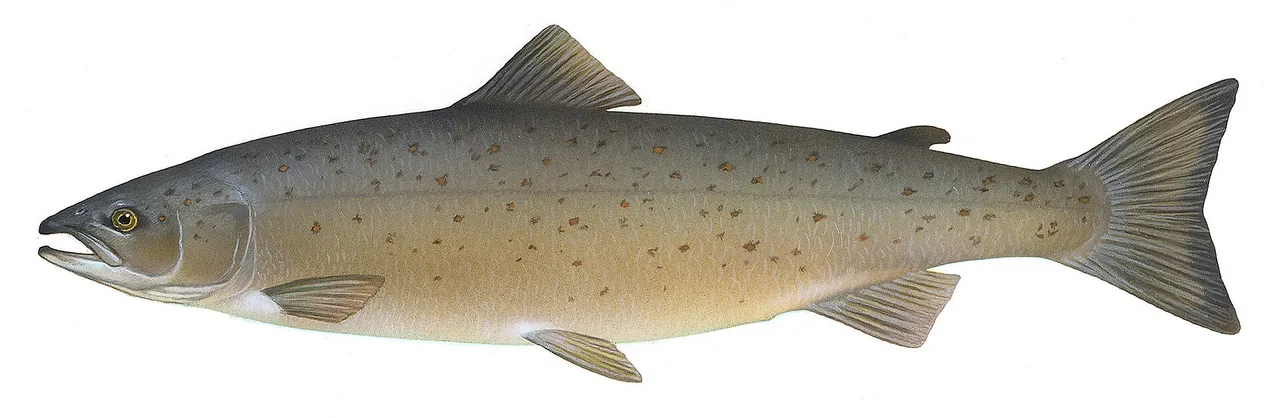
- Fresh-run fish are bright silver with a few black spots, mostly above the lateral line and typically X- or cross-shaped rather than round.
- The upper jaw ends level with or in front of the rear edge of the eye — in brown and sea trout it extends past it.
- A slender wrist in front of a slightly forked tail; a fresh salmon can generally be lifted by the tail, a trout cannot.
- An adipose fin, as in all salmonids.
- Fish that have been in fresh water for some time darken to bronze and red, and males develop a hooked lower jaw — the kype.
Size
- Typical
- Grilse — fish returning after one winter at sea — are commonly 55–70 cm and 1.5–3.5 kg. Multi-sea-winter fish are 75–100 cm and 5–12 kg.
- Large
- Over 105 cm and 14 kg.
Exceptional: Fish over 20 kg are recorded historically and are extremely rare now; the decline in large multi-sea-winter fish is itself one of the documented features of the species' recent history.
Handling a fish that cannot recover condition
The handling question for Atlantic salmon has an answer most species do not: a returning salmon has stopped feeding and cannot rebuild what a long fight costs it.
That single fact reorganises everything. A fish that will feed again can recover from a hard fight over days. A salmon on its spawning migration is running on reserves it cannot replace, so the cost of the fight is permanent and is subtracted from what it has left for spawning. Playing a fish quickly is therefore not merely kinder — it is the difference between a fish that spawns and a fish that arrives unable to.
The mechanics are ordinary and the discipline is not. Keep the fish in the water. Support it horizontally with a hand under the belly and the other around the tail wrist. Never lift a salmon by the tail alone or hold it vertically. Unhook with the fish submerged wherever possible, and revive it facing into the current until it swims off under its own power.
Water temperature changes the calculation sharply. In warm low water the same fight costs more and recovery takes longer, and the honest conclusion in those conditions is sometimes not to fish for them at all.
Where a fishery distinguishes what may be retained, that judgement is made on a fish already in the net — which is another reason the fish stays in the water while it is being made.
Official guidance — why, and the sources (2)
Stated by a fisheries authority, scientific institute or recognised angling body. Authoritative, but summarising rather than demonstrating.
- NASCO conservation and management of North Atlantic salmon — North Atlantic Salmon Conservation Organization (Government fisheries body)Relied on for: Conservation and management guidance for North Atlantic salmon, including catch-and-release handling.States this directlyCitation checked — the work exists and is described correctly
- Understanding the Complexity of Catch-and-Release in Recreational Fishing — Reviews in Fisheries Science 15:75–167, 2007 (Scientific literature)Relied on for: Fight duration, water temperature and handling as determinants of post-release survival.States this directlyCitation checked — the work exists and is described correctly
Why salmon come in two sizes, and what decides which
Atlantic salmon size is not a smooth distribution. It is bimodal, and the reason is the single most interesting thing about the species' life history.
A smolt that goes to sea returns either after ONE winter — a grilse, typically one to three kilos — or after TWO OR MORE, a multi-sea-winter fish of four to ten kilos and occasionally far more. The difference is not growth rate in the river. It is how long the fish stays at sea feeding before the drive to return overtakes it, and the split is partly genetic and partly environmental.
That is why a spring salmon and a summer grilse from the same river look like different fish and are the same species at different points in one decision. It is also why rivers are described as grilse rivers or spring-fish rivers: the proportion differs by system and by season within a system.
THE EXCEPTIONAL FIGURES are old and are getting older. Historic rod-caught fish of over twenty-five kilos exist in the record and modern fish approaching them do not, which reflects a real decline in the abundance of multi-sea-winter fish rather than a change in what the species is capable of.
And size at return says nothing about size in the river. Parr spend one to several years in fresh water reaching perhaps fifteen centimetres before smolting; almost all the growth happens at sea, in months, on a marine diet the fish will never eat again once it turns for home.
Backed by research — why, and the sources (2)
Supported by peer-reviewed research or fisheries science. The sources are listed and can be checked.
- NASCO conservation and management of North Atlantic salmon — North Atlantic Salmon Conservation Organization (Government fisheries body)Relied on for: North Atlantic salmon life history including sea-age at return, grilse and multi-sea-winter components, and stock trends.States this directlyCitation checked — the work exists and is described correctly
- Freshwater Fishes of the British Isles — HarperCollins (New Naturalist 75), 1992 (Reference work)Relied on for: Salmo salar life history in British and Irish waters, including freshwater growth and smolt age.States this directlyCitation checked — the work exists and is described correctly
The salmon year, and why 'the season' means something different on every river
There is no single Atlantic salmon calendar, and any page that offers one is describing a particular river rather than the species.
What is consistent is the SEQUENCE. Adults return from the sea, hold in fresh water without feeding, move upstream as flow allows, spawn in gravel in the colder part of the year, and either die or drop back as kelts. Juveniles spend one to several years in the river before smolting and going to sea in spring.
What varies enormously is WHEN fish enter. Some rivers receive fish from very early in the year — the spring fish that gave the classic salmon season its shape — while others are dominated by summer grilse or by late autumn runs. A single river may have several distinct run components, each genetically distinguishable, entering at different times and destined for different tributaries.
FLOW IS THE PROXIMATE TRIGGER for movement. Salmon hold in pools and run on rising or falling water, which is why rain in the catchment changes a river's fishing far more than anything happening at the bank.
SPAWNING is temperature-driven and happens in the colder months of the local year, on clean gravel in oxygenated water, with the female cutting a redd.
AND THE FISH DOES NOT FEED. A returning salmon has stopped feeding and will not resume. Everything about how it is fished for follows from that, and it is also why a long fight costs a returning fish something it cannot replace.
Backed by research — why, and the sources (2)
Supported by peer-reviewed research or fisheries science. The sources are listed and can be checked.
- NASCO conservation and management of North Atlantic salmon — North Atlantic Salmon Conservation Organization (Government fisheries body)Relied on for: Atlantic salmon run timing, river-specific stock components, spawning and the non-feeding return migration.States this directlyCitation checked — the work exists and is described correctly
- Freshwater Fishes of the British Isles — HarperCollins (New Naturalist 75), 1992 (Reference work)Relied on for: Salmo salar seasonal biology in British and Irish rivers.States this directlyCitation checked — the work exists and is described correctly
The salmon lifecycle, and the part that is genuinely unexplained
ESTABLISHED. Atlantic salmon are anadromous: they hatch in fresh water, spend one to several years as parr, undergo smoltification — a physiological transformation preparing them for salt water, involving changes in gill function, body chemistry and behaviour — migrate to sea feeding grounds, and return to fresh water to spawn. Unlike Pacific salmon, some survive spawning and return again as kelts.
HOMING IS REAL AND PARTLY EXPLAINED. Returning fish locate their natal river with high fidelity. Olfactory imprinting on the chemical signature of the home water is well supported for the final freshwater stage. Navigation across the open ocean before that point is far less settled, with magnetic and celestial mechanisms proposed and none conclusively established.
THE FEEDING PARADOX. Adult salmon do not feed meaningfully once they enter fresh water, yet they take angler's flies and lures. No explanation is settled: aggression, territorial response, residual feeding reflex and curiosity have all been proposed. FishingHQ states this as unresolved because it is, and because the fishery's central practical fact rests on it.
WHAT THIS MEANS PRACTICALLY. A fish that is not feeding cannot be tempted by matching its diet, which is why salmon fishing is organised around water height, temperature and lie rather than around imitation.
Backed by research — why, and the sources (2)
Supported by peer-reviewed research or fisheries science. The sources are listed and can be checked.
- FishBase: a global information system on fishes — Froese, R. and D. Pauly, eds. — FishBase Consortium (Scientific institute)Relied on for: Life history, spawning biology, habitat association and feeding ecology for the species.States this directlyPassage read and verified
- Freshwater Fishes of the British Isles — HarperCollins (New Naturalist 75), 1992 (Reference work)Relied on for: Life history and behaviour of European freshwater fishes, independently of the angling literature.Background and mechanism onlyCitation checked — the work exists and is described correctly
Natal homing, and why a lost salmon population does not come back
The most consequential fact about Atlantic salmon reproduction is not how they spawn but where, and specifically how precisely they choose it.
SALMON RETURN TO THE RIVER THEY WERE BORN IN, and frequently to the tributary and the reach. The navigation appears to combine geomagnetic orientation across the ocean with olfactory imprinting in fresh water — the fish learns the chemical signature of its natal stream as a juvenile and recognises it on return, years later, after a migration of thousands of kilometres.
THE CONSEQUENCE IS GENETIC AND IT IS THE WHOLE POINT. If fish return to their birthplace and spawn there, then each river's salmon breed with each other and not with the next river's. Over thousands of generations that produces populations that are genetically distinct river by river, and locally adapted — to that river's temperature regime, its flow, its timing, the size at which its fish must be to run it. A Spey salmon and a Wye salmon are not interchangeable stock.
WHICH MEANS A LOST POPULATION IS NOT REPLACED FROM NEXT DOOR. Straying between rivers happens at a low rate and is the mechanism by which new rivers are eventually colonised, but it is far too slow to restore a river within a human timescale, and the fish that stray are not adapted to the river they arrive in. A river whose salmon are extirpated has lost something specific and irreplaceable rather than a share of a common pool. That is the reasoning behind river-by-river management and behind the concern about interbreeding with escaped farmed fish, whose genetics are not adapted to any river.
THE SPAWNING ITSELF IS SUBSTRATE ENGINEERING. The female cuts a redd — turning on her side and flexing to displace gravel — deposits eggs in the depression, and covers them. The buried eggs develop over months in the gravel, oxygenated by water flowing through the interstitial spaces between stones. That last detail is why siltation is so damaging: fine sediment fills the gaps, the flow through the gravel stops, and the eggs suffocate in a redd that looks intact.
FISH ON REDDS ARE DOING THE THING EVERYTHING ELSE DEPENDS ON. What is legally permitted in respect of them varies by river and by season and is current local information this page does not state.
Backed by research — why, and the sources (2)
Supported by peer-reviewed research or fisheries science. The sources are listed and can be checked.
- NASCO conservation and management of North Atlantic salmon — North Atlantic Salmon Conservation Organization (Government fisheries body)Relied on for: Conservation of anadromous salmonids, natal homing, the genetic distinctness of river populations, and the management framework built around them.States this directlyCitation checked — the work exists and is described correctly
- Freshwater Fishes of the British Isles — HarperCollins (New Naturalist 75), 1992 (Reference work)Relied on for: Redd construction, gravel spawning and juvenile development in British salmonids.States this directlyCitation checked — the work exists and is described correctly
Four habitats in one life, and the river is the one that fails
An Atlantic salmon needs four quite separate habitats in sequence, and the population is limited by whichever of them is in the worst condition — which is almost always one of the freshwater ones.
THE SPAWNING HABITAT IS CLEAN, LOOSE GRAVEL IN FLOWING WATER. Eggs are buried in a redd cut into gravel of a specific size range, in water shallow and fast enough to force oxygenated flow down through the gravel bed to reach them. That subsurface flow is the whole requirement, and it is what fine sediment destroys: silt from agricultural run-off, forestry or bank erosion fills the interstitial spaces, the eggs suffocate, and the river looks entirely normal from the bank.
THE JUVENILE HABITAT IS FAST, BROKEN, STONY WATER. Fry and parr hold in riffles and runs among cobbles and boulders, each fish occupying a station and defending it. Habitat quality here is a matter of structural complexity and shade: cobble to hide among, broken flow to hold in, tree cover to keep water cool and deliver terrestrial invertebrates. A dredged, straightened, uniform channel supports a small fraction of the parr a natural one does even where the water quality is fine.
THE MIGRATORY CORRIDOR IS A HABITAT IN ITS OWN RIGHT, and it is the one people forget. Smolts must reach the sea and adults must reach the spawning gravel, which requires the river to be passable in both directions at the right times. Weirs, dams, culverts, poorly designed passes and low flows all break the corridor, and a river with perfect gravel above an impassable structure holds no salmon.
THE MARINE HABITAT IS THE LEAST UNDERSTOOD AND THE MOST CONSEQUENTIAL. Post-smolts move to distant North Atlantic feeding grounds, and marine survival — which has declined substantially — now dominates the returns for many rivers. That is a habitat problem occurring somewhere no river manager can reach.
THE TEMPERATURE ENVELOPE BINDS ALL THE FRESHWATER STAGES. Salmon require cold, well-oxygenated water, and warming pushes the southern edge of the range northward and makes low-summer-flow rivers periodically lethal.
WHICH IS WHY THE HABITAT ACCOUNT MATTERS MORE THAN THE DISTRIBUTION MAP. A river within the range is not a salmon river unless it has clean gravel, structurally complex juvenile water, passage from the sea, and enough cold water in summer. Losing any one of the four is enough.
Backed by research — why, and the sources (2)
Supported by peer-reviewed research or fisheries science. The sources are listed and can be checked.
- NASCO conservation and management of North Atlantic salmon — North Atlantic Salmon Conservation Organization (Government fisheries body)Relied on for: Freshwater and marine habitat requirements of anadromous salmonids, the river conditions on which spawning and juvenile survival depend, and the pressures on them.States this directlyCitation checked — the work exists and is described correctly
- FishBase: a global information system on fishes — Froese, R. and D. Pauly, eds. — FishBase Consortium (Scientific institute)Relied on for: Habitat association, life-stage distribution and migratory behaviour for the species.Background and mechanism onlyPassage read and verified
Tackle chosen for the size of the river and the height of the water, not for the size of the fish
Salmon tackle decisions are made almost entirely on water conditions, and a reader who understands that will make better choices than one who knows what fish are in the river.
ROD LENGTH IS ABOUT CONTROLLING LINE ACROSS A RIVER. A double-handed rod exists to cast a long line without back room and, more importantly, to hold and mend that line across conflicting currents so the fly swims at a controlled speed. On a big river in high water that is the whole problem; on a small stream in low water a long rod is a liability and a single-handed outfit does the job better. The fish are the same fish.
LINE DENSITY AND FLY SIZE TRACK WATER HEIGHT AND TEMPERATURE TOGETHER. In cold, high water a salmon will move a short distance for a large fly presented deep, so the tackle is heavier: sinking lines or tips, bigger flies, more weight. In warm, low, clear water the fish will come further for a small fly near the surface, so the tackle lightens all round. That progression is the single most useful principle in the discipline and it is a physical one about how far a fish will move and how fast the fly is travelling.
SWING SPEED IS THE THING BEING CONTROLLED. Everything above — rod length, line density, fly size, casting angle, mending — is aimed at making the fly travel across the current at a speed the fish will intercept. Tackle that cannot control that produces a fly moving too fast, which is the commonest reason a well-fished pool produces nothing.
HOOK CHOICE IS INCREASINGLY A CONSERVATION MATTER. Many salmon rivers now operate mandatory catch-and-release, and hooking damage governs survival. Single, barbless hooks reduce injury and unhooking time relative to trebles, and their use is required on a great many rivers. What is required on any particular water is a matter for the competent authority and it changes; several jurisdictions also restrict methods entirely in parts of the season.
AND WARM LOW WATER IS WHEN TACKLE CHOICE BECOMES A WELFARE DECISION, exactly as with barbel: a long fight in warm water on light tackle kills salmon that would have survived a short one. Where rivers impose temperature-based restrictions, that is the reasoning.
Official guidance — why, and the sources (2)
Stated by a fisheries authority, scientific institute or recognised angling body. Authoritative, but summarising rather than demonstrating.
- Freshwater Fishing — Macdonald & Jane's, 1975 (Specialist angling publication)Relied on for: Game angling technique and tackle, including the relationship between tackle choice and the water being fished.States this directlyCitation checked — the work exists and is described correctly
- Trout & Salmon — Bauer Media (Specialist angling publication)Relied on for: Contemporary game angling practice, tackle and presentation.Background and mechanism onlyCitation checked — the work exists and is described correctly
Lures for a fish that is not feeding, and what is actually being provoked
Salmon lure fishing rests on a premise that has to be stated before anything else makes sense: a salmon in fresh water has stopped feeding, and every lure presented to it is provoking a response rather than offering a meal.
THE FISH DOES NOT NEED TO EAT AND DOES NOT INTEND TO. Returning adults cease feeding on entering fresh water and run on stored reserves, which is why a river salmon can ignore an entire day's presentations and then take savagely. What is being triggered is variously argued to be aggression, territoriality, irritation or a residual feeding reflex from the fish's marine life, and the honest position is that nobody has settled it. FishingHQ records it as unresolved rather than picking an explanation.
WHAT FOLLOWS PRACTICALLY IS THAT SPEED AND DEPTH MATTER MORE THAN PATTERN. A lure passing at the right depth and the right speed in front of a fish gets a response; the same lure passing too fast, too high or too far away does not. That is why salmon anglers talk about covering water systematically rather than about selecting a bait.
WATER HEIGHT AND TEMPERATURE SET THE SIZE AND DEPTH TOGETHER, and this is the single most transferable principle in the discipline. Cold high water: bigger lure, deeper, slower, because the fish will move only a short distance. Warm low water: smaller, higher, faster, because it will come further. That progression works for spoons, spinners, plugs and flies alike.
SPINNERS AND SPOONS WORK BY FLASH AND VIBRATION, which is why they earn their place in coloured water where a fly is hard to find. Plugs and heavier lures cover deep holding water in high flows.
AND HOOK CHOICE IS INCREASINGLY THE BINDING CONSTRAINT RATHER THAN A REFINEMENT. Many salmon rivers now operate mandatory catch-and-release with single, barbless hook requirements, and treble-hooked lures are prohibited on a great many waters. Where they are permitted, the record's tackle section explains why a shorter fight matters in warm low water. What applies on any river is a matter for the competent authority and it changes between seasons.
Official guidance — why, and the sources (2)
Stated by a fisheries authority, scientific institute or recognised angling body. Authoritative, but summarising rather than demonstrating.
- NASCO conservation and management of North Atlantic salmon — North Atlantic Salmon Conservation Organization (Government fisheries body)Relied on for: The behaviour of returning anadromous salmonids in fresh water, including that they are not feeding and that river conditions govern their movement and response.States this directlyCitation checked — the work exists and is described correctly
- Trout & Salmon — Bauer Media (Specialist angling publication)Relied on for: Contemporary game angling practice for migratory salmonids.Background and mechanism onlyCitation checked — the work exists and is described correctly
Lifecycle and reproduction
Eggs hatch in gravel in spring; alevins absorb the yolk sac and emerge as fry, which become territorial parr. After one to several years in fresh water, parr smolt — a physiological reorganisation that allows survival in salt water — and migrate to sea. Marine feeding is rapid, and fish return after one winter as grilse or after several as larger multi-sea-winter fish. Unlike Pacific salmon, Atlantic salmon do not necessarily die after spawning, and a proportion of kelts survive to return again, though most do not.
Spawning takes place in late autumn and winter in clean gravel, with the female cutting a redd and burying the fertilised eggs. Salmon show strong natal homing, returning to the river and often the tributary of their birth, which means populations are genetically distinct river by river — and which means a lost population is not readily replaced from a neighbouring one.
Feeding and senses
At sea, salmon feed heavily on crustaceans and small fish, which is where essentially all their growth occurs. On entering fresh water to spawn they effectively stop feeding and metabolise stored reserves. Why they nonetheless take a fly or a lure is not settled — aggression, territorial response, and residual feeding reflex are all proposed, and the honest position is that the question is open. FishingHQ records it as unresolved rather than picking the most satisfying explanation.
Vision is central to a taking response in fresh water, which is why fly size, depth and speed dominate salmon angling far more than colour or pattern do. The homing mechanism itself is thought to combine geomagnetic orientation at sea with olfactory recognition of natal water in the final stages — the fish smells its way home once it is close.
Through the year
Runs are timed by river and vary enormously: some systems receive fish from early spring, others principally in summer or autumn. Movement within the river is driven overwhelmingly by water height and temperature, which is why salmon angling is so conditions-dependent. Fish that have been in the river for weeks are progressively less inclined to take than fresh-run fish.
Distribution
The North Atlantic and the rivers draining into it, from northern Iberia to Arctic Norway and Russia in Europe, and from New England to northern Canada in North America. The global IUCN category is Near Threatened. That single figure conceals a great deal: populations are river-specific and genetically distinct, their status varies widely between systems, and several are at historically low levels while others are comparatively secure.
This is a biological range — where the species occurs, not a prediction that you will catch one. To browse the fishing geography FishingHQ holds, start at fishing places.
Why anglers care
The most prestigious game fish in Europe and the subject of an angling tradition, an economy and a body of technique of its own. Salmon angling is now conducted under heavy conservation constraint in much of its range, with catch-and-release the norm and access, seasons and methods closely regulated in ways that vary substantially by country and by river.
Handling and returning
Salmon are frequently released and are large enough that handling matters. Keep the fish in the water, do not lift it clear if avoidable, support it under the belly and by the wrist of the tail, use barbless hooks and unhook in the water where possible, and hold the fish facing the flow until it swims away strongly. Warm, low water sharply increases post-release mortality and is a reason to stop.
Going further
- What does atlantic salmon eat? — feeding biology, kept separate from what anglers infer from it.
- Atlantic salmon vs Brown trout — how to tell them apart.
- Atlantic salmon vs Chinook salmon — how to tell them apart.
Safety
Moving water and currents — Can cause serious injury or death
Salmon fishing means wading large, powerful rivers, often in cold conditions and often in water that is deeper and faster than it appears. The combination of force, cold and waders is the one that kills anglers.
What reduces it: Buoyancy aid and wading belt as standard, a wading staff, never alone, and a firm personal limit on depth and flow that you set on the bank rather than in the water. Know how to get out downstream before you commit to a crossing.
Precautions that always apply here
- Wear a buoyancy aid or lifejacket. Cold water incapacitates strong swimmers within a minute, long before swimming ability matters.
- Do not wade alone. Judge depth and flow from the bank first, and turn back sooner than feels necessary.
- Tell somebody where you are going and when you expect to be back.
- Carry a charged phone in a waterproof case, or another means of calling for help.
- Wet your hands before touching a fish. Dry hands strip the protective mucus layer that keeps infection out.
- Support the fish's weight along its body, keep it out of the water for as short a time as possible, and hold it over something soft.
Check the rules before you fish
Fishing laws, bylaws, access rules, seasons, bait restrictions and permitted methods vary by location and can change. Check the current rules from the relevant authority and the water you intend to fish before fishing.
Check with:
- Current national or regional law for where you are fishing
- Current local bylaws
- The relevant fisheries authority
- The landowner, club or fishery whose water it is
- Any restrictions specific to the species or the method you intend to use
Where to go next
Similar and related fish
- CapelinIn northern feeding areas capelin is a principal item in the marine diet, which is one of the connections between capelin stock health and salmon returns.
- Chinook salmonThe clearest illustration of what semelparity means: Atlantic salmon can spawn more than once and Pacific salmon cannot. Same family, one irreversible difference.
- Lesser sandeelAt sea, salmon feed heavily on sandeel, and the growth a salmon achieves during its marine phase is largely a function of forage fish availability rather than anything that happens in fresh water.
Where it lives
Where you will find it
- CanadaRuns the rivers of the Atlantic provinces and Quebec, where the fishery is heavily restricted and substantially catch-and-release.
- Clew Bay and AchillTaken from the shore on this coast on small spinners and sandeel where rivers enter the sea, which is unusual: on most coasts the association is with the river rather than with the salt water in front of it.
- FranceReturns to rivers of the Atlantic seaboard including the Loire-Allier and the Breton and Basque rivers, at the southern edge of the European range where populations are small and locally distinct.
- Greenland and the high ArcticFeeds off West Greenland as a marine phase of populations spawning in rivers on both sides of the Atlantic, which is why this coast matters to European and North American rivers.
- IcelandIceland's salmon rivers are among the most closely managed and most sought-after in the world, fished under a beat-and-rod permit system with measures set river by river.
- Lake VänernThe Gullspång and Klarälven strains complete their entire life cycle in fresh water, feeding in the lake rather than at sea. Wild landlocked Atlantic salmon populations are rare, and these are among the significant ones.
- Loch LomondSalmon and sea trout run through the loch to the Endrick and other feeder rivers, which makes the whole system rather than any part of it the unit that matters.
- Lough CorribRuns the system, using the lough as a corridor to spawning water above, and is fished under the national stock-by-stock conservation framework.
19 more
- Lough Foyle and its rivers Fishing regions
- Scotland Fishing regions
- Shetland Fishing regions
- Skye and the Inner Hebrides Fishing regions
- Sweden Fishing regions
- The Atlantic coast of Ireland Fishing regions
- The Baltic Sea Fishing regions
- The Bay of Biscay Fishing regions
- The Lake District lakes Fishing regions
- The Moray Firth Fishing regions
- The Moy and Lough Conn Fishing regions
- The Republic of Ireland Fishing regions
- The Rhine Fishing regions
- The River Spey Fishing regions
- The River Tay Fishing regions
- The River Tweed Fishing regions
- The River Wye Fishing regions
- The Severn Estuary Fishing regions
- The Welsh sewin rivers Fishing regions
Understanding this fish
- How salmon find their way homeOlfactory imprinting on the natal stream is among the best-established behavioural mechanisms in fish biology; the oceanic half of the navigation is supported rather than settled, and this page says which is which.
- Redds, spawning, and what happens afterEverything about whether the next generation survives depends on water continuing to flow through the spawning gravel for months, which makes fine sediment the largest freshwater threat to recruitment.
- Smoltification, and the change that makes the sea possibleA full metamorphosis rather than a growth stage, with a narrow window: a smolt delayed past it in fresh water can lose smolt status and the migration with it.
- Spey and two-handed casting conceptsThe fish the technique exists for, and the reason is geometry rather than tradition. A salmon river is fished across and down, from a bank with trees or a high wall behind, with a heavy fly and a long line — and a cast that never travels behind the angler is the only way to do that repeatedly for hours.
- The River Spey and Atlantic salmonA case study in how a river's physical character produces its fishery and its tackle: fast heavy water and no room behind the angler produced a family of casts now used worldwide.
- Trout, char and salmon: what the words actually meanA Salmo, sharing its genus with brown trout and not with the Pacific salmon.
- Warm-water fishing, and the oxygen problemA cold-water migratory fish holding in a warming river is the case where the oxygen squeeze becomes a conservation matter rather than a fishing inconvenience.
- What salmon eat at each stage of lifeFour diets in one life, and at the stage anglers meet the fish it is not feeding at all — which is the central strangeness of salmon angling and the reason it cannot be reasoned about by imitation.
1 more
- Why fish migrate Explainer
Told apart from
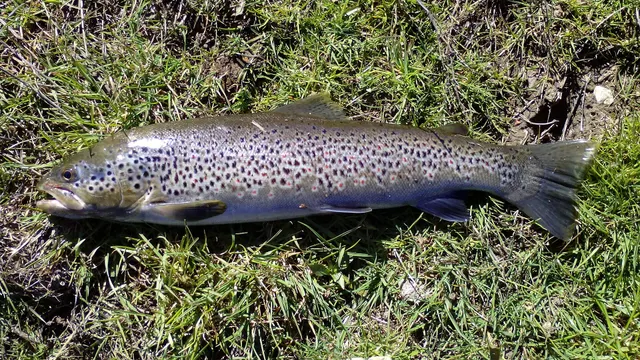 Brown troutSame genus, and frequently confused — the jaw and tail differences in the identification list are what separate them.
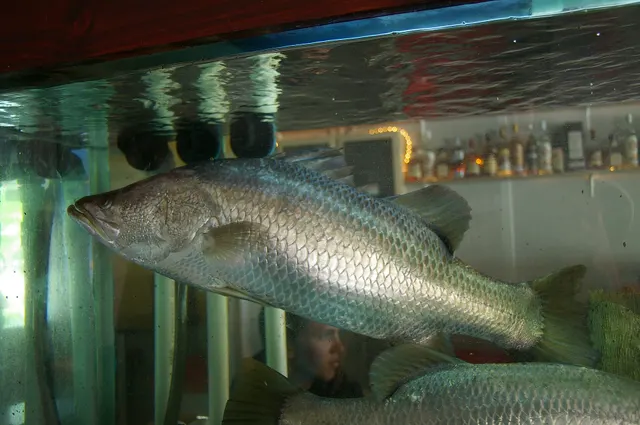 BarramundiBoth are diadromous and they run in opposite directions: salmon spawn in fresh water and grow at sea, barramundi grow in fresh water and spawn in the sea. The barrier that matters is at the opposite end of the river.
Rules and access
Environment and conservation
Sources and evidence
- NASCO conservation and management of North Atlantic salmon — North Atlantic Salmon Conservation Organization (Government fisheries body)Relied on for: The migratory life history, natal homing, and the documented decline in marine survival and in multi-sea-winter fish.States this directlyCitation checked — the work exists and is described correctly
- Freshwater Fishes of the British Isles — HarperCollins (New Naturalist 75), 1992 (Reference work)Relied on for: Identification against brown trout, redd spawning and the freshwater phase of the lifecycle.States this directlyCitation checked — the work exists and is described correctly
- FishBase: a global information system on fishes — Froese, R. and D. Pauly, eds. — FishBase Consortium (Scientific institute)Relied on for: Taxonomy, family and size range.States this directlyPassage read and verified
- FishBase: a global information system on fishes — Froese, R. and D. Pauly, eds. — FishBase Consortium (Scientific institute)Relied on for: The current global IUCN category for Salmo salar (Near Threatened) read during source review, together with the accepted name, family and size maxima.States this directlyPassage read and verified
Why the 50 connections on this page are here, and the sources
Similar and related fish
Backed by research — 3 connections
Supported by peer-reviewed research or fisheries science. The sources are listed and can be checked.
Capelin
Recorded diet evidence identifies Mallotus villosus as a food item of this predator at species level. The edge is written at that granularity and no further.
- FishBase: a global information system on fishes — Froese, R. and D. Pauly, eds. — FishBase Consortium (Scientific institute)Relied on for: Food items recorded for this predator, including Mallotus villosus.States this directlyPassage read and verified
- FAO Species Identification Guides for Fishery Purposes and the FAO Species Catalogues — Food and Agriculture Organization of the United Nations (Scientific institute)Relied on for: Species account describing the diet of this predator in the region where Mallotus villosus occurs.Background and mechanism onlyCitation checked — the work exists and is described correctly
Chinook salmon
A life-history comparison naming both binomials, and one that corrects a common assumption that all salmon die after spawning.
- FishBase: a global information system on fishes — Froese, R. and D. Pauly, eds. — FishBase Consortium (Scientific institute)Relied on for: That Oncorhynchus tshawytscha is an anadromous Salmonidae of the North Pacific, distinct from Salmo salar of the North Atlantic.States this directlyPassage read and verified
- NASCO conservation and management of North Atlantic salmon — North Atlantic Salmon Conservation Organization (Government fisheries body)Relied on for: The anadromous life history of Atlantic salmon, including repeat spawning, and its management as distinct river populations.States this directlyCitation checked — the work exists and is described correctly
Lesser sandeel
Recorded diet evidence identifies Ammodytes marinus as a food item of this predator at species level. The edge is written at that granularity and no further.
- FishBase: a global information system on fishes — Froese, R. and D. Pauly, eds. — FishBase Consortium (Scientific institute)Relied on for: Food items recorded for this predator, including Ammodytes marinus.States this directlyPassage read and verified
- FAO Species Identification Guides for Fishery Purposes and the FAO Species Catalogues — Food and Agriculture Organization of the United Nations (Scientific institute)Relied on for: Species account describing the diet of this predator in the region where Ammodytes marinus occurs.Background and mechanism onlyCitation checked — the work exists and is described correctly
How it is caught
Official guidance — 1 connection
Stated by a fisheries authority, scientific institute or recognised angling body. Authoritative, but summarising rather than demonstrating.
Salmon fly fishing
A river fish taken over beats and named pools through a defined season, and the game-angling sources describe that fishery as a fly fishery throughout.
- Trout & Salmon — Bauer Media (Specialist angling publication)Relied on for: Long-running published description of British and Irish game angling practice by river, beat and season, including the technique, tackle and seasonal decisions of salmon fly fishing.FishingHQ's interpretation of what it saysCitation checked — the work exists and is described correctly
- General angling website restatements of established technique — Various (Credible secondary source)Relied on for: Widely restated public descriptions of salmon fly technique — the down-and-across swing, Spey casting, and the water-temperature convention for fly size and line density — recorded as practitioner consensus rather than as scholarship, including where that consensus is openly disputed.Background and mechanism onlyCitation checked — the work exists and is described correctly
What experienced anglers do — 2 connections
Widely and independently recommended by experienced anglers and specialist sources. This is real angling knowledge, not proof: controlled evidence for it is limited, and FishingHQ records it as convention rather than as a demonstrated effect.
Spinning
Established angling practice for this species, recorded as convention. The note states the property of the animal or its water that makes the method the answer.
- Trout & Salmon — Bauer Media (Specialist angling publication)Relied on for: Established salmonid angling technique and its application to this species.States this directlyCitation checked — the work exists and is described correctly
- General angling website restatements of established technique — Various (Credible secondary source)Relied on for: Widely restated practice connecting this species and method.Background and mechanism onlyCitation checked — the work exists and is described correctly
Trolling
Established angling practice for this species, recorded as convention. The note states the property of the animal or its water that makes the method the answer.
- Trout & Salmon — Bauer Media (Specialist angling publication)Relied on for: Established salmonid angling technique and its application to this species.States this directlyCitation checked — the work exists and is described correctly
- General angling website restatements of established technique — Various (Credible secondary source)Relied on for: Widely restated practice connecting this species and method.Background and mechanism onlyCitation checked — the work exists and is described correctly
Gear for this fish
What experienced anglers do — 3 connections
Widely and independently recommended by experienced anglers and specialist sources. This is real angling knowledge, not proof: controlled evidence for it is limited, and FishingHQ records it as convention rather than as a demonstrated effect.
Spoons
A practitioner claim about which lure family answers this species' feeding or holding behaviour.
- Trout & Salmon — Bauer Media (Specialist angling publication)Relied on for: Fly categories and their application to river salmonids.States this directlyCitation checked — the work exists and is described correctly
- The Compleat Angler, or the Contemplative Man's Recreation — Richard Marriot, 1653 (Reference work)Relied on for: The long documentary record of artificial-fly fishing for trout and grayling in English rivers.Background and mechanism onlyPassage read and verified
Streamers
A practitioner claim about which lure family answers this species' feeding or holding behaviour.
- Trout & Salmon — Bauer Media (Specialist angling publication)Relied on for: Fly categories and their application to river salmonids.States this directlyCitation checked — the work exists and is described correctly
- The Compleat Angler, or the Contemplative Man's Recreation — Richard Marriot, 1653 (Reference work)Relied on for: The long documentary record of artificial-fly fishing for trout and grayling in English rivers.Background and mechanism onlyPassage read and verified
Wet flies
A practitioner claim about which lure family answers this species' feeding or holding behaviour.
- Trout & Salmon — Bauer Media (Specialist angling publication)Relied on for: Fly categories and their application to river salmonids.States this directlyCitation checked — the work exists and is described correctly
- The Compleat Angler, or the Contemplative Man's Recreation — Richard Marriot, 1653 (Reference work)Relied on for: The long documentary record of artificial-fly fishing for trout and grayling in English rivers.Background and mechanism onlyPassage read and verified
Where it lives
Backed by research — 1 connection
Supported by peer-reviewed research or fisheries science. The sources are listed and can be checked.
Spate rivers
A claim that the species uses rain-fed rivers on impermeable geology, resting on documented distribution and spawning habitat rather than on angling report.
- Freshwater Fishes of the British Isles — HarperCollins (New Naturalist 75), 1992 (Reference work)Relied on for: Distribution, habitat association, thermal requirements and life history of the freshwater fishes of the British Isles and north-west Europe.States this directlyCitation checked — the work exists and is described correctly
- FishBase: a global information system on fishes — Froese, R. and D. Pauly, eds. — FishBase Consortium (Scientific institute)Relied on for: Recorded depth range, temperature tolerance and habitat association for the species.States this directlyPassage read and verified
Where you will find it
Backed by research — 27 connections
Supported by peer-reviewed research or fisheries science. The sources are listed and can be checked.
Canada
A distribution association between an animal and a kind of water, rather than a claim about any named mark.
- FishBase: a global information system on fishes — Froese, R. and D. Pauly, eds. — FishBase Consortium (Scientific institute)Relied on for: Distribution, habitat association and depth range recorded for the species, including its occurrence in the water body concerned.States this directlyPassage read and verified
- The IUCN Red List of Threatened Species — International Union for Conservation of Nature (Conservation authority)Relied on for: Assessment and range account for the species, including the systems and coasts it occupies.Background and mechanism onlyCitation checked — the work exists and is described correctly
Clew Bay and Achill
A claim that a coast contains the ground and conditions the species is associated with. It is a distributional statement about the world, it rests on the regional reference literature, and it deliberately asserts nothing about access, permission or catch.
- The Fishes of the British Isles and North-West Europe — Macmillan, 1969 (Reference work)Relied on for: Distribution and habitat association of the marine and estuarine fishes of the British Isles and north-west Europe, including which coasts and ground types a species occupies.States this directlyCitation checked — the work exists and is described correctly
- FishBase: a global information system on fishes — Froese, R. and D. Pauly, eds. — FishBase Consortium (Scientific institute)Relied on for: Recorded distribution, depth range and habitat association for the species named.States this directlyPassage read and verified
France
Occurrence of the species in these waters: a statement about the animal's distribution, not a venue recommendation.
- FishBase: a global information system on fishes — Froese, R. and D. Pauly, eds. — FishBase Consortium (Scientific institute)Relied on for: Distribution, habitat association and salinity tolerance recorded for the species, including its occurrence in these waters.States this directlyPassage read and verified
- The IUCN Red List of Threatened Species — International Union for Conservation of Nature (Conservation authority)Relied on for: Assessment and range description for the species.Background and mechanism onlyCitation checked — the work exists and is described correctly
Greenland and the high Arctic
A distribution association between an animal and a kind of water, rather than a claim about any named mark.
- FishBase: a global information system on fishes — Froese, R. and D. Pauly, eds. — FishBase Consortium (Scientific institute)Relied on for: Distribution, habitat association and depth range recorded for the species, including its occurrence in the water body concerned.States this directlyPassage read and verified
- The IUCN Red List of Threatened Species — International Union for Conservation of Nature (Conservation authority)Relied on for: Assessment and range account for the species, including the systems and coasts it occupies.Background and mechanism onlyCitation checked — the work exists and is described correctly
Iceland
That a species occurs in these waters, drawn from distribution science and stock assessment. It is a statement about where the animal lives and is not a statement that anybody will catch one, still less where.
- Freshwater Fishes of the British Isles — HarperCollins (New Naturalist 75), 1992 (Reference work)Relied on for: Distribution, habitat requirement and life history of European freshwater fishes, including their occurrence across the continental range named.States this directlyCitation checked — the work exists and is described correctly
- FishBase: a global information system on fishes — Froese, R. and D. Pauly, eds. — FishBase Consortium (Scientific institute)Relied on for: Recorded distribution and habitat association of the freshwater and migratory species named.States this directlyPassage read and verified
Lake Vänern
A distributional claim taken from reference works and databases on the fishes of the region rather than from angling report. It states presence and asserts nothing about a fishery.
- FishBase: a global information system on fishes — Froese, R. and D. Pauly, eds. — FishBase Consortium (Scientific institute)Relied on for: Distribution, habitat association, life history and size recorded for the species concerned.States this directlyPassage read and verified
- Freshwater Fishes of the British Isles — HarperCollins (New Naturalist 75), 1992 (Reference work)Relied on for: Biology, distribution, life history and conservation status of northern European freshwater and diadromous fishes.States this directlyCitation checked — the work exists and is described correctly
Loch Lomond
A distributional claim taken from reference works on the fishes of the region rather than from angling report. It states presence and asserts nothing about a fishery.
- FishBase: a global information system on fishes — Froese, R. and D. Pauly, eds. — FishBase Consortium (Scientific institute)Relied on for: Distribution, habitat association, life history and depth range recorded for the species concerned.States this directlyPassage read and verified
- Freshwater Fishes of the British Isles — HarperCollins (New Naturalist 75), 1992 (Reference work)Relied on for: Biology, distribution and conservation status of British and Irish freshwater and diadromous fishes.States this directlyCitation checked — the work exists and is described correctly
- The Fishes of the British Isles and North-West Europe — Macmillan, 1969 (Reference work)Relied on for: Distribution, habitat and biology of the fishes of the British Isles and north-west Europe.States this directlyCitation checked — the work exists and is described correctly
Lough Corrib
A distribution association between an animal and a kind of water, rather than a claim about any named mark.
- Freshwater Fishes of the British Isles — HarperCollins (New Naturalist 75), 1992 (Reference work)Relied on for: Distribution, habitat association and ecology of British and Irish freshwater fishes, including occurrence in the water body concerned.States this directlyCitation checked — the work exists and is described correctly
- FishBase: a global information system on fishes — Froese, R. and D. Pauly, eds. — FishBase Consortium (Scientific institute)Relied on for: Distribution, habitat association and life history recorded for the species.Background and mechanism onlyPassage read and verified
Lough Foyle and its rivers
A claim that a coast or region contains the ground and conditions this species is associated with. It is a distributional statement about the world, it rests on the reference literature and on the institute that surveyed it, and it deliberately asserts nothing about access, permission or catch.
- The Fishes of the British Isles and North-West Europe — Macmillan, 1969 (Reference work)Relied on for: Distribution and habitat association of the marine fishes of the British Isles and north-west Europe, including which coasts and ground types a species occupies.States this directlyCitation checked — the work exists and is described correctly
- FishBase: a global information system on fishes — Froese, R. and D. Pauly, eds. — FishBase Consortium (Scientific institute)Relied on for: Recorded distribution, depth range and habitat association for the species named.States this directlyPassage read and verified
Scotland
A distribution claim about the world, so it rests on the reference works rather than on angling report. FishingHQ's evidence policy requires it.
- FishBase: a global information system on fishes — Froese, R. and D. Pauly, eds. — FishBase Consortium (Scientific institute)Relied on for: Distribution, habitat association, water-type tolerance and occurrence records for the species, including its presence in the countries concerned.States this directlyPassage read and verified
- The IUCN Red List of Threatened Species — International Union for Conservation of Nature (Conservation authority)Relied on for: Assessment and range account for the species, including the countries and systems it occupies and its population trend within them.States this directlyCitation checked — the work exists and is described correctly
Shetland
A distribution association between an animal and a kind of water, rather than a claim about any named mark.
- The Fishes of the British Isles and North-West Europe — Macmillan, 1969 (Reference work)Relied on for: Distribution, habitat association, depth and ground preference of fishes in British and north-west European waters.States this directlyCitation checked — the work exists and is described correctly
- FishBase: a global information system on fishes — Froese, R. and D. Pauly, eds. — FishBase Consortium (Scientific institute)Relied on for: Distribution, habitat association and depth range recorded for the species.Background and mechanism onlyPassage read and verified
Skye and the Inner Hebrides
A distribution association between an animal and a kind of water, rather than a claim about any named mark.
- The Fishes of the British Isles and North-West Europe — Macmillan, 1969 (Reference work)Relied on for: Distribution, habitat association and ground type of fishes in British and north-west European waters.States this directlyCitation checked — the work exists and is described correctly
- FishBase: a global information system on fishes — Froese, R. and D. Pauly, eds. — FishBase Consortium (Scientific institute)Relied on for: Distribution, habitat association and depth range recorded for the species.Background and mechanism onlyPassage read and verified
Sweden
That a species occurs in these waters, drawn from distribution science and stock assessment. It is a statement about where the animal lives and is not a statement that anybody will catch one, still less where.
- Freshwater Fishes of the British Isles — HarperCollins (New Naturalist 75), 1992 (Reference work)Relied on for: Distribution, habitat requirement and life history of European freshwater fishes, including their occurrence across the continental range named.States this directlyCitation checked — the work exists and is described correctly
- FishBase: a global information system on fishes — Froese, R. and D. Pauly, eds. — FishBase Consortium (Scientific institute)Relied on for: Recorded distribution and habitat association of the freshwater and migratory species named.States this directlyPassage read and verified
The Atlantic coast of Ireland
A claim that a place contains the ground and conditions the species is associated with. It is a distributional statement about the world, it rests on the regional reference literature, and it deliberately asserts nothing about access, permission or catch.
- The Fishes of the British Isles and North-West Europe — Macmillan, 1969 (Reference work)Relied on for: Distribution and habitat association of the marine and estuarine fishes of the British Isles, including which coasts and ground types a species occupies.States this directlyCitation checked — the work exists and is described correctly
- FishBase: a global information system on fishes — Froese, R. and D. Pauly, eds. — FishBase Consortium (Scientific institute)Relied on for: Recorded distribution, depth range and habitat association for the species named.States this directlyPassage read and verified
The Baltic Sea
Occurrence of the species in this system or along this coast: a statement about the animal's distribution, not a venue recommendation.
- Freshwater Fishes of the British Isles — HarperCollins (New Naturalist 75), 1992 (Reference work)Relied on for: Distribution and habitat association of European freshwater fishes, including their occurrence in brackish and coastal waters.States this directlyCitation checked — the work exists and is described correctly
- FishBase: a global information system on fishes — Froese, R. and D. Pauly, eds. — FishBase Consortium (Scientific institute)Relied on for: Salinity tolerance and distribution recorded for the species.States this directlyPassage read and verified
The Bay of Biscay
Occurrence of the species in this system or along this coast: a statement about the animal's distribution, not a venue recommendation.
- Freshwater Fishes of the British Isles — HarperCollins (New Naturalist 75), 1992 (Reference work)Relied on for: Distribution and habitat association of European freshwater fishes, including their occurrence in brackish and coastal waters.States this directlyCitation checked — the work exists and is described correctly
- FishBase: a global information system on fishes — Froese, R. and D. Pauly, eds. — FishBase Consortium (Scientific institute)Relied on for: Salinity tolerance and distribution recorded for the species.States this directlyPassage read and verified
The Lake District lakes
A claim that a place contains the ground, water and seasonal conditions the species is associated with. It is a distributional statement about the world, it rests on the regional reference literature, and it deliberately asserts nothing about access, permission or catch.
- Freshwater Fishes of the British Isles — HarperCollins (New Naturalist 75), 1992 (Reference work)Relied on for: Distribution, habitat and conservation status of British freshwater fishes, including the isolated glacial-relict populations of northern England.States this directlyCitation checked — the work exists and is described correctly
- Environment Agency fisheries management, byelaws and rod licensing information — Environment Agency (Government fisheries body)Relied on for: Fisheries monitoring, water quality and species distribution in English rivers and still waters.States this directlyCitation checked — the work exists and is described correctly
The Moray Firth
A claim that a place contains the ground, water and seasonal conditions the species is associated with. It is a distributional statement about the world, it rests on the regional reference literature, and it deliberately asserts nothing about access, permission or catch.
- The Fishes of the British Isles and North-West Europe — Macmillan, 1969 (Reference work)Relied on for: Distribution and habitat association of the marine, estuarine and freshwater fishes of the British Isles, including which coasts, estuaries and ground types a species occupies.States this directlyCitation checked — the work exists and is described correctly
- FishBase: a global information system on fishes — Froese, R. and D. Pauly, eds. — FishBase Consortium (Scientific institute)Relied on for: Recorded distribution, depth range and habitat association for the species named.States this directlyPassage read and verified
The Moy and Lough Conn
A claim that a coast contains the ground and conditions the species is associated with. It is a distributional statement about the world, it rests on the regional reference literature, and it deliberately asserts nothing about access, permission or catch.
- The Fishes of the British Isles and North-West Europe — Macmillan, 1969 (Reference work)Relied on for: Distribution and habitat association of the marine and estuarine fishes of the British Isles and north-west Europe, including which coasts and ground types a species occupies.States this directlyCitation checked — the work exists and is described correctly
- FishBase: a global information system on fishes — Froese, R. and D. Pauly, eds. — FishBase Consortium (Scientific institute)Relied on for: Recorded distribution, depth range and habitat association for the species named.States this directlyPassage read and verified
The Republic of Ireland
A distribution claim about the world, so it rests on the reference works rather than on angling report. FishingHQ's evidence policy requires it.
- FishBase: a global information system on fishes — Froese, R. and D. Pauly, eds. — FishBase Consortium (Scientific institute)Relied on for: Distribution, habitat association, water-type tolerance and occurrence records for the species, including its presence in the countries concerned.States this directlyPassage read and verified
- The IUCN Red List of Threatened Species — International Union for Conservation of Nature (Conservation authority)Relied on for: Assessment and range account for the species, including the countries and systems it occupies and its population trend within them.States this directlyCitation checked — the work exists and is described correctly
The Rhine
A claim that a place contains the ground, water and seasonal conditions the species is associated with. It is a distributional statement about the world, it rests on the regional reference literature, and it deliberately asserts nothing about access, permission or catch.
- Freshwater Fishes of the British Isles — HarperCollins (New Naturalist 75), 1992 (Reference work)Relied on for: Distribution, ecology and conservation status of European freshwater and migratory fishes, including in modified and artificial waters.States this directlyCitation checked — the work exists and is described correctly
- FishBase: a global information system on fishes — Froese, R. and D. Pauly, eds. — FishBase Consortium (Scientific institute)Relied on for: Recorded distribution, habitat association and life history for the freshwater and migratory species named.States this directlyPassage read and verified
The River Spey
A distributional claim about where a species occurs, which is a claim about the world and rests on the reference literature rather than on angling report.
- Freshwater Fishes of the British Isles — HarperCollins (New Naturalist 75), 1992 (Reference work)Relied on for: Distribution, habitat association and ecology of the freshwater fishes of the British Isles.States this directlyCitation checked — the work exists and is described correctly
- FishBase: a global information system on fishes — Froese, R. and D. Pauly, eds. — FishBase Consortium (Scientific institute)Relied on for: Distribution, habitat association and life history recorded for the species.States this directlyPassage read and verified
The River Tay
A claim that a place contains the ground, water and seasonal conditions the species is associated with. It is a distributional statement about the world, it rests on the regional reference literature, and it deliberately asserts nothing about access, permission or catch.
- Freshwater Fishes of the British Isles — HarperCollins (New Naturalist 75), 1992 (Reference work)Relied on for: Distribution, ecology and conservation status of the freshwater fishes of the British Isles, including in artificial and modified waters.States this directlyCitation checked — the work exists and is described correctly
- Environment Agency fisheries management, byelaws and rod licensing information — Environment Agency (Government fisheries body)Relied on for: Fisheries monitoring, water quality and species distribution in English rivers, canals and still waters.States this directlyCitation checked — the work exists and is described correctly
The River Tweed
A distribution association between an animal and a kind of water, rather than a claim about any named mark.
- Freshwater Fishes of the British Isles — HarperCollins (New Naturalist 75), 1992 (Reference work)Relied on for: Distribution, habitat association and ecology of British and Irish freshwater fishes, including occurrence in the water body concerned.States this directlyCitation checked — the work exists and is described correctly
- FishBase: a global information system on fishes — Froese, R. and D. Pauly, eds. — FishBase Consortium (Scientific institute)Relied on for: Distribution, habitat association and life history recorded for the species.Background and mechanism onlyPassage read and verified
The River Wye
A distributional claim taken from reference works on the fishes of the region rather than from angling report. It states presence and asserts nothing about a fishery.
- FishBase: a global information system on fishes — Froese, R. and D. Pauly, eds. — FishBase Consortium (Scientific institute)Relied on for: Distribution, habitat association, life history and depth range recorded for the species concerned.States this directlyPassage read and verified
- Freshwater Fishes of the British Isles — HarperCollins (New Naturalist 75), 1992 (Reference work)Relied on for: Biology, distribution and conservation status of British and Irish freshwater and diadromous fishes.States this directlyCitation checked — the work exists and is described correctly
- The Fishes of the British Isles and North-West Europe — Macmillan, 1969 (Reference work)Relied on for: Distribution, habitat and biology of the fishes of the British Isles and north-west Europe.States this directlyCitation checked — the work exists and is described correctly
The Severn Estuary
A distribution association between an animal and a kind of water, rather than a claim about any named mark.
- Freshwater Fishes of the British Isles — HarperCollins (New Naturalist 75), 1992 (Reference work)Relied on for: Distribution, habitat association and ecology of British and Irish freshwater fishes, including occurrence in the water body concerned.States this directlyCitation checked — the work exists and is described correctly
- FishBase: a global information system on fishes — Froese, R. and D. Pauly, eds. — FishBase Consortium (Scientific institute)Relied on for: Distribution, habitat association and life history recorded for the species.Background and mechanism onlyPassage read and verified
The Welsh sewin rivers
A claim that a place contains the ground, water and seasonal conditions the species is associated with. It is a distributional statement about the world, it rests on the regional reference literature, and it deliberately asserts nothing about access, permission or catch.
- Freshwater Fishes of the British Isles — HarperCollins (New Naturalist 75), 1992 (Reference work)Relied on for: Distribution, ecology and conservation status of the freshwater fishes of the British Isles, including in artificial and modified waters.States this directlyCitation checked — the work exists and is described correctly
- Environment Agency fisheries management, byelaws and rod licensing information — Environment Agency (Government fisheries body)Relied on for: Fisheries monitoring, water quality and species distribution in English rivers, canals and still waters.States this directlyCitation checked — the work exists and is described correctly
Understanding this fish
Backed by research — 6 connections
Supported by peer-reviewed research or fisheries science. The sources are listed and can be checked.
How salmon find their way home
Why it works, and what that rests on. The underlying claims are documented in the fisheries science and reference literature cited rather than restated from practice.
- NASCO conservation and management of North Atlantic salmon — North Atlantic Salmon Conservation Organization (Government fisheries body)Relied on for: The conservation and management of North Atlantic salmon, including life history, run timing, marine survival and identified drivers.States this directlyCitation checked — the work exists and is described correctly
- Freshwater Fishes of the British Isles — HarperCollins (New Naturalist 75), 1992 (Reference work)Relied on for: Biology and life history of British and Irish salmonids, including spawning, juvenile stages and migration.States this directlyCitation checked — the work exists and is described correctly
Redds, spawning, and what happens after
Why it works, and what that rests on. The underlying claims are documented in the fisheries science and reference literature cited rather than restated from practice.
- NASCO conservation and management of North Atlantic salmon — North Atlantic Salmon Conservation Organization (Government fisheries body)Relied on for: The conservation and management of North Atlantic salmon, including life history, run timing, marine survival and identified drivers.States this directlyCitation checked — the work exists and is described correctly
- Freshwater Fishes of the British Isles — HarperCollins (New Naturalist 75), 1992 (Reference work)Relied on for: Biology and life history of British and Irish salmonids, including spawning, juvenile stages and migration.States this directlyCitation checked — the work exists and is described correctly
Smoltification, and the change that makes the sea possible
Why it works, and what that rests on. The underlying claims are documented in the fisheries science and reference literature cited rather than restated from practice.
- NASCO conservation and management of North Atlantic salmon — North Atlantic Salmon Conservation Organization (Government fisheries body)Relied on for: The conservation and management of North Atlantic salmon, including life history, run timing, marine survival and identified drivers.States this directlyCitation checked — the work exists and is described correctly
- Freshwater Fishes of the British Isles — HarperCollins (New Naturalist 75), 1992 (Reference work)Relied on for: Biology and life history of British and Irish salmonids, including spawning, juvenile stages and migration.States this directlyCitation checked — the work exists and is described correctly
Trout, char and salmon: what the words actually mean
Salmon spans two genera in the same way trout does.
- FishBase: a global information system on fishes — Froese, R. and D. Pauly, eds. — FishBase Consortium (Scientific institute)Relied on for: Genus placement within Salmonidae for Salmo, Oncorhynchus and Salvelinus, and the species assigned to each.States this directlyPassage read and verified
What salmon eat at each stage of life
Why it works, and what that rests on. The underlying claims are documented in the fisheries science and reference literature cited rather than restated from practice.
- NASCO conservation and management of North Atlantic salmon — North Atlantic Salmon Conservation Organization (Government fisheries body)Relied on for: The conservation and management of North Atlantic salmon, including life history, run timing, marine survival and identified drivers.States this directlyCitation checked — the work exists and is described correctly
- Freshwater Fishes of the British Isles — HarperCollins (New Naturalist 75), 1992 (Reference work)Relied on for: Biology and life history of British and Irish salmonids, including spawning, juvenile stages and migration.States this directlyCitation checked — the work exists and is described correctly
Why fish migrate
Why it works, and what that rests on. The underlying claims are documented in the fisheries science and reference literature cited rather than restated from practice.
- NASCO conservation and management of North Atlantic salmon — North Atlantic Salmon Conservation Organization (Government fisheries body)Relied on for: The conservation and management of North Atlantic salmon, including life history, run timing, marine survival and identified drivers.States this directlyCitation checked — the work exists and is described correctly
- Freshwater Fishes of the British Isles — HarperCollins (New Naturalist 75), 1992 (Reference work)Relied on for: Biology and life history of British and Irish salmonids, including spawning, juvenile stages and migration.States this directlyCitation checked — the work exists and is described correctly
What experienced anglers do — 2 connections
Widely and independently recommended by experienced anglers and specialist sources. This is real angling knowledge, not proof: controlled evidence for it is limited, and FishingHQ records it as convention rather than as a demonstrated effect.
Spey and two-handed casting concepts
A fish or a water joined to the fly-fishing mechanism it is a worked example of, written only where the subject's own behaviour or physical character is what this page explains. The direction is the one FishingHQ writes this kind of connection in, and the one it already uses 176 times, and it is also the semantically correct one: the mechanism explains the fish, not the reverse.
- Still Water Fly-Fishing — Andre Deutsch, 1952 (Specialist angling publication)Relied on for: Stillwater fly practice: line density and depth, leader construction, fly selection against the food present, and the behaviour of stocked and wild trout in still water.States this directlyCitation checked — the work exists and is described correctly
- Trout & Salmon — Bauer Media (Specialist angling publication)Relied on for: Long-running published description of British game angling practice: river and stillwater trout, grayling and salmon fishing, and the presentation each demands.States this directlyCitation checked — the work exists and is described correctly
- Freshwater Fishes of the British Isles — HarperCollins (New Naturalist 75), 1992 (Reference work)Relied on for: Life history, feeding biology, habitat requirement and seasonal behaviour of the freshwater fishes of the British Isles.States this directlyCitation checked — the work exists and is described correctly
- FishBase: a global information system on fishes — Froese, R. and D. Pauly, eds. — FishBase Consortium (Scientific institute)Relied on for: Recorded environment, depth range, feeding biology and distribution of the species named.States this directlyPassage read and verified
The River Spey and Atlantic salmon
The physical or biological reason behind a situation. Where that reason is documented science the page for it carries the citation; the association itself is practitioner observation and is labelled as such.
- Angling Times — Bauer Media (Specialist angling publication)Relied on for: Contemporary UK coarse and match angling practice as reported by practitioners, including conditions and seasonal observation.States this directlyCitation checked — the work exists and is described correctly
- Trout & Salmon — Bauer Media (Specialist angling publication)Relied on for: Contemporary game angling practice as reported by practitioners, including river height, water reading and run timing.States this directlyCitation checked — the work exists and is described correctly
Official guidance — 1 connection
Stated by a fisheries authority, scientific institute or recognised angling body. Authoritative, but summarising rather than demonstrating.
Warm-water fishing, and the oxygen problem
The reason it behaves as it does, explained rather than merely listed.
- FishBase: a global information system on fishes — Froese, R. and D. Pauly, eds. — FishBase Consortium (Scientific institute)Relied on for: Temperature tolerance, oxygen requirement, activity pattern and habitat association recorded for the species concerned.Background and mechanism onlyPassage read and verified
- Understanding the Complexity of Catch-and-Release in Recreational Fishing — Reviews in Fisheries Science 15:75–167, 2007 (Scientific literature)Relied on for: The factors determining post-release survival in recreational fishing, including water temperature, fight duration, air exposure and handling.States this directlyCitation checked — the work exists and is described correctly
Told apart from
Backed by research — 2 connections
Supported by peer-reviewed research or fisheries science. The sources are listed and can be checked.
Brown trout
The inverse relationship, recorded separately.
- FishBase: a global information system on fishes — Froese, R. and D. Pauly, eds. — FishBase Consortium (Scientific institute)Relied on for: Taxonomic placement of Salmo salar and Salmo trutta.States this directlyPassage read and verified
Both are members of the genus Salmo and the distinguishing morphology is documented.
- FishBase: a global information system on fishes — Froese, R. and D. Pauly, eds. — FishBase Consortium (Scientific institute)Relied on for: Taxonomic placement of Salmo trutta and Salmo salar.States this directlyPassage read and verified
- The Fishes of the British Isles and North-West Europe — Macmillan, 1969 (Reference work)Relied on for: Morphological separation of brown trout and Atlantic salmon.States this directlyCitation checked — the work exists and is described correctly
Barramundi
A life-history comparison held to a scientific standard, and included because it is the clearest available correction to the assumption that diadromy means the salmon pattern.
- FishBase: a global information system on fishes — Froese, R. and D. Pauly, eds. — FishBase Consortium (Scientific institute)Relied on for: That Lates calcarifer is catadromous, moving downstream to spawn in salt water.States this directlyPassage read and verified
- NASCO conservation and management of North Atlantic salmon — North Atlantic Salmon Conservation Organization (Government fisheries body)Relied on for: The anadromous life history of Atlantic salmon and the significance of upstream passage for spawning adults.States this directlyCitation checked — the work exists and is described correctly
What experienced anglers do — 1 connection
Widely and independently recommended by experienced anglers and specialist sources. This is real angling knowledge, not proof: controlled evidence for it is limited, and FishingHQ records it as convention rather than as a demonstrated effect.
Brown trout
The comparison and the identification difficulty are documented across the game literature.
- Trout & Salmon — Bauer Media (Specialist angling publication)Relied on for: Identification and method differences between salmon and sea trout.Citation checked — the work exists and is described correctly
- Freshwater Fishing — Macdonald & Jane's, 1975 (Specialist angling publication)Relied on for: Salmonid identification in British practice.Citation checked — the work exists and is described correctly
Rules and access
Official guidance — 1 connection
Stated by a fisheries authority, scientific institute or recognised angling body. Authoritative, but summarising rather than demonstrating.
Close seasons
Salmon fisheries are managed under close season and access frameworks that vary by jurisdiction and river.
- NASCO conservation and management of North Atlantic salmon — North Atlantic Salmon Conservation Organization (Government fisheries body)Relied on for: That Atlantic salmon are managed under conservation frameworks addressing exploitation and timing.FishingHQ's interpretation of what it saysCitation checked — the work exists and is described correctly
- Environment Agency fisheries management, byelaws and rod licensing information — Environment Agency (Government fisheries body)Relied on for: That statutory close seasons exist and are administered through byelaws differing by area.FishingHQ's interpretation of what it saysCitation checked — the work exists and is described correctly
Environment and conservation
Official guidance — 1 connection
Stated by a fisheries authority, scientific institute or recognised angling body. Authoritative, but summarising rather than demonstrating.
Fish stocks and sustainability
Documented decline in marine survival and in stock status across much of the range.
- NASCO conservation and management of North Atlantic salmon — North Atlantic Salmon Conservation Organization (Government fisheries body)Relied on for: The documented decline in Atlantic salmon marine survival and in multi-sea-winter returns.States this directlyCitation checked — the work exists and is described correctly
- ICES Advice on fishing opportunities, catch and effort — International Council for the Exploration of the Sea (Scientific institute)Relied on for: That salmon stocks are assessed individually and that many are below reference points.FishingHQ's interpretation of what it saysCitation checked — the work exists and is described correctly
How FishingHQ labels evidence is explained in the evidence policy.