Spate rivers
Habitat · Last reviewed 2026-08-15
Rain-fed rivers on hard impermeable rock that rise and fall within hours — the water most migratory salmonid fishing in the world happens in, and a fishery organised entirely around a flood cycle.
Safety: drowning and immersion — can cause serious injury or death. 8 more points apply here.
- Water
- Freshwater, Moves between fresh and salt water
A spate river rises on hard, impermeable rock — granite, slate, old sandstone, volcanic geology, anything that does not hold water — and it behaves in the opposite way from a chalk stream. Rain that falls on a chalk catchment soaks in and emerges weeks later as steady spring flow. Rain that falls on a spate catchment runs off, and the river rises within hours.
That is the whole of the difference and almost everything follows from it.
THE FLOW IS THE FISHING. A spate river spends much of the summer low and clear, with fish either absent or unwilling. Rain brings a flood, the river colours and rises, and fish move. As the flood falls out the water clears from the top down and the fishing becomes possible, then good, then over. The productive window is measured in days rather than in weeks, and anglers who fish these rivers watch gauges and forecasts rather than calendars.
THE BED IS COARSE. Boulders, cobbles, gravel and bedrock rather than silt and weed, because anything fine is carried away in every flood. Pools, runs, glides and streamy necks alternate in a repeating sequence, and the fish hold in specific parts of that sequence depending on the height of the water — which is why the same pool fishes from a different place at different levels.
THE CHEMISTRY IS POOR. Little dissolved calcium, low buffering capacity, and consequently a sparse invertebrate community by chalk-stream standards. Resident trout are smaller and the river supports fewer of them per mile than a rich lowland water. In some catchments the poor buffering makes the river vulnerable to acidification.
AND THE MIGRATORY FISH ARE THE POINT. Atlantic salmon, sea trout and, in other continents, steelhead and Pacific salmon are all fish of rain-fed rivers, and the flood that lets them run upstream past shallow reaches is the mechanism that connects the sea to the spawning gravel. A catchment that cannot flood is a catchment they cannot use.
What characterises it
Rain-fed and flashy, on hard impermeable geology with steep or moderately steep gradient. Flow varies by an order of magnitude or more between drought and flood on the same river within a single season, and the change from one to the other can take a few hours.
The bed is coarse and mobile — boulder, cobble, gravel and bedrock — because every flood moves the finer material downstream. Structure repeats in a sequence of pool, tail, run, streamy neck and pool again, and that sequence is what an angler reads. Water clarity swings from gin-clear at low summer flow to opaque peat-stained brown at the height of a flood, and clears again from the surface downwards as the level drops.
Bank character varies from bedrock gorge to open moorland to wooded valley, and the wading is generally harder than on a lowland river: uneven, slippery, and with a current that concentrates unpredictably around boulders.
What lives there
Nutrient-poor and comparatively unproductive, with an invertebrate community adapted to fast, well-oxygenated water and to being periodically scoured — stoneflies, cased caddis, upwing nymphs of the clinging and swimming kinds, and blackfly larvae on stable stone.
Resident brown trout are typically numerous, small and opportunistic, because a food-poor river with periodic floods does not grow large fish quickly. Grayling occur in many temperate spate systems. Bullhead, minnow and stone loach occupy the interstices of the bed.
The migratory fish are what most anglers come for. Atlantic salmon and sea trout in Europe, steelhead and the Pacific salmon in western North America and north-east Asia: all of them use the coarse clean gravel of a spate river's spawning reaches, and all of them depend on floods to reach it. Juvenile salmon and trout share the same riffle habitat for one to several years before going to sea, so the river is a nursery for far longer than it is a passage.
The scouring is not incidental to the ecology. Periodic floods keep the gravel clean, which is what makes it usable for spawning; a river that stops flooding silts up and stops producing fish.
Through the year
Rain organises the year more than temperature does.
LOW SUMMER FLOW is the difficult condition: clear water, exposed fish, and migratory fish either still in the estuary or held in the deepest pools and unwilling. Night fishing for sea trout is the classic response to it, because darkness restores the cover the low water removed.
THE FLOOD ITSELF is generally unfishable — too high, too coloured, too much debris — and it is the mechanism rather than the opportunity.
THE FALLING FLOW after a flood is the window. Fish that ran on the high water are distributed through reaches that were empty the week before, the water still carries some colour, and the level is dropping. This is what spate-river anglers mean by the river being right, and it lasts days.
AUTUMN generally brings both more reliable rain and the main upstream movement of salmon and sea trout in northern-hemisphere systems, which is why so many spate river seasons are weighted to the back end.
SPAWNING is in late autumn and winter in clean gravel, frequently in the smallest headwater tributaries rather than the main river, which is why those tiny streams matter enormously to a fishery that happens miles downstream.
And close seasons on these rivers are set by the migratory fish rather than by the resident ones, and differ between jurisdictions and between catchments within them.
Some of what lives here
Fish recorded here that FishingHQ holds a reviewed photograph of. It is not a complete list of what Spate rivers holds, and it is not a prediction that you will catch any of them — it is a way in to the ones we can show you.
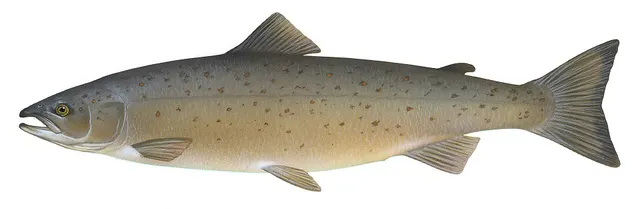 Atlantic salmonAn anadromous salmonid that migrates from its natal river to the North Atlantic and returns to spawn — and a species in serious, well-documented decline.
Knepp, Timothy, Public domain, via Wikimedia Commons
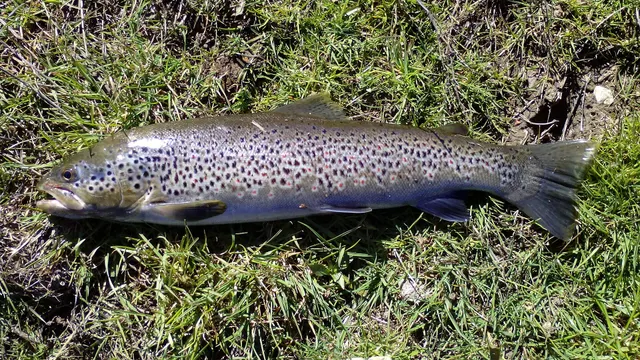 Brown troutA single, extraordinarily plastic species that appears as a tiny hill-stream fish, a deep-bodied loch trout and a silver sea-run migrant — all the same animal.
Robermix, CC0, via Wikimedia Commons
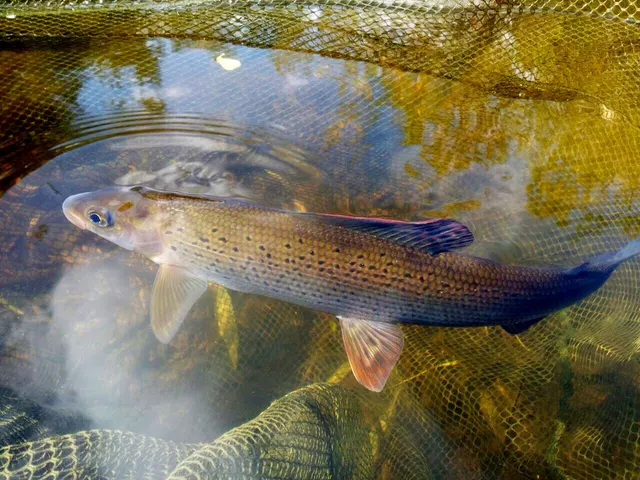 GraylingA salmonid with a sail for a dorsal fin that feeds hard through the winter — which makes it the game angler's season when the trout season has closed.
High Plains Grifter — CC BY-SA 4.0, via Wikimedia Commons
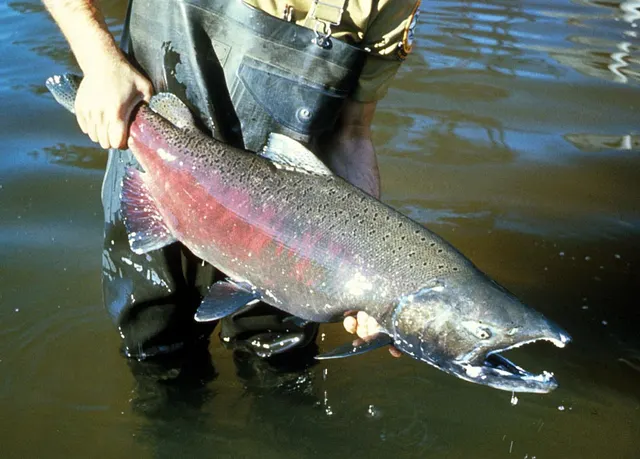 Chinook salmonThe largest Pacific salmon, reaching over sixty kilograms, and the one whose runs carry the most cultural and ecological weight on that coast.
U.S. Geological Survey — public domain, via Wikimedia Commons
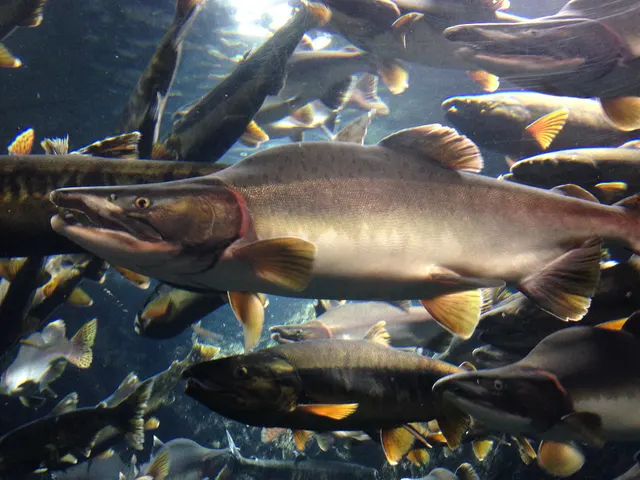 Pink salmonThe smallest and most abundant Pacific salmon, running on a strict two-year cycle, and the male developing a pronounced hump at spawning.
Totti — CC BY-SA 4.0, via Wikimedia Commons
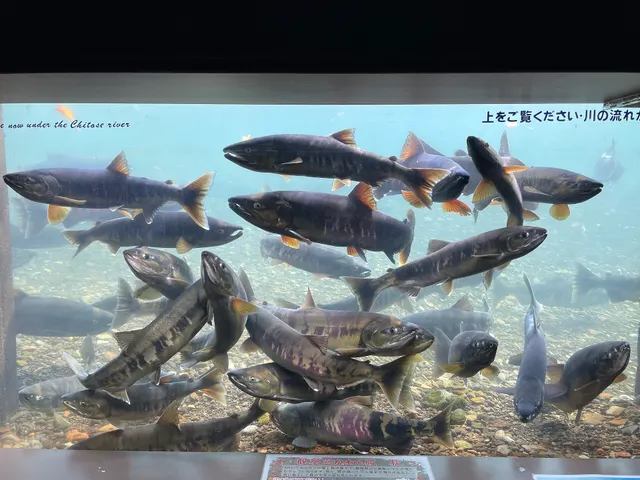 Chum salmonA large Pacific salmon without body spotting, developing striking purple calico bars and enlarged canine teeth at spawning, and the widest-ranging of its genus.
Totti — CC BY-SA 4.0, via Wikimedia Commons
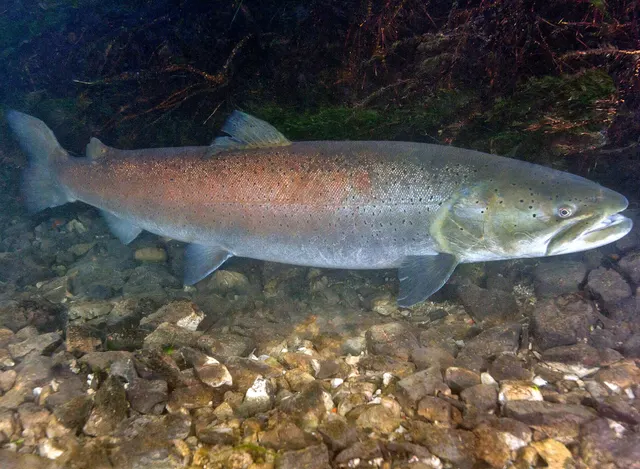 HuchenA very large predatory salmonid of the Danube basin, entirely freshwater, endangered through damming and habitat loss, and fished almost exclusively on a release basis.
Liquid Art — CC BY-SA 4.0, via Wikimedia Commons
Safety
Drowning and immersion — Can cause serious injury or death
A spate river can rise while you are standing in it. Rain falling on high ground a long way upstream produces a rise at your feet hours later under a clear sky, and a wading route that was safe on the way out is not on the way back. Fast water around boulders is uneven and concentrates unpredictably, and a fall in cold pushy water is difficult to recover from.
What reduces it: Check the upstream forecast and the gauge before wading, not just the sky above you. Fix an exit before you commit, and re-check the level against a fixed mark on the bank. Wear a wading belt, carry a staff, and treat a rising level as a reason to get out immediately rather than to fish faster. In a strong current, not wading is a legitimate answer.
Slips, trips and falls — Can cause serious injury or death
Wet bedrock, algae-covered cobble and unstable boulders in fast water, frequently in a steep-sided valley where a fall means a long way down before the water.
What reduces it: Studded or felted soles chosen for the bed you are on, a wading staff used as a third point of contact, and a route planned rather than improvised. Move one foot at a time and do not turn in the current with the feet together.
Hypothermia — Can cause injury needing treatment
Upland catchments are cold, wet and exposed, and a long day standing in cold water in the rain removes body heat steadily. Judgement degrades before the person notices, which is what makes it dangerous in combination with wading.
What reduces it: Layer for the water rather than the air, carry more insulation than the forecast suggests, eat, and set a time to come off.
Fishing alone — Can cause injury needing treatment
Much spate-river fishing is solitary, in valleys with no mobile coverage, a long walk from a road.
What reduces it: Tell somebody the beat and the expected return time. Carry a means of calling for help that does not depend on coverage where it matters, and allow for the walk out being slower than the walk in.
Precautions that always apply here
- Tell somebody where you are going and when you expect to be back.
- Carry a charged phone in a waterproof case, or another means of calling for help.
- Do not wade alone. Judge depth and flow from the bank first, and turn back sooner than feels necessary.
- Check, clean and dry your kit between different waters — the published guidance is 48 hours’ drying, in sunlight where possible, because a number of invasive species survive over two weeks in damp conditions. Nets, boots and wet mats move invasive species and disease more effectively than anything else anglers do.
- Tell somebody where you are going and when you expect to be back.
Further safety reading
- Wading safely — A spate river can rise while you are standing in it. Rain on high ground a long way upstream produces a rise at your feet hours later under a clear sky, so a wading route that was safe on the way out is not on the way back. The upstream gauge matters more than the sky overhead.
Check the rules before you fish
Fishing laws, bylaws, access rules, seasons, bait restrictions and permitted methods vary by location and can change. Check the current rules from the relevant authority and the water you intend to fish before fishing.
Check with:
- Current national or regional law for where you are fishing
- Current local bylaws
- The relevant fisheries authority
- The landowner, club or fishery whose water it is
- Any restrictions specific to the species or the method you intend to use
Where to go next
Fish found here
- Atlantic salmonSpawns and rears in clean coarse gravel in rain-fed rivers, and depends on floods to pass shallow reaches on the upstream migration. The great majority of Atlantic salmon rivers are spate rivers rather than spring-fed ones.
- Brown troutResident brown trout populate spate rivers throughout their range, typically numerous and small because the water is nutrient-poor; the sea-run form uses the same rivers and the same flood cycle as salmon.
- Chinook salmonUses rain-fed and snowmelt rivers across its Pacific range, spawning in coarse gravel and depending on flow events to reach it.
- Chum salmonSpawns in the lower reaches of rain-fed rivers, frequently in areas of upwelling groundwater within the gravel, and depends on autumn flows to enter them.
- Coho salmonSpawns in small rain-fed coastal streams and tributaries, and juveniles rear in them for a year or more before going to sea — which makes the smallest headwaters disproportionately important to the fishery.
- GraylingOccupies the clean gravel runs and glides of many temperate spate rivers, where the coarse well-oxygenated bed suits it, though it is absent from the most acid catchments.
- HuchenA large riverine salmonid of fast, cold, well-oxygenated Danube-basin rivers, dependent on coarse gravel for spawning and on connected river length for its movements.
- Pink salmonSpawns in the lower reaches of rain-fed coastal rivers, often close to tidewater, with fry going to sea almost immediately after emergence.
1 more
- Sooty grunter Fish
Reading this water
- Mending line, and what it is forThe harder case, and it changes what a mend is for. In heavy, uneven, rain-fed flow the belly forms fast and the useful drift is short, so mending becomes a way of buying a few metres of dead drift rather than of maintaining one indefinitely.
- River levels, and what a flood changesThe flood is not weather that interrupts the fishing — it is the mechanism the fishery runs on. It moves migratory fish upstream past shallows they could not otherwise pass, redistributes them through reaches that were empty, scours the spawning gravel clean, and then falls away leaving the few days anglers mean when they say the river is right.
- Spey and two-handed casting conceptsThe water that shaped the cast. Big, cold, rain-fed rivers with wooded or steep banks and a requirement to cover water methodically — the physical constraints that made a water-anchored roll cast a system rather than a trick.
Sources and evidence
- Freshwater Fishes of the British Isles — HarperCollins (New Naturalist 75), 1992 (Reference work)Relied on for: Habitat character, thermal and chemical behaviour, and the fish communities associated with the freshwater environments described.States this directlyCitation checked — the work exists and is described correctly
- Environment Agency fisheries management, byelaws and rod licensing information — Environment Agency (Government fisheries body)Relied on for: That freshwater fisheries are managed under a licensing framework and that access, close seasons and stocking are regulated activities that differ between water types and jurisdictions.Background and mechanism onlyCitation checked — the work exists and is described correctly
- General angling website restatements of established technique — Various (Credible secondary source)Relied on for: That the practical angling patterns described — fishing a spate river on a falling flow, working depth over a summer thermocline, reading a tailwater's generation schedule — are widely restated practitioner knowledge rather than measured findings.Background and mechanism onlyCitation checked — the work exists and is described correctly
Why the 13 connections on this page are here, and the sources
Fish found here
Backed by research — 9 connections
Supported by peer-reviewed research or fisheries science. The sources are listed and can be checked.
Atlantic salmon
A claim that the species uses rain-fed rivers on impermeable geology, resting on documented distribution and spawning habitat rather than on angling report.
- Freshwater Fishes of the British Isles — HarperCollins (New Naturalist 75), 1992 (Reference work)Relied on for: Distribution, habitat association, thermal requirements and life history of the freshwater fishes of the British Isles and north-west Europe.States this directlyCitation checked — the work exists and is described correctly
- FishBase: a global information system on fishes — Froese, R. and D. Pauly, eds. — FishBase Consortium (Scientific institute)Relied on for: Recorded depth range, temperature tolerance and habitat association for the species.States this directlyPassage read and verified
Brown trout
A claim that the species uses rain-fed rivers on impermeable geology, resting on documented distribution and spawning habitat rather than on angling report.
- Freshwater Fishes of the British Isles — HarperCollins (New Naturalist 75), 1992 (Reference work)Relied on for: Distribution, habitat association, thermal requirements and life history of the freshwater fishes of the British Isles and north-west Europe.States this directlyCitation checked — the work exists and is described correctly
- FishBase: a global information system on fishes — Froese, R. and D. Pauly, eds. — FishBase Consortium (Scientific institute)Relied on for: Recorded depth range, temperature tolerance and habitat association for the species.States this directlyPassage read and verified
Chinook salmon
A claim that the species uses rain-fed rivers on impermeable geology, resting on documented distribution and spawning habitat rather than on angling report.
- FishBase: a global information system on fishes — Froese, R. and D. Pauly, eds. — FishBase Consortium (Scientific institute)Relied on for: Recorded depth range, temperature tolerance and habitat association for the species outside north-west Europe.States this directlyPassage read and verified
- The IUCN Red List of Threatened Species — International Union for Conservation of Nature (Conservation authority)Relied on for: Global conservation assessment, range and recorded threats for the species.States this directlyCitation checked — the work exists and is described correctly
Chum salmon
A claim that the species uses rain-fed rivers on impermeable geology, resting on documented distribution and spawning habitat rather than on angling report.
- FishBase: a global information system on fishes — Froese, R. and D. Pauly, eds. — FishBase Consortium (Scientific institute)Relied on for: Recorded depth range, temperature tolerance and habitat association for the species outside north-west Europe.States this directlyPassage read and verified
- The IUCN Red List of Threatened Species — International Union for Conservation of Nature (Conservation authority)Relied on for: Global conservation assessment, range and recorded threats for the species.States this directlyCitation checked — the work exists and is described correctly
Coho salmon
A claim that the species uses rain-fed rivers on impermeable geology, resting on documented distribution and spawning habitat rather than on angling report.
- FishBase: a global information system on fishes — Froese, R. and D. Pauly, eds. — FishBase Consortium (Scientific institute)Relied on for: Recorded depth range, temperature tolerance and habitat association for the species outside north-west Europe.States this directlyPassage read and verified
- The IUCN Red List of Threatened Species — International Union for Conservation of Nature (Conservation authority)Relied on for: Global conservation assessment, range and recorded threats for the species.States this directlyCitation checked — the work exists and is described correctly
Grayling
A claim that the species uses rain-fed rivers on impermeable geology, resting on documented distribution and spawning habitat rather than on angling report.
- Freshwater Fishes of the British Isles — HarperCollins (New Naturalist 75), 1992 (Reference work)Relied on for: Distribution, habitat association, thermal requirements and life history of the freshwater fishes of the British Isles and north-west Europe.States this directlyCitation checked — the work exists and is described correctly
- FishBase: a global information system on fishes — Froese, R. and D. Pauly, eds. — FishBase Consortium (Scientific institute)Relied on for: Recorded depth range, temperature tolerance and habitat association for the species.States this directlyPassage read and verified
Huchen
A claim that the species uses rain-fed rivers on impermeable geology, resting on documented distribution and spawning habitat rather than on angling report.
- Freshwater Fishes of the British Isles — HarperCollins (New Naturalist 75), 1992 (Reference work)Relied on for: Distribution, habitat association, thermal requirements and life history of the freshwater fishes of the British Isles and north-west Europe.States this directlyCitation checked — the work exists and is described correctly
- FishBase: a global information system on fishes — Froese, R. and D. Pauly, eds. — FishBase Consortium (Scientific institute)Relied on for: Recorded depth range, temperature tolerance and habitat association for the species.States this directlyPassage read and verified
Pink salmon
A claim that the species uses rain-fed rivers on impermeable geology, resting on documented distribution and spawning habitat rather than on angling report.
- FishBase: a global information system on fishes — Froese, R. and D. Pauly, eds. — FishBase Consortium (Scientific institute)Relied on for: Recorded depth range, temperature tolerance and habitat association for the species outside north-west Europe.States this directlyPassage read and verified
- The IUCN Red List of Threatened Species — International Union for Conservation of Nature (Conservation authority)Relied on for: Global conservation assessment, range and recorded threats for the species.States this directlyCitation checked — the work exists and is described correctly
Sooty grunter
Recorded as a freshwater benthopelagic fish of tropical rivers at about 25 to 30 °C, endemic to northern Australia from the Daly River to the upper Burdekin — river systems defined by monsoonal flow.
- FishBase: a global information system on fishes — Froese, R. and D. Pauly, eds. — FishBase Consortium (Scientific institute)Relied on for: Environment, depth range, habitat association and distribution for Hephaestus fuliginosus.States this directlyPassage read and verified
Reading this water
What experienced anglers do — 2 connections
Widely and independently recommended by experienced anglers and specialist sources. This is real angling knowledge, not proof: controlled evidence for it is limited, and FishingHQ records it as convention rather than as a demonstrated effect.
Mending line, and what it is for
A fish or a water joined to the fly-fishing mechanism it is a worked example of, written only where the subject's own behaviour or physical character is what this page explains. The direction is the one FishingHQ writes this kind of connection in, and the one it already uses 176 times, and it is also the semantically correct one: the mechanism explains the fish, not the reverse.
- Still Water Fly-Fishing — Andre Deutsch, 1952 (Specialist angling publication)Relied on for: Stillwater fly practice: line density and depth, leader construction, fly selection against the food present, and the behaviour of stocked and wild trout in still water.States this directlyCitation checked — the work exists and is described correctly
- Trout & Salmon — Bauer Media (Specialist angling publication)Relied on for: Long-running published description of British game angling practice: river and stillwater trout, grayling and salmon fishing, and the presentation each demands.States this directlyCitation checked — the work exists and is described correctly
Spey and two-handed casting concepts
A fish or a water joined to the fly-fishing mechanism it is a worked example of, written only where the subject's own behaviour or physical character is what this page explains. The direction is the one FishingHQ writes this kind of connection in, and the one it already uses 176 times, and it is also the semantically correct one: the mechanism explains the fish, not the reverse.
- Still Water Fly-Fishing — Andre Deutsch, 1952 (Specialist angling publication)Relied on for: Stillwater fly practice: line density and depth, leader construction, fly selection against the food present, and the behaviour of stocked and wild trout in still water.States this directlyCitation checked — the work exists and is described correctly
- Trout & Salmon — Bauer Media (Specialist angling publication)Relied on for: Long-running published description of British game angling practice: river and stillwater trout, grayling and salmon fishing, and the presentation each demands.States this directlyCitation checked — the work exists and is described correctly
Backed by research — 1 connection
Supported by peer-reviewed research or fisheries science. The sources are listed and can be checked.
River levels, and what a flood changes
A link from a water type to the physical mechanism that governs it, which is a claim about limnology rather than about fishing.
- Freshwater Fishes of the British Isles — HarperCollins (New Naturalist 75), 1992 (Reference work)Relied on for: Distribution, habitat association, thermal requirements and life history of the freshwater fishes of the British Isles and north-west Europe.States this directlyCitation checked — the work exists and is described correctly
- FishBase: a global information system on fishes — Froese, R. and D. Pauly, eds. — FishBase Consortium (Scientific institute)Relied on for: Recorded depth range, temperature tolerance and habitat association for the species.States this directlyPassage read and verified
Safety reading
Official guidance — 1 connection
Stated by a fisheries authority, scientific institute or recognised angling body. Authoritative, but summarising rather than demonstrating.
Wading safely
A statement that a water type presents a particular hazard, resting on water-safety guidance issued by bodies with responsibility for it rather than on angling practice.
- RNLI water safety guidance: cold water shock and Float to Live — Royal National Lifeboat Institution (Water-safety or diver-training authority)Relied on for: Water-safety guidance on cold water shock, immersion, and the behaviour of moving and rising water.States this directlyPassage read and verified
- RoSPA water safety information and UK accidental drowning statistics — Royal Society for the Prevention of Accidents (Water-safety or diver-training authority)Relied on for: Guidance on inland and coastal water safety, including wading, sudden level change and the hazards of engineered structures.States this directlyPassage read and verified
How FishingHQ labels evidence is explained in the evidence policy.