Stillwater fly fishing
Method · Last reviewed 2026-08-10
Fly fishing without current, where the angler supplies every movement and the problem becomes finding fish rather than presenting to them.
Remove the current and fly fishing changes character completely. There is no drift to manage and no drag to fight; instead, everything the fly does must be supplied by the angler, and the fish are not holding in readable positions but moving.
That makes stillwater fly fishing a location problem first. Fish patrol, following food, wind-driven surface currents and temperature, and a fly in the wrong part of a reservoir is not a presentation error but an absence. Reading wind lanes, depth changes and the direction of the ripple does more here than fly choice does.
The second characteristic is depth control by line rather than by fly. A team of flies on a floating line fishes the top metre; the same flies on an intermediate or a fast sinker fish four metres down. Changing line changes everything, which is why stillwater anglers carry spare spools rather than more patterns.
Buzzer fishing — imitating midge pupae hanging in or just under the surface film — is the method's defining technique, because chironomid pupae are the dominant trout food in most reservoirs.
What it is
Fly fishing on lakes, lochs and reservoirs, from bank or boat, where there is no current to carry the fly and every bit of movement it makes is supplied by the angler. Depth is controlled by the density of the fly line and by how long it is allowed to sink, rather than by weight on the leader or by a drift. A team of two or three flies is normal rather than exceptional, which is itself a consequence of having no current: with nothing to carry a single fly through the water, the angler covers more of it by fishing several at once at slightly different depths.
What it is for
To find and catch fish in water where they are moving rather than holding, and where the productive depth may be anywhere between the surface film and several metres down. That is a genuinely different problem from river fishing and it is worth being blunt about which way round it is: on a river the fish are where the current puts them and the difficulty is the presentation; on a stillwater the presentation is comparatively simple and the difficulty is that the fish are somewhere in four hundred acres. Almost everything a good stillwater angler does — reading wind lanes, counting a line down, working a bank in one direction — is about narrowing that down.
Setting it up
- Find the fish before refining the fly. Wind lanes, depth changes and inflows concentrate food and therefore fish.
- Count the line down and remember the count — depth is the variable you are actually searching.
- Fish into the wind where you can bear to; the food and the fish are usually on the windward side.
- Vary the retrieve systematically rather than randomly, and repeat whatever produced a take.
- Change line density before changing flies. Depth beats pattern.
What it catches
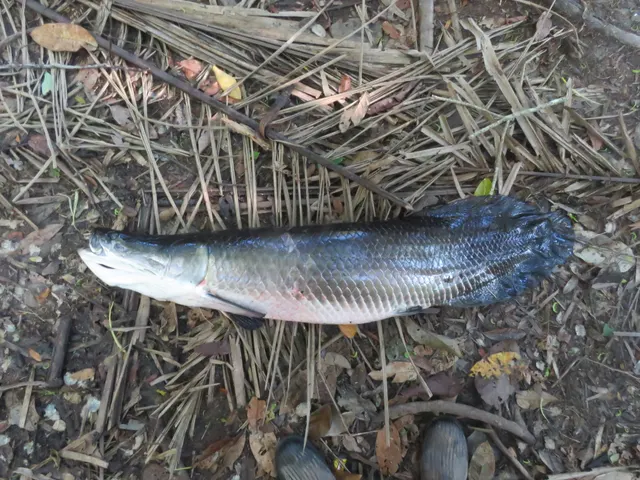 ArapaimaVery large flies and lures in managed floodplain fisheries, handled in the water.
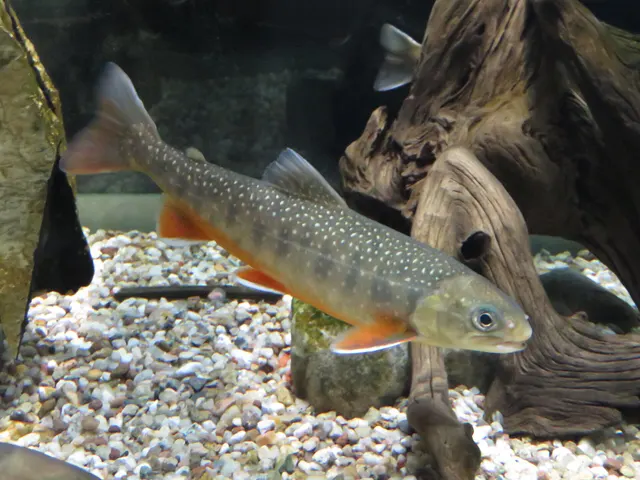 Arctic charFlies, small spoons and trolled lures, fished deep in summer and shallow at the margins of the season.
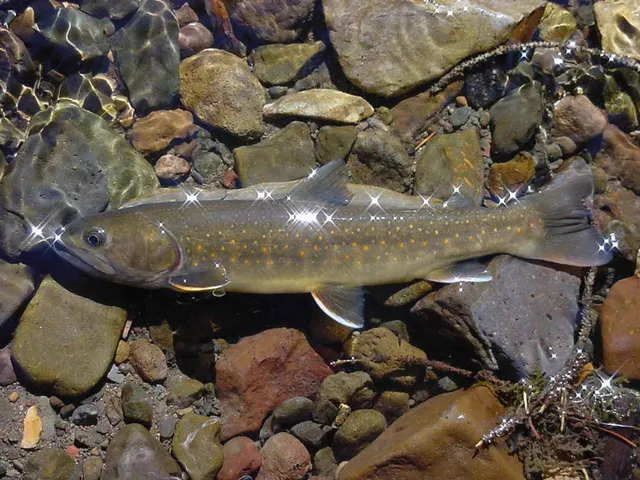 Bull troutStreamers and lures worked in deep pools and around log jams where fishing is permitted.
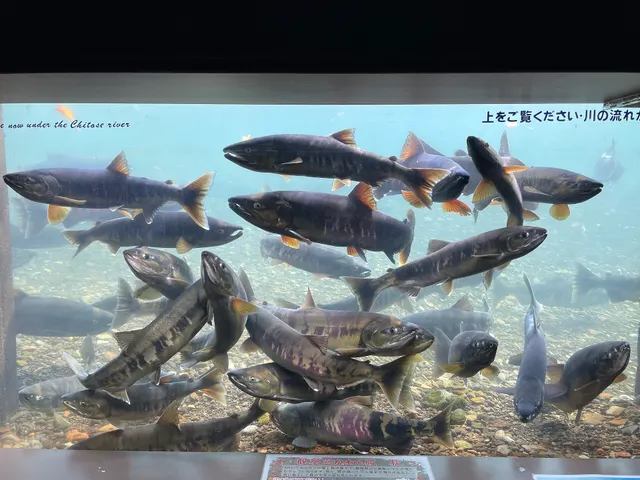 Chum salmonFlies and jigs in rivers and estuaries, valued for the strength of the fight.
- Largemouth yellowfishLarge streamers and lures — south africa's premier freshwater fly target.
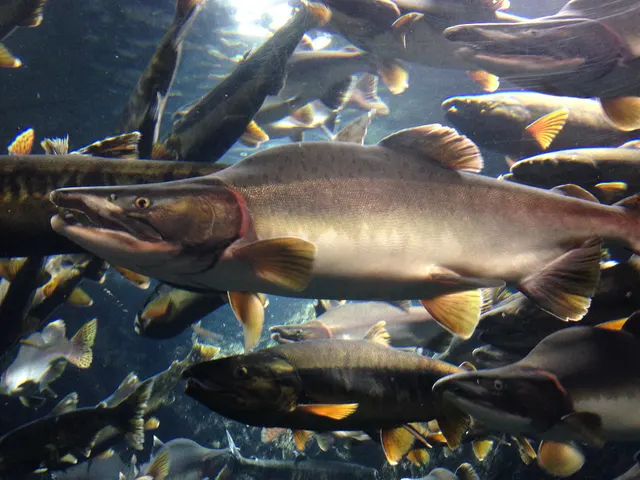 Pink salmonSmall spoons and flies in rivers and estuaries during the run.
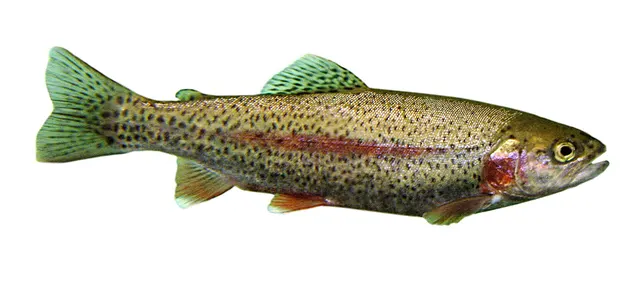 Rainbow troutThe reservoir and small-fishery method the species is stocked for. Rainbows cruise open water rather than holding stations, so the fly is fished to a moving fish at a controlled depth rather than to a lie.
- TaimenVery large streamers, mouse patterns and lures, on strict catch-and-release.
What you fish it with
- Double surgeon's knotUsed both for tippet and for building the dropper sections of a leader carrying a team of flies, where several joins of stepped diameter are made in one leader.
- Dropper loopA team of wet flies is built the same way as a sea trace and by the same knot — point fly at the end, droppers above it — which is one of the few structural things stillwater fly and shore sea fishing genuinely share.
- Dry fliesThe surface half of the same day, when a hatch brings fish up.
- Loop-to-loop connectionFly line to leader, made once and remade rarely, and the join that has to pass through the rings without catching. The loop-to-loop is the connection FishingHQ records for fly line and backing.
- NymphsBuzzers and nymphs fished slow and deep, which is most stillwater fly fishing most of the year.
- StreamersLures and fry patterns pulled rather than drifted, for fish that are eating fish.
How it works
A cast is made, the line is allowed to sink for a counted period, and the flies are retrieved at a chosen speed. Because there is no current, the count-down and the retrieve together define the depth and the path — which means both must be repeatable, or a successful combination cannot be found again. Takes are usually felt directly, since the line is under tension throughout.
Conditions
A ripple beats a flat calm comfortably: it breaks up the surface, reduces the fish's view of the angler, and drives the surface currents that concentrate food. Overcast conditions extend the productive period; bright still days push fish deep and make fine leaders necessary. Wind direction decides where the food accumulates, which is why the uncomfortable bank is frequently the productive one. Cold water slows everything and argues for a slower retrieve rather than a different fly.
Common mistakes
- Changing flies when the problem is depth. Change the line first.
- Not counting the line down, so a successful depth cannot be found again.
- Fishing with the wind at your back for comfort, away from where the food has gone.
- Retrieving at one speed all day rather than searching systematically.
- Striking on a felt take rather than tightening — a stillwater take is usually already a hooked fish.
Advantages
- Fishable year-round and unaffected by river levels.
- The whole water column is accessible by changing line, not tackle.
- Suits both bank and boat, with quite different approaches from each.
- Excellent for learning retrieve control, because the angler supplies all the movement.
Limitations
- Location is genuinely hard, and a large reservoir gives very little away.
- Wind dominates: it decides which bank is fishable and where the food has gone, and those are frequently opposite.
- Without current there is no natural movement, so a poor retrieve produces nothing at all.
- Fishing blind for long periods is demoralising in a way that river fishing rarely is.
Terms you will meet
- Counting down
- Letting the line sink for a counted number of seconds before retrieving, so the depth being fished is a number that can be repeated. Without it, a productive depth is found by accident and lost the same way.
- Buzzer
- An imitation of a chironomid midge pupa hanging in or just under the surface film. Chironomids are the dominant trout food in most reservoirs, which makes this the defining stillwater pattern rather than one among many.
- Wind lane
- A smooth stripe of calmer water running downwind, where surface currents converge and concentrate drifting food. Fish patrol them, and finding one is worth more than any fly change.
- Loch style
- Fishing a team of flies on a floating or intermediate line from a boat drifting broadside to the wind, casting a short line downwind ahead of the drift. The traditional Scottish and Irish method and still the basis of competition fishing.
- Washing line
- A team suspended between a buoyant fly at the point and a buoyant or floating-line anchor, so the middle flies hang horizontally just under the surface rather than sinking. A way of holding small imitative patterns exactly in the film.
Where people fish it
55 places FishingHQ holds name this among the ways they are fished, across 15 coasts and systems. Being named here describes what sources report, not that the method is permitted — check the local rules before you fish.
Eela Water, Loch of Asta, Loch of Benston, Loch of Clousta and 12 more
Bewl Water, Blagdon Lake, Carsington Water, Chew Valley Lake and 7 more
Loch Assynt, Loch Awe, Loch Earn, Loch Leven and 5 more
Kielder Water, Llyn Brenig, Llyn Clywedog, Llyn Tegid and 1 more
The Endrick Bank, The mouth of the Endrick Water
Llyn Alaw
Þingvallavatn
7 further coasts and systems are not listed here. Browse every place FishingHQ holds.
Where to go next
Related techniques
Skills behind it
- Presentation and dragWith no current to work with, presentation in still water is entirely a matter of depth, speed and the shape of the retrieve.
- Choosing a fly line, a leader and a fly for the water in front of youWhere the spine's first question — where in the water column — has no current to answer it, so the line does the searching.
- Floating, sinking and intermediate fly linesStillwater fly fishing is where counting a sinking line down turns depth from a guess into something reproducible, and the method depends on the distinction.
- The four fly types, and what each imitatesThe method that uses all four most evenly through a season, from buzzer fishing in the film to a streamer pulled fast in cold water, and the one where committing to a single approach costs the most.
- Thermoclines and stratificationThe condition that decides which part of the water is worth fishing. A stratified summer lake can have a deep layer with no oxygen in it, so casting a fast sinker into it is fishing water that holds nothing — the productive band is above the boundary and moves through the season.
- Wind, and where it puts the foodOn a stillwater the wind makes the current: it drives a surface drift that concentrates food along a lee shore and into wind lanes, and fishing the ripple rather than the flat is the standing instruction that follows from it.
Sources and evidence
Why the 21 connections on this page are here, and the sources
What it catches
What experienced anglers do — 8 connections
Widely and independently recommended by experienced anglers and specialist sources. This is real angling knowledge, not proof: controlled evidence for it is limited, and FishingHQ records it as convention rather than as a demonstrated effect.
Arapaima
A practitioner claim about how Arapaima gigas is commonly fished, following from where and how it feeds.
- General angling website restatements of established technique — Various (Credible secondary source)Relied on for: Widely restated practitioner accounts of fishing for arapaima.Citation checked — the work exists and is described correctly
- Sea Angler — Bauer Media (Specialist angling publication)Relied on for: Practitioner treatment of the methods used for arapaima and comparable species.Citation checked — the work exists and is described correctly
Arctic char
A practitioner claim about how Salvelinus alpinus is commonly fished, following from where and how it feeds.
- General angling website restatements of established technique — Various (Credible secondary source)Relied on for: Widely restated practitioner accounts of fishing for arctic char.Citation checked — the work exists and is described correctly
- Sea Angler — Bauer Media (Specialist angling publication)Relied on for: Practitioner treatment of the methods used for arctic char and comparable species.Citation checked — the work exists and is described correctly
Bull trout
A practitioner claim about how Salvelinus confluentus is commonly fished, following from where and how it feeds.
- General angling website restatements of established technique — Various (Credible secondary source)Relied on for: Widely restated practitioner accounts of fishing for bull trout.Citation checked — the work exists and is described correctly
- Sea Angler — Bauer Media (Specialist angling publication)Relied on for: Practitioner treatment of the methods used for bull trout and comparable species.Citation checked — the work exists and is described correctly
Chum salmon
A practitioner claim about how Oncorhynchus keta is commonly fished, following from where and how it feeds.
- General angling website restatements of established technique — Various (Credible secondary source)Relied on for: Widely restated practitioner accounts of fishing for chum salmon.Citation checked — the work exists and is described correctly
- Sea Angler — Bauer Media (Specialist angling publication)Relied on for: Practitioner treatment of the methods used for chum salmon and comparable species.Citation checked — the work exists and is described correctly
Largemouth yellowfish
A practitioner claim about how Labeobarbus kimberleyensis is commonly fished, following from where and how it feeds.
- General angling website restatements of established technique — Various (Credible secondary source)Relied on for: Widely restated practitioner accounts of fishing for largemouth yellowfish.Citation checked — the work exists and is described correctly
- Sea Angler — Bauer Media (Specialist angling publication)Relied on for: Practitioner treatment of the methods used for largemouth yellowfish and comparable species.Citation checked — the work exists and is described correctly
Pink salmon
A practitioner claim about how Oncorhynchus gorbuscha is commonly fished, following from where and how it feeds.
- General angling website restatements of established technique — Various (Credible secondary source)Relied on for: Widely restated practitioner accounts of fishing for pink salmon.Citation checked — the work exists and is described correctly
- Sea Angler — Bauer Media (Specialist angling publication)Relied on for: Practitioner treatment of the methods used for pink salmon and comparable species.Citation checked — the work exists and is described correctly
Rainbow trout
Established angling practice for this species, recorded as convention. The note states the property of the animal or its water that makes the method the answer.
- Still Water Fly-Fishing — Andre Deutsch, 1952 (Specialist angling publication)Relied on for: Still-water fly technique and the feeding behaviour it is built on.States this directlyCitation checked — the work exists and is described correctly
- Trout & Salmon — Bauer Media (Specialist angling publication)Relied on for: Contemporary still-water fly practice.Background and mechanism onlyCitation checked — the work exists and is described correctly
Taimen
A practitioner claim about how Hucho taimen is commonly fished, following from where and how it feeds.
- General angling website restatements of established technique — Various (Credible secondary source)Relied on for: Widely restated practitioner accounts of fishing for taimen.Citation checked — the work exists and is described correctly
- Sea Angler — Bauer Media (Specialist angling publication)Relied on for: Practitioner treatment of the methods used for taimen and comparable species.Citation checked — the work exists and is described correctly
Related techniques
What experienced anglers do — 1 connection
Widely and independently recommended by experienced anglers and specialist sources. This is real angling knowledge, not proof: controlled evidence for it is limited, and FishingHQ records it as convention rather than as a demonstrated effect.
Fly fishing
The definitional relationship, with the mechanical difference that makes it a distinct method.
- Still Water Fly-Fishing — Andre Deutsch, 1952 (Specialist angling publication)Relied on for: Still-water fly fishing technique and the role of the retrieve.Citation checked — the work exists and is described correctly
- Trout & Salmon — Bauer Media (Specialist angling publication)Relied on for: Contemporary still-water fly technique.Citation checked — the work exists and is described correctly
What you fish it with
What experienced anglers do — 6 connections
Widely and independently recommended by experienced anglers and specialist sources. This is real angling knowledge, not proof: controlled evidence for it is limited, and FishingHQ records it as convention rather than as a demonstrated effect.
Double surgeon's knot
An arrangement joined to the knot that actually builds it, written where the knot is characteristic of that arrangement rather than merely possible in it. This is the edge a reader travels: they arrive looking for the arrangement and need the connection it depends on.
- Still Water Fly-Fishing — Andre Deutsch, 1952 (Specialist angling publication)Relied on for: Stillwater fly practice: leader construction, teams of flies on droppers, and the joins between backing, fly line, leader and tippet.States this directlyCitation checked — the work exists and is described correctly
- Trout & Salmon — Bauer Media (Specialist angling publication)Relied on for: British game angling practice, including leader and tippet construction and the fly-line connections it rests on.States this directlyCitation checked — the work exists and is described correctly
- Freshwater Fishing — Macdonald & Jane's, 1975 (Specialist angling publication)Relied on for: Comprehensive angling practice: reel filling, leader and dropper construction, and the connections each arrangement rests on.States this directlyCitation checked — the work exists and is described correctly
- Coarse Fishing — A. & C. Black, 1912 (Specialist angling publication)Relied on for: Classical coarse angling practice: hooklengths, loops, droppers and the terminal arrangements built from them.States this directlyCitation checked — the work exists and is described correctly
Dropper loop
An arrangement joined to the knot that actually builds it, written where the knot is characteristic of that arrangement rather than merely possible in it. This is the edge a reader travels: they arrive looking for the arrangement and need the connection it depends on.
- Still Water Fly-Fishing — Andre Deutsch, 1952 (Specialist angling publication)Relied on for: Stillwater fly practice: leader construction, teams of flies on droppers, and the joins between backing, fly line, leader and tippet.States this directlyCitation checked — the work exists and is described correctly
- Trout & Salmon — Bauer Media (Specialist angling publication)Relied on for: British game angling practice, including leader and tippet construction and the fly-line connections it rests on.States this directlyCitation checked — the work exists and is described correctly
- Freshwater Fishing — Macdonald & Jane's, 1975 (Specialist angling publication)Relied on for: Comprehensive angling practice: reel filling, leader and dropper construction, and the connections each arrangement rests on.States this directlyCitation checked — the work exists and is described correctly
- Coarse Fishing — A. & C. Black, 1912 (Specialist angling publication)Relied on for: Classical coarse angling practice: hooklengths, loops, droppers and the terminal arrangements built from them.States this directlyCitation checked — the work exists and is described correctly
Dry flies
Stillwater fly fishing changes register completely during a hatch, and the dry fly is what it changes to. Both records treat that transition as part of the same outing rather than as different fishing.
- Still Water Fly-Fishing — Andre Deutsch, 1952 (Specialist angling publication)Relied on for: Specialist treatment of which bait or lure family this technique is fished with.States this directlyCitation checked — the work exists and is described correctly
- Trout & Salmon — Bauer Media (Specialist angling publication)Relied on for: The independently restated practitioner pairing of this technique with this family.Background and mechanism onlyCitation checked — the work exists and is described correctly
Loop-to-loop connection
Which knot a kind of fishing conventionally uses is established practitioner knowledge that converges across independent traditions and independent state agency guides, and it is labelled as consensus rather than as tested result. Nothing here ranks knots by strength: see `why-knot-strength-tables-disagree` for why that number does not exist.
- Still Water Fly-Fishing — Andre Deutsch, 1952 (Specialist angling publication)Relied on for: Stillwater fly practice including leader construction, droppers and the joins between line, leader and tippet.States this directlyCitation checked — the work exists and is described correctly
- Trout & Salmon — Bauer Media (Specialist angling publication)Relied on for: Long-running published description of British game angling practice, including leader and tippet construction.States this directlyCitation checked — the work exists and is described correctly
Nymphs
Ivens' subject is the imitative sunk fly on reservoirs, and the still-water page describes fishing depth by counting down. A nymph is the fly that technique was developed around.
- Still Water Fly-Fishing — Andre Deutsch, 1952 (Specialist angling publication)Relied on for: Specialist treatment of which bait or lure family this technique is fished with.States this directlyCitation checked — the work exists and is described correctly
- Trout & Salmon — Bauer Media (Specialist angling publication)Relied on for: The independently restated practitioner pairing of this technique with this family.Background and mechanism onlyCitation checked — the work exists and is described correctly
Streamers
The streamer page describes a fish imitation worked actively — fly fishing's answer to a soft plastic. On stillwaters that is a distinct fishery with its own season, rather than a substitution for a nymph.
- Still Water Fly-Fishing — Andre Deutsch, 1952 (Specialist angling publication)Relied on for: Specialist treatment of which bait or lure family this technique is fished with.States this directlyCitation checked — the work exists and is described correctly
- Trout & Salmon — Bauer Media (Specialist angling publication)Relied on for: The independently restated practitioner pairing of this technique with this family.Background and mechanism onlyCitation checked — the work exists and is described correctly
Skills behind it
What experienced anglers do — 6 connections
Widely and independently recommended by experienced anglers and specialist sources. This is real angling knowledge, not proof: controlled evidence for it is limited, and FishingHQ records it as convention rather than as a demonstrated effect.
Presentation and drag
Why it behaves as it does, and the reason the method and the idea behind it are explained separately.
- Still Water Fly-Fishing — Andre Deutsch, 1952 (Specialist angling publication)Relied on for: Depth and retrieve control in still-water presentation.Citation checked — the work exists and is described correctly
- Trout & Salmon — Bauer Media (Specialist angling publication)Relied on for: Contemporary treatment of retrieve and depth control.Citation checked — the work exists and is described correctly
The case where presentation means the opposite of what it means in a river.
- Still Water Fly-Fishing — Andre Deutsch, 1952 (Specialist angling publication)Relied on for: Stillwater fly fishing practice, including line choice for depth and the role of retrieve.States this directlyCitation checked — the work exists and is described correctly
- Freshwater Fishing — Macdonald & Jane's, 1975 (Specialist angling publication)Relied on for: Fly fishing tackle and presentation practice described independently of the stillwater tradition.States this directlyCitation checked — the work exists and is described correctly
Choosing a fly line, a leader and a fly for the water in front of you
The decision record joined to the disciplines and methods it orders, so that a reader arriving at any of them can reach the procedure rather than having to already know it exists. This is the shape `choosing-a-rig-for-the-conditions` established for rigs.
- Still Water Fly-Fishing — Andre Deutsch, 1952 (Specialist angling publication)Relied on for: Stillwater fly practice: line density and depth, leader construction, fly selection against the food present, and the behaviour of stocked and wild trout in still water.States this directlyCitation checked — the work exists and is described correctly
- Trout & Salmon — Bauer Media (Specialist angling publication)Relied on for: Long-running published description of British game angling practice: river and stillwater trout, grayling and salmon fishing, and the presentation each demands.States this directlyCitation checked — the work exists and is described correctly
- Sea Angler — Bauer Media (Specialist angling publication)Relied on for: British sea angling practice including shore fishing for bass, pollack and mullet, the ground each is found over and the presentation each takes.FishingHQ's interpretation of what it saysCitation checked — the work exists and is described correctly
- FAO Species Identification Guides for Fishery Purposes and the FAO Species Catalogues — Food and Agriculture Organization of the United Nations (Scientific institute)Relied on for: Distribution, habitat and feeding biology of coastal and tropical marine species, from regional identification guides prepared for fishery purposes.States this directlyCitation checked — the work exists and is described correctly
Floating, sinking and intermediate fly lines
Why it works, and what that rests on. Fly tackle and technique rest on established practitioner craft rather than on experiment, and the strength shown says so rather than borrowing an authority the subject does not have.
- Still Water Fly-Fishing — Andre Deutsch, 1952 (Specialist angling publication)Relied on for: Stillwater fly fishing technique, including line choice, depth control, retrieve and the imitation of stillwater food forms.States this directlyCitation checked — the work exists and is described correctly
- Freshwater Fishing — Macdonald & Jane's, 1975 (Specialist angling publication)Relied on for: Comprehensive freshwater angling practice including fly tackle, casting, presentation and the reasoning behind terminal tackle choices.States this directlyCitation checked — the work exists and is described correctly
The four fly types, and what each imitates
A fly technique joined to the mechanism it depends on. Ten fly concepts carried no edge to any method, which left the vertical's explainers and its techniques as two halves that could not be navigated between.
- Still Water Fly-Fishing — Andre Deutsch, 1952 (Specialist angling publication)Relied on for: Stillwater fly practice: line density and depth, leader construction, fly selection against the food present, and the behaviour of stocked and wild trout in still water.States this directlyCitation checked — the work exists and is described correctly
- Trout & Salmon — Bauer Media (Specialist angling publication)Relied on for: Long-running published description of British game angling practice: river and stillwater trout, grayling and salmon fishing, and the presentation each demands.States this directlyCitation checked — the work exists and is described correctly
- Sea Angler — Bauer Media (Specialist angling publication)Relied on for: British sea angling practice including shore fishing for bass, pollack and mullet, the ground each is found over and the presentation each takes.FishingHQ's interpretation of what it saysCitation checked — the work exists and is described correctly
- FAO Species Identification Guides for Fishery Purposes and the FAO Species Catalogues — Food and Agriculture Organization of the United Nations (Scientific institute)Relied on for: Distribution, habitat and feeding biology of coastal and tropical marine species, from regional identification guides prepared for fishery purposes.States this directlyCitation checked — the work exists and is described correctly
Thermoclines and stratification
Written only where the method's own conduct changes because of the condition — a different rig, depth, retrieve, or a decision to move or stop. Every condition is true of every method, so an edge that merely records that would distinguish nothing.
- Sea Angler — Bauer Media (Specialist angling publication)Relied on for: British sea angling practice: how tide, wind, swell and water clarity change where and how a mark is fished.FishingHQ's interpretation of what it saysCitation checked — the work exists and is described correctly
- Freshwater Fishing — Macdonald & Jane's, 1975 (Specialist angling publication)Relied on for: Comprehensive angling practice across disciplines, including water reading, seasonal condition and the tackle each demands.States this directlyCitation checked — the work exists and is described correctly
- FishBase: a global information system on fishes — Froese, R. and D. Pauly, eds. — FishBase Consortium (Scientific institute)Relied on for: Recorded environment, temperature and oxygen tolerance, depth range and behaviour of the species named.States this directlyPassage read and verified
- Freshwater Fishes of the British Isles — HarperCollins (New Naturalist 75), 1992 (Reference work)Relied on for: Life history, physiological tolerance and seasonal behaviour of European freshwater fishes.States this directlyCitation checked — the work exists and is described correctly
Wind, and where it puts the food
A link from a practice, an environment or a geography to the mechanism it rests on. It asserts that the mechanism is load-bearing here rather than merely relevant, which is the test applied throughout this file.
- Angling Times — Bauer Media (Specialist angling publication)Relied on for: Contemporary UK and European coarse, match and predator practice as reported by practitioners, including how conditions are read on the waters named.FishingHQ's interpretation of what it saysCitation checked — the work exists and is described correctly
- General angling website restatements of established technique — Various (Credible secondary source)Relied on for: Widely restated descriptions of how the condition named governs the practice named, recorded as practitioner consensus rather than as scholarship.Background and mechanism onlyCitation checked — the work exists and is described correctly
How FishingHQ labels evidence is explained in the evidence policy.