Rainbow trout
Fish · Last reviewed 2026-08-10
The most widely introduced sport fish on Earth — a Pacific salmonid now stocked on every continent except Antarctica, and the same species as the steelhead.
Safety: biosecurity and disease transfer — can cause serious injury or death. 5 more points apply here.
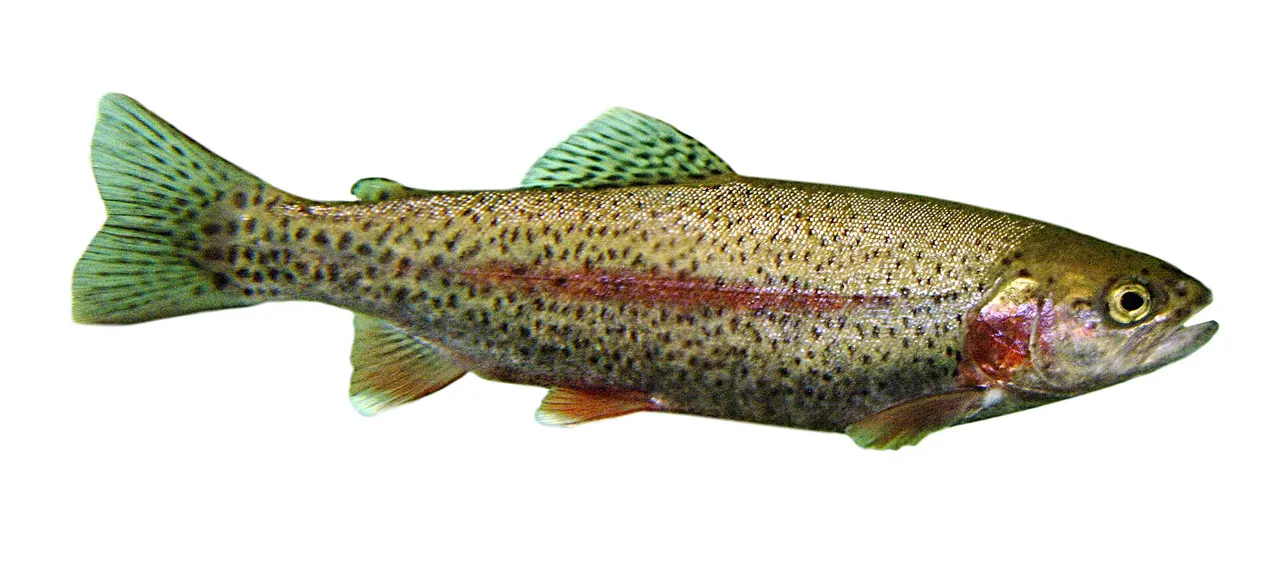
How this was identified, and who took it
Identified by: Complete lateral view with every diagnostic character legible: the broad pink to red lateral band, heavy black spotting extending onto the dorsal and caudal fins, the adipose fin, and the blunt salmonid head. Nothing is obscured and the fish is whole.Jonathunder — CC BY-SA 3.0, via Wikimedia Commons — source, licence
Catching Rainbow trout
Everything here on fishing for it. Each entry opens the page behind it.
- When
- Somewhere documents it in almost every month, so there is no season for the species as a whole — the season is a property of the ground, and each place states its own.
- Where
- 11 places FishingHQ documents — strongest claim anywhere: characteristic of this water · From a boat, From the shore, Fly fishing
The rainbow trout is native to the Pacific drainages of North America and eastern Asia, and it is now fished on every continent except Antarctica. No other sport fish has travelled so far or been stocked so widely, which makes it simultaneously the most accessible trout in the world and one of the most consequential introductions in fisheries history.
The fact that surprises most people is that the STEELHEAD is the same species. A rainbow trout that stays in fresh water for life and a steelhead that runs to sea and returns are Oncorhynchus mykiss in both cases; the difference is life history, not taxonomy, and populations can produce both from the same spawning. That single point resolves a great deal of confusion and is the reason FishingHQ models one species rather than two.
Its spread is the other half of the story. Introduced rainbow trout compete with and prey on native fish in a great many places, and in several — including parts of Australia, New Zealand, South America and southern Africa — they are simultaneously the basis of a valued fishery and a documented pressure on native species. Both things are true, and a guide that reports only the first is doing tourism.
How it is caught
- Float-tube fishingA float tube puts a fly angler afloat on a small stillwater with a draught of nothing and no wake, which reaches the open-water fish a bank angler cannot cover and does not push them the way a boat does.
- NymphingStillwater rainbows feed heavily on buzzer pupae and other subsurface invertebrates, and imitative nymph fishing at a set depth answers that directly.
- SpinningThe principal non-fly approach on stocked waters and on rivers where rainbows have naturalised, where fishery rules permit it.
- Stillwater fly fishingThe reservoir and small-fishery method the species is stocked for. Rainbows cruise open water rather than holding stations, so the fly is fished to a moving fish at a controlled depth rather than to a lie.
Gear for this fish
- Dry fliesRainbow trout rise freely and are the species most stillwater dry-fly fishing is conducted on, where the take is to a static or barely moving pattern on a surface the fish is cruising rather than holding in.
- NymphsStillwater rainbows feed heavily on buzzer pupae and other subsurface invertebrates, and imitative nymph fishing at a controlled depth is the most consistently productive approach in that water.
- SpinnersThe standard non-fly method on stocked stillwaters and on rivers where rainbows have naturalised, taken as a fleeing small fish.
- StreamersStocked and grown-on rainbows take a moving lure readily, and a streamer answers both the fish that is hunting fry and the fish that is simply chasing.
Where Rainbow trout is documented
Places where public sources describe this species as fished, with how it is fished and how strongly the evidence supports it. This is not a range map and it is not a recommendation — it is what has been written down about a fishery rather than a record of any individual catch, and being listed is never permission to fish.
The English trout reservoirs
7 documented places
Reservoir
Characteristic of this water
From a boat · From the shore · Fly fishing
Around Mar, Apr, May, Jun, Jul, Aug, Sept, Oct, Nov, Dec, Jan
Reservoir
Characteristic of this water
From the shore · From a boat · Fly fishing
Around Mar, Apr, May, Jun, Jul, Aug, Sept, Oct, Nov, Dec, Jan
Reservoir
Characteristic of this water
From the shore · From a boat · Fly fishing
Reservoir
Characteristic of this water
From the shore · From a boat · Fly fishing
Reservoir
Characteristic of this water
From the shore · Fly fishing
Reservoir
Characteristic of this water
From the shore · From a boat · Fly fishing
Reservoir
Characteristic of this water
From the shore · From a boat · Fly fishing
The Severn Estuary
1 documented place
Reservoir
Characteristic of this water
From the shore · From a boat · Fly fishing
England and Wales
1 documented place
Reservoir
Regular local target
From the shore · From a boat · Fly fishing
The Lake District lakes
1 documented place
Lake
Regular local target
From the shore · From a boat · Fly fishing
What these strengths mean
- Characteristic of this water
- This water is strongly identified with this species by the sources that cover it.
- Regular local target
- Fishing sources describe this as a normal local target here, not merely as caught.
Managed fisheries for rainbow trout
These are private businesses rather than public water: you pay for a day, and the fishery sets its own rules on top of whatever the law requires. That is the opposite of the section above, where the places are public geography and being listed is never permission to fish. Nothing here is a recommendation, the order is alphabetical, and no price or opening hour is carried because both change faster than this page does.
Blagdon Lake
Stocked trout stillwater · Blagdon, Somerset
A stillwater stocked with trout, fished on a ticket
The older and smaller of the two Somerset trout reservoirs, fly only, where carrying pike fly tackle is grounds for an immediate ban.
Stocked with this species. Also named here: Brown trout.
How you get a day: Day tickets on arrival, Book in advance.
The fishery’s own conditions: Fly only, No night fishing, Limited take, on the fishery's own terms.
Season: Open through the fly season, with the lodge issuing permits in the mornings.
The rules this fishery sets, in its own terms
- Only fly fishing, using traditional fly tackle, with one rod in use at a time. Bait, spinning, trolling and trailing are prohibited.
- Flies no larger than two inches, and no fly heavier than five grams.
- Leader strength must not exceed twenty-five pounds, and wire traces and armoured tippet are not permitted.
- Pike fly fishing is not permitted, and the operator states that carrying pike fly tackle here will result in an immediate ban.
- No brown trout may be taken, and all coarse fish must be returned.
- The dam, the bywash, the stream mouths at Butcombe and Ubley and the water in front of the top end bird hide are closed to fishing.
Checked against the operator's own information. Last checked 2026-08-29.
Chew Valley Lake
Stocked trout stillwater · Chew Stoke, Somerset
A stillwater stocked with trout, fished on a ticket
A large Somerset supply reservoir run as a fly-only trout fishery, and the one water in its operator's system where fishing for pike is permitted.
Stocked with this species. Also named here: Brown trout, Northern pike.
How you get a day: Book in advance, Day tickets on arrival.
The fishery’s own conditions: Fly fishing permitted, Lure fishing permitted, Bait fishing permitted, No night fishing, Limited take, on the fishery's own terms.
Season: Trout through the fly season; deadbait and lure pike fishing on published dates in February and from October to early December only.
The rules this fishery sets, in its own terms
- Only fly fishing, using traditional fly tackle, with one rod in use at a time. Bait, spinning, trolling and trailing are prohibited.
- No brown trout may be taken, and all coarse fish must be returned.
- Pike fly fishing is permitted here and at no other water the operator runs, on a ten-inch wire trace of forty-pound breaking strain.
- Deadbait and lure pike fishing runs only on published dates, booked as a boat for two anglers or a pair of bank permits.
- For pike: only one prong of a deadbait treble may carry a barb, all other hooks barbless, minimum twenty-pound mono or forty-pound braid, and a means of unhooking carried.
- Anglers must not wade deeper than the tops of thigh waders, and several stretches including the dam and the nature reserve are closed to fishing.
Checked against the operator's own information. Last checked 2026-08-29.
Lake of Menteith Fisheries
Stocked trout stillwater · Port of Menteith, Stirlingshire
A stillwater stocked with trout, fished on a ticket
Seven hundred acres of natural lake below the Trossachs, fished entirely from boats with the fly, stocked with trout reared on the fishery's own farm.
Stocked with this species. Also named here: Brown trout, Northern pike.
How you get a day: Book in advance.
The fishery’s own conditions: Fly only, Barbless hooks only, No night fishing, Limited take, on the fishery's own terms.
Season: Open through the fishing season seven days a week, with boats booked in advance for a session.
The rules this fishery sets, in its own terms
- Fly fishing only. No trolling, hand lining or bait.
- Barbless or debarbed hooks must be used when fishing catch and release.
- All fish under eleven inches to be returned.
- Above twenty degrees water temperature, the fishery asks anglers to limit catch and release to protect trout welfare.
- Pike fishing requires debarbed single hooks to a maximum size 6, and all pike are returned unharmed.
- Boat fishing only — a maximum of three people per boat, fifty metres between boats, no anchoring or mooring, and lifejackets or buoyancy aids worn.
Checked against the operator's own information. Last checked 2026-08-29.
Loch Insch Fishery
Stocked trout stillwater · Aberdeenshire
A stillwater stocked with trout, fished on a ticket
Two stocked fly lochs and a bait pond in thirty acres of Aberdeenshire countryside below Bennachie, open all year and run entirely as catch and release.
Stocked with this species. Also named here: Brown trout.
How you get a day: Day tickets on arrival.
The fishery’s own conditions: Fly fishing permitted, Bait fishing permitted, Barbless hooks only, Catch and release only.
Season: Open all year on the fishery's own account, from early morning until dusk.
The rules this fishery sets, in its own terms
- Barbless or de-barbed hooks only.
- Single flies only — boobies are not permitted.
- All fishing is catch and release.
- Fly on the two lochs; the pond is the bait water.
Checked against the operator's own information. Last checked 2026-08-29.
A fishery’s own conditions — barbless hooks, no keepnets, no night fishing — are conditions of that water and not law. The licences and close seasons a jurisdiction requires are a separate matter and are set out by the fisheries authority, never here. Telephone before travelling, and see every fishing business FishingHQ lists.
Identification
- Scientific name
- Oncorhynchus mykiss
- Family
- Salmonidae
- Water
- Freshwater, Brackish, Saltwater, Moves between fresh and salt water
- Conservation status
- Least Concern
- Regions
- North America, Western Europe, Britain & Ireland, Northern Europe, East Asia, Australia, New Zealand, East & Southern Africa, Central & South America, Global
- A broad pink to red band along the flank, strongest in freshwater residents and in spawning fish, and often almost absent in fresh-run sea-going individuals.
- Small black spots scattered over the back, the flanks AND the tail — spots on the tail are the quickest separation from brown trout, which generally has none there.
- Adipose fin present, as in all salmonids.
- No red spots anywhere, which separates it from brown trout at a glance.
- Sea-run fish are bright silver with the band suppressed; the tail spotting remains and is the reliable character.
Size
- Typical
- 0.5–1.5 kg (1–3 lb)
- Large
- 2.5–5 kg (5.5–11 lb)
Exceptional: Over 9 kg (20 lb); maximum published weight 25.9 kg
Cool oxygenated water, and a species that occupies whatever it is put in
Rainbow trout have a wider habitat tolerance than most salmonids, which is precisely why they have been introduced almost everywhere and why describing their habitat requires care.
THE CORE REQUIREMENT IS COOL, WELL-OXYGENATED WATER. Rainbow trout tolerate warmer temperatures than brook trout or bull trout and cooler ones than most warm-water species, occupying a broad middle band. Above their thermal limit they become stressed and stop feeding; the limit is higher than brown trout's in some respects and the difference decides which species dominates in a given river.
IN RIVERS THEY USE FASTER WATER THAN BROWN TROUT. Rainbows are typically found in riffles, runs and the heads of pools, holding in more broken water and feeding in the current, while brown trout occupy the slower, deeper, more structured lies. Where the two coexist that separation is consistent enough to be predictive.
IN LAKES THEY ARE OPEN-WATER FEEDERS, cruising rather than holding, and their distribution follows temperature and food rather than structure — which is why lake rainbow fishing is a searching exercise.
SPAWNING HABITAT IS CLEAN GRAVEL IN FLOWING WATER, and its absence is what makes many stocked populations non-self-sustaining.
THE STEELHEAD FORM USES THE SEA, and an anadromous rainbow occupies estuary and ocean habitat as an adult before returning to the same gravel. Same species, entirely different habitat for most of its life.
AND AS AN INTRODUCED FISH IT FREQUENTLY OCCUPIES HABITAT IT DID NOT EVOLVE FOR — reservoirs, tailwaters and stocked stillwaters — where its presence is a management decision rather than an ecological outcome.
Backed by research — why, and the sources (2)
Supported by peer-reviewed research or fisheries science. The sources are listed and can be checked.
- FishBase: a global information system on fishes — Froese, R. and D. Pauly, eds. — FishBase Consortium (Scientific institute)Relied on for: Distribution, habitat association, depth range, size, reproduction and life-history parameters recorded for the species.States this directlyPassage read and verified
- Freshwater Fishes of the British Isles — HarperCollins (New Naturalist 75), 1992 (Reference work)Relied on for: Distribution, habitat association, spawning requirements and ecology of European freshwater fishes.States this directlyCitation checked — the work exists and is described correctly
Spring redds, and why so many stocked populations never breed
Rainbow trout spawning is a spring gravel event, which distinguishes them from the autumn-spawning trout and char they usually share water with.
SPAWNING IS IN SPRING in most populations, triggered by rising water temperature and increasing daylight, and by rising flow where snowmelt is a factor. That is the opposite end of the year from brown trout and brook trout, and it is why the two can coexist in a river without competing for the same gravel at the same moment.
THE FEMALE CUTS A REDD in clean loose gravel in flowing water, depositing eggs in a depression she covers with gravel displaced from upstream. Eggs incubate in the interstitial flow, and fine sediment is the main cause of failure.
SHE MAY BUILD SEVERAL REDDS and spawn with more than one male, and larger females produce both more and larger eggs.
THE ANADROMOUS FORM RETURNS FROM THE SEA to spawn on the same kind of gravel, and unlike Pacific salmon, steelhead do not necessarily die after spawning and may return more than once.
MANY INTRODUCED POPULATIONS DO NOT REPRODUCE AT ALL. Stocked stillwaters and reservoirs frequently lack the flowing gravel spawning requires, so populations persist only through stocking. That is a genuinely important thing for an angler to understand about the water they are fishing, and it is why the same species can be a self-sustaining wild fish in one river and a put-and-take crop in the lake next door.
AND WHERE THEY DO REPRODUCE OUTSIDE THEIR NATIVE RANGE, they can compete with and displace native salmonids, which is the conservation cost of the introductions.
Backed by research — why, and the sources (2)
Supported by peer-reviewed research or fisheries science. The sources are listed and can be checked.
- FishBase: a global information system on fishes — Froese, R. and D. Pauly, eds. — FishBase Consortium (Scientific institute)Relied on for: Distribution, habitat association, depth range, size, reproduction and life-history parameters recorded for the species.States this directlyPassage read and verified
- Freshwater Fishes of the British Isles — HarperCollins (New Naturalist 75), 1992 (Reference work)Relied on for: Distribution, habitat association, spawning requirements and ecology of European freshwater fishes.States this directlyCitation checked — the work exists and is described correctly
A year set by temperature, insects and, in some waters, a stocking lorry
Rainbow trout seasonality has a biological layer and, in a great many fisheries, a management layer that overrides it.
TEMPERATURE DRIVES FEEDING. Activity rises as water warms through spring, peaks in a middle band, and falls away when water becomes too warm in summer — at which point fish seek cooler water, deeper layers or oxygenated inflows and largely stop feeding until it cools. That summer suppression is the seasonality most anglers actually experience.
SPRING IS SPAWNING AND POST-SPAWNING RECOVERY in wild populations, and the fish are correspondingly variable in condition.
INSECT EMERGENCE SETS THE FLY FISHING YEAR. Hatches of upwing flies, midges and sedges follow their own seasonal sequence, and rainbow trout feeding behaviour tracks it closely — surface feeding when there is something on the surface and subsurface feeding when there is not.
AUTUMN IS FREQUENTLY THE BEST PERIOD in stillwaters, as cooling water raises activity and fish feed before winter.
IN LAKES, THERMAL STRATIFICATION SORTS THE FISH BY DEPTH through summer, and turnover in autumn and spring redistributes them — which is a lake seasonality quite separate from the river one.
AND IN STOCKED FISHERIES THE STOCKING SCHEDULE IS THE SEASON. Where a water is maintained by introductions, availability is a management decision, and an angler's experience of seasonality there says more about the fishery's calendar than about the fish. Recognising which kind of water you are on is the first thing.
Backed by research — why, and the sources (2)
Supported by peer-reviewed research or fisheries science. The sources are listed and can be checked.
- FishBase: a global information system on fishes — Froese, R. and D. Pauly, eds. — FishBase Consortium (Scientific institute)Relied on for: Distribution, habitat association, depth range, size, reproduction and life-history parameters recorded for the species.States this directlyPassage read and verified
- Freshwater Fishes of the British Isles — HarperCollins (New Naturalist 75), 1992 (Reference work)Relied on for: Distribution, habitat association, spawning requirements and ecology of European freshwater fishes.States this directlyCitation checked — the work exists and is described correctly
Why warm water kills released trout, and why the answer is to stop fishing
Rainbow trout are the species on which the temperature problem is most easily explained, because the threshold is low, well documented, and routinely crossed by people who are handling fish impeccably.
THE MECHANISM IS A SUPPLY-AND-DEMAND SQUEEZE AND IT RUNS BOTH WAYS AT ONCE. As water warms, less oxygen dissolves in it — the supply falls. At the same time, a fish is ectothermic, so its metabolic rate rises with temperature — the demand climbs. The gap between what the fish needs at rest and what it can extract at maximum effort is its AEROBIC SCOPE, and that scope narrows as the water warms until, at the top of a species' tolerance, a fish has barely enough capacity to sit still.
A FIGHT IS A MAXIMAL EXERTION. It runs the fish deep into anaerobic metabolism, producing lactate and disturbing blood pH, and clearing that afterwards is itself an aerobic process requiring oxygen the warm water cannot supply. The fish therefore takes far longer to recover, and beyond a certain point does not recover at all — it swims off, and dies some hours later. Delayed mortality of this kind is invisible from the bank, which is exactly why anglers underestimate it.
THE NUMBER THAT MATTERS is not a cliff edge but it is real: above roughly twenty degrees, released rainbow trout survive poorly, and the mortality rises steeply rather than gradually from there. Add a long fight, a warm afternoon, and thirty seconds out of the water for a photograph and the outcome is not in doubt.
WHICH IS WHY THE CORRECT ANSWER IS NOT BETTER TECHNIQUE. There is no way to handle a trout carefully enough to compensate for water that cannot supply it with oxygen. The answer is to stop fishing — to fish early, to fish elsewhere, to fish for something else, or not to fish. A great many fisheries now suspend trout angling on temperature rather than on date for precisely this reason.
Where fishing does go ahead in warm conditions: barbless hooks, the shortest possible fight, no air exposure at all, and the fish supported facing into flow until it leaves under its own power rather than because it was let go.
Backed by research — why, and the sources (2)
Supported by peer-reviewed research or fisheries science. The sources are listed and can be checked.
- Understanding the Complexity of Catch-and-Release in Recreational Fishing — Reviews in Fisheries Science 15:75–167, 2007 (Scientific literature)Relied on for: The determinants of catch-and-release outcome in recreational fisheries, and the gap between angler belief and measured survival.States this directlyCitation checked — the work exists and is described correctly
- Do we need species-specific guidelines for catch-and-release recreational angling? — Biodiversity and Conservation 14:1195–1209, 2005 (Scientific literature)Relied on for: That air exposure, handling duration and water temperature are the dominant modifiable determinants of post-release survival.States this directlyCitation checked — the work exists and is described correctly
Stillwater tackle built for depth control, and the reason the leader does the work
Rainbow trout tackle in the stillwater fisheries where most are caught is organised around one problem that river tackle never faces: finding the depth the fish are at and then keeping a fly there.
THERE IS NO CURRENT TO DO ANYTHING FOR YOU. In a river the flow presents the fly; in a stillwater the angler supplies all the movement and all the depth control. So the fundamental choice is the density of the fly line — floating, intermediate, or one of a range of sinking rates — and that choice is what puts the flies in the layer the fish are using. Getting the line density right matters more than the fly, and it is the single most consequential tackle decision in the discipline.
WHICH MAKES THE LEADER A DEPTH TOOL AS WELL AS A CONNECTION. Leader length and the buoyancy or weight of the flies on it determine where the flies sit relative to the line, so the same line fishes several depths depending on how the leader is made up. That is why stillwater anglers talk about leader construction in a way river anglers rarely do.
ROD AND LINE WEIGHT FOLLOW THE CAST AND THE WIND. Bank fishing on a large exposed reservoir requires the ability to cast a team of flies a long way into a wind, which is a heavier outfit than a small clear fishery needs. On a small water, a lighter outfit presents better and is more pleasant, and the fish do not require anything more.
RETRIEVE SPEED IS PART OF THE SYSTEM. Because the angler supplies the movement, the tackle has to allow a controlled and varied retrieve — which is a function of line, leader and fly working together rather than of the rod.
RAINBOWS ARE FREQUENTLY STOCKED AND FREQUENTLY KEPT, and that changes the tackle logic honestly: where fish are being taken for the table, deep hooking is a smaller concern than where they are returned. Where a fishery is catch-and-release, barbless hooks and short fights matter a great deal, and warm summer water on a shallow stillwater is when released rainbows are most at risk.
AND FISHERY RULES ARE THE BINDING CONSTRAINT more often than in any other kind of trout fishing — hook limits, fly-only rules, restrictions on line density and on retrieve are all common. They are set by the fishery, they differ, and FishingHQ does not state them.
What experienced anglers do — why, and the sources (2)
Widely and independently recommended by experienced anglers and specialist sources. This is real angling knowledge, not proof: controlled evidence for it is limited, and FishingHQ records it as convention rather than as a demonstrated effect.
- Freshwater Fishing — Macdonald & Jane's, 1975 (Specialist angling publication)Relied on for: Game angling technique and tackle, including the relationship between tackle choice and the water being fished.States this directlyCitation checked — the work exists and is described correctly
- Trout & Salmon — Bauer Media (Specialist angling publication)Relied on for: Contemporary game angling practice, tackle and presentation.Background and mechanism onlyCitation checked — the work exists and is described correctly
Stillwater lure logic: depth first, speed second, pattern a long way third
Rainbow trout in stillwaters are caught on lures more than on imitations, and the discipline has a clear internal logic that is worth stating because it is frequently obscured by pattern talk.
DEPTH IS THE FIRST AND LARGEST VARIABLE. Rainbows in a stillwater occupy a layer determined by temperature, light and where the food is, and a lure fished above or below that layer catches nothing regardless of what it looks like. Finding the depth — by counting the lure down, by changing line density, by systematic search — is the whole first half of the problem and the one that separates consistent anglers from lucky ones.
SPEED IS THE SECOND. Rainbows respond to retrieve speed strongly and the right speed changes through the day and with temperature. Fast, erratic retrieves provoke recently stocked and aggressive fish; slow, steady ones take settled fish and are usually better in cold water. Varying the retrieve within a cast is a deliberate search of that variable.
PATTERN IS THIRD AND IT IS OFTEN A PROXY FOR SOMETHING ELSE. Much of what looks like a colour preference is really a difference in how visible a lure is at a given depth and light level, or how much water it moves. In coloured water and low light, high contrast and strong movement are findable; in clear bright conditions, subtlety works better.
STOCKED FISH BEHAVE DIFFERENTLY FROM SETTLED ONES, and it is worth saying plainly. Recently introduced rainbows are naive, aggressive, shoaled and often shallow, and they take bright attractor lures readily. The same fish weeks later behaves like a wild fish, feeds selectively on natural food and requires imitation. A fishery's character depends heavily on which of those it holds.
FRY AND NATURAL PREY DRIVE THE AUTUMN FISHING in waters holding coarse fish, and a lure that matches the size and behaviour of a fleeing small fish is doing imitation rather than provocation — the two logics meeting.
AND FISHERY RULES CONSTRAIN THIS DISCIPLINE MORE THAN MOST. Restrictions on lure type, hook numbers, line density and retrieve exist on many stillwaters, and they are set by the fishery. FishingHQ does not state what any of them are.
What experienced anglers do — why, and the sources (2)
Widely and independently recommended by experienced anglers and specialist sources. This is real angling knowledge, not proof: controlled evidence for it is limited, and FishingHQ records it as convention rather than as a demonstrated effect.
- Freshwater Fishing — Macdonald & Jane's, 1975 (Specialist angling publication)Relied on for: Game angling technique and tackle, including the relationship between tackle choice and the water being fished.States this directlyCitation checked — the work exists and is described correctly
- Trout & Salmon — Bauer Media (Specialist angling publication)Relied on for: Contemporary game angling practice, tackle and presentation.Background and mechanism onlyCitation checked — the work exists and is described correctly
Stillwater fly fishing, and the honest place of every other method
Rainbow trout are caught by a well-developed set of stillwater methods, and it is worth setting them out with their actual strengths rather than with the hierarchy the tradition implies.
THE CORE DISCIPLINE IS FLY FISHING FROM BANK OR BOAT, and it divides by depth strategy. Fishing a floating line with imitative patterns takes fish feeding on natural food near the surface. Fishing an intermediate or sinking line with a team of flies searches the layers below. Fishing lures on a fast-sinking line finds fish that are deep or recently stocked. These are not levels of skill; they are answers to different situations, and the lure section explains the depth-first logic.
BOAT FISHING ADDS DRIFT CONTROL AS A VARIABLE. Drifting broadside with a drogue and casting ahead covers water systematically, and it is how large reservoirs are fished efficiently. Anchoring works where fish are located on a specific feature.
BAIT FISHING IS PERMITTED ON MANY SMALL FISHERIES and it is worth treating honestly rather than dismissively. It is effective, it is how a great many people first catch a trout, and its main practical drawback is that deep hooking is more common, which matters where fish are returned. Where fish are being taken for the table it is a legitimate and efficient method.
SPINNING AND LURE FISHING WITH CONVENTIONAL TACKLE is similarly effective where permitted, and it suits deep water and windy conditions that defeat a fly line.
WHAT DECIDES THE METHOD MOST OFTEN IS THE FISHERY'S RULES rather than the angler's judgement. Fly-only waters, hook restrictions, bait bans, limits on line density, and catch-and-release or take-limited regimes are all common and are set by the fishery. FishingHQ does not state what any of them are, and they should be checked before travelling.
AND THE STOCKED-FISH QUESTION SHAPES EVERYTHING HONESTLY. On most stillwater rainbow fisheries the fish were introduced recently, and recently stocked fish behave differently from settled ones — shoaled, shallow, aggressive and naive. Recognising which kind of fish a water holds is the most useful single judgement an angler can make there, and it determines whether attractor lures or imitative patterns are the right approach.
What experienced anglers do — why, and the sources (2)
Widely and independently recommended by experienced anglers and specialist sources. This is real angling knowledge, not proof: controlled evidence for it is limited, and FishingHQ records it as convention rather than as a demonstrated effect.
- Freshwater Fishing — Macdonald & Jane's, 1975 (Specialist angling publication)Relied on for: Game angling technique and tackle, including the relationship between tackle choice and the water being fished.States this directlyCitation checked — the work exists and is described correctly
- Trout & Salmon — Bauer Media (Specialist angling publication)Relied on for: Contemporary game angling practice, tackle and presentation.Background and mechanism onlyCitation checked — the work exists and is described correctly
Two seasonal clocks in one fishery: the fish's temperature, and the stocking lorry
Rainbow trout seasonality is unusual because two completely different cycles are operating in most of the waters where the species is caught, and confusing them is the source of a great deal of misplaced confidence.
THE BIOLOGICAL CLOCK IS TEMPERATURE AND IT IS NOT A CALENDAR. Rainbows feed hardest in cool water and their feeding drops away sharply as water warms past the high teens. That is a threshold effect rather than a gradual decline, and it means the productive periods are spring and autumn in most temperate stillwaters, with high summer poor and cold winter slow but genuinely fishable. Because the species has been introduced into both hemispheres and into tropical highlands, the months attached to that pattern are meaningless outside a given region — the temperature is the fact, the date is not.
WARM WATER IS ALSO WHEN RELEASED FISH DIE, which the record's handling section sets out. So the period of worst fishing coincides with the period of worst post-release survival, and the honest conclusion in a heatwave is to stop rather than to try harder.
THE OTHER CLOCK IS THE STOCKING SCHEDULE AND ON MANY WATERS IT DOMINATES. In a stocked fishery the number and behaviour of catchable fish is set principally by when fish were last introduced, and a 'good day' is very often a recently stocked day. Recently stocked rainbows are shoaled, shallow, aggressive and naive; the same fish a few weeks later behave like wild fish and feed selectively. Neither state has anything to do with the season.
WHICH MEANS A SLOW DAY HAS TWO POSSIBLE EXPLANATIONS AND THEY REQUIRE OPPOSITE RESPONSES. If the water is warm and the fish are deep and off the feed, the answer is depth, small imitative patterns and patience — or not fishing. If the water is fine and the fish are simply settled and educated, the answer is finer tackle and better imitation. If the last stocking was three days ago, neither applies.
SPAWNING SEASONALITY IS LARGELY IRRELEVANT IN STOCKED FISHERIES because most stocked rainbows do not successfully reproduce in the waters they are placed in, and many are triploid and cannot. Where rainbows have established self-sustaining populations — and they have, widely — spawning is in the cooler part of the year and varies by strain.
AND WHAT A FISHERY PERMITS IS THE OTHER SEASONAL VARIABLE. Opening dates, take limits and catch-and-release periods are set by the fishery or the competent authority; FishingHQ does not state them.
Official guidance — why, and the sources (2)
Stated by a fisheries authority, scientific institute or recognised angling body. Authoritative, but summarising rather than demonstrating.
- Understanding the Complexity of Catch-and-Release in Recreational Fishing — Reviews in Fisheries Science 15:75–167, 2007 (Scientific literature)Relied on for: Temperature-dependent post-release survival in salmonids and the behavioural and physiological consequences of warm water.States this directlyCitation checked — the work exists and is described correctly
- Trout & Salmon — Bauer Media (Specialist angling publication)Relied on for: Contemporary stillwater fishery practice, including stocking and seasonal fishing.Background and mechanism onlyCitation checked — the work exists and is described correctly
Lifecycle and reproduction
Spawns in gravel in flowing water, the female cutting a redd with her tail and the eggs buried after fertilisation. Populations may be entirely resident in fresh water, entirely sea-going, or — commonly — both from the same river, since the decision to migrate is not fixed at hatching. Growth is fast in productive water and slow in cold infertile lakes, so size at age varies enormously between waters.
Redd-spawning over gravel, generally in flowing water, with eggs buried and abandoned. The plasticity between resident and anadromous life histories within one population is the biologically remarkable part: the same parents can produce both, and which strategy a fish adopts appears to depend on growth and conditions rather than on descent. That flexibility is a large part of why the species establishes so readily where it is introduced.
Feeding and senses
Opportunistic, taking aquatic insect larvae and nymphs, emerging and adult insects at the surface, crustaceans, fish eggs and small fish. Larger fish become increasingly piscivorous. The breadth is what makes the species so catchable on so many methods — fly, bait, lure and spinner all work because the fish is genuinely eating that range.
Sight-dominant, with good colour vision and a strong response to movement, which is why the fly-fishing tradition around it works and why fine tippet matters in clear water. The lateral line supports feeding in coloured water and at low light. Rainbows feed actively in daylight more readily than brown trout, which is a real behavioural difference and part of why they are easier to catch.
Through the year
Driven by water temperature rather than by calendar, which matters because the species has been introduced into both hemispheres and into the tropics at altitude. Feeding is strongest in cool water and drops sharply as water warms past the high teens; spawning is generally in the cooler part of the year but varies with strain and with stocking practice. In stocked fisheries the practical seasonality is often the stocking schedule rather than anything biological, which is worth knowing before reading too much into a slow day.
Distribution
Native to Pacific drainages of North America and eastern Asia, from Alaska to Mexico and in the Kamchatka peninsula. Introduced very widely for sport fishing and aquaculture across Europe, Africa, Asia, Australasia and South America, and established in a great many of those places.
This is a biological range — where the species occurs, not a prediction that you will catch one. To browse the fishing geography FishingHQ holds, start at fishing places.
Why anglers care
The default trout of stocked fisheries worldwide and the species on which an enormous number of people learn to fly fish. Taken on fly, bait, spinner and lure. Where it runs to sea as steelhead it supports a distinct and highly regarded fishery with its own culture and techniques, particularly on the Pacific coast of North America.
Handling and returning
Wet hands, support the fish horizontally and minimise air time. Rainbow trout are less robust in warm water than many species — above about 20 degrees, released fish survive poorly and the responsible answer is to stop fishing rather than to fish carefully. Use barbless or debarbed hooks where release is intended, and revive the fish facing into the current until it swims off under its own power.
Going further
- What does rainbow trout eat? — feeding biology, kept separate from what anglers infer from it.
- Rainbow trout vs Brown trout — how to tell them apart.
- Rainbow trout vs Chinook salmon — how to tell them apart.
- Rainbow trout vs Cutthroat trout — how to tell them apart.
Safety
Biosecurity and disease transfer — Can cause serious injury or death
Introduced rainbow trout compete with and prey on native fish, and are documented as a pressure on native species across several continents. Live movement of fish and of water between systems is how it spreads.
What reduces it: Never move live fish or water between waters. Clean, drain, dry and check equipment between waters — this species in particular is associated with the spread of pathogens through stocking and equipment. Where the fish is non-native, establish the local requirement rather than assuming it should be returned.
Fish welfare — Can cause injury needing treatment
Released trout survive poorly in warm water, and a fish played hard and handled in water above about 20 degrees frequently dies after apparently swimming away.
What reduces it: Stop fishing when the water is too warm rather than fishing more carefully. Play fish quickly, keep them in the water, use barbless hooks and revive properly before release.
Precautions that always apply here
- Wet your hands before touching a fish. Dry hands strip the protective mucus layer that keeps infection out.
- Support the fish's weight along its body, keep it out of the water for as short a time as possible, and hold it over something soft.
- Check, clean and dry your kit between different waters — the published guidance is 48 hours’ drying, in sunlight where possible, because a number of invasive species survive over two weeks in damp conditions. Nets, boots and wet mats move invasive species and disease more effectively than anything else anglers do.
- Never move live fish, live bait or water from one water to another.
Check the rules before you fish
Fishing laws, bylaws, access rules, seasons, bait restrictions and permitted methods vary by location and can change. Check the current rules from the relevant authority and the water you intend to fish before fishing.
Check with:
- Current national or regional law for where you are fishing
- Current local bylaws
- The relevant fisheries authority
- The landowner, club or fishery whose water it is
- Any restrictions specific to the species or the method you intend to use
Where to go next
Similar and related fish
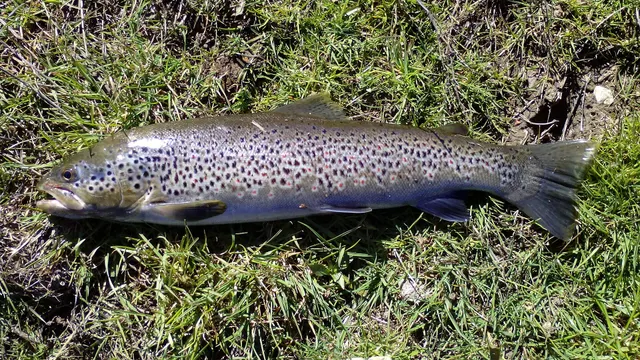 Brown troutBoth are salmonids of the same broad group and are constantly confused. The separation is simple once known: rainbows are spotted on the tail and have no red spots; brown trout have red spots and a clean tail.
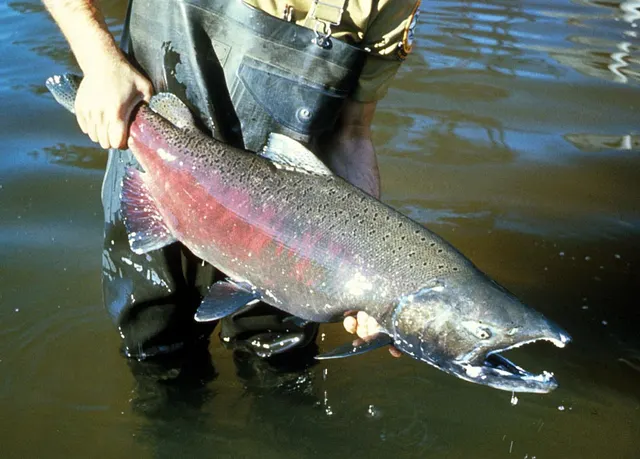 Chinook salmonCongeners in the genus Oncorhynchus. The difference that matters is that chinook is semelparous and dies after spawning while rainbow trout is not — the same genus, two entirely different life strategies.
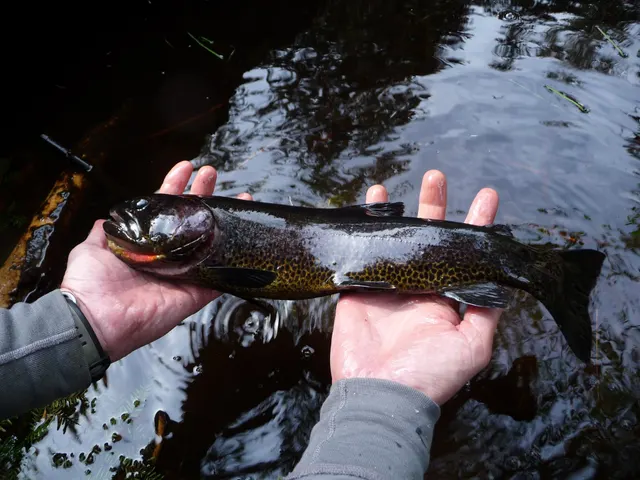 Cutthroat troutCongeners that hybridise readily and produce fertile offspring, which is why introduced rainbows swamp native cutthroat genetically rather than out-competing them.
Where it lives
- ReservoirsThe stocked species most British stillwater trout fishing is built on, feeding on open-water items rather than the marginal life drawdown prevents.
- Tailwaters below damsCold, thermally stable dam releases support rainbow trout well outside the latitudes and altitudes that would otherwise hold them, and the dense invertebrate populations of those reaches grow fish quickly.
Where you will find it
- AlaskaResident populations in the salmon drainages reach exceptional size on a diet of salmon eggs and flesh, which is the basis of the state's trout fishery.
- CyprusStocked in the higher and colder Troodos reservoirs, which is the only cold-water fishing on the island and the only part of it that a visitor would recognise as game fishing.
- Mauritius and RéunionIntroduced into the upland streams of Réunion, which is high, wet and steep enough to hold permanent cold rivers — a combination almost no other Indian Ocean island has.
- PatagoniaEstablished across the region's rivers and lakes following deliberate stocking, and self-sustaining in most of them.
- The English trout reservoirsThe principal stocked species of these fisheries, growing fast on the enormous daphnia, buzzer and fry production of nutrient-rich water. A fish that has been in a season is a different animal from the one that went in.
- The Great LakesPresent as lake-run steelhead, feeding in open water and ascending tributaries, and supporting a major seasonal river fishery.
- The Himalayan mahseer riversStocked into the same cold upper tributaries as brown trout and persisting in several of them.
- The Pacific Northwest coastPresent as native steelhead, whose sea-run populations are of high conservation concern across much of this coast.
1 more
- The Soča and Slovenia's Adriatic rivers Fishing regions
Understanding this fish
- Aquatic insect larvae as preyAquatic insect larvae are the staple of stream rainbow trout, and the fish's position in the current is chosen to intercept the drift carrying them.
- Floating, sinking and intermediate fly linesThe fish that made line density a routine decision rather than a specialist one. Stocked rainbows in reservoirs move through the water column with light, temperature and food, and finding the depth they are holding at is the whole problem — which is what a range of line densities is for.
- Trout, char and salmon: what the words actually meanAn Oncorhynchus, and more closely related to chinook salmon than to a brown trout.
Sources and evidence
- FishBase: a global information system on fishes — Froese, R. and D. Pauly, eds. — FishBase Consortium (Scientific institute)Relied on for: Scientific name, family placement in the Salmonidae, a maximum length of 122 cm TL, a maximum published weight of 25.9 kg, a maximum reported age of 11 years.States this directlyPassage read and verified
- FishBase: a global information system on fishes — Froese, R. and D. Pauly, eds. — FishBase Consortium (Scientific institute)Relied on for: Environment, climate zone and depth range as recorded: Marine; freshwater; brackish; benthopelagic; anadromous ; depth range 0 - 200 m . Subtropical; 10°C - 24°C ; 67°N - 32°N, 135°E - 117°WStates this directlyPassage read and verified
- FishBase: a global information system on fishes — Froese, R. and D. Pauly, eds. — FishBase Consortium (Scientific institute)Relied on for: The IUCN Red List category for Oncorhynchus mykiss — Least Concern, assessed 28 July 2020 — as republished by FishBase, the Red List itself being unreachable during review.States this directlyPassage read and verified
- Check Clean Dry — biosecurity guidance for water users — GB Non-native Species Secretariat (Conservation authority)Relied on for: The framework by which introduced fish are assessed and managed, and live movement plus equipment as transmission routes.FishingHQ's interpretation of what it saysPassage read and verified
- Understanding the Complexity of Catch-and-Release in Recreational Fishing — Reviews in Fisheries Science 15:75–167, 2007 (Scientific literature)Relied on for: That water temperature, fight duration and handling materially affect the survival of released fish.States this directlyCitation checked — the work exists and is described correctly
Why the 25 connections on this page are here, and the sources
Similar and related fish
Backed by research — 3 connections
Supported by peer-reviewed research or fisheries science. The sources are listed and can be checked.
Brown trout
A taxonomic and identification comparison, naming both scientific names so there is no ambiguity about which animals are being compared.
- FishBase: a global information system on fishes — Froese, R. and D. Pauly, eds. — FishBase Consortium (Scientific institute)Relied on for: That Oncorhynchus mykiss is a Salmonidae native to Pacific drainages of North America and eastern Asia and introduced worldwide.States this directlyPassage read and verified
- The Fishes of the British Isles and North-West Europe — Macmillan, 1969 (Reference work)Relied on for: The morphological separation of Salmo trutta from introduced Oncorhynchus mykiss by spotting pattern and tail markings.States this directlyCitation checked — the work exists and is described correctly
Chinook salmon
A taxonomic claim naming both binomials, with the life-history contrast being the useful content.
- FishBase: a global information system on fishes — Froese, R. and D. Pauly, eds. — FishBase Consortium (Scientific institute)Relied on for: That Oncorhynchus mykiss and Oncorhynchus tshawytscha are congeners in the genus Oncorhynchus, the Pacific salmon and trout.States this directlyPassage read and verified
Cutthroat trout
A comparison whose substance is the hybridisation, which is the species' principal conservation problem.
- FishBase: a global information system on fishes — Froese, R. and D. Pauly, eds. — FishBase Consortium (Scientific institute)Relied on for: That Oncorhynchus clarkii and Oncorhynchus mykiss are congeners in the genus Oncorhynchus with overlapping western North American ranges.States this directlyPassage read and verified
- Check Clean Dry — biosecurity guidance for water users — GB Non-native Species Secretariat (Conservation authority)Relied on for: That hybridisation with introduced congeners is a recognised harm in the assessment of non-native fish.FishingHQ's interpretation of what it saysPassage read and verified
How it is caught
What experienced anglers do — 4 connections
Widely and independently recommended by experienced anglers and specialist sources. This is real angling knowledge, not proof: controlled evidence for it is limited, and FishingHQ records it as convention rather than as a demonstrated effect.
Float-tube fishing
Established angling practice for this species, recorded as convention. The note states the property of the animal or its water that makes the method the answer.
- Still Water Fly-Fishing — Andre Deutsch, 1952 (Specialist angling publication)Relied on for: Still-water fly technique and the feeding behaviour it is built on.States this directlyCitation checked — the work exists and is described correctly
- Trout & Salmon — Bauer Media (Specialist angling publication)Relied on for: Contemporary still-water fly practice.Background and mechanism onlyCitation checked — the work exists and is described correctly
Nymphing
Established angling practice for this species, recorded as convention. The note states the property of the animal or its water that makes the method the answer.
- Still Water Fly-Fishing — Andre Deutsch, 1952 (Specialist angling publication)Relied on for: Still-water fly technique and the feeding behaviour it is built on.States this directlyCitation checked — the work exists and is described correctly
- Trout & Salmon — Bauer Media (Specialist angling publication)Relied on for: Contemporary still-water fly practice.Background and mechanism onlyCitation checked — the work exists and is described correctly
Spinning
Established angling practice for this species, recorded as convention. The note states the property of the animal or its water that makes the method the answer.
- Trout & Salmon — Bauer Media (Specialist angling publication)Relied on for: Established salmonid angling technique and its application to this species.States this directlyCitation checked — the work exists and is described correctly
- General angling website restatements of established technique — Various (Credible secondary source)Relied on for: Widely restated practice connecting this species and method.Background and mechanism onlyCitation checked — the work exists and is described correctly
Stillwater fly fishing
Established angling practice for this species, recorded as convention. The note states the property of the animal or its water that makes the method the answer.
- Still Water Fly-Fishing — Andre Deutsch, 1952 (Specialist angling publication)Relied on for: Still-water fly technique and the feeding behaviour it is built on.States this directlyCitation checked — the work exists and is described correctly
- Trout & Salmon — Bauer Media (Specialist angling publication)Relied on for: Contemporary still-water fly practice.Background and mechanism onlyCitation checked — the work exists and is described correctly
Gear for this fish
What experienced anglers do — 4 connections
Widely and independently recommended by experienced anglers and specialist sources. This is real angling knowledge, not proof: controlled evidence for it is limited, and FishingHQ records it as convention rather than as a demonstrated effect.
Dry flies
A practitioner claim about which lure family answers this species' feeding or holding behaviour.
- Trout & Salmon — Bauer Media (Specialist angling publication)Relied on for: Fly categories and their application to salmonids in running and still water.States this directlyCitation checked — the work exists and is described correctly
- Still Water Fly-Fishing — Andre Deutsch, 1952 (Specialist angling publication)Relied on for: Still-water fly categories, and the feeding observations they are chosen from.Background and mechanism onlyCitation checked — the work exists and is described correctly
Nymphs
A practitioner claim about which lure family answers this species' feeding or holding behaviour.
- Trout & Salmon — Bauer Media (Specialist angling publication)Relied on for: Fly categories and their application to salmonids in running and still water.States this directlyCitation checked — the work exists and is described correctly
- Still Water Fly-Fishing — Andre Deutsch, 1952 (Specialist angling publication)Relied on for: Still-water fly categories, and the feeding observations they are chosen from.Background and mechanism onlyCitation checked — the work exists and is described correctly
Spinners
A practitioner claim about which lure family answers this species' feeding or holding behaviour.
- Freshwater Fishing — Macdonald & Jane's, 1975 (Specialist angling publication)Relied on for: Lure and spinning practice for freshwater predators in Britain and northern Europe.States this directlyCitation checked — the work exists and is described correctly
- Angling Times — Bauer Media (Specialist angling publication)Relied on for: Contemporary British and European lure practice for this species in the weekly angling press.Background and mechanism onlyCitation checked — the work exists and is described correctly
Streamers
A practitioner claim about which lure family answers this species' feeding or holding behaviour.
- Trout & Salmon — Bauer Media (Specialist angling publication)Relied on for: Fly categories and their application to salmonids in running and still water.States this directlyCitation checked — the work exists and is described correctly
- Still Water Fly-Fishing — Andre Deutsch, 1952 (Specialist angling publication)Relied on for: Still-water fly categories, and the feeding observations they are chosen from.Background and mechanism onlyCitation checked — the work exists and is described correctly
Where it lives
Backed by research — 2 connections
Supported by peer-reviewed research or fisheries science. The sources are listed and can be checked.
Reservoirs
Habitat association recorded for the species, in an environment FishingHQ describes on its own page.
- Freshwater Fishes of the British Isles — HarperCollins (New Naturalist 75), 1992 (Reference work)Relied on for: Habitat association and distribution of European freshwater fishes, including occurrence in artificial and modified waters.States this directlyCitation checked — the work exists and is described correctly
- FishBase: a global information system on fishes — Froese, R. and D. Pauly, eds. — FishBase Consortium (Scientific institute)Relied on for: Habitat association, depth range and water-type tolerance recorded for the species.States this directlyPassage read and verified
Tailwaters below dams
A claim that a species occupies an engineered habitat outside its natural thermal range, resting on documented distribution rather than on angling report.
- FishBase: a global information system on fishes — Froese, R. and D. Pauly, eds. — FishBase Consortium (Scientific institute)Relied on for: Recorded depth range, temperature tolerance and habitat association for the species outside north-west Europe.States this directlyPassage read and verified
- The IUCN Red List of Threatened Species — International Union for Conservation of Nature (Conservation authority)Relied on for: Global conservation assessment, range and recorded threats for the species.States this directlyCitation checked — the work exists and is described correctly
Where you will find it
Backed by research — 9 connections
Supported by peer-reviewed research or fisheries science. The sources are listed and can be checked.
Alaska
A distribution association between an animal and a kind of water, rather than a claim about any named mark.
- FishBase: a global information system on fishes — Froese, R. and D. Pauly, eds. — FishBase Consortium (Scientific institute)Relied on for: Distribution, habitat association and depth range recorded for the species, including its occurrence in the water body concerned.States this directlyPassage read and verified
- The IUCN Red List of Threatened Species — International Union for Conservation of Nature (Conservation authority)Relied on for: Assessment and range account for the species, including the systems and coasts it occupies.Background and mechanism onlyCitation checked — the work exists and is described correctly
Cyprus
A distribution edge resting on published regional identification and distribution references, written where the species is genuinely characteristic of the destination's fishing rather than merely recorded from its waters.
- FAO Species Identification Guides for Fishery Purposes and the FAO Species Catalogues — Food and Agriculture Organization of the United Nations (Scientific institute)Relied on for: Distribution, habitat association and biology of the fishes of the eastern central Atlantic and the Mediterranean, from the regional identification guides prepared for fishery purposes.States this directlyCitation checked — the work exists and is described correctly
- FishBase: a global information system on fishes — Froese, R. and D. Pauly, eds. — FishBase Consortium (Scientific institute)Relied on for: Recorded environment, depth range, distribution and biology of the species named.States this directlyPassage read and verified
Mauritius and Réunion
That a species occurs in these waters, drawn from distribution science. It is a statement about where the animal lives and is not a statement that anybody will catch one, still less where.
- FishBase: a global information system on fishes — Froese, R. and D. Pauly, eds. — FishBase Consortium (Scientific institute)Relied on for: Recorded distribution, habitat association and life history of the freshwater species named, including introduced populations where those are recorded.States this directlyPassage read and verified
- The Flood Pulse Concept in River-Floodplain Systems — Canadian Special Publication of Fisheries and Aquatic Sciences 106, Department of Fisheries and Oceans, Ottawa, 1989 (Scientific literature)Relied on for: That in tropical river-floodplain systems the seasonal flood pulse organises fish movement and production, which is the basis for stating where and when a species is available.Background and mechanism onlyCitation checked — the work exists and is described correctly
Patagonia
A distribution association between an animal and a kind of water, rather than a claim about any named mark.
- The IUCN Red List of Threatened Species — International Union for Conservation of Nature (Conservation authority)Relied on for: Assessment and habitat account for the species, including the river or lake system it occupies and the pressures acting on it.States this directlyCitation checked — the work exists and is described correctly
- FishBase: a global information system on fishes — Froese, R. and D. Pauly, eds. — FishBase Consortium (Scientific institute)Relied on for: Distribution, habitat association, size and life history recorded for the species in the system concerned.States this directlyPassage read and verified
The English trout reservoirs
A claim that a place contains the ground, water and seasonal conditions the species is associated with. It is a distributional statement about the world, it rests on the regional reference literature, and it deliberately asserts nothing about access, permission or catch.
- Freshwater Fishes of the British Isles — HarperCollins (New Naturalist 75), 1992 (Reference work)Relied on for: Distribution, ecology and conservation status of the freshwater fishes of the British Isles, including in artificial and modified waters.States this directlyCitation checked — the work exists and is described correctly
- Environment Agency fisheries management, byelaws and rod licensing information — Environment Agency (Government fisheries body)Relied on for: Fisheries monitoring, water quality and species distribution in English rivers, canals and still waters.States this directlyCitation checked — the work exists and is described correctly
The Great Lakes
Occurrence of the species in this system or along this coast: a statement about the animal's distribution, not a venue recommendation.
- FishBase: a global information system on fishes — Froese, R. and D. Pauly, eds. — FishBase Consortium (Scientific institute)Relied on for: Distribution, salinity tolerance and habitat association recorded for the species, including its occurrence in this system.States this directlyPassage read and verified
- The IUCN Red List of Threatened Species — International Union for Conservation of Nature (Conservation authority)Relied on for: Assessment and range description for the species, including the waters in which it occurs.Background and mechanism onlyCitation checked — the work exists and is described correctly
The Himalayan mahseer rivers
A distribution association between an animal and a kind of water, rather than a claim about any named mark.
- The IUCN Red List of Threatened Species — International Union for Conservation of Nature (Conservation authority)Relied on for: Assessment and habitat account for the species, including the river or lake system it occupies and the pressures acting on it.States this directlyCitation checked — the work exists and is described correctly
- FishBase: a global information system on fishes — Froese, R. and D. Pauly, eds. — FishBase Consortium (Scientific institute)Relied on for: Distribution, habitat association, size and life history recorded for the species in the system concerned.States this directlyPassage read and verified
The Pacific Northwest coast
Occurrence of the species in this system or along this coast: a statement about the animal's distribution, not a venue recommendation.
- FishBase: a global information system on fishes — Froese, R. and D. Pauly, eds. — FishBase Consortium (Scientific institute)Relied on for: Distribution, salinity tolerance and habitat association recorded for the species, including its occurrence in this system.States this directlyPassage read and verified
- The IUCN Red List of Threatened Species — International Union for Conservation of Nature (Conservation authority)Relied on for: Assessment and range description for the species, including the waters in which it occurs.Background and mechanism onlyCitation checked — the work exists and is described correctly
The Soča and Slovenia's Adriatic rivers
A distributional claim about where a species occurs, which is a claim about the world and rests on the reference literature rather than on angling report.
- FishBase: a global information system on fishes — Froese, R. and D. Pauly, eds. — FishBase Consortium (Scientific institute)Relied on for: Distribution, habitat association and life history recorded for the species.States this directlyPassage read and verified
- The IUCN Red List of Threatened Species — International Union for Conservation of Nature (Conservation authority)Relied on for: Global conservation assessment, range and recorded threats for the species.States this directlyCitation checked — the work exists and is described correctly
Understanding this fish
Backed by research — 2 connections
Supported by peer-reviewed research or fisheries science. The sources are listed and can be checked.
Aquatic insect larvae as prey
Recorded diet evidence identifies mayfly, caddis, stonefly and chironomid larvae as a food item of this predator at group level rather than to species. The edge points at the taxon record for that reason, and encoding it as a species-level claim would assert something the source does not.
- FishBase: a global information system on fishes — Froese, R. and D. Pauly, eds. — FishBase Consortium (Scientific institute)Relied on for: Food items recorded for this predator, given as mayfly, caddis, stonefly and chironomid larvae.States this directlyPassage read and verified
- FAO Species Identification Guides for Fishery Purposes and the FAO Species Catalogues — Food and Agriculture Organization of the United Nations (Scientific institute)Relied on for: Species account describing this predator's diet, recorded at the level of mayfly, caddis, stonefly and chironomid larvae.Background and mechanism onlyCitation checked — the work exists and is described correctly
Trout, char and salmon: what the words actually mean
The other genus the word trout spans, and the counter-intuitive half.
- FishBase: a global information system on fishes — Froese, R. and D. Pauly, eds. — FishBase Consortium (Scientific institute)Relied on for: Genus placement within Salmonidae for Salmo, Oncorhynchus and Salvelinus, and the species assigned to each.States this directlyPassage read and verified
What experienced anglers do — 1 connection
Widely and independently recommended by experienced anglers and specialist sources. This is real angling knowledge, not proof: controlled evidence for it is limited, and FishingHQ records it as convention rather than as a demonstrated effect.
Floating, sinking and intermediate fly lines
A fish or a water joined to the fly-fishing mechanism it is a worked example of, written only where the subject's own behaviour or physical character is what this page explains. The direction is the one FishingHQ writes this kind of connection in, and the one it already uses 176 times, and it is also the semantically correct one: the mechanism explains the fish, not the reverse.
- Still Water Fly-Fishing — Andre Deutsch, 1952 (Specialist angling publication)Relied on for: Stillwater fly practice: line density and depth, leader construction, fly selection against the food present, and the behaviour of stocked and wild trout in still water.States this directlyCitation checked — the work exists and is described correctly
- Trout & Salmon — Bauer Media (Specialist angling publication)Relied on for: Long-running published description of British game angling practice: river and stillwater trout, grayling and salmon fishing, and the presentation each demands.States this directlyCitation checked — the work exists and is described correctly
- Freshwater Fishes of the British Isles — HarperCollins (New Naturalist 75), 1992 (Reference work)Relied on for: Life history, feeding biology, habitat requirement and seasonal behaviour of the freshwater fishes of the British Isles.States this directlyCitation checked — the work exists and is described correctly
- FishBase: a global information system on fishes — Froese, R. and D. Pauly, eds. — FishBase Consortium (Scientific institute)Relied on for: Recorded environment, depth range, feeding biology and distribution of the species named.States this directlyPassage read and verified
How FishingHQ labels evidence is explained in the evidence policy.