Alaska
Fishing regions · Last reviewed 2026-08-14
Five salmon species, halibut on a shelf that goes on for ever, and a fishery whose limiting factor is access rather than abundance.
Being listed here is not permission to fish. What that meansClose
Access, fishing rights, seasons, licences, local bylaws and permitted methods vary and can change. Check current access, permission, local regulations, closures and restrictions before you travel or fish. FishingHQ describes what the ground is and names who holds the answer; it does not hold the answer itself.
Find the authority for a jurisdiction · What FishingHQ does and does not cover
Alaska is a jurisdiction-tier record because it is administered as one and because its fishing is genuinely distinct from the rest of the United States in scale, species and access.
THE SALMON ARE THE ORGANISING FACT. All five Pacific salmon species return to Alaskan rivers in enormous numbers, and the runs structure the ecology, the economy, the culture and the calendar. The Bristol Bay sockeye run is among the largest wild salmon runs remaining anywhere, and it is managed on escapement counts rather than on quota — the fishery opens and closes on how many fish have gone up the river.
HALIBUT AND GROUNDFISH ARE THE SECOND PILLAR. A very wide, productive continental shelf supports Pacific halibut, rockfish, lingcod and cod, and the halibut fishery in particular is a major recreational draw with its own management structure and, for charter fishing, its own allocation arrangements.
FRESH WATER IS EXTRAORDINARY AND UNDERSTATED. Rainbow trout that grow large on salmon eggs and flesh, Arctic char and Dolly Varden, Arctic grayling, sheefish, northern pike in the interior, and lake trout in the deep cold lakes. The rainbow fishery of the Bristol Bay drainages is a genuine world fishery built entirely on the salmon that feed it.
ACCESS IS THE LIMITING FACTOR AND IT DEFINES THE EXPERIENCE. Very little of Alaska is reachable by road. The practical fishery is reached by float plane, by boat, or by walking, and the difference between a road-accessible river and one an hour's flight away is a difference in fish population as much as in solitude.
SUBSISTENCE FISHING IS A LEGAL CATEGORY HERE AND NOT A DESCRIPTION. Alaskan fisheries law recognises subsistence use with priority in many circumstances, alongside personal use, sport and commercial categories, and the allocation between them is a live and frequently contested matter. Understanding that there are four distinct legal categories of fishing rather than two is basic to understanding the state.
AND THE MANAGEMENT IS IN-SEASON AND ADAPTIVE THROUGHOUT. Nothing here states what any current rule is.
What fishing here is like
A very large, cold, largely roadless jurisdiction whose fishing is dominated by Pacific salmon runs and by a wide productive continental shelf. Five salmon species plus steelhead return to its rivers; halibut, rockfish and lingcod occupy the shelf; and the freshwater fishery for large rainbow trout, char, grayling, pike and sheefish rests substantially on the nutrients the salmon bring inland. Access rather than abundance is the practical constraint, and most serious fishing is reached by float plane or boat.
What dominates
River and estuary fishing for the five Pacific salmon species by fly, spinning and drift methods. Fly fishing for large rainbow trout, Dolly Varden and Arctic char in the salmon drainages, frequently keyed to salmon eggs and flesh. Halibut and groundfish fishing from charter and private boats over the shelf. Rockfish and lingcod jigging on rocky ground, with descending-device release practice. Ice fishing in the interior. Northern pike fishing in interior lakes and slow rivers. Personal-use dipnetting in designated fisheries, which is a legally distinct category.
The water available
Thousands of salmon rivers from short coastal streams to enormous drainages; a very wide and productive continental shelf; a deeply indented southeastern coast of fjords, islands and inside passages; the volcanic Aleutian chain; large interior lakes and slow tundra rivers; extensive tundra and taiga wetland; and a northern coast fringed with sea ice for much of the year.
How the rules are structured
Fisheries are managed by the state fish and game department for most inland and state waters, and federally for offshore waters, listed species and federal subsistence on federal land and water. Alaskan law recognises four distinct categories of fishery use — subsistence, personal use, sport and commercial — and the allocation between them is set by regulatory boards and is frequently contested. Salmon fisheries are managed on escapement, so openings and closures are set in-season on actual counts rather than fixed in advance. Halibut carries its own international and federal management, with separate arrangements for charter and private anglers. Emergency orders altering seasons and limits are routine and can be issued at short notice. FishingHQ does not state what any current rule is.
Who to ask
- The Alaska Department of Fish and Game, for sport, personal-use and most state-water fisheries, and for the emergency orders that adjust them in-season.
- The Alaska Board of Fisheries, which sets the allocation and regulatory framework between user categories.
- The Federal Subsistence Board, for subsistence fisheries on federal lands and waters.
- NOAA Fisheries, for federally managed offshore fisheries and listed species.
- The International Pacific Halibut Commission, for the management framework governing Pacific halibut.
- The relevant Alaska Native tribal or corporate authority where fishing takes place on or affects their lands and waters.
Words you will meet
- Escapement
- The number of adult salmon that pass upstream to spawn rather than being caught. Alaskan salmon fisheries are managed to escapement targets, so openings and closures are decided in-season on counts rather than set in advance.
- Personal use
- A legally distinct category of Alaskan fishery, separate from sport, subsistence and commercial, in which residents may take fish by methods such as dipnetting under specific arrangements. Not a synonym for recreational fishing.
- Dipnetting
- Taking salmon with a large hand-held net from the bank or from a boat, permitted in designated personal-use fisheries. A major seasonal activity in some drainages and a distinct method rather than a variation of angling.
- Sheefish
- Inconnu, a large predatory whitefish of northern and interior Alaskan rivers, taken on lures and flies. Effectively unknown outside the far north and a substantial sport fish where it occurs.
- Emergency order
- An in-season regulatory change issued at short notice to open, close or restrict a fishery on the basis of current run data. Ordinary practice here rather than an exceptional measure.
Conditions and hazards
Cold water is the dominant hazard and it applies year-round; immersion produces cold water shock and rapid incapacitation, and water temperatures do not become forgiving in summer. Remoteness compounds every incident: much of the fishery is hours from assistance by air, and communications equipment and a filed plan matter more here than in almost any other fishery FishingHQ describes. Rivers in salmon country are fast, cold and frequently silty, and wading them is a recognised cause of drowning. Bears concentrate on salmon rivers during the runs and are a genuine and routine consideration rather than a remote possibility, managed through awareness, food handling and behaviour rather than avoidance. Weather changes rapidly and can ground aircraft for days. Offshore, large swell, cold water and long distances apply. Tidal ranges in parts of the state are among the largest in the world, and mudflats there can trap a person.
The salmon are not just the fishery, they are the nutrient supply
The most useful single idea for understanding Alaskan fishing is that the salmon runs feed the entire freshwater system, and almost every other fishery in the state is downstream of that fact.
SALMON CARRY MARINE NUTRIENTS INLAND AND DIE THERE. Pacific salmon feed at sea, accumulate their entire body mass from marine production, return to fresh water, spawn and die. Their carcasses release nitrogen, phosphorus and organic matter into rivers and lakes that are otherwise nutrient-poor, and that pulse is measurable in the vegetation of the riverbank as well as in the water.
SO THE RESIDENT FISH LIVE ON SALMON. Alaskan rainbow trout in the great salmon drainages grow to sizes their food supply could not otherwise support, because they eat salmon eggs during the spawning run and salmon flesh afterwards, and they key on it so specifically that egg and flesh imitations are the mainstream fly patterns. Dolly Varden and Arctic char do the same. The famous rainbow fishery of the Bristol Bay drainages is, in a direct sense, a salmon fishery conducted on a different species.
WHICH MEANS THE TIMING OF THE RESIDENT FISHERY IS SET BY THE RUNS rather than by the trout. The productive periods for rainbows follow the salmon: the egg drop during spawning, then the flesh as carcasses break down, then a post-run period of recovery. An angler planning for rainbows is planning around salmon.
AND THE BEARS ARE PART OF THE SAME SYSTEM, which is why they concentrate where they do at the times they do. Bear presence on a salmon river in the run is not bad luck; it is the predictable consequence of the same nutrient pulse the fishing depends on.
THE MANAGEMENT CONSEQUENCE IS THAT ESCAPEMENT MATTERS TO MORE THAN SALMON. Allowing enough fish upstream is not only about next generation's run; it is about maintaining the nutrient subsidy that the resident fish, the invertebrates and the riparian forest depend on. That is a substantial part of why escapement-based management is used, and it is a more complete argument than fisheries arithmetic alone.
WHEN A RUN FAILS, THEREFORE, THE EFFECT IS SYSTEM-WIDE and it appears in the resident fishery a season or more later.
Backed by research — why, and the sources (2)
Supported by peer-reviewed research or fisheries science. The sources are listed and can be checked.
- NASCO conservation and management of North Atlantic salmon — North Atlantic Salmon Conservation Organization (Government fisheries body)Relied on for: Anadromous salmonid biology, run timing, freshwater habitat requirements and the management principles applied to them.Background and mechanism onlyCitation checked — the work exists and is described correctly
- FishBase: a global information system on fishes — Froese, R. and D. Pauly, eds. — FishBase Consortium (Scientific institute)Relied on for: Distribution, habitat association, migratory behaviour and life history of the species occurring in the area.States this directlyPassage read and verified
Four kinds of fishing in law, and a season that is decided while it happens
Alaska's regulatory framework has two features that visitors consistently misunderstand, and both are structural rather than bureaucratic.
THERE ARE FOUR LEGAL CATEGORIES OF FISHERY, NOT TWO. Alaskan law distinguishes subsistence, personal use, sport and commercial fishing, and they are genuinely separate categories with separate rules, separate participants and separate allocations rather than gradations of one thing. Subsistence use carries priority in many circumstances under both state and federal law, and the federal and state subsistence regimes do not align perfectly, which is itself a long-running legal and political question. Personal use — which includes the dipnet fisheries — is available to residents under specific arrangements and is not a recreational category.
A VISITOR IS THEREFORE IN THE SPORT CATEGORY and should not assume that what they see other people doing is available to them. Watching a dipnet fishery in operation and concluding it is a method one may use is the commonest misreading of the state's rules.
THE SECOND FEATURE IS THAT SEASONS ARE DECIDED IN-SEASON. Salmon fisheries here are managed to escapement targets: fish passing upstream are counted, and openings, closures and limits are adjusted by emergency order on the basis of those counts. A fishery may open, close and reopen within a fortnight, and a rule published before the season is a starting position rather than a settlement.
WHICH MAKES CHECKING CURRENT STATUS AN OPERATIONAL NECESSITY rather than diligence. There is no stable annual calendar to learn, and the honest advice is that anybody planning a trip must check the position for the specific water on the specific dates, close to the time.
HALIBUT ADDS AN INTERNATIONAL LAYER, managed through a bilateral commission with federal implementation, and with different arrangements for charter and private anglers.
AND LAND OWNERSHIP ADDS A FURTHER ONE. Access to and across Alaska Native corporation lands, federal lands and state lands is governed differently in each case, and being on the right water does not by itself resolve being on the right ground. The competent authorities are the sources and FishingHQ does not state what any current rule is.
Official guidance — why, and the sources (2)
Stated by a fisheries authority, scientific institute or recognised angling body. Authoritative, but summarising rather than demonstrating.
- NASCO conservation and management of North Atlantic salmon — North Atlantic Salmon Conservation Organization (Government fisheries body)Relied on for: Anadromous salmonid biology, run timing, freshwater habitat requirements and the management principles applied to them.Background and mechanism onlyCitation checked — the work exists and is described correctly
- FishBase: a global information system on fishes — Froese, R. and D. Pauly, eds. — FishBase Consortium (Scientific institute)Relied on for: Distribution, habitat association, migratory behaviour and life history of the species occurring in the area.States this directlyPassage read and verified
Subsistence first, and a fishing culture built on a short summer
Alaskan fishing culture is organised around two things that have no southern equivalent: a legal subsistence priority and a season compressed into a few months.
SUBSISTENCE IS A RECOGNISED PRIORITY IN LAW, not a description of poverty. Federal and state frameworks provide for subsistence fishing and hunting, with a priority for rural residents on federal public lands and waters, and the resulting three-way division between subsistence, commercial and sport fishing is the fundamental structure of Alaskan fisheries. Understanding that ordering explains most of what follows.
THE SEASON IS SHORT AND EVERYTHING HAPPENS IN IT. Salmon runs, the tourist fishery, the commercial season and the subsistence harvest all compress into a few months of long daylight, and the intensity of that period is a defining feature of Alaskan life.
FISH CAMPS AND PUTTING UP FISH are ordinary practice. Drying, smoking and canning salmon for winter use is a household activity across much of the state, and the annual harvest is a food security matter rather than a sporting one.
THE SPORT FISHERY IS LARGE AND VISITOR-DRIVEN, with lodges, guides and charter fleets serving people who travel a long way for salmon and halibut.
DIPNETTING IS A MASS PARTICIPATION EVENT for residents on particular rivers, and the personal-use fishery it belongs to is a distinctive Alaskan institution.
THE COMMERCIAL FISHERY IS ENORMOUS AND IS PART OF THE CULTURE, with salmon, pollock, crab and halibut fisheries that are among the most valuable in the United States.
AND SELF-RELIANCE IS ASSUMED. Distances, weather, bears and limited rescue capacity make competence a practical requirement rather than a virtue, and a visitor who arrives without it becomes somebody else's problem.
What experienced anglers do — why, and the sources (2)
Widely and independently recommended by experienced anglers and specialist sources. This is real angling knowledge, not proof: controlled evidence for it is limited, and FishingHQ records it as convention rather than as a demonstrated effect.
- General angling website restatements of established technique — Various (Credible secondary source)Relied on for: Widely restated practice associating this discipline or technique with this place, recorded as practitioner consensus rather than as tested fact.Background and mechanism onlyCitation checked — the work exists and is described correctly
- Fishers' Craft and Lettered Art: Tracts on Fishing from the End of the Middle Ages — University of Toronto Press, 1997 (Scientific literature)Relied on for: That fishing traditions develop around the water and fish available to them, and the historical method of reading such traditions from their documentary record.States this directlyCitation checked — the work exists and is described correctly
Dipnet, drift, jig and fly
Alaska's disciplines span a personal-use fishery unlike anything else in the United States and a sport fishery of international standing.
DIPNETTING IS THE DISTINCTIVE PERSONAL-USE METHOD. Residents take salmon with large hand-held or boat-operated dip nets on particular rivers during defined periods, filling freezers for the year. It is a food fishery conducted at scale by ordinary households and it has no equivalent elsewhere in the country.
FLY FISHING FOR SALMON AND TROUT is the classic sport discipline, on rivers where fish are abundant enough that the fishing is about selection rather than about finding.
DRIFT AND BOAT FISHING ON THE RIVERS takes salmon on the move, with drift boats and jet boats reaching water that has no road.
SALTWATER CHARTER FISHING FOR HALIBUT AND SALMON is a major visitor industry, working from a number of coastal ports, and halibut in particular draws people for the size of fish available.
JIGGING AND BOTTOM FISHING takes rockfish, lingcod and halibut over hard ground, with the descending-device practice FishingHQ describes for barotrauma now an established requirement in the region's rockfish fisheries.
ICE FISHING OPERATES IN THE INTERIOR, for pike, burbot, whitefish and char, in a genuinely severe winter.
SUBSISTENCE NETTING, FISH WHEELS AND TRAPS are used under the subsistence framework on particular rivers, and the fish wheel — a current-powered rotating scoop — is a distinctive northern river technology.
AND FLY-OUT AND REMOTE FISHING is common, because most of the state has no road, and a bush plane is ordinary transport rather than an adventure.
What experienced anglers do — why, and the sources (2)
Widely and independently recommended by experienced anglers and specialist sources. This is real angling knowledge, not proof: controlled evidence for it is limited, and FishingHQ records it as convention rather than as a demonstrated effect.
- General angling website restatements of established technique — Various (Credible secondary source)Relied on for: Widely restated practice associating this discipline or technique with this place, recorded as practitioner consensus rather than as tested fact.Background and mechanism onlyCitation checked — the work exists and is described correctly
- Fishers' Craft and Lettered Art: Tracts on Fishing from the End of the Middle Ages — University of Toronto Press, 1997 (Scientific literature)Relied on for: That fishing traditions develop around the water and fish available to them, and the historical method of reading such traditions from their documentary record.States this directlyCitation checked — the work exists and is described correctly
A year with one enormous summer in it
Alaska's fishing calendar is the most compressed on FishingHQ and it is driven by light and by salmon runs.
BREAK-UP IS THE SPRING EVENT. Ice leaving the rivers and lakes is what starts the year, and its timing varies by weeks between years and enormously across the state.
THE SALMON RUNS ARE THE SUMMER AND THEY ARE SEQUENCED. Different species run at different times through the summer — king, sockeye, chum, pink and coho in an overlapping sequence — and the fishery, the subsistence harvest and the commercial season all track that sequence. Which fish is running is a more useful question here than what month it is.
RUN TIMING IS DRIVEN BY THE RIVER AND THE YEAR, not by the calendar, and management is in-season: openings and closures are decided from actual escapement counts rather than set in advance. That is the same adaptive logic the Humboldt page describes, applied to salmon.
MIDSUMMER HAS ALMOST NO DARKNESS in much of the state, which extends the fishing day enormously and is one of the genuine attractions of the season.
AUTUMN IS SHORT AND IS THE TROPHY PERIOD for rainbow trout feeding on salmon eggs and flesh, and for coho at the end of the run sequence.
WINTER IS LONG, DARK AND SEVERE, and the fishery contracts to ice fishing in the interior and to whatever the coastal weather allows.
AND HALIBUT AND GROUNDFISH RUN THEIR OWN CALENDAR, governed by quota and season decisions rather than by run timing, and the charter fishery operates within limits set annually.
Backed by research — why, and the sources (2)
Supported by peer-reviewed research or fisheries science. The sources are listed and can be checked.
- NASCO conservation and management of North Atlantic salmon — North Atlantic Salmon Conservation Organization (Government fisheries body)Relied on for: Anadromous salmonid biology, run timing, freshwater habitat requirements and the management principles applied to them.States this directlyCitation checked — the work exists and is described correctly
- FishBase: a global information system on fishes — Froese, R. and D. Pauly, eds. — FishBase Consortium (Scientific institute)Relied on for: Distribution, habitat association, migratory behaviour and life history of the species concerned.Background and mechanism onlyPassage read and verified
Purchase, statehood and a constitution that names sustained yield
Alaska's fisheries history is short as a state and very long as a place, and one constitutional decision shapes everything.
INDIGENOUS FISHERIES ARE ANCIENT AND CONTINUOUS across the region, with salmon central to the economies and cultures of many peoples for thousands of years, and fish camps, drying racks and preservation techniques descending from that.
RUSSIAN AND EARLY AMERICAN PERIODS SAW EXTRACTIVE FISHERIES develop with little management, and the salmon canning industry that grew from the late nineteenth century operated under federal control from a great distance.
FISH TRAPS BECAME THE POLITICAL ISSUE. Large fixed traps operated by outside canning interests took enormous quantities of salmon and were widely resented locally as extraction by absentees. Their abolition became a central demand of the statehood movement.
STATEHOOD IN 1959 CHANGED THE MANAGEMENT COMPLETELY. Alaska's constitution requires that renewable resources be managed on the sustained yield principle, which is an unusual constitutional commitment, and the state took over fisheries management with a mandate to rebuild salmon runs. Fish traps were banned.
THE RECOVERY OF THE SALMON RUNS under state management is one of the better fisheries stories anywhere, and escapement-based in-season management — counting fish onto the spawning grounds and opening or closing the fishery accordingly — is the mechanism.
THE SUBSISTENCE PRIORITY WAS ESTABLISHED IN LAW, with federal and state provisions that remain a live and complicated legal question.
THE 1989 OIL SPILL IN PRINCE WILLIAM SOUND devastated a fishery and a coastline and remains a defining event in the state's environmental history.
AND THE GROUNDFISH AND CRAB FISHERIES became among the largest and most valuable in the United States, managed under quota systems whose design has been influential well beyond Alaska.
Official guidance — why, and the sources (2)
Stated by a fisheries authority, scientific institute or recognised angling body. Authoritative, but summarising rather than demonstrating.
- Fishers' Craft and Lettered Art: Tracts on Fishing from the End of the Middle Ages — University of Toronto Press, 1997 (Scientific literature)Relied on for: The historical development of fishing practice and its transmission, and the method of reading a fishing tradition from its documentary record.States this directlyCitation checked — the work exists and is described correctly
- Code of Conduct for Responsible Fisheries — Food and Agriculture Organization of the United Nations, Rome, 1995 (Standards body)Relied on for: Principles for fisheries management including the treatment of traditional, small-scale and shared fisheries, against which historical arrangements can be read.Background and mechanism onlyCitation checked — the work exists and is described correctly
Some of what lives here
Fish recorded here that FishingHQ holds a reviewed photograph of. It is not a complete list of what Alaska holds, and it is not a prediction that you will catch any of them — it is a way in to the ones we can show you.
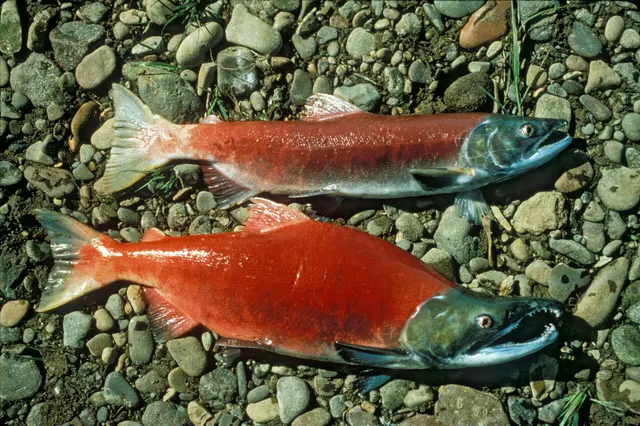 Sockeye salmonThe plankton-feeding Pacific salmon that turns brilliant scarlet to spawn, depends on lakes rather than just rivers, and barely takes a lure at all.
David Menke — Public domain, via Wikimedia Commons
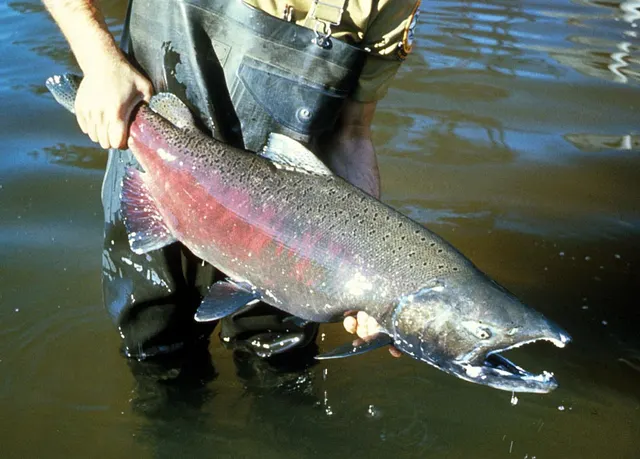 Chinook salmonThe largest Pacific salmon, reaching over sixty kilograms, and the one whose runs carry the most cultural and ecological weight on that coast.
U.S. Geological Survey — public domain, via Wikimedia Commons
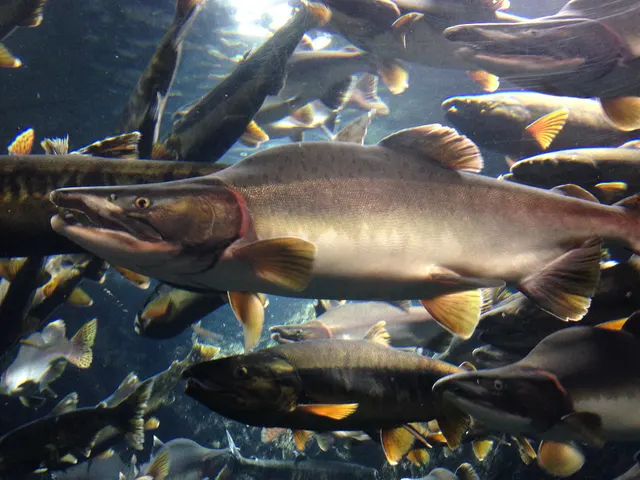 Pink salmonThe smallest and most abundant Pacific salmon, running on a strict two-year cycle, and the male developing a pronounced hump at spawning.
Totti — CC BY-SA 4.0, via Wikimedia Commons
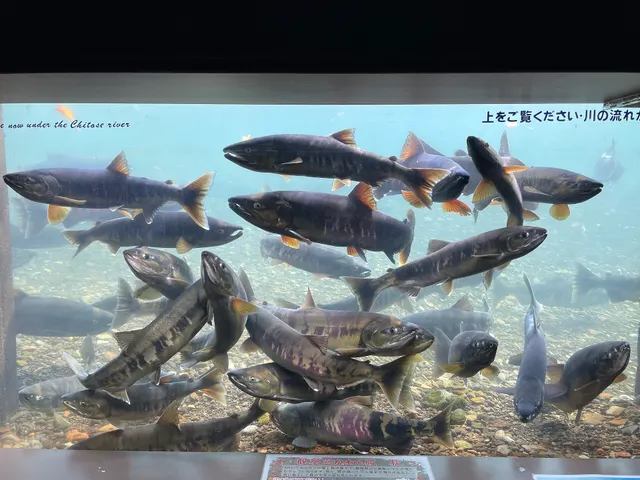 Chum salmonA large Pacific salmon without body spotting, developing striking purple calico bars and enlarged canine teeth at spawning, and the widest-ranging of its genus.
Totti — CC BY-SA 4.0, via Wikimedia Commons
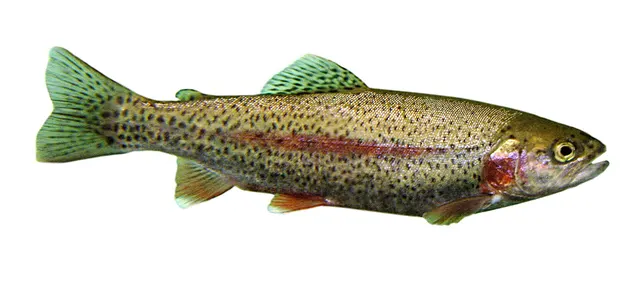 Rainbow troutThe most widely introduced sport fish on Earth — a Pacific salmonid now stocked on every continent except Antarctica, and the same species as the steelhead.
Jonathunder — CC BY-SA 3.0, via Wikimedia Commons
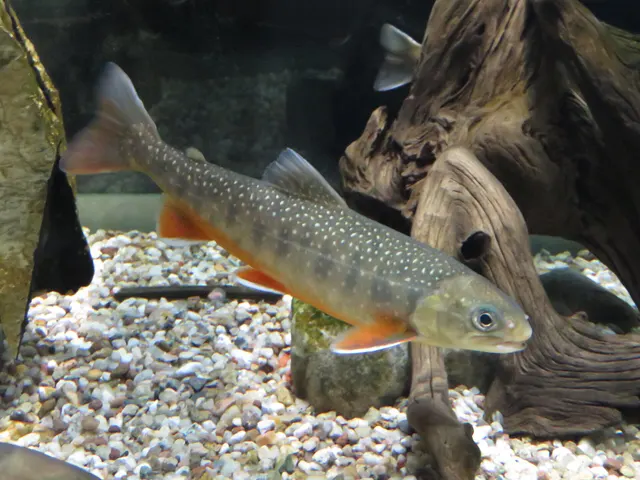 Arctic charThe most northerly freshwater fish in the world, a cold-demanding char with brilliant orange-red spawning bellies and highly distinct landlocked populations.
Xepheid — CC BY-SA 4.0, via Wikimedia Commons
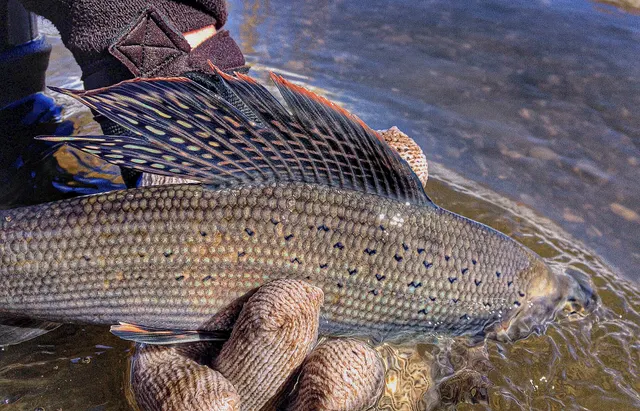 Arctic graylingA northern river salmonid with an enormous sail-like dorsal fin, feeding on drifting insects in cold clear water across Arctic North America and Siberia.
U.S. Fish and Wildlife Service — public domain, via Wikimedia Commons
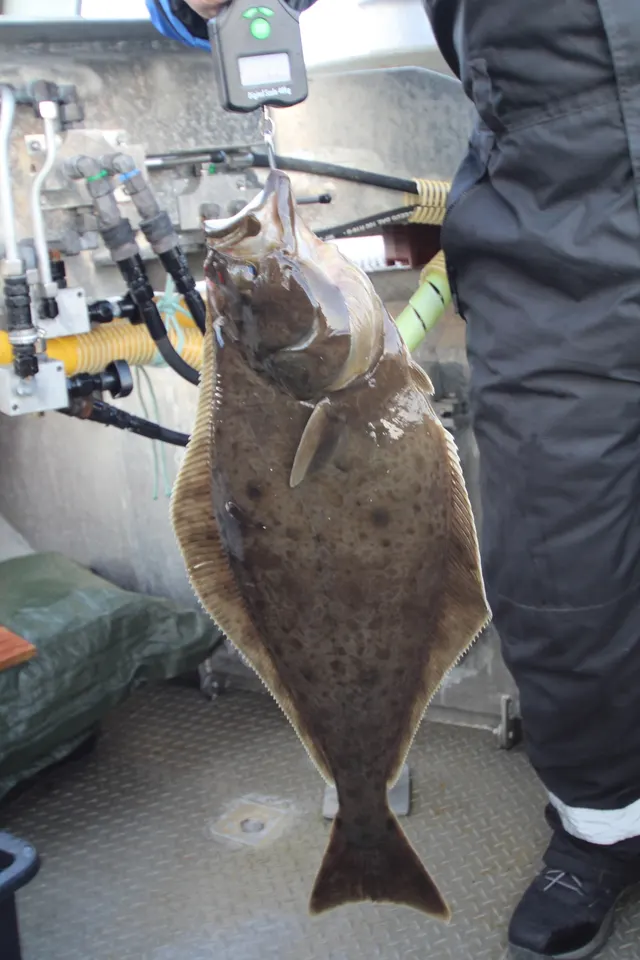 Atlantic halibutThe largest flatfish in the world, reaching over four metres, and a species whose commercial collapse made it one of the clearest cautionary tales in North Atlantic fisheries.
portulaca — CC BY, via iNaturalist
Safety
Further safety reading
- Cold water shock and immersion — Water temperatures do not become forgiving in summer, and immersion in a fast cold river or in coastal water produces rapid incapacitation a long way from help.
- Dangerous animals where you fish — Bears and anglers occupy salmon rivers for the same reason at the same season, and a caught fish is an attractant.
- Fishing alone — Remoteness is the state's defining risk multiplier: much of the fishery is hours from assistance by air, and weather can ground aircraft for days.
- Wading safely — Fast, cold, frequently silty salmon rivers are a recognised cause of drowning, and wading them is the ordinary way anglers get into difficulty here.
Check the rules before you fish
Fishing laws, bylaws, access rules, seasons, bait restrictions and permitted methods vary by location and can change. Check the current rules from the relevant authority and the water you intend to fish before fishing.
Check with:
- Current national or regional law for where you are fishing
- Current local bylaws
- The relevant fisheries authority
- The landowner, club or fishery whose water it is
- Any restrictions specific to the species or the method you intend to use
Where to go next
What swims here
- Arctic charOccurs across the north as both landlocked and sea-run populations, in the coldest fresh water the state holds.
- Arctic graylingOccupies interior and northern rivers, moving seasonally between spawning tributaries, summer feeding reaches and deep overwintering water.
- Atlantic halibutNot the Pacific species that dominates the state's groundfish fishery; recorded here only where FishingHQ's halibut material describes the shared biology of very slow-maturing flatfish on a wide shelf.
- Chinook salmonRuns rivers across the state, with several stocks in serious decline and managed by in-season emergency order.
- Chum salmonReturns to rivers throughout the state and is of particular importance to subsistence fisheries in the western and northern drainages.
- Coho salmonReturns late and rain-driven to small tributaries across the state, rearing in fresh water for a year or more before smolting.
- Pink salmonThe most numerous of the Pacific salmon returning to Alaskan rivers, on a strict two-year cycle producing strong and weak alternating years.
- Rainbow troutResident populations in the salmon drainages reach exceptional size on a diet of salmon eggs and flesh, which is the basis of the state's trout fishery.
1 more
- Sockeye salmon Fish
How people fish here
Local knowledge
How this compares
Environment and conservation
Sources and evidence
- NASCO conservation and management of North Atlantic salmon — North Atlantic Salmon Conservation Organization (Government fisheries body)Relied on for: Anadromous salmonid biology, run timing, freshwater habitat requirements and the management principles applied to them.Background and mechanism onlyCitation checked — the work exists and is described correctly
- FishBase: a global information system on fishes — Froese, R. and D. Pauly, eds. — FishBase Consortium (Scientific institute)Relied on for: Distribution, habitat association, migratory behaviour and life history of the species occurring in the area.States this directlyPassage read and verified
Why the 17 connections on this page are here, and the sources
What swims here
Backed by research — 9 connections
Supported by peer-reviewed research or fisheries science. The sources are listed and can be checked.
Arctic char
A distribution association between an animal and a kind of water, rather than a claim about any named mark.
- FishBase: a global information system on fishes — Froese, R. and D. Pauly, eds. — FishBase Consortium (Scientific institute)Relied on for: Distribution, habitat association and depth range recorded for the species, including its occurrence in the water body concerned.States this directlyPassage read and verified
- The IUCN Red List of Threatened Species — International Union for Conservation of Nature (Conservation authority)Relied on for: Assessment and range account for the species, including the systems and coasts it occupies.Background and mechanism onlyCitation checked — the work exists and is described correctly
Arctic grayling
A distribution association between an animal and a kind of water, rather than a claim about any named mark.
- FishBase: a global information system on fishes — Froese, R. and D. Pauly, eds. — FishBase Consortium (Scientific institute)Relied on for: Distribution, habitat association and depth range recorded for the species, including its occurrence in the water body concerned.States this directlyPassage read and verified
- The IUCN Red List of Threatened Species — International Union for Conservation of Nature (Conservation authority)Relied on for: Assessment and range account for the species, including the systems and coasts it occupies.Background and mechanism onlyCitation checked — the work exists and is described correctly
Atlantic halibut
A distribution association between an animal and a kind of water, rather than a claim about any named mark.
- FishBase: a global information system on fishes — Froese, R. and D. Pauly, eds. — FishBase Consortium (Scientific institute)Relied on for: Distribution, habitat association and depth range recorded for the species, including its occurrence in the water body concerned.States this directlyPassage read and verified
- The IUCN Red List of Threatened Species — International Union for Conservation of Nature (Conservation authority)Relied on for: Assessment and range account for the species, including the systems and coasts it occupies.Background and mechanism onlyCitation checked — the work exists and is described correctly
Chinook salmon
A distribution association between an animal and a kind of water, rather than a claim about any named mark.
- FishBase: a global information system on fishes — Froese, R. and D. Pauly, eds. — FishBase Consortium (Scientific institute)Relied on for: Distribution, habitat association and depth range recorded for the species, including its occurrence in the water body concerned.States this directlyPassage read and verified
- The IUCN Red List of Threatened Species — International Union for Conservation of Nature (Conservation authority)Relied on for: Assessment and range account for the species, including the systems and coasts it occupies.Background and mechanism onlyCitation checked — the work exists and is described correctly
Chum salmon
A distribution association between an animal and a kind of water, rather than a claim about any named mark.
- FishBase: a global information system on fishes — Froese, R. and D. Pauly, eds. — FishBase Consortium (Scientific institute)Relied on for: Distribution, habitat association and depth range recorded for the species, including its occurrence in the water body concerned.States this directlyPassage read and verified
- The IUCN Red List of Threatened Species — International Union for Conservation of Nature (Conservation authority)Relied on for: Assessment and range account for the species, including the systems and coasts it occupies.Background and mechanism onlyCitation checked — the work exists and is described correctly
Coho salmon
A distribution association between an animal and a kind of water, rather than a claim about any named mark.
- FishBase: a global information system on fishes — Froese, R. and D. Pauly, eds. — FishBase Consortium (Scientific institute)Relied on for: Distribution, habitat association and depth range recorded for the species, including its occurrence in the water body concerned.States this directlyPassage read and verified
- The IUCN Red List of Threatened Species — International Union for Conservation of Nature (Conservation authority)Relied on for: Assessment and range account for the species, including the systems and coasts it occupies.Background and mechanism onlyCitation checked — the work exists and is described correctly
Pink salmon
A distribution association between an animal and a kind of water, rather than a claim about any named mark.
- FishBase: a global information system on fishes — Froese, R. and D. Pauly, eds. — FishBase Consortium (Scientific institute)Relied on for: Distribution, habitat association and depth range recorded for the species, including its occurrence in the water body concerned.States this directlyPassage read and verified
- The IUCN Red List of Threatened Species — International Union for Conservation of Nature (Conservation authority)Relied on for: Assessment and range account for the species, including the systems and coasts it occupies.Background and mechanism onlyCitation checked — the work exists and is described correctly
Rainbow trout
A distribution association between an animal and a kind of water, rather than a claim about any named mark.
- FishBase: a global information system on fishes — Froese, R. and D. Pauly, eds. — FishBase Consortium (Scientific institute)Relied on for: Distribution, habitat association and depth range recorded for the species, including its occurrence in the water body concerned.States this directlyPassage read and verified
- The IUCN Red List of Threatened Species — International Union for Conservation of Nature (Conservation authority)Relied on for: Assessment and range account for the species, including the systems and coasts it occupies.Background and mechanism onlyCitation checked — the work exists and is described correctly
Sockeye salmon
A distribution association between an animal and a kind of water, rather than a claim about any named mark.
- FishBase: a global information system on fishes — Froese, R. and D. Pauly, eds. — FishBase Consortium (Scientific institute)Relied on for: Distribution, habitat association and depth range recorded for the species, including its occurrence in the water body concerned.States this directlyPassage read and verified
- The IUCN Red List of Threatened Species — International Union for Conservation of Nature (Conservation authority)Relied on for: Assessment and range account for the species, including the systems and coasts it occupies.Background and mechanism onlyCitation checked — the work exists and is described correctly
How people fish here
What experienced anglers do — 1 connection
Widely and independently recommended by experienced anglers and specialist sources. This is real angling knowledge, not proof: controlled evidence for it is limited, and FishingHQ records it as convention rather than as a demonstrated effect.
Fly fishing
A discipline that is characteristic of the place rather than merely possible there, joined so a reader can move between the place and the practice.
- General angling website restatements of established technique — Various (Credible secondary source)Relied on for: Widely restated practice associating this discipline with this place, recorded as practitioner consensus rather than as tested fact.Background and mechanism onlyCitation checked — the work exists and is described correctly
- Fishers' Craft and Lettered Art: Tracts on Fishing from the End of the Middle Ages — University of Toronto Press, 1997 (Scientific literature)Relied on for: That fishing traditions develop around the water and fish available to them, and the historical method of reading such traditions.States this directlyCitation checked — the work exists and is described correctly
Local knowledge
Backed by research — 1 connection
Supported by peer-reviewed research or fisheries science. The sources are listed and can be checked.
Day length, and what it does to fish
A place that describes a physical process in prose and cannot point at it is restating something FishingHQ should explain once. This is the link that turns the restatement into a reference.
- ICES Advice on fishing opportunities, catch and effort — International Council for the Exploration of the Sea (Scientific institute)Relied on for: Stock assessment and advice for north-east Atlantic stocks, including the environmental drivers of small pelagic productivity and recruitment.States this directlyCitation checked — the work exists and is described correctly
- Cefas science, advice and data on marine and freshwater environments — Centre for Environment, Fisheries and Aquaculture Science (Government fisheries body)Relied on for: Marine environmental science including coastal physical processes, productivity and the monitoring behind them.States this directlyCitation checked — the work exists and is described correctly
How this compares
What experienced anglers do — 1 connection
Widely and independently recommended by experienced anglers and specialist sources. This is real angling knowledge, not proof: controlled evidence for it is limited, and FishingHQ records it as convention rather than as a demonstrated effect.
Greenland and the high Arctic
Two places a reader would reasonably weigh against one another, joined where the comparison teaches something about both. It is also how the larger geography is linked to what sits inside it.
- General angling website restatements of established technique — Various (Credible secondary source)Relied on for: Widely restated practice associating this discipline with this place, recorded as practitioner consensus rather than as tested fact.Background and mechanism onlyCitation checked — the work exists and is described correctly
- Fishers' Craft and Lettered Art: Tracts on Fishing from the End of the Middle Ages — University of Toronto Press, 1997 (Scientific literature)Relied on for: That fishing traditions develop around the water and fish available to them, and the historical method of reading such traditions.States this directlyCitation checked — the work exists and is described correctly
Safety reading
Official guidance — 4 connections
Stated by a fisheries authority, scientific institute or recognised angling body. Authoritative, but summarising rather than demonstrating.
Cold water shock and immersion
A place is joined to the safety topic that explains a hazard genuinely characteristic of it, so the mechanism is reachable rather than restated as a weak warning.
- RNLI water safety guidance: cold water shock and Float to Live — Royal National Lifeboat Institution (Water-safety or diver-training authority)Relied on for: Cold water shock and the immersion response, shore angling hazards, small-craft guidance and the circumstances in which water users are most often killed.States this directlyPassage read and verified
- RoSPA water safety information and UK accidental drowning statistics — Royal Society for the Prevention of Accidents (Water-safety or diver-training authority)Relied on for: Accidental drowning statistics and the circumstances in which recreational water users are most often killed.Background and mechanism onlyPassage read and verified
Dangerous animals where you fish
A place or practice joined to the hazard that is characteristic of it, so the hazard has real settings and the place cannot describe the fishing without the risk.
- The IUCN Red List of Threatened Species — International Union for Conservation of Nature (Conservation authority)Relied on for: Assessment, range and habitat account for the species concerned, including large predators and their distribution.States this directlyCitation checked — the work exists and is described correctly
- FishBase: a global information system on fishes — Froese, R. and D. Pauly, eds. — FishBase Consortium (Scientific institute)Relied on for: Habitat association, distribution and, where recorded, venom and injury risk for the species concerned.States this directlyPassage read and verified
Fishing alone
A place is joined to the safety topic that explains a hazard genuinely characteristic of it, so the mechanism is reachable rather than restated as a weak warning.
- RNLI water safety guidance: cold water shock and Float to Live — Royal National Lifeboat Institution (Water-safety or diver-training authority)Relied on for: Cold water shock and the immersion response, shore angling hazards, small-craft guidance and the circumstances in which water users are most often killed.States this directlyPassage read and verified
- RoSPA water safety information and UK accidental drowning statistics — Royal Society for the Prevention of Accidents (Water-safety or diver-training authority)Relied on for: Accidental drowning statistics and the circumstances in which recreational water users are most often killed.Background and mechanism onlyPassage read and verified
Wading safely
A place is joined to the safety topic that explains a hazard genuinely characteristic of it, so the mechanism is reachable rather than restated as a weak warning.
- RNLI water safety guidance: cold water shock and Float to Live — Royal National Lifeboat Institution (Water-safety or diver-training authority)Relied on for: Cold water shock and the immersion response, shore angling hazards, small-craft guidance and the circumstances in which water users are most often killed.States this directlyPassage read and verified
- RoSPA water safety information and UK accidental drowning statistics — Royal Society for the Prevention of Accidents (Water-safety or diver-training authority)Relied on for: Accidental drowning statistics and the circumstances in which recreational water users are most often killed.Background and mechanism onlyPassage read and verified
Environment and conservation
Backed by research — 1 connection
Supported by peer-reviewed research or fisheries science. The sources are listed and can be checked.
Fish stocks and sustainability
An environmental pressure that is specific to this place rather than general to fishing, joined so the issue is anchored to a real example.
- ICES Advice on fishing opportunities, catch and effort — International Council for the Exploration of the Sea (Scientific institute)Relied on for: Stock status, environmental pressures and the scientific basis for advice in the waters concerned.Background and mechanism onlyCitation checked — the work exists and is described correctly
- The IUCN Red List of Threatened Species — International Union for Conservation of Nature (Conservation authority)Relied on for: Assessment of the species and habitats affected, and the pressures acting on them.States this directlyCitation checked — the work exists and is described correctly
How FishingHQ labels evidence is explained in the evidence policy.