Float-tube fishing
Method · Last reviewed 2026-08-13
Fishing from an inflated seat with your legs in the water, propelled by fins. The smallest craft in fishing, the quietest, and the one where the angler is genuinely immersed rather than aboard.
Safety: hypothermia — can cause serious injury or death. 3 more points apply here.
A float tube is an inflated ring or U-shaped bladder with a seat slung in it, in which the angler sits with their legs in the water and moves by kicking with swim fins worn on the feet. It is the smallest usable fishing craft there is: it packs into a rucksack, weighs a few kilograms, and can be carried to water that has no road, no launch and no bank worth fishing from.
IT IS ALMOST ENTIRELY A STILLWATER FLY-FISHING DEVICE, and it was developed for exactly that. On a small trout water a bank angler is limited to the margins and a boat is either unavailable, prohibited or too disturbing. A float tube puts the angler in the open water at eye level with the surface, drifting at the speed of the wind, with a fly line laid out on water nothing has disturbed.
THE THREE ADVANTAGES ARE ACCESS, SILENCE AND POSITION. Access, because a tube goes where a boat cannot be launched and a bank angler cannot walk. Silence, because there is no hull, no engine, no rowlock and almost no wake — the angler is in the water rather than on it. And position, because the angler's eye is roughly at the level of the surface film, which is where a great deal of stillwater fly fishing is actually happening and which nobody standing on a bank can see.
THE COSTS ARE EQUALLY CLEAR. It is slow — fin propulsion moves a tube at a walking pace at best and a headwind can stop it entirely. It has essentially no capacity. It is cold, because the angler's lower half is in the water for the whole session. And it offers no reserve: a tube that deflates, a wind that gets up, or an angler whose legs cramp has very few options.
The modern U-shaped and V-shaped tubes are a genuine improvement on the original ring design, because the angler sits higher, gets in and out from the front rather than by climbing through a hole, and can put their feet down.
What it is
Fishing from a small inflated personal craft in which the angler sits with their legs in the water and propels themselves backwards with swim fins. Used almost exclusively on stillwaters, and principally for fly fishing.
What it is for
It reaches stillwater that has no boat launch, no accessible bank or a prohibition on powered craft, and it fishes it more quietly than anything else afloat. On small waters it is frequently the only way to cover the water at all.
Setting it up
- A buoyancy aid is worn over the tube, not instead of it. The tube is the thing that can fail; the buoyancy aid is the thing that cannot.
- Fins are attached to the feet with retaining straps. A fin lost in deep water leaves an angler with half their propulsion and a long, cold problem.
- Everything needed is on the angler or on the tube, because there is no fetching anything and no room for a bag.
- Dress for full lower-body immersion for the whole session, in every season. Chest waders under the tube are the norm and neoprene is normal in cold water.
- Multi-chamber tubes are worth the money for one reason: a single-chamber tube that fails, fails completely.
What it catches
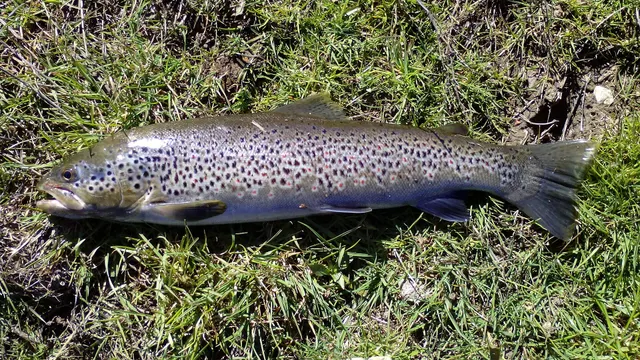 Brown troutOn small lochs and lakes where bank access is limited by trees or by depth, a float tube is often the only way to fish the water at all, and the angler sits at eye level with the surface.
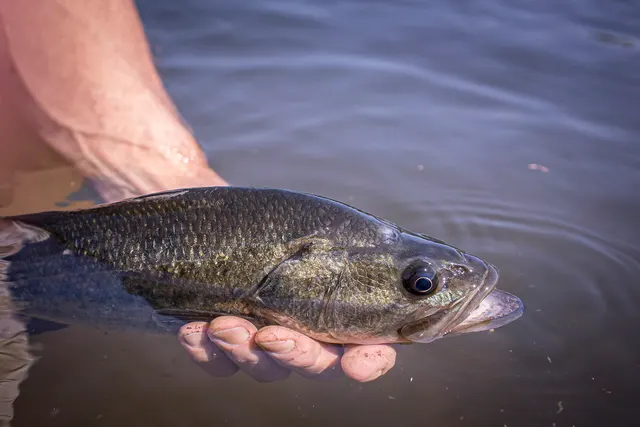 Largemouth bassFloat tubes are used on small, weedy North American waters where a boat cannot be launched and the shallow, timbered margins that hold bass are unreachable from the bank.
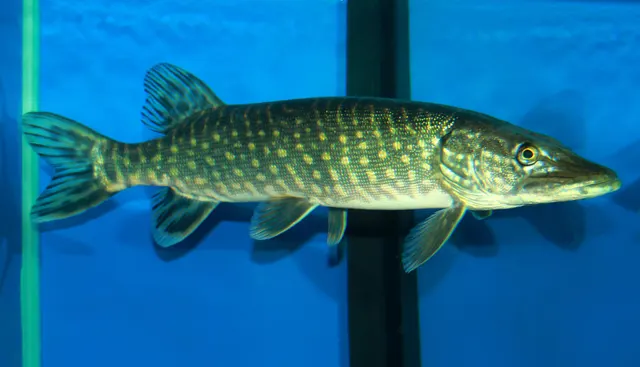 Northern pikeA float tube gives access to shallow weedy bays on waters with no launch, though a pike alongside a float tube puts the angler's legs in the water beside a fish with the dentition to matter, which is a real and specific reason for care.
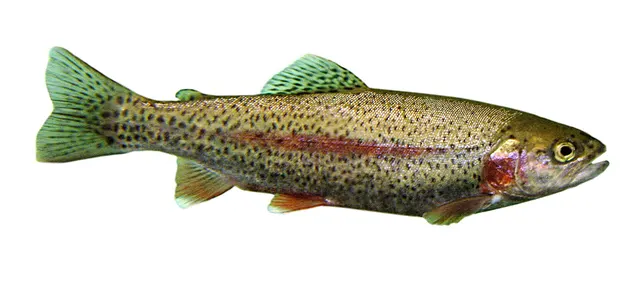 Rainbow troutA float tube puts a fly angler afloat on a small stillwater with a draught of nothing and no wake, which reaches the open-water fish a bank angler cannot cover and does not push them the way a boat does.
How it works
The angler's buoyancy comes from the tube, not from the water, and their propulsion comes from fins worn on the feet. Because the fins push backwards, a float tube travels backwards — the angler faces the water they have just fished and moves away from the water they are about to. Experienced tubers use this: they position by kicking backwards to a spot and then fish forwards over undisturbed water.
Drift is the normal way of covering water. A tube presents almost no windage above the surface and a great deal of drag below it, so it moves slowly with the wind and can be steered across it with the fins. That slow, controllable drift over a fixed depth of water is a genuinely good way to fish a fly, and it is why the device survives despite being uncomfortable.
Depth is fixed and it is the sitting depth of the angler. There is no adjusting it, which means everything is fished from the same height above the bottom regardless of the water's depth — a limitation and, on a shallow water, an advantage.
Conditions
Small to medium stillwaters, light winds, no boat traffic and water warm enough for a session of the intended length. It is genuinely unsuited to open water, to any wind that cannot be kicked back against, to rivers with current, and to cold water without proper immersion clothing. On a large reservoir the return leg is the whole risk, and a tube blown to the far end of one is not a recoverable situation by kicking.
Common mistakes
- Drifting downwind all session and discovering the kick back is beyond you. Work upwind first, drift back.
- Dressing for the air. The lower half is in the water from the first minute to the last.
- Fishing a water with boat traffic. A float tube is invisible and unable to get out of the way.
- Using a single-chamber tube on anything but small sheltered water.
- Bringing a pike or a large perch to the tube without thinking about where your legs are.
Advantages
- Access to water with no launch, no road and no fishable bank.
- Silence and minimal disturbance — the quietest way of being afloat.
- Eye level at the surface film, which is where a lot of stillwater fly fishing is happening.
- It packs into a rucksack and can be walked in.
Limitations
- Slow. A headwind can stop a tube completely, and getting back is the problem.
- Cold. The lower body is immersed for the whole session and hypothermia is a real limit on session length.
- Almost no capacity for tackle or catch.
- Very low freeboard and no visibility to other craft, which rules it out on any water with boat traffic.
- It is a poor platform for anything with teeth or spines, because the angler's legs are in the water beside the fish.
Terms you will meet
- Belly boat
- The common informal name, from the original round tube design that the angler sat inside with the tube around their waist.
- Kick boat
- A larger pontoon-style craft, fin- or oar-propelled, which the angler sits above rather than in. More capable and less portable than a float tube.
- Stripping apron
- A mesh panel across the front of the tube on which fly line is stripped, so it does not sink and tangle around the angler's legs.
Safety
Hypothermia — Can cause serious injury or death
The angler's lower body is immersed continuously for the whole session, which is a mode of heat loss no other fishing method involves. Cooling is gradual and the early stages impair judgement and coordination before the angler notices, which is exactly when propulsion and decision-making are needed.
What reduces it: Wear proper immersion clothing — chest waders as a minimum, neoprene in cold water — set a session length appropriate to the water temperature rather than to the fishing, and get out and warm up rather than pushing on.
Worse when:
- Cold or upland water, and early or late season.
- Wind, which strips heat from the immersed and the exposed parts at once.
- Long sessions, and any delay in getting back to shore.
Drowning and immersion — Can cause serious injury or death
The angler's buoyancy is the tube. A single-chamber tube that punctures or a valve that fails leaves a person in deep water in waders with fins on and no craft, potentially some distance from shore and unable to make progress quickly.
What reduces it: Wear a buoyancy aid over the tube on every session. Use a multi-chamber tube on anything larger than a small sheltered water, check it before launching, and stay within a distance of the shore you could cover if the tube were gone.
Boat traffic and being seen — Can cause serious injury or death
A float tube presents almost nothing above the water and cannot move out of the way of anything. On a water with sailing, powered boats or rowing traffic it is both invisible and unable to take avoiding action.
What reduces it: Do not use a float tube on water carrying other craft. Where a fishery permits both, stay well clear of the areas boats work and carry something high-visibility.
Injury while handling fish — Can cause injury needing treatment
A fish is brought to a craft in which the angler's legs are in the water beside it. Pike, perch, zander and anything with teeth or locking spines are handled at very close quarters with the angler's own body in the water.
What reduces it: Use a net and long forceps, keep the fish in front of the tube rather than beside your legs, and think about the species before deciding to fish for it from a tube at all.
Check the rules before you fish
Fishing laws, bylaws, access rules, seasons, bait restrictions and permitted methods vary by location and can change. Check the current rules from the relevant authority and the water you intend to fish before fishing.
Check with:
- Current national or regional law for where you are fishing
- Current local bylaws
- The relevant fisheries authority
- The landowner, club or fishery whose water it is
- Any restrictions specific to the species or the method you intend to use
Where to go next
Rules and access
More methods
Not related to this page — just the rest of the section. There is little else joined to this subject yet, and a short page should still lead somewhere.
Sources and evidence
- Still Water Fly-Fishing — Andre Deutsch, 1952 (Specialist angling publication)Relied on for: Still-water fly technique and the feeding behaviour it is built on.States this directlyCitation checked — the work exists and is described correctly
- Trout & Salmon — Bauer Media (Specialist angling publication)Relied on for: Contemporary still-water fly practice and the craft used to fish it.Background and mechanism onlyCitation checked — the work exists and is described correctly
- RNLI water safety guidance: cold water shock and Float to Live — Royal National Lifeboat Institution (Water-safety or diver-training authority)Relied on for: Cold water shock and the immersion response, the function of a buoyancy aid, and guidance for recreational water users on tides, cut-off and calling for help.States this directlyPassage read and verified
- RoSPA water safety information and UK accidental drowning statistics — Royal Society for the Prevention of Accidents (Water-safety or diver-training authority)Relied on for: UK accidental drowning statistics and the circumstances in which recreational water users are most often killed.States this directlyPassage read and verified
Why the 5 connections on this page are here, and the sources
What it catches
What experienced anglers do — 4 connections
Widely and independently recommended by experienced anglers and specialist sources. This is real angling knowledge, not proof: controlled evidence for it is limited, and FishingHQ records it as convention rather than as a demonstrated effect.
Brown trout
Established angling practice for this species, recorded as convention. The note states the property of the animal or its water that makes the method the answer.
- Still Water Fly-Fishing — Andre Deutsch, 1952 (Specialist angling publication)Relied on for: Still-water fly technique and the feeding behaviour it is built on.States this directlyCitation checked — the work exists and is described correctly
- Trout & Salmon — Bauer Media (Specialist angling publication)Relied on for: Contemporary still-water fly practice.Background and mechanism onlyCitation checked — the work exists and is described correctly
Largemouth bass
Established angling practice for this species, recorded as convention. The note states the property of the animal or its water that makes the method the answer.
- IGFA International Angling Rules and World Record Requirements — International Game Fish Association (Angling or fisheries organisation)Relied on for: Recognition of the species as an established sport fish and the angling methods and tackle classes conventionally used for it.States this directlyPassage read and verified
- General angling website restatements of established technique — Various (Credible secondary source)Relied on for: Widely restated practice connecting this species and method.Background and mechanism onlyCitation checked — the work exists and is described correctly
Northern pike
Established angling practice for this species, recorded as convention. The note states the property of the animal or its water that makes the method the answer.
- Freshwater Fishing — Macdonald & Jane's, 1975 (Specialist angling publication)Relied on for: Freshwater angling technique and its application to this species.States this directlyCitation checked — the work exists and is described correctly
- Angling Times — Bauer Media (Specialist angling publication)Relied on for: Contemporary practice for this species in the British and European coarse press.Background and mechanism onlyCitation checked — the work exists and is described correctly
Rainbow trout
Established angling practice for this species, recorded as convention. The note states the property of the animal or its water that makes the method the answer.
- Still Water Fly-Fishing — Andre Deutsch, 1952 (Specialist angling publication)Relied on for: Still-water fly technique and the feeding behaviour it is built on.States this directlyCitation checked — the work exists and is described correctly
- Trout & Salmon — Bauer Media (Specialist angling publication)Relied on for: Contemporary still-water fly practice.Background and mechanism onlyCitation checked — the work exists and is described correctly
Rules and access
Official guidance — 1 connection
Stated by a fisheries authority, scientific institute or recognised angling body. Authoritative, but summarising rather than demonstrating.
Biosecurity, and moving equipment between waters
This points to the kind of rule that applies rather than to a rule itself.
- Check Clean Dry — biosecurity guidance for water users — GB Non-native Species Secretariat (Conservation authority)Relied on for: The pathways by which non-native species and pathogens move between waters on damp equipment, and the check-clean-dry principle developed to interrupt them.States this directlyPassage read and verified
- Environment Agency fisheries management, byelaws and rod licensing information — Environment Agency (Government fisheries body)Relied on for: Fisheries management including fish movement controls, disease and the biosecurity measures applied to equipment.States this directlyCitation checked — the work exists and is described correctly
How FishingHQ labels evidence is explained in the evidence policy.