Gigging
Method · Last reviewed 2026-08-13
Wading shallow water at night with a light and a short spear, taking flatfish that lie buried and still. It works because the animal's defence is to not move.
Safety: tides and being cut off — can cause serious injury or death. 3 more points apply here.
Gigging is the practice of taking fish in shallow water at night with a hand-held multi-pronged spear — the gig — using a light to find them. In North America it is most strongly associated with flounder in the shallow bays and sounds of the Gulf and south-east coasts, and inland with suckers and other rough fish in Ozark streams; comparable practices exist wherever shallow water, clear conditions and a buriable flatfish coincide.
THE METHOD IS THE ANIMAL'S DEFENCE TURNED AGAINST IT. A flounder's survival strategy is crypsis: it settles on sand, works itself down until only its eyes are proud, matches the bottom, and stays absolutely still. That defeats a predator hunting by movement, and it defeats an angler too — flounder are hard to locate and are mostly caught by putting a bait past one by chance.
At night with a light, it stops working. The outline of a buried flounder is visible from directly above once you know what you are looking at — a faint oval disturbance in the sand, or the two eyes — and the fish does not flee, because fleeing is not what it does. The gigger walks slowly, sees the fish, and spears it.
THE PRACTICE IS ANCIENT AND THE EQUIPMENT IS MODERN. Spearing fish from the shallows with a light is one of the oldest fishing methods there is and was practised with torches long before it was practised with batteries. What has changed is the light: submersible LED arrays and boat-mounted flood lighting have made the fishery far more efficient than it was, which is precisely why the regulation around it has tightened in several places.
IT IS A KILLING METHOD WITH NO RELEASE. A gigged fish is a speared fish, and there is no version of this where an undersized or wrong-species animal is returned. That single fact drives most of its regulation and most of the objection to it, and it means identification and size judgement have to happen before the strike rather than after it.
What it is
Taking fish in shallow water, almost always at night, with a hand-held multi-pronged spear and an artificial light. Practised on foot by wading or from a shallow-draught boat with mounted lights, and associated principally with flatfish in coastal shallows and with rough fish in inland streams.
What it is for
It takes an animal that cannot readily be located by any other means. A flounder's crypsis makes it inefficient to fish for with a rod and easy to find with a light, and gigging is the method built around that asymmetry.
Setting it up
- Establish the local rules first. Gigging is variously licensed, seasonally restricted, gear-limited, species-limited and prohibited outright, and the rules differ between neighbouring states and counties.
- Light quality decides the session. A light that cannot cut surface glare cannot find fish however bright it is.
- Approach from directly overhead. Refraction puts the fish somewhere other than where it appears from an angle.
- Identify the fish and judge its size before striking, because there is no releasing it afterwards.
- Wade with a plan for the tide and know the ground, because this is done at night in water that is about to change depth.
What it catches
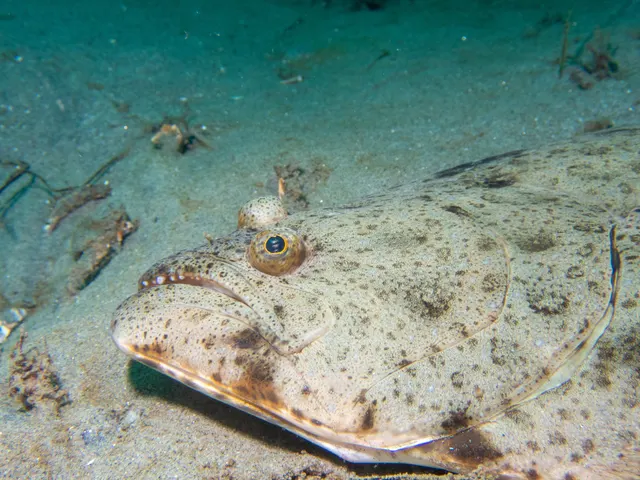 California halibutThe same shallow-water night gigging is practised on other flatfish in the same way and for the same reason, and it is separately regulated everywhere it happens.
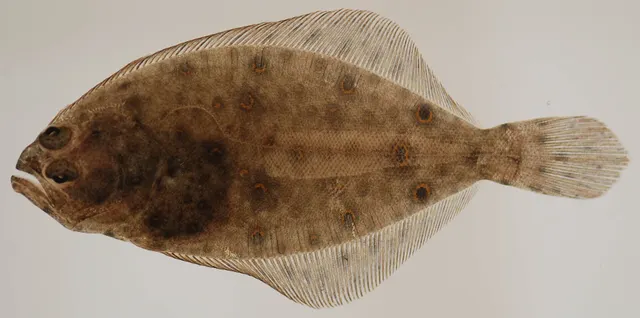 Summer flounderFlounder gigging works because the fish lies buried and still on sand in shallow water at night and does not flee a light. That is the whole method: the animal's ambush strategy is exactly what makes it takeable by hand-held spear in the shallows.
How it works
The light does two things. It illuminates the bottom well enough to see a buried fish, and — where a submersible or forward-facing light is used — it cuts through the surface glare and ripple that otherwise make looking into shallow water impossible. Most of the equipment development in this method has been about light rather than about spears.
The strike is short, hard and vertical. Refraction means a fish seen from above is not where it appears to be if approached at an angle, so the gig goes in from as close to directly overhead as possible, and the multiple prongs cover the error that remains. The prongs are barbed, because a speared flatfish that comes off in silt is not found again.
The walking is the fishing. A gigger covers ground slowly against or across the light's beam, watching a strip of bottom, and the fish is found by recognising a shape rather than by seeing a fish. Water clarity decides everything: a clear night after settled weather is the whole difference between a productive session and a walk.
Conditions
Clear, calm, shallow water at night — typically a sand or firm mud bottom in a bay, sound, estuary or shallow inland stream. Wind is the limiting factor because ripple makes the bottom unreadable, and any run-off or swell that colours the water ends the session. Tide state matters both for where the fish are and for whether the ground being waded is about to be under too much water to work.
Common mistakes
- Striking at an angle and missing because of refraction, then losing the fish into disturbed silt.
- Wading unfamiliar ground at night without knowing where the channels, drop-offs and soft spots are.
- Fishing a tide without having worked out when and how the ground being waded floods.
- Assuming the practice is permitted. It frequently is not, and it is comparatively easy to enforce against.
Advantages
- It locates fish that are effectively invisible and largely uncatchable by other means.
- It is highly selective at the moment of the strike — the fish is seen, identified and sized before anything happens.
- It requires very little equipment beyond a light and a spear.
Limitations
- There is no catch and release. Every fish struck is killed.
- It requires clear, calm, shallow water and is useless without it.
- It is done at night, in water, often alone, which stacks several hazards at once.
- It is prohibited or tightly restricted in many jurisdictions and is unlawful for many species everywhere.
Terms you will meet
- Gig
- The spear itself: a short shaft with a multi-pronged barbed head, usually three to five prongs.
- Crypsis
- The animal's camouflage-and-stillness strategy. It is what makes a flounder hard to catch on a rod and easy to find with a light.
Safety
Tides and being cut off — Can cause serious injury or death
Gigging is done by wading shallow water at night, frequently over ground that floods. A flooding tide across sand and mud flats moves faster than a person can wade, and it fills channels behind the wader before it reaches them.
What reduces it: Work out the tide and the exit before dark rather than during the session, know the ground in daylight before wading it at night, and set a time to be off the flat that is not negotiable.
Worse when:
- Spring tides, when the flood is fastest and the range is greatest.
- Unfamiliar ground, and any flat with channels behind it.
- Onshore wind, which raises the water above predicted height.
Knives and cutting tools — Can cause injury needing treatment
A gig is a barbed multi-pronged spear used with a downward strike, in the dark, by somebody standing in the water it is being driven into. Foot and lower-leg injuries are the characteristic accident and a barbed prong in a foot does not come out the way it went in.
What reduces it: Wear substantial footwear, know where your feet are before striking, and never strike toward a foot or toward another person. Carry the gig point-down and controlled when moving.
Venomous and spined species — Can cause injury needing treatment
The shallow sandy ground gigged at night is also where stingrays, weever fish and other buried spined animals lie, and a wading foot finds them. A stingray barb through a foot is a serious injury and weever stings are severely painful.
What reduces it: Shuffle rather than step, so a buried animal is nudged and moves rather than trodden on. Wear stout footwear, and know what the local buried hazards are before wading at night.
Fishing alone — Can cause injury needing treatment
This is done at night, in water, often alone, with a spear, on ground that may be flooding. Any one of those is manageable and the combination removes the margin for a simple problem such as a twisted ankle.
What reduces it: Go with somebody. Tell somebody ashore where you are and when you will be back, and carry a light and a means of calling for help that survives immersion.
Check the rules before you fish
Fishing laws, bylaws, access rules, seasons, bait restrictions and permitted methods vary by location and can change. Check the current rules from the relevant authority and the water you intend to fish before fishing.
Check with:
- Current national or regional law for where you are fishing
- Current local bylaws
- The relevant fisheries authority
- The landowner, club or fishery whose water it is
- Any restrictions specific to the species or the method you intend to use
Where to go next
Compared with
More methods
Not related to this page — just the rest of the section. There is little else joined to this subject yet, and a short page should still lead somewhere.
Sources and evidence
- FAO fishing gear types and fishing technology information — Food and Agriculture Organization of the United Nations (Scientific institute)Relied on for: Classification, construction and operating principle of this gear type in the FAO gear taxonomy.States this directlyCitation checked — the work exists and is described correctly
- Fishers' Craft and Lettered Art: Tracts on Fishing from the End of the Middle Ages — University of Toronto Press, 1997 (Scientific literature)Relied on for: That fishing practices develop around the fish and water available to them, and the historical method of reading such traditions.Background and mechanism onlyCitation checked — the work exists and is described correctly
- Fishers' Craft and Lettered Art: Tracts on Fishing from the End of the Middle Ages — University of Toronto Press, 1997 (Scientific literature)Relied on for: The long documentary record of traditional and pre-industrial fishing practices, and how such traditions are read.States this directlyCitation checked — the work exists and is described correctly
- Words of the Lagoon: Fishing and Marine Lore in the Palau District of Micronesia — University of California Press, Berkeley, 1981 (Reference work)Relied on for: That traditional fishing practices encode detailed knowledge of fish behaviour, and that the practice is frequently the record of the biology.Background and mechanism onlyCitation checked — the work exists and is described correctly
Why the 3 connections on this page are here, and the sources
What it catches
What experienced anglers do — 2 connections
Widely and independently recommended by experienced anglers and specialist sources. This is real angling knowledge, not proof: controlled evidence for it is limited, and FishingHQ records it as convention rather than as a demonstrated effect.
California halibut
Established angling practice for this species, recorded as convention. The note states the property of the animal or its water that makes the method the answer.
- Fishers' Craft and Lettered Art: Tracts on Fishing from the End of the Middle Ages — University of Toronto Press, 1997 (Scientific literature)Relied on for: That fishing practices develop around the fish and water available to them, and the historical method of reading such traditions.Background and mechanism onlyCitation checked — the work exists and is described correctly
- FAO fishing gear types and fishing technology information — Food and Agriculture Organization of the United Nations (Scientific institute)Relied on for: Classification and operation of the gear type described.States this directlyCitation checked — the work exists and is described correctly
Summer flounder
Established angling practice for this species, recorded as convention. The note states the property of the animal or its water that makes the method the answer.
- Fishers' Craft and Lettered Art: Tracts on Fishing from the End of the Middle Ages — University of Toronto Press, 1997 (Scientific literature)Relied on for: That fishing practices develop around the fish and water available to them, and the historical method of reading such traditions.Background and mechanism onlyCitation checked — the work exists and is described correctly
- FAO fishing gear types and fishing technology information — Food and Agriculture Organization of the United Nations (Scientific institute)Relied on for: Classification and operation of the gear type described.States this directlyCitation checked — the work exists and is described correctly
Compared with
What experienced anglers do — 1 connection
Widely and independently recommended by experienced anglers and specialist sources. This is real angling knowledge, not proof: controlled evidence for it is limited, and FishingHQ records it as convention rather than as a demonstrated effect.
Darkhouse spearing
Two records a reader would reasonably weigh against one another, joined where reading both teaches something neither says alone.
- Freshwater Fishing — Macdonald & Jane's, 1975 (Specialist angling publication)Relied on for: Comprehensive angling practice including tackle, presentation and the reasoning behind terminal tackle choices.States this directlyCitation checked — the work exists and is described correctly
- Angling Times — Bauer Media (Specialist angling publication)Relied on for: Contemporary UK angling practice as reported by practitioners, including tackle convention, rig use and technique.Background and mechanism onlyCitation checked — the work exists and is described correctly
How FishingHQ labels evidence is explained in the evidence policy.