Hole hunting
Method · Last reviewed 2026-08-10
Searching caves, cracks, overhangs and undercuts for the fish that live in them — highly productive, and the technique with the least margin when something goes wrong.
Safety: entanglement — can cause serious injury or death. 6 more points apply here.
Never dive alone, dive one up one down, and never extend a dive for a fish.
Shallow water blackout and breath-hold loss of consciousness — Can cause serious injury or death
The usual mechanism, made worse by an overhead environment and by a buddy who frequently cannot see the diver. A blackout inside structure is very unlikely to be survived.
What reduces it: Short, conservative dives with the time set on the surface. One up, one down with the surface diver close enough to intervene. Never hyperventilate. Do not extend a dive because a fish is in reach — in this technique above all.
A great many fish do not sit in open water. They live in holes: under boulders, inside cracks in reef, beneath overhangs and in the caves that rock and coral form. Hole hunting is going and looking in them.
It is productive because the fish are reliably there, they are frequently large, and many of them do not flee — a grouper backed into a cave has decided the cave is safer than the open, and it may not move at all. That makes hole hunting the most consistent way of finding certain species and one of the more thoughtful branches of the sport, because it depends on knowing which holes hold what and reading the ground rather than covering it.
It is also where the margins are thinnest, and this should be stated plainly rather than in a footnote. A diver with their head and shoulders in a hole is in an overhead environment on a breath-hold. They cannot ascend. They frequently cannot see their buddy and their buddy cannot see them. A short gun, a torch and a hand are all in a confined space with a fish that may object, and the route out is behind them, backwards, in a cloud of disturbed sediment.
Everything about the technique's equipment — very short guns, a torch on the wrist, a cutting tool reachable with either hand — follows from that.
What it is
Breath-hold spearfishing that searches confined structure — caves, cracks, overhangs, undercut rock and coral heads — for the species that shelter in it, rather than hunting fish in open water.
What it is for
To reach species that live in structure and are not available to any technique that hunts open water, on ground where they can be found reliably rather than encountered by chance.
Setting it up
- A SHORT gun. A long gun cannot be aimed in a hole and is a liability getting in and out of one.
- A torch on the wrist or the gun, so both hands stay available.
- Never put your head somewhere you have not looked into first, and never a hand.
- Go in far enough to see and no further. The technique does not require entering anything.
- A cutting tool reachable with EITHER hand, and practised blind — this is the technique where you will need it.
What it catches
- Red scorpionfishScorpionfish occupy exactly the holes and ledges hole hunting searches, which is why the technique and the envenomation risk arrive together.
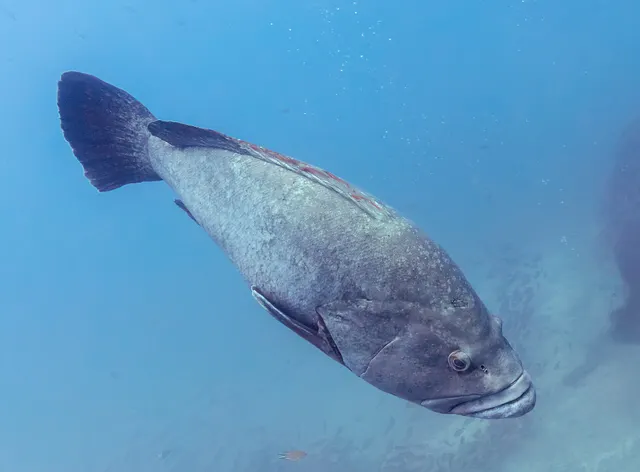 Dusky grouperThe grouper's habit of holding in a known hole and not fleeing makes it findable and makes it exceptionally vulnerable — a fish that stays put is not adapted to a predator that can follow it home.
How it works
The diver descends to structure and inspects it, usually with a torch, looking into holes rather than across ground. Where a fish is found, the shot is taken at very short range with a short gun that can be manoeuvred in a confined space. Because the fish is in cover, the shot must be placed to stop it rather than to hold it — a fish that runs deeper into a hole with a shaft in it is frequently lost, and lost badly.
Conditions
Hole hunting needs settled conditions above all. Swell moves a diver against rock in a confined space, and doing that with a head inside a hole is how people are injured. It needs visibility good enough to see into structure, which usually means a torch regardless. It suits rock, reef and boulder ground; over sand and open bottom there is nothing to search.
Common mistakes
- Using the gun you were already carrying instead of a short one.
- Putting a hand into a hole to feel for a fish.
- Entering far enough that the exit requires manoeuvring rather than backing out.
- Continuing after a shot goes into structure rather than accepting the loss.
- Hole hunting in swell, which is the condition that turns a mistake into an injury.
Advantages
- Finds fish that are genuinely there rather than passing, which makes sessions repeatable.
- Reaches species unavailable to open-water technique.
- Rewards knowledge of ground over fitness, so it suits a diver working a small area well.
- Short range makes identification and shot placement easier than at distance.
Limitations
- An overhead environment on a breath-hold, with all that implies.
- Sediment disturbed on entry can remove visibility on the way out.
- Buddy contact is frequently broken at the moment it matters most.
- Shot fish can run into structure and be lost, which is a welfare failure as well as a lost fish.
Reaching into a hole is a decision about what you cannot see
Hole hunting is the technique with the highest ratio of risk to reward in the whole vertical, and the risk is not the one people expect. It is not the fish. It is the geometry.
WHAT MAKES IT DIFFERENT FROM EVERY OTHER TECHNIQUE: the diver is putting a limb, a head, a gun or a light into a space they cannot fully see, at the bottom of a breath-hold, and the exit from that space is not always the reverse of the entry.
THE ENTRAPMENT PROBLEM IS THE SERIOUS ONE. A shoulder that fits going in can jam coming out at a slightly different angle, particularly with a suit, a weight belt and a gun involved. Surge moves a diver a few centimetres at exactly the wrong moment. Kelp and loose line at the mouth of a hole complete the picture. This is entanglement's near relative and it has the same property: on a breath-hold there is no option to stop and think.
WHICH GIVES THE RULES THAT ARE SAFE TO PUBLISH. Do not enter a space you cannot back straight out of. Do not put a head where a hand has not been. Keep the gun and the line out of the hole rather than following them in. Know where the cutting tool is by feel. And have a buddy positioned to see you rather than somewhere else on the reef — this is the technique where a buddy who is 'nearby' is not a buddy.
THE MARINE-LIFE PART IS REAL AND SECOND-ORDER. Holes hold conger and moray, both of which bite defensively and hold on, and in some waters they hold things that sting. A gloved hand into an unseen hole is how those encounters happen. The mitigation is looking first and reaching second, which also happens to be the mitigation for the entrapment problem.
AND THE WELFARE AND CONSERVATION EDGE MATTERS HERE MORE THAN ELSEWHERE. A fish in a hole is a fish in cover it cannot be pulled out of without tearing, and a fish shot in a hole frequently wedges. `a-fish-that-comes-off-and-what-you-owe-it` covers the obligation and its boundary. The additional consideration specific to this technique is that holes are where resident, slow-growing, territorial fish live — the fish that do not come back for years if a hole is emptied.
Spearfishing is regulated differently in every jurisdiction and frequently differently within one — on equipment, on areas, on seasons, on species, on minimum sizes, on the use of any breathing apparatus and on who may do it at all. Those rules change. Check the current rules with the authority for the water you are diving before you go.
Official guidance — why, and the sources (3)
Stated by a fisheries authority, scientific institute or recognised angling body. Authoritative, but summarising rather than demonstrating.
- BSAC diving safety guidance and annual incident report — British Sub-Aqua Club (Water-safety or diver-training authority)Relied on for: Diving safety guidance covering buddy protocol, shore and boat diving practice, entanglement and the incident patterns behind them.States this directlyCitation checked — the work exists and is described correctly
- DAN guidance on freediving safety, hypoxia and shallow-water blackout — Divers Alert Network (Water-safety or diver-training authority)Relied on for: Freediving safety practice: hypoxic blackout, its absence of warning symptoms, the ascent as the highest-risk phase, and the surface supervision that addresses it.States this directlyPassage read and verified
- CMAS technical and sporting standards for underwater activities — Confédération Mondiale des Activités Subaquatiques (Standards body)Relied on for: Technical and sporting standards for underwater activities, including spearfishing conduct, technique convention and the safety expectations set by the international underwater federation.States this directlyCitation checked — the work exists and is described correctly
Safety
Shallow water blackout and breath-hold loss of consciousness is set out at the top of this page, where it cannot be missed.
Never dive alone, dive one up one down, and never extend a dive for a fish. The full set of breath-hold essentials — training, the buddy system, conditions, equipment and visibility — is on the spearfishing safety page.
Entanglement — Can cause serious injury or death
A diver in confined structure on a breath-hold has no vertical escape and a route out that is behind them. Snagging on the structure, on their own line, or on discarded fishing gear that has collected in exactly this kind of ground is a time-limited emergency with the least room to solve it.
What reduces it: Do not enter structure — look into it. Keep the float line short and clear. Carry a cutting tool reachable with either hand and practise drawing it blind. Keep your buddy positioned where they can actually reach you, which for this technique means close. Back out the way you came in, and be willing to abandon gun and fish immediately.
Worse when:
- Where discarded line and netting have collected in structure
- In swell, which moves the diver against rock
- When sediment has been disturbed and visibility inside is gone
Encounters with marine life — Can cause injury needing treatment
Holes hold morays, conger eels, octopus, venomous species and, in some regions, animals capable of a serious bite. A hand or a face put into a hole without looking is how those encounters happen.
What reduces it: Look before you reach, always, and use a torch to do it. Know what lives in structure where you are diving. Do not reach into anything to retrieve a fish or a shaft.
Precautions that always apply here
- Never spearfish or freedive alone.
- Dive one up, one down: one diver down, one on the surface actively watching, every single dive.
- Never hyperventilate before a breath-hold. It delays the urge to breathe without adding oxygen, which is precisely the mechanism behind shallow water blackout.
- Carry a charged phone in a waterproof case, or another means of calling for help.
Further safety reading
- Entanglement while breath-hold diving — The technique with no vertical escape and an exit that is behind you. Everything that saves a diver here is prepared before the dive, because there is no time to improvise once it starts.
Where to go next
Related techniques
Skills behind it
- Bottom type, and what lives on itHoles and ledges are where the technique's specific risks live.
- Entanglement, and the knife that is not a weaponFollowing your own shooting line into structure is the specific interaction behind most entanglement incidents.
- Line and float-line tanglesFollowing your own line into a space you cannot back out of is the highest-risk version of this.
- Pneumatic spearguns, and what they tradeShort powerful guns suit confined ground, which is where pneumatics have their strongest technical case.
- Shallow-water blackout: what it is, and why it gives no warningA technique that extends bottom time while occupied inside structure is the profile with the least margin for error.
- Speargun length, and what it decidesA long gun cannot be brought to bear in a hole, a gully or a kelp stand.
Compared with
Sources and evidence
- BSAC diving safety guidance and annual incident report — British Sub-Aqua Club (Water-safety or diver-training authority)Relied on for: Entanglement and overhead environments as recognised diving hazards, and the equipment and buddy practice that address them.States this directlyCitation checked — the work exists and is described correctly
- DAN guidance on freediving safety, hypoxia and shallow-water blackout — Divers Alert Network (Water-safety or diver-training authority)Relied on for: That breath-hold emergencies are time-limited from the moment they begin, and that an overhead environment removes the ascent that would otherwise resolve one.FishingHQ's interpretation of what it saysPassage read and verified
Why the 12 connections on this page are here, and the sources
What it catches
What experienced anglers do — 1 connection
Widely and independently recommended by experienced anglers and specialist sources. This is real angling knowledge, not proof: controlled evidence for it is limited, and FishingHQ records it as convention rather than as a demonstrated effect.
Red scorpionfish
What divers actually use a technique for, recorded as convention.
- CMAS technical and sporting standards for underwater activities — Confédération Mondiale des Activités Subaquatiques (Standards body)Relied on for: Breath-hold diving and spearfishing practice, training structure and safety expectations as set out by the international underwater federation.States this directlyCitation checked — the work exists and is described correctly
- BlueWater Hunting and Freediving — BlueWater Freedivers, Ventura, California, 1995 (Practitioner report)Relied on for: Spearfishing practice: approach, fish behaviour and the handling of speared fish, from a practitioner tradition distinct from the European one.States this directlyCitation checked — the work exists and is described correctly
Practice, recorded as practice.
- CMAS technical and sporting standards for underwater activities — Confédération Mondiale des Activités Subaquatiques (Standards body)Relied on for: Breath-hold diving and spearfishing practice, training structure and safety expectations as set out by the international underwater federation.States this directlyCitation checked — the work exists and is described correctly
- BlueWater Hunting and Freediving — BlueWater Freedivers, Ventura, California, 1995 (Practitioner report)Relied on for: Spearfishing practice: approach, fish behaviour and the handling of speared fish, from a practitioner tradition distinct from the European one.States this directlyCitation checked — the work exists and is described correctly
Backed by research — 1 connection
Supported by peer-reviewed research or fisheries science. The sources are listed and can be checked.
Dusky grouper
A claim resting on the species' documented territoriality and habitat use rather than on practitioner report, because it is the basis of the conservation argument on both records.
- FishBase: a global information system on fishes — Froese, R. and D. Pauly, eds. — FishBase Consortium (Scientific institute)Relied on for: That Epinephelus marginatus is reef-associated on rocky bottom, with adults solitary and territorial, and that it has low resilience with a minimum population doubling time of 4.5 to 14 years and a vulnerability score of 64 out of 100.States this directlyPassage read and verified
- Good Fish Guide — Marine Conservation Society (Conservation authority)Relied on for: That site fidelity and slow replacement are material to whether a local population can sustain harvest.FishingHQ's interpretation of what it saysCitation checked — the work exists and is described correctly
Related techniques
Official guidance — 1 connection
Stated by a fisheries authority, scientific institute or recognised angling body. Authoritative, but summarising rather than demonstrating.
Spearfishing
A technique claim inseparable from its hazard: this is breath-hold diving in an overhead environment, which is a materially different activity from open-water spearfishing.
- BSAC diving safety guidance and annual incident report — British Sub-Aqua Club (Water-safety or diver-training authority)Relied on for: Overhead environments and entanglement as recognised diving hazards, and the equipment and buddy practice that address them.States this directlyCitation checked — the work exists and is described correctly
- DAN guidance on freediving safety, hypoxia and shallow-water blackout — Divers Alert Network (Water-safety or diver-training authority)Relied on for: That breath-hold emergencies are time-limited from the moment they begin, and that an overhead environment removes the ascent that would resolve one.FishingHQ's interpretation of what it saysPassage read and verified
What you fish it with
What experienced anglers do — 1 connection
Widely and independently recommended by experienced anglers and specialist sources. This is real angling knowledge, not proof: controlled evidence for it is limited, and FishingHQ records it as convention rather than as a demonstrated effect.
Spearguns
A requirement rather than a preference: the ground makes a long gun unusable rather than merely awkward.
- CMAS technical and sporting standards for underwater activities — Confédération Mondiale des Activités Subaquatiques (Standards body)Relied on for: Breath-hold spearfishing practice, equipment convention and the safety expectations set out by the international underwater federation.States this directlyCitation checked — the work exists and is described correctly
- BlueWater Hunting and Freediving — BlueWater Freedivers, Ventura, California, 1995 (Practitioner report)Relied on for: Spearfishing equipment and practice: gun, shaft, tip and rigging choice, and the handling of a shot fish, from a practitioner tradition distinct from the European one.States this directlyCitation checked — the work exists and is described correctly
Skills behind it
Backed by research — 2 connections
Supported by peer-reviewed research or fisheries science. The sources are listed and can be checked.
Bottom type, and what lives on it
The ground that creates the risk.
- Cefas science, advice and data on marine and freshwater environments — Centre for Environment, Fisheries and Aquaculture Science (Government fisheries body)Relied on for: Marine habitat science on substrate type, structural complexity and associated fish communities.States this directlyCitation checked — the work exists and is described correctly
Shallow-water blackout: what it is, and why it gives no warning
The highest-risk technique meets the principal hazard here.
- DAN guidance on freediving safety, hypoxia and shallow-water blackout — Divers Alert Network (Water-safety or diver-training authority)Relied on for: The physiology of hypoxic blackout, including the carbon dioxide basis of the urge to breathe and the ascent-related fall in oxygen partial pressure.States this directlyPassage read and verified
Official guidance — 4 connections
Stated by a fisheries authority, scientific institute or recognised angling body. Authoritative, but summarising rather than demonstrating.
Entanglement, and the knife that is not a weapon
The technique that most reliably produces the hazard.
- BSAC diving safety guidance and annual incident report — British Sub-Aqua Club (Water-safety or diver-training authority)Relied on for: Diving safety guidance on entanglement hazards and emergency cutting equipment.States this directlyCitation checked — the work exists and is described correctly
Line and float-line tangles
The technique that most reliably produces it.
- BSAC diving safety guidance and annual incident report — British Sub-Aqua Club (Water-safety or diver-training authority)Relied on for: Diving safety guidance on entanglement hazards, line management and emergency cutting equipment.States this directlyCitation checked — the work exists and is described correctly
Pneumatic spearguns, and what they trade
The technique the design suits best.
- FAO fishing gear types and fishing technology information — Food and Agriculture Organization of the United Nations (Scientific institute)Relied on for: Gear classification for powered spear devices and their propulsion systems.States this directlyCitation checked — the work exists and is described correctly
Speargun length, and what it decides
The clearest case where length is the wrong variable to maximise.
- FAO fishing gear types and fishing technology information — Food and Agriculture Organization of the United Nations (Scientific institute)Relied on for: Spear and powered spear gear specification and classification.States this directlyCitation checked — the work exists and is described correctly
Compared with
Official guidance — 1 connection
Stated by a fisheries authority, scientific institute or recognised angling body. Authoritative, but summarising rather than demonstrating.
Freediving for lobster
The two methods share their dominant hazard — a diver committed head-first into a space at the end of a dive — and a reader of either should meet the other.
- DAN guidance on freediving safety, hypoxia and shallow-water blackout — Divers Alert Network (Water-safety or diver-training authority)Relied on for: Breath-hold diving safety practice, including supervision, surface marking and the equipment the discipline depends on.Background and mechanism onlyPassage read and verified
Safety reading
Official guidance — 1 connection
Stated by a fisheries authority, scientific institute or recognised angling body. Authoritative, but summarising rather than demonstrating.
Entanglement while breath-hold diving
A direct safety claim about the technique's defining hazard.
- BSAC diving safety guidance and annual incident report — British Sub-Aqua Club (Water-safety or diver-training authority)Relied on for: Entanglement as a recognised diving hazard and the practice that addresses it.States this directlyCitation checked — the work exists and is described correctly
- DAN guidance on freediving safety, hypoxia and shallow-water blackout — Divers Alert Network (Water-safety or diver-training authority)Relied on for: The physiological constraint that makes a breath-hold emergency time-limited.States this directlyPassage read and verified
The technique record and the hazards specific to it.
- BSAC diving safety guidance and annual incident report — British Sub-Aqua Club (Water-safety or diver-training authority)Relied on for: Diving safety guidance on planning, conditions assessment, buddy protocol, entanglement and equipment handling.States this directlyCitation checked — the work exists and is described correctly
How FishingHQ labels evidence is explained in the evidence policy.