Dusky grouper
Fish · Last reviewed 2026-08-10
The Mediterranean's iconic reef predator: territorial, slow to mature, sex-changing, and the species whose decline made the case for marine protected areas there.
Safety: fish welfare — can cause injury needing treatment. 4 more points apply here.
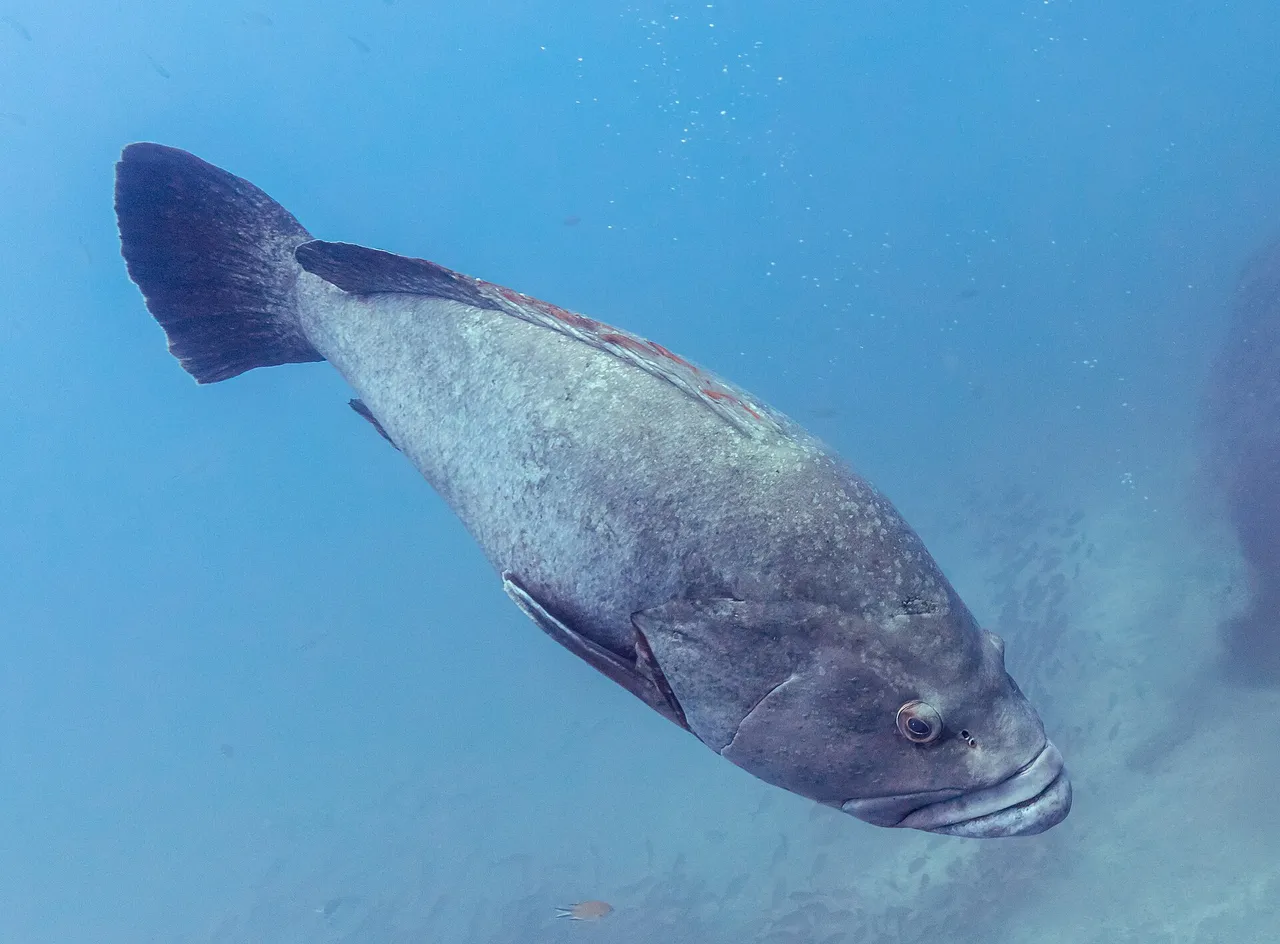
Catching Dusky grouper
Everything here on fishing for it. Each entry opens the page behind it.
- When
- Jun–Sept — months recorded at the places that document it, not a season for the whole range.
- Where
- 19 places FishingHQ documents — strongest claim anywhere: regular local target · From the shore, Spearfishing, From a boat
The dusky grouper is the fish Mediterranean spearfishers built a culture around, and the fish whose disappearance from much of that sea became the argument for protecting parts of it.
It is a large, solitary, territorial predator of rocky bottom, living in a hole it knows intimately and defending it. That habit makes it findable — a grouper is where it was last week — and it is exactly why the species is so vulnerable to a method that goes and looks in holes. A fish that stays put and does not flee is not adapted for a predator that can follow it home.
The biology compounds the problem. It is a protogynous hermaphrodite: females mature at around five years and change sex to male at around ten, so every large individual is a male and the breeding males are the last fish to arrive and the first to be taken. It is long-lived and slow-growing, with FishBase rating its vulnerability at 64 out of 100 and its resilience as low, with a minimum population doubling time of four and a half to fourteen years.
Where it has been protected — in reserves where fishing and spearfishing are excluded — it has come back, and it has done so visibly and quickly enough that those reserves became the clearest available demonstration of what protection actually does. That is the fish's real significance now: not as a trophy but as evidence.
How it is caught
- Hole huntingThe grouper's habit of holding in a known hole and not fleeing makes it findable and makes it exceptionally vulnerable — a fish that stays put is not adapted to a predator that can follow it home.
- Reef spearfishingFour specimens for 8.61 kg in the Canary catch, and EVERY ONE of them below the minimum scientifically advised length. The species is IUCN-vulnerable, sequentially hermaphroditic, and matures late — which is what makes an all-immature catch a finding rather than a footnote.
Where Dusky grouper is documented
Places where public sources describe this species as fished, with how it is fished and how strongly the evidence supports it. This is not a range map and it is not a recommendation — it is what has been written down about a fishery rather than a record of any individual catch, and being listed is never permission to fish.
The Azores
5 documented places
Cliff coast
Regular local target
From a boat · Spearfishing
The Terceira coastal reefs
Reef
Repeatedly reported
From a boat
Around Jun, Jul, Aug, Sept
Offshore bank
Repeatedly reported
From a boat
Around Jun, Jul, Aug, Sept
The Formigas and the Dollabarat bank
Offshore bank
Repeatedly reported
From a boat
Around Jun, Jul, Aug, Sept
The Graciosa north-west coast
Cliff coast
Recorded here
From a boat
Around Jun, Jul, Aug, Sept
Canary Islands
7 documented places
Reef
Recorded here
From a boat
Punta de Fuencaliente, La Palma
Rock platform
Occasional
Spearfishing
The south-east coast of La Gomera
Cliff coast
Occasional
Spearfishing
The Tamaduste coast, El Hierro
Rock platform
Occasional
Spearfishing
Rock platform
Recorded here
From the shore · Spearfishing
Cliff coast
Recorded here
From the shore · Spearfishing
Cove
Recorded here
From the shore · Spearfishing
Lanzarote
5 documented places
Puerto del Carmen harbour, Lanzarote
Harbour wall
Recorded here
From the shore
Cove
Occasional
Spearfishing
The Costa Teguise shore, Lanzarote
Rock platform
Recorded here
From the shore
Rock platform
Recorded here
From the shore
Rock platform
Recorded here
From the shore
What these strengths mean
- Repeatedly reported
- Several independent public accounts. Enough to say it happens more than once; not enough to call it a fishery.
- Regular local target
- Fishing sources describe this as a normal local target here, not merely as caught.
- Recorded here
- At least one credible public account of this species being caught here. That is all it means.
- Occasional
- Caught here, and described as unusual rather than normal. Do not plan a session around it.
When to fish for dusky grouper
Where the places here state a season for dusky grouper, it clusters in Jun–Sep. This is a count of how many documented places name each month — evidence about when people fish for it, not a prediction of what any particular day will produce.
| Jan | Feb | Mar | Apr | May | Jun | Jul | Aug | Sep | Oct | Nov | Dec |
|---|---|---|---|---|---|---|---|---|---|---|---|
| January: no place here names this month — no place names it. | February: no place here names this month — no place names it. | March: no place here names this month — no place names it. | April: no place here names this month — no place names it. | May: no place here names this month — no place names it. | June: 4 places name this month — most places. | July: 4 places name this month — most places. | August: 4 places name this month — most places. | September: 4 places name this month — most places. | October: no place here names this month — no place names it. | November: no place here names this month — no place names it. | December: no place here names this month — no place names it. |
4 of the 19 places that record catches of dusky grouper state which months. The other 15 name no season, so they are counted in neither direction: the shape above is what the dated records say, not the whole picture. The dated records come from a single area, so this is a local season rather than a general one.
Identification
- Scientific name
- Epinephelus marginatus
- Family
- Epinephelidae
- Water
- Saltwater
- Conservation status
- Not assessed
- Regions
- Mediterranean, Western Europe, North Africa, East & Southern Africa, Central & South America
- Massive, deep, heavy body with a very large mouth and a projecting lower jaw — the classic grouper outline.
- Dark brown to grey-green with irregular pale blotches and mottling that changes with mood and background; juveniles are more strongly marked.
- A single long dorsal fin with the spiny and soft portions continuous, and rounded pectoral, anal and tail fins.
- A pale margin on the soft dorsal, anal and tail fins in many individuals, which is the origin of marginatus.
- Several Epinephelus species overlap in the eastern Atlantic and Mediterranean; body proportion, fin shape and the pale fin margins separate them rather than colour, which is unreliable underwater.
Size
- Typical
- 2–8 kg (4–18 lb)
- Large
- 15–25 kg (33–55 lb)
Exceptional: Over 35 kg (77 lb); maximum published weight 60 kg
A hole in the rock, held for years
Dusky grouper are the archetypal site-attached Mediterranean reef predator, and their habitat use is best described as tenancy rather than range.
EACH FISH OCCUPIES A SHELTER AND DEFENDS IT. An adult dusky grouper takes a cave, crevice or overhang in rocky reef and occupies it for years, foraging within a limited area around it and returning to the same hole. That fidelity is the single most important fact about the species.
ROCKY REEF WITH COMPLEX RELIEF IS THE REQUIREMENT — boulder fields, cliff bases, cave systems and broken rock, generally in the shallow to mid-depth range, with larger fish deeper.
JUVENILES USE SHALLOW ROCKY GROUND AND TIDE POOLS, in very shallow water close inshore, moving progressively deeper as they grow.
THEY ARE AMBUSH PREDATORS WITH POWERFUL SUCTION FEEDING, taking octopus, crustaceans and fish from close range, so their foraging habitat is the ground immediately around the shelter.
AND SITE FIDELITY IS EXACTLY WHY THE SPECIES WAS DEPLETED. A large, slow-growing, curious fish that lives in a known hole is trivially easy to remove, particularly by spearfishing, and populations near population centres were reduced severely across the Mediterranean during the twentieth century.
THE RECOVERY INSIDE MARINE RESERVES IS CORRESPONDINGLY VISIBLE, and dusky grouper abundance and size inside protected areas is one of the better-documented reserve effects in European waters.
Backed by research — why, and the sources (2)
Supported by peer-reviewed research or fisheries science. The sources are listed and can be checked.
- FAO Species Identification Guides for Fishery Purposes and the FAO Species Catalogues — Food and Agriculture Organization of the United Nations (Scientific institute)Relied on for: Distribution, habitat, depth and fishery accounts for the species in the FAO regional identification guides for the ocean area concerned.States this directlyCitation checked — the work exists and is described correctly
- The IUCN Red List of Threatened Species — International Union for Conservation of Nature (Conservation authority)Relied on for: Assessment and range account for the species, including the habitats it depends on, its life history and the pressures acting on it.States this directlyCitation checked — the work exists and is described correctly
Summer aggregation, and a species that changes sex late
Dusky grouper are protogynous hermaphrodites that aggregate to spawn, and both facts drive their vulnerability.
THEY BEGIN LIFE AS FEMALES AND BECOME MALE LATE, at a large size and an advanced age. The consequence is direct: males are the biggest, oldest fish, and a fishery that removes large individuals removes the males specifically. A population fished hard can end up with too few males to fertilise the eggs its females produce, which is a failure mode that no catch statistic reveals.
SPAWNING IS IN SUMMER, when water is warmest, and fish gather in aggregations at particular sites rather than spawning from their individual shelters.
AGGREGATIONS ARE PREDICTABLE AND THAT IS THE PROBLEM. A gathering of large reproductive adults at a known place and time is the most efficiently removable form a population can take, and the loss of grouper aggregations across the Mediterranean and worldwide is among the best-documented reef fishery declines.
EGGS AND LARVAE ARE PELAGIC, drifting before juveniles settle into very shallow rocky habitat.
MATURITY IS LATE, GROWTH IS SLOW AND LIFESPAN IS LONG — several decades — so recovery from depletion takes decades too.
AND SUMMER IS ALSO WHEN DIVING PRESSURE PEAKS, which is why seasonal protection of aggregations exists in some jurisdictions. This page describes biology and does not state what any current measure permits.
Backed by research — why, and the sources (2)
Supported by peer-reviewed research or fisheries science. The sources are listed and can be checked.
- Reef Fish Spawning Aggregations: Biology, Research and Management — Springer, Fish & Fisheries Series vol. 35, 2012 (Scientific literature)Relied on for: Reef fish spawning aggregations, their predictability in space and time, and the vulnerability that predictability creates.States this directlyCitation checked — the work exists and is described correctly
- The IUCN Red List of Threatened Species — International Union for Conservation of Nature (Conservation authority)Relied on for: Assessment and range account for the species, including the habitats it depends on, its life history and the pressures acting on it.States this directlyCitation checked — the work exists and is described correctly
A population that can stop reproducing while still full of fish
Dusky grouper combine the two most dangerous reproductive traits a fish can have, and the combination produces a failure mode that is invisible from the catch.
THE FIRST IS PROTOGYNY. Individuals mature as females and change sex to male with age and size. The largest fish in a population are therefore the males, and size-selective removal — which is what every fishery does, and what spearfishing does most precisely of all — takes the breeding males specifically.
AND HERE IS THE FAILURE MODE. A heavily fished dusky grouper population can lose its capacity to reproduce while still containing plenty of grouper. The fish that are left are females; the fish that fertilised them are gone; and nothing about the number of fish an angler or a diver sees indicates the problem. A stock can look fished-down-but-functional and be reproductively broken. Sex change offers some compensation, since the loss of males prompts large females to switch, but that takes years and it does so by removing large females from the female pool — it is a redistribution of a shrinking resource rather than a recovery.
THE SECOND IS AGGREGATION. Spawning occurs in the warmer months with aggregation behaviour recorded in some areas, which adds a second and independent predictability: fish concentrating in known places at known times, on top of a size structure that means the fish taken are the reproductively critical ones.
EVERYTHING ELSE ABOUT THE ANIMAL COMPOUNDS IT. Dusky grouper are very slow-growing, very late-maturing, extremely long-lived, and strongly site-attached — an individual occupies a hole on a particular piece of reef for years. They are also curious and approachable rather than wary, which is why they were among the first species to disappear from accessible Mediterranean coastlines once spearfishing became widespread, and why their presence is now used as an indicator of effectively protected areas.
THE PRACTICAL CONSEQUENCE, AND IT IS A HANDLING POINT AS MUCH AS A BIOLOGICAL ONE: for a speared fish there is no release, so the entire decision is made before the shot. For a rod-caught fish taken from depth, barotrauma frequently makes release ineffective anyway. Either way the species offers very little opportunity to change your mind, which is exactly why the biology above is worth knowing before fishing rather than after.
Backed by research — why, and the sources (4)
Supported by peer-reviewed research or fisheries science. The sources are listed and can be checked.
- FishBase: a global information system on fishes — Froese, R. and D. Pauly, eds. — FishBase Consortium (Scientific institute)Relied on for: Reproductive mode, spawning season, fecundity, parental care, sex-change pattern and larval development recorded for the species.States this directlyPassage read and verified
- The IUCN Red List of Threatened Species — International Union for Conservation of Nature (Conservation authority)Relied on for: Assessment, population trend, and the life-history traits — age at maturity, longevity, reproductive strategy — that determine sensitivity to exploitation.States this directlyCitation checked — the work exists and is described correctly
- Reef Fish Spawning Aggregations: Biology, Research and Management — Springer, Fish & Fisheries Series vol. 35, 2012 (Scientific literature)Relied on for: The biology of reef fish spawning aggregations, their predictability in time and space, and the disproportionate effect of fishing them on population reproductive output.States this directlyCitation checked — the work exists and is described correctly
- FishBase: a global information system on fishes — Froese, R. and D. Pauly, eds. — FishBase Consortium (Scientific institute)Relied on for: Spawning season, aggregation behaviour and reproductive mode recorded for the species.States this directlyPassage read and verified
The handling decision is made before the fish is hooked
Almost everything worth saying about handling a dusky grouper is about depth and about size, and both are decided before anybody touches the fish.
THE FIRST PROBLEM IS THAT IT CANNOT GO BACK DOWN. A dusky grouper has a closed swim bladder, so the gas in it cannot be vented through the gut on the way up. A fish brought from meaningful depth arrives over-inflated: stomach everted through the mouth, eyes bulging, the body rigid and buoyant. That fish cannot swim down, and returning it at the surface returns it to drift and to whatever finds it first. Barotrauma is not visible damage that heals — it is a fish that has lost the ability to control its position in the water column, and the deeper the capture, the less recoverable it is.
WHICH MEANS THE ONLY RELIABLE HANDLING CONTROL IS NOT FISHING THE DEPTH IF THE FISH IS TO GO BACK. A grouper taken in a few metres from a rocky margin can be released with a reasonable prospect; one winched from thirty or forty metres usually cannot, whatever is done afterwards. Descending devices and recompression are used in some fisheries and improve outcomes, and they are a mitigation rather than a solution.
THE SECOND PROBLEM IS THAT THE BIG FISH ARE THE BREEDING MALES. Dusky grouper mature as females and change sex to male with age and size, so the largest fish in a population are disproportionately male, and a fishery that keeps the largest fish removes males preferentially. That is a handling matter because it changes which fish it is worth trying to return: releasing the small one and keeping the big one is exactly backwards for this reproductive system.
THE PHYSICAL HANDLING ITSELF IS ORDINARY AND UNFORGIVING. A large grouper is heavy, deep-bodied and awkward; supported under the belly with both hands, not held vertically by the jaw, because the mass of a deep-bodied fish hanging on its own jaw joint does damage that is internal and invisible. The mouth is full of small backward-facing teeth and the gill covers carry a sharp spine — neither is a serious hazard to a careful hand, and both are a reason for pliers rather than fingers.
AND THE SPECIES' STATUS SITS OVER ALL OF IT. This is an assessed, declining, slow-growing, long-lived fish, protected or restricted in a number of Mediterranean jurisdictions, and the local rule is the authority on what may be taken. FishingHQ does not state what any current rule is.
Official guidance — why, and the sources (3)
Stated by a fisheries authority, scientific institute or recognised angling body. Authoritative, but summarising rather than demonstrating.
- The IUCN Red List of Threatened Species — International Union for Conservation of Nature (Conservation authority)Relied on for: Assessment of the dusky grouper, its population trend, the pressures on it, and the vulnerability of a long-lived protogynous species to size-selective removal.States this directlyCitation checked — the work exists and is described correctly
- FishBase: a global information system on fishes — Froese, R. and D. Pauly, eds. — FishBase Consortium (Scientific institute)Relied on for: Depth range, maximum size, longevity and reproductive mode recorded for the species.Background and mechanism onlyPassage read and verified
- Do we need species-specific guidelines for catch-and-release recreational angling? — Biodiversity and Conservation 14:1195–1209, 2005 (Scientific literature)Relied on for: Review of catch-and-release science, including depth-related injury, air exposure and the determinants of post-release survival.States this directlyCitation checked — the work exists and is described correctly
Lifecycle and reproduction
Slow-growing and long-lived. Females mature at around five years and change sex to male at around ten, though some remain female longer. FishBase rates the species' resilience as low, with a minimum population doubling time of 4.5 to 14 years and a vulnerability score of 64 out of 100 — figures that describe a fish which cannot replace what is removed on any timescale useful to a fishery.
Protogynous hermaphrodite: individuals mature as females and undergo sex change to male with age and size. The consequence is direct and severe — the largest fish in a population are the males, so size-selective removal takes the breeding males specifically, and a heavily fished population can lose its capacity to reproduce while still containing plenty of fish. Spawning occurs in the warmer months, with aggregation behaviour recorded in some areas, which adds a second predictable vulnerability.
Feeding and senses
Feeds mainly on crabs and octopus, with larger individuals taking a greater proportion of fish, particularly reef-associated species. Hunting is ambush from cover — the fish waits in or near its hole and takes prey passing it — with a very large mouth generating strong suction. It does not pursue.
Adapted to the low light of caves, overhangs and deep rocky bottom, where the fish spends much of its time. Sight and the lateral line both matter at the short ranges its ambush strategy uses. Its territorial habit means individual fish learn their surroundings, and heavily dived populations become markedly more wary — one of the clearer examples of ground having a memory.
Through the year
Resident and territorial rather than migratory, with individual fish occupying the same rocky ground for long periods. Moves shallower in warm months and deeper in cold, within a depth range that runs to 300 m but is usually shallower than 50. Because the fish stays put, seasonal change affects depth and activity rather than location — which is precisely why local depletion is possible in a way it is not for a mobile species.
Distribution
Eastern Atlantic and western Indian Ocean: the Mediterranean and from the southern Bay of Biscay to southern Africa, with populations off south-eastern Brazil, Uruguay and Argentina and eastward to southern Mozambique and Madagascar. Reef-associated on rocky bottom from about 8 to 300 m, usually shallower than 50 m.
This is a biological range — where the species occurs, not a prediction that you will catch one. To browse the fishing geography FishingHQ holds, start at fishing places.
Why anglers care
A prized target for Mediterranean spearfishers and a highly commercial species, taken also by bottom fishing. Its territorial, hole-dwelling habit makes it exceptionally vulnerable to hole hunting, and it is protected, size-limited or closed to spearfishing in a number of jurisdictions. Its recovery inside marine protected areas has made it one of the standard illustrations of what spatial protection achieves.
Handling and returning
A heavy, powerful fish. Where it is fished on rod and line and released, barotrauma from being brought up from depth is a real risk and the fish may need venting or a descending device to return successfully — which is a reason to think carefully before targeting it deep. Where it is speared, there is no release: the decision is made before the shot, which is precisely why identification and size judgement matter more here than for almost any other species on FishingHQ.
Going further
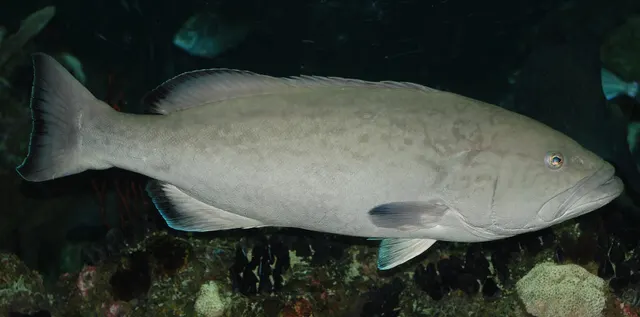
- Dusky grouper vs Gag grouper — how to tell them apart.
Safety
Fish welfare — Can cause injury needing treatment
A grouper shot in a hole that runs deeper into structure is frequently lost, and a lost fish with a shaft wound is a wounded animal that is not recovered. The species' habit of retreating into cover makes this more likely than for open-water fish.
What reduces it: Take shots only at ranges and angles where placement will stop the fish, and decline the rest. Use a tip adequate for the size. Where a fish cannot be recovered from the structure it is in, the shot should not have been taken.
Injury while handling fish — Can cause injury needing treatment
A large heavy fish with a very large mouth, strong jaws and sharp gill covers, handled at close quarters.
What reduces it: Support the fish's weight properly, keep hands clear of the mouth and gill plates, and use a tool rather than fingers.
Precautions that always apply here
- Wet your hands before touching a fish. Dry hands strip the protective mucus layer that keeps infection out.
- Keep fingers out of the gills and clear of the teeth. Gill damage is usually fatal to the fish, and several species will remove skin from a finger.
- Support the fish's weight along its body, keep it out of the water for as short a time as possible, and hold it over something soft.
Check the rules before you fish
Fishing laws, bylaws, access rules, seasons, bait restrictions and permitted methods vary by location and can change. Check the current rules from the relevant authority and the water you intend to fish before fishing.
Check with:
- Current national or regional law for where you are fishing
- Current local bylaws
- The relevant fisheries authority
- The landowner, club or fishery whose water it is
- Any restrictions specific to the species or the method you intend to use
Where to go next
Similar and related fish
,_Madeira,_Portugal,_2019-05-31,_DD_24.jpg)
Where you will find it
- Balearic IslandsOccurs on rocky reef, and its presence and size are used as an indicator of effectively protected ground because it is among the first species lost from accessible coast.
- Cape VerdeResident on the volcanic hard bottom close inshore. A long-lived, slow-growing, heavily fished species whose conservation position is considerably worse than its abundance on a menu suggests, and one of the reasons the vernacular name garoupa is a poor identification.
- CyprusPresent on the rock and reef ground, long-lived, slow-growing and heavily depleted across the Mediterranean. It is the species most often cited when the eastern basin's fishing is described as having been much better within living memory.
- ItalyThe Mediterranean's flagship reef predator and the species around which a great deal of Italian spearfishing ethic and regulation is organised, being long-lived, site-attached and easily over-harvested.
- Malta and GozoThe prize of the local spearfishing tradition, and — being protogynous, territorial and slow-growing — the species where the cost of taking the large ones is highest.
- MediterraneanThe fish Mediterranean spearfishers built a culture around, and the one whose disappearance from much of that sea became the argument for protecting parts of it.
- The Croatian AdriaticIn the caves, overhangs and vertical structure that dissolved limestone produces in quantity. A site-attached, slow-growing, easily targeted fish in habitat that is easy to find is the clearest case for restraint on this coast.
- The Moroccan Mediterranean coastThe iconic Mediterranean rock-dwelling predator, slow-growing, long-lived and of conservation concern across the basin.
1 more
- The Strait of Messina Fishing regions
Told apart from
Environment and conservation
Sources and evidence
- FishBase: a global information system on fishes — Froese, R. and D. Pauly, eds. — FishBase Consortium (Scientific institute)Relied on for: Scientific name, family placement in the Epinephelidae, maximum length of 150 cm and maximum published weight of 60 kg, distribution across the Mediterranean and from the southern Bay of Biscay to southern Africa with populations off south-eastern Brazil, Uruguay and Argentina and eastward to southern Mozambique and Madagascar.States this directlyPassage read and verified
- FishBase: a global information system on fishes — Froese, R. and D. Pauly, eds. — FishBase Consortium (Scientific institute)Relied on for: FishBase records the IUCN status for this species as Not Evaluated, so no Red List category is asserted here.States this directlyPassage read and verified
- Good Fish Guide — Marine Conservation Society (Conservation authority)Relied on for: That life-history traits including longevity, late maturity and sex change are material to whether a stock can sustain harvest.FishingHQ's interpretation of what it saysCitation checked — the work exists and is described correctly
Why the 15 connections on this page are here, and the sources
Similar and related fish
Backed by research — 2 connections
Supported by peer-reviewed research or fisheries science. The sources are listed and can be checked.
Gag grouper
A comparison resting on shared reproductive biology, naming both binomials, and the basis of the demographic argument on both records.
- FishBase: a global information system on fishes — Froese, R. and D. Pauly, eds. — FishBase Consortium (Scientific institute)Relied on for: That Mycteroperca microlepis and Epinephelus marginatus are both protogynous hermaphrodites in which individuals mature as female and change sex to male with size and age.States this directlyPassage read and verified
Island grouper
Mycteroperca fusca is longer-bodied, reaches 80 cm and 3 kg, and is known with certainty only from four eastern Atlantic archipelagos; Epinephelus marginatus is deeper-bodied, heavier-headed and much larger, with a far wider range. The island grouper is assessed as Vulnerable and the dusky grouper's assessment is its own.
- FishBase: a global information system on fishes — Froese, R. and D. Pauly, eds. — FishBase Consortium (Scientific institute)Relied on for: The morphology, size, depth range and distribution that separate these two species from one another.States this directlyPassage read and verified
How it is caught
Backed by research — 1 connection
Supported by peer-reviewed research or fisheries science. The sources are listed and can be checked.
Hole hunting
A claim resting on the species' documented territoriality and habitat use rather than on practitioner report, because it is the basis of the conservation argument on both records.
- FishBase: a global information system on fishes — Froese, R. and D. Pauly, eds. — FishBase Consortium (Scientific institute)Relied on for: That Epinephelus marginatus is reef-associated on rocky bottom, with adults solitary and territorial, and that it has low resilience with a minimum population doubling time of 4.5 to 14 years and a vulnerability score of 64 out of 100.States this directlyPassage read and verified
- Good Fish Guide — Marine Conservation Society (Conservation authority)Relied on for: That site fidelity and slow replacement are material to whether a local population can sustain harvest.FishingHQ's interpretation of what it saysCitation checked — the work exists and is described correctly
Official guidance — 1 connection
Stated by a fisheries authority, scientific institute or recognised angling body. Authoritative, but summarising rather than demonstrating.
Reef spearfishing
A scientific institute reporting what its own survey of the fishery recorded: a two-year catch-recording programme across the Canary archipelago counted and weighed every specimen, and this species appears in its published catch table. That is what Canary spearfishers were measured taking, rather than an inference from where the species lives or an assertion about what people do.
- Spearfishing in the Canary Islands: is the devil as black as it seems to be? — Pablo Martín-Sosa, Instituto Español de Oceanografía — Revista Scientia Insularum, 2019 (Scientific literature)Relied on for: The Canary spearfishing catch table, in which this species appears with a specimen count and a landed weight over the study's two-year recording period.States this directlyPassage read and verified
Where you will find it
Backed by research — 9 connections
Supported by peer-reviewed research or fisheries science. The sources are listed and can be checked.
Balearic Islands
Occurrence of the species in these waters: a statement about the animal's distribution, not a venue recommendation.
- The Fishes of the British Isles and North-West Europe — Macmillan, 1969 (Reference work)Relied on for: Distribution and habitat association of fishes in north-west European and eastern Atlantic waters.States this directlyCitation checked — the work exists and is described correctly
- FishBase: a global information system on fishes — Froese, R. and D. Pauly, eds. — FishBase Consortium (Scientific institute)Relied on for: Distribution, depth range and habitat association recorded for the species.States this directlyPassage read and verified
Cape Verde
A distribution edge resting on published regional identification and distribution references, written where the species is genuinely characteristic of the destination's fishing rather than merely recorded from its waters.
- FAO Species Identification Guides for Fishery Purposes and the FAO Species Catalogues — Food and Agriculture Organization of the United Nations (Scientific institute)Relied on for: Distribution, habitat association and biology of the fishes of the eastern central Atlantic and the Mediterranean, from the regional identification guides prepared for fishery purposes.States this directlyCitation checked — the work exists and is described correctly
- FishBase: a global information system on fishes — Froese, R. and D. Pauly, eds. — FishBase Consortium (Scientific institute)Relied on for: Recorded environment, depth range, distribution and biology of the species named.States this directlyPassage read and verified
Cyprus
A distribution edge resting on published regional identification and distribution references, written where the species is genuinely characteristic of the destination's fishing rather than merely recorded from its waters.
- FAO Species Identification Guides for Fishery Purposes and the FAO Species Catalogues — Food and Agriculture Organization of the United Nations (Scientific institute)Relied on for: Distribution, habitat association and biology of the fishes of the eastern central Atlantic and the Mediterranean, from the regional identification guides prepared for fishery purposes.States this directlyCitation checked — the work exists and is described correctly
- FishBase: a global information system on fishes — Froese, R. and D. Pauly, eds. — FishBase Consortium (Scientific institute)Relied on for: Recorded environment, depth range, distribution and biology of the species named.States this directlyPassage read and verified
Italy
That a species occurs in these waters, drawn from distribution science and stock assessment. It is a statement about where the animal lives and is not a statement that anybody will catch one, still less where.
- FAO Species Identification Guides for Fishery Purposes and the FAO Species Catalogues — Food and Agriculture Organization of the United Nations (Scientific institute)Relied on for: Identification, distribution and habitat association of the fishes and invertebrates of the Mediterranean and Black Sea.States this directlyCitation checked — the work exists and is described correctly
- FishBase: a global information system on fishes — Froese, R. and D. Pauly, eds. — FishBase Consortium (Scientific institute)Relied on for: Recorded distribution, depth range and habitat association of the species named.States this directlyPassage read and verified
Malta and Gozo
A distributional claim about where a species occurs, resting on the regional identification literature rather than on angling report. It says nothing about where a reader should fish.
- FAO Species Identification Guides for Fishery Purposes and the FAO Species Catalogues — Food and Agriculture Organization of the United Nations (Scientific institute)Relied on for: Species composition, habitat association and distribution for the region concerned, as set out in the FAO species identification sheets.States this directlyCitation checked — the work exists and is described correctly
- The IUCN Red List of Threatened Species — International Union for Conservation of Nature (Conservation authority)Relied on for: Global assessment and distribution for the species concerned.States this directlyCitation checked — the work exists and is described correctly
Mediterranean
A distribution claim held to a scientific standard.
- FishBase: a global information system on fishes — Froese, R. and D. Pauly, eds. — FishBase Consortium (Scientific institute)Relied on for: That Epinephelus marginatus ranges from the Mediterranean Sea through the southern Bay of Biscay to southern Africa, and is reef-associated on rocky bottoms usually shallower than 50 m.States this directlyPassage read and verified
The Croatian Adriatic
A claim that a place contains the ground, water and seasonal conditions the species is associated with. It is a distributional statement about the world, it rests on the regional reference literature, and it deliberately asserts nothing about access, permission or catch.
- FishBase: a global information system on fishes — Froese, R. and D. Pauly, eds. — FishBase Consortium (Scientific institute)Relied on for: Recorded distribution, depth range and habitat association for the Mediterranean species named.States this directlyPassage read and verified
- FAO Species Identification Guides for Fishery Purposes and the FAO Species Catalogues — Food and Agriculture Organization of the United Nations (Scientific institute)Relied on for: Regional species identification and distribution for the Mediterranean and eastern Atlantic, including habitat association.States this directlyCitation checked — the work exists and is described correctly
The Moroccan Mediterranean coast
A distribution claim about the world, so it rests on the reference datasets rather than on angling report. FishingHQ's evidence policy requires it.
- FishBase: a global information system on fishes — Froese, R. and D. Pauly, eds. — FishBase Consortium (Scientific institute)Relied on for: Distribution, habitat association and depth range recorded for the species, including its occurrence in the water body concerned.States this directlyPassage read and verified
- FAO Species Identification Guides for Fishery Purposes and the FAO Species Catalogues — Food and Agriculture Organization of the United Nations (Scientific institute)Relied on for: Distribution, habitat, depth and fishery accounts for the species of the eastern central Atlantic and Mediterranean.States this directlyCitation checked — the work exists and is described correctly
The Strait of Messina
A distribution association between an animal and a kind of water, rather than a claim about any named mark.
- FishBase: a global information system on fishes — Froese, R. and D. Pauly, eds. — FishBase Consortium (Scientific institute)Relied on for: Distribution, habitat association and depth range recorded for the species, including its occurrence in the water body concerned.States this directlyPassage read and verified
- The IUCN Red List of Threatened Species — International Union for Conservation of Nature (Conservation authority)Relied on for: Assessment and range account for the species, including the systems and coasts it occupies.Background and mechanism onlyCitation checked — the work exists and is described correctly
Told apart from
Backed by research — 1 connection
Supported by peer-reviewed research or fisheries science. The sources are listed and can be checked.
Common dentex
A comparison resting on documented habits — territorial and solitary against mobile over hard ground — rather than on reputation.
- FishBase: a global information system on fishes — Froese, R. and D. Pauly, eds. — FishBase Consortium (Scientific institute)Relied on for: That Epinephelus marginatus adults are solitary and territorial on rocky bottoms, while Dentex dentex occurs on hard bottoms of rock or rubble and feeds on fish, molluscs and cephalopods.States this directlyPassage read and verified
Environment and conservation
Backed by research — 1 connection
Supported by peer-reviewed research or fisheries science. The sources are listed and can be checked.
Selectivity and what it is used for
A conservation claim resting entirely on verified life-history figures rather than on advocacy, which is why it is FishingHQ's worked example.
- FishBase: a global information system on fishes — Froese, R. and D. Pauly, eds. — FishBase Consortium (Scientific institute)Relied on for: That Epinephelus marginatus is a protogynous hermaphrodite with females maturing at about five years and changing sex to male at about ten, has low resilience, a minimum population doubling time of 4.5 to 14 years and a vulnerability score of 64 out of 100.States this directlyPassage read and verified
- Good Fish Guide — Marine Conservation Society (Conservation authority)Relied on for: That life-history traits including longevity, late maturity and sex change are material to whether a stock can sustain harvest.States this directlyCitation checked — the work exists and is described correctly
How FishingHQ labels evidence is explained in the evidence policy.