Gag grouper
Fish · Last reviewed 2026-08-10
A protogynous grouper of the American south-east whose entire male population comes from sex-changed females — which makes size-selective fishing a demographic problem, not just a numerical one.
Safety: barotrauma and pressure injury — can cause serious injury or death. 5 more points apply here.
Barotrauma and pressure injury — Can cause serious injury or death
Fish brought up from reef depth suffer severe swim bladder expansion and cannot return unaided, and the largest fish — which are the males — are the ones most worth returning.
What reduces it: Carry and use a descending device. Return fish promptly and at depth. Where venting is permitted, learn the technique properly rather than improvising.
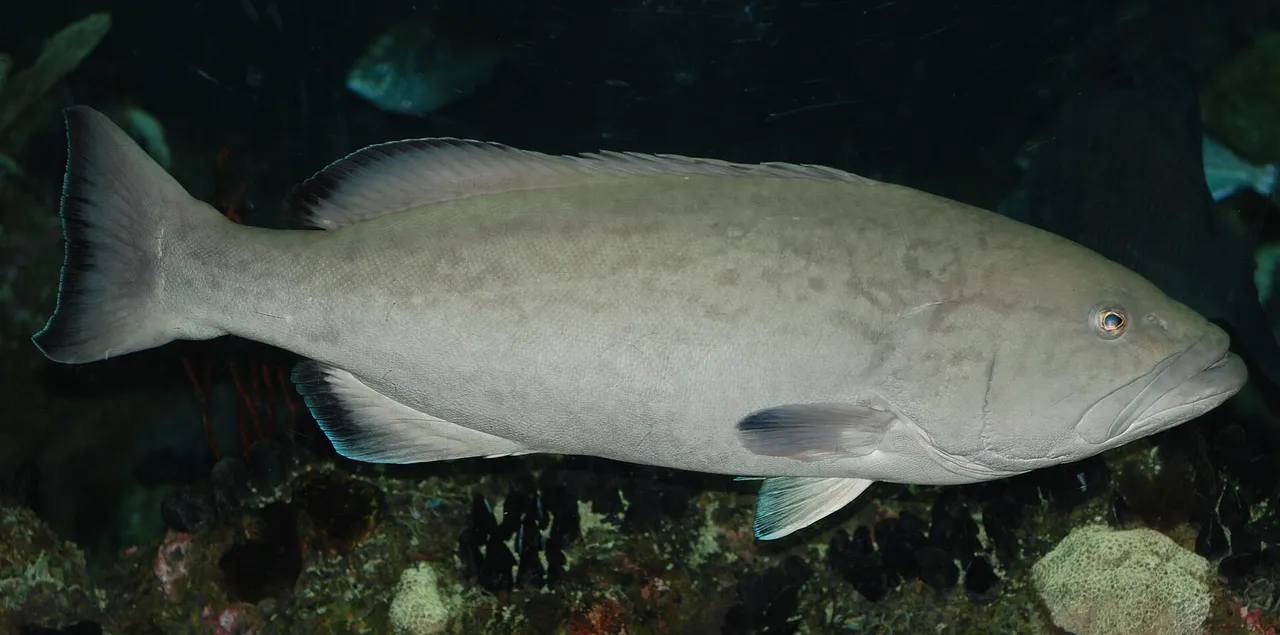
How this was identified, and who took it
Identified by: Complete lateral view, sharp, with the whole fish in frame. The elongate Mycteroperca body form, the faint darker marbling over a pale grey-brown ground, the dark margins to the soft dorsal, anal and caudal fins and the projecting lower jaw are all visible. Photographed in an aquarium rather than in the wild, which is recorded in the caption.Jarek Tuszyński — CC BY 4.0, via Wikimedia Commons — source, licence
Catching Gag grouper
Everything here on fishing for it. Each entry opens the page behind it.
The gag grouper is the working grouper of the south-eastern United States and the Gulf, and it is the clearest available illustration of why protogyny matters to fisheries.
It is a protogynous hermaphrodite: every individual matures as a female, and some change sex to male at larger size and greater age. That means the male population is drawn entirely from the largest, oldest fish — and a fishery that selects for size, as almost every fishery does, removes males specifically. Where that has happened, the proportion of males in gag populations has fallen markedly, and a population can end up with plenty of fish and not enough of one sex to reproduce properly. It is a demographic failure rather than a numerical one, and no catch limit expressed purely in numbers or weight will detect it.
As a target it is a structure-bound ambush predator that does exactly what a grouper does: takes a bait and immediately returns to the hole it came from. The fight is decided in the first seconds, and the tackle exists to prevent that rather than to play a fish.
Like red snapper, it suffers severe barotrauma from depth, and descending devices matter for the same reasons.
How it is caught
Identification
- Scientific name
- Mycteroperca microlepis
- Family
- Epinephelidae
- Water
- Saltwater
- Conservation status
- Vulnerable
- Regions
- North America, Caribbean, Central & South America
- Grey to brownish-grey with a pattern of darker worm-like or box-shaped markings on the flank, most visible in smaller fish.
- Body more elongate and less heavy-set than most Epinephelus groupers.
- Tail slightly concave with the outer rays extended, giving a distinctly notched trailing edge — a useful separator from black grouper.
- Fins dark, with the anal and tail fins often edged in blue-white.
- Separated from black grouper by the tail shape and the pattern of the flank markings rather than by colour, which varies with mood and depth.
Size
- Typical
- 2–8 kg (4.4–18 lb)
- Large
- 12–20 kg (26–44 lb)
Exceptional: Over 25 kg (55 lb); maximum published weight 36.5 kg
Estuarine grass as a nursery, offshore reef as an adult
Gag grouper undergo one of the more dramatic habitat shifts of any reef fish, and the two ends of it are barely comparable.
JUVENILES LIVE IN ESTUARIES. Post-larval gag settle into shallow seagrass beds and estuarine habitat, sometimes far up into low-salinity water, where they spend their first months. Estuarine seagrass condition therefore drives recruitment to reefs a long way offshore — a dependency that is easy to miss and hard to manage.
THEY MOVE OFFSHORE AS THEY GROW, progressively occupying deeper hard bottom, ledges, reef and wreck out onto the shelf and shelf edge.
ADULTS ARE STRUCTURE-ASSOCIATED AND SITE-FAITHFUL, holding on ledges, rock outcrops, artificial reef and wreck, with larger fish generally deeper.
THEY ARE AMBUSH PREDATORS taking fish and crustaceans from close range, so relief and overhang matter more than absolute depth.
BAROTRAUMA IS A HABITAT-DRIVEN HANDLING PROBLEM. Because adults occupy depth, a released gag suffers pressure injury, and descending devices are now standard or required practice in the fisheries concerned.
AND THE SPECIES ILLUSTRATES WHY REEF FISH MANAGEMENT CANNOT STOP AT THE REEF. Protecting offshore adults while allowing estuarine seagrass to degrade addresses one end of the life cycle and ignores the other.
Backed by research — why, and the sources (2)
Supported by peer-reviewed research or fisheries science. The sources are listed and can be checked.
- Reef Fish Spawning Aggregations: Biology, Research and Management — Springer, Fish & Fisheries Series vol. 35, 2012 (Scientific literature)Relied on for: Reef fish spawning aggregations, their predictability in space and time, and the vulnerability that predictability creates.States this directlyCitation checked — the work exists and is described correctly
- FishBase: a global information system on fishes — Froese, R. and D. Pauly, eds. — FishBase Consortium (Scientific institute)Relied on for: Distribution, habitat association, depth range, size, reproduction and life-history parameters recorded for the species.States this directlyPassage read and verified
A winter aggregation offshore, and males that are getting rarer
Gag grouper spawn in winter aggregations at the shelf edge, and the species has a documented sex-ratio problem that makes the timing consequential.
THEY ARE PROTOGYNOUS HERMAPHRODITES — female first, changing to male at larger size and older age. Males are therefore the big old fish, and fishing that targets large individuals removes males disproportionately.
THE MALE FRACTION HAS DECLINED MEASURABLY in assessed populations, to levels well below historical values, which raises a genuine question about fertilisation success that catch-based assessment does not answer.
SPAWNING AGGREGATIONS FORM IN WINTER AND EARLY SPRING at specific offshore sites near the shelf edge, with fish migrating from their resident reefs to reach them.
EGGS AND LARVAE ARE PELAGIC, and successful recruitment requires transport inshore to the estuarine seagrass nurseries — so spawning success and nursery condition are linked by a current.
THE AGGREGATION IS THE VULNERABILITY, as it is for every aggregating grouper: predictable place, predictable season, and the largest and rarest individuals concentrated together.
AND SEASONAL CLOSURES EXIST FOR THIS SPECIES in several management areas for precisely these reasons. This page describes the biology and does not state what any current closure permits.
Backed by research — why, and the sources (2)
Supported by peer-reviewed research or fisheries science. The sources are listed and can be checked.
- Reef Fish Spawning Aggregations: Biology, Research and Management — Springer, Fish & Fisheries Series vol. 35, 2012 (Scientific literature)Relied on for: Reef fish spawning aggregations, their predictability in space and time, and the vulnerability that predictability creates.States this directlyCitation checked — the work exists and is described correctly
- FishBase: a global information system on fishes — Froese, R. and D. Pauly, eds. — FishBase Consortium (Scientific institute)Relied on for: Distribution, habitat association, depth range, size, reproduction and life-history parameters recorded for the species.States this directlyPassage read and verified
Barotrauma is the handling problem, and it happens before you touch the fish
For a reef grouper the decisive handling event occurs during the retrieve rather than on the deck. A fish brought up from forty metres or more suffers swim bladder expansion it cannot equalise, and by the time it reaches the surface the damage is done: the bladder may be distended into the body cavity, the stomach everted through the mouth, the eyes bulging.
A fish in that condition cannot swim down. Released as it is, it floats, and it is taken by a bird or a shark or simply dies at the surface. Neither the fight nor the unhooking is what killed it.
The remedy is a DESCENDING DEVICE — a weighted clip or inverted hook that carries the fish back down to a depth where the gas recompresses and it can swim off. Measured survival with one is dramatically better than releasing at the surface. Venting with a needle is the older approach, is easier to do wrong, and is now generally the second choice.
The demographic argument sharpens all of this. Gag grouper are protogynous — individuals mature as female and change to male with size and age — so the largest fish are the males, and they are the ones brought up from the deepest water. Losing them to barotrauma removes disproportionately from the breeding population.
The ordinary hazards remain: sharp gill covers, a large mouth and strong jaws, on a heavy fish handled quickly on a moving deck.
Backed by research — why, and the sources (2)
Supported by peer-reviewed research or fisheries science. The sources are listed and can be checked.
- A review of catch-and-release angling mortality with implications for no-take reserves — Reviews in Fish Biology and Fisheries 15:129–154, 2005 (Scientific literature)Relied on for: Review of catch-and-release mortality including depth, barotrauma and release method.States this directlyCitation checked — the work exists and is described correctly
- Do we need species-specific guidelines for catch-and-release recreational angling? — Biodiversity and Conservation 14:1195–1209, 2005 (Scientific literature)Relied on for: Species-specific catch-and-release considerations including physiological injury from depth.States this directlyCitation checked — the work exists and is described correctly
Aggregations of females and a small number of males, and what happens when the males are removed
Gag grouper reproduction is the textbook case of protogynous aggregation spawning, and it is worth setting out precisely because the failure mode is counter-intuitive and well documented.
GAG MATURE AS FEMALES AND A MINORITY BECOME MALE. Individuals begin reproductive life as females and some change sex to male at larger size and older age. The result is a population in which males are a small proportion of the total, and are concentrated among the largest and oldest fish.
SPAWNING HAPPENS IN AGGREGATIONS ON OFFSHORE STRUCTURE. Mature fish migrate from inshore and shelf habitat to specific offshore reef and hard-bottom sites in late winter and spring, gathering in numbers to spawn. Those sites are traditional, predictable in place and time, and known.
WHICH CREATES THE PROBLEM: THE MALES ARE THE BIGGEST FISH AND THEY ARE ALL IN ONE PLACE. A fishery that targets aggregations and keeps the largest fish removes males preferentially from a population that has few of them to start with, and it does so at the moment they are most concentrated. Documented consequences include sex ratios shifting sharply toward females and reduced fertilisation success at the aggregation — a reproductive failure occurring in a population that still contains plenty of fish.
SEX CHANGE DOES NOT AUTOMATICALLY COMPENSATE. It is influenced by social and demographic cues as well as by size, and in heavily fished populations the rate of change has not reliably kept pace with male removal. Assuming the population will simply make more males is exactly the assumption the evidence does not support.
JUVENILES USE INSHORE SEAGRASS AND ESTUARINE HABITAT, entirely separate from the offshore adult and spawning grounds, so recruitment depends on nursery habitat that offshore management does not touch.
GROWTH IS SLOW AND LONGEVITY IS CONSIDERABLE, so both the male component and the age structure rebuild slowly once lost.
AND THIS SPECIES IS ACTIVELY AND FREQUENTLY MANAGED FOR EXACTLY THESE REASONS, with seasonal closures, area closures, size limits and bag limits that change. Nothing above states what any current rule is; the competent authority does, and for aggregating groupers the rules are revised more often than most.
Backed by research — why, and the sources (2)
Supported by peer-reviewed research or fisheries science. The sources are listed and can be checked.
- Reef Fish Spawning Aggregations: Biology, Research and Management — Springer, Fish & Fisheries Series vol. 35, 2012 (Scientific literature)Relied on for: Reef fish spawning aggregations, their predictability, their vulnerability to fishing, and the consequences of aggregation fishing for stock structure.States this directlyCitation checked — the work exists and is described correctly
- FishBase: a global information system on fishes — Froese, R. and D. Pauly, eds. — FishBase Consortium (Scientific institute)Relied on for: Reproductive mode, sexual pattern, spawning season and maturity for the species.States this directlyPassage read and verified
Lifecycle and reproduction
Long-lived, with documented ages beyond thirty years, and protogynous: individuals mature as females at around five years and some change sex to male at greater size and age. Juveniles use shallow estuarine and seagrass habitat before moving offshore to reef as they grow. That ontogenetic shift ties the offshore fishery to the condition of inshore nursery habitat.
Protogynous hermaphroditism with aggregating spawning in winter and early spring on offshore reefs. Because all males are derived from large old females, size-selective fishing removes the male component of the population specifically, and reduced male ratios have been documented in heavily fished gag populations. Spawning aggregations are predictable and are protected in parts of the range for exactly that reason.
Feeding and senses
An ambush predator taking fish, crustaceans and cephalopods from and around structure, striking with strong suction through a large mouth and returning immediately to cover. The habit of returning to the hole is the defining behavioural fact for anglers: a gag that reaches structure is generally lost, along with the terminal tackle.
Sight and the lateral line both contribute at the short ranges its ambush strategy uses. Gag hold in and around structure and take what passes close, which is a strategy suited to the low light and complex geometry of reef rather than a preference. Heavily fished structures produce noticeably warier fish.
Through the year
Moves to offshore spawning aggregations in winter and early spring, dispersing across reef and structure through the rest of the year, with some movement between depths seasonally. Juveniles occupy inshore seagrass and estuarine habitat through their first years. Regulatory seasons frequently govern the practical fishery more than the biology does.
Distribution
Western Atlantic: from North Carolina south through the Gulf of Mexico and the Caribbean to Brazil. Adults occupy offshore reefs, rock and wrecks generally between about 40 and 150 m; juveniles use shallow estuarine and seagrass habitat.
This is a biological range — where the species occurs, not a prediction that you will catch one. To browse the fishing geography FishingHQ holds, start at fishing places.
Why anglers care
A major reef target in the south-eastern United States and Gulf, taken on live and dead bait and on jigs fished over structure. Heavily managed with seasons, size limits and area closures, including protection of spawning aggregations. Highly regarded as food, which is a large part of the pressure on it.
Handling and returning
Fish taken from reef depth suffer severe barotrauma and require a descending device to return successfully — the same problem and the same solution as red snapper. Sharp gill covers and a large mouth with strong jaws; keep fingers clear. Support large fish horizontally. Given the protogyny, releasing large individuals successfully has a demographic value that goes beyond the individual fish.
Going further
- What does gag grouper eat? — feeding biology, kept separate from what anglers infer from it.
- Gag grouper vs Dusky grouper — how to tell them apart.
- Gag grouper vs Atlantic goliath grouper — how to tell them apart.
Safety
Barotrauma and pressure injury is set out at the top of this page, where it cannot be missed.
Injury while handling fish — Can cause injury needing treatment
Sharp gill covers and strong jaws on a heavy fish handled quickly on a moving deck.
What reduces it: Support the body, keep fingers clear of the gill plates and the mouth, and use long pliers or a de-hooking tool.
Precautions that always apply here
- Support the fish's weight along its body, keep it out of the water for as short a time as possible, and hold it over something soft.
- Wet your hands before touching a fish. Dry hands strip the protective mucus layer that keeps infection out.
- Keep fingers out of the gills and clear of the teeth. Gill damage is usually fatal to the fish, and several species will remove skin from a finger.
- Wear a buoyancy aid or lifejacket. Cold water incapacitates strong swimmers within a minute, long before swimming ability matters.
Check the rules before you fish
Fishing laws, bylaws, access rules, seasons, bait restrictions and permitted methods vary by location and can change. Check the current rules from the relevant authority and the water you intend to fish before fishing.
Check with:
- Current national or regional law for where you are fishing
- Current local bylaws
- The relevant fisheries authority
- The landowner, club or fishery whose water it is
- Any restrictions specific to the species or the method you intend to use
Where to go next
Similar and related fish
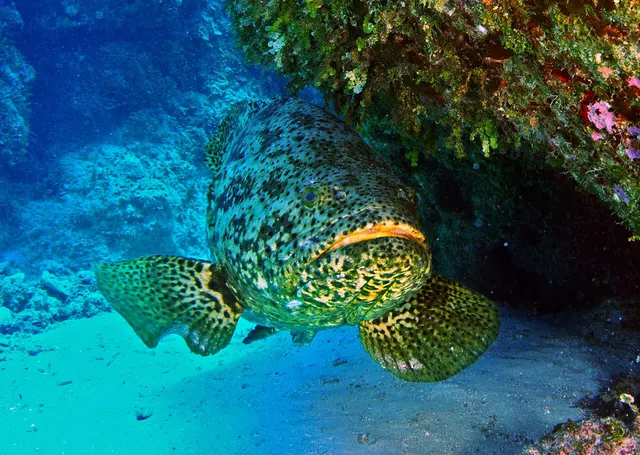 Atlantic goliath grouperGroupers of the same structure separated by size, tail shape and spotting.
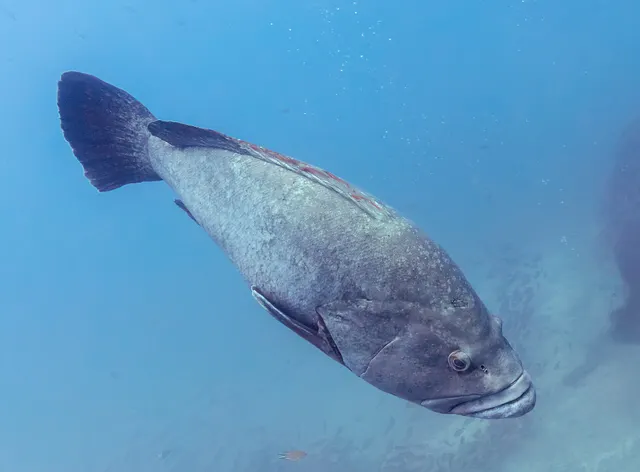 Dusky grouperBoth are protogynous groupers whose entire male population comes from sex-changed females, which is why size-selective fishing removes males specifically in both.
- Scaled sardineSmall clupeids are a principal fish prey for gag over inshore and nearshore structure.
Where you will find it
- FloridaUses estuarine seagrass as a juvenile nursery before moving offshore to ledges and reef as an adult, which links the offshore fishery to inshore habitat condition.
- The Gulf of MexicoUses inshore seagrass as a nursery and offshore hard bottom as adult and spawning habitat, aggregating on known offshore sites.
Understanding this fish
- Ciguatera and reef fish poisoningA large, long-lived grouper of the western Atlantic and Caribbean — the family and the trophic position the page names first.
- Decapod crustaceans as preyCrustaceans are taken alongside fish, particularly by smaller gag grouper on inshore structure before they move to deeper reefs.
Environment and conservation
Sources and evidence
- FishBase: a global information system on fishes — Froese, R. and D. Pauly, eds. — FishBase Consortium (Scientific institute)Relied on for: Scientific name, family placement in the Epinephelidae, a maximum length of 145 cm TL, a maximum published weight of 36.5 kg, a maximum reported age of 31 years.States this directlyPassage read and verified
- FishBase: a global information system on fishes — Froese, R. and D. Pauly, eds. — FishBase Consortium (Scientific institute)Relied on for: Environment, climate zone and depth range as recorded: Marine; brackish; reef-associated; oceanodromous ; depth range 30 - 160 m . Subtropical; 40°N - 27°S, 98°W - 38°WStates this directlyPassage read and verified
- FishBase: a global information system on fishes — Froese, R. and D. Pauly, eds. — FishBase Consortium (Scientific institute)Relied on for: The IUCN Red List category for Mycteroperca microlepis — Vulnerable, assessed 21 November 2016 — as republished by FishBase, the Red List itself being unreachable during review.States this directlyPassage read and verified
- FishBase: a global information system on fishes — Froese, R. and D. Pauly, eds. — FishBase Consortium (Scientific institute)Relied on for: That protogynous hermaphroditism occurs in Mycteroperca and related reef genera, such that the largest individuals in a population are disproportionately male.States this directlyPassage read and verified
- Good Fish Guide — Marine Conservation Society (Conservation authority)Relied on for: That sex-change life history and aggregating spawning are material to whether a stock can sustain harvest.States this directlyCitation checked — the work exists and is described correctly
- Understanding the Complexity of Catch-and-Release in Recreational Fishing — Reviews in Fisheries Science 15:75–167, 2007 (Scientific literature)Relied on for: That barotrauma is a principal cause of post-release mortality.States this directlyCitation checked — the work exists and is described correctly
Why the 11 connections on this page are here, and the sources
Similar and related fish
Backed by research — 3 connections
Supported by peer-reviewed research or fisheries science. The sources are listed and can be checked.
Atlantic goliath grouper
An identification comparison naming both binomials: Epinephelus itajara and Mycteroperca microlepis.
- FishBase: a global information system on fishes — Froese, R. and D. Pauly, eds. — FishBase Consortium (Scientific institute)Relied on for: Morphological and distributional data for Epinephelus itajara and for Mycteroperca microlepis.States this directlyPassage read and verified
- The IUCN Red List of Threatened Species — International Union for Conservation of Nature (Conservation authority)Relied on for: Separate assessments treating Epinephelus itajara and Mycteroperca microlepis as distinct species.States this directlyCitation checked — the work exists and is described correctly
Dusky grouper
A comparison resting on shared reproductive biology, naming both binomials, and the basis of the demographic argument on both records.
- FishBase: a global information system on fishes — Froese, R. and D. Pauly, eds. — FishBase Consortium (Scientific institute)Relied on for: That Mycteroperca microlepis and Epinephelus marginatus are both protogynous hermaphrodites in which individuals mature as female and change sex to male with size and age.States this directlyPassage read and verified
Scaled sardine
Recorded diet evidence identifies Harengula jaguana as a food item of this predator at species level. The edge is written at that granularity and no further.
- FishBase: a global information system on fishes — Froese, R. and D. Pauly, eds. — FishBase Consortium (Scientific institute)Relied on for: Food items recorded for this predator, including Harengula jaguana.States this directlyPassage read and verified
- FAO Species Identification Guides for Fishery Purposes and the FAO Species Catalogues — Food and Agriculture Organization of the United Nations (Scientific institute)Relied on for: Species account describing the diet of this predator in the region where Harengula jaguana occurs.Background and mechanism onlyCitation checked — the work exists and is described correctly
How it is caught
What experienced anglers do — 2 connections
Widely and independently recommended by experienced anglers and specialist sources. This is real angling knowledge, not proof: controlled evidence for it is limited, and FishingHQ records it as convention rather than as a demonstrated effect.
Jigging
The page names jigs as the second technique. It matters separately because area closures protecting spawning aggregations apply to the fishery rather than to the bait.
- Florida saltwater fishing regulations and Keys sanctuary rules — Florida state wildlife authority and the Florida Keys National Marine Sanctuary (Government fisheries body)Relied on for: Documents which fishery and which technique takes this species.States this directlyCitation checked — the work exists and is described correctly
- General angling website restatements of established technique — Various (Credible secondary source)Relied on for: Independently corroborates the species' recreational capture and range.Background and mechanism onlyCitation checked — the work exists and is described correctly
Livebaiting at sea
The page names live and dead bait over structure. A grouper takes a live bait and runs for the reef, and that first run is what the tackle in this fishery is chosen for.
- Florida saltwater fishing regulations and Keys sanctuary rules — Florida state wildlife authority and the Florida Keys National Marine Sanctuary (Government fisheries body)Relied on for: Documents which fishery and which technique takes this species.States this directlyCitation checked — the work exists and is described correctly
- General angling website restatements of established technique — Various (Credible secondary source)Relied on for: Independently corroborates the species' recreational capture and range.Background and mechanism onlyCitation checked — the work exists and is described correctly
Gear for this fish
What experienced anglers do — 1 connection
Widely and independently recommended by experienced anglers and specialist sources. This is real angling knowledge, not proof: controlled evidence for it is limited, and FishingHQ records it as convention rather than as a demonstrated effect.
Swimbaits
A practitioner claim about which lure family answers this species' feeding or holding behaviour.
- General angling website restatements of established technique — Various (Credible secondary source)Relied on for: Widely restated North American lure practice for this species.Background and mechanism onlyCitation checked — the work exists and is described correctly
- IGFA International Angling Rules and World Record Requirements — International Game Fish Association (Angling or fisheries organisation)Relied on for: Recognition of the species as an established sport fish taken on artificial lures, and the tackle conventions used for it.States this directlyPassage read and verified
Where you will find it
Backed by research — 2 connections
Supported by peer-reviewed research or fisheries science. The sources are listed and can be checked.
Florida
A distribution association between an animal and a kind of water, rather than a claim about any named mark.
- NOAA National Ocean Service education on estuaries and the National Estuarine Research Reserve System — National Oceanic and Atmospheric Administration, United States (Government fisheries body)Relied on for: Estuarine, seagrass and coastal habitat function in North American waters, and the nursery role of shallow habitat for the species concerned.Background and mechanism onlyCitation checked — the work exists and is described correctly
- FishBase: a global information system on fishes — Froese, R. and D. Pauly, eds. — FishBase Consortium (Scientific institute)Relied on for: Distribution, habitat association, depth range and life history recorded for the species.States this directlyPassage read and verified
The Gulf of Mexico
A distribution association between an animal and a kind of water, rather than a claim about any named mark.
- FishBase: a global information system on fishes — Froese, R. and D. Pauly, eds. — FishBase Consortium (Scientific institute)Relied on for: Distribution, habitat association and depth range recorded for the species, including its occurrence in the water body concerned.States this directlyPassage read and verified
- The IUCN Red List of Threatened Species — International Union for Conservation of Nature (Conservation authority)Relied on for: Assessment and range account for the species, including the systems and coasts it occupies.Background and mechanism onlyCitation checked — the work exists and is described correctly
Understanding this fish
Backed by research — 2 connections
Supported by peer-reviewed research or fisheries science. The sources are listed and can be checked.
Ciguatera and reef fish poisoning
That the ciguatera mechanism is relevant to this species, because it occupies the trophic position and habitat the toxin concentrates through. It is not a statement that any individual fish is toxic, and the record it points at says plainly that the risk is intensely local and that local knowledge outperforms any species list.
- Fish and Fishery Products Hazards and Controls Guidance — US Food and Drug Administration, Center for Food Safety and Applied Nutrition, 2022 (Standards body)Relied on for: Natural toxins in fishery products including ciguatera, the fish groups and regions associated with it, and that the toxin is not removed by cooking, freezing or any other domestic process.States this directlyPassage read and verified
- FishBase: a global information system on fishes — Froese, R. and D. Pauly, eds. — FishBase Consortium (Scientific institute)Relied on for: Trophic level, maximum size, longevity, reef association and recorded distribution of the species named, which is the basis for treating it as one the mechanism applies to.States this directlyPassage read and verified
Decapod crustaceans as prey
Recorded diet evidence identifies decapod crustaceans as a food item of this predator at group level rather than to species. The edge points at the taxon record for that reason, and encoding it as a species-level claim would assert something the source does not.
- FishBase: a global information system on fishes — Froese, R. and D. Pauly, eds. — FishBase Consortium (Scientific institute)Relied on for: Food items recorded for this predator, given as decapod crustaceans.States this directlyPassage read and verified
- FAO Species Identification Guides for Fishery Purposes and the FAO Species Catalogues — Food and Agriculture Organization of the United Nations (Scientific institute)Relied on for: Species account describing this predator's diet, recorded at the level of decapod crustaceans.Background and mechanism onlyCitation checked — the work exists and is described correctly
Environment and conservation
Official guidance — 1 connection
Stated by a fisheries authority, scientific institute or recognised angling body. Authoritative, but summarising rather than demonstrating.
Fish stocks and sustainability
A conservation claim resting on documented reproductive biology, held to an authoritative standard.
- FishBase: a global information system on fishes — Froese, R. and D. Pauly, eds. — FishBase Consortium (Scientific institute)Relied on for: That protogynous hermaphroditism in Mycteroperca means the male component of a population is derived entirely from large old females.States this directlyPassage read and verified
- Good Fish Guide — Marine Conservation Society (Conservation authority)Relied on for: That sex-change life history and aggregating spawning are material to whether a stock can sustain harvest.States this directlyCitation checked — the work exists and is described correctly
How FishingHQ labels evidence is explained in the evidence policy.