The Gulf of Mexico
Fishing regions · Last reviewed 2026-08-14
A warm, shallow, enclosed sea with a vast river pouring into it, thousands of standing oil platforms acting as artificial reef, and a fishery built on both.
Being listed here is not permission to fish. What that meansClose
Access, fishing rights, seasons, licences, local bylaws and permitted methods vary and can change. Check current access, permission, local regulations, closures and restrictions before you travel or fish. FishingHQ describes what the ground is and names who holds the answer; it does not hold the answer itself.
Find the authority for a jurisdiction · What FishingHQ does and does not cover
The Gulf of Mexico is a system-tier record because three physical features that exist nowhere else in combination explain its fishery, and none of them is a jurisdiction.
IT IS A LARGE, WARM, ENCLOSED SEA WITH A NARROW MOUTH. Water enters between the Yucatán and Cuba, loops through the basin as the Loop Current, and exits between Cuba and Florida to become the Gulf Stream. That circulation, the shallow broad shelf on the northern side, and the enclosure together make the Gulf warmer, less flushed and more productive than its latitude alone would suggest.
THE MISSISSIPPI IS THE SECOND FEATURE AND IT DOMINATES THE NORTHERN GULF. An enormous river discharges freshwater, sediment and nutrients into the northern basin, creating a vast estuarine and deltaic complex, extensive coastal marsh, and the productivity that underpins the shrimp, crab and inshore fisheries. It also delivers agricultural nutrients that drive a large seasonal hypoxic zone — a genuine and well-documented consequence rather than a contested one.
THE OIL AND GAS PLATFORMS ARE THE THIRD, AND THEY ARE UNIQUE AT THIS SCALE. Thousands of standing structures across the northern Gulf function as artificial reef in a basin whose natural bottom is largely soft. They concentrate reef fish, pelagic predators and bait to a degree that has reshaped the recreational fishery, and the decommissioning of ageing platforms is consequently a fisheries question as well as an industrial one — the rigs-to-reefs arrangements exist precisely because of it.
THE FISHERY THAT RESULTS IS UNUSUALLY LAYERED. Inshore marsh and estuary for redfish, seatrout and flounder; nearshore and shelf structure for snapper, grouper and amberjack; blue water beyond the shelf edge for tuna, marlin and mahi; and the platforms providing structure at every depth in between.
AND THE MANAGEMENT IS FEDERAL, STATE AND INTERNATIONAL AT ONCE. Nothing here states what any current rule is.
What fishing here is like
A warm, shallow, enclosed sea with an enormous river discharging into its northern side and thousands of standing platforms providing artificial structure over a largely soft bottom. The fishery is layered by distance from shore: marsh and estuary inshore, reef and platform structure across the shelf, and blue water beyond the shelf edge. Red snapper is the defining and most contested species. Extensive coastal marsh supports inshore fishing and a major shrimp and crab fishery, and a large seasonal hypoxic zone driven by river-borne nutrients affects part of the northern shelf each summer.
What dominates
Inshore lure, fly and bait fishing in marsh, bay and estuary for redfish, spotted seatrout, flounder and black drum. Bottom fishing and jigging for red snapper, grouper and amberjack on natural reef, artificial reef and platform structure. Trolling and live-baiting in blue water beyond the shelf edge for tuna, marlin, mahi and wahoo. Platform fishing at every depth from nearshore to deep water. Recreational crabbing and cast-net bait gathering. Pier and surf fishing along the sand coasts.
The water available
Extensive coastal marsh and deltaic wetland, particularly across the northern Gulf; shallow bays, sounds and estuaries; long barrier-island sand beaches; a broad shallow shelf with limited natural hard bottom; scattered natural reef and hard-bottom banks; thousands of standing oil and gas platforms acting as artificial reef; a shelf edge dropping into deep blue water; and the Loop Current and its eddies moving warm oceanic water through the basin.
How the rules are structured
Management is split between federal and state authority by distance from shore, and the boundary differs between states — which means the same species may be under state rules close in and federal rules further out on the same trip. A regional fishery management council develops federal management plans for the Gulf, and individual states manage their own waters, so seasons, size limits and bag limits for the same fish can differ between adjacent states. Red snapper in particular has been managed through repeatedly revised federal and state arrangements, including state-managed seasons for private anglers. Mexico and Cuba border the basin and administer their own waters entirely separately. Descending devices and venting tools are required for released reef fish in some circumstances. All of this changes frequently and FishingHQ does not state what any current rule is.
Who to ask
- The state marine fisheries agency of the state being fished, for state waters and for state-managed seasons.
- NOAA Fisheries, for federally managed species and federal waters in the United States portion of the Gulf.
- The Gulf of Mexico Fishery Management Council, which develops the federal management plans for the region.
- The national fisheries authority of Mexico or Cuba where fishing takes place in their waters.
- State health authorities, for shellfish harvest classification and any consumption advisories.
Words you will meet
- The rigs
- Standing oil and gas platforms across the northern Gulf, which function as artificial reef over a largely soft bottom and concentrate reef and pelagic fish. A defining feature of the fishery rather than an industrial intrusion into it.
- Rigs-to-reefs
- Arrangements under which a decommissioned platform is left in place, partly removed or toppled on site to continue functioning as reef rather than being removed entirely. A fisheries response to platform decommissioning.
- The dead zone
- The large seasonal hypoxic area on the northern Gulf shelf, driven by nutrient loading from the Mississippi and by summer stratification, in which dissolved oxygen falls too low to support most fish.
- The Loop Current
- The warm current entering between the Yucatán and Cuba, looping through the basin and exiting through the Florida Straits to become the Gulf Stream. It and its detached eddies move warm blue water across the basin and drive much of the offshore fishing.
- Marsh / the marsh
- The extensive coastal wetland of the northern Gulf, a maze of shallow ponds, bayous and grass edge, and the principal inshore fishing environment for redfish and seatrout.
Conditions and hazards
The Gulf is shallow and enclosed, which means wind builds a short, steep, uncomfortable sea very quickly — considerably faster than the same wind would on deeper water. Afternoon thunderstorms in summer develop rapidly and produce severe conditions with little warning, and lightning is a genuine hazard on open water and on platforms. Hurricane season is a seasonal planning matter of a different order. Distances offshore are substantial and the shelf edge is a long run from most ports. Fishing around standing platforms carries its own hazards: structure below the waterline, strong current around legs, and the platform's own operational restrictions on approach. Inshore, the marsh is genuinely disorienting and running it at night or in fog without local knowledge is how people get lost. Heat and sun exposure are consistently underestimated. Bacterial infection from puncture wounds in warm brackish water is a recognised and occasionally serious risk.
Thousands of platforms on a soft bottom, and what that did to the fishery
The northern Gulf's recreational fishery is built to an unusual degree on structure that was not put there for fish, and the consequences are worth setting out plainly because they cut both ways.
THE NATURAL BOTTOM IS MOSTLY SOFT. Much of the Gulf shelf is sand and mud with limited natural hard bottom, and reef-associated fish need relief to hold on. In a basin like that, any vertical structure is disproportionately valuable.
THE PLATFORMS SUPPLIED IT AT AN ENORMOUS SCALE. Thousands of standing oil and gas structures across the northern Gulf provide vertical relief from the surface to the seabed, fouled with growth and holding bait, and they concentrate red snapper, grouper, amberjack, cobia and pelagic species accordingly. A platform is effectively a purpose-built reef several hundred feet tall, and there are enough of them to have changed the distribution of the region's reef fish.
WHICH MADE DECOMMISSIONING A FISHERIES QUESTION. As platforms age they are removed, and removing one removes the reef with it. Rigs-to-reefs arrangements — leaving a structure in place, partly removing it, or toppling it on site — exist precisely to retain the habitat, and they are a genuine and reasonably well-studied conservation intervention rather than industry public relations.
THE HONEST CAVEAT IS THAT CONCENTRATION IS NOT PRODUCTION. There is a long-running scientific argument about whether artificial structure increases the total number of fish or merely gathers the existing ones into findable places, and the answer appears to be some of both and to differ by species. Concentrating fish where they are easy to catch is not automatically a benefit to the stock, and red snapper management has had to grapple with exactly that.
ARTIFICIAL REEF PROGRAMMES HAVE EXTENDED THE PRINCIPLE deliberately, with states deploying purpose-built structures, and much of the accessible nearshore bottom fishing now depends on them.
AND THE BAROTRAUMA PROBLEM RIDES ON TOP OF ALL OF IT. Fish concentrated on deep structure and caught under tight bag limits are released in large numbers from depth, which is why descending devices and venting requirements have become part of Gulf fishing practice — the same physiology the record's red snapper and grouper material describes.
Backed by research — why, and the sources (2)
Supported by peer-reviewed research or fisheries science. The sources are listed and can be checked.
- NOAA National Ocean Service education on estuaries and the National Estuarine Research Reserve System — National Oceanic and Atmospheric Administration, United States (Government fisheries body)Relied on for: Estuarine and coastal structure and function in North American waters, and the nursery role of estuarine habitat.Background and mechanism onlyCitation checked — the work exists and is described correctly
- FishBase: a global information system on fishes — Froese, R. and D. Pauly, eds. — FishBase Consortium (Scientific institute)Relied on for: Distribution, habitat association and life history of the species occurring in the area.States this directlyPassage read and verified
Red snapper, and a fishery managed by argument as much as by science
No species on FishingHQ is a better illustration of how recreational fisheries management actually works than Gulf red snapper, and the story is worth telling because it is instructive rather than because it is settled.
THE STOCK WAS SEVERELY DEPLETED and a long rebuilding plan was put in place. Federal management applied to a species that is long-lived, slow to mature, structure-bound and easy to concentrate — the record's spawning section explains why age structure matters so much for it.
REBUILDING WORKED, AND THE SEASONS GOT SHORTER ANYWAY. As the stock recovered, individual fish grew larger, so anglers reached the quota in fewer fish and the federal season for private anglers contracted to a handful of days in some years. That produced the widely-felt paradox of more fish and less fishing, and it drove sustained political conflict.
THE RESOLUTION WAS DEVOLUTION RATHER THAN A SCIENTIFIC BREAKTHROUGH. Management of the private recreational sector was substantially devolved to the individual Gulf states under exempted arrangements, so seasons for private anglers are now set state by state within a federal framework. Charter and commercial sectors are managed differently again.
WHICH MEANS FIVE ADJACENT STATES CAN HAVE FIVE DIFFERENT SEASONS for the same fish in the same body of water, and the boundary between state and federal water differs between states as well. Anybody fishing the Gulf needs to know which state's rules apply, which sector they are in, and where the boundary is.
THE UNDERLYING BIOLOGY HAS NOT CHANGED THROUGHOUT. Red snapper still mature young, live long, spawn repeatedly through a long summer season, and rely on old large females for a disproportionate share of reproductive output. The management argument is about allocation between users far more than about what the fish needs.
AND THE GENERAL LESSON TRANSFERS. Where a recovering stock meets a large recreational sector and a fixed quota, shorter seasons rather than fewer fish is the standard outcome, and the political pressure that follows shapes management as much as the assessment does. What any current season, size or bag limit is remains a matter for the competent authority and changes frequently.
Official guidance — why, and the sources (2)
Stated by a fisheries authority, scientific institute or recognised angling body. Authoritative, but summarising rather than demonstrating.
- NOAA National Ocean Service education on estuaries and the National Estuarine Research Reserve System — National Oceanic and Atmospheric Administration, United States (Government fisheries body)Relied on for: Estuarine and coastal structure and function in North American waters, and the nursery role of estuarine habitat.Background and mechanism onlyCitation checked — the work exists and is described correctly
- FishBase: a global information system on fishes — Froese, R. and D. Pauly, eds. — FishBase Consortium (Scientific institute)Relied on for: Distribution, habitat association and life history of the species occurring in the area.States this directlyPassage read and verified
Redfish, snapper and a shrimp fishery underneath
The Gulf's species picture is warm, shallow and diverse, and three groups dominate it.
RED DRUM AND SPOTTED SEATROUT ARE THE INSHORE FISHERY. The Gulf's marsh, bay and flats systems hold red drum — redfish — which feed in very shallow water and tail visibly, and speckled trout alongside them. This is the fishery the Gulf's recreational culture is built on and it is conducted in water measured in inches.
SNAPPERS AND GROUPERS OCCUPY THE STRUCTURE. Red snapper in particular is the Gulf's most contested fish, associated with hard bottom, wrecks and the enormous artificial reef created by offshore oil and gas platforms, and its management has been one of the most litigated fisheries questions in the United States.
BLACK DRUM, SHEEPSHEAD AND FLOUNDER fill the inshore and structure niches, and sheepshead in particular are associated with pilings and hard structure.
KING MACKEREL, COBIA AND TARPON work the coastal pelagic zone, and tarpon migrating along the Gulf coast support a specialist sight fishery.
OFFSHORE IT IS BLUE-WATER PELAGICS: yellowfin tuna, blue marlin, mahi-mahi and wahoo, reachable from a number of ports and strongly associated with the deep water beyond the shelf edge.
SHRIMP IS THE ECONOMIC FISHERY. The Gulf shrimp fishery is one of the most valuable in the United States, it is a trawl fishery, and its bycatch problem drove the development and mandating of turtle excluder devices — one of the clearest gear-modification success stories in world fisheries.
AND OYSTERS ARE THE OTHER GREAT INVERTEBRATE FISHERY, on reefs that are habitat as well as harvest, and their decline under disease, freshwater alteration and storm damage is a continuing regional issue.
Backed by research — why, and the sources (2)
Supported by peer-reviewed research or fisheries science. The sources are listed and can be checked.
- NOAA National Ocean Service education on estuaries and the National Estuarine Research Reserve System — National Oceanic and Atmospheric Administration, United States (Government fisheries body)Relied on for: Estuarine, coastal and Great Lakes structure and function in North American waters, and the nursery role of shallow habitat.States this directlyCitation checked — the work exists and is described correctly
- FishBase: a global information system on fishes — Froese, R. and D. Pauly, eds. — FishBase Consortium (Scientific institute)Relied on for: Distribution, habitat association and life history of the species occurring in the area.Background and mechanism onlyPassage read and verified
Poling a flat, fishing a platform, running offshore
The Gulf's disciplines divide by depth and each has a distinct culture.
FLATS AND MARSH FISHING IS THE INSHORE DISCIPLINE. Poling or trolling-motoring a shallow-draught boat across marsh, flats and bay, sight-casting to visible redfish, is the Gulf's signature recreational practice and it is closer to hunting than to fishing in its rhythm.
BAY AND PIER FISHING IS THE ACCESSIBLE FORM, from piers, jetties, bridges and small boats, for trout, drum, sheepshead and flounder, and it is what most people actually do.
PLATFORM AND STRUCTURE FISHING IS DISTINCTIVELY GULF. Thousands of offshore oil and gas structures function as artificial reef, aggregating fish through the water column, and fishing them is an established discipline with its own techniques. The interaction between energy infrastructure and a fishery is more direct here than anywhere else on FishingHQ.
BOTTOM FISHING FOR SNAPPER AND GROUPER works hard bottom, wrecks and platforms, with barotrauma a serious welfare and management issue given the depths involved, and descending devices now a standard requirement.
OFFSHORE TROLLING AND DEEP-DROP FISHING reaches the blue water beyond the shelf edge for pelagics and deep-slope species.
SHRIMP TRAWLING IS THE COMMERCIAL DISCIPLINE, conducted at large scale across the shelf.
OYSTER HARVESTING by tonging and dredging works the reefs of the bays and sounds.
AND CAST NETTING FOR BAIT is an ordinary skill here rather than a specialist one, because live bait is central to a great deal of Gulf fishing.
What experienced anglers do — why, and the sources (2)
Widely and independently recommended by experienced anglers and specialist sources. This is real angling knowledge, not proof: controlled evidence for it is limited, and FishingHQ records it as convention rather than as a demonstrated effect.
- General angling website restatements of established technique — Various (Credible secondary source)Relied on for: Widely restated practice associating this discipline or technique with this place, recorded as practitioner consensus rather than as tested fact.Background and mechanism onlyCitation checked — the work exists and is described correctly
- Fishers' Craft and Lettered Art: Tracts on Fishing from the End of the Middle Ages — University of Toronto Press, 1997 (Scientific literature)Relied on for: That fishing traditions develop around the water and fish available to them, and the historical method of reading such traditions from their documentary record.States this directlyCitation checked — the work exists and is described correctly
Flat, marsh, rig: a shallow-water vocabulary
The Gulf's vocabulary describes shallow water, structure and the specific problems of fishing deep in warm seas.
FLAT NAMES SHALLOW WATER OVER SAND, MUD OR GRASS where fish can be seen and cast to. Sight fishing a flat is a visual discipline and the vocabulary around it — tailing, pushing, waking — describes what a fish looks like rather than where it is.
MARSH NAMES THE VAST COASTAL WETLAND SYSTEM, particularly along the northern Gulf, of grass, bayou and shallow pond. It is nursery habitat for a very large proportion of the Gulf's fishery and it is being lost to subsidence, sea level rise and channelisation at a substantial rate.
BAYOU NAMES A SLOW CHANNEL THROUGH MARSH, and the bayou systems are both fishery and transport network in the delta country.
RIG NAMES AN OFFSHORE PLATFORM, and rig fishing names the discipline built around structures that were installed for hydrocarbons and function as reef.
RIGS-TO-REEFS NAMES THE PROGRAMME under which decommissioned platforms are left in place or relocated as permanent artificial reef, which is a genuine and slightly uncomfortable intersection of energy policy and fisheries policy.
DEAD ZONE NAMES THE SEASONAL HYPOXIC AREA that forms off the Louisiana coast each summer, driven by nutrient runoff from the Mississippi basin. It is one of the largest such areas in the world and it displaces or kills bottom life over a substantial area.
DESCENDING DEVICE NAMES THE TOOL used to return a barotrauma-affected fish to depth, and its use is now a requirement in the Gulf's reef fish fisheries rather than a courtesy.
AND TED NAMES THE TURTLE EXCLUDER DEVICE fitted to shrimp trawls, which is the gear modification that made a large bycatch problem substantially smaller.
What experienced anglers do — why, and the sources (2)
Widely and independently recommended by experienced anglers and specialist sources. This is real angling knowledge, not proof: controlled evidence for it is limited, and FishingHQ records it as convention rather than as a demonstrated effect.
- General angling website restatements of established technique — Various (Credible secondary source)Relied on for: Widely restated practice associating this discipline or technique with this place, recorded as practitioner consensus rather than as tested fact.Background and mechanism onlyCitation checked — the work exists and is described correctly
- Fishers' Craft and Lettered Art: Tracts on Fishing from the End of the Middle Ages — University of Toronto Press, 1997 (Scientific literature)Relied on for: That fishing traditions develop around the water and fish available to them, and the historical method of reading such traditions from their documentary record.States this directlyCitation checked — the work exists and is described correctly
Oysters, oil, hurricanes and a contested snapper
The Gulf's fisheries history is dominated by the interaction between an enormous fishery and an enormous energy industry.
THE OYSTER AND SHRIMP FISHERIES ARE THE OLD ECONOMY, supporting coastal communities around the Gulf for well over a century and shaping the settlement pattern of the bays and sounds.
OFFSHORE OIL AND GAS ARRIVED IN THE MID-TWENTIETH CENTURY and built thousands of structures across the shelf. Those structures became artificial reef and created a fishery; they also created a permanent industrial presence on a fishing ground, and the two have been entangled ever since.
THE SHRIMP FISHERY'S BYCATCH PROBLEM DROVE A GEAR SOLUTION. Turtle mortality in shrimp trawls led to the development and eventual mandating of turtle excluder devices, and the resulting reduction is one of the better-documented gear modification successes in world fisheries.
RED SNAPPER MANAGEMENT BECAME THE MOST CONTESTED FISHERIES QUESTION IN THE COUNTRY. A stock that was severely depleted, a rebuilding plan, a recreational sector that repeatedly exceeded its allocation, seasons measured in days, and a long series of legal and political disputes between federal and state authorities — it is the reference case for recreational fisheries allocation conflict.
THE 2010 DEEPWATER HORIZON BLOWOUT was the largest marine oil spill in United States history, closing fisheries across a large part of the Gulf, and its ecological and economic consequences are still being assessed and litigated.
HURRICANES ARE A RECURRING RESHAPING FORCE, destroying oyster reefs, altering passes and marsh, and periodically devastating fishing communities.
AND WETLAND LOSS IS THE SLOW CATASTROPHE. The northern Gulf's marsh is disappearing under subsidence, sea level rise and the channelisation of the river that built it, and since that marsh is the nursery for much of the Gulf's fishery, it is the most consequential long-term fisheries issue in the region.
Official guidance — why, and the sources (2)
Stated by a fisheries authority, scientific institute or recognised angling body. Authoritative, but summarising rather than demonstrating.
- Fishers' Craft and Lettered Art: Tracts on Fishing from the End of the Middle Ages — University of Toronto Press, 1997 (Scientific literature)Relied on for: The historical development of fishing practice and its transmission, and the method of reading a fishing tradition from its documentary record.States this directlyCitation checked — the work exists and is described correctly
- Code of Conduct for Responsible Fisheries — Food and Agriculture Organization of the United Nations, Rome, 1995 (Standards body)Relied on for: Principles for fisheries management including the treatment of traditional, small-scale and shared fisheries, against which historical arrangements can be read.Background and mechanism onlyCitation checked — the work exists and is described correctly
A big recreational culture on a working industrial sea
The Gulf supports one of the largest recreational fisheries in the world alongside one of the largest energy provinces, and the culture reflects both.
RECREATIONAL FISHING IS A MASS ACTIVITY. Participation rates around the Gulf are very high, boat ownership is widespread, and inshore fishing for redfish and speckled trout is an ordinary weekend activity rather than a specialist one.
THE FLATS AND MARSH FISHERY HAS A STRONG SPORTING CULTURE, with guides, shallow-draught skiffs and a sight-fishing ethic that shares a great deal with the Caribbean flats tradition.
THE OFFSHORE CULTURE IS BIG-BOAT AND EXPENSIVE, running to the platforms and the shelf edge for snapper, grouper and pelagics.
THE SNAPPER SEASON IS A PUBLIC EVENT AND A PUBLIC GRIEVANCE. Federal recreational seasons for red snapper have at times been measured in days, and the resulting political conflict between anglers, states and federal management is a defining feature of the region's fishing culture.
EATING THE CATCH IS THE NORM, and the Gulf's food culture is directly continuous with its fishery — shrimp, oysters, redfish and snapper are regional foods, not restaurant specialities.
THE COMMERCIAL AND RECREATIONAL SECTORS ARE IN DIRECT COMPETITION for the same reef fish, and the allocation argument between them is more open and more political here than almost anywhere else.
HURRICANE PREPARATION IS PART OF COASTAL LIFE, and the fishing infrastructure — marinas, launches, camps — is periodically rebuilt.
AND THE ENERGY INDUSTRY IS PART OF THE FISHING LANDSCAPE. Anglers fish structures owned by oil companies, in a sea whose most damaging recent event was an industrial one, and the relationship is pragmatic rather than comfortable.
What experienced anglers do — why, and the sources (2)
Widely and independently recommended by experienced anglers and specialist sources. This is real angling knowledge, not proof: controlled evidence for it is limited, and FishingHQ records it as convention rather than as a demonstrated effect.
- General angling website restatements of established technique — Various (Credible secondary source)Relied on for: Widely restated practice associating this discipline or technique with this place, recorded as practitioner consensus rather than as tested fact.Background and mechanism onlyCitation checked — the work exists and is described correctly
- Fishers' Craft and Lettered Art: Tracts on Fishing from the End of the Middle Ages — University of Toronto Press, 1997 (Scientific literature)Relied on for: That fishing traditions develop around the water and fish available to them, and the historical method of reading such traditions from their documentary record.States this directlyCitation checked — the work exists and is described correctly
Some of what lives here
Fish recorded here that FishingHQ holds a reviewed photograph of. It is not a complete list of what The Gulf of Mexico holds, and it is not a prediction that you will catch any of them — it is a way in to the ones we can show you.
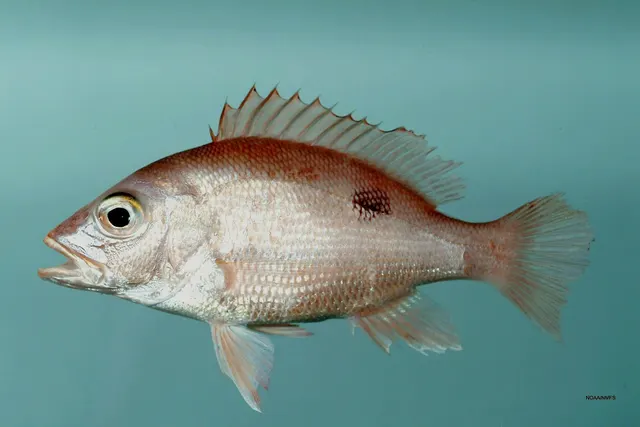 Northern red snapperThe Gulf of Mexico's emblematic reef fish — long-lived, structure-bound, subject to the most contested recreational quota in American fishing, and a barotrauma case study.
SEFSC Pascagoula Laboratory, NOAA/NMFS — public domain, via Wikimedia Commons
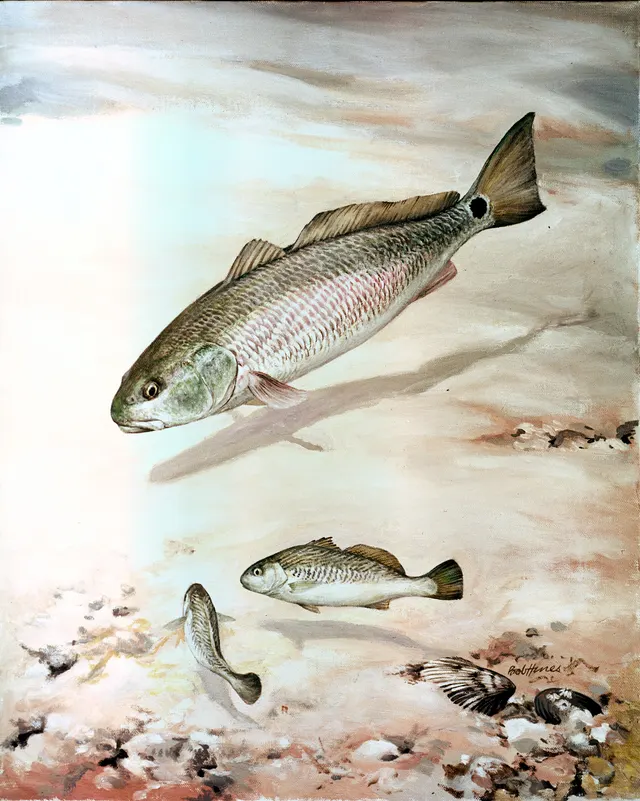 Red drumA copper-coloured inshore predator of the American south-east, marked with a false eyespot at the tail, fished on shallow flats where its tail breaks the surface as it feeds.
Hines, Robert W., Public domain, via Wikimedia Commons
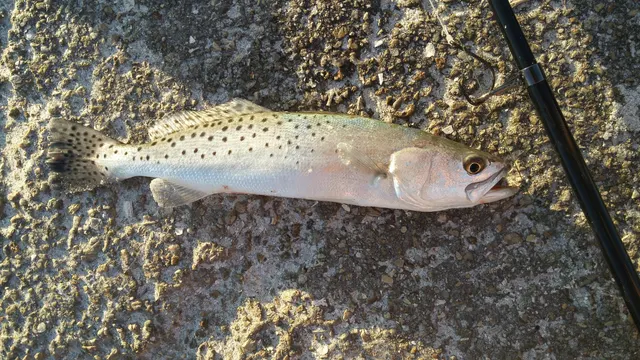 Spotted seatroutA drum-family inshore predator of American southern estuaries, marked with distinct round black spots and armed with two prominent canine teeth.
Quinn — CC BY, via iNaturalist
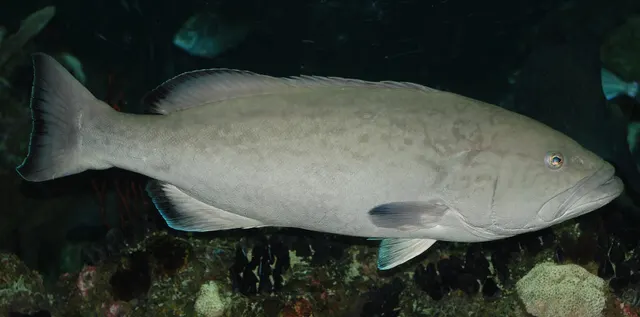 Gag grouperA protogynous grouper of the American south-east whose entire male population comes from sex-changed females — which makes size-selective fishing a demographic problem, not just a numerical one.
Jarek Tuszyński — CC BY 4.0, via Wikimedia Commons
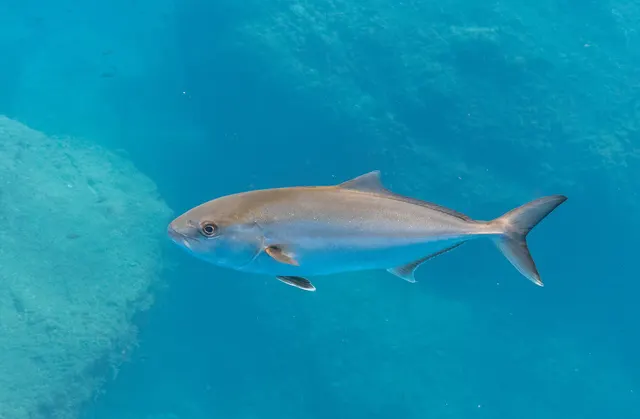 Greater amberjackThe largest amberjack — a circumglobal reef and wreck predator that fights downward with more raw power per kilogram than almost anything, and carries a genuine ciguatera caveat.
Diego Delso — CC BY-SA 4.0, via Wikimedia Commons
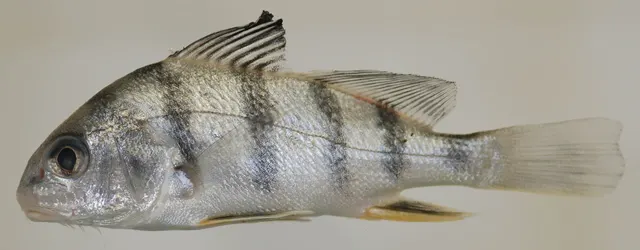 Black drumThe largest of the drums, reaching over fifty kilograms, with chin barbels, crushing throat teeth and a drumming call audible from a boat.
Smithsonian Environmental Research Center — CC BY 2.0, via Wikimedia Commons
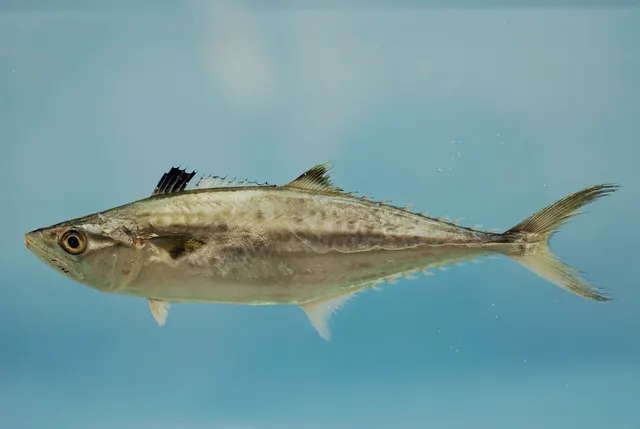 King mackerelA fast, toothy, migratory Atlantic mackerel taken by slow-trolling live bait and by pier fishing, known for a vertical strike that cuts baits in half.
NOAA Fisheries, SEFSC Pascagoula Laboratory, public domain, via Wikimedia Commons
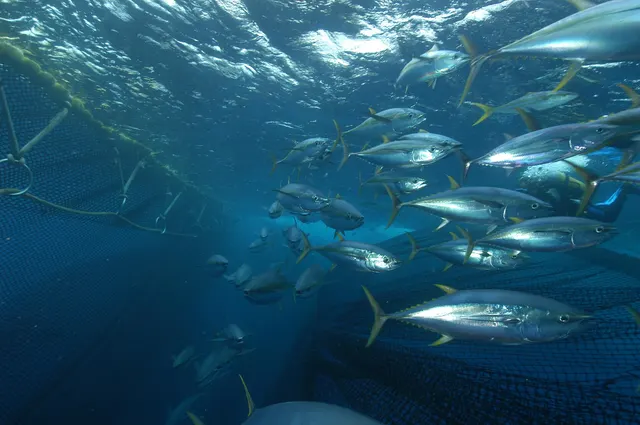 Yellowfin tunaA warm-blooded, high-speed oceanic predator that schools with dolphins and under floating debris, and one of the most commercially important fish in the world.
Marc Taquet — CC BY 4.0, via Wikimedia Commons
Safety
Further safety reading
- Boat safety for anglers — A shallow enclosed sea builds a short steep sea far faster than the same wind would on deeper water, and the shelf edge is a long run from most ports.
- Weather, lightning and open water — Summer afternoon thunderstorms develop rapidly over a shallow enclosed sea and produce severe conditions and lightning with very little warning.
Check the rules before you fish
Fishing laws, bylaws, access rules, seasons, bait restrictions and permitted methods vary by location and can change. Check the current rules from the relevant authority and the water you intend to fish before fishing.
Check with:
- Current national or regional law for where you are fishing
- Current local bylaws
- The relevant fisheries authority
- The landowner, club or fishery whose water it is
- Any restrictions specific to the species or the method you intend to use
Where to go next
What swims here
- Atlantic bluefin tunaThe western Atlantic population's principal spawning ground, used in spring and early summer, which makes the Gulf central to the species' management.
- Black drumOccupies the bays, passes and nearshore waters of the northern Gulf, feeding on shellfish over soft and mixed bottom.
- CobiaMoves seasonally through Gulf coastal waters, associating with buoys, wrecks, rays and any substantial floating or moving structure.
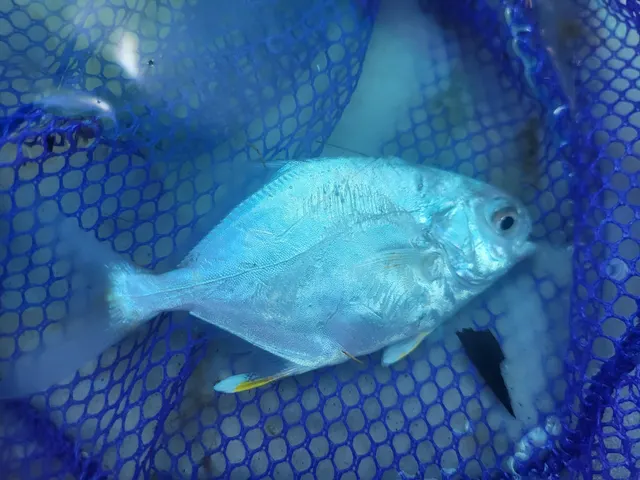 Florida pompanoOccupies the surf zone and nearshore sand of the Gulf's barrier-island beaches, feeding on small crustaceans in moving water.
- Gag grouperUses inshore seagrass as a nursery and offshore hard bottom as adult and spawning habitat, aggregating on known offshore sites.
- Greater amberjackHolds on wrecks, reefs, platforms and hard bottom across the shelf, aggregating to spawn on offshore structure in spring.
- King mackerelMoves along the Gulf coast seasonally with water temperature, holding on structure and bait concentrations across the shelf.
- Northern red snapperThe Gulf's defining and most contested reef species, concentrated on natural hard bottom, artificial reef and standing platform structure.
4 more
- Red drum Fish
- Sheepshead Fish
- Spotted seatrout Fish
- Yellowfin tuna Fish
How people fish here
How this compares
- FloridaOne coast of the state is the Gulf's eastern margin, so the system page explains the water and the jurisdiction page explains the fisheries and the rules on it.
- North American saltwater fishingThe Gulf is the clearest single instance of the subtropical estuarine coast the overview describes, and of the regulatory complexity that goes with a shared stock across many states.
Environment and conservation
- Fish stocks and sustainabilityRed snapper rebuilding produced shorter seasons rather than fewer fish, and the resulting allocation conflict devolved private recreational management to the individual states.
- Marine protected areas and spearfishingStanding platforms function as artificial reef over a largely soft bottom, which makes decommissioning a habitat question and is why rigs-to-reefs arrangements exist.
Sources and evidence
- NOAA National Ocean Service education on estuaries and the National Estuarine Research Reserve System — National Oceanic and Atmospheric Administration, United States (Government fisheries body)Relied on for: Estuarine and coastal structure and function in North American waters, and the nursery role of estuarine habitat.Background and mechanism onlyCitation checked — the work exists and is described correctly
- FishBase: a global information system on fishes — Froese, R. and D. Pauly, eds. — FishBase Consortium (Scientific institute)Relied on for: Distribution, habitat association and life history of the species occurring in the area.States this directlyPassage read and verified
Why the 19 connections on this page are here, and the sources
What swims here
Backed by research — 12 connections
Supported by peer-reviewed research or fisheries science. The sources are listed and can be checked.
Atlantic bluefin tuna
A distribution association between an animal and a kind of water, rather than a claim about any named mark.
- FishBase: a global information system on fishes — Froese, R. and D. Pauly, eds. — FishBase Consortium (Scientific institute)Relied on for: Distribution, habitat association and depth range recorded for the species, including its occurrence in the water body concerned.States this directlyPassage read and verified
- The IUCN Red List of Threatened Species — International Union for Conservation of Nature (Conservation authority)Relied on for: Assessment and range account for the species, including the systems and coasts it occupies.Background and mechanism onlyCitation checked — the work exists and is described correctly
Black drum
A distribution association between an animal and a kind of water, rather than a claim about any named mark.
- FishBase: a global information system on fishes — Froese, R. and D. Pauly, eds. — FishBase Consortium (Scientific institute)Relied on for: Distribution, habitat association and depth range recorded for the species, including its occurrence in the water body concerned.States this directlyPassage read and verified
- The IUCN Red List of Threatened Species — International Union for Conservation of Nature (Conservation authority)Relied on for: Assessment and range account for the species, including the systems and coasts it occupies.Background and mechanism onlyCitation checked — the work exists and is described correctly
Cobia
A distribution association between an animal and a kind of water, rather than a claim about any named mark.
- FishBase: a global information system on fishes — Froese, R. and D. Pauly, eds. — FishBase Consortium (Scientific institute)Relied on for: Distribution, habitat association and depth range recorded for the species, including its occurrence in the water body concerned.States this directlyPassage read and verified
- The IUCN Red List of Threatened Species — International Union for Conservation of Nature (Conservation authority)Relied on for: Assessment and range account for the species, including the systems and coasts it occupies.Background and mechanism onlyCitation checked — the work exists and is described correctly
Florida pompano
A distribution association between an animal and a kind of water, rather than a claim about any named mark.
- FishBase: a global information system on fishes — Froese, R. and D. Pauly, eds. — FishBase Consortium (Scientific institute)Relied on for: Distribution, habitat association and depth range recorded for the species, including its occurrence in the water body concerned.States this directlyPassage read and verified
- The IUCN Red List of Threatened Species — International Union for Conservation of Nature (Conservation authority)Relied on for: Assessment and range account for the species, including the systems and coasts it occupies.Background and mechanism onlyCitation checked — the work exists and is described correctly
Gag grouper
A distribution association between an animal and a kind of water, rather than a claim about any named mark.
- FishBase: a global information system on fishes — Froese, R. and D. Pauly, eds. — FishBase Consortium (Scientific institute)Relied on for: Distribution, habitat association and depth range recorded for the species, including its occurrence in the water body concerned.States this directlyPassage read and verified
- The IUCN Red List of Threatened Species — International Union for Conservation of Nature (Conservation authority)Relied on for: Assessment and range account for the species, including the systems and coasts it occupies.Background and mechanism onlyCitation checked — the work exists and is described correctly
Greater amberjack
A distribution association between an animal and a kind of water, rather than a claim about any named mark.
- FishBase: a global information system on fishes — Froese, R. and D. Pauly, eds. — FishBase Consortium (Scientific institute)Relied on for: Distribution, habitat association and depth range recorded for the species, including its occurrence in the water body concerned.States this directlyPassage read and verified
- The IUCN Red List of Threatened Species — International Union for Conservation of Nature (Conservation authority)Relied on for: Assessment and range account for the species, including the systems and coasts it occupies.Background and mechanism onlyCitation checked — the work exists and is described correctly
King mackerel
A distribution association between an animal and a kind of water, rather than a claim about any named mark.
- FishBase: a global information system on fishes — Froese, R. and D. Pauly, eds. — FishBase Consortium (Scientific institute)Relied on for: Distribution, habitat association and depth range recorded for the species, including its occurrence in the water body concerned.States this directlyPassage read and verified
- The IUCN Red List of Threatened Species — International Union for Conservation of Nature (Conservation authority)Relied on for: Assessment and range account for the species, including the systems and coasts it occupies.Background and mechanism onlyCitation checked — the work exists and is described correctly
Northern red snapper
A distribution association between an animal and a kind of water, rather than a claim about any named mark.
- FishBase: a global information system on fishes — Froese, R. and D. Pauly, eds. — FishBase Consortium (Scientific institute)Relied on for: Distribution, habitat association and depth range recorded for the species, including its occurrence in the water body concerned.States this directlyPassage read and verified
- The IUCN Red List of Threatened Species — International Union for Conservation of Nature (Conservation authority)Relied on for: Assessment and range account for the species, including the systems and coasts it occupies.Background and mechanism onlyCitation checked — the work exists and is described correctly
Red drum
A distribution association between an animal and a kind of water, rather than a claim about any named mark.
- FishBase: a global information system on fishes — Froese, R. and D. Pauly, eds. — FishBase Consortium (Scientific institute)Relied on for: Distribution, habitat association and depth range recorded for the species, including its occurrence in the water body concerned.States this directlyPassage read and verified
- The IUCN Red List of Threatened Species — International Union for Conservation of Nature (Conservation authority)Relied on for: Assessment and range account for the species, including the systems and coasts it occupies.Background and mechanism onlyCitation checked — the work exists and is described correctly
Sheepshead
A distribution association between an animal and a kind of water, rather than a claim about any named mark.
- FishBase: a global information system on fishes — Froese, R. and D. Pauly, eds. — FishBase Consortium (Scientific institute)Relied on for: Distribution, habitat association and depth range recorded for the species, including its occurrence in the water body concerned.States this directlyPassage read and verified
- The IUCN Red List of Threatened Species — International Union for Conservation of Nature (Conservation authority)Relied on for: Assessment and range account for the species, including the systems and coasts it occupies.Background and mechanism onlyCitation checked — the work exists and is described correctly
Spotted seatrout
A distribution association between an animal and a kind of water, rather than a claim about any named mark.
- FishBase: a global information system on fishes — Froese, R. and D. Pauly, eds. — FishBase Consortium (Scientific institute)Relied on for: Distribution, habitat association and depth range recorded for the species, including its occurrence in the water body concerned.States this directlyPassage read and verified
- The IUCN Red List of Threatened Species — International Union for Conservation of Nature (Conservation authority)Relied on for: Assessment and range account for the species, including the systems and coasts it occupies.Background and mechanism onlyCitation checked — the work exists and is described correctly
Yellowfin tuna
A distribution association between an animal and a kind of water, rather than a claim about any named mark.
- FishBase: a global information system on fishes — Froese, R. and D. Pauly, eds. — FishBase Consortium (Scientific institute)Relied on for: Distribution, habitat association and depth range recorded for the species, including its occurrence in the water body concerned.States this directlyPassage read and verified
- The IUCN Red List of Threatened Species — International Union for Conservation of Nature (Conservation authority)Relied on for: Assessment and range account for the species, including the systems and coasts it occupies.Background and mechanism onlyCitation checked — the work exists and is described correctly
How people fish here
What experienced anglers do — 1 connection
Widely and independently recommended by experienced anglers and specialist sources. This is real angling knowledge, not proof: controlled evidence for it is limited, and FishingHQ records it as convention rather than as a demonstrated effect.
Sea fishing
A discipline that is characteristic of the place rather than merely possible there, joined so a reader can move between the place and the practice.
- General angling website restatements of established technique — Various (Credible secondary source)Relied on for: Widely restated practice associating this discipline with this place, recorded as practitioner consensus rather than as tested fact.Background and mechanism onlyCitation checked — the work exists and is described correctly
- Fishers' Craft and Lettered Art: Tracts on Fishing from the End of the Middle Ages — University of Toronto Press, 1997 (Scientific literature)Relied on for: That fishing traditions develop around the water and fish available to them, and the historical method of reading such traditions.States this directlyCitation checked — the work exists and is described correctly
How this compares
What experienced anglers do — 2 connections
Widely and independently recommended by experienced anglers and specialist sources. This is real angling knowledge, not proof: controlled evidence for it is limited, and FishingHQ records it as convention rather than as a demonstrated effect.
Florida
Two places a reader would reasonably weigh against one another, joined where the comparison teaches something about both. It is also how the larger geography is linked to what sits inside it.
- General angling website restatements of established technique — Various (Credible secondary source)Relied on for: Widely restated practice associating this discipline with this place, recorded as practitioner consensus rather than as tested fact.Background and mechanism onlyCitation checked — the work exists and is described correctly
- Fishers' Craft and Lettered Art: Tracts on Fishing from the End of the Middle Ages — University of Toronto Press, 1997 (Scientific literature)Relied on for: That fishing traditions develop around the water and fish available to them, and the historical method of reading such traditions.States this directlyCitation checked — the work exists and is described correctly
North American saltwater fishing
A continental overview joined to a record it sits above, so that the synthesis and the detail are reachable from one another rather than duplicating each other.
- FAO fishing gear types and fishing technology information — Food and Agriculture Organization of the United Nations (Scientific institute)Relied on for: Classification and description of world fishing gears and the regions in which each is used.States this directlyCitation checked — the work exists and is described correctly
- General angling website restatements of established technique — Various (Credible secondary source)Relied on for: Widely restated descriptions of regional angling practice, recorded as consensus rather than as scholarship.Background and mechanism onlyCitation checked — the work exists and is described correctly
Safety reading
Official guidance — 2 connections
Stated by a fisheries authority, scientific institute or recognised angling body. Authoritative, but summarising rather than demonstrating.
Boat safety for anglers
A place is joined to the safety topic that explains a hazard genuinely characteristic of it, so the mechanism is reachable rather than restated as a weak warning.
- RNLI water safety guidance: cold water shock and Float to Live — Royal National Lifeboat Institution (Water-safety or diver-training authority)Relied on for: Cold water shock and the immersion response, shore angling hazards, small-craft guidance and the circumstances in which water users are most often killed.States this directlyPassage read and verified
- RoSPA water safety information and UK accidental drowning statistics — Royal Society for the Prevention of Accidents (Water-safety or diver-training authority)Relied on for: Accidental drowning statistics and the circumstances in which recreational water users are most often killed.Background and mechanism onlyPassage read and verified
Weather, lightning and open water
A place is joined to the safety topic that explains a hazard genuinely characteristic of it, so the mechanism is reachable rather than restated as a weak warning.
- RNLI water safety guidance: cold water shock and Float to Live — Royal National Lifeboat Institution (Water-safety or diver-training authority)Relied on for: Cold water shock and the immersion response, shore angling hazards, small-craft guidance and the circumstances in which water users are most often killed.States this directlyPassage read and verified
- RoSPA water safety information and UK accidental drowning statistics — Royal Society for the Prevention of Accidents (Water-safety or diver-training authority)Relied on for: Accidental drowning statistics and the circumstances in which recreational water users are most often killed.Background and mechanism onlyPassage read and verified
Environment and conservation
Backed by research — 2 connections
Supported by peer-reviewed research or fisheries science. The sources are listed and can be checked.
Fish stocks and sustainability
An environmental pressure that is specific to this place rather than general to fishing, joined so the issue is anchored to a real example.
- ICES Advice on fishing opportunities, catch and effort — International Council for the Exploration of the Sea (Scientific institute)Relied on for: Stock status, environmental pressures and the scientific basis for advice in the waters concerned.Background and mechanism onlyCitation checked — the work exists and is described correctly
- The IUCN Red List of Threatened Species — International Union for Conservation of Nature (Conservation authority)Relied on for: Assessment of the species and habitats affected, and the pressures acting on them.States this directlyCitation checked — the work exists and is described correctly
Marine protected areas and spearfishing
An environmental pressure that is specific to this place rather than general to fishing, joined so the issue is anchored to a real example.
- Good Fish Guide — Marine Conservation Society (Conservation authority)Relied on for: Assessment of the fishery and the management measures applied to it, including spatial protection.Background and mechanism onlyCitation checked — the work exists and is described correctly
- Reef Fish Spawning Aggregations: Biology, Research and Management — Springer, Fish & Fisheries Series vol. 35, 2012 (Scientific literature)Relied on for: The vulnerability of aggregating and site-attached species and the role of spatial protection in managing them.States this directlyCitation checked — the work exists and is described correctly
How FishingHQ labels evidence is explained in the evidence policy.