Northern red snapper
Fish · Last reviewed 2026-08-10
The Gulf of Mexico's emblematic reef fish — long-lived, structure-bound, subject to the most contested recreational quota in American fishing, and a barotrauma case study.
Safety: barotrauma and pressure injury — can cause serious injury or death. 5 more points apply here.
Barotrauma and pressure injury — Can cause serious injury or death
Fish brought up from depth suffer severe swim bladder expansion and cannot return unaided. A red snapper released at the surface without help floats and dies, which is why descending devices became standard equipment.
What reduces it: Carry and use a descending device — in much of the range this is a requirement rather than good practice. Return fish quickly and at depth. Where venting is permitted, learn to do it correctly rather than improvising.
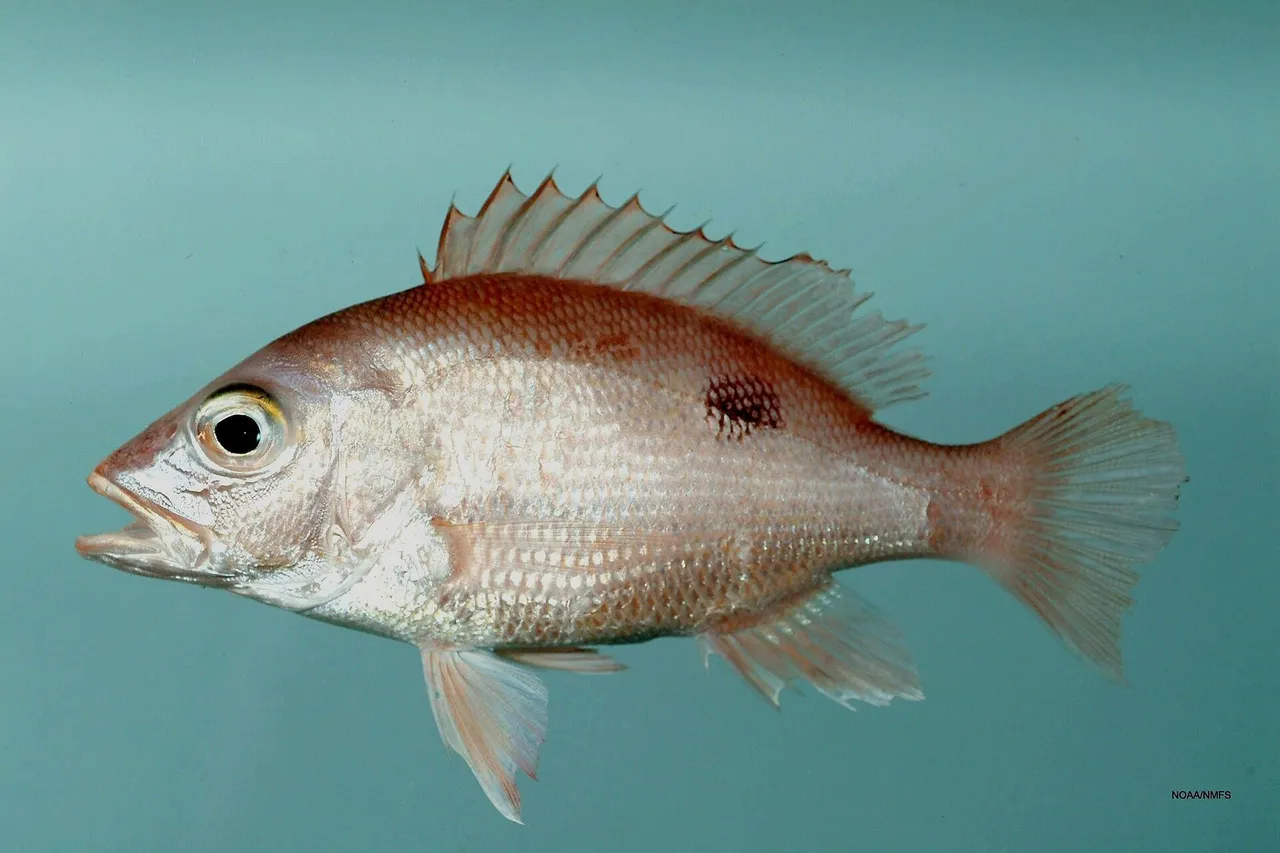
How this was identified, and who took it
Identified by: A NOAA fisheries laboratory voucher photographed on a plain ground. The dark spot on the upper flank below the front of the soft dorsal is prominent, and the anal fin is sharply angular rather than rounded, which is the record's stated separation from the similar vermilion snapper. Body rose-red above shading to silver below with red fins. Identified on the anal-fin shape rather than on the spot, because the spot is a life-stage character.SEFSC Pascagoula Laboratory, NOAA/NMFS — public domain, via Wikimedia Commons — source, licence
Catching Northern red snapper
Everything here on fishing for it. Each entry opens the page behind it.
- Ground
The northern red snapper is a genuine snapper — family Lutjanidae — and the fish most Americans mean by the name, which matters because a great deal of fish sold as red snapper is not this species.
It lives over structure in the Gulf of Mexico and the south-eastern United States: natural reef, rock, wrecks and, very substantially, artificial reef and offshore platforms. It is long-lived, with documented ages beyond fifty years, matures relatively early but continues growing for decades, and shows strong site fidelity to particular structures.
That combination — long life, site fidelity and enormous popularity — has made its management the most contested recreational fisheries argument in the United States, with seasons at times measured in days. FishingHQ does not state what any current season is, and for this species that restraint is doing more work than usual.
It is also the textbook barotrauma species. Red snapper brought up from depth suffer severe swim bladder expansion, and the development and now widespread requirement of descending devices to return them is one of the clearest cases of a specific handling technology being adopted at scale to fix a specific mortality problem.
How it is caught
Identification
- Scientific name
- Lutjanus campechanus
- Family
- Lutjanidae
- Water
- Saltwater
- Conservation status
- Vulnerable
- Regions
- North America, Caribbean, Central & South America
- Uniformly rose-red to brick-red body, brighter on the back and paler below, with red fins.
- Red iris — a distinctive and useful character in fresh fish.
- A dark spot on the upper flank below the front of the soft dorsal fin, prominent in juveniles and fading in large adults.
- Sharply pointed anal fin — the separation from the similar vermilion snapper, whose anal fin is rounded.
- Canine teeth present in the jaws, as in all Lutjanidae.
Size
- Typical
- 1–3 kg (2.2–6.6 lb)
- Large
- 6–10 kg (13–22 lb)
Exceptional: Over 15 kg (33 lb); maximum published weight 22.8 kg
Hard bottom, relief and a great deal of artificial structure
Red snapper are demersal reef-associated fish of the Gulf and south Atlantic shelf, and in that region a very large part of the habitat is man-made.
THEY REQUIRE HARD BOTTOM AND RELIEF. Natural rocky outcrops, ledges, banks and reef hold them, and adults are strongly associated with vertical relief rather than with flat bottom.
ARTIFICIAL STRUCTURE IS A MAJOR HABITAT COMPONENT. Oil and gas platforms, artificial reefs and wrecks across the Gulf function as red snapper habitat at a scale that materially affects the population's distribution, and the relationship between energy infrastructure and this fishery is closer than for any other species on FishingHQ.
DEPTH INCREASES WITH AGE. Juveniles occupy shallow shelf habitat including low-relief bottom and shell ridges; adults move progressively to deeper structure, with the largest fish on deep offshore relief.
JUVENILES USE LOW-RELIEF AND SOFT-BOTTOM SHELF as nursery habitat, which is a less obvious dependency than the adult one and matters to recruitment.
THEY SCHOOL AROUND STRUCTURE, size-sorted, and a given piece of relief tends to hold a cohort.
AND BAROTRAUMA IS UNAVOIDABLE FROM THESE DEPTHS. Released red snapper suffer pressure injury and require descending devices to survive, and the mandating of those devices is one of the clearer recent gear interventions in the region's recreational fishery.
Backed by research — why, and the sources (2)
Supported by peer-reviewed research or fisheries science. The sources are listed and can be checked.
- FishBase: a global information system on fishes — Froese, R. and D. Pauly, eds. — FishBase Consortium (Scientific institute)Relied on for: Distribution, habitat association, depth range, size, reproduction and life-history parameters recorded for the species.States this directlyPassage read and verified
- The IUCN Red List of Threatened Species — International Union for Conservation of Nature (Conservation authority)Relied on for: Assessment and range account for the species, including the habitats it depends on, its life history and the pressures acting on it.States this directlyCitation checked — the work exists and is described correctly
A long summer spawning season, and a fishery season that is not it
Red snapper have an extended warm-season spawning period, and the interesting seasonal fact about them is the gap between their biology and their fishery.
SPAWNING RUNS THROUGH THE WARM MONTHS, from late spring into autumn, with females spawning in batches repeatedly over that whole period rather than in a single event. Frequency is high — individual females may spawn many times in a season.
OLDER, LARGER FEMALES SPAWN MORE OFTEN AND PRODUCE MORE AND BETTER EGGS, so the reproductive contribution of a population is concentrated in its oldest fish. That is the biological argument behind protecting large individuals, and it applies to this species with unusual force.
EGGS AND LARVAE ARE PELAGIC, and settlement onto shelf nursery habitat depends on transport.
SPAWNING IS ASSOCIATED WITH STRUCTURE AND WITH THE SHELF EDGE, in the same general habitat the fishery works.
AND THE FISHERY SEASON IS AN ADMINISTRATIVE OBJECT, NOT A BIOLOGICAL ONE. Federal recreational seasons for this species have at times been measured in days, set by quota and effort rather than by the fish's calendar, and the resulting allocation dispute is among the most litigated fisheries questions in the United States. A reader looking up red snapper seasons is looking at a management decision that changes annually, and this page does not state what any current one permits.
Backed by research — why, and the sources (2)
Supported by peer-reviewed research or fisheries science. The sources are listed and can be checked.
- FishBase: a global information system on fishes — Froese, R. and D. Pauly, eds. — FishBase Consortium (Scientific institute)Relied on for: Distribution, habitat association, depth range, size, reproduction and life-history parameters recorded for the species.States this directlyPassage read and verified
- The IUCN Red List of Threatened Species — International Union for Conservation of Nature (Conservation authority)Relied on for: Assessment and range account for the species, including the habitats it depends on, its life history and the pressures acting on it.States this directlyCitation checked — the work exists and is described correctly
Descend it or keep it, but do not float it
This is the fish that made descending devices a legal requirement in a major fishery, and the reasoning is worth understanding rather than merely complying with.
THE PROBLEM. Northern red snapper are taken from depths at which barotrauma is routine, in a fishery with tight bag and size limits, which means a very large number of fish are caught and released by regulation rather than by choice. Released at the surface with an everted stomach and no ability to submerge, a high proportion of them die. The discard mortality was large enough to matter to the stock assessment, which is how it became a rules question.
WHAT WORKS. Recompression with a descending device, promptly. Federal rules in the Gulf now require descending or venting equipment to be aboard and rigged, and the practical instruction is to have it ready before the first fish comes up rather than to look for it afterwards. Speed matters: the fish's odds fall with every minute it spends distended at the surface.
THE SPINES ARE SHARP AND THE GILL PLATE IS NOT FRIENDLY. Handle from above and behind with a wet cloth, keep fingers clear of the operculum edge, and use pliers rather than hands in the mouth.
WHAT NOT TO ASSUME. That a fish which disappeared under the surface swam away. A fish that sinks may be sinking rather than swimming. The test of a good release is a fish that goes down under its own power from a descender at depth, not one that vanishes from the surface.
AND THE HONEST PART. If you are catching fish you must release at a depth where they will not survive release, the useful change is depth or location, not technique.
Backed by research — why, and the sources (2)
Supported by peer-reviewed research or fisheries science. The sources are listed and can be checked.
- Do we need species-specific guidelines for catch-and-release recreational angling? — Biodiversity and Conservation 14:1195–1209, 2005 (Scientific literature)Relied on for: That post-release mortality varies with species, capture depth, water temperature, air exposure and handling, and that species-specific guidance outperforms general guidance.States this directlyCitation checked — the work exists and is described correctly
- A review of catch-and-release angling mortality with implications for no-take reserves — Reviews in Fish Biology and Fisheries 15:129–154, 2005 (Scientific literature)Relied on for: Review of hooking and release mortality across fisheries, including the contribution of depth of capture and handling duration.States this directlyCitation checked — the work exists and is described correctly
Batch spawning through a long summer, and why the oldest females matter most
Red snapper reproduction is unusually well studied because the species has been at the centre of one of the most contested fishery management arguments anywhere, and the biology is what the argument turns on.
SPAWNING IS BATCHED AND EXTENDED. Red snapper do not spawn once a year; mature females release eggs in repeated batches through a long warm season, spawning many times over several months. That spreads reproductive risk across a whole summer's worth of plankton conditions rather than staking it on one event, and it means a single female's annual output is far larger than a single spawning would suggest.
BATCH FREQUENCY AND FECUNDITY BOTH RISE STEEPLY WITH SIZE AND AGE. A large old female spawns more often and releases more eggs per batch than a small one, and the difference is not marginal — it is a multiple. So a stock's reproductive output is concentrated in its oldest fish to a degree that a simple biomass figure conceals.
WHICH IS WHY AGE STRUCTURE IS THE CENTRAL MANAGEMENT VARIABLE FOR THIS SPECIES. A population rebuilt to the same tonnage but composed of young fish produces far fewer eggs than one containing old ones. Recovering the age structure, not just the biomass, is what the rebuilding effort has been about.
SPAWNING OCCURS OVER STRUCTURE AND HARD BOTTOM in shelf waters, with fish associating with reef, wreck and artificial structure. Artificial reefs and platforms have become significant habitat for this species, which complicates the picture: they concentrate fish, which aids both the fishery and the fishing pressure on it.
MATURITY IS REACHED YOUNG AND LONGEVITY IS LONG — a combination that means a fish can be reproductively active for a very long time if allowed to be, and that a fishery removing fish shortly after maturity captures a tiny fraction of an individual's lifetime output.
BAROTRAUMA IS A REPRODUCTIVE ISSUE HERE, NOT ONLY A WELFARE ONE. Released fish from depth that fail to survive are removed from the spawning stock regardless of the regulation that released them, which is why descending devices and venting practice have become part of the management conversation.
AND THE RULES CHANGE OFTEN AND DIFFER BY AREA AND SECTOR. The competent authority is the only source for what currently applies.
Backed by research — why, and the sources (2)
Supported by peer-reviewed research or fisheries science. The sources are listed and can be checked.
- Reef Fish Spawning Aggregations: Biology, Research and Management — Springer, Fish & Fisheries Series vol. 35, 2012 (Scientific literature)Relied on for: Reef fish spawning aggregations, their predictability, their vulnerability to fishing, and the consequences of aggregation fishing for stock structure.States this directlyCitation checked — the work exists and is described correctly
- FishBase: a global information system on fishes — Froese, R. and D. Pauly, eds. — FishBase Consortium (Scientific institute)Relied on for: Reproductive mode, sexual pattern, spawning season and maturity for the species.States this directlyPassage read and verified
Lifecycle and reproduction
Long-lived, with documented ages beyond fifty years, maturing at around two to three years but continuing to grow for decades. Spawns repeatedly through the warm months over structure, with pelagic eggs and larvae. Strong site fidelity to particular reefs, wrecks and platforms means individual structures hold distinct groups that can be fished down and are slowly replaced.
Batch spawning over structure through the warmer months, with individuals spawning many times in a season and large females contributing disproportionately more eggs. That relationship between size and reproductive output is the central argument in the management debate, and it is why the size structure of the population matters as much as its total abundance.
Feeding and senses
Feeds on fish, crustaceans and cephalopods around and above structure, taking prey from the water column as well as the bottom. Larger fish are increasingly piscivorous. The willingness to come up off the structure for a bait is what makes the species so catchable and, given the depth involved, is also what makes barotrauma such a consistent problem.
Sight-dominant in the clear water over reef and structure, with good low-light performance. Red snapper are notably aggressive around structure and will compete for a bait, which is why a drop into a holding group frequently produces an immediate response and why a school can be depleted quickly.
Through the year
Present on structure year-round, with spawning through the warmer months and some movement between depths seasonally. The practical seasonality of the fishery is regulatory rather than biological — the season is set by management rather than by the fish — which is an unusual case and worth understanding as such.
Distribution
Western Atlantic: the Gulf of Mexico and the south-eastern United States coast, from the Carolinas south, and along the Mexican coast. Associated with natural and artificial reef, rock, wrecks and offshore structures, generally between about 10 and 190 m.
This is a biological range — where the species occurs, not a prediction that you will catch one. To browse the fishing geography FishingHQ holds, start at fishing places.
Why anglers care
One of the most popular and most contested recreational species in the United States, fished on bait and jigs over structure. Its management — seasons, quotas and the allocation between recreational and commercial sectors — is among the most argued-over in fisheries anywhere, and descending device requirements for released fish are now standard in much of the range.
Handling and returning
THE BAROTRAUMA SPECIES. Fish brought up from depth suffer swim bladder expansion, protruding stomach and displaced eyes, and cannot swim down unaided; released without help they float and die. A descending device returns the fish to depth so the gas recompresses and is now required in much of the range. Venting is an alternative where permitted and done correctly. Sharp dorsal spines and canine teeth make handling itself a minor hazard.
Going further
- What does northern red snapper eat? — feeding biology, kept separate from what anglers infer from it.
- Northern red snapper vs Yellowtail snapper — how to tell them apart.
Safety
Barotrauma and pressure injury is set out at the top of this page, where it cannot be missed.
Venomous and spined species — Can cause injury needing treatment
Sharp dorsal and anal spines and canine teeth on a fish handled quickly in numbers on a moving deck.
What reduces it: Wet hands, support the body, keep fingers clear of the spines and mouth, and use pliers and a proper grip rather than improvising.
Precautions that always apply here
- Handle spined and venomous species with the spines controlled. Know which local species have them before you fish, not afterwards.
- Support the fish's weight along its body, keep it out of the water for as short a time as possible, and hold it over something soft.
- Wear a buoyancy aid or lifejacket. Cold water incapacitates strong swimmers within a minute, long before swimming ability matters.
- Wet your hands before touching a fish. Dry hands strip the protective mucus layer that keeps infection out.
Check the rules before you fish
Fishing laws, bylaws, access rules, seasons, bait restrictions and permitted methods vary by location and can change. Check the current rules from the relevant authority and the water you intend to fish before fishing.
Check with:
- Current national or regional law for where you are fishing
- Current local bylaws
- The relevant fisheries authority
- The landowner, club or fishery whose water it is
- Any restrictions specific to the species or the method you intend to use
Where to go next
Similar and related fish
Where it lives
Where you will find it
- FloridaHolds hard bottom, ledges and artificial structure on the Gulf shelf, in the fishery whose season is among the most contested in the United States.
- The Gulf of MexicoThe Gulf's defining and most contested reef species, concentrated on natural hard bottom, artificial reef and standing platform structure.
Understanding this fish
- Cephalopods as preySquid are taken over reef and wreck structure, particularly at night and in deeper water.
- Ciguatera and reef fish poisoningSnappers are among the families implicated in affected regions, and the risk varies with size, reef and locality rather than with the species name.
- Decapod crustaceans as preyCrustaceans are a major part of the red snapper diet over structure, alongside fish and cephalopods.
- What actually happens to a released fishThe textbook barotrauma species. A red snapper released at the surface from depth floats and dies, which is why descending devices went from a good idea to a requirement.
Sources and evidence
- FishBase: a global information system on fishes — Froese, R. and D. Pauly, eds. — FishBase Consortium (Scientific institute)Relied on for: Scientific name, family placement in the Lutjanidae, a maximum length of 100.0 cm TL, a maximum published weight of 22.8 kg, a maximum reported age of 57 years.States this directlyPassage read and verified
- FishBase: a global information system on fishes — Froese, R. and D. Pauly, eds. — FishBase Consortium (Scientific institute)Relied on for: Environment, climate zone and depth range as recorded: Marine; reef-associated; depth range 10 - 190 m , usually 30 - 130 m . Subtropical; 43°N - 4°S, 100°W - 40°WStates this directlyPassage read and verified
- FishBase: a global information system on fishes — Froese, R. and D. Pauly, eds. — FishBase Consortium (Scientific institute)Relied on for: The IUCN Red List category for Lutjanus campechanus — Vulnerable, assessed 10 August 2015 — as republished by FishBase, the Red List itself being unreachable during review.States this directlyPassage read and verified
- Understanding the Complexity of Catch-and-Release in Recreational Fishing — Reviews in Fisheries Science 15:75–167, 2007 (Scientific literature)Relied on for: That barotrauma is a principal cause of post-release mortality and that release survival depends on the physical trauma of capture and on the handling that follows.States this directlyCitation checked — the work exists and is described correctly
- Good Fish Guide — Marine Conservation Society (Conservation authority)Relied on for: That longevity and the disproportionate reproductive contribution of large individuals are material to stock assessment.FishingHQ's interpretation of what it saysCitation checked — the work exists and is described correctly
Why the 10 connections on this page are here, and the sources
Similar and related fish
Backed by research — 1 connection
Supported by peer-reviewed research or fisheries science. The sources are listed and can be checked.
Yellowtail snapper
An identification comparison naming both binomials: Ocyurus chrysurus and Lutjanus campechanus.
- FishBase: a global information system on fishes — Froese, R. and D. Pauly, eds. — FishBase Consortium (Scientific institute)Relied on for: Morphological and distributional data for Ocyurus chrysurus and for Lutjanus campechanus.States this directlyPassage read and verified
- The IUCN Red List of Threatened Species — International Union for Conservation of Nature (Conservation authority)Relied on for: Separate assessments treating Ocyurus chrysurus and Lutjanus campechanus as distinct species.States this directlyCitation checked — the work exists and is described correctly
How it is caught
What experienced anglers do — 2 connections
Widely and independently recommended by experienced anglers and specialist sources. This is real angling knowledge, not proof: controlled evidence for it is limited, and FishingHQ records it as convention rather than as a demonstrated effect.
Drift fishing
The page names bait and jigs over structure. Descending-device requirements for released fish are now standard through much of the range, which is a fact about this fishery and not about the fish.
- Florida saltwater fishing regulations and Keys sanctuary rules — Florida state wildlife authority and the Florida Keys National Marine Sanctuary (Government fisheries body)Relied on for: Documents which fishery and which technique takes this species.States this directlyCitation checked — the work exists and is described correctly
- General angling website restatements of established technique — Various (Credible secondary source)Relied on for: Independently corroborates the species' recreational capture and range.Background and mechanism onlyCitation checked — the work exists and is described correctly
Jigging
The page names jigs beside bait as the two ways the species is fished. Jigging is separated because it is a lure fishery with a different selectivity and a different release profile.
- Florida saltwater fishing regulations and Keys sanctuary rules — Florida state wildlife authority and the Florida Keys National Marine Sanctuary (Government fisheries body)Relied on for: Documents which fishery and which technique takes this species.States this directlyCitation checked — the work exists and is described correctly
- General angling website restatements of established technique — Various (Credible secondary source)Relied on for: Independently corroborates the species' recreational capture and range.Background and mechanism onlyCitation checked — the work exists and is described correctly
Where it lives
Backed by research — 1 connection
Supported by peer-reviewed research or fisheries science. The sources are listed and can be checked.
Inshore ground
A habitat claim held to a scientific standard.
- FishBase: a global information system on fishes — Froese, R. and D. Pauly, eds. — FishBase Consortium (Scientific institute)Relied on for: That Lutjanus campechanus is a reef-associated species of the western Atlantic and Gulf of Mexico, generally between about 10 and 190 m.States this directlyPassage read and verified
Where you will find it
Backed by research — 2 connections
Supported by peer-reviewed research or fisheries science. The sources are listed and can be checked.
Florida
A distribution association between an animal and a kind of water, rather than a claim about any named mark.
- NOAA National Ocean Service education on estuaries and the National Estuarine Research Reserve System — National Oceanic and Atmospheric Administration, United States (Government fisheries body)Relied on for: Estuarine, seagrass and coastal habitat function in North American waters, and the nursery role of shallow habitat for the species concerned.Background and mechanism onlyCitation checked — the work exists and is described correctly
- FishBase: a global information system on fishes — Froese, R. and D. Pauly, eds. — FishBase Consortium (Scientific institute)Relied on for: Distribution, habitat association, depth range and life history recorded for the species.States this directlyPassage read and verified
The Gulf of Mexico
A distribution association between an animal and a kind of water, rather than a claim about any named mark.
- FishBase: a global information system on fishes — Froese, R. and D. Pauly, eds. — FishBase Consortium (Scientific institute)Relied on for: Distribution, habitat association and depth range recorded for the species, including its occurrence in the water body concerned.States this directlyPassage read and verified
- The IUCN Red List of Threatened Species — International Union for Conservation of Nature (Conservation authority)Relied on for: Assessment and range account for the species, including the systems and coasts it occupies.Background and mechanism onlyCitation checked — the work exists and is described correctly
Understanding this fish
Backed by research — 3 connections
Supported by peer-reviewed research or fisheries science. The sources are listed and can be checked.
Cephalopods as prey
Recorded diet evidence identifies cephalopods as a food item of this predator at group level rather than to species. The edge points at the taxon record for that reason, and encoding it as a species-level claim would assert something the source does not.
- FishBase: a global information system on fishes — Froese, R. and D. Pauly, eds. — FishBase Consortium (Scientific institute)Relied on for: Food items recorded for this predator, given as cephalopods.States this directlyPassage read and verified
- FAO Species Identification Guides for Fishery Purposes and the FAO Species Catalogues — Food and Agriculture Organization of the United Nations (Scientific institute)Relied on for: Species account describing this predator's diet, recorded at the level of cephalopods.Background and mechanism onlyCitation checked — the work exists and is described correctly
Ciguatera and reef fish poisoning
A link from a species or a place to the accumulation mechanism that decides whether what is caught there should be eaten, resting on published seafood-hazard guidance and on the species' recorded diet and trophic position.
- FAO Species Identification Guides for Fishery Purposes and the FAO Species Catalogues — Food and Agriculture Organization of the United Nations (Scientific institute)Relied on for: Identification, distribution and trophic position of tropical reef fishes, including the large predatory species associated with reef toxin.States this directlyCitation checked — the work exists and is described correctly
- FishBase: a global information system on fishes — Froese, R. and D. Pauly, eds. — FishBase Consortium (Scientific institute)Relied on for: Recorded distribution, diet, size and trophic level of the species named, which is the basis for its position in a reef food web.States this directlyPassage read and verified
Decapod crustaceans as prey
Recorded diet evidence identifies decapod crustaceans as a food item of this predator at group level rather than to species. The edge points at the taxon record for that reason, and encoding it as a species-level claim would assert something the source does not.
- FishBase: a global information system on fishes — Froese, R. and D. Pauly, eds. — FishBase Consortium (Scientific institute)Relied on for: Food items recorded for this predator, given as decapod crustaceans.States this directlyPassage read and verified
- FAO Species Identification Guides for Fishery Purposes and the FAO Species Catalogues — Food and Agriculture Organization of the United Nations (Scientific institute)Relied on for: Species account describing this predator's diet, recorded at the level of decapod crustaceans.Background and mechanism onlyCitation checked — the work exists and is described correctly
Official guidance — 1 connection
Stated by a fisheries authority, scientific institute or recognised angling body. Authoritative, but summarising rather than demonstrating.
What actually happens to a released fish
A release-survival claim held to an authoritative standard, and the clearest case in FishingHQ of a specific technology adopted to fix a specific mortality.
- Understanding the Complexity of Catch-and-Release in Recreational Fishing — Reviews in Fisheries Science 15:75–167, 2007 (Scientific literature)Relied on for: That barotrauma from depth is a principal cause of post-release mortality and that release survival depends on the physical trauma of capture.States this directlyCitation checked — the work exists and is described correctly
How FishingHQ labels evidence is explained in the evidence policy.