What does northern red snapper eat?
What is established about how northern red snapper feeds, kept separate from what anglers infer from it.
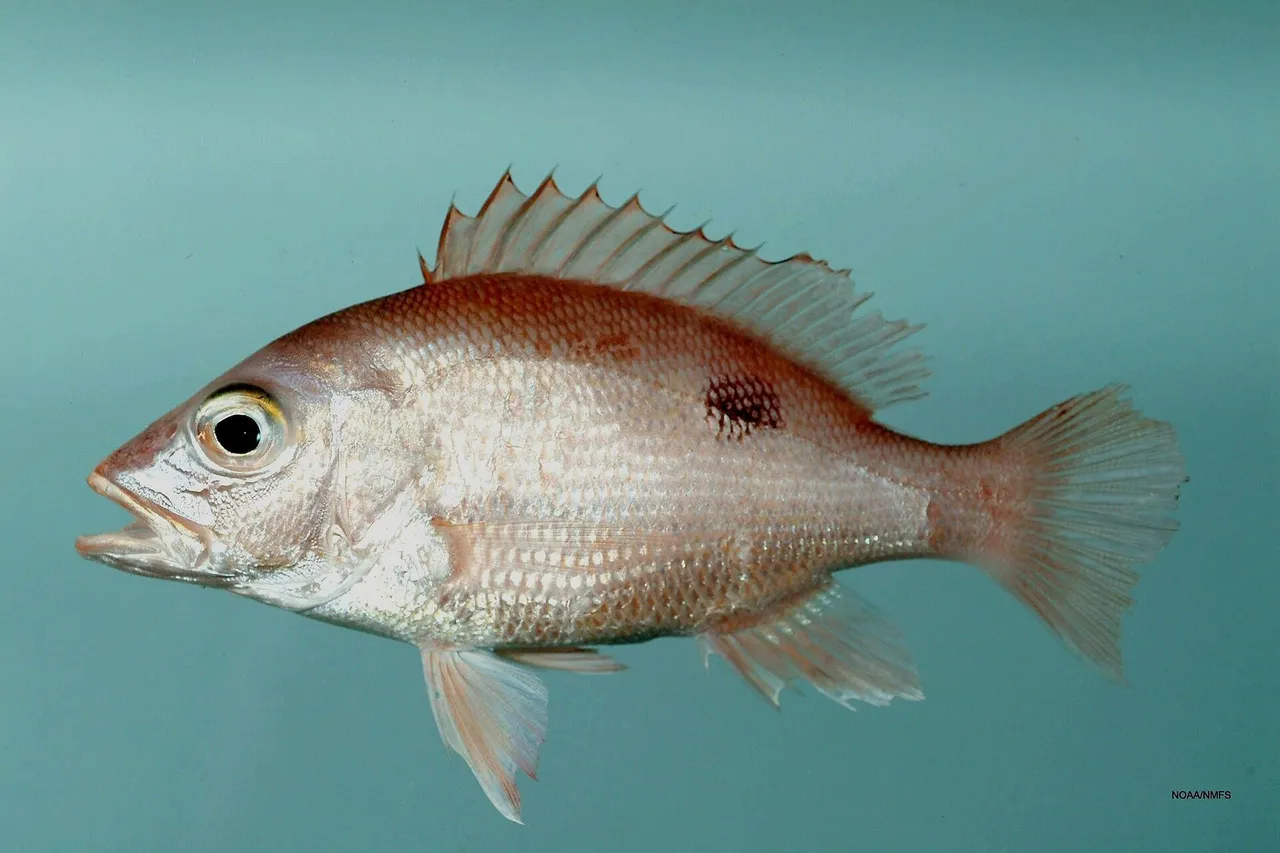
How this was identified, and who took it
Identified by: A NOAA fisheries laboratory voucher photographed on a plain ground. The dark spot on the upper flank below the front of the soft dorsal is prominent, and the anal fin is sharply angular rather than rounded, which is the record's stated separation from the similar vermilion snapper. Body rose-red above shading to silver below with red fins. Identified on the anal-fin shape rather than on the spot, because the spot is a life-stage character.SEFSC Pascagoula Laboratory, NOAA/NMFS — public domain, via Wikimedia Commons — source, licenceWhat is known about how it feeds
The red snapper is the structure-associated predator that is willing to leave the structure, and that willingness explains both its catchability and its management history.
The fish holds over reef, wreck and artificial structure and takes prey from the water column above it as well as from the bottom — rising well off the structure to intercept, which a grouper on the same reef will not do.
Both verified relationships are group-level and both are structure-associated: decapod crustaceans, dominant in smaller fish, and cephalopods, taken over and around the reef particularly at night and in deeper water. Fish enter the diet increasingly with size, and large red snapper are substantially piscivorous.
The ontogenetic pattern is spatial as well as dietary. Juveniles use shallow, low-relief bottom and even open sand; sub-adults move to structure; large adults occupy deep reef and wreck. The diet shifts from small crustaceans to fish along that path.
Depth is the constraint that governs everything about how the species is fished and released. Red snapper are taken from water deep enough that pressure injury on ascent is the norm rather than the exception, and the stock's recovery from severe depletion has depended as much on release survival as on catch limits.
The food
Prey with a verified dietary link to this fish. Each entry carries its own evidence, and each is written at the precision the source actually used: a named species where the source named one, a group or food category where it said “polychaetes”, “crustaceans” or “detritus” and meant it. That is why this list is shorter than the animal’s real diet rather than longer.
- Decapod crustaceans as prey — a group rather than a species: the evidence names the group
Crustaceans are a major part of the red snapper diet over structure, alongside fish and cephalopods.
- Cephalopods as prey — a group rather than a species: the evidence names the group
Squid are taken over reef and wreck structure, particularly at night and in deeper water.
Food with no page of its own here yet
These are real components of the diet, listed as plain text because FishingHQ has no page for them yet. Inventing pages to make the list look fuller would be the fabrication this whole approach exists to prevent.
- pinfish and small grunts
- shrimp
- crabs
- octopus
- juvenile fish of many species
What anglers do with this
Everything below is interpretation, not finding. It is what experienced anglers conclude from the biology above, and the reasoning is usually sound and almost never tested. It is separated from the biology deliberately.
The willingness to rise off structure is what makes the species so catchable, and anglers use it directly: presentations worked above the reef take fish that a bottom-only approach would miss.
The shift towards fish prey with size is used to argue for larger offerings where large fish are the target, which is inference from the recorded diet rather than a demonstrated selection effect.
The release position is not interpretation and is the most consequential thing on this page. A red snapper brought up from depth will usually show barotrauma, descending devices and venting tools materially improve survival, and in several fisheries carrying one is a legal requirement. Season and retention rules for this species change frequently and are a question for the relevant authority.
What this does not establish
Both relationships are group-level. Diet composition changes substantially across the size range and with depth, and the fish component in large individuals is not represented by a verified relationship. The account describes the Gulf of Mexico and south-eastern American populations.
Where this connects
These are the baits, lures, methods and explainers FishingHQ already joins to this fish — which is why the list is sometimes short. They are not chosen for this page, and a link here means an evidenced relationship exists, not that it follows from the diet.
Methods used for it
Where it lives
The science behind the feeding
This page covers feeding. The Northern red snapper record covers identification, lifecycle, seasonal behaviour, handling and the sources behind all of it.
Reviewed 2026-08-12.