Yellowtail snapper
Fish · Last reviewed 2026-08-10
A slim reef snapper with a broad yellow stripe and deeply forked yellow tail, feeding well above the bottom and fished with drifting chum.
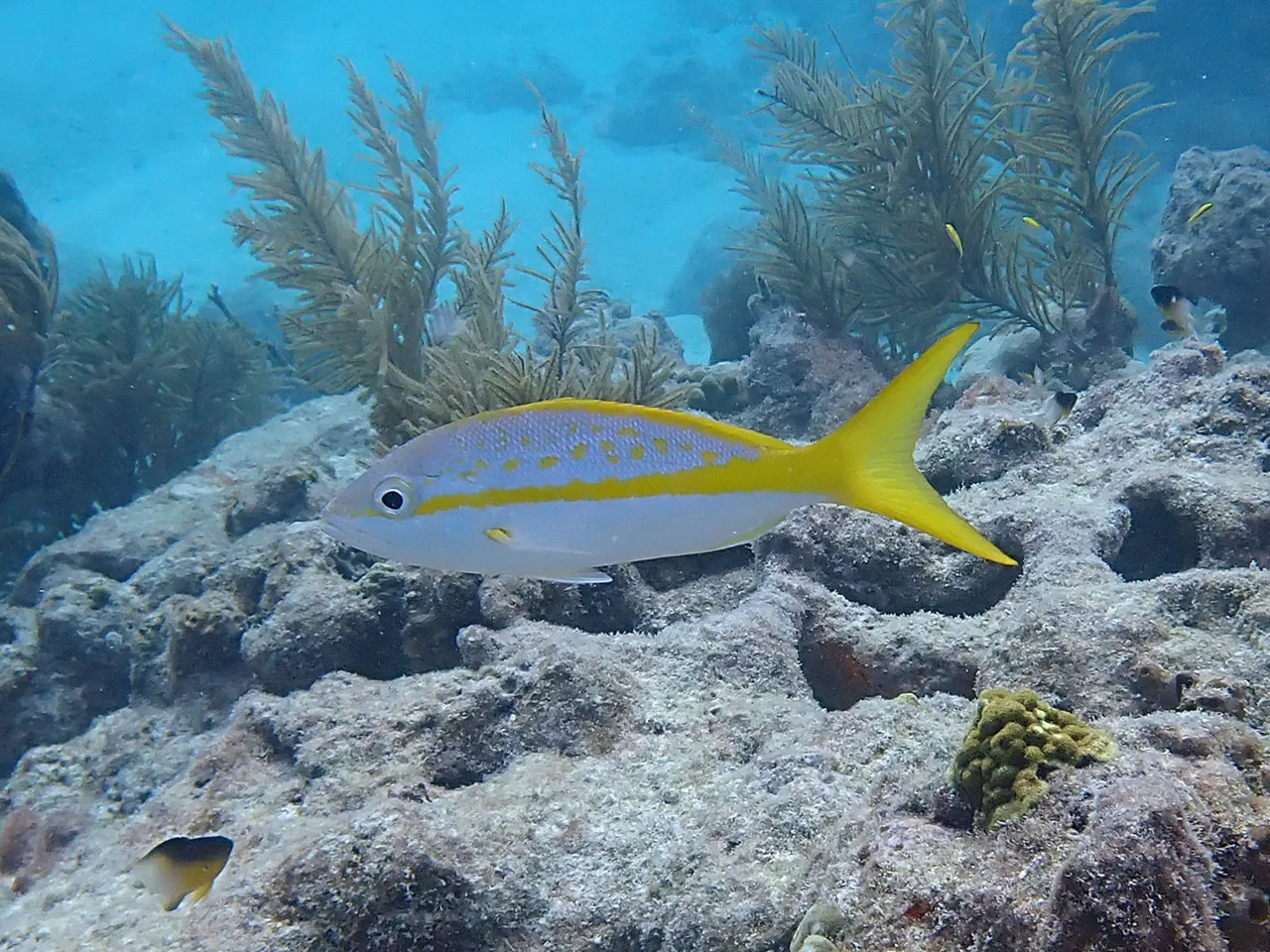
How this was identified, and who took it
Identified by: The record's leading character is exactly what the frame shows: a broad yellow stripe running from the snout through the eye and WIDENING backwards into a deeply forked, entirely yellow tail, with yellow blotches scattered above it over a pale violet-silver flank. Three agreeing identifications, none disagreeing. The fish is unobstructed and in full lateral.Zygy — CC0, via iNaturalist — source, licenceCatching Yellowtail snapper
Everything here on fishing for it. Each entry opens the page behind it.
- Ground
- Where
- 2 places FishingHQ documents — strongest claim anywhere: repeatedly reported · From the shore, From a boat, On a charter
Yellowtail snapper is the snapper that does not behave like one. Where most Lutjanidae hold hard on the bottom, yellowtail feed well up in the water column above reef, which changes the entire approach to catching them: anglers set a chum slick and drift light baits back into it, fishing several metres off the bottom.
It is a slim, elegant fish with a broad yellow stripe running from the snout through the eye to a deeply forked yellow tail, and it is unmistakable on a Caribbean or Florida reef.
It is among the best-eating snappers and one of the most heavily targeted reef species in its range, which makes size and bag management genuinely consequential for it.
How it is caught
Where Yellowtail snapper is documented
Places where public sources describe this species as fished, with how it is fished and how strongly the evidence supports it. This is not a range map and it is not a recommendation — it is what has been written down about a fishery rather than a record of any individual catch, and being listed is never permission to fish.
Florida
2 documented places
Bridge
Recorded here
From the shore · From a boat
Reef
Repeatedly reported
From a boat · On a charter
What these strengths mean
- Recorded here
- At least one credible public account of this species being caught here. That is all it means.
- Repeatedly reported
- Several independent public accounts. Enough to say it happens more than once; not enough to call it a fishery.
Identification
- Scientific name
- Ocyurus chrysurus
- Family
- Lutjanidae
- Water
- Saltwater
- Conservation status
- Data Deficient
- Regions
- Caribbean, North America, Central & South America
- A broad yellow stripe running from the snout through the eye and widening to the tail.
- A deeply forked, entirely yellow caudal fin.
- Slim body for a snapper, with yellow blotches or spots above the lateral line.
- Pointed snout with a moderate mouth and small canine teeth.
Size
- Typical
- 0.4–1.2 kg (1–2.6 lb)
- Large
- 1.8–3 kg (4–6.6 lb)
Exceptional: FishBase records a maximum of 86.3 cm and 4.1 kg
Above the reef rather than on it
Yellowtail snapper occupy Caribbean and western Atlantic reef systems, and they use them differently from the other snappers they share water with.
THEY SCHOOL IN THE WATER COLUMN ABOVE THE REEF, frequently well off the bottom, rather than holding in and among structure as most snappers do. A yellowtail school is a midwater mark over hard ground.
THAT REFLECTS THE DIET. Yellowtail take plankton and small drifting organisms as well as small fish and crustaceans, feeding up in the current rather than ambushing from cover, which is why they respond to a drifting chum stream in a way bottom-dwelling snappers do not.
REEF, HARD BOTTOM AND DROP-OFFS ARE THE ASSOCIATED HABITAT, from shallow patch reef down to well over a hundred metres, with larger fish generally deeper and further offshore.
CURRENT IS PART OF THE HABITAT. Schools hold on the up-current side of reef features and feed on what the flow delivers.
JUVENILES USE SEAGRASS AND SHALLOW INSHORE HABITAT, which is a genuine nursery dependency and links the offshore fishery to inshore habitat condition.
THEY ARE WARY IN CLEAR WATER, which is why the fishery for them is a light-tackle, long-leader one and why they are a good indicator species for fishing pressure on a reef.
AND THEY ARE COMPARATIVELY RESILIENT for a snapper — faster growing and earlier maturing than the large groupers and snappers around them — which is why they remain abundant on reefs where slower species have been fished down.
Backed by research — why, and the sources (2)
Supported by peer-reviewed research or fisheries science. The sources are listed and can be checked.
- FAO Species Identification Guides for Fishery Purposes and the FAO Species Catalogues — Food and Agriculture Organization of the United Nations (Scientific institute)Relied on for: Distribution, habitat, depth and fishery accounts for the species in the FAO regional identification guides for the ocean area concerned.States this directlyCitation checked — the work exists and is described correctly
- FishBase: a global information system on fishes — Froese, R. and D. Pauly, eds. — FishBase Consortium (Scientific institute)Relied on for: Distribution, habitat association, depth range, size, reproduction and life-history parameters recorded for the species.States this directlyPassage read and verified
Lifecycle and reproduction
Moderately long-lived and slower-growing than its small size suggests, with fish recorded past fifteen years. That longevity means heavy pressure on the larger size classes has more effect than the abundance of small fish implies.
Spawns in aggregations over reef and shelf edge through the warmer months, releasing pelagic eggs. Aggregation spawning makes localised populations vulnerable to concentrated fishing.
Feeding and senses
Takes small fish, crustaceans and plankton well above the reef rather than on the bottom, feeding in the water column both by day and at night.
A visual feeder in clear reef water, and a notably cautious one — the reason yellowtail fishing depends on light leaders, small hooks and a chum slick that brings fish up and holds them.
Through the year
Present on reef year-round in the tropics, with spawning aggregations forming seasonally on the shelf edge and larger fish generally taken in deeper water.
Distribution
Western Atlantic: extending northward to Massachusetts, USA and Bermuda and southward to southeastern Brazil, in Gulf of Mexico and Antilles (Anderson, pers. comm.). Most common in the Bahamas, off south Florida and throughout the Caribbean. Lutjanus ambiguus (Poey, 1860), an intergeneric hybrid with Lutjanus synagris (Linnaeus) as demonstrated by Loftus (1992: ), followed by McEachran &. Fechhelm (2005: )
This is a biological range — where the species occurs, not a prediction that you will catch one. To browse the fishing geography FishingHQ holds, start at fishing places.
Why anglers care
A mainstay of Florida Keys and Caribbean reef fishing, fished with a chum slick and light baits drifted back into it well off the bottom — a technique quite unlike bottom fishing for other snappers. Its significance is eating quality and accessibility, and the chumming approach is one of the more distinctive reef methods anywhere. Practitioner consensus is that leader diameter matters more than almost anything else.
Handling and returning
Small, spiny and easily released. Grip across the body with the dorsal folded, unhook with pliers, and return promptly. Fish from deeper shelf-edge water may show barotrauma and need a descending device.
Going further
- Yellowtail snapper vs Northern red snapper — how to tell them apart.
Where to go next
Similar and related fish
Where it lives
Where you will find it
Understanding this fish
Sources and evidence
- FishBase: a global information system on fishes — Froese, R. and D. Pauly, eds. — FishBase Consortium (Scientific institute)Relied on for: Family, maximum size, depth and environment, distribution and the IUCN assessment for Ocyurus chrysurus.States this directlyPassage read and verified
- The IUCN Red List of Threatened Species — International Union for Conservation of Nature (Conservation authority)Relied on for: The Data Deficient assessment for Ocyurus chrysurus, assessed 10 October 2015.States this directlyCitation checked — the work exists and is described correctly
Why the 6 connections on this page are here, and the sources
Similar and related fish
Backed by research — 1 connection
Supported by peer-reviewed research or fisheries science. The sources are listed and can be checked.
Northern red snapper
An identification comparison naming both binomials: Ocyurus chrysurus and Lutjanus campechanus.
- FishBase: a global information system on fishes — Froese, R. and D. Pauly, eds. — FishBase Consortium (Scientific institute)Relied on for: Morphological and distributional data for Ocyurus chrysurus and for Lutjanus campechanus.States this directlyPassage read and verified
- The IUCN Red List of Threatened Species — International Union for Conservation of Nature (Conservation authority)Relied on for: Separate assessments treating Ocyurus chrysurus and Lutjanus campechanus as distinct species.States this directlyCitation checked — the work exists and is described correctly
How it is caught
What experienced anglers do — 2 connections
Widely and independently recommended by experienced anglers and specialist sources. This is real angling knowledge, not proof: controlled evidence for it is limited, and FishingHQ records it as convention rather than as a demonstrated effect.
Drift fishing
A practitioner claim about how Ocyurus chrysurus is commonly fished, following from where and how it feeds.
- General angling website restatements of established technique — Various (Credible secondary source)Relied on for: Widely restated practitioner accounts of fishing for yellowtail snapper.Citation checked — the work exists and is described correctly
- Sea Angler — Bauer Media (Specialist angling publication)Relied on for: Practitioner treatment of the methods used for yellowtail snapper and comparable species.Citation checked — the work exists and is described correctly
Reef spearfishing
A practitioner claim about how Ocyurus chrysurus is commonly fished, following from where and how it feeds.
- General angling website restatements of established technique — Various (Credible secondary source)Relied on for: Widely restated practitioner accounts of fishing for yellowtail snapper.Citation checked — the work exists and is described correctly
- Sea Angler — Bauer Media (Specialist angling publication)Relied on for: Practitioner treatment of the methods used for yellowtail snapper and comparable species.Citation checked — the work exists and is described correctly
Where it lives
Backed by research — 1 connection
Supported by peer-reviewed research or fisheries science. The sources are listed and can be checked.
Coral reef
A habitat association for Ocyurus chrysurus taken from the environment and distribution data on its FishBase summary.
- FishBase: a global information system on fishes — Froese, R. and D. Pauly, eds. — FishBase Consortium (Scientific institute)Relied on for: The environment, depth range and habitat description recorded for Ocyurus chrysurus.States this directlyPassage read and verified
Where you will find it
Backed by research — 1 connection
Supported by peer-reviewed research or fisheries science. The sources are listed and can be checked.
Florida
A distribution association between an animal and a kind of water, rather than a claim about any named mark.
- NOAA National Ocean Service education on estuaries and the National Estuarine Research Reserve System — National Oceanic and Atmospheric Administration, United States (Government fisheries body)Relied on for: Estuarine, seagrass and coastal habitat function in North American waters, and the nursery role of shallow habitat for the species concerned.Background and mechanism onlyCitation checked — the work exists and is described correctly
- FishBase: a global information system on fishes — Froese, R. and D. Pauly, eds. — FishBase Consortium (Scientific institute)Relied on for: Distribution, habitat association, depth range and life history recorded for the species.States this directlyPassage read and verified
Understanding this fish
Backed by research — 1 connection
Supported by peer-reviewed research or fisheries science. The sources are listed and can be checked.
Ciguatera and reef fish poisoning
That the ciguatera mechanism is relevant to this species, because it occupies the trophic position and habitat the toxin concentrates through. It is not a statement that any individual fish is toxic, and the record it points at says plainly that the risk is intensely local and that local knowledge outperforms any species list.
- Fish and Fishery Products Hazards and Controls Guidance — US Food and Drug Administration, Center for Food Safety and Applied Nutrition, 2022 (Standards body)Relied on for: Natural toxins in fishery products including ciguatera, the fish groups and regions associated with it, and that the toxin is not removed by cooking, freezing or any other domestic process.States this directlyPassage read and verified
- FishBase: a global information system on fishes — Froese, R. and D. Pauly, eds. — FishBase Consortium (Scientific institute)Relied on for: Trophic level, maximum size, longevity, reef association and recorded distribution of the species named, which is the basis for treating it as one the mechanism applies to.States this directlyPassage read and verified
How FishingHQ labels evidence is explained in the evidence policy.