How to identify yellowtail snapper
Ocyurus chrysurus · Lutjanidae
The characters that identify yellowtail snapper, ranked by how far each one can be trusted on its own.
How this was identified, and who took it
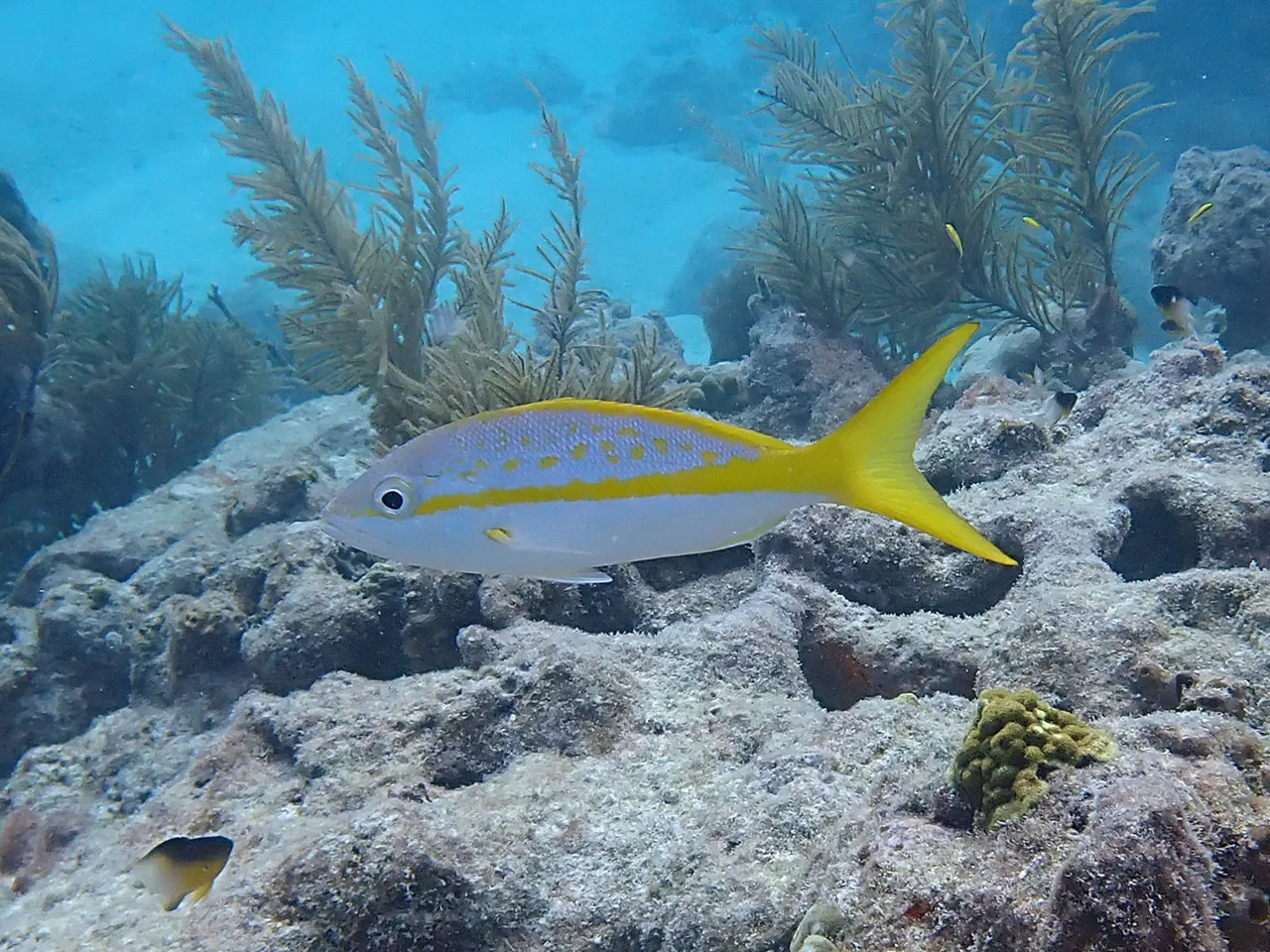
Identified by: The record's leading character is exactly what the frame shows: a broad yellow stripe running from the snout through the eye and WIDENING backwards into a deeply forked, entirely yellow tail, with yellow blotches scattered above it over a pale violet-silver flank. Three agreeing identifications, none disagreeing. The fish is unobstructed and in full lateral.Zygy — CC0, via iNaturalist — source, licenceAbout the image above: The photograph is an in-water frame over reef. Water softens the edges and shifts every tone slightly towards blue-green, so the yellow on a fish in your hand will read warmer and stronger than the image shows.
Look at this first
One yellow band does all the work. It begins at the snout, runs straight back through the eye, widens as it goes, and does not stop at the tail wrist — it becomes the entire tail. No other Caribbean or Floridian snapper has a stripe that turns into its caudal fin, and this one holds in every light a diver or an angler will meet.
Diagnostic — settles it on its own
Each of these settles the identification on its own. If one is clear, you have your answer.
A yellow stripe from snout to tail that widens and becomes the tail
Trace it forwards from the caudal fin. On this fish the yellow does not end at the peduncle; it broadens through the rear body and flows into a caudal fin which is entirely yellow. Several snappers carry yellow fins and a few carry a flank stripe, but the continuity between stripe and tail is unique here. It is a colour, which this project normally distrusts, and it is admissible because it is a structural pattern that holds on live fish, dead fish and fish on ice.
Supporting — use with other characters
Real characters that are not conclusive by themselves. Use two or three together.
A deeply forked tail, entirely yellow
The caudal fin is strongly forked with pointed lobes and carries no dark margin, no pale edge and no other colour. Combined with the stripe it settles the species; on its own it would leave room for a yellowtail form of another snapper, which is why the two are read together.
Slimmer in the body than most snappers, with a pointed snout
The build is noticeably more streamlined than a mutton, mangrove or red snapper of the same length, and the snout is pointed with a moderate mouth carrying small canines. It reads as a mid-water fish rather than a bottom ambusher, which is what it is, and it helps at distance before the colour is resolvable.
Suggestive only — varies with condition
Hints only. These vary with condition, season, water and how long the fish has been out of it, and a fish that contradicts them is still the same species.
Yellow blotches scattered over the back above the stripe
Above the lateral line the back carries irregular yellow spots and blotches on a violet-silver ground. They are strongest on a live fish over reef and dull rapidly out of water. Use them as a confirmation on a fish in the water and expect them to be gone by the time it reaches a slab.
What it gets confused with
- Lane snapper, which has yellow horizontal lines along the flank but a pink-red body and a tail that is not yellow.
- Mahogany snapper, which carries a dark flank spot and a red-margined tail rather than a full yellow one.
- Yellowtail amberjack and the yellowtail jacks, which have yellow tails but are carangids with a quite different body form and no snapper dentition.
- Juvenile mutton snapper, which shows a blue line through the eye and a flank spot, and which is deeper-bodied.
Side by side: Yellowtail snapper vs Northern red snapper.
Where this stops working
Small snappers of several species are genuinely difficult, and juveniles of this one show the stripe less strongly than adults. Colour-led identification also fails on fish that have been on ice for a day, where the yellow dulls towards olive; on a market slab the body proportion and the forked tail carry more weight than the tone. Snapper regulations in the Gulf, the Atlantic and the Caribbean differ by species, by season and by jurisdiction, and several look-alikes are managed separately, so where the species determines what a reader may do the answer must come from the current rules of the responsible fisheries authority rather than from a page.
The full record
This page covers identification only. The Yellowtail snapper record covers behaviour, lifecycle, distribution, handling and the sources behind all of it.
Reviewed 2026-08-16.
More about this fish
Telling it apart is one question. Here are the others.
Similar and related fish
How it is caught
Where it lives
Where you will find it
Why the 5 connections on this page are here, and the sources
Similar and related fish
Backed by research — 1 connection
Supported by peer-reviewed research or fisheries science. The sources are listed and can be checked.
Northern red snapper
An identification comparison naming both binomials: Ocyurus chrysurus and Lutjanus campechanus.
- FishBase: a global information system on fishes — Froese, R. and D. Pauly, eds. — FishBase Consortium (Scientific institute)Relied on for: Morphological and distributional data for Ocyurus chrysurus and for Lutjanus campechanus.States this directlyPassage read and verified
- The IUCN Red List of Threatened Species — International Union for Conservation of Nature (Conservation authority)Relied on for: Separate assessments treating Ocyurus chrysurus and Lutjanus campechanus as distinct species.States this directlyCitation checked — the work exists and is described correctly
How it is caught
What experienced anglers do — 2 connections
Widely and independently recommended by experienced anglers and specialist sources. This is real angling knowledge, not proof: controlled evidence for it is limited, and FishingHQ records it as convention rather than as a demonstrated effect.
Drift fishing
A practitioner claim about how Ocyurus chrysurus is commonly fished, following from where and how it feeds.
- General angling website restatements of established technique — Various (Credible secondary source)Relied on for: Widely restated practitioner accounts of fishing for yellowtail snapper.Citation checked — the work exists and is described correctly
- Sea Angler — Bauer Media (Specialist angling publication)Relied on for: Practitioner treatment of the methods used for yellowtail snapper and comparable species.Citation checked — the work exists and is described correctly
Reef spearfishing
A practitioner claim about how Ocyurus chrysurus is commonly fished, following from where and how it feeds.
- General angling website restatements of established technique — Various (Credible secondary source)Relied on for: Widely restated practitioner accounts of fishing for yellowtail snapper.Citation checked — the work exists and is described correctly
- Sea Angler — Bauer Media (Specialist angling publication)Relied on for: Practitioner treatment of the methods used for yellowtail snapper and comparable species.Citation checked — the work exists and is described correctly
Where it lives
Backed by research — 1 connection
Supported by peer-reviewed research or fisheries science. The sources are listed and can be checked.
Coral reef
A habitat association for Ocyurus chrysurus taken from the environment and distribution data on its FishBase summary.
- FishBase: a global information system on fishes — Froese, R. and D. Pauly, eds. — FishBase Consortium (Scientific institute)Relied on for: The environment, depth range and habitat description recorded for Ocyurus chrysurus.States this directlyPassage read and verified
Where you will find it
Backed by research — 1 connection
Supported by peer-reviewed research or fisheries science. The sources are listed and can be checked.
Florida
A distribution association between an animal and a kind of water, rather than a claim about any named mark.
- NOAA National Ocean Service education on estuaries and the National Estuarine Research Reserve System — National Oceanic and Atmospheric Administration, United States (Government fisheries body)Relied on for: Estuarine, seagrass and coastal habitat function in North American waters, and the nursery role of shallow habitat for the species concerned.Background and mechanism onlyCitation checked — the work exists and is described correctly
- FishBase: a global information system on fishes — Froese, R. and D. Pauly, eds. — FishBase Consortium (Scientific institute)Relied on for: Distribution, habitat association, depth range and life history recorded for the species.States this directlyPassage read and verified