Coral reef
Habitat · Last reviewed 2026-08-10
Structurally complex tropical reef built by living organisms — the most biodiverse fishing environment there is, and the most easily damaged.
Safety: shallow water blackout and breath-hold loss of consciousness — can cause serious injury or death. 3 more points apply here.
Shallow water blackout and breath-hold loss of consciousness — Can cause serious injury or death
Warm water, excellent visibility and comfortable conditions make long dives feel easy, which is exactly the circumstance in which a diver extends one. The physiology does not care that the water is pleasant.
What reduces it: The same rules that apply everywhere: training, one up one down, no hyperventilation, surface intervals longer than the dive, and a dive time decided on the surface.
- Water
- Saltwater
A coral reef is a structure built by animals. That single fact separates it from every other habitat on FishingHQ and governs everything about how it should be treated: the substrate is alive, it grows extremely slowly, and physical damage takes decades to recover.
For a spearfisher it is the most productive and most selective environment available. Visibility is typically excellent, species diversity is very high, and fish can be identified precisely before a shot is taken — which makes reef spearfishing, done carefully, among the most selective ways of taking a fish that exists.
It is also where the sport's conservation questions are sharpest. Reef fish are frequently slow-growing, site-attached and long-lived; many are protogynous, so the largest fish are the breeding males; and reef systems worldwide are under pressure from bleaching, sedimentation and fishing. A method that can select the largest individual on a piece of reef is a method that needs its practitioners to think about what they are selecting for.
What characterises it
Structures built by colonial coral polyps in warm, clear, nutrient-poor tropical water, forming fringing, barrier and atoll reefs with enormous structural complexity at every scale from a crevice to a wall. The substrate is living and slow-growing; broken coral does not regrow on a human timescale.
What lives there
The most biodiverse marine environment, supporting very high densities and varieties of fish across distinct zones — reef flat, crest, slope and drop-off — each with its own community. Many reef fish are site-attached, long-lived and slow to mature, and a substantial number change sex during life, which makes the size structure of a local population ecologically meaningful rather than incidental.
Through the year
Less seasonally variable than temperate habitats, with conditions driven by monsoon or trade-wind cycles, cyclone seasons and water temperature rather than by a spring-to-winter progression. Spawning aggregations, where they occur, are highly predictable in time and place — which makes them both ecologically critical and acutely vulnerable, and is why many are protected.
Some of what lives here
Fish recorded here that FishingHQ holds a reviewed photograph of. It is not a complete list of what Coral reef holds, and it is not a prediction that you will catch any of them — it is a way in to the ones we can show you.
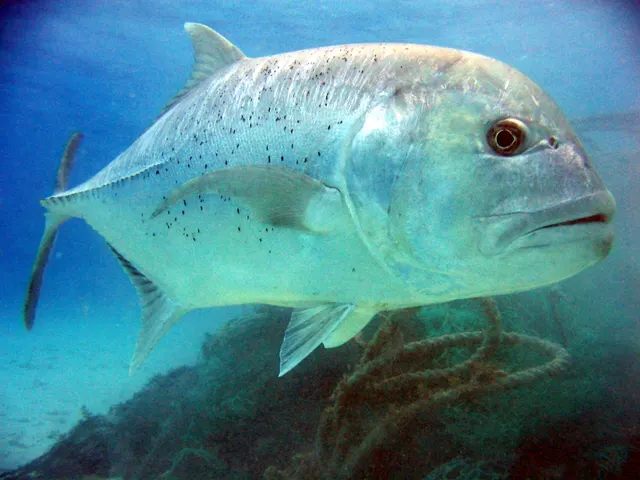 Giant trevallyA hugely powerful Indo-Pacific reef predator that hunts over shallow structure, and the fish popping was built around.
Dr. Dwayne Meadows, NOAA/NMFS/OPR — Public domain, via Wikimedia Commons
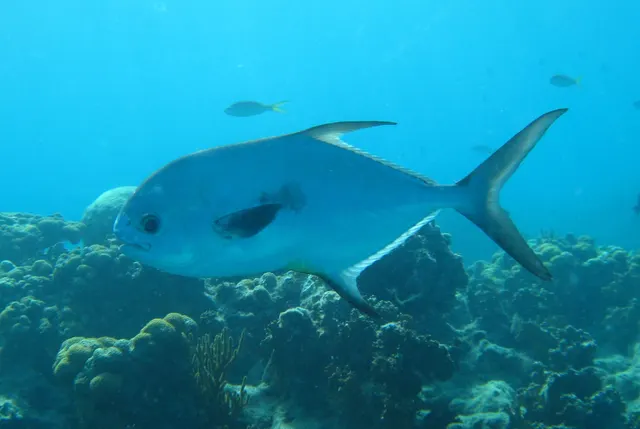 PermitA large, deep-bodied jack of tropical flats and wrecks, famously difficult on fly and the third fish of the flats grand slam.
Robert Webster — CC BY-SA, via iNaturalist
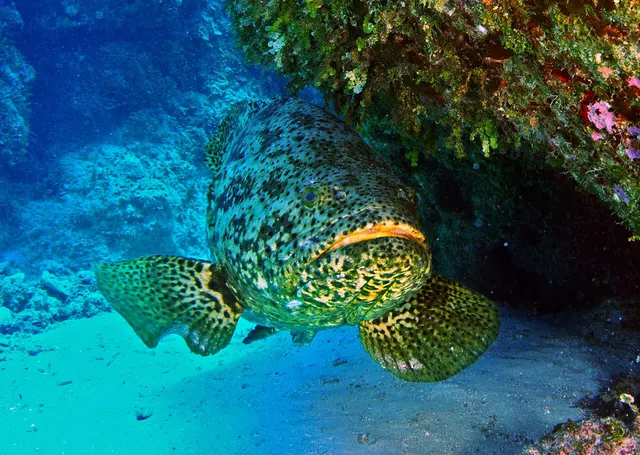 Atlantic goliath grouperAn enormous, slow-growing reef grouper that was fished to collapse, is now protected across much of its range, and must be released without being lifted.
Albert kok — CC BY-SA 3.0, via Wikimedia Commons
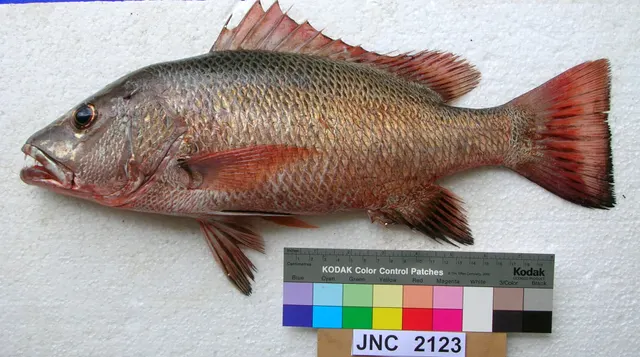 Mangrove jackA powerful red snapper of mangrove creeks and estuaries that moves to offshore reef as it matures, notorious for reaching structure the instant it is hooked.
Jean-Lou Justine — CC BY-SA 4.0, via Wikimedia Commons
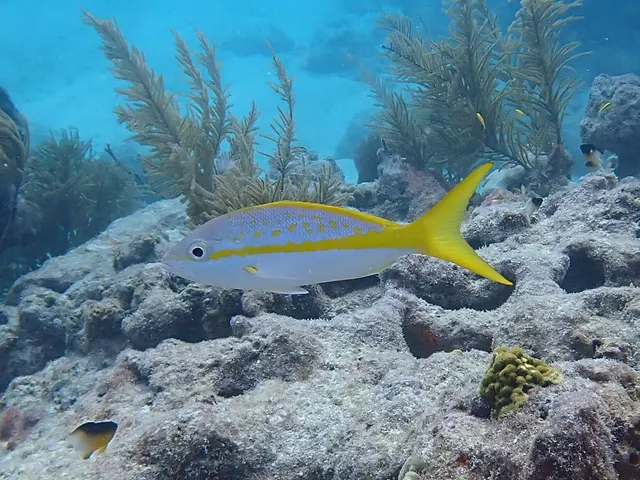 Yellowtail snapperA slim reef snapper with a broad yellow stripe and deeply forked yellow tail, feeding well above the bottom and fished with drifting chum.
Zygy — CC0, via iNaturalist
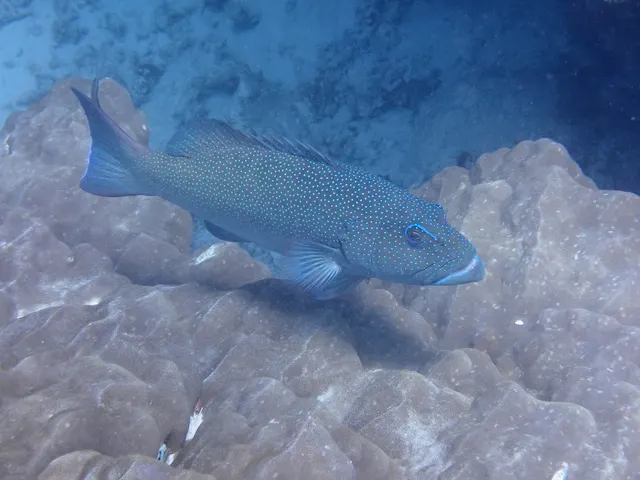 Coral troutA brilliant red-orange coral reef grouper marked with blue spots, known for cooperative hunting with moray eels, and a prime Great Barrier Reef target.
Donald Davesne — CC BY, via iNaturalist
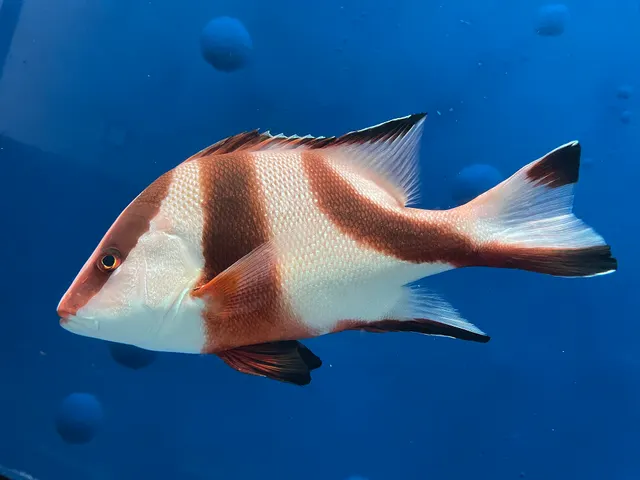 Red emperorA large deep-red Indo-Pacific snapper whose juveniles carry three bold dark bands that fade almost entirely with age.
Totti — CC BY-SA 4.0, via Wikimedia Commons
Safety
Shallow water blackout and breath-hold loss of consciousness is set out at the top of this page, where it cannot be missed.
Encounters with marine life — Can cause injury needing treatment
Reef environments hold venomous and hazardous species — stonefish, lionfish, cone shells, fire coral, moray eels in holes — and a speared struggling fish attracts larger predators. Most incidents involve a diver placing a hand somewhere without looking, or holding a bleeding fish.
What reduces it: Know which hazardous species are present where you are diving before you go. Do not put hands into holes. Get shot fish out of the water promptly rather than towing them. Wear gloves and a suit that covers you. Be prepared to abandon a fish.
Precautions that always apply here
- Never spearfish or freedive alone.
- Dive one up, one down: one diver down, one on the surface actively watching, every single dive.
Further safety reading
- Entanglement while breath-hold diving — Reef holds structure at every scale, and the discarded line and netting that collect on it are worse than the coral itself.
Check the rules before you fish
Fishing laws, bylaws, access rules, seasons, bait restrictions and permitted methods vary by location and can change. Check the current rules from the relevant authority and the water you intend to fish before fishing.
Check with:
- Current national or regional law for where you are fishing
- Current local bylaws
- The relevant fisheries authority
- The landowner, club or fishery whose water it is
- Any restrictions specific to the species or the method you intend to use
Where to go next
Fish found here
- Atlantic goliath grouperHolds on specific wrecks and reef structures, returning to the same ones for years.
- Blacktip reef sharkReef flats, lagoons and reef edges, frequently in water barely deep enough to cover the animal — which is why it is the shark visitors actually see.
- Bumphead parrotfishIt does not merely live on the reef — it eats it, and excretes it as sand.
- Caribbean spiny lobsterLedge, undercut and reef-hole habitat, where animals shelter communally in daylight with antennae protruding.
- Common octopusReef and rubble ground in the warmer parts of the range, where dens are abundant and crab prey is dense.
- Coral troutAmbushes small fish from coral structure on tropical reefs.
- Dogtooth tunaA tuna that lives on the reef rather than in open water.
- Giant trevallyReef edges, passes and lagoon entrances are where current concentrates bait against structure, and that is where this fish hunts.
11 more
- Great barracuda Fish
- Green jobfish Fish
- Humphead wrasse Fish
- Mangrove jack Fish
- Permit Fish
- Red emperor Fish
- Red lionfish Fish
- Reef stonefish Fish
- Spangled emperor Fish
- Spotted eagle ray Fish
- Yellowtail snapper Fish
Reading this water
- Fly fishing for warm-water and tropical speciesThe ground that sets the tackle limit. A hooked fish that reaches coral cuts off, so the fishing runs heavier tippet than the fish's caution would otherwise allow — the opposite of the freshwater instinct to go finer when refused.
- Reef fish territory, and where a species holdsVertical relief, up-current edges and habitat boundaries put fish in predictable positions, and the pattern repeats on every reef.
- Spearfishing in Asia and the Indo-PacificThe Coral Triangle holds the greatest marine biodiversity there is, which is an identification problem as well as a wonder.
- Spearfishing in the Caribbean and Central AmericaReef under pressure from disease, bleaching, storms and fishing at the same time, with herbivorous fish increasingly recognised as central to recovery.
How this compares
- Kelp forestBoth are habitat-forming structures on hard ground that hold fish because of their complexity — one built by an animal in warm nutrient-poor water, one grown by an alga in cold rich water.
- The Egyptian Red Sea coastThe habitat this whole coast is made of, and the reason a hundred metres of walking reaches ground that would need a boat elsewhere.
Environment and conservation
- Fish stocks and sustainabilityReef fish are frequently long-lived, site-attached and slow to mature, and a substantial number change sex with age — so removing the largest individuals has a structural effect on the population that the same weight of smaller fish would not.
- Marine protected areas and spearfishingCoral reef is the habitat most frequently placed under protection.
Sources and evidence
- FAO fishing gear types and fishing technology information — Food and Agriculture Organization of the United Nations (Scientific institute)Relied on for: The characterisation of reef environments in relation to fishing method selectivity and gear impact.Background and mechanism onlyCitation checked — the work exists and is described correctly
Why the 28 connections on this page are here, and the sources
Fish found here
Backed by research — 19 connections
Supported by peer-reviewed research or fisheries science. The sources are listed and can be checked.
Atlantic goliath grouper
A habitat association for Epinephelus itajara taken from the environment and distribution data on its FishBase summary.
- FishBase: a global information system on fishes — Froese, R. and D. Pauly, eds. — FishBase Consortium (Scientific institute)Relied on for: The environment, depth range and habitat description recorded for Epinephelus itajara.States this directlyPassage read and verified
Blacktip reef shark
A distributional claim about where a species is found, resting on the standard identification and compilation sources rather than on fishing report.
- FAO Species Identification Guides for Fishery Purposes and the FAO Species Catalogues — Food and Agriculture Organization of the United Nations (Scientific institute)Relied on for: Diagnostic characters, habitat association, depth range and distribution as set out in the FAO species identification guides for fishery purposes.States this directlyCitation checked — the work exists and is described correctly
- FishBase: a global information system on fishes — Froese, R. and D. Pauly, eds. — FishBase Consortium (Scientific institute)Relied on for: Distribution, maximum size, depth range, habitat association and biology as compiled for the species.States this directlyPassage read and verified
Bumphead parrotfish
Recorded as reef-associated over a depth range of 0 to 40 m across the Indo-Pacific. Its diet of live and dead coral makes it an agent of reef structure rather than only a resident of it.
- FishBase: a global information system on fishes — Froese, R. and D. Pauly, eds. — FishBase Consortium (Scientific institute)Relied on for: Environment, depth range, habitat association and distribution for Bolbometopon muricatum.States this directlyPassage read and verified
Caribbean spiny lobster
A distributional claim about where a species is found, resting on the standard identification and compilation sources rather than on fishing report.
- FAO Species Identification Guides for Fishery Purposes and the FAO Species Catalogues — Food and Agriculture Organization of the United Nations (Scientific institute)Relied on for: Diagnostic characters, habitat association, depth range and distribution as set out in the FAO species identification guides for fishery purposes.States this directlyCitation checked — the work exists and is described correctly
- FishBase: a global information system on fishes — Froese, R. and D. Pauly, eds. — FishBase Consortium (Scientific institute)Relied on for: Distribution, maximum size, depth range, habitat association and biology as compiled for the species.States this directlyPassage read and verified
Common octopus
A distributional claim about where a species is found, resting on the standard identification and compilation sources rather than on fishing report.
- FAO Species Identification Guides for Fishery Purposes and the FAO Species Catalogues — Food and Agriculture Organization of the United Nations (Scientific institute)Relied on for: Diagnostic characters, habitat association, depth range and distribution as set out in the FAO species identification guides for fishery purposes.States this directlyCitation checked — the work exists and is described correctly
- FishBase: a global information system on fishes — Froese, R. and D. Pauly, eds. — FishBase Consortium (Scientific institute)Relied on for: Distribution, maximum size, depth range, habitat association and biology as compiled for the species.States this directlyPassage read and verified
Coral trout
A habitat association for Plectropomus leopardus taken from the environment and distribution data on its FishBase summary.
- FishBase: a global information system on fishes — Froese, R. and D. Pauly, eds. — FishBase Consortium (Scientific institute)Relied on for: The environment, depth range and habitat description recorded for Plectropomus leopardus.States this directlyPassage read and verified
Dogtooth tuna
Recorded as reef-associated and oceanodromous over a depth range of 0 to 250 m in tropical water of roughly 20 to 28 °C. The reef association is what separates it from every other large scombrid.
- FishBase: a global information system on fishes — Froese, R. and D. Pauly, eds. — FishBase Consortium (Scientific institute)Relied on for: Environment, depth range, habitat association and distribution for Gymnosarda unicolor.States this directlyPassage read and verified
Giant trevally
A habitat claim held to a scientific standard.
- FishBase: a global information system on fishes — Froese, R. and D. Pauly, eds. — FishBase Consortium (Scientific institute)Relied on for: Recorded habitat for Caranx ignobilis across reef and coastal environments.States this directlyPassage read and verified
- FAO fishing gear types and fishing technology information — Food and Agriculture Organization of the United Nations (Scientific institute)Relied on for: The characterisation of reef environments in relation to fish distribution.Background and mechanism onlyCitation checked — the work exists and is described correctly
Great barracuda
A habitat claim held to a scientific standard.
- FishBase: a global information system on fishes — Froese, R. and D. Pauly, eds. — FishBase Consortium (Scientific institute)Relied on for: That Sphyraena barracuda is reef-associated, occurring from 0 to 100 m and usually between 3 and 30 m, with juveniles in mangroves and estuaries and adults ranging from inner harbours to open seas.States this directlyPassage read and verified
Green jobfish
Reef-associated over a depth range of 0 to 180 m across the Indo-Pacific from East Africa to Hawaii. Its long near-cylindrical build is a pursuit shape rather than an ambush one, which is why it is met in open water above reef as often as against it.
- FishBase: a global information system on fishes — Froese, R. and D. Pauly, eds. — FishBase Consortium (Scientific institute)Relied on for: Environment, depth range, habitat association and distribution for Aprion virescens.States this directlyPassage read and verified
Humphead wrasse
Recorded as reef-associated over a depth range of 0 to 100 m across the Indo-Pacific, from the Red Sea to South Africa and east to the Tuamotus.
- FishBase: a global information system on fishes — Froese, R. and D. Pauly, eds. — FishBase Consortium (Scientific institute)Relied on for: Environment, depth range, habitat association and distribution for Cheilinus undulatus.States this directlyPassage read and verified
Mangrove jack
A habitat association for Lutjanus argentimaculatus taken from the environment and distribution data on its FishBase summary.
- FishBase: a global information system on fishes — Froese, R. and D. Pauly, eds. — FishBase Consortium (Scientific institute)Relied on for: The environment, depth range and habitat description recorded for Lutjanus argentimaculatus.States this directlyPassage read and verified
Permit
A habitat association for Trachinotus falcatus taken from the environment and distribution data on its FishBase summary.
- FishBase: a global information system on fishes — Froese, R. and D. Pauly, eds. — FishBase Consortium (Scientific institute)Relied on for: The environment, depth range and habitat description recorded for Trachinotus falcatus.States this directlyPassage read and verified
Red emperor
A habitat association for Lutjanus sebae taken from the environment and distribution data on its FishBase summary.
- FishBase: a global information system on fishes — Froese, R. and D. Pauly, eds. — FishBase Consortium (Scientific institute)Relied on for: The environment, depth range and habitat description recorded for Lutjanus sebae.States this directlyPassage read and verified
Red lionfish
A distributional claim resting on the regional identification and fisheries literature rather than on angling report.
- Cefas science, advice and data on marine and freshwater environments — Centre for Environment, Fisheries and Aquaculture Science (Government fisheries body)Relied on for: UK marine science: distribution, habitat association, shellfish and crustacean monitoring, and the biological basis of management advice.States this directlyCitation checked — the work exists and is described correctly
- FAO Species Identification Guides for Fishery Purposes and the FAO Species Catalogues — Food and Agriculture Organization of the United Nations (Scientific institute)Relied on for: Habitat, depth range and distribution as set out in the FAO species identification sheets for the region concerned.States this directlyCitation checked — the work exists and is described correctly
Reef stonefish
A habitat association resting on the standard regional reference works rather than on angling report.
- FAO Species Identification Guides for Fishery Purposes and the FAO Species Catalogues — Food and Agriculture Organization of the United Nations (Scientific institute)Relied on for: Habitat association, depth range and distribution as set out in the FAO species identification sheets for the Indo-Pacific and Red Sea.States this directlyCitation checked — the work exists and is described correctly
- The IUCN Red List of Threatened Species — International Union for Conservation of Nature (Conservation authority)Relied on for: Global assessment and distribution for the species concerned.States this directlyCitation checked — the work exists and is described correctly
Spangled emperor
Recorded by FishBase as reef-associated and non-migratory over a depth range of about 10 to 75 m, across the Indo-West Pacific from the Red Sea to Samoa.
- FishBase: a global information system on fishes — Froese, R. and D. Pauly, eds. — FishBase Consortium (Scientific institute)Relied on for: Environment, depth range, habitat association and distribution for Lethrinus nebulosus.States this directlyPassage read and verified
Spotted eagle ray
A distributional claim about where a species is found, resting on the standard identification and compilation sources rather than on fishing report.
- FAO Species Identification Guides for Fishery Purposes and the FAO Species Catalogues — Food and Agriculture Organization of the United Nations (Scientific institute)Relied on for: Diagnostic characters, habitat association, depth range and distribution as set out in the FAO species identification guides for fishery purposes.States this directlyCitation checked — the work exists and is described correctly
- FishBase: a global information system on fishes — Froese, R. and D. Pauly, eds. — FishBase Consortium (Scientific institute)Relied on for: Distribution, maximum size, depth range, habitat association and biology as compiled for the species.States this directlyPassage read and verified
Yellowtail snapper
A habitat association for Ocyurus chrysurus taken from the environment and distribution data on its FishBase summary.
- FishBase: a global information system on fishes — Froese, R. and D. Pauly, eds. — FishBase Consortium (Scientific institute)Relied on for: The environment, depth range and habitat description recorded for Ocyurus chrysurus.States this directlyPassage read and verified
Reading this water
What experienced anglers do — 1 connection
Widely and independently recommended by experienced anglers and specialist sources. This is real angling knowledge, not proof: controlled evidence for it is limited, and FishingHQ records it as convention rather than as a demonstrated effect.
Fly fishing for warm-water and tropical species
A fish or a water joined to the fly-fishing mechanism it is a worked example of, written only where the subject's own behaviour or physical character is what this page explains. The direction is the one FishingHQ writes this kind of connection in, and the one it already uses 176 times, and it is also the semantically correct one: the mechanism explains the fish, not the reverse.
- FAO Species Identification Guides for Fishery Purposes and the FAO Species Catalogues — Food and Agriculture Organization of the United Nations (Scientific institute)Relied on for: Distribution, habitat association and feeding biology of tropical inshore and reef species, from regional identification guides prepared for fishery purposes.States this directlyCitation checked — the work exists and is described correctly
- FishBase: a global information system on fishes — Froese, R. and D. Pauly, eds. — FishBase Consortium (Scientific institute)Relied on for: Recorded environment, depth range, feeding biology and distribution of the tropical species named.States this directlyPassage read and verified
Backed by research — 3 connections
Supported by peer-reviewed research or fisheries science. The sources are listed and can be checked.
Reef fish territory, and where a species holds
The habitat record and the behavioural structure within it.
- FishBase: a global information system on fishes — Froese, R. and D. Pauly, eds. — FishBase Consortium (Scientific institute)Relied on for: Species habitat association, depth range and feeding ecology across marine fishes.Background and mechanism onlyPassage read and verified
Spearfishing in Asia and the Indo-Pacific
The habitat at its richest, and what that richness costs a visiting diver in certainty.
- FishBase: a global information system on fishes — Froese, R. and D. Pauly, eds. — FishBase Consortium (Scientific institute)Relied on for: Species habitat association, depth range and feeding ecology across marine fishes.Background and mechanism onlyPassage read and verified
Spearfishing in the Caribbean and Central America
The habitat record and the fishery that sits on it.
- FishBase: a global information system on fishes — Froese, R. and D. Pauly, eds. — FishBase Consortium (Scientific institute)Relied on for: Species habitat association, depth range and feeding ecology across marine fishes.Background and mechanism onlyPassage read and verified
How this compares
Backed by research — 1 connection
Supported by peer-reviewed research or fisheries science. The sources are listed and can be checked.
Kelp forest
A structural-ecology comparison, held to a scientific standard because the claim is about how the habitats function rather than about how to fish them.
- JNCC species and habitat conservation advice — Joint Nature Conservation Committee (Conservation authority)Relied on for: The characterisation of kelp as a habitat-forming species supporting an associated community.States this directlyCitation checked — the work exists and is described correctly
- FAO fishing gear types and fishing technology information — Food and Agriculture Organization of the United Nations (Scientific institute)Relied on for: The characterisation of structurally complex marine habitats in relation to gear and selectivity.Background and mechanism onlyCitation checked — the work exists and is described correctly
What experienced anglers do — 1 connection
Widely and independently recommended by experienced anglers and specialist sources. This is real angling knowledge, not proof: controlled evidence for it is limited, and FishingHQ records it as convention rather than as a demonstrated effect.
The Egyptian Red Sea coast
A destination joined to the ground it is made of, so a reader can follow from the place to how the habitat behaves.
- General angling website restatements of established technique — Various (Credible secondary source)Relied on for: Widely restated descriptions of regional practice, ground and species, recorded as consensus rather than as scholarship.Background and mechanism onlyCitation checked — the work exists and is described correctly
- Code of Conduct for Responsible Fisheries — Food and Agriculture Organization of the United Nations, Rome, 1995 (Standards body)Relied on for: International principles for responsible fisheries, including the management of small-scale and artisanal fisheries.Background and mechanism onlyCitation checked — the work exists and is described correctly
Safety reading
Official guidance — 1 connection
Stated by a fisheries authority, scientific institute or recognised angling body. Authoritative, but summarising rather than demonstrating.
Entanglement while breath-hold diving
A habitat-specific hazard claim sourced to diving safety guidance.
- BSAC diving safety guidance and annual incident report — British Sub-Aqua Club (Water-safety or diver-training authority)Relied on for: Entanglement as a recognised diving hazard including on structure.States this directlyCitation checked — the work exists and is described correctly
- FAO fishing gear types and fishing technology information — Food and Agriculture Organization of the United Nations (Scientific institute)Relied on for: That lost and abandoned gear persists and continues to fish.States this directlyCitation checked — the work exists and is described correctly
Environment and conservation
Backed by research — 1 connection
Supported by peer-reviewed research or fisheries science. The sources are listed and can be checked.
Fish stocks and sustainability
A population-biology claim with direct management consequences, held to a scientific standard.
- FishBase: a global information system on fishes — Froese, R. and D. Pauly, eds. — FishBase Consortium (Scientific institute)Relied on for: That protogynous hermaphroditism occurs widely in reef-associated genera, such that the largest individuals are disproportionately male.States this directlyPassage read and verified
- Good Fish Guide — Marine Conservation Society (Conservation authority)Relied on for: That life-history traits including longevity, maturity and sex change are material to fishery sustainability assessment.States this directlyCitation checked — the work exists and is described correctly
Official guidance — 1 connection
Stated by a fisheries authority, scientific institute or recognised angling body. Authoritative, but summarising rather than demonstrating.
Marine protected areas and spearfishing
Coral reef is the habitat most frequently placed under protection.
- DAN guidance on freediving safety, hypoxia and shallow-water blackout — Divers Alert Network (Water-safety or diver-training authority)Relied on for: Diver safety guidance underlying this connection. Coral reef is the habitat most frequently placed under protection.States this directlyPassage read and verified
How FishingHQ labels evidence is explained in the evidence policy.