Giant trevally
Fish · Last reviewed 2026-08-10
A hugely powerful Indo-Pacific reef predator that hunts over shallow structure, and the fish popping was built around.
Safety: hooks and barbs — can cause serious injury or death. 6 more points apply here.
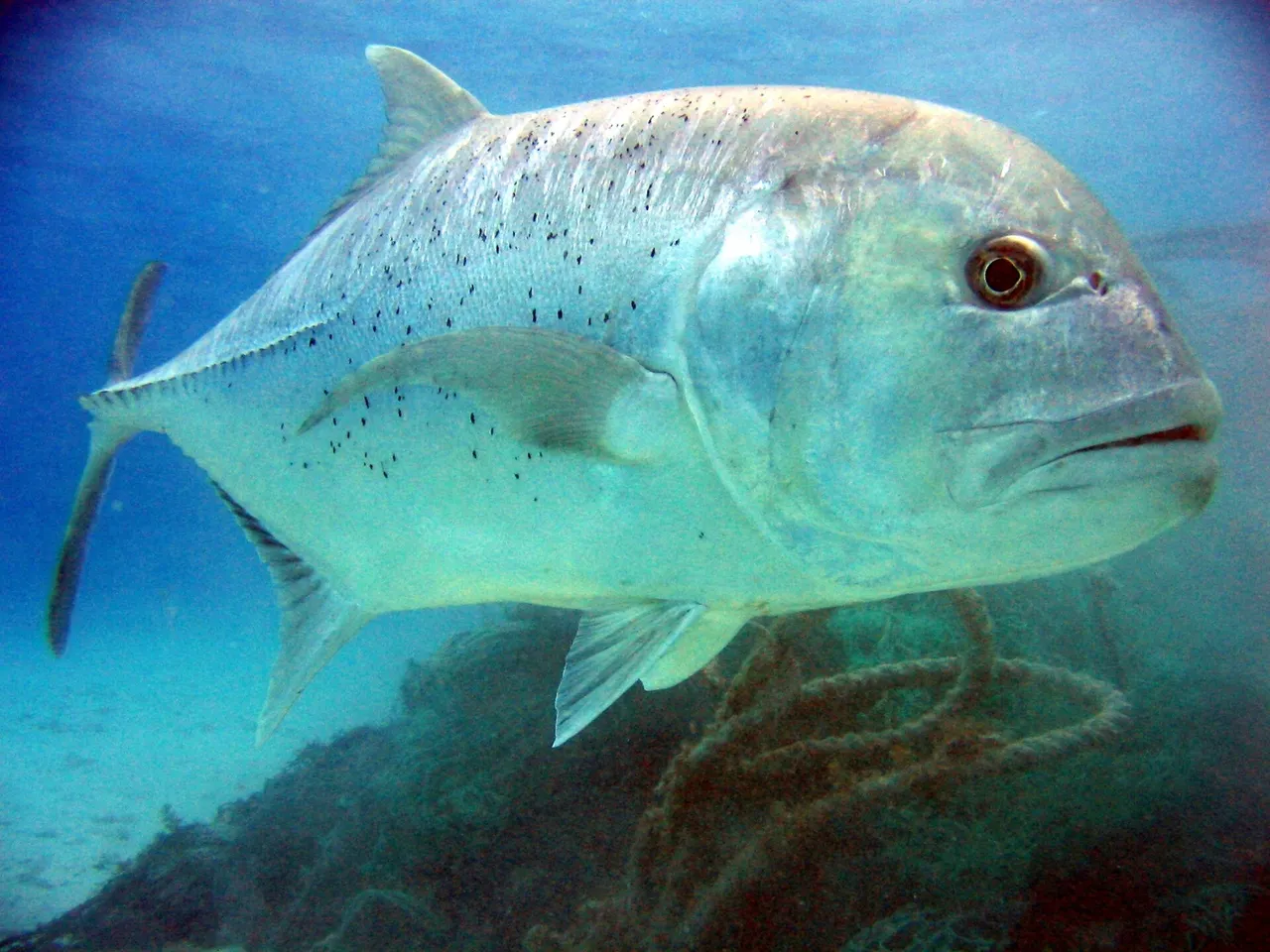
How this was identified, and who took it
Identified by: Near-full lateral view of a large fish. The steep head profile, deep compressed body and the scutes along the straight rear lateral line are the characters that place it in Caranx, and they are clear.Dr. Dwayne Meadows, NOAA/NMFS/OPR — Public domain, via Wikimedia Commons — source, licence
Catching Giant trevally
Everything here on fishing for it. Each entry opens the page behind it.
- Where
- 1 place FishingHQ documents — strongest claim anywhere: regular local target · From a boat, From the shore, Spearfishing
The giant trevally is the largest of the trevallies and one of the most formidable inshore predators anywhere. It reaches well over fifty kilograms, hunts in water shallow enough to stand in, and takes prey with a violence that has made it the target species for a whole branch of lure fishing.
What makes it distinctive as a target is where it hunts. Most fish of that size and power are found in deep or open water. A giant trevally works reef edges, surf zones, lagoon entrances and shallow flats — often in water a metre or two deep, over coral that will part any line dragged across it. So the angler is connected to a very large, very fast fish that is immediately trying to reach structure, using tackle strong enough to stop it, on foot or from a small boat, in shallow water. Very little in fishing is comparable.
It hunts both alone and in groups, driving bait against reef and structure, and it feeds heavily at night as well as by day. A great deal more is asserted about its hunting behaviour in the angling literature than this review could confirm against a reference source, so what is stated here is limited to what could be.
Almost all recreational GT fishing is catch-and-release, and the species is under real pressure from commercial and subsistence fishing across much of its range.
How it is caught
- Popping and stickbaitingPopping and stickbaiting were developed around this species more than any other, and the tackle's weight is a direct response to what it does when hooked over reef.
- Saltwater fly fishingThe blue-water problem: speed and endurance that make backing capacity a real equipment question rather than a number on a box.
Gear for this fish
- Saltwater luresPoppers and stickbaits exist in their present form largely because of this fish, and the whole method is the retrieve — a lure worked gently is not a quieter version of it but not the method at all.
- Surface luresThe stickbait and popper fishery for giant trevally is the one that defined the modern heavy surface category, and it exists because the fish feeds explosively at the surface over shallow reef where a sinking lure would be lost on the first cast.
Where Giant trevally is documented
Places where public sources describe this species as fished, with how it is fished and how strongly the evidence supports it. This is not a range map and it is not a recommendation — it is what has been written down about a fishery rather than a record of any individual catch, and being listed is never permission to fish.
The KwaZulu-Natal coast
1 documented place
Bay
Regular local target
From a boat · From the shore · Spearfishing
What these strengths mean
- Regular local target
- Fishing sources describe this as a normal local target here, not merely as caught.
Identification
- Scientific name
- Caranx ignobilis
- Family
- Carangidae
- Water
- Saltwater, Brackish
- Conservation status
- Least Concern
- Regions
- Indo-Pacific, East & Southern Africa, South Asia, South-East Asia, Australia, Pacific Islands
- Body deep and strongly compressed laterally, with a steep, blunt head profile — much steeper than other large trevallies.
- A row of hard, keeled scutes along the rear of the lateral line, characteristic of the family and unmistakable to the touch.
- Silver to grey overall, males typically darkening to near-black with age; a small dark spot on the upper gill cover.
- Two dorsal fins, the second long and low; deeply forked tail.
- Separated from other large Caranx species primarily by the steep head profile and the absence of the strong markings some of the others carry.
Size
- Typical
- 5–15 kg (11–33 lb)
- Large
- 25–40 kg (55–88 lb)
Exceptional: Over 50 kg (110 lb); a widely reported angling figure rather than a published scientific maximum
A tidal and lunar season rather than a thermal one
Giant trevally live in warm water year-round across most of their range, so their seasonality operates on cycles shorter than a year.
THE TIDE IS THE PRIMARY CYCLE. Giant trevally hunt where flow concentrates prey — reef passes, channel mouths, the edges of flats, the crest of a reef on a flooding tide — so a piece of ground fishes on a state of tide rather than at a time of year. Slack water switches most marks off.
SPRING TIDES ARE THE FORTNIGHTLY PEAK, moving far more water through a pass and pushing fish onto reef flats that a neap does not cover. Land-based fishing in particular is organised around the tides that put water on the flat.
SPAWNING AGGREGATIONS ARE LUNAR AND SEASONAL, forming at reef promontories and passes at particular moon phases, generally in the warmer months at the range edges and more protracted near the equator.
AT THE COOLER MARGINS THERE IS A GENUINE THERMAL SEASON, with fish present in the warm months and scarce in the cool ones — which is the pattern in the Ryukyus, southern Japan and the subtropical fringes.
MONSOON AND TRADE WIND REGIMES SUPPLY THE PRACTICAL SEASON on most tropical coasts, deciding which side of an island or atoll is workable rather than whether the fish are there.
AND CYCLONE SEASONS INTERRUPT ACCESS RATHER THAN DISTRIBUTION, which is a different kind of seasonality from a temperate fish's and is worth distinguishing when reading advice about when to travel.
Backed by research — why, and the sources (2)
Supported by peer-reviewed research or fisheries science. The sources are listed and can be checked.
- Reef Fish Spawning Aggregations: Biology, Research and Management — Springer, Fish & Fisheries Series vol. 35, 2012 (Scientific literature)Relied on for: Reef fish spawning aggregations, their predictability in space and time, and the vulnerability that predictability creates.States this directlyCitation checked — the work exists and is described correctly
- FishBase: a global information system on fishes — Froese, R. and D. Pauly, eds. — FishBase Consortium (Scientific institute)Relied on for: Distribution, habitat association, depth range, size, reproduction and life-history parameters recorded for the species.States this directlyPassage read and verified
Scutes, weight, and the hooks that are attached to both
Three hazards, and the one that injures most people is not the fish.
The keeled scutes along the rear lateral line are hard, ridged and sharp enough to lacerate a forearm drawn across them. A giant trevally thrashing in shallow water or at a boat's side will do that without any intention.
The weight is a hazard in its own right. A large trevally is heavy enough to injure somebody with its body alone, and lifting one vertically by the jaw damages its jaw structure and internal support — so the fish is held horizontally, in the water, or not held at all.
And THE CHARACTERISTIC INJURY OF THIS FISHERY IS A HOOK. Popping and stickbaiting use large, strong trebles, and they are attached to a green, extremely powerful fish beside the angler. A treble driven through a hand by a fish that has decided to move is not a minor injury and it is the reason the fish is controlled before anybody reaches for the lure.
Much of this fishing happens from reef edges and surf-washed rock, connected to something pulling hard. Being pulled off balance onto wet coral is a fall onto sharp ground, and it belongs in the same paragraph as the hooks because it happens in the same moment.
What experienced anglers do — why, and the sources (2)
Widely and independently recommended by experienced anglers and specialist sources. This is real angling knowledge, not proof: controlled evidence for it is limited, and FishingHQ records it as convention rather than as a demonstrated effect.
- Sea Angler — Bauer Media (Specialist angling publication)Relied on for: Popping and stickbaiting practice, including hook hazard and handling large trevally.States this directlyCitation checked — the work exists and is described correctly
- Rock fishing safety and the declared lifejacket areas of New South Wales — NSW Department of Primary Industries and Surf Life Saving NSW (Water-safety or diver-training authority)Relied on for: Rock and platform fishing hazards including footing and swell.Background and mechanism onlyCitation checked — the work exists and is described correctly
Reef, flat, surge zone and blue water: a predator that uses all of it
Giant trevally are unusual among large reef-associated predators in that they are not restricted to the reef, and the breadth of habitat they use is the most interesting thing about them.
THE CORE ASSOCIATION IS CORAL REEF AND ITS MARGINS, across the Indo-Pacific from East Africa to the central Pacific. But within that they range far more widely than a grouper or a coral trout does: outer reef slopes, drop-offs, channels and passes, lagoons, shallow sand and coral flats, surge zones against exposed reef, atoll edges, and adjacent blue water. Juveniles use estuaries and brackish habitat, which extends the range further still.
THE FLATS BEHAVIOUR IS WHAT THE SPECIES IS KNOWN FOR AND IT IS GENUINELY UNUSUAL. Large giant trevally hunt in very shallow water — sometimes barely covering their backs — over sand and coral flats, pushing bonefish, mullet and other prey into the shallows where escape routes are limited. A predator of that size choosing to operate in water that shallow is committing to a place where it cannot manoeuvre freely, and it does so because the prey cannot either.
THE SURGE ZONE IS THE OTHER SIGNATURE HABITAT. Giant trevally work the broken water against exposed reef edges and in passes where tidal flow accelerates — turbulent, aerated, structurally violent water where prey is disoriented and where the fish's power lets it operate when smaller predators cannot. That is why the popping and stickbaiting fishery is conducted where it is: the lure is being fished in the specific hydraulic conditions the animal hunts in.
THE TIDAL COMPONENT IS ESSENTIAL. Flats and passes are only usable at particular states of tide, and giant trevally move onto and off them accordingly. Habitat here is a place plus a time, and the place alone is not predictive.
AND THEY ARE APEX PREDATORS WITH LARGE MOVEMENTS, unlike the sedentary reef species around them — individuals range considerably and adults may occupy home ranges spanning multiple reefs. That makes them less protectable by small closed areas than coral trout are, and more exposed to fishing across a wide area.
Backed by research — why, and the sources (2)
Supported by peer-reviewed research or fisheries science. The sources are listed and can be checked.
- FishBase: a global information system on fishes — Froese, R. and D. Pauly, eds. — FishBase Consortium (Scientific institute)Relied on for: Reef association, depth range, substrate preference and habitat use recorded for the species.States this directlyPassage read and verified
- FAO Species Identification Guides for Fishery Purposes and the FAO Species Catalogues — Food and Agriculture Organization of the United Nations (Scientific institute)Relied on for: Habitat, depth and distribution accounts for the species in the FAO regional identification guides.Background and mechanism onlyCitation checked — the work exists and is described correctly
A fish sold on its maximum, and what an ordinary one actually weighs
Giant trevally have a reputation built almost entirely on the largest fish in the species, and the gap between that reputation and an ordinary day's fishing is wider here than for almost anything else on FishingHQ.
THE FISH MOST PEOPLE CATCH IS A FRACTION OF THE FISH IN THE PHOTOGRAPHS. The typical range on this page covers what a popping or jigging session over reef and flats actually produces, and it is a powerful fish at that size — the species' reputation for pulling is a matter of power-to-weight rather than of absolute mass. The 'large' band describes fish that a well-run trip in good ground might produce a handful of in a week. The exceptional figure describes a small number of animals.
AND THAT EXCEPTIONAL FIGURE IS AN ANGLING NUMBER RATHER THAN A SCIENTIFIC ONE. This page grades it accordingly. Record claims for large pelagic and reef predators are weighed on boats, under rules that govern tackle and witnessing rather than measurement precision, and they are not a survey of the population. Treating a record weight as a species maximum is a category error that this family exists partly to prevent.
GROWTH IS FAST EARLY AND THEN SLOWS SHARPLY, which is the standard pattern for a large predator and has a specific consequence: most of the years in a very large trevally's life bought very little of its weight. The oldest fish are far older than their size difference from mid-sized fish suggests, and they are the ones a fishery loses first.
BIG FISH ALSO BEHAVE DIFFERENTLY, WHICH SKEWS WHAT GETS CAUGHT. The largest giant trevally are less gregarious than the mid-sized schooling fish, hold in specific ground, and are encountered singly. So a fishery can be full of trevally and produce no large ones, and the size distribution of the catch reflects behaviour as much as abundance.
FINALLY, WEIGHT AND LENGTH SEPARATE IN THIS SPECIES. Giant trevally deepen and thicken disproportionately as they grow — an old fish is a slab rather than a scaled-up young one — so a length-based estimate taken from a smaller fish will badly understate a large one.
What experienced anglers do — why, and the sources (2)
Widely and independently recommended by experienced anglers and specialist sources. This is real angling knowledge, not proof: controlled evidence for it is limited, and FishingHQ records it as convention rather than as a demonstrated effect.
- IGFA International Angling Rules and World Record Requirements — International Game Fish Association (Angling or fisheries organisation)Relied on for: The rules under which a record claim is measured, weighed and witnessed, and the line-class structure that record lists are organised by.States this directlyPassage read and verified
- FishBase: a global information system on fishes — Froese, R. and D. Pauly, eds. — FishBase Consortium (Scientific institute)Relied on for: Maximum recorded length and weight and reported longevity for the species.Background and mechanism onlyPassage read and verified
Aggregating on reef edges, and a predator that is briefly as vulnerable as its prey
Giant trevally reproduction follows the reef-aggregation pattern, and it is worth stating for a species that is otherwise thought of as an apex predator immune to the pressures that trouble smaller reef fish.
SPAWNING IS AN AGGREGATION EVENT ON REEF EDGES AND PASSES. Mature giant trevally gather in numbers at particular locations — outer reef slopes, channel entrances, seamounts and reef promontories — during warm months, and spawning is broadly tied to lunar and tidal cycles so that eggs are released into water moving away from the reef. The aggregations are predictable in place and in time.
WHICH PUTS THE BIGGEST FISH IN ONE PLACE ON A KNOWN SCHEDULE. That is the same structural vulnerability that afflicts groupers and snappers, and it applies here despite the species' size and power. An aggregation of large adults is the most concentrated reproductive value the population ever presents, and it is the easiest to find.
EGGS AND LARVAE ARE PELAGIC and drift before the young settle into shallow, sheltered habitat — including estuaries, lagoons and brackish water, which is a long way from the surge zones and outer reefs the adults occupy. So recruitment depends on inshore nursery habitat that a reef-focused view of the species entirely misses, and coastal development affects a fish most people associate with blue water.
MATURITY IS LATE FOR THE SIZE AND FISH ARE LONG-LIVED, so the large aggregating adults represent many years of accumulation and are not quickly replaced. Local depletion of an aggregation site is a real and documented phenomenon on heavily fished reefs.
ADULTS RANGE WIDELY BETWEEN AGGREGATIONS, which is a partial protection — a population is not confined to one reef — and also a complication, because it means a single aggregation may draw fish from a large area, so removing them affects more ground than the site itself.
AND CATCH-AND-RELEASE IS THE NORM IN MOST OF THE MODERN SPORT FISHERY, which matters reproductively only if the fish survive; a large trevally fought to exhaustion in warm shallow water on a spawning aggregation may not. Where any protection of aggregation sites exists it is a local arrangement, and the competent authority is the source.
What experienced anglers do — why, and the sources (2)
Widely and independently recommended by experienced anglers and specialist sources. This is real angling knowledge, not proof: controlled evidence for it is limited, and FishingHQ records it as convention rather than as a demonstrated effect.
- Reef Fish Spawning Aggregations: Biology, Research and Management — Springer, Fish & Fisheries Series vol. 35, 2012 (Scientific literature)Relied on for: Reef fish spawning aggregations, their predictability, their vulnerability to fishing, and the consequences of aggregation fishing for stock structure.States this directlyCitation checked — the work exists and is described correctly
- FishBase: a global information system on fishes — Froese, R. and D. Pauly, eds. — FishBase Consortium (Scientific institute)Relied on for: Reproductive mode, sexual pattern, spawning season and maturity for the species.States this directlyPassage read and verified
The one fishery where the hardware fails before the line does
Giant trevally tackle is the clearest case in angling of a system specified by its weakest component, and the weakest component is almost never the line.
THE FISH PULLS ITSELF INTO REEF AND THE FIGHT IS SHORT AND EXTREME. A hooked giant trevally accelerates toward structure with a power-to-weight ratio no fish of comparable size matches, and the outcome is decided in seconds. That produces peak loads on every component at once, in a situation where the drag cannot be eased without losing the fish.
SO THE HARDWARE IS WHAT BREAKS. Split rings open, hooks straighten, lure through-wire pulls out, and rod guides fail. Anglers in this fishery routinely replace every ring and hook on a lure before using it, and the specification is expressed in the load the component holds rather than in anything about the lure. This is the fishery where terminal hardware failure is the norm rather than the exception, and it is worth stating plainly because it is the thing visiting anglers are least prepared for.
THE DRAG HAS TO BE BOTH HIGH AND SMOOTH. High, because line given is line into coral; smooth, because a drag that stutters under load parts the leader or pulls the hook. That is a genuine engineering requirement rather than a preference, and it is why the reels used are what they are.
KNOTS ARE THE OTHER FAILURE POINT. A braid-to-leader connection that holds under sustained maximum load, casts through the guides, and does not degrade with repeated casting, is a real problem and it is why this fishery is unusually attentive to joining knots.
THE ANGLER IS PART OF THE SYSTEM. Popping and stickbaiting for this species is physically demanding for hours, and fatigue causes both poor casting and poor decisions at the critical moment. Tackle chosen beyond what the angler can work all day is the wrong tackle however strong it is.
AND THE FISH IS ALMOST ALWAYS RELEASED, which makes fight duration a welfare variable. Heavy tackle here is the humane option: the record's handling section sets out why a large trevally must never be lifted vertically, and a shorter fight is what gives it a chance.
What experienced anglers do — why, and the sources (2)
Widely and independently recommended by experienced anglers and specialist sources. This is real angling knowledge, not proof: controlled evidence for it is limited, and FishingHQ records it as convention rather than as a demonstrated effect.
- IGFA International Angling Rules and World Record Requirements — International Game Fish Association (Angling or fisheries organisation)Relied on for: Recognition of the species as a recognised game fish, the tackle classes record fisheries are organised by, and the practice of the fisheries that target it.States this directlyPassage read and verified
- General angling website restatements of established technique — Various (Credible secondary source)Relied on for: The widely restated tackle practice for this species, recorded as a consensus position rather than as an original observation.States this directlyCitation checked — the work exists and is described correctly
Lifecycle and reproduction
Juveniles use estuaries, mangroves and sheltered shallow water, moving out to reef and coastal environments as they grow. Adults are long-lived and reach very large size, and the largest individuals represent a great many years of growth. Because the fish is both slow to replace and easy to locate on predictable reef structure, local populations respond quickly to fishing pressure and slowly to its removal.
Spawns in aggregations at particular times and places, generally associated with reef structure, outer slopes and specific lunar and seasonal cues. As with most aggregating reef species, that predictability is the vulnerability: an aggregation is the easiest thing in the ocean to fish and the worst thing to remove, which is why aggregation sites and periods are protected in a number of jurisdictions.
Feeding and senses
An apex inshore predator taking fish, cephalopods and crustaceans, hunting both alone and in groups and driving prey against reef and structure. Feeds by day and at night. Its willingness to attack large prey at and near the surface is what makes very large surface lures effective — the fish is not being deceived about size so much as provoked into committing.
Sight dominates in the clear water it usually hunts in, and it is acute enough that the fish will inspect and refuse a lure at speed. The lateral line matters more than clarity suggests, which is why a popper that makes a great deal of noise draws fish from beyond visual range and why the retrieve is worked hard rather than delicately. In coloured or turbid water and at night, displacement and vibration carry the presentation entirely.
Through the year
Present year-round through the tropical parts of its range, with movement and feeding driven by tide, current and bait availability rather than by season. In the subtropical margins of the range it is seasonal, appearing as water temperatures rise. Tidal state governs the fishing on any given day: fish work reef edges, passes and lagoon entrances where current concentrates bait, and those places switch on and off with the flow.
Distribution
Widely distributed through the tropical and subtropical Indo-Pacific, from the east coast of Africa and the Red Sea through the Indian Ocean and across the Pacific to Hawaii and French Polynesia. Absent from the Atlantic.
This is a biological range — where the species occurs, not a prediction that you will catch one. To browse the fishing geography FishingHQ holds, start at fishing places.
Why anglers care
The defining target of popping and stickbait fishing, and the reason that discipline's tackle is built as heavily as it is. Culturally significant in Hawaii, where the ulua has long carried social and ceremonial importance and shore fishing for it is a tradition in its own right. Recreational fishing for it is predominantly catch-and-release.
Handling and returning
A large, powerful fish that must be handled in the water. Do not lift a big one vertically by the jaw — the weight will damage its jaw structure and its internal support. Support horizontally, keep it in the water, minimise handling time entirely, and revive properly before release. The lateral scutes are sharp enough to cut, and the fish is strong enough to injure an angler who is holding it when it decides to move.
Going further
- What does giant trevally eat? — feeding biology, kept separate from what anglers infer from it.
- Giant trevally vs Bluefin trevally — how to tell them apart.
Safety
Hooks and barbs — Can cause serious injury or death
Popping lures carry large, strong trebles, and they are attached to a green, extremely powerful fish beside the boat or the angler. A hook driven into a hand by a fish is the characteristic injury of this fishery, and it is not a minor one.
What reduces it: Control the fish before touching the leader or the lure. Use a de-hooking tool. Single hooks where they are permitted and adequate. Nobody puts a hand near the lure while the fish is capable of moving.
Injury while handling fish — Can cause injury needing treatment
A large trevally thrashing at boatside or in the shallows is capable of injuring people with its body alone, and the keeled scutes along the lateral line are sharp enough to lacerate a hand or forearm.
What reduces it: Handle in the water with the fish under control and two people where the fish is large. Gloves. Keep the treble hooks of the lure accounted for at all times — this is where the serious injuries happen.
Slips, trips and falls — Can cause injury needing treatment
Much of this fishing is done from reef edges, rock and surf-washed platforms, connected to a fish pulling hard. Being pulled off balance on wet coral or rock in swell is a serious fall onto sharp ground.
What reduces it: Fish with secure footing and never with your back to the sea. Do not brace against a fish in a position you could be pulled from. Wear footwear with grip on wet rock and coral.
Precautions that always apply here
- Support the fish's weight along its body, keep it out of the water for as short a time as possible, and hold it over something soft.
- Wet your hands before touching a fish. Dry hands strip the protective mucus layer that keeps infection out.
- If a hook goes past the barb into a person, cut the line, leave the hook where it is, and get medical help. Pulling it back out does far more damage than pushing it through under proper care.
- Tell somebody where you are going and when you expect to be back.
Where to go next
Similar and related fish
Where it lives
Where you will find it
- Fiji and MelanesiaWorks the reef passes and outer reefs throughout the region, and is both a food fish and the fish of what sport fishing operates here.
- HawaiiThe ulua of the shore-casting fishery, patrolling the rocky shoreline and reef edges at night, and the target the whole slide-bait discipline exists for.
- Mauritius and RéunionOver reef and drop-off and into the Mauritian lagoon on the tide, and the species most of the popping and jigging effort here is directed at.
- Pacific island fishingThe reef edge predator that draws visiting anglers across the region, and a fish whose behaviour around passes and drop-offs shapes how the ground is fished.
- South AfricaReaches the warm north-eastern coast as part of the Indian Ocean fauna carried down by the Agulhas Current.
- Sri LankaReef edges, lagoon mouths and offshore, and one of the species the small charter sector runs for.
- The Agulhas CurrentReaches the south-east African coast on warm current water, at the southern margin of its Indo-Pacific range.
- The Coral TriangleA characteristic large reef predator across the region, and one of the species whose Indo-Pacific distribution radiates outward from this centre of diversity.
6 more
- The Egyptian Red Sea coast Fishing regions
- The Great Barrier Reef Fishing regions
- The Indian subcontinent coasts Fishing regions
- The Maldives Fishing regions
- The Ryukyu Islands Fishing regions
- The western Indian Ocean coast Fishing regions
Understanding this fish
- Cephalopods as preySquid and octopus are taken alongside fish and crustaceans, and giant trevally are opportunistic enough that diet composition varies substantially between locations.
- Ciguatera and reef fish poisoningA large, long-lived apex reef predator across the tropical Indo-Pacific, and among the fish most frequently implicated where ciguatera occurs. The species is also very largely released by the anglers who travel for it, which makes the question one of local advice rather than of the angler's own catch.
- Decapod crustaceans as preyCrustaceans are a regular component of the diet, particularly for smaller fish on shallow reef and flats habitat.
- The double haul, and casting a fly in windThe extreme case, and it shows what the cast is really buying. A very large air-resistant fly on a heavy line into a trade wind, with one chance at a fish moving fast, is a line-speed problem before it is anything else.
- What salt water does to fly tackleThe fish that justifies the whole specification. Sealed drags, corrosion-resistant materials, heavy fast-taper lines and backing measured in hundreds of metres are not refinements here; they are what survives one fish.
Sources and evidence
- FishBase: a global information system on fishes — Froese, R. and D. Pauly, eds. — FishBase Consortium (Scientific institute)Relied on for: Scientific name, family placement, morphology including the lateral scutes, maximum published size of 170 cm and 80 kg, Indo-Pacific distribution, habitat use, and that the species feeds on crustaceans and fish including at night.States this directlyPassage read and verified
- FishBase: a global information system on fishes — Froese, R. and D. Pauly, eds. — FishBase Consortium (Scientific institute)Relied on for: The IUCN Red List category for Caranx ignobilis as republished by FishBase with its assessment date — Least Concern, assessed 9 March 2015. The Red List itself was not reachable during this review.States this directlyPassage read and verified
Why the 26 connections on this page are here, and the sources
Similar and related fish
Backed by research — 1 connection
Supported by peer-reviewed research or fisheries science. The sources are listed and can be checked.
Bluefin trevally
A taxonomic and identification comparison naming both binomials.
- FishBase: a global information system on fishes — Froese, R. and D. Pauly, eds. — FishBase Consortium (Scientific institute)Relied on for: That Caranx melampygus and Caranx ignobilis are congeners in the genus Caranx associated with Indo-Pacific reef habitat.States this directlyPassage read and verified
How it is caught
What experienced anglers do — 2 connections
Widely and independently recommended by experienced anglers and specialist sources. This is real angling knowledge, not proof: controlled evidence for it is limited, and FishingHQ records it as convention rather than as a demonstrated effect.
Popping and stickbaiting
A practitioner claim about the defining method for the species.
- Sea Angler — Bauer Media (Specialist angling publication)Relied on for: Heavy surface lure technique for large tropical reef predators.Citation checked — the work exists and is described correctly
- IGFA International Angling Rules and World Record Requirements — International Game Fish Association (Angling or fisheries organisation)Relied on for: Tackle and line class conventions for large marine predators.Passage read and verified
A practitioner claim about the origin and purpose of a method, with the species' behaviour supported separately on its own record.
- Sea Angler — Bauer Media (Specialist angling publication)Relied on for: Heavy surface lure fishing for large tropical reef predators.Citation checked — the work exists and is described correctly
- IGFA International Angling Rules and World Record Requirements — International Game Fish Association (Angling or fisheries organisation)Relied on for: Line and tackle class conventions used in fishing for large marine predators.Passage read and verified
Saltwater fly fishing
A statement about how a species is fished, which is angling convention rather than biology and is labelled as such.
- Still Water Fly-Fishing — Andre Deutsch, 1952 (Specialist angling publication)Relied on for: Fly-fishing practice from a practitioner tradition: line control, depth management, retrieve and the reading of water.States this directlyCitation checked — the work exists and is described correctly
- Sea Angler — Bauer Media (Specialist angling publication)Relied on for: Contemporary UK sea angling practice as reported by practitioners: ground, tackle, presentation and seasonal timing.States this directlyCitation checked — the work exists and is described correctly
Gear for this fish
What experienced anglers do — 2 connections
Widely and independently recommended by experienced anglers and specialist sources. This is real angling knowledge, not proof: controlled evidence for it is limited, and FishingHQ records it as convention rather than as a demonstrated effect.
Saltwater lures
A practitioner claim about the relationship between the lure and the technique.
- Sea Angler — Bauer Media (Specialist angling publication)Relied on for: Practitioner treatment of popper and stickbait retrieve technique.Citation checked — the work exists and is described correctly
- IGFA International Angling Rules and World Record Requirements — International Game Fish Association (Angling or fisheries organisation)Relied on for: The tackle classes used in heavy lure fishing for large marine predators.Passage read and verified
Surface lures
A practitioner claim about which lure family answers this species' feeding or holding behaviour.
- IGFA International Angling Rules and World Record Requirements — International Game Fish Association (Angling or fisheries organisation)Relied on for: Recognition of the species as an established sport fish taken on artificial lures, and the line and tackle classes used for it.States this directlyPassage read and verified
- General angling website restatements of established technique — Various (Credible secondary source)Relied on for: Widely restated lure practice for this species.Background and mechanism onlyCitation checked — the work exists and is described correctly
Where it lives
Backed by research — 2 connections
Supported by peer-reviewed research or fisheries science. The sources are listed and can be checked.
Coral reef
A habitat claim held to a scientific standard.
- FishBase: a global information system on fishes — Froese, R. and D. Pauly, eds. — FishBase Consortium (Scientific institute)Relied on for: Recorded habitat for Caranx ignobilis across reef and coastal environments.States this directlyPassage read and verified
- FAO fishing gear types and fishing technology information — Food and Agriculture Organization of the United Nations (Scientific institute)Relied on for: The characterisation of reef environments in relation to fish distribution.Background and mechanism onlyCitation checked — the work exists and is described correctly
Tropical estuary and tidal creek
A habitat association resting on the regional identification and fisheries literature rather than on angling report.
- FAO Species Identification Guides for Fishery Purposes and the FAO Species Catalogues — Food and Agriculture Organization of the United Nations (Scientific institute)Relied on for: Habitat association, depth range and distribution of the species concerned as set out in the FAO species identification sheets for the region.States this directlyCitation checked — the work exists and is described correctly
- The World's Mangroves and their Fisheries — FAO Forestry and Fisheries assessments — Food and Agriculture Organization of the United Nations, Rome (Standards body)Relied on for: The dependence of tropical coastal fisheries species on mangrove and estuarine habitat, including the nursery function.States this directlyCitation checked — the work exists and is described correctly
Where you will find it
Backed by research — 14 connections
Supported by peer-reviewed research or fisheries science. The sources are listed and can be checked.
Fiji and Melanesia
A distribution association between an animal and a kind of water, rather than a claim about any named mark.
- FAO Species Identification Guides for Fishery Purposes and the FAO Species Catalogues — Food and Agriculture Organization of the United Nations (Scientific institute)Relied on for: Distribution, habitat, depth and fishery accounts for the species in the FAO regional identification guides for the ocean area concerned.States this directlyCitation checked — the work exists and is described correctly
- FishBase: a global information system on fishes — Froese, R. and D. Pauly, eds. — FishBase Consortium (Scientific institute)Relied on for: Distribution, habitat association and depth range recorded for the species.States this directlyPassage read and verified
Hawaii
A distribution association between an animal and a kind of water, rather than a claim about any named mark.
- FAO Species Identification Guides for Fishery Purposes and the FAO Species Catalogues — Food and Agriculture Organization of the United Nations (Scientific institute)Relied on for: Distribution, habitat, depth and fishery accounts for the species in the FAO regional identification guides for the ocean area concerned.States this directlyCitation checked — the work exists and is described correctly
- FishBase: a global information system on fishes — Froese, R. and D. Pauly, eds. — FishBase Consortium (Scientific institute)Relied on for: Distribution, habitat association and depth range recorded for the species.States this directlyPassage read and verified
Mauritius and Réunion
That a species occurs in these waters, drawn from distribution science. It is a statement about where the animal lives and is not a statement that anybody will catch one, still less where.
- FAO Species Identification Guides for Fishery Purposes and the FAO Species Catalogues — Food and Agriculture Organization of the United Nations (Scientific institute)Relied on for: Identification, distribution and habitat association of the fishes and invertebrates of the tropical region named.States this directlyCitation checked — the work exists and is described correctly
- FishBase: a global information system on fishes — Froese, R. and D. Pauly, eds. — FishBase Consortium (Scientific institute)Relied on for: Recorded distribution, depth range and habitat association of the species named, including its occurrence in the waters concerned.States this directlyPassage read and verified
Pacific island fishing
A distributional claim taken from reference sources on the species rather than from angling report. It states presence and asserts nothing about a fishery.
- FishBase: a global information system on fishes — Froese, R. and D. Pauly, eds. — FishBase Consortium (Scientific institute)Relied on for: Distribution, habitat association, depth range and life history recorded for the species concerned.States this directlyPassage read and verified
- The IUCN Red List of Threatened Species — International Union for Conservation of Nature (Conservation authority)Relied on for: Global distribution, population trend and extinction-risk assessment for the species concerned.States this directlyCitation checked — the work exists and is described correctly
South Africa
A distribution association between an animal and a kind of water, rather than a claim about any named mark.
- FishBase: a global information system on fishes — Froese, R. and D. Pauly, eds. — FishBase Consortium (Scientific institute)Relied on for: Distribution, habitat association and depth range recorded for the species, including its occurrence in the water body concerned.States this directlyPassage read and verified
- The IUCN Red List of Threatened Species — International Union for Conservation of Nature (Conservation authority)Relied on for: Assessment and range account for the species, including the systems and coasts it occupies.Background and mechanism onlyCitation checked — the work exists and is described correctly
Sri Lanka
A distributional claim about where a species occurs, resting on the regional identification literature rather than on angling report. It says nothing about where a reader should fish.
- FAO Species Identification Guides for Fishery Purposes and the FAO Species Catalogues — Food and Agriculture Organization of the United Nations (Scientific institute)Relied on for: Species composition, habitat association and distribution for the region concerned, as set out in the FAO species identification sheets.States this directlyCitation checked — the work exists and is described correctly
- The IUCN Red List of Threatened Species — International Union for Conservation of Nature (Conservation authority)Relied on for: Global assessment and distribution for the species concerned.States this directlyCitation checked — the work exists and is described correctly
The Agulhas Current
A distribution association between an animal and a kind of water, rather than a claim about any named mark.
- FAO Species Identification Guides for Fishery Purposes and the FAO Species Catalogues — Food and Agriculture Organization of the United Nations (Scientific institute)Relied on for: Distribution, habitat, depth and fishery accounts for the species in the FAO regional identification guides for the ocean area concerned.States this directlyCitation checked — the work exists and is described correctly
- FishBase: a global information system on fishes — Froese, R. and D. Pauly, eds. — FishBase Consortium (Scientific institute)Relied on for: Distribution, habitat association and depth range recorded for the species.States this directlyPassage read and verified
The Coral Triangle
A distribution association between an animal and a kind of water, rather than a claim about any named mark.
- FAO Species Identification Guides for Fishery Purposes and the FAO Species Catalogues — Food and Agriculture Organization of the United Nations (Scientific institute)Relied on for: Distribution, habitat, depth and fishery accounts for the species in the FAO regional identification guides for the ocean area concerned.States this directlyCitation checked — the work exists and is described correctly
- FishBase: a global information system on fishes — Froese, R. and D. Pauly, eds. — FishBase Consortium (Scientific institute)Relied on for: Distribution, habitat association and depth range recorded for the species.States this directlyPassage read and verified
The Egyptian Red Sea coast
A distributional claim about where a species occurs, resting on the regional identification literature rather than on angling report. It says nothing about where a reader should fish.
- FAO Species Identification Guides for Fishery Purposes and the FAO Species Catalogues — Food and Agriculture Organization of the United Nations (Scientific institute)Relied on for: Species composition, habitat association and distribution for the region concerned, as set out in the FAO species identification sheets.States this directlyCitation checked — the work exists and is described correctly
- The IUCN Red List of Threatened Species — International Union for Conservation of Nature (Conservation authority)Relied on for: Global assessment and distribution for the species concerned.States this directlyCitation checked — the work exists and is described correctly
The Great Barrier Reef
A distribution association between an animal and a kind of water, rather than a claim about any named mark.
- FishBase: a global information system on fishes — Froese, R. and D. Pauly, eds. — FishBase Consortium (Scientific institute)Relied on for: Distribution, habitat association and depth range recorded for the species, including its occurrence in the water body concerned.States this directlyPassage read and verified
- The IUCN Red List of Threatened Species — International Union for Conservation of Nature (Conservation authority)Relied on for: Assessment and range account for the species, including the systems and coasts it occupies.Background and mechanism onlyCitation checked — the work exists and is described correctly
The Indian subcontinent coasts
A distribution association between an animal and a kind of water, rather than a claim about any named mark.
- FAO Species Identification Guides for Fishery Purposes and the FAO Species Catalogues — Food and Agriculture Organization of the United Nations (Scientific institute)Relied on for: Distribution, habitat, depth and fishery accounts for the species in the FAO regional identification guides for the ocean area concerned.States this directlyCitation checked — the work exists and is described correctly
- FishBase: a global information system on fishes — Froese, R. and D. Pauly, eds. — FishBase Consortium (Scientific institute)Relied on for: Distribution, habitat association and depth range recorded for the species.States this directlyPassage read and verified
The Maldives
A distribution association between an animal and a kind of water, rather than a claim about any named mark.
- FAO Species Identification Guides for Fishery Purposes and the FAO Species Catalogues — Food and Agriculture Organization of the United Nations (Scientific institute)Relied on for: Distribution, habitat, depth and fishery accounts for the species in the FAO regional identification guides for the ocean area concerned.States this directlyCitation checked — the work exists and is described correctly
- FishBase: a global information system on fishes — Froese, R. and D. Pauly, eds. — FishBase Consortium (Scientific institute)Relied on for: Distribution, habitat association and depth range recorded for the species.States this directlyPassage read and verified
The Ryukyu Islands
A distribution association between an animal and a kind of water, rather than a claim about any named mark.
- FAO Species Identification Guides for Fishery Purposes and the FAO Species Catalogues — Food and Agriculture Organization of the United Nations (Scientific institute)Relied on for: Distribution, habitat, depth and fishery accounts for the species in the FAO regional identification guides for the ocean area concerned.States this directlyCitation checked — the work exists and is described correctly
- FishBase: a global information system on fishes — Froese, R. and D. Pauly, eds. — FishBase Consortium (Scientific institute)Relied on for: Distribution, habitat association and depth range recorded for the species.States this directlyPassage read and verified
The western Indian Ocean coast
A distribution association between an animal and a kind of water, rather than a claim about any named mark.
- FAO Species Identification Guides for Fishery Purposes and the FAO Species Catalogues — Food and Agriculture Organization of the United Nations (Scientific institute)Relied on for: Distribution, habitat, depth and fishery accounts for the species in the FAO regional identification guides for the ocean area concerned.States this directlyCitation checked — the work exists and is described correctly
- FishBase: a global information system on fishes — Froese, R. and D. Pauly, eds. — FishBase Consortium (Scientific institute)Relied on for: Distribution, habitat association and depth range recorded for the species.States this directlyPassage read and verified
Understanding this fish
Backed by research — 3 connections
Supported by peer-reviewed research or fisheries science. The sources are listed and can be checked.
Cephalopods as prey
Recorded diet evidence identifies cephalopods as a food item of this predator at group level rather than to species. The edge points at the taxon record for that reason, and encoding it as a species-level claim would assert something the source does not.
- FishBase: a global information system on fishes — Froese, R. and D. Pauly, eds. — FishBase Consortium (Scientific institute)Relied on for: Food items recorded for this predator, given as cephalopods.States this directlyPassage read and verified
- FAO Species Identification Guides for Fishery Purposes and the FAO Species Catalogues — Food and Agriculture Organization of the United Nations (Scientific institute)Relied on for: Species account describing this predator's diet, recorded at the level of cephalopods.Background and mechanism onlyCitation checked — the work exists and is described correctly
Ciguatera and reef fish poisoning
That the ciguatera mechanism is relevant to this species, because it occupies the trophic position and habitat the toxin concentrates through. It is not a statement that any individual fish is toxic, and the record it points at says plainly that the risk is intensely local and that local knowledge outperforms any species list.
- Fish and Fishery Products Hazards and Controls Guidance — US Food and Drug Administration, Center for Food Safety and Applied Nutrition, 2022 (Standards body)Relied on for: Natural toxins in fishery products including ciguatera, the fish groups and regions associated with it, and that the toxin is not removed by cooking, freezing or any other domestic process.States this directlyPassage read and verified
- FishBase: a global information system on fishes — Froese, R. and D. Pauly, eds. — FishBase Consortium (Scientific institute)Relied on for: Trophic level, maximum size, longevity, reef association and recorded distribution of the species named, which is the basis for treating it as one the mechanism applies to.States this directlyPassage read and verified
Decapod crustaceans as prey
Recorded diet evidence identifies decapod crustaceans as a food item of this predator at group level rather than to species. The edge points at the taxon record for that reason, and encoding it as a species-level claim would assert something the source does not.
- FishBase: a global information system on fishes — Froese, R. and D. Pauly, eds. — FishBase Consortium (Scientific institute)Relied on for: Food items recorded for this predator, given as decapod crustaceans.States this directlyPassage read and verified
- FAO Species Identification Guides for Fishery Purposes and the FAO Species Catalogues — Food and Agriculture Organization of the United Nations (Scientific institute)Relied on for: Species account describing this predator's diet, recorded at the level of decapod crustaceans.Background and mechanism onlyCitation checked — the work exists and is described correctly
What experienced anglers do — 2 connections
Widely and independently recommended by experienced anglers and specialist sources. This is real angling knowledge, not proof: controlled evidence for it is limited, and FishingHQ records it as convention rather than as a demonstrated effect.
The double haul, and casting a fly in wind
A fish or a water joined to the fly-fishing mechanism it is a worked example of, written only where the subject's own behaviour or physical character is what this page explains. The direction is the one FishingHQ writes this kind of connection in, and the one it already uses 176 times, and it is also the semantically correct one: the mechanism explains the fish, not the reverse.
- FAO Species Identification Guides for Fishery Purposes and the FAO Species Catalogues — Food and Agriculture Organization of the United Nations (Scientific institute)Relied on for: Distribution, habitat association and feeding biology of tropical inshore and reef species, from regional identification guides prepared for fishery purposes.States this directlyCitation checked — the work exists and is described correctly
- FishBase: a global information system on fishes — Froese, R. and D. Pauly, eds. — FishBase Consortium (Scientific institute)Relied on for: Recorded environment, depth range, feeding biology and distribution of the tropical species named.States this directlyPassage read and verified
What salt water does to fly tackle
A fish or a water joined to the fly-fishing mechanism it is a worked example of, written only where the subject's own behaviour or physical character is what this page explains. The direction is the one FishingHQ writes this kind of connection in, and the one it already uses 176 times, and it is also the semantically correct one: the mechanism explains the fish, not the reverse.
- FAO Species Identification Guides for Fishery Purposes and the FAO Species Catalogues — Food and Agriculture Organization of the United Nations (Scientific institute)Relied on for: Distribution, habitat association and feeding biology of tropical inshore and reef species, from regional identification guides prepared for fishery purposes.States this directlyCitation checked — the work exists and is described correctly
- FishBase: a global information system on fishes — Froese, R. and D. Pauly, eds. — FishBase Consortium (Scientific institute)Relied on for: Recorded environment, depth range, feeding biology and distribution of the tropical species named.States this directlyPassage read and verified
How FishingHQ labels evidence is explained in the evidence policy.