Sodwana Bay
Bay · Salt water · in The KwaZulu-Natal coast
A shallow bay on the far northern KwaZulu-Natal coast inside the iSimangaliso Wetland Park, fronting the southernmost coral reefs in Africa — a series of named reefs lying parallel to the shore in warm tropical water, reached by ski-boat launched off the beach.
Safety: boat safety — can cause serious injury or death. One more point applies here.
FishingHQ describes what this place is, not whether you may fish it. Access, permits and who to ask.
What you can catch here
Documented at this place, grouped by how you would be fishing, with how strongly the sources support each one. This is what has been written down, not a forecast, and being listed is never permission to fish.
From the shore · 2

From a boat · 5
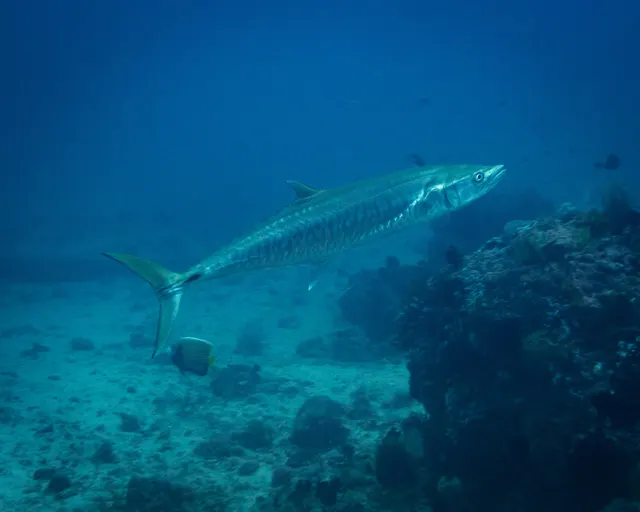 Narrow-barred Spanish mackerelCharacteristic of this water1 placeSodwana BayOver bay
Photo: ppericard, via Wikimedia Commons, CC BY 4.0; resized and trimmed to fit
- Bigeye trevallyRegular local target1 placeSodwana BayOver bay
- Eastern little tunaRegular local target1 placeSodwana BayOver bay
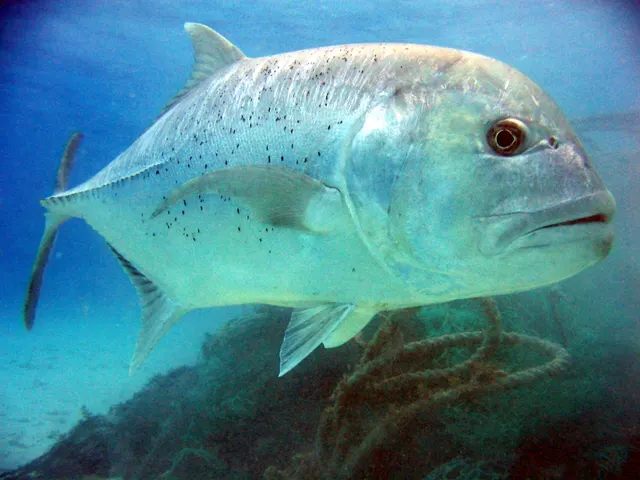 Giant trevallyRegular local target1 placeSodwana BayOver bay
Photo: Dr. Dwayne Meadows, NOAA/NMFS/OPR, via Wikimedia Commons, public domain; resized
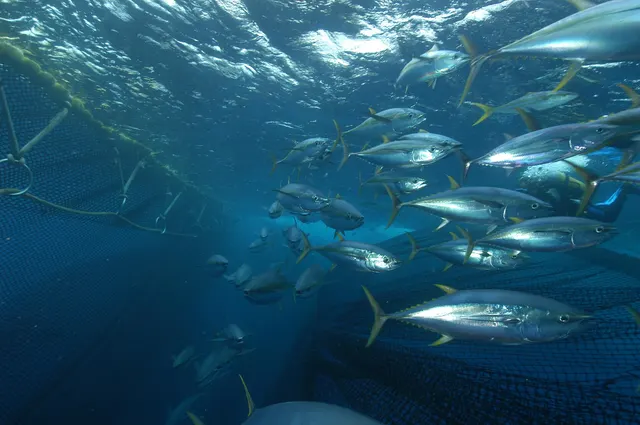 Yellowfin tunaSeasonal1 placeSodwana BayOver bayAround Jan–Apr, Nov–Dec
Photo: Marc Taquet, via Wikimedia Commons, CC BY 4.0; resized and trimmed to fit

_(Ifremer_00568-68027_-_25201).jpg)
On a charter · 2
- Narrow-barred Spanish mackerelCharacteristic of this water1 placeSodwana BayOver bay
Photo: ppericard, via Wikimedia Commons, CC BY 4.0; resized and trimmed to fit
- Yellowfin tunaSeasonal1 placeSodwana BayOver bayAround Jan–Apr, Nov–Dec
Photo: Marc Taquet, via Wikimedia Commons, CC BY 4.0; resized and trimmed to fit
Spearfishing · 1
What these strengths mean
- Characteristic of this water
- This water is strongly identified with this species by the sources that cover it.
- Regular local target
- Fishing sources describe this as a normal local target here, not merely as caught.
- Seasonal
- Well supported, and concentrated in part of the year rather than spread through it.
- How breadth is counted
- A fish documented at six marks is shown as six marks: breadth never raises the strength on its own. A fishery account describes the fishing; a recorded catch reports one specific catch. How evidence is weighed.
Also associated with this ground
Recorded as present here without a documented method or strength behind them.
Skipjack tuna · Mahi-mahi · Sailfish · Coral trout · Natal stumpnose
How people fish it
Practised here: Sea fishing, Spearfishing, Blue-water spearfishing.
Methods the sources name for this ground. Each one is explained in full on its own page.
- Trolling
Towing lures or baits behind a moving boat to cover large volumes of water and locate scattered fish.
- Livebaiting at sea
Presenting a living fish where a predator will find it — the most effective method for many species and the one with the clearest welfare questions attached.
- Drift fishing
Letting the boat move with tide and wind while fishing, so the tackle searches ground instead of waiting on it — and the decision that determines whether a boat session works at all.
- Popping and stickbaiting
Casting a large surface lure at reef structure and working it hard enough that a predator comes up from depth to kill it.
- Reef spearfishing
Hunting the most species-rich environment there is, where identification matters more than technique and the substrate is a living animal.
- Boat diving
Spearfishing from a vessel, which removes the swim and adds the two things most likely to kill a diver: propellers and drift.
Baits and lures for these fish
The baits and lures each of the fish above is commonly taken on, from that fish’s own page. This is what works for the fish, not a report of what people use on this particular water — local knowledge and the conditions on the day still decide.
Lures
- Saltwater lures — for Narrow-barred Spanish mackerel, Giant trevally, Yellowfin tuna
- Metal jigs — for Yellowfin tuna
- Surface lures — for Giant trevally
The ground and the water
- The ground
- A shallow bay on the far northern KwaZulu-Natal coast inside the iSimangaliso Wetland Park, fronting the southernmost coral reefs in Africa — a series of named reefs lying parallel to the shore in warm tropical water, reached by ski-boat launched off the beach.
- Exposure
- A shallow open bay on a tropical coast, with reef offering some shelter close in. Boats launch off the beach through the surf, which is the practical limit on when the reefs are reachable.
- Depth
- Shallow inshore over sand and coral, with the named reefs lying in a series of depth bands parallel to the shore and deeper water beyond.
- Tide and flow
- A modest tropical range. The Agulhas Current runs offshore and the inshore water is warm and comparatively still, which is why the coral grows here at all.
Through the year
Warm through the year, with the game fishing best in the warmer months and the diving conditions best in winter. This is the tropical end of the South African coast.
Safety
Boat safety — Can cause serious injury or death
Ski-boats on this coast launch through the shore break off open beaches rather than from harbours. Getting a loaded boat out through a KwaZulu-Natal surf and back in again is a skill, the window can close during the day as swell builds, and boats are rolled in the break with people aboard.
What reduces it: Do not launch through surf without somebody aboard who does it regularly. Assess the break before committing and be prepared not to go. Watch the swell forecast for the return as well as the outward trip. Wear flotation, secure everything, and know the recovery procedure before you need it.
Worse when:
- A building swell during the day, so the launch was manageable and the recovery is not
- A heavily loaded boat, which is slower to accelerate through the break
- An unfamiliar beach with a bar or a rip nobody has pointed out
Cliffs and rock platforms — Can cause serious injury or death
The fish that South African rock-and-surf angling is built around — galjoen, both musselcrackers, red steenbras — live where the water is most disturbed, which means the productive stances are low wave-washed ledges and gullies on a high-energy ocean coast. Being swept from rock is the leading cause of death in South African shore angling, and it happens to people who are fishing rather than to people who are careless.
What reduces it: Watch a mark through several full wave sets before committing to a position, and identify the exit before you fish rather than when you need it. Never fish a low ledge on a building swell or a making tide. Fish with a companion. Footwear that grips wet rock, and a flotation aid on exposed marks.
Worse when:
- Long-period south-westerly ground swell, where the dangerous set arrives minutes apart out of a sea that looked manageable
- Kelp and algal growth on the ledge, which is as slippery as anything on a fishing mark anywhere
- Working a heavy fish out of a gully, which is exactly when nobody is watching the water
Rules and access
FishingHQ does not know the current access position here. South Africa licenses recreational sea angling nationally — a permit is required from the age of twelve — and layers over it a minimum size and daily bag limit set SPECIES BY SPECIES, a cumulative daily cap across all species, closed seasons on some fish, a prohibited list of species that may not be caught at all, and separate rules again for spearfishing, which is prohibited outright in estuaries. Much of the accessible coast additionally sits inside a marine protected area zoned into no-take and controlled areas, administered by a park, provincial or conservation authority rather than by the fisheries department. All of it changes, and the department's own guidance says adjustments may be forthcoming. Check the current position with the Department of Forestry, Fisheries and the Environment and with the authority that manages the protected area before going.
Particular to this water: Sodwana Bay lies inside the iSimangaliso Wetland Park, a World Heritage Site with its own authority and its own zonation. The reefs are heavily used by the dive industry, several areas are closed to extraction, and permits are required from the park authority in addition to the national fishing permit.
Who holds the answer:
- The Department of Forestry, Fisheries and the Environment, which issues the recreational fishing permit and sets the species, size, bag and closed-season measures.
- The authority managing the marine protected area — SANParks, CapeNature, Ezemvelo KZN Wildlife or the relevant provincial body — for whether this particular stretch of coast is open and on what terms.
- The harbour, municipality or landowner, for physical access to structures, beaches and rock.
- The Department of Forestry, Fisheries and the Environment, which issues the recreational fishing permit and sets the species, size, bag and closed-season measures
- The authority managing the marine protected area — SANParks, CapeNature, Ezemvelo KZN Wildlife or the relevant provincial body — for whether a particular stretch of coast is open and on what terms
- The harbour authority, municipality or landowner, for physical access to structures, beaches and rock
- The South African Post Office, which is where the recreational permit is actually bought
- The iSimangaliso Wetland Park Authority, for park entry, zonation and the permits required to fish or dive
- Ezemvelo KZN Wildlife, for the marine protected area management
Sources for this place
- JNCC species and habitat conservation advice — Joint Nature Conservation Committee (Conservation authority)Relied on for: Description, designation and habitat characterisation of the named coastal and marine features of the United Kingdom, and the species characteristically associated with them.States this directlyCitation checked — the work exists and is described correctly
- Cefas science, advice and data on marine and freshwater environments — Centre for Environment, Fisheries and Aquaculture Science (Government fisheries body)Relied on for: Marine environmental science for UK shelf seas: sediment characterisation, estuarine process, shellfish bed distribution, tidal range and the monitoring that describes them.States this directlyCitation checked — the work exists and is described correctly
- Sea Angler — Bauer Media (Specialist angling publication)Relied on for: Long-running published description of British sea angling practice by region, ground type and named mark.FishingHQ's interpretation of what it saysCitation checked — the work exists and is described correctly
- General angling website restatements of established technique — Various (Credible secondary source)Relied on for: Widely restated public descriptions of which places are conventionally fished and how, recorded as practitioner consensus rather than as scholarship, and not relied on for access, permission or any current rule.Background and mechanism onlyCitation checked — the work exists and is described correctly
How FishingHQ labels evidence is explained in the evidence policy. Last reviewed 2026-08-16.