Coral trout
Fish · Last reviewed 2026-08-10
A brilliant red-orange coral reef grouper marked with blue spots, known for cooperative hunting with moray eels, and a prime Great Barrier Reef target.
Safety: barotrauma and pressure injury — can cause injury needing treatment. One more point applies here.
Barotrauma and pressure injury — Can cause injury needing treatment
Fish brought up from reef depth suffer swim bladder expansion and cannot return to the bottom unaided.
What reduces it: Carry and use a descending device, and avoid repeated catch and release at depth.
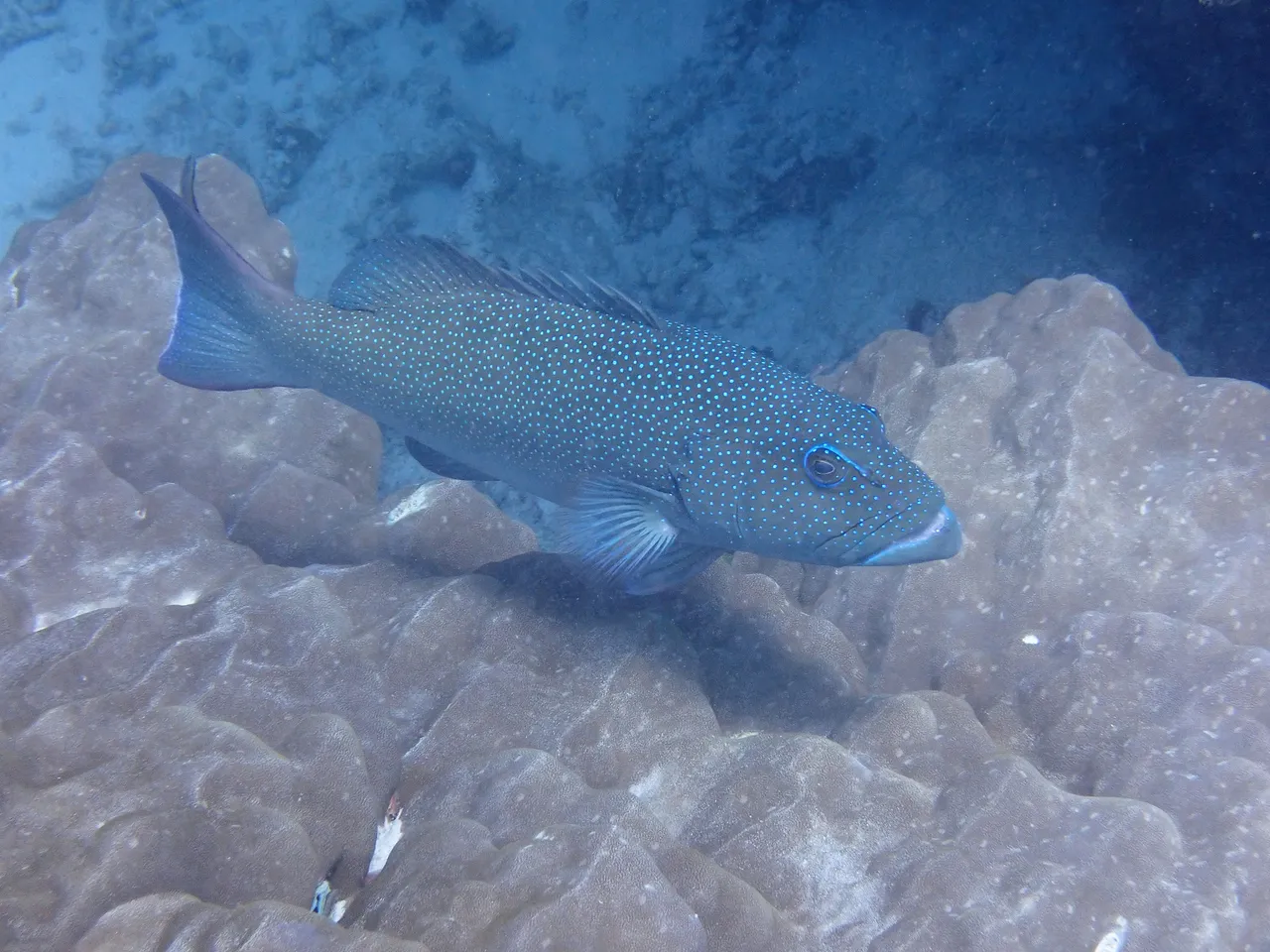
How this was identified, and who took it
Identified by: Small round blue spots densely covering the body, the head AND the fins — the distribution the page names, and the part that separates it from spotted groupers whose spots stop at the fins — on an elongate grouper body with a large mouth. Two agreeing identifications, none disagreeing.Donald Davesne — CC BY, via iNaturalist — source, licenceCatching Coral trout
Everything here on fishing for it. Each entry opens the page behind it.
- Ground
Coral trout is the premier reef fish of the Great Barrier Reef and much of the tropical Indo-Pacific — a brilliant red to orange grouper covered in small blue spots, holding on coral structure and ambushing small fish.
It is one of the very few fish known to hunt cooperatively with another species. Coral trout use head-shake signals to recruit moray eels and Napoleon wrasse to a hunt, and to indicate where prey has hidden in the reef: the eel flushes the prey from the crevice, and either partner may catch it. The behaviour has been studied experimentally, and coral trout choose effective partners over ineffective ones.
It is also of major commercial importance in the live reef fish trade, which is the principal pressure on it.
How it is caught
Identification
- Scientific name
- Plectropomus leopardus
- Family
- Epinephelidae
- Water
- Saltwater
- Conservation status
- Least Concern
- Regions
- Indo-Pacific, Australia, South-East Asia
- Brilliant red to orange-brown body covered in small round blue spots, including on the head and fins.
- Rounded caudal fin with a narrow white margin.
- Large mouth with prominent canine teeth and a projecting lower jaw.
- Blue ring around the eye, and dorsal spines shorter than the soft rays behind.
Size
- Typical
- 1–4 kg (2.2–8.8 lb)
- Large
- 6–12 kg (13–26 lb)
Exceptional: FishBase records a maximum of 120 cm and 23.6 kg
How coral trout are fished, and why
A reef ambush predator that lives in and immediately around coral structure, which makes every method a compromise between reaching the fish and losing tackle in the ground.
JIGGING works because the fish holds close to reef and will strike a lure worked vertically past its position, and because vertical presentation keeps line clear of coral for longer than a cast retrieve does.
TROLLING covers ground along reef edges and drop-offs, which is where the fish patrols.
SPEARFISHING is a major method throughout the range and is genuinely selective — the diver identifies the fish, its size and its species before taking it, which matters on reefs holding many similar-looking serranids of sharply differing conservation status.
AND THE CONSTRAINT THAT SHAPES ALL OF THEM. A hooked coral trout runs immediately for structure, and the contest is decided in the first seconds. That is why heavy tackle is normal for a fish of modest size, and it is a property of the habitat rather than of the fish's strength.
What experienced anglers do — why, and the sources (2)
Widely and independently recommended by experienced anglers and specialist sources. This is real angling knowledge, not proof: controlled evidence for it is limited, and FishingHQ records it as convention rather than as a demonstrated effect.
- FishBase: a global information system on fishes — Froese, R. and D. Pauly, eds. — FishBase Consortium (Scientific institute)Relied on for: Habitat association, depth range, feeding ecology and prey of the species, from which the method association follows.Background and mechanism onlyPassage read and verified
- IGFA International Angling Rules and World Record Requirements — International Game Fish Association (Angling or fisheries organisation)Relied on for: Recognised angling methods and the tackle classes used for them internationally.Background and mechanism onlyPassage read and verified
Reef depth, a descending device, and the one hazard that is not about the fish
Coral trout are caught over reef at depths where the release question is decided by physics, and eaten in a region where the safety question is decided by chemistry. Both are worth understanding and neither is about how the fish is held.
DEPTH. Coral trout come off reef and reef edges at depths where swim-bladder expansion is routine, and the visible signs — everted stomach, protruding eyes, distended belly — mean the fish cannot get back down. A descending device is standard equipment on this fishery for that reason. The fish's own physiology is capable of reabsorbing the gas over time; what it cannot do is get itself to the depth where that happens.
CIGUATERA, WHICH IS THE ONE PEOPLE UNDERESTIMATE. Ciguatoxins are produced by dinoflagellates on reef surfaces, accumulate up the reef food chain, and concentrate in large predatory reef fish. Coral trout are a recognised risk species in parts of their range. The toxins are heat-stable — cooking does not destroy them — and they cannot be detected by looking at, smelling or tasting the fish. Illness involves gastrointestinal and neurological symptoms that can persist for months, including the characteristic reversal of hot and cold sensation.
What makes this a handling subject rather than a cooking one is that the decision is made at the point of capture. Risk is strongly geographic: particular reefs and particular areas have histories, and local knowledge about which ground is implicated is the only practical guide there is. Larger fish carry more. Where local advice exists — and in ciguatera areas it generally does, through fisheries agencies and through the fishing community — it is worth more than any general rule, and this page does not attempt to replace it.
AND THE FISH ITSELF is straightforward: canine teeth, sharp gill covers, a spiny dorsal, all handled by gripping across the body with the spines folded and keeping fingers out of the mouth.
Official guidance — why, and the sources (2)
Stated by a fisheries authority, scientific institute or recognised angling body. Authoritative, but summarising rather than demonstrating.
- Fish and Fishery Products Hazards and Controls Guidance — US Food and Drug Administration, Center for Food Safety and Applied Nutrition, 2022 (Standards body)Relied on for: That ciguatoxins accumulate in large predatory reef fish, are heat-stable, cannot be detected organoleptically, and that risk is geographically specific.States this directlyPassage read and verified
- FishBase: a global information system on fishes — Froese, R. and D. Pauly, eds. — FishBase Consortium (Scientific institute)Relied on for: Depth range, morphology and ciguatera association recorded for the species.Background and mechanism onlyPassage read and verified
Live coral, a home range of metres, and a fish that knows its own patch
Coral trout habitat is narrow, structurally specific and occupied by individuals with very small home ranges, which is a combination that has direct consequences for how a reef holds them.
THE ASSOCIATION IS WITH CORAL, AND WITH LIVE CORAL PARTICULARLY. Coral trout occupy coral reef habitat across the Indo-Pacific, using reef slopes, lagoons, patch reefs and channels, generally in the shallower part of the reef profile. They are ambush predators that hold among coral structure and take reef fish over short distances, so what they require is complex three-dimensional relief with cover and sightlines — which is what living branching and plate coral provides and what dead, algal-covered or storm-flattened reef does not.
WHICH MAKES THEM SENSITIVE TO REEF CONDITION IN A DIRECT PHYSICAL WAY. Bleaching, cyclone damage and crown-of-thorns outbreaks reduce structural complexity, and the loss of complexity reduces both shelter and prey. A reef can retain its outline and lose the habitat, and coral trout abundance tracks the structure rather than the geography.
THE HOME RANGE IS SMALL AND THE SITE FIDELITY IS HIGH. Individual coral trout occupy areas measured in tens to hundreds of metres and remain within them, using particular shelters. That has two consequences worth stating: local depletion of a patch of reef is real and is not quickly refilled by movement from adjacent reef; and marine protected areas work unusually well for this species, because a fish that does not travel is a fish that stays protected.
THE SPAWNING BEHAVIOUR BREAKS THAT PATTERN AND IS THE VULNERABILITY. Coral trout aggregate to spawn at predictable times and places, which concentrates fish from a wider area into known locations — the standard reef-fish aggregation problem, layered on top of an otherwise sedentary life.
THEY ARE ALSO PROTOGYNOUS, maturing as females and changing to male with size, so the largest fish are the males and size-selective fishing is male-selective. That is the same structure as dusky grouper and ballan wrasse, and it means the reef's breeding males are the ones a fishery preferentially removes.
AND THE COLOUR CHANGE IS A HABITAT ADAPTATION rather than a curiosity: coral trout alter their colour and pattern rapidly to match background and situation, which is what an ambush predator on a visually complex reef requires.
Backed by research — why, and the sources (2)
Supported by peer-reviewed research or fisheries science. The sources are listed and can be checked.
- FishBase: a global information system on fishes — Froese, R. and D. Pauly, eds. — FishBase Consortium (Scientific institute)Relied on for: Reef association, depth range, substrate preference and habitat use recorded for the species.States this directlyPassage read and verified
- FAO Species Identification Guides for Fishery Purposes and the FAO Species Catalogues — Food and Agriculture Organization of the United Nations (Scientific institute)Relied on for: Habitat, depth and distribution accounts for the species in the FAO regional identification guides.Background and mechanism onlyCitation checked — the work exists and is described correctly
Lifecycle and reproduction
Moderately long-lived and protogynous — individuals mature as female and a proportion change to male with size — so the largest fish are disproportionately male and size-selective fishing alters the sex ratio.
Forms predictable spawning aggregations on reef around the new moon in spring, which concentrates a large share of the breeding population into small areas at known times and makes them highly vulnerable.
Feeding and senses
An ambush predator taking small reef fish, and notably recruiting moray eels and Napoleon wrasse to cooperative hunts using directional head-shake signals.
A daylight visual predator of clear reef water, with the additional and unusual capacity to communicate hunting information to another species by gesture.
Through the year
Resident on reef year-round, aggregating to spawn seasonally around new moons in spring. Those aggregations are the focus of both fishing effort and management concern.
Distribution
Western Pacific: from Western Australia, eastward to the Caroline Islands and Fiji: from southern Japan to Australia (Queensland); also recently recorded from Tonga . Often misidentified as Plectropomus maculatus
This is a biological range — where the species occurs, not a prediction that you will catch one. To browse the fishing geography FishingHQ holds, start at fishing places.
Why anglers care
A prime Great Barrier Reef and Indo-Pacific target, taken on baits, jigs and trolled lures over coral structure, and a common spearfishing catch. Its significance is eating quality and its central role in both recreational and live-trade commercial fisheries. Aggregation spawning means seasonal and area closures are widely used; FishingHQ does not state what any rule is.
Handling and returning
Fish taken from reef depths suffer barotrauma and need a descending device. Handle across the body avoiding the sharp gill covers and dorsal spines, and keep hands clear of the canine teeth. In ciguatera-prone areas, local advice on consumption should be followed.
Safety
Barotrauma and pressure injury is set out at the top of this page, where it cannot be missed.
Lead and toxic materials — Can cause injury needing treatment
Large predatory reef fish in certain areas can accumulate ciguatoxin, which is not destroyed by cooking and causes serious illness.
What reduces it: Follow local advice on which reefs and which sizes are affected, and avoid eating large individuals from areas with known ciguatera history.
Where to go next
Where it lives
Where you will find it
- The Coral TriangleA high-value reef grouper of the region and one of the principal species of the live reef food fish trade.
- The Great Barrier ReefThe principal reef fin fish target of the system, holding on live coral with a very small home range and high site fidelity.
- The MaldivesA resident reef grouper of the atoll reefs, and one of the species whose taking is controlled because of its value in the live trade.
- The Ryukyu IslandsA resident reef grouper of the fringing reefs, at the northern margin of the Indo-Pacific reef fauna the chain carries.
- The western Indian Ocean coastA resident reef grouper of the fringing reefs along this seaboard.
Understanding this fish
Sources and evidence
- FishBase: a global information system on fishes — Froese, R. and D. Pauly, eds. — FishBase Consortium (Scientific institute)Relied on for: Family, maximum size, depth and environment, distribution and the IUCN assessment for Plectropomus leopardus.States this directlyPassage read and verified
- The IUCN Red List of Threatened Species — International Union for Conservation of Nature (Conservation authority)Relied on for: The Least Concern assessment for Plectropomus leopardus, assessed 20 November 2016.States this directlyCitation checked — the work exists and is described correctly
Why the 10 connections on this page are here, and the sources
How it is caught
What experienced anglers do — 3 connections
Widely and independently recommended by experienced anglers and specialist sources. This is real angling knowledge, not proof: controlled evidence for it is limited, and FishingHQ records it as convention rather than as a demonstrated effect.
Jigging
A practitioner claim about how Plectropomus leopardus is commonly fished, following from where and how it feeds.
- General angling website restatements of established technique — Various (Credible secondary source)Relied on for: Widely restated practitioner accounts of fishing for coral trout.Citation checked — the work exists and is described correctly
- Sea Angler — Bauer Media (Specialist angling publication)Relied on for: Practitioner treatment of the methods used for coral trout and comparable species.Citation checked — the work exists and is described correctly
Reef spearfishing
A practitioner claim about how Plectropomus leopardus is commonly fished, following from where and how it feeds.
- General angling website restatements of established technique — Various (Credible secondary source)Relied on for: Widely restated practitioner accounts of fishing for coral trout.Citation checked — the work exists and is described correctly
- Sea Angler — Bauer Media (Specialist angling publication)Relied on for: Practitioner treatment of the methods used for coral trout and comparable species.Citation checked — the work exists and is described correctly
Trolling
A practitioner claim about how Plectropomus leopardus is commonly fished, following from where and how it feeds.
- General angling website restatements of established technique — Various (Credible secondary source)Relied on for: Widely restated practitioner accounts of fishing for coral trout.Citation checked — the work exists and is described correctly
- Sea Angler — Bauer Media (Specialist angling publication)Relied on for: Practitioner treatment of the methods used for coral trout and comparable species.Citation checked — the work exists and is described correctly
Where it lives
Backed by research — 1 connection
Supported by peer-reviewed research or fisheries science. The sources are listed and can be checked.
Coral reef
A habitat association for Plectropomus leopardus taken from the environment and distribution data on its FishBase summary.
- FishBase: a global information system on fishes — Froese, R. and D. Pauly, eds. — FishBase Consortium (Scientific institute)Relied on for: The environment, depth range and habitat description recorded for Plectropomus leopardus.States this directlyPassage read and verified
Where you will find it
Backed by research — 5 connections
Supported by peer-reviewed research or fisheries science. The sources are listed and can be checked.
The Coral Triangle
A distribution association between an animal and a kind of water, rather than a claim about any named mark.
- FAO Species Identification Guides for Fishery Purposes and the FAO Species Catalogues — Food and Agriculture Organization of the United Nations (Scientific institute)Relied on for: Distribution, habitat, depth and fishery accounts for the species in the FAO regional identification guides for the ocean area concerned.States this directlyCitation checked — the work exists and is described correctly
- FishBase: a global information system on fishes — Froese, R. and D. Pauly, eds. — FishBase Consortium (Scientific institute)Relied on for: Distribution, habitat association and depth range recorded for the species.States this directlyPassage read and verified
The Great Barrier Reef
A distribution association between an animal and a kind of water, rather than a claim about any named mark.
- FishBase: a global information system on fishes — Froese, R. and D. Pauly, eds. — FishBase Consortium (Scientific institute)Relied on for: Distribution, habitat association and depth range recorded for the species, including its occurrence in the water body concerned.States this directlyPassage read and verified
- The IUCN Red List of Threatened Species — International Union for Conservation of Nature (Conservation authority)Relied on for: Assessment and range account for the species, including the systems and coasts it occupies.Background and mechanism onlyCitation checked — the work exists and is described correctly
The Maldives
A distribution association between an animal and a kind of water, rather than a claim about any named mark.
- FAO Species Identification Guides for Fishery Purposes and the FAO Species Catalogues — Food and Agriculture Organization of the United Nations (Scientific institute)Relied on for: Distribution, habitat, depth and fishery accounts for the species in the FAO regional identification guides for the ocean area concerned.States this directlyCitation checked — the work exists and is described correctly
- FishBase: a global information system on fishes — Froese, R. and D. Pauly, eds. — FishBase Consortium (Scientific institute)Relied on for: Distribution, habitat association and depth range recorded for the species.States this directlyPassage read and verified
The Ryukyu Islands
A distribution association between an animal and a kind of water, rather than a claim about any named mark.
- FAO Species Identification Guides for Fishery Purposes and the FAO Species Catalogues — Food and Agriculture Organization of the United Nations (Scientific institute)Relied on for: Distribution, habitat, depth and fishery accounts for the species in the FAO regional identification guides for the ocean area concerned.States this directlyCitation checked — the work exists and is described correctly
- FishBase: a global information system on fishes — Froese, R. and D. Pauly, eds. — FishBase Consortium (Scientific institute)Relied on for: Distribution, habitat association and depth range recorded for the species.States this directlyPassage read and verified
The western Indian Ocean coast
A distribution association between an animal and a kind of water, rather than a claim about any named mark.
- FAO Species Identification Guides for Fishery Purposes and the FAO Species Catalogues — Food and Agriculture Organization of the United Nations (Scientific institute)Relied on for: Distribution, habitat, depth and fishery accounts for the species in the FAO regional identification guides for the ocean area concerned.States this directlyCitation checked — the work exists and is described correctly
- FishBase: a global information system on fishes — Froese, R. and D. Pauly, eds. — FishBase Consortium (Scientific institute)Relied on for: Distribution, habitat association and depth range recorded for the species.States this directlyPassage read and verified
Understanding this fish
Backed by research — 1 connection
Supported by peer-reviewed research or fisheries science. The sources are listed and can be checked.
Ciguatera and reef fish poisoning
A link from a species or a place to the accumulation mechanism that decides whether what is caught there should be eaten, resting on published seafood-hazard guidance and on the species' recorded diet and trophic position.
- FAO Species Identification Guides for Fishery Purposes and the FAO Species Catalogues — Food and Agriculture Organization of the United Nations (Scientific institute)Relied on for: Identification, distribution and trophic position of tropical reef fishes, including the large predatory species associated with reef toxin.States this directlyCitation checked — the work exists and is described correctly
- FishBase: a global information system on fishes — Froese, R. and D. Pauly, eds. — FishBase Consortium (Scientific institute)Relied on for: Recorded distribution, diet, size and trophic level of the species named, which is the basis for its position in a reef food web.States this directlyPassage read and verified
How FishingHQ labels evidence is explained in the evidence policy.