The Great Barrier Reef
Fishing regions · Last reviewed 2026-08-14
The largest reef system on earth, zoned in detail for what may happen where, and a fishery whose defining constraint is a map rather than a season.
Safety: venomous and spined species — can cause serious injury or death. One more point applies here.
Being listed here is not permission to fish. What that meansClose
Access, fishing rights, seasons, licences, local bylaws and permitted methods vary and can change. Check current access, permission, local regulations, closures and restrictions before you travel or fish. FishingHQ describes what the ground is and names who holds the answer; it does not hold the answer itself.
Find the authority for a jurisdiction · What FishingHQ does and does not cover
The Great Barrier Reef is a system-tier record because the physical structure of the reef explains the fishing, and because its management is the most spatially detailed of any fishery on FishingHQ.
THE REEF IS NOT ONE REEF. It is a system of thousands of individual reefs and hundreds of islands stretching along a very long stretch of Queensland coast, arranged in a broad band with the mainland and its inshore waters on one side and the Coral Sea drop-off on the other. That arrangement produces three quite different fishing environments in a cross-section: inshore, mid-shelf and outer reef.
INSHORE IS ESTUARY AND MANGROVE. Barramundi, mangrove jack, grunter, threadfin and mud crab in tidal creeks, mangrove systems and shallow coastal water — a fishery with far more in common with northern Australian estuary fishing than with the reef itself.
THE MID-SHELF AND OUTER REEFS ARE THE CORAL FISHERY. Coral trout is the principal target and the mainstay of the commercial and recreational reef fishery; red emperor, sweetlip, and various emperors and snappers accompany it. Beyond the outer edge the bottom drops into blue water holding pelagic species.
AND THE PELAGICS RUN ALONG THE WHOLE SYSTEM. Spanish mackerel, giant trevally, tuna and billfish use the reef edges, channels and current lines, with the mackerel run in particular being a major seasonal fishery.
THE MANAGEMENT IS THE OTHER DEFINING FACT. The whole system is a marine park, zoned in detail, with different zones permitting different activities — some open to fishing, some to limited fishing, some no-take, some no-entry. That zoning is the primary regulatory instrument and it is spatial rather than temporal: the question is usually where you are rather than what time of year it is.
NOTHING HERE STATES WHAT ANY CURRENT ZONE, RULE OR SEASON IS, and zoning maps are the authoritative source.
What fishing here is like
A vast system of thousands of reefs and hundreds of islands along a long tropical coast, producing three distinct fishing environments in cross-section — inshore estuary and mangrove, mid-shelf and outer coral reef, and blue water beyond the shelf. Coral trout dominates the reef fishery, barramundi and mangrove jack the inshore one, and Spanish mackerel and trevally the pelagic one. Management is by detailed spatial zoning within a marine park, so where you are matters more than when. Access is overwhelmingly by boat, and distances to the outer reef are substantial.
What dominates
Bottom fishing and jigging over coral reef for coral trout, red emperor and other reef species. Lure and fly fishing in inshore estuaries and mangrove systems for barramundi and mangrove jack. Trolling and casting along reef edges and channels for Spanish mackerel, trevally and tuna. Popping and stickbaiting for giant trevally on reef edges and in passes. Game fishing for billfish beyond the outer reef. Recreational mud crab potting in inshore creeks. Spearfishing on breath-hold where the zoning permits it, with scuba spearfishing prohibited.
The water available
Tidal creeks, mangrove systems and turbid inshore water along the mainland coast; shallow inshore fringing reefs and continental islands; a broad mid-shelf lagoon with scattered patch reefs and shoals; the outer ribbon reefs at the shelf edge; passes and channels through the reef where tidal flow accelerates; the Coral Sea drop-off into deep blue water; extensive seagrass beds and sand flats; and coral cays.
How the rules are structured
The system lies within a marine park administered by a federal authority, overlaid by a complementary state marine park and by state fisheries management. The primary instrument is spatial zoning: the park is divided into zones permitting different activities, ranging from general use where fishing is allowed through habitat protection and conservation park zones with restrictions, to marine national park zones which are no-take and preservation zones which are no-entry. Zone boundaries are mapped and enforced, and being in the wrong zone is an offence regardless of what is caught. On top of the zoning, state fisheries rules impose size limits, bag limits, closed seasons — including seasonal closures around coral reef fin fish spawning — and gear restrictions. Some species carry no-take status entirely. Spearfishing is permitted only on breath-hold and only in certain zones. The official zoning maps and the state fisheries authority are the sources, and FishingHQ does not state what any current rule is.
Who to ask
- The Great Barrier Reef Marine Park Authority, for park zoning, permitted activities and the zoning maps that govern where fishing may take place.
- The Queensland state fisheries authority, for size limits, bag limits, closed seasons, gear rules and no-take species.
- The Queensland parks authority, for the complementary state marine park and for island and cay access.
- The relevant Traditional Owner group, whose traditional use of marine resources is recognised and separately arranged.
- The Australian maritime safety authority, for navigation and safety requirements in what is a substantial offshore undertaking.
Words you will meet
- Zoning
- The spatial management system dividing the marine park into areas permitting different activities, from general use through to no-take and no-entry zones. The primary regulatory instrument for the whole system, and the thing an angler must establish before fishing.
- Green zone
- Common shorthand for a marine national park zone, in which no fishing or collecting is permitted. Entering is allowed; fishing is not.
- Ribbon reefs
- The long narrow reefs at the outer edge of the shelf, facing the Coral Sea drop-off, and the outermost of the system's three broad reef environments.
- Coral trout
- The principal reef fin fish target of both the commercial and recreational fisheries — an ambush grouper with a small home range and high site fidelity, and the species most of the reef fishery's management is built around.
- Coral reef fin fish closure
- Seasonal closures applied around the spawning periods of reef fin fish species, during which taking them is prohibited. A recurring seasonal instrument distinct from the spatial zoning.
Conditions and hazards
This is a serious offshore undertaking and the distances are the first hazard: the outer reef is a long run from the coast, well beyond assistance, and weather can change during it. The south-east trade winds blow strongly for much of the year and produce difficult sea states over a shallow shelf. Navigation among reefs is genuinely hazardous — coral comes up steeply and is not always visible, and reef groundings are a recurring cause of incidents. Tidal flow through passes and channels is strong. In the water, the tropical hazards are real and specific: stinging jellyfish including Irukandji and box jellyfish in the warmer months along the coast, stonefish and other venomous fish on the bottom, cone shells, and sharks. Coral cuts become infected readily in tropical conditions. Heat, sun and dehydration cause more trouble than any of the above. Crocodiles occur in inshore and estuarine waters along this coast and are a genuine and serious consideration there. Local guidance is authoritative on all of it.
Three environments in a cross-section, and why the fishing changes with distance offshore
The most useful way to hold the Great Barrier Reef in mind is as a cross-section rather than as a place, because the fishing changes completely between the mainland and the shelf edge.
INSHORE IS AN ESTUARY FISHERY AND IT IS NOT REEF FISHING AT ALL. The mainland coast carries tidal creeks, mangrove systems, turbid shallow water and seagrass, and the fishing there is for barramundi, mangrove jack, grunter, threadfin and mud crab. It is conducted by casting at structure in moving water, and it has far more in common with the barramundi fishing of northern Australia generally than with anything on the reef. An angler who has fished the creeks has not fished the reef.
THE MID-SHELF LAGOON IS TRANSITIONAL. Between the coast and the outer reefs lies a broad shallow area with scattered patch reefs, shoals and sand, holding reef species in lower densities and providing much of the accessible day-trip fishing.
THE OUTER REEFS ARE THE CORAL FISHERY PROPER. At the shelf edge the ribbon reefs face deep water, and the ground is complex, high-relief and productive. Coral trout, red emperor, sweetlip and emperors are the bottom targets, and the record's coral trout material explains why site fidelity and small home ranges make individual reefs deplete locally and refill slowly.
BEYOND THE EDGE IT IS BLUE WATER, dropping into the Coral Sea and holding billfish, tuna and pelagic species.
AND THE PASSES BETWEEN REEFS ARE THE HIGH-ENERGY GROUND. Tidal flow accelerating through a channel concentrates bait and disorients it, which is where giant trevally and Spanish mackerel hunt — the same hydraulic logic the giant trevally page describes, at reef scale.
WHICH MEANS A SINGLE DAY CAN COVER THREE FISHERIES OR NONE, depending entirely on how far the boat goes and what the weather allows. Distance offshore is the organising variable, and the outer reef is a substantial undertaking rather than a longer version of an inshore trip.
Backed by research — why, and the sources (2)
Supported by peer-reviewed research or fisheries science. The sources are listed and can be checked.
- Reef Fish Spawning Aggregations: Biology, Research and Management — Springer, Fish & Fisheries Series vol. 35, 2012 (Scientific literature)Relied on for: Reef fish spawning aggregations, their predictability and their vulnerability, and the management responses to them.Background and mechanism onlyCitation checked — the work exists and is described correctly
- FishBase: a global information system on fishes — Froese, R. and D. Pauly, eds. — FishBase Consortium (Scientific institute)Relied on for: Reef association, depth range and habitat use recorded for the species occurring in the area.States this directlyPassage read and verified
Managed by map: zoning as the primary instrument
The Great Barrier Reef's management is unusual on FishingHQ because the principal question is not what you may catch or when, but where you are.
THE WHOLE SYSTEM IS A ZONED MARINE PARK. Rather than regulating primarily through seasons and limits, the park is divided spatially into zones that permit different activities. Some allow general fishing; some restrict gear or method; some are no-take, permitting entry and prohibiting any fishing or collecting; and a small number are no-entry. Those boundaries are mapped, they are enforced, and being inside the wrong one is an offence irrespective of whether anything was caught.
WHICH MAKES ESTABLISHING YOUR POSITION A REGULATORY ACT rather than a navigational convenience. The zoning maps are the authoritative source, they are published, and reading them is the first step in planning a trip. A visitor chartering a boat is relying on the operator to have done this; a visitor with their own boat is not relieved of it.
STATE FISHERIES RULES SIT ON TOP OF THE ZONING and do the work zoning does not: size limits, bag limits, no-take species, gear restrictions and seasonal closures — including closures around the spawning periods of coral reef fin fish, which are timed rather than spatial and are the instrument that addresses the aggregation problem the reef's groupers present.
SPEARFISHING IS PERMITTED ONLY ON BREATH-HOLD AND ONLY WHERE THE ZONING ALLOWS. Spearfishing on scuba is prohibited, which is a deliberate limitation on effectiveness of exactly the kind the spearfishing records describe as a conservation instrument.
TRADITIONAL USE IS SEPARATELY RECOGNISED AND ARRANGED, and is not part of the recreational framework.
AND THE WHOLE STRUCTURE IS PERIODICALLY REVIEWED, with rezoning exercises that have materially changed what is permitted where. A zoning map from a previous decade is not a guide. FishingHQ does not state what any current zone, rule or season is; the park authority and the state fisheries authority are the sources, and checking both is the actual task.
Official guidance — why, and the sources (2)
Stated by a fisheries authority, scientific institute or recognised angling body. Authoritative, but summarising rather than demonstrating.
- Reef Fish Spawning Aggregations: Biology, Research and Management — Springer, Fish & Fisheries Series vol. 35, 2012 (Scientific literature)Relied on for: Reef fish spawning aggregations, their predictability and their vulnerability, and the management responses to them.Background and mechanism onlyCitation checked — the work exists and is described correctly
- FishBase: a global information system on fishes — Froese, R. and D. Pauly, eds. — FishBase Consortium (Scientific institute)Relied on for: Reef association, depth range and habitat use recorded for the species occurring in the area.States this directlyPassage read and verified
A reef with a zoning plan and a tourism economy
The Great Barrier Reef's fishing culture is shaped by being simultaneously a working fishery, a mass tourism destination and one of the most closely managed marine areas on earth.
RECREATIONAL FISHING IS A MAINSTREAM QUEENSLAND ACTIVITY, with high boat ownership, a strong trailer-boat culture and a large number of people fishing the reef, the inshore and the estuaries as an ordinary weekend pursuit.
THE ZONING PLAN IS PART OF EVERYDAY PRACTICE. Because the entire marine park is zoned, and different zones permit different activities, checking which zone a boat is in before fishing is normal behaviour rather than an exceptional precaution. Anglers here are unusually literate about spatial management for that reason.
CHARTER AND LIVEABOARD FISHING serves both a domestic and an international market, working the outer reef and the coral sea beyond it.
THE COMMERCIAL REEF LINE FISHERY IS SMALL-BOAT AND SELECTIVE, with hand and rod lines rather than nets over the reef itself, supplying a high-value market for coral trout in particular.
TOURISM DOMINATES THE REGIONAL ECONOMY, and the reef's value as a viewing resource substantially exceeds its value as a fishery — a calculation that has shaped management in the same way it shaped the Maldivian shark ban.
INDIGENOUS TRADITIONAL USE IS RECOGNISED, with traditional owner groups holding rights and, in places, formal sea country agreements covering traditional hunting and fishing.
AND THE PUBLIC ATTACHMENT TO THE REEF IS UNUSUALLY STRONG. Bleaching events are national news in Australia, and the fishery operates inside a public conversation about the reef's condition that has no equivalent for most fisheries on FishingHQ.
What experienced anglers do — why, and the sources (2)
Widely and independently recommended by experienced anglers and specialist sources. This is real angling knowledge, not proof: controlled evidence for it is limited, and FishingHQ records it as convention rather than as a demonstrated effect.
- General angling website restatements of established technique — Various (Credible secondary source)Relied on for: Widely restated practice associating this discipline or technique with this place, recorded as practitioner consensus rather than as tested fact.Background and mechanism onlyCitation checked — the work exists and is described correctly
- Fishers' Craft and Lettered Art: Tracts on Fishing from the End of the Middle Ages — University of Toronto Press, 1997 (Scientific literature)Relied on for: That fishing traditions develop around the water and fish available to them, and the historical method of reading such traditions from their documentary record.States this directlyCitation checked — the work exists and is described correctly
Reef line, estuary and the run out to the coral sea
The reef system's disciplines are organised by which part of the system a boat is on.
REEF LINE FISHING IS THE CHARACTERISTIC DISCIPLINE. Hand and rod lines fished over hard coral bottom for coral trout, red emperor and other reef species, from small boats and charters, is the mainstream reef fishery and it is deliberately selective — nets are not used over the reef.
ESTUARY AND INSHORE FISHING IS THE OTHER HALF and is arguably larger by participation. Barramundi, mangrove jack, threadfin and grunter in the creeks, mangroves and river mouths of the adjacent coast support an enormous recreational fishery with its own strong culture.
OFFSHORE AND CORAL SEA FISHING reaches beyond the outer barrier for pelagics — Spanish mackerel, wahoo, tuna and billfish — and the giant black marlin fishery off the northern reef in the warmer months has an international reputation.
POPPING AND JIGGING work the reef edges and passes for giant trevally and other reef predators.
SPEARFISHING IS PRACTISED where zoning permits, and the selectivity argument FishingHQ makes applies with force on a reef.
CRABBING AND CAST NETTING in the estuaries and mangroves is an ordinary and popular activity, with mud crab a prized target.
BAROTRAUMA MANAGEMENT IS A DISCIPLINE IN ITSELF here, because reef fish are taken from depth and released fish need returning to depth; release weights and venting are established practice.
AND THE ZONE DECIDES WHAT IS POSSIBLE. Which of the reef's zones a boat sits in determines whether line fishing, spearfishing, collecting or nothing at all is permitted, which makes navigation and zoning literacy part of the discipline.
What experienced anglers do — why, and the sources (2)
Widely and independently recommended by experienced anglers and specialist sources. This is real angling knowledge, not proof: controlled evidence for it is limited, and FishingHQ records it as convention rather than as a demonstrated effect.
- Reef Fish Spawning Aggregations: Biology, Research and Management — Springer, Fish & Fisheries Series vol. 35, 2012 (Scientific literature)Relied on for: Reef fish spawning aggregations, their predictability in space and time, and the management responses to them.States this directlyCitation checked — the work exists and is described correctly
- Fear of fishers: human predation explains behavioral changes in coral reef fishes — PLoS ONE 6(8): e22761, 2011 (Scientific literature)Relied on for: Behavioural change in coral reef fishes under fishing pressure, inside and outside protected areas.States this directlyCitation checked — the work exists and is described correctly
A tropical year of monsoon, spawning moons and a closed season
The reef's seasonal cycle is tropical and its most distinctive feature is a closure timed to a moon.
THE WET SEASON RUNS THROUGH THE SOUTHERN SUMMER, bringing monsoon rain, freshwater runoff into the inshore lagoon, and the cyclone season. Access is the constraint, and severe cyclones can damage reef structure directly.
THE DRY SEASON IS THE SETTLED PERIOD, with south-easterly trade winds, clearer water and more reliable boating, and it is when most fishing and most tourism happen.
THE CORAL TROUT SPAWNING CLOSURES ARE THE DISTINCTIVE MEASURE. Reef fish spawning closures are timed around new moons in the spring months, closing the fishery for defined periods to protect aggregating fish. That a closure is set by the lunar calendar rather than by dates alone is a direct application of the spawning aggregation science FishingHQ cites.
BARRAMUNDI HAVE THEIR OWN CLOSED SEASON, timed to their spawning period in the wet season, and it is one of the better-known recreational closures in Australia.
THE BLACK MARLIN SEASON runs in the later part of the year off the northern reef, when very large fish are present, and the fishery is short and internationally attended.
SPANISH MACKEREL RUN SEASONALLY along the reef and are a major recreational and commercial target.
CORAL SPAWNING IS AN ANNUAL EVENT tied to water temperature and the lunar cycle, and it is one of the more spectacular biological events on the reef.
AND BLEACHING RISK IS NOW A SEASONAL VARIABLE. Marine heatwaves in the southern summer have caused mass bleaching repeatedly within recent decades, and reef condition is monitored and reported seasonally in a way that would have been unnecessary a generation ago.
Backed by research — why, and the sources (2)
Supported by peer-reviewed research or fisheries science. The sources are listed and can be checked.
- Reef Fish Spawning Aggregations: Biology, Research and Management — Springer, Fish & Fisheries Series vol. 35, 2012 (Scientific literature)Relied on for: Reef fish spawning aggregations, their predictability in space and time, and the management responses to them.States this directlyCitation checked — the work exists and is described correctly
- Fear of fishers: human predation explains behavioral changes in coral reef fishes — PLoS ONE 6(8): e22761, 2011 (Scientific literature)Relied on for: Behavioural change in coral reef fishes under fishing pressure, inside and outside protected areas.States this directlyCitation checked — the work exists and is described correctly
From cheap resource to zoned park to bleaching
The Great Barrier Reef's management history is one of the more instructive in world marine conservation.
THE REEF WAS TREATED AS A RESOURCE BEFORE IT WAS TREATED AS A SYSTEM. Commercial fishing, shell and coral collection and, in the mid-twentieth century, proposals for oil drilling and limestone mining on the reef were all live prospects.
THE DRILLING AND MINING PROPOSALS PRODUCED THE PARK. Public opposition in the 1960s and 1970s to oil exploration and coral mining led to the establishment of the marine park in the mid-1970s, one of the earliest large-scale marine protected areas anywhere.
ZONING WAS THE INSTRUMENT. Rather than a single blanket rule, the park was divided into zones permitting different activities, from general use through to no-take and no-entry, which allowed fishing, tourism, shipping and conservation to be reconciled spatially rather than by prohibition.
THE 2004 REZONING WAS THE MAJOR REFORM, substantially increasing the proportion of the park in no-take zones and applying a systematic representative approach across habitat types. The measured effects on fish biomass inside the green zones have been documented and are a reference case in marine reserve science.
CROWN-OF-THORNS OUTBREAKS have recurred through the modern period, consuming coral over large areas, and control programmes operate continuously.
WATER QUALITY FROM CATCHMENT RUNOFF became a recognised major pressure, with sediment, nutrients and pesticides from agriculture affecting inshore reefs, and catchment management is now a central part of reef policy.
AND THE BLEACHING EVENTS OF RECENT DECADES ARE THE DEFINING MODERN CHAPTER. Repeated mass bleaching driven by marine heatwaves has caused extensive coral mortality across large parts of the reef. It is the first pressure the park's zoning cannot address, because its cause is global rather than local, and it has changed what management is managing for.
Official guidance — why, and the sources (2)
Stated by a fisheries authority, scientific institute or recognised angling body. Authoritative, but summarising rather than demonstrating.
- Fishers' Craft and Lettered Art: Tracts on Fishing from the End of the Middle Ages — University of Toronto Press, 1997 (Scientific literature)Relied on for: The historical development of fishing practice and its transmission, and the method of reading a fishing tradition from its documentary record.States this directlyCitation checked — the work exists and is described correctly
- Code of Conduct for Responsible Fisheries — Food and Agriculture Organization of the United Nations, Rome, 1995 (Standards body)Relied on for: Principles for fisheries management including the treatment of traditional, small-scale and shared fisheries, against which historical arrangements can be read.Background and mechanism onlyCitation checked — the work exists and is described correctly
Some of what lives here
Fish recorded here that FishingHQ holds a reviewed photograph of. It is not a complete list of what The Great Barrier Reef holds, and it is not a prediction that you will catch any of them — it is a way in to the ones we can show you.
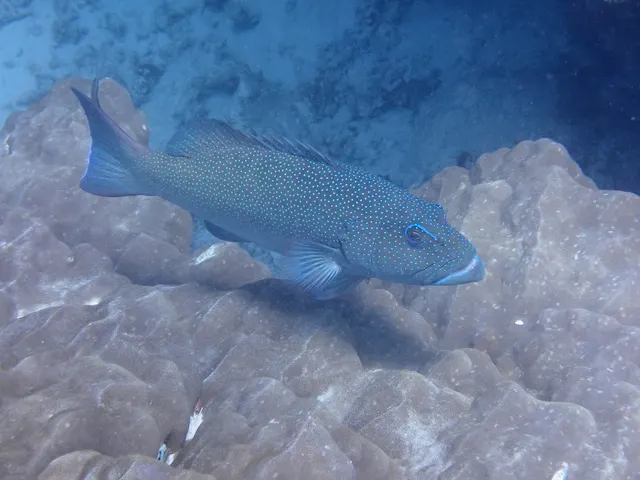 Coral troutA brilliant red-orange coral reef grouper marked with blue spots, known for cooperative hunting with moray eels, and a prime Great Barrier Reef target.
Donald Davesne — CC BY, via iNaturalist
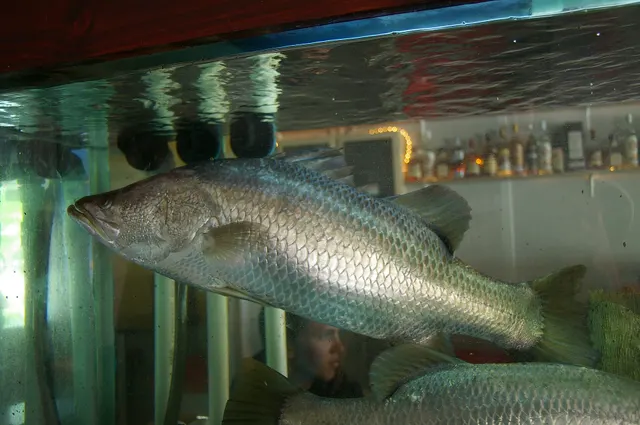 BarramundiAn estuarine ambush predator that begins life as a male and changes sex to female, so the largest fish are all breeding hens.
John Robert McPherson — CC0 1.0 Public Domain Dedication, via Wikimedia Commons
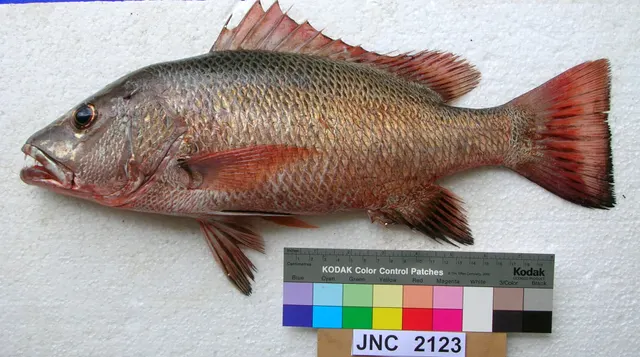 Mangrove jackA powerful red snapper of mangrove creeks and estuaries that moves to offshore reef as it matures, notorious for reaching structure the instant it is hooked.
Jean-Lou Justine — CC BY-SA 4.0, via Wikimedia Commons
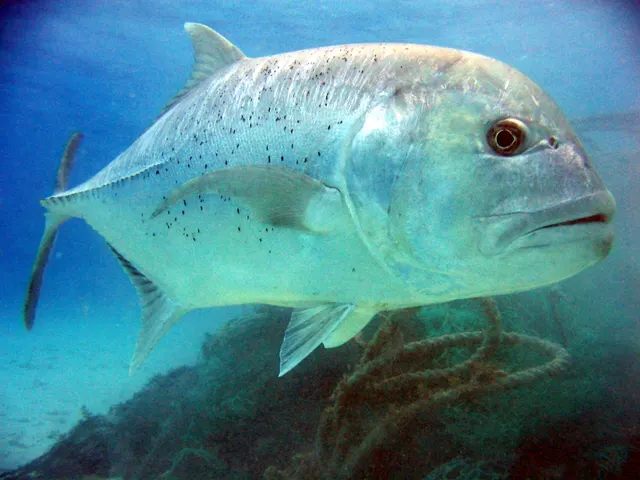 Giant trevallyA hugely powerful Indo-Pacific reef predator that hunts over shallow structure, and the fish popping was built around.
Dr. Dwayne Meadows, NOAA/NMFS/OPR — Public domain, via Wikimedia Commons
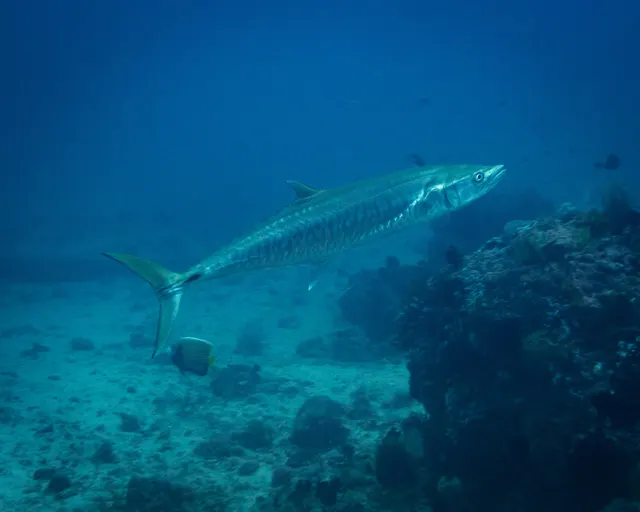 Narrow-barred Spanish mackerelA fast Indo-Pacific mackerel with vertical bars and shearing teeth that is a headline sport and food fish from South Africa to Australia — and a well-known ciguatera risk in parts of its range.
ppericard — CC BY 4.0, via Wikimedia Commons
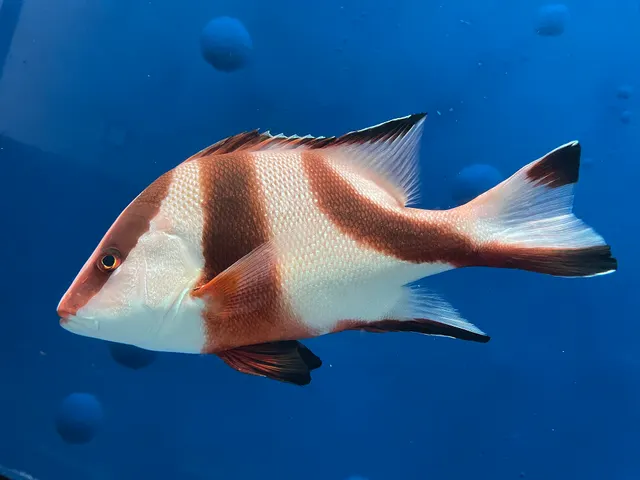 Red emperorA large deep-red Indo-Pacific snapper whose juveniles carry three bold dark bands that fade almost entirely with age.
Totti — CC BY-SA 4.0, via Wikimedia Commons
Safety
Venomous and spined species — Can cause serious injury or death
A wader, diver or spearfisher steps on or handles a stonefish, scorpionfish or other venomous bottom species, or is stung by box jellyfish or Irukandji in the warmer months. Envenomation ranges from intensely painful to life-threatening, and the animals concerned are cryptic and easily trodden on over reef and sand.
What reduces it: Wear substantial footwear over reef and sand and shuffle rather than step. Wear full-body protection in the water during the stinger season and follow local advice on it, which is specific and authoritative. Do not handle bottom fish by hand. Know where the nearest medical assistance is before going out, because the response for serious envenomation is medical rather than field treatment.
Worse when:
- The warmer months, when box jellyfish and Irukandji are present in coastal waters.
- Wading or landing on reef flats where cryptic bottom species are impossible to see.
- Remote outer-reef locations a long way from medical assistance.
Boat safety — Can cause serious injury or death
A vessel grounds on coral that rises steeply and is not visible from the surface, or is caught out on the long run to the outer reef when the south-east trades strengthen. The outer reef is well beyond assistance and the shallow shelf builds an unpleasant sea quickly.
What reduces it: Navigate on current charts with a proper lookout in good light, and do not run reef ground into the sun or at night without local knowledge. Treat the outer reef as an offshore passage requiring communications, a filed plan and a weather window rather than as a longer inshore trip.
Further safety reading
- Boat safety for anglers — The outer reef is a long run beyond assistance, the south-east trades blow hard for much of the year, and reef groundings are a recurring cause of incidents.
- Venomous and spined fish — Stonefish and other venomous fish on the bottom, cone shells and stinging jellyfish in the warmer months are genuine and specific tropical hazards here.
Check the rules before you fish
Fishing laws, bylaws, access rules, seasons, bait restrictions and permitted methods vary by location and can change. Check the current rules from the relevant authority and the water you intend to fish before fishing.
Check with:
- Current national or regional law for where you are fishing
- Current local bylaws
- The relevant fisheries authority
- The landowner, club or fishery whose water it is
- Any restrictions specific to the species or the method you intend to use
Where to go next
What swims here
- BarramundiOccupies the inshore tidal creeks, mangrove systems and coastal shallows along the mainland coast rather than the reef itself.
- Coral troutThe principal reef fin fish target of the system, holding on live coral with a very small home range and high site fidelity.
- Giant trevallyHunts the reef edges, passes and surge zones where tidal flow accelerates and disorients prey.
- Mangrove jackUses inshore mangrove and estuary habitat as juveniles and moves out to offshore reef as adults, spanning the system's cross-section.
- Narrow-barred Spanish mackerelMoves along the reef seasonally with water temperature and bait, supporting a major pelagic fishery on the reef edges and channels.
- Red emperorOccupies deeper reef and hard bottom across the shelf and is among the principal bottom-fishing targets of the system.
How people fish here
- Sea fishingThe reef supports three distinct fisheries in cross-section — inshore estuary, mid-shelf and outer reef, and blue water beyond the shelf edge.
- SpearfishingPermitted on breath-hold only and only where the zoning allows, with scuba spearfishing prohibited — a deliberate limitation on effectiveness as a conservation instrument.
Environment and conservation
Sources and evidence
- Reef Fish Spawning Aggregations: Biology, Research and Management — Springer, Fish & Fisheries Series vol. 35, 2012 (Scientific literature)Relied on for: Reef fish spawning aggregations, their predictability and their vulnerability, and the management responses to them.Background and mechanism onlyCitation checked — the work exists and is described correctly
- FishBase: a global information system on fishes — Froese, R. and D. Pauly, eds. — FishBase Consortium (Scientific institute)Relied on for: Reef association, depth range and habitat use recorded for the species occurring in the area.States this directlyPassage read and verified
Why the 11 connections on this page are here, and the sources
What swims here
Backed by research — 6 connections
Supported by peer-reviewed research or fisheries science. The sources are listed and can be checked.
Barramundi
A distribution association between an animal and a kind of water, rather than a claim about any named mark.
- FishBase: a global information system on fishes — Froese, R. and D. Pauly, eds. — FishBase Consortium (Scientific institute)Relied on for: Distribution, habitat association and depth range recorded for the species, including its occurrence in the water body concerned.States this directlyPassage read and verified
- The IUCN Red List of Threatened Species — International Union for Conservation of Nature (Conservation authority)Relied on for: Assessment and range account for the species, including the systems and coasts it occupies.Background and mechanism onlyCitation checked — the work exists and is described correctly
Coral trout
A distribution association between an animal and a kind of water, rather than a claim about any named mark.
- FishBase: a global information system on fishes — Froese, R. and D. Pauly, eds. — FishBase Consortium (Scientific institute)Relied on for: Distribution, habitat association and depth range recorded for the species, including its occurrence in the water body concerned.States this directlyPassage read and verified
- The IUCN Red List of Threatened Species — International Union for Conservation of Nature (Conservation authority)Relied on for: Assessment and range account for the species, including the systems and coasts it occupies.Background and mechanism onlyCitation checked — the work exists and is described correctly
Giant trevally
A distribution association between an animal and a kind of water, rather than a claim about any named mark.
- FishBase: a global information system on fishes — Froese, R. and D. Pauly, eds. — FishBase Consortium (Scientific institute)Relied on for: Distribution, habitat association and depth range recorded for the species, including its occurrence in the water body concerned.States this directlyPassage read and verified
- The IUCN Red List of Threatened Species — International Union for Conservation of Nature (Conservation authority)Relied on for: Assessment and range account for the species, including the systems and coasts it occupies.Background and mechanism onlyCitation checked — the work exists and is described correctly
Mangrove jack
A distribution association between an animal and a kind of water, rather than a claim about any named mark.
- FishBase: a global information system on fishes — Froese, R. and D. Pauly, eds. — FishBase Consortium (Scientific institute)Relied on for: Distribution, habitat association and depth range recorded for the species, including its occurrence in the water body concerned.States this directlyPassage read and verified
- The IUCN Red List of Threatened Species — International Union for Conservation of Nature (Conservation authority)Relied on for: Assessment and range account for the species, including the systems and coasts it occupies.Background and mechanism onlyCitation checked — the work exists and is described correctly
Narrow-barred Spanish mackerel
A distribution association between an animal and a kind of water, rather than a claim about any named mark.
- FishBase: a global information system on fishes — Froese, R. and D. Pauly, eds. — FishBase Consortium (Scientific institute)Relied on for: Distribution, habitat association and depth range recorded for the species, including its occurrence in the water body concerned.States this directlyPassage read and verified
- The IUCN Red List of Threatened Species — International Union for Conservation of Nature (Conservation authority)Relied on for: Assessment and range account for the species, including the systems and coasts it occupies.Background and mechanism onlyCitation checked — the work exists and is described correctly
Red emperor
A distribution association between an animal and a kind of water, rather than a claim about any named mark.
- FishBase: a global information system on fishes — Froese, R. and D. Pauly, eds. — FishBase Consortium (Scientific institute)Relied on for: Distribution, habitat association and depth range recorded for the species, including its occurrence in the water body concerned.States this directlyPassage read and verified
- The IUCN Red List of Threatened Species — International Union for Conservation of Nature (Conservation authority)Relied on for: Assessment and range account for the species, including the systems and coasts it occupies.Background and mechanism onlyCitation checked — the work exists and is described correctly
How people fish here
What experienced anglers do — 2 connections
Widely and independently recommended by experienced anglers and specialist sources. This is real angling knowledge, not proof: controlled evidence for it is limited, and FishingHQ records it as convention rather than as a demonstrated effect.
Sea fishing
A discipline that is characteristic of the place rather than merely possible there, joined so a reader can move between the place and the practice.
- General angling website restatements of established technique — Various (Credible secondary source)Relied on for: Widely restated practice associating this discipline with this place, recorded as practitioner consensus rather than as tested fact.Background and mechanism onlyCitation checked — the work exists and is described correctly
- Fishers' Craft and Lettered Art: Tracts on Fishing from the End of the Middle Ages — University of Toronto Press, 1997 (Scientific literature)Relied on for: That fishing traditions develop around the water and fish available to them, and the historical method of reading such traditions.States this directlyCitation checked — the work exists and is described correctly
Spearfishing
A discipline that is characteristic of the place rather than merely possible there, joined so a reader can move between the place and the practice.
- General angling website restatements of established technique — Various (Credible secondary source)Relied on for: Widely restated practice associating this discipline with this place, recorded as practitioner consensus rather than as tested fact.Background and mechanism onlyCitation checked — the work exists and is described correctly
- Fishers' Craft and Lettered Art: Tracts on Fishing from the End of the Middle Ages — University of Toronto Press, 1997 (Scientific literature)Relied on for: That fishing traditions develop around the water and fish available to them, and the historical method of reading such traditions.States this directlyCitation checked — the work exists and is described correctly
Safety reading
Official guidance — 2 connections
Stated by a fisheries authority, scientific institute or recognised angling body. Authoritative, but summarising rather than demonstrating.
Boat safety for anglers
A place is joined to the safety topic that explains a hazard genuinely characteristic of it, so the mechanism is reachable rather than restated as a weak warning.
- RNLI water safety guidance: cold water shock and Float to Live — Royal National Lifeboat Institution (Water-safety or diver-training authority)Relied on for: Cold water shock and the immersion response, shore angling hazards, small-craft guidance and the circumstances in which water users are most often killed.States this directlyPassage read and verified
- RoSPA water safety information and UK accidental drowning statistics — Royal Society for the Prevention of Accidents (Water-safety or diver-training authority)Relied on for: Accidental drowning statistics and the circumstances in which recreational water users are most often killed.Background and mechanism onlyPassage read and verified
Venomous and spined fish
A place is joined to the safety topic that explains a hazard genuinely characteristic of it, so the mechanism is reachable rather than restated as a weak warning.
- RNLI water safety guidance: cold water shock and Float to Live — Royal National Lifeboat Institution (Water-safety or diver-training authority)Relied on for: Cold water shock and the immersion response, shore angling hazards, small-craft guidance and the circumstances in which water users are most often killed.States this directlyPassage read and verified
- RoSPA water safety information and UK accidental drowning statistics — Royal Society for the Prevention of Accidents (Water-safety or diver-training authority)Relied on for: Accidental drowning statistics and the circumstances in which recreational water users are most often killed.Background and mechanism onlyPassage read and verified
Environment and conservation
Backed by research — 1 connection
Supported by peer-reviewed research or fisheries science. The sources are listed and can be checked.
Marine protected areas and spearfishing
An environmental pressure that is specific to this place rather than general to fishing, joined so the issue is anchored to a real example.
- Good Fish Guide — Marine Conservation Society (Conservation authority)Relied on for: Assessment of the fishery and the management measures applied to it, including spatial protection.Background and mechanism onlyCitation checked — the work exists and is described correctly
- Reef Fish Spawning Aggregations: Biology, Research and Management — Springer, Fish & Fisheries Series vol. 35, 2012 (Scientific literature)Relied on for: The vulnerability of aggregating and site-attached species and the role of spatial protection in managing them.States this directlyCitation checked — the work exists and is described correctly
How FishingHQ labels evidence is explained in the evidence policy.