Red emperor
Fish · Last reviewed 2026-08-10
A large deep-red Indo-Pacific snapper whose juveniles carry three bold dark bands that fade almost entirely with age.
Safety: barotrauma and pressure injury — can cause injury needing treatment. One more point applies here.
Barotrauma and pressure injury — Can cause injury needing treatment
Fish brought up from reef depth cannot return to the bottom without assistance.
What reduces it: Carry and use a descending device for released fish.
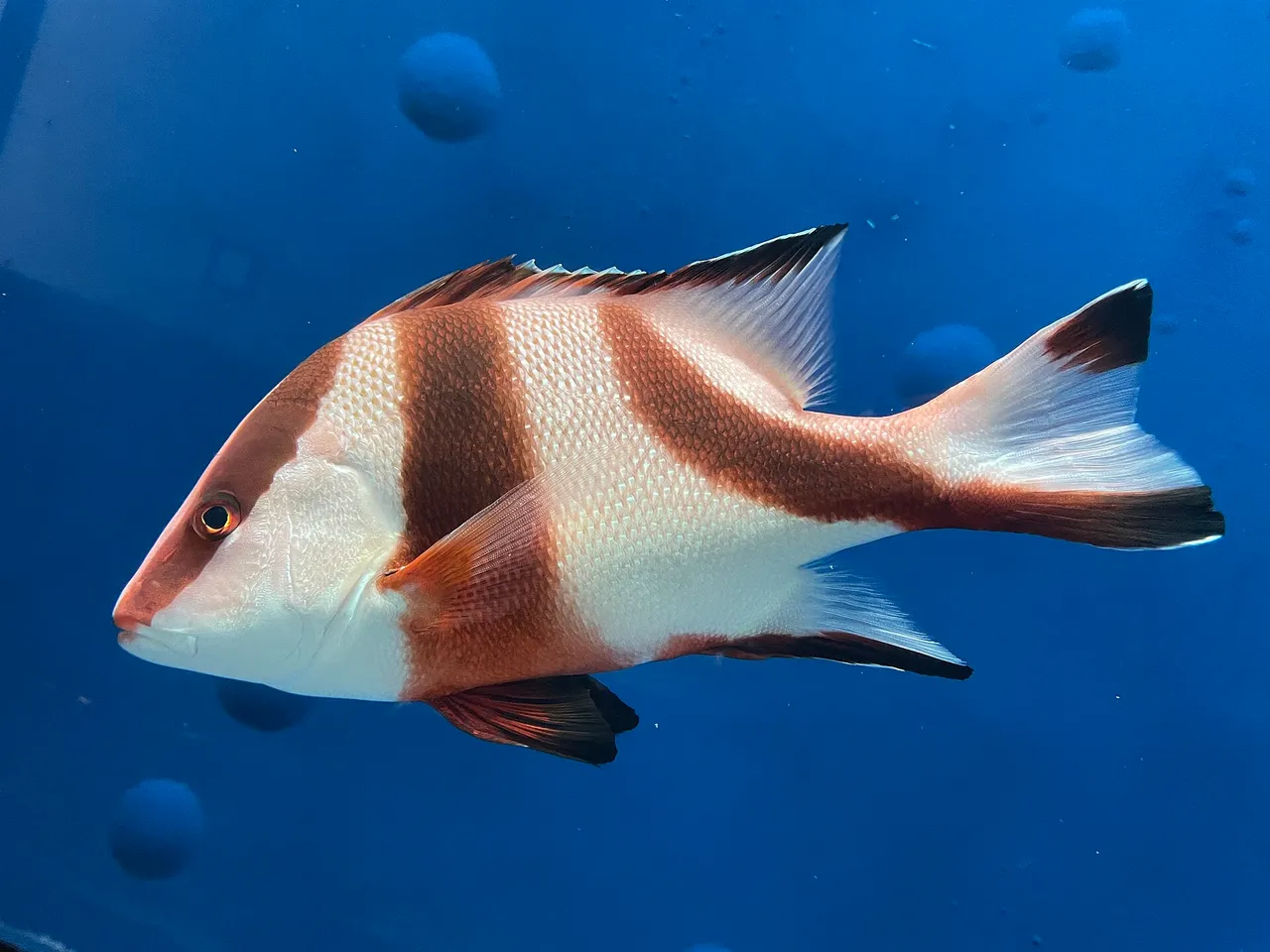
How this was identified, and who took it
Identified by: Identified on the three-band pattern the page names, all three present and complete: one band through the eye, one running from the dorsal fin down to the pelvic, and one across the caudal wrist continuing onto both lobes of the tail. Deep compressed body with a steep forehead and a slightly forked tail. The bands are a juvenile and sub-adult state; this page says they fade with age and adults become nearly uniform red, which is why the caption says so.Totti — CC BY-SA 4.0, via Wikimedia Commons — source, licence
Catching Red emperor
Everything here on fishing for it. Each entry opens the page behind it.
- Ground
Red emperor is one of the most prized reef snappers of the Indo-Pacific — a deep-bodied, brilliant red fish of coral and rubble ground from northern Australia across to East Africa.
Its most striking feature is how much it changes. Juveniles are white or pale pink with three broad, sharply defined dark red-brown bands across the body, one running through the eye. As the fish grows those bands fade progressively, and a large adult is almost uniformly deep red with only a trace of the pattern remaining.
It is slow-growing and long-lived, which is the usual and important caveat for tropical reef snappers: a big red emperor is decades old.
How it is caught
Identification
- Scientific name
- Lutjanus sebae
- Family
- Lutjanidae
- Water
- Saltwater
- Conservation status
- Least Concern
- Regions
- Indo-Pacific, Australia, South-East Asia, East & Southern Africa
- Three broad dark bands in juveniles — one through the eye, one from the dorsal to the pelvic, one across the tail wrist — fading with age.
- Deep red to pink body in adults, with a steep forehead and a deep compressed body.
- Large canine teeth in both jaws, and a slightly forked tail.
- Adults nearly uniform red, with only faint traces of the juvenile banding.
Size
- Typical
- 3–10 kg (6.6–22 lb)
- Large
- 12–20 kg (26–44 lb)
Exceptional: FishBase records a maximum of 116 cm and 32.7 kg
Three armaments and a depth problem, in the order they will find you
Red emperor combine most of the ways a reef fish can injure a person with the release problem that comes from where they live, and the order in which they are met is worth knowing because it is not the order they look dangerous in.
THE GILL COVER GETS PEOPLE FIRST. The rear edge of the operculum on a lutjanid is a thin, hard plate with an edge, and the natural grip on a heavy fish being lifted from a net puts a hand exactly there. It slices rather than punctures, and it does so on the way to doing something else.
THE DORSAL COMES SECOND, when the fish is controlled on a deck and somebody puts a hand across the back to hold it still. The spines are stiff, they lock into position under load, and they go in.
THE TEETH ARE THIRD and are the least likely to cause a problem, because everybody can see them. The canines are large and the jaws are strong, and the answer is long pliers and no fingers, which people manage because the hazard is obvious.
AND THE THING THAT DECIDES WHETHER THE FISH LIVES has happened before any of that. Red emperor come off reef at depths where swim-bladder expansion is severe, and a released fish that floats is a dead fish. This is a fishery where a descending device belongs in the boat as standard rather than as an accessory, and where the size and bag decisions made before the trip do more for the stock than anything done after a fish is aboard.
The useful summary is that a red emperor is handled from behind and above, across the body, with the dorsal folded, using a tool, and returned with a weight — and that the grip that feels natural is the one that meets the gill cover.
What experienced anglers do — why, and the sources (2)
Widely and independently recommended by experienced anglers and specialist sources. This is real angling knowledge, not proof: controlled evidence for it is limited, and FishingHQ records it as convention rather than as a demonstrated effect.
- Sea Angler — Bauer Media (Specialist angling publication)Relied on for: Established boat and shore practice for handling and returning the species.States this directlyCitation checked — the work exists and is described correctly
- IGFA International Angling Rules and World Record Requirements — International Game Fish Association (Angling or fisheries organisation)Relied on for: Handling, release and tackle conventions in recognised sport fisheries for the species.Background and mechanism onlyPassage read and verified
Lifecycle and reproduction
Slow-growing and long-lived, with fish recorded past thirty years, and late to mature. Juveniles use shallow inshore and seagrass habitat before moving to deeper reef as adults.
Spawns on reef in the warmer months, releasing pelagic eggs. Juveniles recruit into shallow coastal habitat quite distinct from the adult ground, so both habitats matter to the stock.
Feeding and senses
Takes fish, crabs, prawns and other crustaceans from coral, rubble and adjacent sand, feeding most actively in low light.
Hunts around reef structure in low light using sight and lateral-line detection, and feeds heavily at dusk and after dark.
Through the year
Resident on reef ground through the year, with movements driven by depth and temperature rather than by long migrations.
Distribution
Indo-West Pacific: southern Red Sea and East Africa to New Caledonia, north to southern Japan, south to Australia
This is a biological range — where the species occurs, not a prediction that you will catch one. To browse the fishing geography FishingHQ holds, start at fishing places.
Why anglers care
A premier northern Australian and Indo-Pacific bottom-fishing target, taken on baits and jigs over coral and rubble ground, and highly regarded as food. Its significance is size, colour and eating quality, and its slow growth is the reason many jurisdictions apply strict size and bag limits. Fish from depth need proper release handling.
Handling and returning
Large canine teeth, sharp dorsal spines and sharp gill covers. Grip across the body with the spines folded, use long pliers, and keep fingers clear of the mouth. Barotrauma is significant from reef depths and a descending device should be carried.
Going further
- Red emperor vs Mangrove jack — how to tell them apart.
Safety
Barotrauma and pressure injury is set out at the top of this page, where it cannot be missed.
Injury while handling fish — Minor injury
Large canines, stiff dorsal spines and sharp gill covers all cause injury during handling of a struggling fish.
What reduces it: Grip across the body with the dorsal folded, use long pliers, and keep hands clear of the head.
Where to go next
Similar and related fish
Where it lives
Where you will find it
- The Coral TriangleOccupies deeper reef and slope ground across the region and is a mainstay of the handline fishery.
- The Great Barrier ReefOccupies deeper reef and hard bottom across the shelf and is among the principal bottom-fishing targets of the system.
- The MaldivesOccupies the deeper outer slope, which drops away very steeply here, and is a target of the traditional night handline fishery.
- The Ryukyu IslandsOccupies deeper reef and slope ground around the islands and is one of the prized food fish of the local fishery.
- The western Indian Ocean coastHolds deeper reef and slope ground and is a mainstay of the artisanal handline fishery.
Told apart from
Sources and evidence
- FishBase: a global information system on fishes — Froese, R. and D. Pauly, eds. — FishBase Consortium (Scientific institute)Relied on for: Family, maximum size, depth and environment, distribution and the IUCN assessment for Lutjanus sebae.States this directlyPassage read and verified
- The IUCN Red List of Threatened Species — International Union for Conservation of Nature (Conservation authority)Relied on for: The Least Concern assessment for Lutjanus sebae, assessed 05 March 2015.States this directlyCitation checked — the work exists and is described correctly
Why the 11 connections on this page are here, and the sources
Similar and related fish
Backed by research — 1 connection
Supported by peer-reviewed research or fisheries science. The sources are listed and can be checked.
Mangrove jack
An identification comparison naming both binomials: Lutjanus sebae and Lutjanus argentimaculatus.
- FishBase: a global information system on fishes — Froese, R. and D. Pauly, eds. — FishBase Consortium (Scientific institute)Relied on for: Morphological and distributional data for Lutjanus sebae and for Lutjanus argentimaculatus.States this directlyPassage read and verified
- The IUCN Red List of Threatened Species — International Union for Conservation of Nature (Conservation authority)Relied on for: Separate assessments treating Lutjanus sebae and Lutjanus argentimaculatus as distinct species.States this directlyCitation checked — the work exists and is described correctly
How it is caught
What experienced anglers do — 2 connections
Widely and independently recommended by experienced anglers and specialist sources. This is real angling knowledge, not proof: controlled evidence for it is limited, and FishingHQ records it as convention rather than as a demonstrated effect.
Deep-drop fishing
A practitioner claim about how Lutjanus sebae is commonly fished, following from where and how it feeds.
- General angling website restatements of established technique — Various (Credible secondary source)Relied on for: Widely restated practitioner accounts of fishing for red emperor.Citation checked — the work exists and is described correctly
- Sea Angler — Bauer Media (Specialist angling publication)Relied on for: Practitioner treatment of the methods used for red emperor and comparable species.Citation checked — the work exists and is described correctly
Ledgering
A practitioner claim about how Lutjanus sebae is commonly fished, following from where and how it feeds.
- General angling website restatements of established technique — Various (Credible secondary source)Relied on for: Widely restated practitioner accounts of fishing for red emperor.Citation checked — the work exists and is described correctly
- Sea Angler — Bauer Media (Specialist angling publication)Relied on for: Practitioner treatment of the methods used for red emperor and comparable species.Citation checked — the work exists and is described correctly
Where it lives
Backed by research — 2 connections
Supported by peer-reviewed research or fisheries science. The sources are listed and can be checked.
Coral reef
A habitat association for Lutjanus sebae taken from the environment and distribution data on its FishBase summary.
- FishBase: a global information system on fishes — Froese, R. and D. Pauly, eds. — FishBase Consortium (Scientific institute)Relied on for: The environment, depth range and habitat description recorded for Lutjanus sebae.States this directlyPassage read and verified
Inshore ground
A habitat association for Lutjanus sebae taken from the environment and distribution data on its FishBase summary.
- FishBase: a global information system on fishes — Froese, R. and D. Pauly, eds. — FishBase Consortium (Scientific institute)Relied on for: The environment, depth range and habitat description recorded for Lutjanus sebae.States this directlyPassage read and verified
Where you will find it
Backed by research — 5 connections
Supported by peer-reviewed research or fisheries science. The sources are listed and can be checked.
The Coral Triangle
A distribution association between an animal and a kind of water, rather than a claim about any named mark.
- FAO Species Identification Guides for Fishery Purposes and the FAO Species Catalogues — Food and Agriculture Organization of the United Nations (Scientific institute)Relied on for: Distribution, habitat, depth and fishery accounts for the species in the FAO regional identification guides for the ocean area concerned.States this directlyCitation checked — the work exists and is described correctly
- FishBase: a global information system on fishes — Froese, R. and D. Pauly, eds. — FishBase Consortium (Scientific institute)Relied on for: Distribution, habitat association and depth range recorded for the species.States this directlyPassage read and verified
The Great Barrier Reef
A distribution association between an animal and a kind of water, rather than a claim about any named mark.
- FishBase: a global information system on fishes — Froese, R. and D. Pauly, eds. — FishBase Consortium (Scientific institute)Relied on for: Distribution, habitat association and depth range recorded for the species, including its occurrence in the water body concerned.States this directlyPassage read and verified
- The IUCN Red List of Threatened Species — International Union for Conservation of Nature (Conservation authority)Relied on for: Assessment and range account for the species, including the systems and coasts it occupies.Background and mechanism onlyCitation checked — the work exists and is described correctly
The Maldives
A distribution association between an animal and a kind of water, rather than a claim about any named mark.
- FAO Species Identification Guides for Fishery Purposes and the FAO Species Catalogues — Food and Agriculture Organization of the United Nations (Scientific institute)Relied on for: Distribution, habitat, depth and fishery accounts for the species in the FAO regional identification guides for the ocean area concerned.States this directlyCitation checked — the work exists and is described correctly
- FishBase: a global information system on fishes — Froese, R. and D. Pauly, eds. — FishBase Consortium (Scientific institute)Relied on for: Distribution, habitat association and depth range recorded for the species.States this directlyPassage read and verified
The Ryukyu Islands
A distribution association between an animal and a kind of water, rather than a claim about any named mark.
- FAO Species Identification Guides for Fishery Purposes and the FAO Species Catalogues — Food and Agriculture Organization of the United Nations (Scientific institute)Relied on for: Distribution, habitat, depth and fishery accounts for the species in the FAO regional identification guides for the ocean area concerned.States this directlyCitation checked — the work exists and is described correctly
- FishBase: a global information system on fishes — Froese, R. and D. Pauly, eds. — FishBase Consortium (Scientific institute)Relied on for: Distribution, habitat association and depth range recorded for the species.States this directlyPassage read and verified
The western Indian Ocean coast
A distribution association between an animal and a kind of water, rather than a claim about any named mark.
- FAO Species Identification Guides for Fishery Purposes and the FAO Species Catalogues — Food and Agriculture Organization of the United Nations (Scientific institute)Relied on for: Distribution, habitat, depth and fishery accounts for the species in the FAO regional identification guides for the ocean area concerned.States this directlyCitation checked — the work exists and is described correctly
- FishBase: a global information system on fishes — Froese, R. and D. Pauly, eds. — FishBase Consortium (Scientific institute)Relied on for: Distribution, habitat association and depth range recorded for the species.States this directlyPassage read and verified
Told apart from
What experienced anglers do — 1 connection
Widely and independently recommended by experienced anglers and specialist sources. This is real angling knowledge, not proof: controlled evidence for it is limited, and FishingHQ records it as convention rather than as a demonstrated effect.
Spangled emperor
The spangled emperor is a lethrinid and the red emperor is a lutjanid — an emperor and a snapper, sharing a vernacular word and not a family. Both are taken on the same ground, which is exactly why the confusion is worth a note rather than a shrug.
- Gear restrictions for the recreational take of saltwater crustaceans, California Code of Regulations title 14 § 29.80 — California Fish and Game Commission, as published by the Legal Information Institute (Government fisheries body)Relied on for: That the crab loop trap and the hoop net are defined recreational gear categories, with servicing intervals and geographic limits attached.States this directlyPassage read and verified
- General angling website restatements of established technique — Various (Credible secondary source)Relied on for: The widely restated practitioner account of how these methods are fished.Background and mechanism onlyCitation checked — the work exists and is described correctly
How FishingHQ labels evidence is explained in the evidence policy.