The Coral Triangle
Fishing regions · Last reviewed 2026-08-14
The centre of marine biodiversity on earth, where more reef fish and coral species occur than anywhere else, and where the world's largest small-scale fishery works on top of them.
Safety: venomous and spined species — can cause serious injury or death. 3 more points apply here.
Barotrauma and pressure injury — Can cause serious injury or death
Compressor diving as practised in parts of the region supplies air from a surface petrol compressor through a plain hose, with no decompression management, no filtration and no training framework. Decompression sickness, permanent neurological injury, carbon monoxide contamination and death are all documented consequences.
What reduces it: Do not do it, and do not treat it as a local variant of diving. Any diving on compressed gas requires training, planned decompression, filtered air and a competent surface team. This hazard is recorded so that the practice is recognised for what it is rather than copied.
Being listed here is not permission to fish. What that meansClose
Access, fishing rights, seasons, licences, local bylaws and permitted methods vary and can change. Check current access, permission, local regulations, closures and restrictions before you travel or fish. FishingHQ describes what the ground is and names who holds the answer; it does not hold the answer itself.
Find the authority for a jurisdiction · What FishingHQ does and does not cover
The Coral Triangle is a system record because the fishing across an area spanning several countries is explained by one physical and biological fact rather than by any of the jurisdictions inside it.
IT IS THE GLOBAL PEAK OF MARINE SPECIES RICHNESS. The waters around Indonesia, the Philippines, Malaysia, Papua New Guinea, Timor-Leste and the Solomon Islands hold more reef-building coral species and more coral reef fish species than any comparable area anywhere. Species richness in the ocean declines outward from here in every direction, and a great deal of the Indo-Pacific fauna FishingHQ describes elsewhere originates in or radiates from this region.
THE REASON IS GEOGRAPHY AND HISTORY TOGETHER. An enormous number of islands produce an enormous length of shallow reef edge; complex seas and straits between them create many partly separated basins; sea level has risen and fallen repeatedly, repeatedly connecting and isolating those basins; and the whole thing sits in the warm pool where the Pacific and Indian Oceans exchange. That combination has generated and retained species over a very long period.
THE THROUGHFLOW IS THE PHYSICAL ENGINE. Water moves from the Pacific to the Indian Ocean through the Indonesian straits, and the mixing, upwelling and nutrient supply that results is what keeps the system productive rather than merely diverse — coral seas are usually nutrient-poor, and this one has places where that is not true.
THE FISHERY IS ENORMOUS AND OVERWHELMINGLY SMALL-SCALE. Millions of people fish these reefs from small boats with hooks, nets, traps and spears, mostly for food and local sale. The tuna fisheries that also work these waters are among the largest in the world.
AND THE PRESSURE IS PROPORTIONATE. Destructive fishing, overfishing of high-value reef species, coral bleaching and sedimentation from land act on the same reefs at once, which is why this system is simultaneously the most biodiverse and among the most threatened.
What fishing here is like
The global centre of marine biodiversity: a vast archipelagic region of fringing and barrier reefs, straits, atolls, seagrass and mangrove, sitting where the Pacific flows through to the Indian Ocean. Fishing is overwhelmingly small-scale and artisanal, worked from small boats with lines, nets, traps and spears for food and local sale, alongside industrial tuna fisheries and a high-value live reef fish trade. Reef predators, groupers, snappers, emperors and trevallies are the characteristic species, and the whole system is under simultaneous pressure from fishing, warming and land-based sediment.
What dominates
Small-boat handlining and simple rod fishing over reef and drop-off, which is the dominant practice by effort. Gillnetting, trap fishing and seine netting at village scale. Spearfishing and breath-hold reef diving, both traditional and modern, including a documented compressor-diving practice that is genuinely dangerous. Popping, stickbaiting and jigging in the visiting sport fishery for trevally and dogtooth tuna. Trolling and pole-and-line for tuna. Reef-flat and seagrass gleaning for shellfish, octopus and sea cucumber, largely by women and children and largely uncounted in fishery statistics.
The water available
Fringing and barrier coral reefs in enormous total length; reef flats, back-reef lagoons and passes; steep outer drop-offs into deep water; deep straits with strong through-flow and localised upwelling; seagrass meadows and extensive mangrove fringes acting as nurseries; atolls and isolated seamounts; and open oceanic water between islands carrying tuna and other pelagics. Freshwater fishing exists on the larger islands but is not what this system is about.
How the rules are structured
The region spans six countries with distinct national fisheries laws, and in several of them substantial management authority is devolved to provincial or district level, so the operative rule is frequently local. Community-based and customary management is widespread and in places legally recognised, including area closures and rotational harvesting arrangements administered by villages rather than by agencies. A multi-country initiative provides a cooperative framework for reef, fishery and food security policy across the region, which is coordination rather than regulation. Marine protected areas and locally managed marine areas are the principal spatial instrument and vary from paper designations to effectively enforced no-take zones. Destructive fishing methods, including the use of explosives and cyanide, are prohibited nationally across the region and remain a live enforcement problem. Trade in several reef species and in live reef fish is subject to national controls and international listings. FishingHQ does not state what any current rule is.
Who to ask
- The national fisheries ministry or agency of the country concerned, which sets the primary framework for marine fishing.
- The provincial or district authority, which in several of these countries holds real management power over nearshore waters.
- The village or community body managing a locally managed marine area or customary ground, which is often the body that actually decides what happens on a reef.
- The marine protected area management authority where the reef sits inside a designated area.
- The regional multi-country initiative for coral reefs, fisheries and food security, for regional policy coordination rather than for rules.
Words you will meet
- Coral Triangle
- The area delimited by reef coral and reef fish species richness, spanning Indonesian, Philippine, Malaysian, Timorese, Papua New Guinean and Solomon Islands waters. A biogeographic boundary rather than a political one.
- Indonesian Throughflow
- The movement of water from the Pacific into the Indian Ocean through the Indonesian straits. It drives mixing and localised upwelling and is why parts of a coral sea are unusually productive.
- Locally managed marine area
- A stretch of coastal water managed by the community that uses it, typically through closures, gear rules or rotational harvest. In much of this region it is the most consequential form of marine management in practice.
- Live reef food fish trade
- The trade in reef fish, principally groupers and wrasses, kept alive from capture to point of sale. High value per fish, focused on large spawning-age individuals, and historically associated with cyanide capture.
- Compressor diving
- Diving supplied with air from a surface petrol compressor through a plain hose, used in parts of the region for reef fishing and collecting. It carries severe and well-documented decompression and contamination risks and is not a recognised diving practice.
Conditions and hazards
This is warm, remote, tropical water and the hazards follow from all three. Reef itself is sharp and wounds infect quickly. The venomous and hazardous fauna is the richest anywhere: stonefish, scorpionfish, lionfish, cone shells, sea snakes, box jellyfish in season, and stingrays on sand and seagrass. Currents through straits and passes are strong and can be unpredictable in direction as well as speed. Distances are large and rescue capacity is limited over much of the region, so a minor problem far from help is a serious problem. Tropical storms affect the northern and southern parts of the region at different times of year. Compressor diving as practised locally is genuinely hazardous and should not be emulated. Ciguatera occurs in parts of the region and cannot be detected by inspection or removed by cooking. Heat, sun and dehydration are constant background risks on open boats.
Why the species richness peaks here and nowhere else
The Coral Triangle is not simply a big area of reef. It is the place where marine species richness reaches a global maximum, and the explanation is worth setting out because it is a genuine piece of science rather than a superlative.
THE PATTERN IS REAL AND STEEP. Counts of reef-building coral species and of reef fish species peak in these waters and decline in every direction outward — eastward across the Pacific, westward across the Indian Ocean, north and south with latitude. The gradient is one of the strongest and best documented in marine biogeography.
THE FIRST CAUSE IS HABITAT AREA AND EDGE. An archipelago of tens of thousands of islands produces an extraordinary total length of shallow reef edge, and reef organisms live on edges. Area alone supports more species.
THE SECOND IS REPEATED ISOLATION AND RECONNECTION. Sea level has fallen and risen many times over the Pleistocene. Each fall partly isolated basins within the region, allowing populations to diverge; each rise reconnected them, allowing the products to spread and coexist. A region that repeatedly fragments and reassembles generates and accumulates species faster than a continuous one.
THE THIRD IS POSITION. These waters sit in the warm pool at the junction of two oceans, receive larvae from both, and export them in both directions. Whether the region is best understood as a cradle where species arise, a museum where they persist, or a junction where two faunas overlap is a real scientific argument, and the current answer is that it is measurably some of each.
THE FOURTH IS THE THROUGHFLOW. Water moving from the Pacific into the Indian Ocean through the Indonesian straits generates mixing and localised upwelling. Coral seas are usually nutrient-poor and therefore productive only in the tight recycling sense; here there are places where genuine nutrient supply raises production, which supports pelagic fisheries on top of the reef fauna.
WHY IT MATTERS TO A FISHING CATALOGUE is that a great many of the species described elsewhere in these records — trevallies, groupers, snappers, emperors, coral trout, barracuda — are Indo-Pacific species whose distributions radiate from here. This is the source population for a large part of the tropical fauna FishingHQ describes.
Backed by research — why, and the sources (2)
Supported by peer-reviewed research or fisheries science. The sources are listed and can be checked.
- Reef Fish Spawning Aggregations: Biology, Research and Management — Springer, Fish & Fisheries Series vol. 35, 2012 (Scientific literature)Relied on for: Reef fish spawning aggregations, their predictability in space and time, and the vulnerability that predictability creates.States this directlyCitation checked — the work exists and is described correctly
- Fear of fishers: human predation explains behavioral changes in coral reef fishes — PLoS ONE 6(8): e22761, 2011 (Scientific literature)Relied on for: Behavioural change in coral reef fishes in response to fishing pressure, including flight-initiation distance inside and outside protected areas.States this directlyCitation checked — the work exists and is described correctly
Reef predators, pelagics and the invertebrates the statistics miss
The fishing here divides into three groups that are fished by different people for different reasons.
REEF PREDATORS ARE THE HIGH-VALUE GROUP. Groupers including coral trout, snappers including red emperor and mangrove jack, emperors, and the large trevallies — giant trevally and bluefin trevally — occupy the reef and its edges. Several of these are the target of the live reef food fish trade, which pays by the fish for large live individuals and therefore targets exactly the big, old, spawning-age animals a fishery should protect.
PELAGICS ARE THE VOLUME GROUP. Yellowfin tuna, longtail tuna, narrow-barred Spanish mackerel, wahoo and mahi-mahi move through the deeper water between islands, and the tuna fisheries operating here are among the world's largest by catch. Pole-and-line, handline and purse seine all work these waters, and a substantial part of the global canned tuna supply originates in this region.
BARRACUDA, JOBFISH AND DOGTOOTH TUNA fill the drop-off and pass niches, and are the visiting sport fishery's secondary catch after trevally.
AND THE INVERTEBRATE FISHERY IS LARGE AND ALMOST INVISIBLE IN THE STATISTICS. Gleaning on reef flats and in seagrass for shellfish, octopus, sea urchin, sea cucumber and crab is done at enormous aggregate scale, largely by women and children, largely for household consumption, and largely uncounted. Sea cucumber in particular supports a high-value export trade that has serially depleted stocks across the region. A guide that had to be corrected during an earlier pass for treating catch as finfish should note that in this system the invertebrate fishery may involve more people than the finfish one.
SPAWNING AGGREGATIONS TIE THE WHOLE THING TOGETHER AND ARE THE VULNERABILITY. Many of the high-value reef species gather to spawn at predictable places, times and lunar phases. A fishery that finds an aggregation can remove a large share of a population's reproductive output in a few days, and the loss of aggregations across this region is one of the better documented reef fishery declines anywhere.
Backed by research — why, and the sources (2)
Supported by peer-reviewed research or fisheries science. The sources are listed and can be checked.
- Reef Fish Spawning Aggregations: Biology, Research and Management — Springer, Fish & Fisheries Series vol. 35, 2012 (Scientific literature)Relied on for: Reef fish spawning aggregations, their predictability in space and time, and the vulnerability that predictability creates.States this directlyCitation checked — the work exists and is described correctly
- Fear of fishers: human predation explains behavioral changes in coral reef fishes — PLoS ONE 6(8): e22761, 2011 (Scientific literature)Relied on for: Behavioural change in coral reef fishes in response to fishing pressure, including flight-initiation distance inside and outside protected areas.States this directlyCitation checked — the work exists and is described correctly
Handline, net, spear and the industrial fleet above them
Fishing practice here spans a wider range than anywhere else on FishingHQ, from a child with a handline to a purse seiner, on the same water.
SMALL-BOAT HANDLINING IS THE DOMINANT PRACTICE BY EFFORT. A simple line, a hook, a weight and local knowledge of the reef edge accounts for a very large share of the fishing that happens in this region. It is selective in the sense that the fisher chooses what to keep, and unselective in that the gear will take anything that eats.
GILLNETS, TRAPS AND SMALL SEINES ARE THE OTHER VILLAGE GEARS, worked from the same boats and beaches. Fish traps set on reef are an old technology here and remain in use.
SPEARFISHING IS BOTH TRADITIONAL AND MODERN. Breath-hold spearfishing on reef is a long-standing food practice across the region, and it coexists with a modern recreational form. The selectivity advantage FishingHQ attributes to spearfishing is real here — a diver chooses the individual fish and takes nothing else — and it is precisely why spearfishing on aggregations is so damaging when it happens.
COMPRESSOR DIVING IS A PRACTICE THAT MUST BE NAMED AND NOT EMULATED. In parts of the region, divers work at depth breathing air pumped from a surface petrol compressor through a plain hose. There is no training framework, no decompression management and no filtration; the documented consequences include decompression sickness, permanent injury and death. FishingHQ records that this practice exists because a description of the region's fisheries that omitted it would be incomplete, and states plainly that it is not a diving method.
DESTRUCTIVE METHODS PERSIST DESPITE PROHIBITION. Explosives and cyanide have been used to take reef fish across parts of this region for decades. Both are prohibited nationally throughout the area; both damage the reef itself rather than merely the fish; and cyanide in particular is tied to the live reef fish trade. This is a well-documented enforcement problem rather than an accusation.
AND THE VISITING SPORT FISHERY IS SMALL, TECHNICAL AND CONCENTRATED, working remote reefs and seamounts with poppers, stickbaits and jigs for trevally and dogtooth tuna, usually from liveaboard boats.
What experienced anglers do — why, and the sources (2)
Widely and independently recommended by experienced anglers and specialist sources. This is real angling knowledge, not proof: controlled evidence for it is limited, and FishingHQ records it as convention rather than as a demonstrated effect.
- FAO fishing gear types and fishing technology information — Food and Agriculture Organization of the United Nations (Scientific institute)Relied on for: Descriptions of fishing gear types and their operation, including the small-scale gears used in the region.States this directlyCitation checked — the work exists and is described correctly
- IGFA International Angling Rules and World Record Requirements — International Game Fish Association (Angling or fisheries organisation)Relied on for: International recreational angling practice, tackle categories and the conventions applied to recognised catches.Background and mechanism onlyPassage read and verified
Monsoons, lunar cycles and a year with no winter
Equatorial water means the seasonal structure comes from wind and moon rather than from temperature, which takes some adjustment for a temperate reader.
THERE IS NO THERMAL SEASON WORTH SPEAKING OF. Sea temperature varies within a few degrees across the year over most of the region, so fish do not migrate seasonally in the way a temperate fauna does and there is no biological close season imposed by cold.
THE MONSOONS SET ACCESS. Most of the region alternates between two monsoon wind regimes, with a transition period between them. Which side of an island is fishable, whether a strait can be crossed, and whether small boats go out at all are decided by which monsoon is running. Local fishing calendars are therefore about wind direction rather than about fish availability.
TROPICAL STORMS AFFECT THE MARGINS. The northern part of the region, particularly Philippine waters, receives typhoons on a seasonal cycle; the equatorial core is largely outside the cyclone belt, which is one reason the fishery there is year-round.
THE LUNAR CYCLE IS THE FINE STRUCTURE AND IT IS ECOLOGICALLY REAL. Many reef fish spawn on specific lunar phases, and tidal amplitude follows the moon, so flow through passes and access to reef flats both follow a fortnightly rhythm. Village fishing calendars across the region are lunar for good reason.
SPAWNING AGGREGATIONS ARE SEASONAL, PREDICTABLE AND FRAGILE. Particular species gather at particular reef promontories and passes, in particular months, on particular moons. That predictability is knowledge that has been used for generations to feed communities and, with modern gear and modern markets, to remove entire aggregations in a season. It is recorded here as ecology and as a conservation concern rather than as a suggestion.
AND WARMING HAS ADDED A NEW SEASONALITY. Marine heatwaves producing coral bleaching now recur on a scale that changes reef structure between years rather than between decades. A reef fished this year may be a structurally different reef in five, which is a seasonality of a kind the region did not previously have.
Backed by research — why, and the sources (2)
Supported by peer-reviewed research or fisheries science. The sources are listed and can be checked.
- Reef Fish Spawning Aggregations: Biology, Research and Management — Springer, Fish & Fisheries Series vol. 35, 2012 (Scientific literature)Relied on for: Reef fish spawning aggregations, their predictability in space and time, and the vulnerability that predictability creates.States this directlyCitation checked — the work exists and is described correctly
- Fear of fishers: human predation explains behavioral changes in coral reef fishes — PLoS ONE 6(8): e22761, 2011 (Scientific literature)Relied on for: Behavioural change in coral reef fishes in response to fishing pressure, including flight-initiation distance inside and outside protected areas.States this directlyCitation checked — the work exists and is described correctly
Six countries, devolved power, and villages that hold the real authority
Management here has a shape that a European reader will find unfamiliar, and getting the shape right matters more than any individual rule.
NATIONAL LAW IS THE FRAME AND NOT USUALLY THE OPERATIVE RULE. Each of the six countries has its own fisheries legislation, and in several of them substantial authority over nearshore waters is devolved to provincial or district government. The rule that applies on a given reef is frequently a local ordinance.
COMMUNITY AND CUSTOMARY MANAGEMENT IS WIDESPREAD AND IN PLACES LEGALLY RECOGNISED. Locally managed marine areas — closures, rotational harvest, gear restrictions decided and enforced by the community that uses the water — are the most consequential form of management across much of the region in practice. Some derive from customary tenure systems that long predate national fisheries law, and where they are legally recognised, the village body is genuinely the authority.
MARINE PROTECTED AREAS ARE THE FORMAL SPATIAL INSTRUMENT and their effectiveness varies enormously, from designations that exist only on paper to well-enforced no-take zones with measurable biomass recovery inside them. The research FishingHQ cites on fish behaviour inside and outside protected areas comes substantially from reefs in and around this region.
DESTRUCTIVE FISHING IS PROHIBITED EVERYWHERE AND STILL OCCURS. Explosive and cyanide fishing are illegal across the region; enforcement is the constraint rather than the law. Stating that clearly is not an accusation against fishers, most of whom neither use nor want these methods.
TRADE CONTROLS BITE HARDER THAN FISHING CONTROLS FOR SOME SPECIES. Several high-value reef species and the live reef fish trade are subject to national controls and international listings, and for species whose value is entirely in export, the trade measure is frequently the effective one.
A REGIONAL INITIATIVE COORDINATES POLICY across the six countries on reefs, fisheries and food security. It is a cooperation mechanism rather than a regulator.
AND NOTHING IN THIS PAGE STATES A CURRENT RULE. In a region this large, this devolved and this varied, the only durable answer is the list of authorities above.
Official guidance — why, and the sources (2)
Stated by a fisheries authority, scientific institute or recognised angling body. Authoritative, but summarising rather than demonstrating.
- Good Fish Guide — Marine Conservation Society (Conservation authority)Relied on for: Assessment of fisheries and the management measures applied to them, including spatial protection and gear restriction.Background and mechanism onlyCitation checked — the work exists and is described correctly
- Code of Conduct for Responsible Fisheries — Food and Agriculture Organization of the United Nations, Rome, 1995 (Standards body)Relied on for: Principles for responsible fisheries management, precaution, and the treatment of small-scale and shared stocks.States this directlyCitation checked — the work exists and is described correctly
The words the region has given to fisheries science
Several terms that now belong to global fisheries and reef science were coined for or shaped by this region, and knowing them makes the literature legible.
CORAL TRIANGLE IS ITSELF A DEFINED TERM, delimited by species richness rather than by politics. It names the area within which reef coral and reef fish diversity exceed defined thresholds, and it was adopted as a conservation and policy unit because the biological boundary turned out to be a useful management one.
THE INDONESIAN THROUGHFLOW NAMES THE PHYSICAL CONNECTION between the Pacific and Indian Oceans through the archipelago's straits. It matters to fishing because it drives mixing and localised upwelling in an otherwise nutrient-poor sea.
LOCALLY MANAGED MARINE AREA NAMES THE DOMINANT MANAGEMENT FORM. It is a technical term with a body of literature behind it, describing coastal water managed by the community using it, and it is the concept that connects customary tenure to modern conservation practice.
LIVE REEF FOOD FISH TRADE NAMES A SPECIFIC MARKET with specific consequences: fish kept alive from reef to restaurant tank, priced per fish, favouring large individuals of a few species. Understanding that the market wants the fish alive explains both the capture methods used and why the trade concentrates on spawning-age animals.
GLEANING NAMES THE INVERTEBRATE FISHERY on reef flats and seagrass. It is a real fishery term, it describes an activity that involves very large numbers of people, and its absence from catch statistics is one of the known biases in the region's fishery data.
SPAWNING AGGREGATION IS THE TERM THAT CARRIES THE MOST WEIGHT. It names a predictable gathering of reproductive adults at a specific site and time, and the scientific literature on it — much of it developed on these reefs — is the basis for a great deal of modern reef fishery management.
AND COMPRESSOR DIVING NAMES SOMETHING FISHINGHQ WILL NOT DIGNIFY WITH A METHOD PAGE. It is included in the vocabulary because a reader encountering the term should learn immediately that it describes an unregulated and dangerous practice rather than a diving discipline.
What experienced anglers do — why, and the sources (2)
Widely and independently recommended by experienced anglers and specialist sources. This is real angling knowledge, not proof: controlled evidence for it is limited, and FishingHQ records it as convention rather than as a demonstrated effect.
- Good Fish Guide — Marine Conservation Society (Conservation authority)Relied on for: Assessment of fisheries and the management measures applied to them, including spatial protection and gear restriction.Background and mechanism onlyCitation checked — the work exists and is described correctly
- Code of Conduct for Responsible Fisheries — Food and Agriculture Organization of the United Nations, Rome, 1995 (Standards body)Relied on for: Principles for responsible fisheries management, precaution, and the treatment of small-scale and shared stocks.States this directlyCitation checked — the work exists and is described correctly
From customary tenure to cyanide and back again
The history of fishing in this region is a long period of local management, a short and destructive commercial interruption, and a partial recovery of the older logic under a new name.
CUSTOMARY MARINE TENURE IS THE DEEP HISTORY. Across much of the region, rights to fish particular reefs were held by clans, villages or chiefs, with rules about who could fish where, when a reef was closed, and what could be taken. These were not conservation systems in the modern sense — closures were often social or ritual rather than biological — but they had the effect of limiting effort, and the ethnographic record for them is substantial.
COLONIAL AND POST-COLONIAL STATES DISPLACED MUCH OF IT. National fisheries law generally vested marine resources in the state, which undercut customary authority without replacing its enforcement capacity. The result in many places was open access where there had previously been controlled access, and it is a well-documented cause of subsequent depletion.
THE EXPORT MARKETS ARRIVED IN THE TWENTIETH CENTURY AND CHANGED THE INCENTIVES. Sea cucumber, shark fin, aquarium fish and the live reef food fish trade each created a high price for a specific reef product, and each was followed by serial depletion moving from reef to reef across the region.
CYANIDE AND EXPLOSIVES BELONG TO THAT PERIOD. Both spread as ways of meeting export demand quickly, both destroy the reef itself, and both were subsequently prohibited across the region. The damage they did to reef structure is still visible in places decades later.
THE RECOVERY OF LOCAL MANAGEMENT IS THE RECENT STORY. From the late twentieth century onwards, community-based management and locally managed marine areas have been rebuilt across much of the region, often deliberately reconnecting to customary tenure, and the evidence that they work where communities genuinely control the water is now reasonably strong.
AND BLEACHING IS THE NEW CHAPTER. Repeated marine heatwaves have caused mass coral mortality across parts of the region within the last three decades. It is the first pressure in this history that local management cannot solve locally, and it changes what the fishery is managing for.
Official guidance — why, and the sources (2)
Stated by a fisheries authority, scientific institute or recognised angling body. Authoritative, but summarising rather than demonstrating.
- Good Fish Guide — Marine Conservation Society (Conservation authority)Relied on for: Assessment of fisheries and the management measures applied to them, including spatial protection and gear restriction.Background and mechanism onlyCitation checked — the work exists and is described correctly
- Code of Conduct for Responsible Fisheries — Food and Agriculture Organization of the United Nations, Rome, 1995 (Standards body)Relied on for: Principles for responsible fisheries management, precaution, and the treatment of small-scale and shared stocks.States this directlyCitation checked — the work exists and is described correctly
Fishing as everybody's work, and what the visiting angler is stepping into
The social reality of this region is the context every other statement in this page sits inside.
FISHING IS NOT A HOBBY HERE FOR MOST OF THE PEOPLE DOING IT. Millions of households depend on reef and nearshore fishing for protein and income, using small boats, simple gear and detailed local knowledge. Effort is spread across whole coastal populations, and the fishery is a livelihood system rather than an industry with employees.
GLEANING IS THE PART OUTSIDERS MISS. Collecting shellfish, octopus, urchins and sea cucumber from reef flats and seagrass at low water is done at very large aggregate scale, predominantly by women and children, and it contributes substantially to household nutrition. It is rarely counted, rarely regulated and rarely discussed in fishery policy, and any account of who fishes in this region that leaves it out is describing half the picture.
KNOWLEDGE IS DETAILED, LOCAL AND ORAL. Which reef holds what, which moon brings the aggregation, where the current runs on which wind — this is transmitted knowledge of real precision, and the ethnographic literature documenting equivalent Pacific systems shows how much of it there can be.
THE VISITING SPORT FISHERY IS TINY IN EFFORT AND LARGE IN FOOTPRINT PER ANGLER. Liveaboard trips to remote reefs bring money to some communities and pressure to particular reef edges, and the interaction between a release-oriented visiting fishery and a food fishery on the same reef is not always comfortable.
HANDLING AND RELEASE IN WARM WATER IS DEMANDING. Warm water holds less oxygen, a hard-fought reef predator recovers slowly, and reef sharks are efficient at intercepting a released fish. A claim to release in this environment carries a heavier obligation than the same claim in cold water, and FishingHQ's handling material is where the mechanism is set out.
AND FISHINGHQ DOES NOT SPEAK FOR THE COMMUNITIES OF THIS REGION. What is recorded is what the public, scientific and ethnographic record supports about how these fisheries work. The value and meaning of them belongs to the people who hold them.
Official guidance — why, and the sources (2)
Stated by a fisheries authority, scientific institute or recognised angling body. Authoritative, but summarising rather than demonstrating.
- Good Fish Guide — Marine Conservation Society (Conservation authority)Relied on for: Assessment of fisheries and the management measures applied to them, including spatial protection and gear restriction.Background and mechanism onlyCitation checked — the work exists and is described correctly
- Code of Conduct for Responsible Fisheries — Food and Agriculture Organization of the United Nations, Rome, 1995 (Standards body)Relied on for: Principles for responsible fisheries management, precaution, and the treatment of small-scale and shared stocks.States this directlyCitation checked — the work exists and is described correctly
Depth, remoteness, and why the chamber is the constraint
The Coral Triangle holds the greatest marine biodiversity on earth and a long, living tradition of breath-hold spearfishing, and the two together create a risk profile that is unlike anywhere else FishingHQ covers.
START WITH THE PHYSICAL FACT. Reef here frequently drops from a shallow flat straight into very deep water over a short horizontal distance. Depth is therefore available immediately, without a boat, without a plan and without any of the friction that in a temperate sea makes going deep a deliberate decision. A wall a few metres from where somebody is standing goes to sixty metres.
THE PHYSIOLOGY DOES NOT CARE HOW EASY IT WAS TO GET THERE. Breath-hold blackout occurs most often near the surface on ascent, when falling ambient pressure drops the partial pressure of oxygen below what consciousness requires — which is why it takes people who felt fine at depth and why it is silent. Barotrauma of the lungs, sinuses and ears follows depth and equalisation rather than effort. Neither risk is reduced by fitness, by experience or by knowing the reef.
WHAT MAKES THE REGION DISTINCTIVE IS THE DENOMINATOR. Recompression chambers are few and far between across an enormous archipelagic area, evacuation from an outer island can take many hours or days, and a great deal of the diving is done from small boats with no radio and no second craft. A problem that is survivable within an hour of a chamber is a different problem eighteen hours from one. THAT DISTANCE, RATHER THAN THE DIVING ITSELF, IS THE REGION'S SPECIFIC HAZARD, and it should change the dive plan rather than only the emergency plan: dive well inside your limits because the margin for error is set by geography rather than by ability.
FISHINGHQ DOES NOT PUBLISH ANYTHING DESIGNED TO EXTEND BREATH-HOLD OR INCREASE DEPTH, and that refusal is sharpest here. Progression is what a qualified instructor is for. The one-up-one-down buddy system — one diver in the water at a time, one watching from the surface, watching all the way to the surface and for thirty seconds after — is the single practice that turns a blackout into an incident rather than a death, and it is not optional in any water.
AND THE REEF ITSELF CARRIES THE OTHER LAYER: stonefish, scorpionfish, lionfish, urchins, fire coral, cone shells and moray in holes that hands go into. The rule that covers nearly all of it is to put nothing into a hole you cannot see the back of, and to treat every unidentified animal on a Coral Triangle reef as capable of hurting you until you know otherwise. Channel currents between islands run hard on the tide for the same reason they do in any archipelago, and they run past the same reef edges the fishing is done on.
Official guidance — why, and the sources (3)
Stated by a fisheries authority, scientific institute or recognised angling body. Authoritative, but summarising rather than demonstrating.
- NOAA Diving Manual: Diving for Science and Technology — National Oceanic and Atmospheric Administration, US Department of Commerce (Scientific institute)Relied on for: Diving physiology and operational practice, including barotrauma mechanisms, ascent behaviour and the constraints imposed by remoteness from definitive care.States this directlyCitation checked — the work exists and is described correctly
- DAN guidance on freediving safety, hypoxia and shallow-water blackout — Divers Alert Network (Water-safety or diver-training authority)Relied on for: Breath-hold diving safety practice, the mechanism of hypoxic blackout, and the buddy procedures that address it.States this directlyPassage read and verified
- FAO Species Identification Guides for Fishery Purposes and the FAO Species Catalogues — Food and Agriculture Organization of the United Nations (Scientific institute)Relied on for: Regional species identification and the distribution of venomous, spined and otherwise hazardous species in the waters named.States this directlyCitation checked — the work exists and is described correctly
Some of what lives here
Fish recorded here that FishingHQ holds a reviewed photograph of. It is not a complete list of what The Coral Triangle holds, and it is not a prediction that you will catch any of them — it is a way in to the ones we can show you.
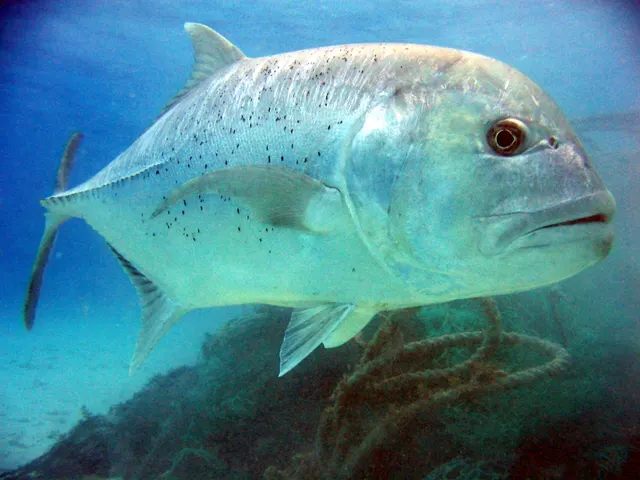 Giant trevallyA hugely powerful Indo-Pacific reef predator that hunts over shallow structure, and the fish popping was built around.
Dr. Dwayne Meadows, NOAA/NMFS/OPR — Public domain, via Wikimedia Commons
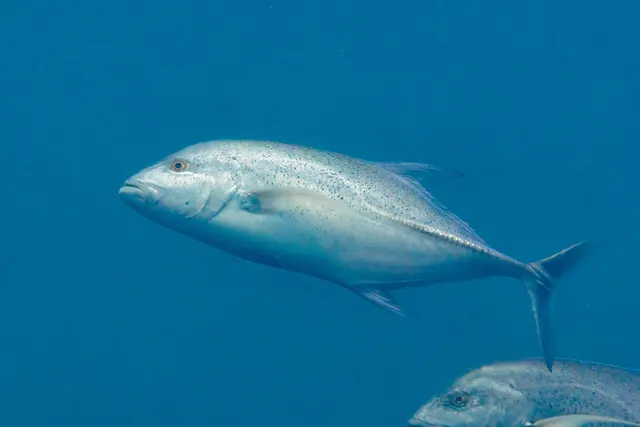 Bluefin trevallyA brilliantly marked reef trevally with electric blue fins that hunts cooperatively with other predators — including, remarkably, with octopus and moray eels.
Diego Delso — CC BY-SA 4.0, via Wikimedia Commons
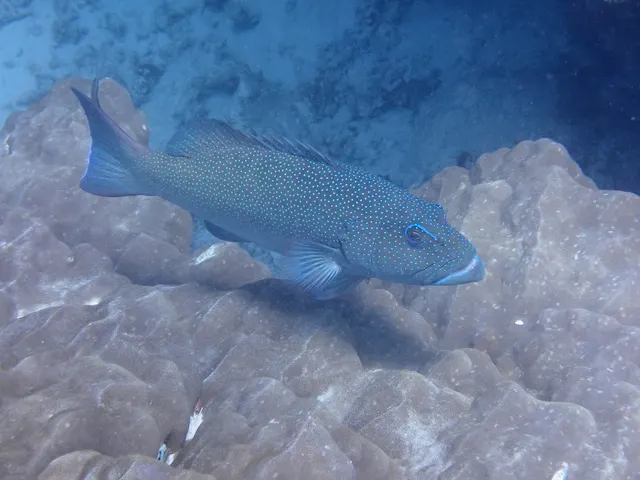 Coral troutA brilliant red-orange coral reef grouper marked with blue spots, known for cooperative hunting with moray eels, and a prime Great Barrier Reef target.
Donald Davesne — CC BY, via iNaturalist
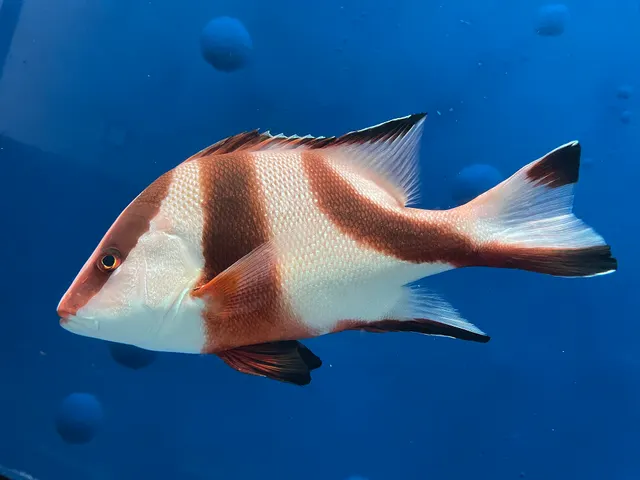 Red emperorA large deep-red Indo-Pacific snapper whose juveniles carry three bold dark bands that fade almost entirely with age.
Totti — CC BY-SA 4.0, via Wikimedia Commons
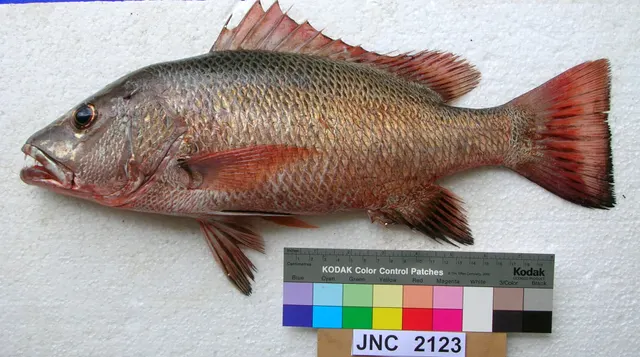 Mangrove jackA powerful red snapper of mangrove creeks and estuaries that moves to offshore reef as it matures, notorious for reaching structure the instant it is hooked.
Jean-Lou Justine — CC BY-SA 4.0, via Wikimedia Commons
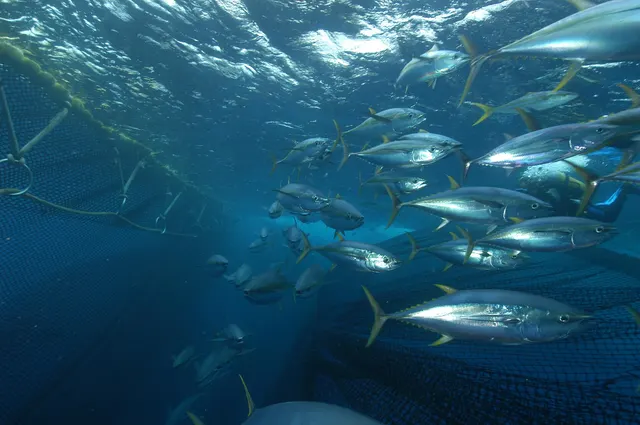 Yellowfin tunaA warm-blooded, high-speed oceanic predator that schools with dolphins and under floating debris, and one of the most commercially important fish in the world.
Marc Taquet — CC BY 4.0, via Wikimedia Commons
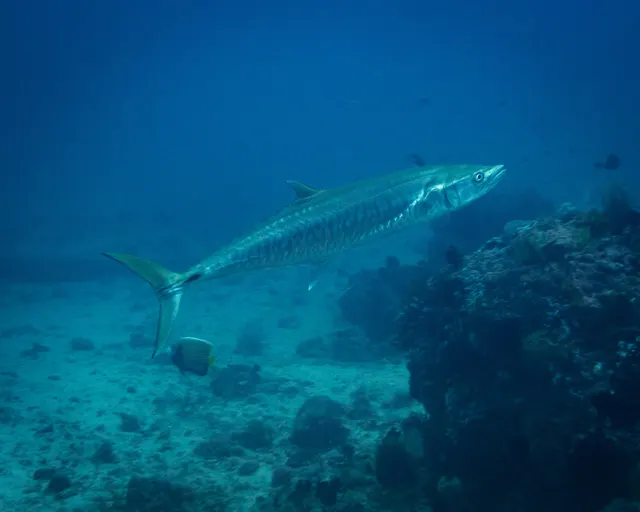 Narrow-barred Spanish mackerelA fast Indo-Pacific mackerel with vertical bars and shearing teeth that is a headline sport and food fish from South Africa to Australia — and a well-known ciguatera risk in parts of its range.
ppericard — CC BY 4.0, via Wikimedia Commons
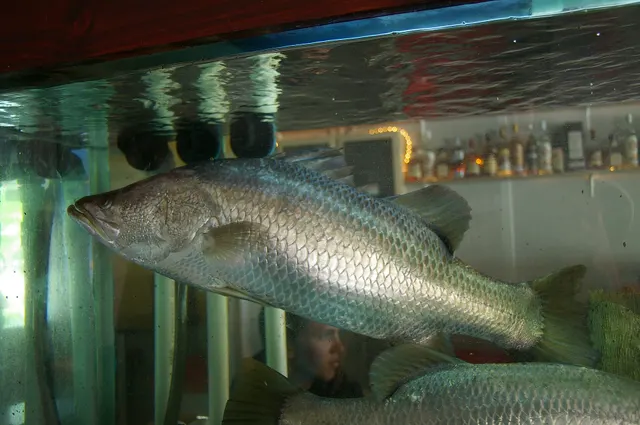 BarramundiAn estuarine ambush predator that begins life as a male and changes sex to female, so the largest fish are all breeding hens.
John Robert McPherson — CC0 1.0 Public Domain Dedication, via Wikimedia Commons
Safety
Barotrauma and pressure injury is set out at the top of this page, where it cannot be missed.
Venomous and spined species — Can cause serious injury or death
These reefs hold the richest hazardous fauna anywhere: stonefish and scorpionfish that are effectively invisible against reef and sand, lionfish, cone shells, sea snakes, stingrays on sand and seagrass, and seasonal box jellyfish in parts of the region. Almost every incident results from standing on, reaching into or handling something unseen.
What reduces it: Wear stiff-soled footwear on reef and shuffle on sand, never reach into a hole or under a ledge blind, do not pick up shells, and identify a fish before handling it. Know where medical help is and how long it takes to reach, because that distance is the real determinant of outcome here.
Worse when:
- Wading reef flats and seagrass, where stonefish and rays are hardest to see.
- Remote reefs, where evacuation to definitive care may take many hours.
- Night, and any time visibility is reduced.
Moving water and currents — Can cause serious injury or death
Flow through straits and reef passes in this region is strong, can change direction with the tide, and can carry a diver or a small boat away from the reef quickly. Down-currents on steep drop-offs are a documented hazard to divers.
What reduces it: Plan reef and pass work around slack water, carry a surface marker and a means of signalling, never dive or wade a pass alone, and treat a boat that cannot recover you promptly as an unacceptable plan rather than an inconvenience.
Sun, dehydration and fatigue — Can cause injury needing treatment
Equatorial sun on open water with no shade, high humidity and long boat days produce heat exhaustion and dehydration that degrade judgement well before they produce obvious symptoms. Distances between islands are large and days are long.
What reduces it: Cover up rather than relying on sunscreen, carry substantially more water than seems necessary, rig shade on small boats, and treat fatigue as a safety condition rather than a comfort one.
Further safety reading
- Breath-hold blackout — Compressor diving as practised in parts of the region has no training framework, no decompression management and no filtration, and its documented consequences include permanent injury and death.
- Sharks and spearfishing — Reef sharks are abundant and are principally a consideration for spearfishers carrying speared fish rather than for anglers.
- Sun, dehydration and fatigue — Equatorial sun on open water with no shade, over long boat days and large distances, produces heat exhaustion before it produces obvious symptoms.
- Venomous and spined fish — This region holds the richest hazardous reef fauna anywhere, and remoteness means the distance to definitive medical care determines the outcome more than the envenomation does.
Check the rules before you fish
Fishing laws, bylaws, access rules, seasons, bait restrictions and permitted methods vary by location and can change. Check the current rules from the relevant authority and the water you intend to fish before fishing.
Check with:
- Current national or regional law for where you are fishing
- Current local bylaws
- The relevant fisheries authority
- The landowner, club or fishery whose water it is
- Any restrictions specific to the species or the method you intend to use
Where to go next
What swims here
- BarramundiOccupies the estuarine and mangrove systems of the region's larger islands, moving between fresh and salt water.
- Blue threadfinWorks the turbid inshore and estuarine ground of the region, feeding over soft bottoms rather than on reef.
- Bluefin trevallyOccupies reef edges and passes throughout the region alongside its larger relative.
- Coral troutA high-value reef grouper of the region and one of the principal species of the live reef food fish trade.
- Giant trevallyA characteristic large reef predator across the region, and one of the species whose Indo-Pacific distribution radiates outward from this centre of diversity.
- Great barracudaAbundant on reef edges and drop-offs throughout the region.
- Longtail tunaA coastal tuna of the region's shelf and inshore waters, taken by both artisanal and recreational fisheries.
- Mangrove jackUses the region's extensive mangrove and estuarine nursery habitat as a juvenile before moving to reef as an adult.
3 more
- Narrow-barred Spanish mackerel Fish
- Red emperor Fish
- Yellowfin tuna Fish
How people fish here
- Blue-water spearfishingBlue-water hunting for pelagic species off the outer reefs and drop-offs is practised where the drop-off is close and the visibility high.
- HandliningSmall-boat handlining over reef and drop-off is the dominant fishing practice by effort across the entire region.
- Purse seiningIndustrial purse seining for tuna operates in the region's deep water and is one of the largest tuna fisheries in the world.
- SpearfishingBreath-hold reef spearfishing is a widespread and efficient food method here, both traditional and modern.
- Traps and potsReef traps are an old and continuing technology across the region, set on hard ground and worked from small boats.
How this compares
- CaribbeanTwo reef regions at opposite ends of the world with convergent structure and completely different faunas — the comparison is the clearest way to see which features of reef fishing are about the reef and which are about the fish.
- South-East Asian fishingThe Coral Triangle is the global centre of marine biodiversity, and the overview is where its relationship to the everyday artisanal fishery is set out.
Rules and access
- Customary, community and indigenous fishing rightsCommunity closure systems and locally managed marine areas are a principal management instrument across this region, alongside and sometimes ahead of state regulation.
- Method and bait restrictionsExplosive and cyanide fishing are prohibited across the whole region and remain an enforcement problem rather than a legal ambiguity.
- Taking crabs, lobsters, squid and shellfish: how the rules are structuredSea cucumber, giant clam and other invertebrates carry national controls and international listings, and for export-driven species the trade measure is frequently the effective one.
Environment and conservation
- Fish stocks and sustainabilitySpawning aggregations of high-value reef species are predictable in place and time, and that predictability is exactly what has allowed them to be removed across the region.
- Marine protected areas and spearfishingLocally managed marine areas and marine protected areas are the principal spatial instrument here, and the research on fish behaviour inside and outside protection comes substantially from these reefs.
- Selectivity and what it is used forA diver choosing an individual fish is the most selective method available here, which is also why spearfishing on an aggregation is so damaging when it happens.
Sources and evidence
- Reef Fish Spawning Aggregations: Biology, Research and Management — Springer, Fish & Fisheries Series vol. 35, 2012 (Scientific literature)Relied on for: Reef fish spawning aggregations, their predictability in space and time, and the vulnerability that predictability creates.States this directlyCitation checked — the work exists and is described correctly
- Fear of fishers: human predation explains behavioral changes in coral reef fishes — PLoS ONE 6(8): e22761, 2011 (Scientific literature)Relied on for: Behavioural change in coral reef fishes in response to fishing pressure, including flight-initiation distance inside and outside protected areas.States this directlyCitation checked — the work exists and is described correctly
- Good Fish Guide — Marine Conservation Society (Conservation authority)Relied on for: Assessment of fisheries and the management measures applied to them, including spatial protection and gear restriction.Background and mechanism onlyCitation checked — the work exists and is described correctly
- Code of Conduct for Responsible Fisheries — Food and Agriculture Organization of the United Nations, Rome, 1995 (Standards body)Relied on for: Principles for responsible fisheries management, precaution, and the treatment of small-scale and shared stocks.States this directlyCitation checked — the work exists and is described correctly
Why the 28 connections on this page are here, and the sources
What swims here
Backed by research — 11 connections
Supported by peer-reviewed research or fisheries science. The sources are listed and can be checked.
Barramundi
A distribution association between an animal and a kind of water, rather than a claim about any named mark.
- FAO Species Identification Guides for Fishery Purposes and the FAO Species Catalogues — Food and Agriculture Organization of the United Nations (Scientific institute)Relied on for: Distribution, habitat, depth and fishery accounts for the species in the FAO regional identification guides for the ocean area concerned.States this directlyCitation checked — the work exists and is described correctly
- FishBase: a global information system on fishes — Froese, R. and D. Pauly, eds. — FishBase Consortium (Scientific institute)Relied on for: Distribution, habitat association and depth range recorded for the species.States this directlyPassage read and verified
Blue threadfin
A distribution association between an animal and a kind of water, rather than a claim about any named mark.
- FAO Species Identification Guides for Fishery Purposes and the FAO Species Catalogues — Food and Agriculture Organization of the United Nations (Scientific institute)Relied on for: Distribution, habitat, depth and fishery accounts for the species in the FAO regional identification guides for the ocean area concerned.States this directlyCitation checked — the work exists and is described correctly
- FishBase: a global information system on fishes — Froese, R. and D. Pauly, eds. — FishBase Consortium (Scientific institute)Relied on for: Distribution, habitat association and depth range recorded for the species.States this directlyPassage read and verified
Bluefin trevally
A distribution association between an animal and a kind of water, rather than a claim about any named mark.
- FAO Species Identification Guides for Fishery Purposes and the FAO Species Catalogues — Food and Agriculture Organization of the United Nations (Scientific institute)Relied on for: Distribution, habitat, depth and fishery accounts for the species in the FAO regional identification guides for the ocean area concerned.States this directlyCitation checked — the work exists and is described correctly
- FishBase: a global information system on fishes — Froese, R. and D. Pauly, eds. — FishBase Consortium (Scientific institute)Relied on for: Distribution, habitat association and depth range recorded for the species.States this directlyPassage read and verified
Coral trout
A distribution association between an animal and a kind of water, rather than a claim about any named mark.
- FAO Species Identification Guides for Fishery Purposes and the FAO Species Catalogues — Food and Agriculture Organization of the United Nations (Scientific institute)Relied on for: Distribution, habitat, depth and fishery accounts for the species in the FAO regional identification guides for the ocean area concerned.States this directlyCitation checked — the work exists and is described correctly
- FishBase: a global information system on fishes — Froese, R. and D. Pauly, eds. — FishBase Consortium (Scientific institute)Relied on for: Distribution, habitat association and depth range recorded for the species.States this directlyPassage read and verified
Giant trevally
A distribution association between an animal and a kind of water, rather than a claim about any named mark.
- FAO Species Identification Guides for Fishery Purposes and the FAO Species Catalogues — Food and Agriculture Organization of the United Nations (Scientific institute)Relied on for: Distribution, habitat, depth and fishery accounts for the species in the FAO regional identification guides for the ocean area concerned.States this directlyCitation checked — the work exists and is described correctly
- FishBase: a global information system on fishes — Froese, R. and D. Pauly, eds. — FishBase Consortium (Scientific institute)Relied on for: Distribution, habitat association and depth range recorded for the species.States this directlyPassage read and verified
Great barracuda
A distribution association between an animal and a kind of water, rather than a claim about any named mark.
- FAO Species Identification Guides for Fishery Purposes and the FAO Species Catalogues — Food and Agriculture Organization of the United Nations (Scientific institute)Relied on for: Distribution, habitat, depth and fishery accounts for the species in the FAO regional identification guides for the ocean area concerned.States this directlyCitation checked — the work exists and is described correctly
- FishBase: a global information system on fishes — Froese, R. and D. Pauly, eds. — FishBase Consortium (Scientific institute)Relied on for: Distribution, habitat association and depth range recorded for the species.States this directlyPassage read and verified
Longtail tuna
A distribution association between an animal and a kind of water, rather than a claim about any named mark.
- FAO Species Identification Guides for Fishery Purposes and the FAO Species Catalogues — Food and Agriculture Organization of the United Nations (Scientific institute)Relied on for: Distribution, habitat, depth and fishery accounts for the species in the FAO regional identification guides for the ocean area concerned.States this directlyCitation checked — the work exists and is described correctly
- FishBase: a global information system on fishes — Froese, R. and D. Pauly, eds. — FishBase Consortium (Scientific institute)Relied on for: Distribution, habitat association and depth range recorded for the species.States this directlyPassage read and verified
Mangrove jack
A distribution association between an animal and a kind of water, rather than a claim about any named mark.
- FAO Species Identification Guides for Fishery Purposes and the FAO Species Catalogues — Food and Agriculture Organization of the United Nations (Scientific institute)Relied on for: Distribution, habitat, depth and fishery accounts for the species in the FAO regional identification guides for the ocean area concerned.States this directlyCitation checked — the work exists and is described correctly
- FishBase: a global information system on fishes — Froese, R. and D. Pauly, eds. — FishBase Consortium (Scientific institute)Relied on for: Distribution, habitat association and depth range recorded for the species.States this directlyPassage read and verified
Narrow-barred Spanish mackerel
A distribution association between an animal and a kind of water, rather than a claim about any named mark.
- FAO Species Identification Guides for Fishery Purposes and the FAO Species Catalogues — Food and Agriculture Organization of the United Nations (Scientific institute)Relied on for: Distribution, habitat, depth and fishery accounts for the species in the FAO regional identification guides for the ocean area concerned.States this directlyCitation checked — the work exists and is described correctly
- FishBase: a global information system on fishes — Froese, R. and D. Pauly, eds. — FishBase Consortium (Scientific institute)Relied on for: Distribution, habitat association and depth range recorded for the species.States this directlyPassage read and verified
Red emperor
A distribution association between an animal and a kind of water, rather than a claim about any named mark.
- FAO Species Identification Guides for Fishery Purposes and the FAO Species Catalogues — Food and Agriculture Organization of the United Nations (Scientific institute)Relied on for: Distribution, habitat, depth and fishery accounts for the species in the FAO regional identification guides for the ocean area concerned.States this directlyCitation checked — the work exists and is described correctly
- FishBase: a global information system on fishes — Froese, R. and D. Pauly, eds. — FishBase Consortium (Scientific institute)Relied on for: Distribution, habitat association and depth range recorded for the species.States this directlyPassage read and verified
Yellowfin tuna
A distribution association between an animal and a kind of water, rather than a claim about any named mark.
- FAO Species Identification Guides for Fishery Purposes and the FAO Species Catalogues — Food and Agriculture Organization of the United Nations (Scientific institute)Relied on for: Distribution, habitat, depth and fishery accounts for the species in the FAO regional identification guides for the ocean area concerned.States this directlyCitation checked — the work exists and is described correctly
- FishBase: a global information system on fishes — Froese, R. and D. Pauly, eds. — FishBase Consortium (Scientific institute)Relied on for: Distribution, habitat association and depth range recorded for the species.States this directlyPassage read and verified
How people fish here
What experienced anglers do — 5 connections
Widely and independently recommended by experienced anglers and specialist sources. This is real angling knowledge, not proof: controlled evidence for it is limited, and FishingHQ records it as convention rather than as a demonstrated effect.
Blue-water spearfishing
A discipline that is characteristic of the place rather than merely possible there, joined so a reader can move between the place and the practice.
- General angling website restatements of established technique — Various (Credible secondary source)Relied on for: Widely restated practice associating this discipline with this place, recorded as practitioner consensus rather than as tested fact.Background and mechanism onlyCitation checked — the work exists and is described correctly
- Fishers' Craft and Lettered Art: Tracts on Fishing from the End of the Middle Ages — University of Toronto Press, 1997 (Scientific literature)Relied on for: That fishing traditions develop around the water and fish available to them, and the historical method of reading such traditions.States this directlyCitation checked — the work exists and is described correctly
Handlining
A discipline that is characteristic of the place rather than merely possible there, joined so a reader can move between the place and the practice.
- General angling website restatements of established technique — Various (Credible secondary source)Relied on for: Widely restated practice associating this discipline with this place, recorded as practitioner consensus rather than as tested fact.Background and mechanism onlyCitation checked — the work exists and is described correctly
- Fishers' Craft and Lettered Art: Tracts on Fishing from the End of the Middle Ages — University of Toronto Press, 1997 (Scientific literature)Relied on for: That fishing traditions develop around the water and fish available to them, and the historical method of reading such traditions.States this directlyCitation checked — the work exists and is described correctly
Purse seining
A discipline that is characteristic of the place rather than merely possible there, joined so a reader can move between the place and the practice.
- General angling website restatements of established technique — Various (Credible secondary source)Relied on for: Widely restated practice associating this discipline with this place, recorded as practitioner consensus rather than as tested fact.Background and mechanism onlyCitation checked — the work exists and is described correctly
- Fishers' Craft and Lettered Art: Tracts on Fishing from the End of the Middle Ages — University of Toronto Press, 1997 (Scientific literature)Relied on for: That fishing traditions develop around the water and fish available to them, and the historical method of reading such traditions.States this directlyCitation checked — the work exists and is described correctly
Spearfishing
A discipline that is characteristic of the place rather than merely possible there, joined so a reader can move between the place and the practice.
- General angling website restatements of established technique — Various (Credible secondary source)Relied on for: Widely restated practice associating this discipline with this place, recorded as practitioner consensus rather than as tested fact.Background and mechanism onlyCitation checked — the work exists and is described correctly
- Fishers' Craft and Lettered Art: Tracts on Fishing from the End of the Middle Ages — University of Toronto Press, 1997 (Scientific literature)Relied on for: That fishing traditions develop around the water and fish available to them, and the historical method of reading such traditions.States this directlyCitation checked — the work exists and is described correctly
Traps and pots
A discipline that is characteristic of the place rather than merely possible there, joined so a reader can move between the place and the practice.
- General angling website restatements of established technique — Various (Credible secondary source)Relied on for: Widely restated practice associating this discipline with this place, recorded as practitioner consensus rather than as tested fact.Background and mechanism onlyCitation checked — the work exists and is described correctly
- Fishers' Craft and Lettered Art: Tracts on Fishing from the End of the Middle Ages — University of Toronto Press, 1997 (Scientific literature)Relied on for: That fishing traditions develop around the water and fish available to them, and the historical method of reading such traditions.States this directlyCitation checked — the work exists and is described correctly
How this compares
What experienced anglers do — 2 connections
Widely and independently recommended by experienced anglers and specialist sources. This is real angling knowledge, not proof: controlled evidence for it is limited, and FishingHQ records it as convention rather than as a demonstrated effect.
Caribbean
Two places or records a reader will hold together, joined where the comparison teaches something neither states alone.
- Sea Angler — Bauer Media (Specialist angling publication)Relied on for: Contemporary UK and European sea angling practice as reported by practitioners, including regional ground and species behaviour.States this directlyCitation checked — the work exists and is described correctly
- General angling website restatements of established technique — Various (Credible secondary source)Relied on for: Widely restated descriptions of regional angling practice, recorded as consensus rather than as scholarship.Background and mechanism onlyCitation checked — the work exists and is described correctly
South-East Asian fishing
A continental overview joined to a record it sits above, so that the synthesis and the detail are reachable from one another rather than duplicating each other.
- FAO fishing gear types and fishing technology information — Food and Agriculture Organization of the United Nations (Scientific institute)Relied on for: Classification and description of world fishing gears and the regions in which each is used.States this directlyCitation checked — the work exists and is described correctly
- General angling website restatements of established technique — Various (Credible secondary source)Relied on for: Widely restated descriptions of regional angling practice, recorded as consensus rather than as scholarship.Background and mechanism onlyCitation checked — the work exists and is described correctly
Safety reading
Official guidance — 4 connections
Stated by a fisheries authority, scientific institute or recognised angling body. Authoritative, but summarising rather than demonstrating.
Breath-hold blackout
A place is joined to the safety topic that explains a hazard genuinely characteristic of it, so the mechanism is reachable rather than restated as a weak warning.
- NOAA National Weather Service marine forecasts and marine weather services — National Oceanic and Atmospheric Administration, United States (Government fisheries body)Relied on for: Marine forecasting, tropical cyclone warning practice and the products issued for coastal and offshore waters.States this directlyCitation checked — the work exists and is described correctly
- NOAA Diving Manual: Diving for Science and Technology — National Oceanic and Atmospheric Administration, US Department of Commerce (Scientific institute)Relied on for: Diving and in-water hazards, including hazardous marine life, currents and the management of operations in remote locations.Background and mechanism onlyCitation checked — the work exists and is described correctly
Sharks and spearfishing
A place is joined to the safety topic that explains a hazard genuinely characteristic of it, so the mechanism is reachable rather than restated as a weak warning.
- NOAA National Weather Service marine forecasts and marine weather services — National Oceanic and Atmospheric Administration, United States (Government fisheries body)Relied on for: Marine forecasting, tropical cyclone warning practice and the products issued for coastal and offshore waters.States this directlyCitation checked — the work exists and is described correctly
- NOAA Diving Manual: Diving for Science and Technology — National Oceanic and Atmospheric Administration, US Department of Commerce (Scientific institute)Relied on for: Diving and in-water hazards, including hazardous marine life, currents and the management of operations in remote locations.Background and mechanism onlyCitation checked — the work exists and is described correctly
Sun, dehydration and fatigue
A place is joined to the safety topic that explains a hazard genuinely characteristic of it, so the mechanism is reachable rather than restated as a weak warning.
- NOAA National Weather Service marine forecasts and marine weather services — National Oceanic and Atmospheric Administration, United States (Government fisheries body)Relied on for: Marine forecasting, tropical cyclone warning practice and the products issued for coastal and offshore waters.States this directlyCitation checked — the work exists and is described correctly
- NOAA Diving Manual: Diving for Science and Technology — National Oceanic and Atmospheric Administration, US Department of Commerce (Scientific institute)Relied on for: Diving and in-water hazards, including hazardous marine life, currents and the management of operations in remote locations.Background and mechanism onlyCitation checked — the work exists and is described correctly
Venomous and spined fish
A place is joined to the safety topic that explains a hazard genuinely characteristic of it, so the mechanism is reachable rather than restated as a weak warning.
- NOAA National Weather Service marine forecasts and marine weather services — National Oceanic and Atmospheric Administration, United States (Government fisheries body)Relied on for: Marine forecasting, tropical cyclone warning practice and the products issued for coastal and offshore waters.States this directlyCitation checked — the work exists and is described correctly
- NOAA Diving Manual: Diving for Science and Technology — National Oceanic and Atmospheric Administration, US Department of Commerce (Scientific institute)Relied on for: Diving and in-water hazards, including hazardous marine life, currents and the management of operations in remote locations.Background and mechanism onlyCitation checked — the work exists and is described correctly
Rules and access
Official guidance — 3 connections
Stated by a fisheries authority, scientific institute or recognised angling body. Authoritative, but summarising rather than demonstrating.
Customary, community and indigenous fishing rights
A place joined to the regulatory concept whose structure it illustrates. The edge asserts that the concept applies here, never what any current arrangement requires.
- Words of the Lagoon: Fishing and Marine Lore in the Palau District of Micronesia — University of California Press, Berkeley, 1981 (Reference work)Relied on for: Customary marine tenure, traditional fishing rights, closed areas and local marine knowledge, and the way community-held rights operate in practice.States this directlyCitation checked — the work exists and is described correctly
- Code of Conduct for Responsible Fisheries — Food and Agriculture Organization of the United Nations, Rome, 1995 (Standards body)Relied on for: The international framework for responsible fisheries, including recognition of traditional and small-scale fishing rights.States this directlyCitation checked — the work exists and is described correctly
Method and bait restrictions
A place joined to the regulatory concept whose structure it illustrates. The edge asserts that the concept applies here, never what any current rule says.
- Code of Conduct for Responsible Fisheries — Food and Agriculture Organization of the United Nations, Rome, 1995 (Standards body)Relied on for: Principles for the management of fisheries, including licensing, closed seasons, size limits and the treatment of small-scale and shared stocks.States this directlyCitation checked — the work exists and is described correctly
- Good Fish Guide — Marine Conservation Society (Conservation authority)Relied on for: Assessment of fisheries and the management measures applied to them, including the instruments used and their purpose.Background and mechanism onlyCitation checked — the work exists and is described correctly
Taking crabs, lobsters, squid and shellfish: how the rules are structured
A place joined to the regulatory concept whose structure it illustrates. The edge asserts that the concept applies here, never what any current rule says.
- Code of Conduct for Responsible Fisheries — Food and Agriculture Organization of the United Nations, Rome, 1995 (Standards body)Relied on for: Principles for the management of fisheries, including licensing, closed seasons, size limits and the treatment of small-scale and shared stocks.States this directlyCitation checked — the work exists and is described correctly
- Good Fish Guide — Marine Conservation Society (Conservation authority)Relied on for: Assessment of fisheries and the management measures applied to them, including the instruments used and their purpose.Background and mechanism onlyCitation checked — the work exists and is described correctly
Environment and conservation
Backed by research — 3 connections
Supported by peer-reviewed research or fisheries science. The sources are listed and can be checked.
Fish stocks and sustainability
An environmental pressure that is specific to this place rather than general to fishing, joined so the issue is anchored to a real example.
- The IUCN Red List of Threatened Species — International Union for Conservation of Nature (Conservation authority)Relied on for: Assessment of the species and habitats affected, and the pressures acting on them, including habitat change and exploitation.States this directlyCitation checked — the work exists and is described correctly
- Code of Conduct for Responsible Fisheries — Food and Agriculture Organization of the United Nations, Rome, 1995 (Standards body)Relied on for: Principles for responsible fisheries management, precaution, gear selectivity and the treatment of shared and small-scale fisheries.Background and mechanism onlyCitation checked — the work exists and is described correctly
Marine protected areas and spearfishing
An environmental pressure that is specific to this place rather than general to fishing, joined so the issue is anchored to a real example.
- Reef Fish Spawning Aggregations: Biology, Research and Management — Springer, Fish & Fisheries Series vol. 35, 2012 (Scientific literature)Relied on for: The vulnerability of aggregating and site-attached species and the role of spatial protection in managing them.States this directlyCitation checked — the work exists and is described correctly
- Fear of fishers: human predation explains behavioral changes in coral reef fishes — PLoS ONE 6(8): e22761, 2011 (Scientific literature)Relied on for: Measured behavioural differences in reef fishes inside and outside protected areas, and what they indicate about protection.States this directlyCitation checked — the work exists and is described correctly
Selectivity and what it is used for
An environmental pressure that is specific to this place rather than general to fishing, joined so the issue is anchored to a real example.
- The IUCN Red List of Threatened Species — International Union for Conservation of Nature (Conservation authority)Relied on for: Assessment of the species and habitats affected, and the pressures acting on them, including habitat change and exploitation.States this directlyCitation checked — the work exists and is described correctly
- Code of Conduct for Responsible Fisheries — Food and Agriculture Organization of the United Nations, Rome, 1995 (Standards body)Relied on for: Principles for responsible fisheries management, precaution, gear selectivity and the treatment of shared and small-scale fisheries.Background and mechanism onlyCitation checked — the work exists and is described correctly
How FishingHQ labels evidence is explained in the evidence policy.