South-East Asian fishing
Fishing regions · Last reviewed 2026-08-14
The centre of the world's marine biodiversity and the largest inland fishery on earth, feeding hundreds of millions of people — and the region where the gap between a visiting angler's experience and the everyday reality of fishing is widest.
Safety: sun, dehydration and fatigue — can cause injury needing treatment. One more point applies here.
Being listed here is not permission to fish. What that meansClose
Access, fishing rights, seasons, licences, local bylaws and permitted methods vary and can change. Check current access, permission, local regulations, closures and restrictions before you travel or fish. FishingHQ describes what the ground is and names who holds the answer; it does not hold the answer itself.
Find the authority for a jurisdiction · What FishingHQ does and does not cover
South-East Asia holds two superlatives at once, and both are about food rather than sport.
THE CORAL TRIANGLE is the global centre of marine biodiversity: more coral species and more reef fish species than anywhere else on earth, concentrated across Indonesia, the Philippines, Malaysia, Papua New Guinea, Timor-Leste and the Solomon Islands. The reef fisheries here support tens of millions of people directly.
THE MEKONG is the world's largest inland fishery by catch, and one of the most biologically remarkable rivers anywhere. Its flood pulse reverses the flow of a major tributary annually — the Tonle Sap in Cambodia runs backwards for months each year, filling an enormous lake — and the fishery that produces feeds a very large population.
EVERYTHING ELSE FOLLOWS FROM SCALE AND FROM FOOD. This is the region where the disconnect between recreational angling and fishing-as-livelihood is widest. The overwhelming majority of fishing here is subsistence and artisanal, conducted with nets, traps, lines and small boats, by people for whom the catch is dinner and income. A sport fishery exists — for giant snakehead, mahseer, barramundi, giant trevally, sailfish and the great Mekong catfishes — but it sits within that reality.
THE PRESSURES ARE CORRESPONDINGLY SEVERE. Destructive fishing practices, though illegal almost everywhere, persist in places. Dam construction on the Mekong is altering the flood pulse the fishery depends on. Several of the world's largest freshwater fish live here and several are critically endangered. An honest account of this region has to hold the wonder and the loss together.
What fishing here is like
A region where fishing is first a food system feeding hundreds of millions and second a sport. Marine biodiversity at a global maximum on the reefs; the largest inland fishery in the world in the Mekong; and enormous pressure on both.
The recreational sector is genuine and locally significant — lodge fisheries for snakehead and mahseer, offshore game fishing, and a growing lure and fly scene — but a visitor who reads the region only through that lens will misunderstand almost everything they see.
What dominates
Net, trap, weir and handline fishing throughout, which is the everyday artisanal fishery and by far the largest activity. Lure and fly fishing for giant snakehead, hampala barb and jungle perch in the freshwater systems, usually from small boats with guides. Mahseer fishing in the northern hill rivers. Barramundi fishing in estuaries and impoundments. Offshore trolling and popping for giant trevally, sailfish, tuna and dogtooth tuna. Squid fishing at night from lit boats, which is both a commercial and a recreational activity. Reef gleaning and shellfish collection at low tide. Spearfishing on breath-hold, which is both traditional and modern here and which carries very serious risks where compressed air or improvised equipment is involved.
The water available
Coral reef at the world's highest diversity, from fringing reef to atoll and barrier systems. Extensive mangrove and estuarine systems, which are the nursery for a very large share of the coastal fishery. The Mekong and its tributaries, with a flood pulse that reverses a major tributary annually and fills a great lake. The Chao Phraya, Irrawaddy, Salween and Red River systems. Peat swamp forest and blackwater streams in Borneo, Sumatra and the peninsula. Hill rivers in the north. Enormous reservoir and impoundment systems built for power and irrigation. Deep water close inshore in the island archipelagos.
How the rules are structured
Regulation is national and varies very widely between the region's countries, and enforcement capacity varies as much again. Each of Indonesia, the Philippines, Malaysia, Thailand, Vietnam, Cambodia, Laos, Myanmar, Singapore, Brunei and Timor-Leste has its own fisheries administration. In several countries recreational fishing requires no licence in the sense a European reader expects, while access to specific waters is controlled by the owner, the community, the lodge or the reservoir authority. Community and customary arrangements over reef and inshore water are widespread and are frequently the operative permission. Protected areas, marine parks and locally managed marine areas cover substantial areas and carry their own rules. Several high-profile species are protected or subject to specific management, including some of the great Mekong fishes. Destructive practices are prohibited almost everywhere. Cross-border rules on the Mekong involve several countries and a regional commission. FishingHQ does not state what any current rule is: establish the position with the national authority and, for reef and inshore water, with the community or protected-area authority — and in practice through a licensed local operator.
Who to ask
- The national fisheries authority of the country concerned, which differ substantially across the region
- The community or customary rights holders over reef and inshore water, whose permission is frequently the operative one
- The managing body of any marine park, protected area or locally managed marine area
- The reservoir, dam or irrigation authority for impounded waters, which are frequently the accessible sport fisheries
- A licensed local operator, lodge or guide, who in practice holds current knowledge of what is permitted and where
Words you will meet
- Toman and haruan
- Giant snakehead and common snakehead in Malay usage. Snakeheads are the headline freshwater sport fish of the region and are air-breathers that can survive in water no other predator tolerates.
- Tonle Sap reversal
- The annual reversal of the Tonle Sap river in Cambodia, which runs backwards for months as the Mekong floods, filling a great lake. The single most important event in the region's inland fishery.
- Bagan and lift net
- Platform lift-net fisheries, frequently working at night under lights for squid and small pelagics. A characteristic sight across the archipelago and a substantial commercial method.
- Kelong
- An offshore stilted platform, historically a fish trap and now often a fishing and leisure structure. A distinctive feature of the Malay and Singaporean coasts.
Conditions and hazards
Heat, humidity, sun and dehydration are constant and are underestimated by visitors, particularly in a boat with no shade.
Insect-borne disease is a genuine travel-health matter across much of the region and is settled before departure rather than on arrival.
Medical facilities vary enormously and evacuation from remote reef or river locations can be very slow.
Marine hazards on the reef are the usual tropical set — stonefish, cone shells, lionfish, stingrays, coral cuts that infect fast — and ciguatera is present in parts of the region, which is local knowledge rather than a general rule.
Water quality in some rivers and near some urban areas is a real consideration for anybody intending to eat their catch.
Boat safety standards vary and buoyancy aids are not universally provided; a visitor should assume they must bring their own thinking about that.
Monsoon and typhoon seasons are defined and serious, and they differ between the region's coasts.
Reef, mangrove and the largest inland fishery in the world
THE CORAL TRIANGLE is the global centre of marine biodiversity — more coral and more reef fish species than anywhere else — spanning Indonesia, the Philippines, Malaysia, Papua New Guinea, Timor-Leste and the Solomons. Fringing reef, barrier reef and atoll, with deep water close inshore through much of the archipelago.
MANGROVE AND ESTUARY systems are the nursery for a very large share of the coastal fishery, and their loss is one of the region's most consequential environmental problems.
THE MEKONG is the world's largest inland fishery by catch. Its annual flood pulse is so large that it reverses the Tonle Sap in Cambodia, filling a great lake for months and creating the flooded habitat the fishery depends on.
PEAT SWAMP AND BLACKWATER systems in Borneo, Sumatra and the peninsula hold a distinct and specialised fish community.
AND THE IMPOUNDMENTS — enormous reservoirs built for power and irrigation — are where a good deal of the accessible sport fishing now happens.
Backed by research — why, and the sources (2)
Supported by peer-reviewed research or fisheries science. The sources are listed and can be checked.
- FishBase: a global information system on fishes — Froese, R. and D. Pauly, eds. — FishBase Consortium (Scientific institute)Relied on for: Distribution, habitat association, life history and diet recorded for the species concerned.States this directlyPassage read and verified
- The IUCN Red List of Threatened Species — International Union for Conservation of Nature (Conservation authority)Relied on for: Global extinction-risk assessment, population trend and identified threats for the species concerned.States this directlyCitation checked — the work exists and is described correctly
What lives here, and the flood that times the rivers
REEF AND COAST: an extraordinary diversity — groupers, snappers, emperors, trevally, wrasse, parrotfish — plus sailfish, tuna, dogtooth tuna and Spanish mackerel offshore, and barramundi and mangrove jack in the estuaries.
FRESH WATER: giant snakehead and its relatives, hampala barb, jungle perch, mahseer in the northern hill rivers, and the great Mekong fishes — giant catfish, giant barb and freshwater stingrays among the largest freshwater fish on earth, several of them critically endangered.
THE SEASONALITY IN THE RIVERS IS THE FLOOD PULSE, not temperature. Rising water disperses fish into flooded forest and floodplain to feed and breed; falling water concentrates them into channels and lakes, which is when both the fishery and the fishing are at their most productive. The Tonle Sap reversal is the largest expression of this anywhere.
ON THE COAST the monsoon seasons set what is fishable and when, and they differ between coasts of the same country.
Backed by research — why, and the sources (2)
Supported by peer-reviewed research or fisheries science. The sources are listed and can be checked.
- FishBase: a global information system on fishes — Froese, R. and D. Pauly, eds. — FishBase Consortium (Scientific institute)Relied on for: Distribution, habitat association, life history and diet recorded for the species concerned.States this directlyPassage read and verified
- The IUCN Red List of Threatened Species — International Union for Conservation of Nature (Conservation authority)Relied on for: Global extinction-risk assessment, population trend and identified threats for the species concerned.States this directlyCitation checked — the work exists and is described correctly
How it is fished, and what a visitor will mostly see
What a visitor will actually see is the artisanal fishery: nets, traps, weirs, handlines and small boats, worked by people for whom the catch is food and income. Lift-net platforms working at night under lights, stilted traps, cast nets, and long-line and gill-net operations from small craft.
THE SPORT FISHERY sits within that.
LURE AND FLY FISHING for giant snakehead in the peat swamps and reservoirs, which is the region's signature freshwater sport fishery and is usually guided.
MAHSEER FISHING in the northern hill rivers.
BARRAMUNDI in estuaries and impoundments.
OFFSHORE TROLLING AND POPPING for giant trevally, sailfish and tuna.
SQUID FISHING at night, both commercial and recreational.
REEF GLEANING at low tide, which feeds a great many households and is largely invisible in official statistics.
AND SPEARFISHING, which is traditional and modern here at once — and where improvised equipment and compressed-air use have produced a genuinely serious injury record that no visitor should imitate.
What experienced anglers do — why, and the sources (2)
Widely and independently recommended by experienced anglers and specialist sources. This is real angling knowledge, not proof: controlled evidence for it is limited, and FishingHQ records it as convention rather than as a demonstrated effect.
- FAO fishing gear types and fishing technology information — Food and Agriculture Organization of the United Nations (Scientific institute)Relied on for: Classification and description of world fishing gears and the regions in which each is used.States this directlyCitation checked — the work exists and is described correctly
- Words of the Lagoon: Fishing and Marine Lore in the Palau District of Micronesia — University of California Press, Berkeley, 1981 (Reference work)Relied on for: Systematic documentation of traditional fishing knowledge and customary marine management in island and coastal communities.Background and mechanism onlyCitation checked — the work exists and is described correctly
A food system under pressure, and what is being lost
This region is where the honest account is hardest and most necessary.
FISHING HERE IS FOOD. Tens of millions of people depend directly on these fisheries for protein and income, and the inland fishery of the Mekong basin alone is among the most important food systems on the planet. Recreational angling is a small activity beside it, and a visitor who does not understand that will misread everything from the gear to the attitude to catch and release.
THE PRESSURES ARE SEVERE AND DOCUMENTED. Destructive practices — blast fishing and the use of poisons — are illegal almost everywhere and persist in places, driven by poverty rather than by malice. Mangrove clearance has removed nursery habitat at scale. Overfishing of reef species, particularly for the live fish trade, has depleted spawning aggregations.
AND THE MEKONG DAMS are the largest single question. Hydropower construction on the mainstream and tributaries alters the flood pulse, blocks migration routes for species that move hundreds of kilometres to spawn, and traps the sediment that builds the delta. The fishery that feeds the basin depends on that pulse continuing. This is an active, contested and consequential situation rather than a settled one, and several of the great Mekong fishes are critically endangered while it plays out.
Official guidance — why, and the sources (2)
Stated by a fisheries authority, scientific institute or recognised angling body. Authoritative, but summarising rather than demonstrating.
- The IUCN Red List of Threatened Species — International Union for Conservation of Nature (Conservation authority)Relied on for: Global extinction-risk assessment, population trend and identified threats for the species concerned.States this directlyCitation checked — the work exists and is described correctly
- Code of Conduct for Responsible Fisheries — Food and Agriculture Organization of the United Nations, Rome, 1995 (Standards body)Relied on for: International principles for responsible fisheries, including small-scale and artisanal fisheries, and the role of national authorities.States this directlyCitation checked — the work exists and is described correctly
The words a visitor will meet
TOMAN and HARUAN are giant snakehead and common snakehead in Malay usage — the headline freshwater sport fish, and air-breathers that survive in water no other predator tolerates.
BAGAN and LIFT NET name the platform fisheries working at night under lights, which are a characteristic sight across the archipelago.
KELONG names the stilted offshore platform, historically a trap and now often a fishing and leisure structure.
THE TONLE SAP REVERSAL names the annual backward flow that fills Cambodia's great lake and is the single most important event in the inland fishery.
AND FISH NAMES VARY BY LANGUAGE AND BY ISLAND to a degree that makes cross-checking essential. The region spans many languages, the same species carries several names, and the same name is applied to different species in different places — which matters when a protected species is involved.
What experienced anglers do — why, and the sources (2)
Widely and independently recommended by experienced anglers and specialist sources. This is real angling knowledge, not proof: controlled evidence for it is limited, and FishingHQ records it as convention rather than as a demonstrated effect.
- FishBase: a global information system on fishes — Froese, R. and D. Pauly, eds. — FishBase Consortium (Scientific institute)Relied on for: Distribution, habitat association, life history and diet recorded for the species concerned.States this directlyPassage read and verified
- General angling website restatements of established technique — Various (Credible secondary source)Relied on for: Widely restated descriptions of regional angling practice, recorded as consensus rather than as scholarship.Background and mechanism onlyCitation checked — the work exists and is described correctly
Who governs it, and why the answer is usually local
Regulation is national and differs very widely across the region's countries, and enforcement capacity differs as much again.
IN SEVERAL COUNTRIES recreational fishing requires no licence in the sense a European reader expects, and access to specific waters is instead controlled by the owner, the community, the lodge or the reservoir authority. The absence of a licence requirement is not an absence of rules.
COMMUNITY AND CUSTOMARY ARRANGEMENTS over reef and inshore water are widespread, and permission from the people who hold that water is frequently the operative permission.
PROTECTED AREAS, MARINE PARKS AND LOCALLY MANAGED MARINE AREAS cover substantial areas with their own rules.
SPECIES PROTECTION applies to several high-profile fish, including some of the great Mekong species.
DESTRUCTIVE PRACTICES are prohibited almost everywhere, and a visitor who encounters them is looking at an offence rather than a local method.
THE MEKONG ITSELF involves several countries and a regional commission, which is a governance problem of a different order.
In practice, a visiting angler fishes through a licensed local operator, and that is both the practical and the responsible route. FishingHQ states no current rule.
Official guidance — why, and the sources (2)
Stated by a fisheries authority, scientific institute or recognised angling body. Authoritative, but summarising rather than demonstrating.
- Code of Conduct for Responsible Fisheries — Food and Agriculture Organization of the United Nations, Rome, 1995 (Standards body)Relied on for: International principles for responsible fisheries, including small-scale and artisanal fisheries, and the role of national authorities.States this directlyCitation checked — the work exists and is described correctly
- The IUCN Red List of Threatened Species — International Union for Conservation of Nature (Conservation authority)Relied on for: Global extinction-risk assessment, population trend and identified threats for the species concerned.States this directlyCitation checked — the work exists and is described correctly
Some of what lives here
Fish recorded here that FishingHQ holds a reviewed photograph of. It is not a complete list of what South-East Asian fishing holds, and it is not a prediction that you will catch any of them — it is a way in to the ones we can show you.
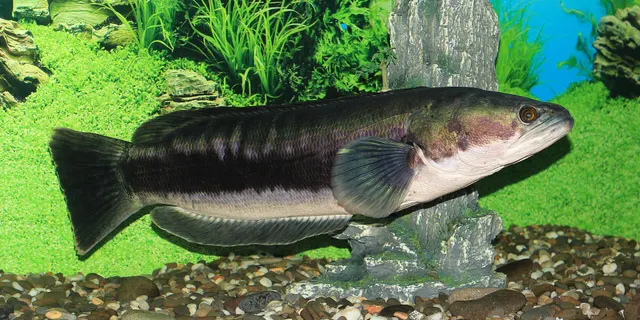 Giant snakeheadAn air-breathing Southeast Asian predator that guards its young in a shoal and defends them aggressively — the fish that made topwater lure fishing a South-East Asian sport.
George Chernilevsky — Public domain, via Wikimedia Commons
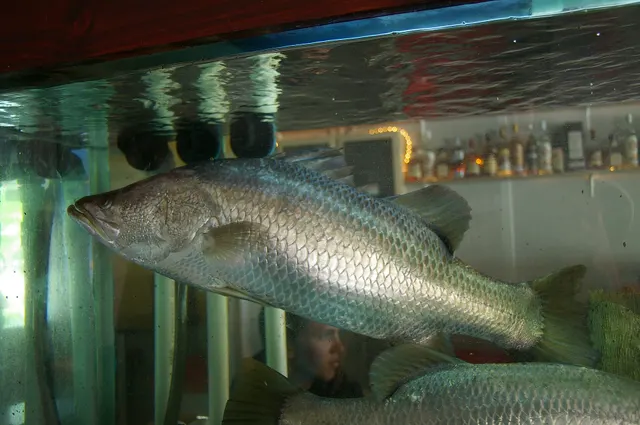 BarramundiAn estuarine ambush predator that begins life as a male and changes sex to female, so the largest fish are all breeding hens.
John Robert McPherson — CC0 1.0 Public Domain Dedication, via Wikimedia Commons
Safety
Sun, dehydration and fatigue — Can cause injury needing treatment
Equatorial sun, high humidity and long days on open water produce heat illness and severe sunburn quickly, and dehydration degrades judgement before obvious symptoms appear. Shade is frequently absent and medical help may be distant.
What reduces it: Cover up rather than relying on sunscreen, drink well beyond thirst, take shade through the middle of the day, and treat the day's schedule as adjustable.
Encounters with marine life — Can cause injury needing treatment
Tropical reefs here carry stonefish, cone shells, lionfish, stingrays and sea snakes, and coral cuts infect rapidly in the climate. Ciguatera — a biotoxin accumulating in some reef fish — is present in parts of the region and is not detectable by appearance, smell or cooking.
What reduces it: Wear reef footwear, look before placing hands and feet, shuffle when wading, clean every reef wound immediately and thoroughly, and take local advice on which species from which reefs are eaten locally.
Check the rules before you fish
Fishing laws, bylaws, access rules, seasons, bait restrictions and permitted methods vary by location and can change. Check the current rules from the relevant authority and the water you intend to fish before fishing.
Check with:
- Current national or regional law for where you are fishing
- Current local bylaws
- The relevant fisheries authority
- The landowner, club or fishery whose water it is
- Any restrictions specific to the species or the method you intend to use
Where to go next
What swims here
- BarramundiAn estuarine and impoundment fish across the region, and one that moves between fresh and salt water through its life.
- Giant snakeheadThe region's signature freshwater sport fish, an air-breather that survives in water no other large predator tolerates, which is why it dominates the peat swamp and reservoir fisheries.
How people fish here
How this compares
- The Coral TriangleThe Coral Triangle is the global centre of marine biodiversity, and the overview is where its relationship to the everyday artisanal fishery is set out.
- The Mekong systemThe Mekong is the largest inland fishery in the world and the clearest case of a food system dependent on a flood pulse that is now being altered.
Environment and conservation
Sources and evidence
- FishBase: a global information system on fishes — Froese, R. and D. Pauly, eds. — FishBase Consortium (Scientific institute)Relied on for: Distribution, habitat association, life history and diet recorded for the species concerned.States this directlyPassage read and verified
- The IUCN Red List of Threatened Species — International Union for Conservation of Nature (Conservation authority)Relied on for: Global extinction-risk assessment, population trend and identified threats for the species concerned.States this directlyCitation checked — the work exists and is described correctly
- Code of Conduct for Responsible Fisheries — Food and Agriculture Organization of the United Nations, Rome, 1995 (Standards body)Relied on for: International principles for responsible fisheries, including small-scale and artisanal fisheries, and the role of national authorities.States this directlyCitation checked — the work exists and is described correctly
Why the 6 connections on this page are here, and the sources
What swims here
Backed by research — 2 connections
Supported by peer-reviewed research or fisheries science. The sources are listed and can be checked.
Barramundi
A distributional claim taken from reference sources on the species rather than from angling report. It states presence and asserts nothing about a fishery.
- FishBase: a global information system on fishes — Froese, R. and D. Pauly, eds. — FishBase Consortium (Scientific institute)Relied on for: Distribution, habitat association, depth range and life history recorded for the species concerned.States this directlyPassage read and verified
- The IUCN Red List of Threatened Species — International Union for Conservation of Nature (Conservation authority)Relied on for: Global distribution, population trend and extinction-risk assessment for the species concerned.States this directlyCitation checked — the work exists and is described correctly
Giant snakehead
A distributional claim taken from reference sources on the species rather than from angling report. It states presence and asserts nothing about a fishery.
- FishBase: a global information system on fishes — Froese, R. and D. Pauly, eds. — FishBase Consortium (Scientific institute)Relied on for: Distribution, habitat association, depth range and life history recorded for the species concerned.States this directlyPassage read and verified
- The IUCN Red List of Threatened Species — International Union for Conservation of Nature (Conservation authority)Relied on for: Global distribution, population trend and extinction-risk assessment for the species concerned.States this directlyCitation checked — the work exists and is described correctly
How people fish here
What experienced anglers do — 1 connection
Widely and independently recommended by experienced anglers and specialist sources. This is real angling knowledge, not proof: controlled evidence for it is limited, and FishingHQ records it as convention rather than as a demonstrated effect.
Traditional net fishing
Which branch of fishing dominates a region is a statement about practice rather than about the place, and is recorded as convention.
- FAO fishing gear types and fishing technology information — Food and Agriculture Organization of the United Nations (Scientific institute)Relied on for: Classification and description of world fishing gears and the regions in which each is used.States this directlyCitation checked — the work exists and is described correctly
- General angling website restatements of established technique — Various (Credible secondary source)Relied on for: Widely restated descriptions of regional angling practice, recorded as consensus rather than as scholarship.Background and mechanism onlyCitation checked — the work exists and is described correctly
How this compares
What experienced anglers do — 2 connections
Widely and independently recommended by experienced anglers and specialist sources. This is real angling knowledge, not proof: controlled evidence for it is limited, and FishingHQ records it as convention rather than as a demonstrated effect.
The Coral Triangle
A continental overview joined to a record it sits above, so that the synthesis and the detail are reachable from one another rather than duplicating each other.
- FAO fishing gear types and fishing technology information — Food and Agriculture Organization of the United Nations (Scientific institute)Relied on for: Classification and description of world fishing gears and the regions in which each is used.States this directlyCitation checked — the work exists and is described correctly
- General angling website restatements of established technique — Various (Credible secondary source)Relied on for: Widely restated descriptions of regional angling practice, recorded as consensus rather than as scholarship.Background and mechanism onlyCitation checked — the work exists and is described correctly
The Mekong system
A continental overview joined to a record it sits above, so that the synthesis and the detail are reachable from one another rather than duplicating each other.
- FAO fishing gear types and fishing technology information — Food and Agriculture Organization of the United Nations (Scientific institute)Relied on for: Classification and description of world fishing gears and the regions in which each is used.States this directlyCitation checked — the work exists and is described correctly
- General angling website restatements of established technique — Various (Credible secondary source)Relied on for: Widely restated descriptions of regional angling practice, recorded as consensus rather than as scholarship.Background and mechanism onlyCitation checked — the work exists and is described correctly
Environment and conservation
Official guidance — 1 connection
Stated by a fisheries authority, scientific institute or recognised angling body. Authoritative, but summarising rather than demonstrating.
Fish stocks and sustainability
An environmental claim about a region, limited to what the cited fisheries and conservation bodies set out.
- Code of Conduct for Responsible Fisheries — Food and Agriculture Organization of the United Nations, Rome, 1995 (Standards body)Relied on for: International principles for responsible fisheries, including small-scale fisheries and the role of national authorities.States this directlyCitation checked — the work exists and is described correctly
- Good Fish Guide — Marine Conservation Society (Conservation authority)Relied on for: Synthesis of stock and gear information relating fishing methods to their effects on stocks and habitats.Background and mechanism onlyCitation checked — the work exists and is described correctly
How FishingHQ labels evidence is explained in the evidence policy.