Giant snakehead
Fish · Last reviewed 2026-08-10
An air-breathing Southeast Asian predator that guards its young in a shoal and defends them aggressively — the fish that made topwater lure fishing a South-East Asian sport.
Safety: biosecurity and disease transfer — can cause serious injury or death. 6 more points apply here.
How this was identified, and who took it
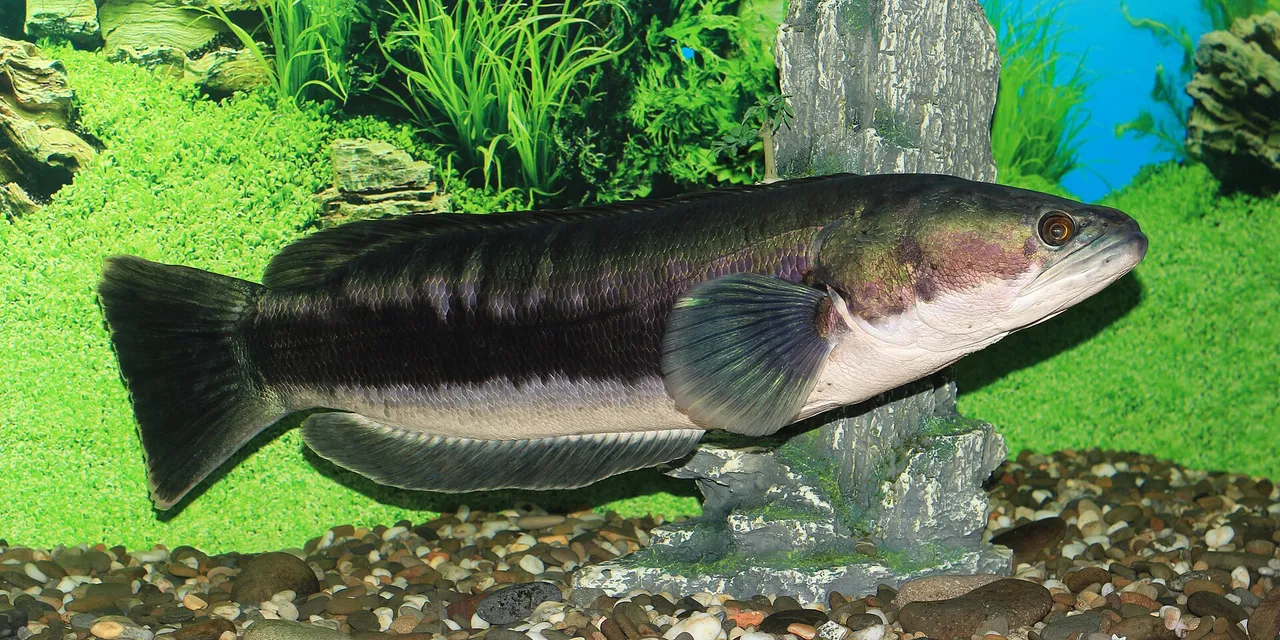
Identified by: Full lateral view. The cylindrical body, the very long-based dorsal and anal fins, the rounded tail and the snake-like head with forward-set dorsal eyes are all clear, as are the two dark lateral bands of an adult.George Chernilevsky — Public domain, via Wikimedia Commons — source, licence
Catching Giant snakehead
Everything here on fishing for it. Each entry opens the page behind it.
- Ground
The giant snakehead is the largest of the snakeheads and one of the most compelling freshwater sport fish in Asia. It reaches 130 centimetres and 20 kilograms, it hunts in shallow vegetated water, and it takes a surface lure with a strike that has to be seen.
Its defining biology is respiratory. Snakeheads are OBLIGATE AIR-BREATHERS — they must surface to breathe atmospheric air and will drown if prevented from doing so. That lets them live in warm, stagnant, deoxygenated swamps and canals where nothing else of that size can, and it produces the behaviour anglers exploit: a snakehead has to come up, so it gives its position away.
The other defining behaviour is parental. Snakeheads guard their fry, which move as a dense red-orange shoal at the surface with one or both parents beneath. The adults defend that shoal with real aggression, and a lure cast into it draws a response that is territorial rather than hungry. That is the basis of a large part of the fishery and it is also a genuine ethical question, since the fish being caught is a parent defending its brood.
FishBase rates its vulnerability at 90 out of 100 with low resilience and a minimum doubling time of 4.5 to 14 years, which is worth setting against its reputation as an aggressive invasive elsewhere.
Identification
- Scientific name
- Channa micropeltes
- Family
- Channidae
- Water
- Freshwater
- Conservation status
- Least Concern
- Regions
- South-East Asia
- Long cylindrical body with a broad flattened head and large scales on the head — the snake-like appearance the family is named for.
- Very long dorsal and anal fins running most of the body length, without spines.
- Adults dark blue-grey to black above with a pale belly; juveniles are bright orange-red with black stripes, which is the life stage most people see in numbers.
- Large mouth with prominent teeth and a protruding lower jaw.
- Separated from other Channa species by size, by the adult colouring and by the juvenile's distinctive orange-and-black pattern.
Size
- Typical
- 1–4 kg (2–9 lb)
- Large
- 6–10 kg (13–22 lb)
Exceptional: Over 15 kg (33 lb); maximum published weight 20 kg
Guarded fry in a floating nest, and parents that attack
Giant snakehead reproduction involves the most conspicuous parental care of any fish on FishingHQ, and it is the basis of both the fishery and the species' resilience.
THE PAIR BUILDS A NEST at the surface in vegetation, clearing a circular opening in floating and emergent plants, and eggs float within it.
BOTH PARENTS GUARD, and they guard aggressively. Adults attack anything approaching the fry, including animals far larger than themselves, and attacks on people wading near a nest are documented. That behaviour is not incidental — it is the species' reproductive strategy.
THE FRY FORM A DENSE ORANGE-RED BALL at the surface, moving as a unit with the parents beneath and beside them. The ball is visible at distance and is the single most reliable way of locating spawning fish.
WHICH IS ALSO THE FISHERY. Casting to a fry ball provokes an immediate attack from the guarding parents, and this is how giant snakehead are commonly targeted. It is effective precisely because it exploits parental defence, and taking both parents leaves the entire brood to be eaten within hours — a consequence worth stating plainly rather than leaving implied.
SPAWNING FOLLOWS THE WARM SEASON AND RISING WATER, and multiple broods a year are possible in warm productive systems.
AND AIR BREATHING UNDERPINS ALL OF IT. Because the adults and fry can breathe air, the nest can be in warm, still, deoxygenated water that would kill most other species' eggs — which is why snakeheads occupy floodplain habitat nothing else can use.
Backed by research — why, and the sources (2)
Supported by peer-reviewed research or fisheries science. The sources are listed and can be checked.
- FishBase: a global information system on fishes — Froese, R. and D. Pauly, eds. — FishBase Consortium (Scientific institute)Relied on for: Distribution, habitat association, depth range, size, reproduction and life-history parameters recorded for the species.States this directlyPassage read and verified
- The IUCN Red List of Threatened Species — International Union for Conservation of Nature (Conservation authority)Relied on for: Assessment and range account for the species, including the habitats it depends on, its life history and the pressures acting on it.States this directlyCitation checked — the work exists and is described correctly
A season set by the rains and by the fry balls
Giant snakehead seasonality in tropical systems is driven by water level and temperature rather than by a thermal winter.
THE RAINS AND THE RISING WATER START THE CYCLE. Warm, rising water triggers spawning, and the breeding season follows the wet season in most of the range, with multiple broods possible where conditions allow.
THE FRY-BALL PERIOD IS THE VISIBLE SEASON. For weeks after each spawning, guarded fry balls are present at the surface in vegetated margins, and this is when adults are most locatable and most aggressive.
FALLING WATER CONCENTRATES FISH into remaining pools, channels and lakes as floodplain habitat drains, which increases density and encounter rates.
DRY-SEASON POOLS ARE THE REFUGE, and air breathing allows snakeheads to survive in water that would be lethal to most fish — which is why they persist through droughts that empty a system of other species.
TEMPERATURE MATTERS AT THE COOLER MARGINS of the range and in impoundments at altitude, where activity falls in the cool season.
AND IN INTRODUCED RANGES THE SEASONALITY TRAVELS WITH THE FISH, which is part of the invasive concern: a species that breeds repeatedly, guards its young and tolerates deoxygenated water establishes quickly where it is released.
Backed by research — why, and the sources (2)
Supported by peer-reviewed research or fisheries science. The sources are listed and can be checked.
- FishBase: a global information system on fishes — Froese, R. and D. Pauly, eds. — FishBase Consortium (Scientific institute)Relied on for: Distribution, habitat association, depth range, size, reproduction and life-history parameters recorded for the species.States this directlyPassage read and verified
- The IUCN Red List of Threatened Species — International Union for Conservation of Nature (Conservation authority)Relied on for: Assessment and range account for the species, including the habitats it depends on, its life history and the pressures acting on it.States this directlyCitation checked — the work exists and is described correctly
An air-breather that keeps fighting on the bank, and guards its young
Giant snakehead handling combines an aggressive fish, a set of real teeth, and a legal situation that in many places overrides everything else.
THE FISH IS ARMED AND WILLING. A large mouth with numerous sharp conical teeth in strong jaws, and a temperament that does not become passive on landing. Snakeheads bite deliberately. Never lip one, never put a hand in the mouth, control the head from behind with a gloved grip or a wet cloth, and use long pliers.
IT DOES NOT RUN OUT OF AIR. Snakeheads breathe atmospheric air through a suprabranchial organ and survive out of water for extended periods. A fish laid on the bank stays fully capable and mobile, and it will move. That is unlike almost any other predator an angler handles.
THE PARENTAL BEHAVIOUR IS WORTH KNOWING because it explains the fishing and creates an ethical question: adults guard a mass of fry aggressively and are readily provoked into striking a lure worked near them. Fish caught that way are guarding parents, and removing them leaves the brood undefended.
AND THE LEGAL POSITION IS FREQUENTLY DECISIVE. Snakeheads are among the most tightly regulated invasive fish in the world outside their native range: in many jurisdictions live possession or return to the water is prohibited outright, and the required action is to kill the fish and report it. In their native range they are an ordinary and valued food fish. There is no single correct answer, and an angler must establish which situation they are in before fishing.
Official guidance — why, and the sources (1)
Stated by a fisheries authority, scientific institute or recognised angling body. Authoritative, but summarising rather than demonstrating.
- Check Clean Dry — biosecurity guidance for water users — GB Non-native Species Secretariat (Conservation authority)Relied on for: Regulatory approach to high-risk invasive freshwater fish, including prohibitions on live possession and return to the water.Background and mechanism onlyPassage read and verified
A fish that breathes air, and therefore lives where fish are not supposed to
Giant snakehead habitat is defined by a physiological capability rather than by a preference, and once that is understood the distribution stops looking strange.
THE FISH BREATHES ATMOSPHERIC AIR. Snakeheads possess a suprabranchial chamber — an accessory respiratory organ above the gills — and they surface to gulp air, obligately in the adult. That single adaptation removes dissolved oxygen from the list of things that constrain them, and dissolved oxygen is the constraint that excludes most fish from most warm shallow water.
SO THE HABITAT IS WATER THAT WOULD SUFFOCATE A COMPETITOR. Stagnant swamps, weed-choked ponds, flooded rice paddies, oxbows, drainage canals, slow turbid rivers and reservoir margins across tropical Asia. Warm, shallow, vegetated, poorly oxygenated water is not tolerated by this animal; it is preferred, because nothing else can hold it and the snakehead is left as the dominant predator.
VEGETATION IS THE STRUCTURAL REQUIREMENT. Snakeheads are ambush predators that hold in dense submerged and emergent plants and strike over a short distance, and they use the same cover to guard young. Open water with no vegetation supports them poorly.
THEY CAN SURVIVE OUT OF WATER FOR PERIODS, and in some conditions move short distances over damp ground, which means a pond that dries partially does not necessarily lose its snakeheads and isolated waters are not as isolated as they look. This is also why they are so consequential as an introduced species and why the movement of live fish is restricted in many jurisdictions.
TEMPERATURE IS THE ACTUAL LIMIT. Giant snakehead are tropical and are killed by cold, which is what confines them; the northern edge of any introduced population is a winter temperature line rather than a habitat one.
AND PARENTAL CARE MAKES THE HABITAT ACCOUNT A DENSITY ACCOUNT. Adults guard a nest and then a dense shoal of fry in vegetated shallows, which produces very high survival and allows a small water to hold a substantial population. Whether the species may be caught, kept, moved or returned differs sharply by jurisdiction and is a matter for the competent authority.
Backed by research — why, and the sources (2)
Supported by peer-reviewed research or fisheries science. The sources are listed and can be checked.
- FishBase: a global information system on fishes — Froese, R. and D. Pauly, eds. — FishBase Consortium (Scientific institute)Relied on for: Habitat association, depth range, salinity tolerance, temperature range, spawning season and reproductive mode recorded for the species.States this directlyPassage read and verified
- The IUCN Red List of Threatened Species — International Union for Conservation of Nature (Conservation authority)Relied on for: Assessment and life-history account, including the habitats the species depends on and the pressures on them.Background and mechanism onlyCitation checked — the work exists and is described correctly
Lifecycle and reproduction
Spawns in small streams with dense vegetation. Juveniles form dense shoals guarded by the adults, and the bright orange-red juvenile colouring makes those shoals highly visible at the surface. Growth is fast. FishBase rates the species' vulnerability at 90 out of 100 with low resilience and a minimum population doubling time of 4.5 to 14 years — figures that sit oddly beside its reputation as a resilient invader elsewhere, and are worth stating for that reason.
Spawns in vegetated shallow water, with both parents guarding the resulting fry shoal. The guarding behaviour is prolonged and aggressive, and it is the behaviour the recreational fishery most often targets — which raises a welfare and conservation question that FishingHQ records rather than resolves, since removing a guarding parent exposes the whole brood.
Feeding and senses
Primarily piscivorous, taking fish and some crustaceans. Hunts in shallow vegetated water by ambush, striking upward at prey near or on the surface. The upward strike is why surface lures are so effective and why the takes are so visible — the fish is doing at a lure exactly what it does to prey.
Adapted to turbid, warm, low-oxygen water where sight is limited. Snakeheads detect surface disturbance acutely, which is the basis of frog and popper fishing for them, and they hunt effectively in water where a visual predator could not operate. The obligate air-breathing means they also give their position away by surfacing, which no other behaviour compensates for.
Through the year
Governed by the monsoon and by water temperature rather than a temperate seasonal cycle. Spawning and fry-guarding are concentrated in the warmer, wetter part of the year, which is also when surface fishing is most productive. Flooded and receding water levels move fish between swamp, canal and main channel. Describing this year by month would be misleading; the monsoon is the organising variable.
Distribution
Asia: the Mekong and Chao Phraya basins, the Malay Peninsula, and the islands of Sumatra and Borneo. Occurs in lowland rivers and swamps with standing or slowly flowing water, and in large streams, canals and deeper water bodies.
This is a biological range — where the species occurs, not a prediction that you will catch one. To browse the fishing geography FishingHQ holds, start at fishing places.
Why anglers care
A principal freshwater sport fish across Thailand, Malaysia, Indonesia and Cambodia, fished with surface frogs, poppers and soft plastics in shallow vegetated water. Also an important food and aquaculture species. Introduced populations exist outside the native range, where the species is treated as a serious invasive and where the management position is the opposite of the one that applies at home.
Handling and returning
Teeth are sharp and the jaws are strong; keep fingers clear of the mouth entirely and use long pliers or a de-hooking tool. Support the body horizontally. Because these fish tolerate air far better than most — they breathe it — the temptation to keep them out of the water for photographs is stronger and should be resisted anyway, since the rest of the stress response is unchanged. Where a guarding parent has been caught, returning it promptly matters more than usual.
Safety
Biosecurity and disease transfer — Can cause serious injury or death
Giant snakeheads introduced outside their native range are effective predators that establish readily, and air-breathing lets them survive transport and short overland movement in a way most fish cannot.
What reduces it: Never move live fish or water between waters. Clean, drain, dry and check equipment. Where the species is non-native, establish the local requirement rather than assuming a fish should be returned.
Species that bite — Can cause injury needing treatment
Sharp teeth and strong jaws on a powerful fish that thrashes when handled. Guarding adults are also genuinely aggressive and have been recorded striking at people who approach a fry shoal in the water.
What reduces it: Never put a hand near the mouth. Use long pliers or a de-hooking tool with the fish controlled. Do not wade into a fry shoal.
Precautions that always apply here
- Keep fingers out of the gills and clear of the teeth. Gill damage is usually fatal to the fish, and several species will remove skin from a finger.
- Wet your hands before touching a fish. Dry hands strip the protective mucus layer that keeps infection out.
- Support the fish's weight along its body, keep it out of the water for as short a time as possible, and hold it over something soft.
- Never move live fish, live bait or water from one water to another.
- Check, clean and dry your kit between different waters — the published guidance is 48 hours’ drying, in sunlight where possible, because a number of invasive species survive over two weeks in damp conditions. Nets, boots and wet mats move invasive species and disease more effectively than anything else anglers do.
Check the rules before you fish
Fishing laws, bylaws, access rules, seasons, bait restrictions and permitted methods vary by location and can change. Check the current rules from the relevant authority and the water you intend to fish before fishing.
Check with:
- Current national or regional law for where you are fishing
- Current local bylaws
- The relevant fisheries authority
- The landowner, club or fishery whose water it is
- Any restrictions specific to the species or the method you intend to use
Where to go next
Similar and related fish
Where it lives
Where you will find it
- South-East Asian fishingThe region's signature freshwater sport fish, an air-breather that survives in water no other large predator tolerates, which is why it dominates the peat swamp and reservoir fisheries.
- ThailandA native freshwater predator of rivers, reservoirs and irrigation systems, and the fish that makes Thai freshwater lure fishing a wild fishery rather than a stocked one.
- The Mekong systemA large air-breathing floodplain predator of the basin, tolerant of the warm deoxygenated water that a draining flood leaves behind.
Told apart from
Environment and conservation
Sources and evidence
- FishBase: a global information system on fishes — Froese, R. and D. Pauly, eds. — FishBase Consortium (Scientific institute)Relied on for: Scientific name, family placement in the Channidae, maximum length of 130 cm standard length and maximum published weight of 20 kg, Asian distribution across the Mekong and Chao Phraya basins, the Malay Peninsula and the islands of Sumatra and Borneo, habitat in lowland rivers and swamps with standing or slowly flowing water including large streams, canals and deep water bodies.States this directlyPassage read and verified
- FishBase: a global information system on fishes — Froese, R. and D. Pauly, eds. — FishBase Consortium (Scientific institute)Relied on for: The IUCN Red List category for Channa micropeltes — Least Concern, assessed 3 December 2019 — as republished by FishBase.States this directlyPassage read and verified
- Check Clean Dry — biosecurity guidance for water users — GB Non-native Species Secretariat (Conservation authority)Relied on for: The framework by which introduced predatory fish are assessed and managed, and live movement as the transmission route.FishingHQ's interpretation of what it saysPassage read and verified
Why the 8 connections on this page are here, and the sources
Similar and related fish
Backed by research — 1 connection
Supported by peer-reviewed research or fisheries science. The sources are listed and can be checked.
Great snakehead
An identification comparison naming both binomials: Channa marulius and Channa micropeltes.
- FishBase: a global information system on fishes — Froese, R. and D. Pauly, eds. — FishBase Consortium (Scientific institute)Relied on for: Morphological and distributional data for Channa marulius and for Channa micropeltes.States this directlyPassage read and verified
- The IUCN Red List of Threatened Species — International Union for Conservation of Nature (Conservation authority)Relied on for: Separate assessments treating Channa marulius and Channa micropeltes as distinct species.States this directlyCitation checked — the work exists and is described correctly
How it is caught
What experienced anglers do — 1 connection
Widely and independently recommended by experienced anglers and specialist sources. This is real angling knowledge, not proof: controlled evidence for it is limited, and FishingHQ records it as convention rather than as a demonstrated effect.
Spinning
A practitioner claim consistent with the species' verified feeding behaviour.
- General angling website restatements of established technique — Various (Credible secondary source)Relied on for: Widely restated practitioner accounts of surface lure fishing for snakeheads in South-East Asia.Citation checked — the work exists and is described correctly
- Angling Times — Bauer Media (Specialist angling publication)Relied on for: Contemporary treatment of surface lure fishing technique.Citation checked — the work exists and is described correctly
Where it lives
Backed by research — 1 connection
Supported by peer-reviewed research or fisheries science. The sources are listed and can be checked.
Lowland rivers
A habitat and physiology claim held to a scientific standard.
- FishBase: a global information system on fishes — Froese, R. and D. Pauly, eds. — FishBase Consortium (Scientific institute)Relied on for: That Channa micropeltes occurs in lowland rivers and swamps with standing or slowly flowing water including large streams, canals and deep water bodies, and is an obligate air-breather.States this directlyPassage read and verified
Where you will find it
Backed by research — 3 connections
Supported by peer-reviewed research or fisheries science. The sources are listed and can be checked.
South-East Asian fishing
A distributional claim taken from reference sources on the species rather than from angling report. It states presence and asserts nothing about a fishery.
- FishBase: a global information system on fishes — Froese, R. and D. Pauly, eds. — FishBase Consortium (Scientific institute)Relied on for: Distribution, habitat association, depth range and life history recorded for the species concerned.States this directlyPassage read and verified
- The IUCN Red List of Threatened Species — International Union for Conservation of Nature (Conservation authority)Relied on for: Global distribution, population trend and extinction-risk assessment for the species concerned.States this directlyCitation checked — the work exists and is described correctly
Thailand
That a species occurs in these waters, drawn from distribution science. It is a statement about where the animal lives and is not a statement that anybody will catch one, still less where.
- FishBase: a global information system on fishes — Froese, R. and D. Pauly, eds. — FishBase Consortium (Scientific institute)Relied on for: Recorded distribution, habitat association and life history of the freshwater species named, including introduced populations where those are recorded.States this directlyPassage read and verified
- The Flood Pulse Concept in River-Floodplain Systems — Canadian Special Publication of Fisheries and Aquatic Sciences 106, Department of Fisheries and Oceans, Ottawa, 1989 (Scientific literature)Relied on for: That in tropical river-floodplain systems the seasonal flood pulse organises fish movement and production, which is the basis for stating where and when a species is available.Background and mechanism onlyCitation checked — the work exists and is described correctly
The Mekong system
A distribution association between an animal and a kind of water, rather than a claim about any named mark.
- The IUCN Red List of Threatened Species — International Union for Conservation of Nature (Conservation authority)Relied on for: Assessment and habitat account for the species, including the river or lake system it occupies and the pressures acting on it.States this directlyCitation checked — the work exists and is described correctly
- FishBase: a global information system on fishes — Froese, R. and D. Pauly, eds. — FishBase Consortium (Scientific institute)Relied on for: Distribution, habitat association, size and life history recorded for the species in the system concerned.States this directlyPassage read and verified
Told apart from
Backed by research — 1 connection
Supported by peer-reviewed research or fisheries science. The sources are listed and can be checked.
Atlantic tarpon
A physiological comparison naming both binomials, and one that explains a shared distribution pattern rather than noting a coincidence.
- FishBase: a global information system on fishes — Froese, R. and D. Pauly, eds. — FishBase Consortium (Scientific institute)Relied on for: That Channa micropeltes is an obligate air-breather of standing or slowly flowing lowland water, and that the swim bladder of Megalops atlanticus attaches to the oesophagus and can be filled directly with air, permitting the fish to live in oxygen-poor waters.States this directlyPassage read and verified
Environment and conservation
Official guidance — 1 connection
Stated by a fisheries authority, scientific institute or recognised angling body. Authoritative, but summarising rather than demonstrating.
Invasive species and biosecurity
An introduction-pathway claim resting on the verified physiology plus the biosecurity framework.
- FishBase: a global information system on fishes — Froese, R. and D. Pauly, eds. — FishBase Consortium (Scientific institute)Relied on for: That Channa micropeltes is an obligate air-breather.States this directlyPassage read and verified
- Check Clean Dry — biosecurity guidance for water users — GB Non-native Species Secretariat (Conservation authority)Relied on for: That the movement of live fish is a principal pathway for the introduction and spread of non-native aquatic species.States this directlyPassage read and verified
How FishingHQ labels evidence is explained in the evidence policy.