Lowland rivers
Habitat · Last reviewed 2026-08-10
Slower, deeper, often coloured rain-fed rivers with mixed beds — the classic coarse fishing rivers, and the ones most shaped by what happens upstream.
- Water
- Freshwater
A lowland river is what most rivers become by the time they reach flat ground: slower, deeper, wider, carrying silt as well as gravel, and responding sharply to rainfall in its catchment.
That responsiveness is the defining characteristic for an angler. Unlike a chalk stream, a lowland river rises and falls, colours up and clears, and moves food around according to what the weather has been doing upstream — sometimes many kilometres away and a day or two earlier. Reading a river's state and trend is more important than almost anything else about fishing one.
The habitat is structurally varied in a way stillwaters are not. Gravel runs, slack eddies, undercut banks, streamer weed, creases where fast and slow water meet, and the deep water on the outside of a bend are all distinct places supporting distinct species and behaviours. Almost all river craft is about reading those features.
What characterises it
Rain-fed rivers on gentle gradients, with mixed beds of gravel, sand and silt and a channel that varies substantially along its length. Flow is unstable: levels and colour respond to rainfall in the catchment, sometimes with a considerable lag. Channel features — pools, riffles, glides, creases, undercut banks, weed beds — create a mosaic of conditions within a very short distance, and it is that variation rather than the average condition that determines where fish are.
What lives there
Species distribution follows flow and substrate: barbel and chub over clean gravel in faster water, roach and bream in slower deeper glides, pike and perch around slacks and structure. Invertebrate communities are dominated by caddis, mayfly nymphs, freshwater shrimp and — in siltier reaches — bloodworm. The whole system is longitudinally connected, so a change in one part of a catchment propagates downstream; siltation from agricultural run-off is the pressure that most directly affects the gravel-spawning species.
Through the year
Winter rain brings high, coloured, cold water, which concentrates fish in slacks and slower margins. Spring brings falling levels and spawning. Summer brings low, clear, warm water, which pushes feeding into darkness and makes fish exceptionally wary — and which is when warm-water welfare risks are highest for species like barbel. Autumn rain, bringing a rise and a colour to a low river, is traditionally the most productive condition of the year, because it dislodges food and reduces the fish's caution simultaneously.
Some of what lives here
Fish recorded here that FishingHQ holds a reviewed photograph of. It is not a complete list of what Lowland rivers holds, and it is not a prediction that you will catch any of them — it is a way in to the ones we can show you.
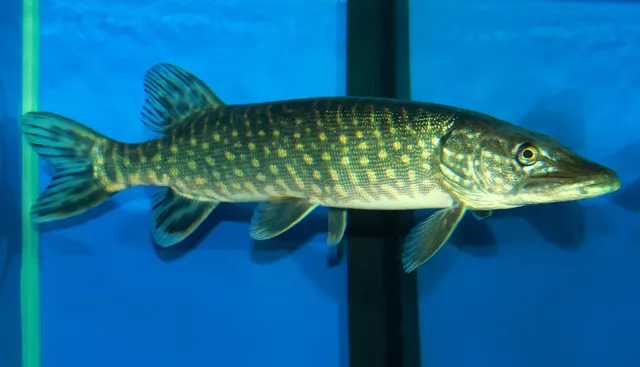 Northern pikeThe dominant freshwater ambush predator of the northern hemisphere: long, cryptic, and built for one violent acceleration rather than pursuit.
Photo: Karelj, via Wikimedia Commons, public domain; resized and trimmed to fit
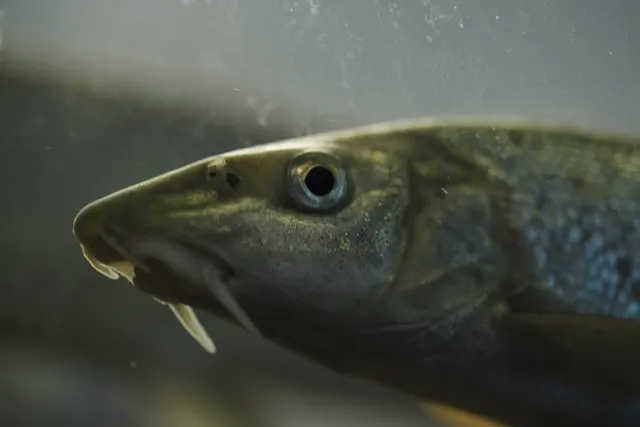 BarbelA powerful, streamlined river cyprinid built for holding station in fast water — and the hardest-fighting freshwater fish most British anglers will meet.
Photo: Pmau, via Wikimedia Commons, CC BY-SA 4.0; resized and trimmed to fit; shared under the same licence
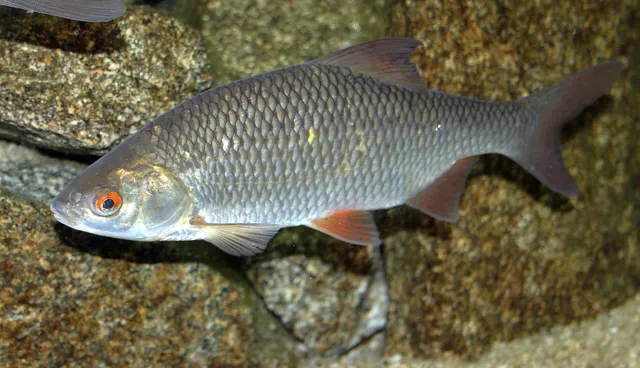 RoachThe most numerous and most frequently caught coarse fish across much of Europe, and the prey species that underpins the whole freshwater predator food web.
Photo: Karelj, via Wikimedia Commons, public domain; resized and trimmed to fit
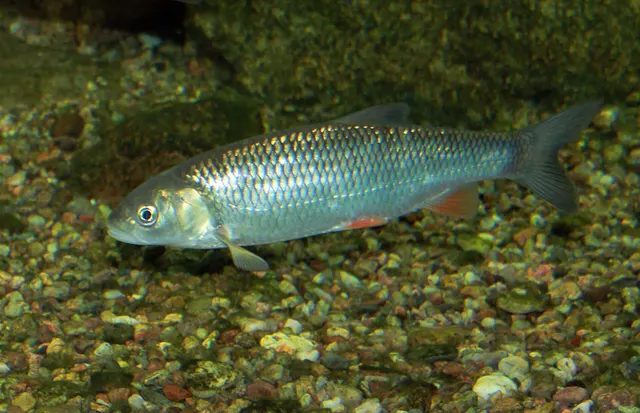 ChubA bold, omnivorous river fish that eats almost anything and grows large enough to be a predator — and the species most likely to be caught on a bait nobody expected to work.
Photo: Karelj, via Wikimedia Commons, public domain; resized and trimmed to fit
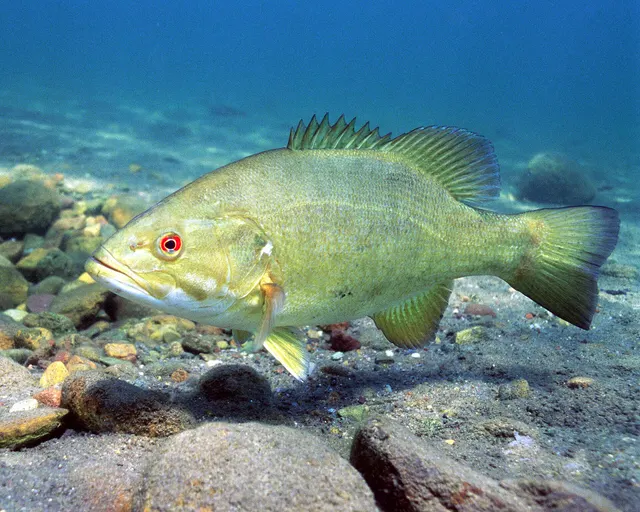 Smallmouth bassA hard-fighting river and rocky-lake predator of North America, reckoned pound for pound the strongest freshwater fish on the continent.
Photo: Eric Engbretson, U.S. Fish and Wildlife Service, via Wikimedia Commons, public domain; resized and trimmed to fit
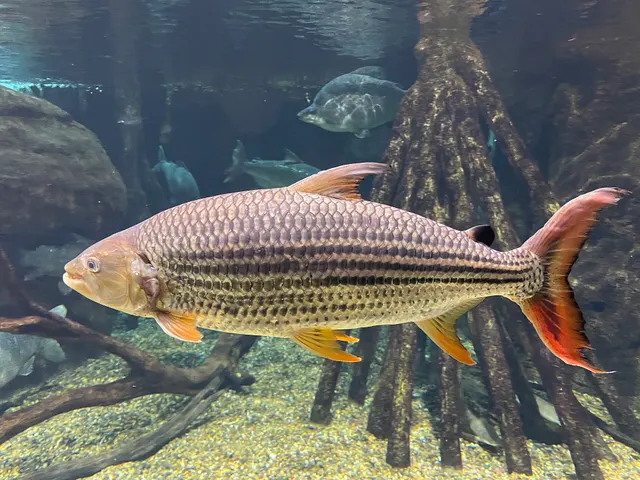 African tigerfishA fast, silver, heavily toothed river predator of tropical Africa whose interlocking fangs are visible with its mouth shut — and one of the hardest fish in fresh water to hook.
Photo: Totti, via Wikimedia Commons, CC BY-SA 4.0; resized; shared under the same licence
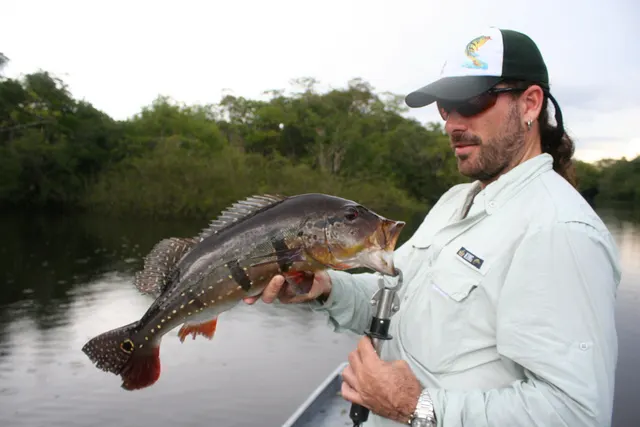 Speckled peacock bassA large Amazonian cichlid — not a bass at all — that hunts small characins in blackwater rivers and strikes surface lures with more violence than almost anything in fresh water.
Photo: Wellerson Santana, via Wikimedia Commons, CC BY-SA 4.0; resized and trimmed to fit; shared under the same licence
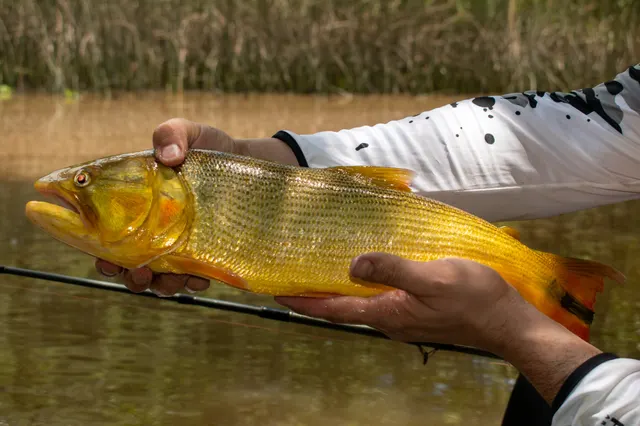 Golden doradoA brilliant gold, heavily toothed river predator of the Paraná and Paraguay systems — a characin built like a salmon and fighting like a tarpon.
Photo: Ezequiel Racker, via iNaturalist, CC BY; resized and trimmed to fit


Where a trout stands in a river, and why it is not where the water looks best
Where a trout stands in a river, and why it is not where the water looks best
Reading the ground · Draft — not yet checked against an external reference
This drawing has not been checked against any reference outside FishingHQ. It is a schematic of what the surrounding text describes, and the text is what carries the detail.
Describe this diagram in words
A plan view of a short stretch of river, seen from above, with the current running from left to right. The far bank is a straight line along the top and the near bank runs along the bottom with a shallow point pushing out into the flow around the middle. An arrow along the upper third marks the main flow: fast water, carrying the drifting food. A boulder stands in mid-river, and a second arrow curves downstream from its edge marking the seam — the line where the fast water meets the slack behind the obstruction. One trout is drawn in that slack, immediately beside the seam and facing upstream into it. A second trout sits in the eddy downstream of the point on the near bank, in exactly the same relationship to the flow. The wide open middle of the pool, which is the easiest water to cast to, is labelled as almost empty. The figure publishes no depths, no distances and no current speeds, because all three differ by river and by day.
How this drawing was produced
Drawn from coordinates written by hand for this figure and rendered by the site's own diagram component, using the shared element vocabulary rather than any per-diagram styling. Nothing is traced from a photograph or a chart of any real river; the shapes are schematic and the proportions were chosen so the seam and the two lies read clearly at the width the figure is displayed at. It carries no numbers of any kind, and no fly, cast or angler, so that it cannot be read as a tip.
A river bend in section: deep and fast outside, shallow and slow inside
A river bend in section: deep and fast outside, shallow and slow inside
Reading the ground · Reference linked — a canonical reference is named, the check is not signed off — reference: OneGeology Kids: meandering rivers
A canonical reference for this drawing has been identified, but the check against it has not been completed and signed off. Treat the drawing as an aid to the text rather than as an authority.
Describe this diagram in words
A cross-section across a river at a bend, looking downstream, with the outside of the bend on the right. A dotted line marks the surface. From the inside bank on the left the bed slopes down gently for most of the width — the point bar, labelled the point bar, with a small arrow settling onto it; a note says the water inside the bend is shallower and slower and lays sediment down there. The bed reaches its deepest point close to the right-hand bank, labelled the deepest water, on the outside of the bend. There the bank rises steeply, with an arrow pushing against it and a label saying faster water erodes it. A note says the figure shows structure, not a record of where fish were caught, and that fast and slow water sit side by side across one bend; another says no depths, widths or speeds are given because they differ by river and by flow.
How this drawing was produced
Drawn from coordinates written for this figure, in the site's shared vocabulary, from OneGeology's account of meandering rivers: deepest and fastest on the outside of a bend, eroding the bank there; shallower and slower inside, depositing point bars. The shape is schematic and not taken from any surveyed river or any source's picture. It draws no fish and no angler.
Safety
Further safety reading
Where to go next
Fish found here
- African sharptooth catfishPersists in warm, poorly oxygenated african waters by breathing air.
- African tigerfishA characin turned specialist predator of large African rivers, hunting in fast open water rather than from cover, in warm well-oxygenated water between about twenty-two and twenty-eight degrees.
- Allis shadSpawns over gravel in moderate flow, often far upstream — which is the requirement that weirs and barrages take away and the reason the species collapsed across engineered rivers.
62 more
- Arapaima Fish
- Arctic grayling Fish
- Asp Fish
- Ayu Fish
- Barbel Fish
- Bowfin Fish
- Brook trout Fish
- Bull shark Fish
- Bull trout Fish
- Burbot Fish
- Butterfly peacock bass Fish
- Catla Fish
- Chub Fish
- Chum salmon Fish
- Dace Fish
- Deccan mahseer Fish
- Eel-tailed catfish Fish
- Estuary perch Fish
- European flounder Fish
- Freshwater drum Fish
- Giant freshwater stingray Fish
- Giant snakehead Fish
- Golden dorado Fish
- Golden mahseer Fish
- Golden perch Fish
- Goliath tigerfish Fish
- Goonch Fish
- Great snakehead Fish
- Gudgeon Fish
- Hampala barb Fish
- Huchen Fish
- Ide Fish
- Jungle perch Fish
- Lake sturgeon Fish
- Largemouth yellowfish Fish
- Longnose gar Fish
- Murray cod Fish
- Nile tilapia Fish
- Northern pike Fish
- Payara Fish
- Pink salmon Fish
- Redtail catfish Fish
- Rohu Fish
- Saratoga Fish
- Sauger Fish
- Signal crayfish Fish
- Silver bream Fish
- Silver carp Fish
- Silver perch Fish
- Smallmouth bass Fish
- Smallmouth yellowfish Fish
- Speckled peacock bass Fish
- Spotted sorubim Fish
- Sterlet Fish
- Taimen Fish
- Tambaqui Fish
- Twaite shad Fish
- Wels catfish Fish
- White bass Fish
- White sturgeon Fish
- White-clawed crayfish Fish
- Roach Fish
Reading this water
- Currents, eddies and where fish holdRiver fish position themselves by the cost of holding station.
- Mending line, and what it is forThe mechanism made concrete. A faster central current and a slower inside seam is the ordinary state of a river, and it is what makes a mend a routine operation rather than an occasional correction.
- Presentation and dragWhere the problem is at its most physical. Different current speeds at different distances across a river pull a floating line into a belly at different rates, and it is that differential — not the fish's suspicion — that drags a fly. A single-speed flow would need no mending at all.
3 more
- Reading a river for fish Explainer
- River levels, and what a flood changes Explainer
- Spawning triggers Explainer
How this compares
- Floodplains, backwaters and oxbowsThe channel and the ground beside it. A lowland river page describes the water on the map; this describes where the fish go when it rises, which in most large systems is where the production actually happens.
Sources and evidence
Why the 73 connections on this page are here, and the sources
Fish found here
Backed by research — 65 connections
Supported by peer-reviewed research or fisheries science. The sources are listed and can be checked.
African sharptooth catfish
A habitat association for Clarias gariepinus taken from the environment and distribution data on its FishBase summary.
- FishBase: a global information system on fishes — Froese, R. and D. Pauly, eds. — FishBase Consortium (Scientific institute)Relied on for: The environment, depth range and habitat description recorded for Clarias gariepinus.States this directlyPassage read and verified
African tigerfish
A habitat claim held to a scientific standard.
- FishBase: a global information system on fishes — relied on for: That Hydrocynus vittatus is a freshwater demersal potamodromous species of warm well-oxygenated waters in larger rivers and lakes at 22 to 28 degrees.
Allis shad
A distributional claim about where a species is found, which is a claim about the world and rests on regional reference works rather than on angling report.
- Freshwater Fishes of the British Isles — HarperCollins (New Naturalist 75), 1992 (Reference work)Relied on for: Distribution, habitat association, identification and life history of the freshwater fishes of the British Isles.States this directlyCitation checked — the work exists and is described correctly
- FishBase: a global information system on fishes — relied on for: Distribution, habitat association, depth range, diet and reproductive parameters recorded for the species.
Arapaima
A habitat association for Arapaima gigas taken from the environment and distribution data on its FishBase summary.
- FishBase: a global information system on fishes — relied on for: The environment, depth range and habitat description recorded for Arapaima gigas.
Arctic grayling
A habitat association for Thymallus arcticus taken from the environment and distribution data on its FishBase summary.
- FishBase: a global information system on fishes — relied on for: The environment, depth range and habitat description recorded for Thymallus arcticus.
Asp
A habitat association for Leuciscus aspius taken from the environment and distribution data on its FishBase summary.
- FishBase: a global information system on fishes — relied on for: The environment, depth range and habitat description recorded for Leuciscus aspius.
Ayu
A habitat association for Plecoglossus altivelis taken from the environment and distribution data on its FishBase summary.
- FishBase: a global information system on fishes — relied on for: The environment, depth range and habitat description recorded for Plecoglossus altivelis.
Barbel
Habitat requirement is documented and follows from the species' morphology.
- FishBase: a global information system on fishes — relied on for: Habitat requirements for Barbus barbus.
- Freshwater Fishes of the British Isles — relied on for: Barbel habitat association and gravel spawning requirements in British rivers.
Bowfin
A habitat association for Amia calva taken from the environment and distribution data on its FishBase summary.
- FishBase: a global information system on fishes — relied on for: The environment, depth range and habitat description recorded for Amia calva.
Brook trout
A habitat and tolerance claim held to a scientific standard because FishingHQ uses it as an indicator elsewhere.
- FishBase: a global information system on fishes — relied on for: That Salvelinus fontinalis occupies marine, fresh and brackish benthopelagic habitat with an anadromous life history in part of the range, in temperate water from 0 to 25 degrees.
Bull shark
A distributional claim about where a species is found, resting on the standard identification and compilation sources rather than on fishing report.
- FAO Species Identification Guides for Fishery Purposes and the FAO Species Catalogues — Food and Agriculture Organization of the United Nations (Scientific institute)Relied on for: Diagnostic characters, habitat association, depth range and distribution as set out in the FAO species identification guides for fishery purposes.States this directlyCitation checked — the work exists and is described correctly
- FishBase: a global information system on fishes — relied on for: Distribution, maximum size, depth range, habitat association and biology as compiled for the species.
Bull trout
A habitat association for Salvelinus confluentus taken from the environment and distribution data on its FishBase summary.
- FishBase: a global information system on fishes — relied on for: The environment, depth range and habitat description recorded for Salvelinus confluentus.
Burbot
A habitat association for Lota lota taken from the environment and distribution data on its FishBase summary.
- FishBase: a global information system on fishes — relied on for: The environment, depth range and habitat description recorded for Lota lota.
Butterfly peacock bass
A habitat association for Cichla ocellaris taken from the environment and distribution data on its FishBase summary.
- FishBase: a global information system on fishes — relied on for: The environment, depth range and habitat description recorded for Cichla ocellaris.
Catla
A habitat association for Labeo catla taken from the environment and distribution data on its FishBase summary.
- FishBase: a global information system on fishes — relied on for: The environment, depth range and habitat description recorded for Labeo catla.
Chub
A habitat claim held to an authoritative standard because it is about where a species is actually found rather than about how to catch it.
- Freshwater Fishes of the British Isles — relied on for: Habitat use of Squalius cephalus in European rivers.
- FishBase: a global information system on fishes — relied on for: Recorded habitat for Squalius cephalus.
Chum salmon
A habitat association for Oncorhynchus keta taken from the environment and distribution data on its FishBase summary.
- FishBase: a global information system on fishes — relied on for: The environment, depth range and habitat description recorded for Oncorhynchus keta.
Dace
A distributional claim about where a species is found, which is a claim about the world and rests on regional reference works rather than on angling report.
- Freshwater Fishes of the British Isles — relied on for: Distribution, habitat association, identification and life history of the freshwater fishes of the British Isles.
- FishBase: a global information system on fishes — relied on for: Distribution, habitat association, depth range, diet and reproductive parameters recorded for the species.
Deccan mahseer
A habitat association for Tor khudree taken from the environment and distribution data on its FishBase summary.
- FishBase: a global information system on fishes — relied on for: The environment, depth range and habitat description recorded for Tor khudree.
Eel-tailed catfish
A national museum's species page.
- Freshwater Catfish, Tandanus tandanus — Australian Museum (Scientific institute)Relied on for: The species' range in the Murray-Darling and eastern coastal drainages.States this directlyPassage read and verified
Estuary perch
A habitat association for Percalates colonorum taken from the environment and distribution data on its FishBase summary.
- FishBase: a global information system on fishes — relied on for: The environment, depth range and habitat description recorded for Percalates colonorum.
European flounder
A distributional claim about where a species is found, which is a claim about the world and rests on the standard regional reference works rather than on angling report.
- The Fishes of the British Isles and North-West Europe — Macmillan, 1969 (Reference work)Relied on for: Distribution, habitat association, identification and biology of the fishes of the British Isles and north-west Europe.States this directlyCitation checked — the work exists and is described correctly
- FAO Species Identification Guides for Fishery Purposes and the FAO Species Catalogues — relied on for: Diagnostic characters, habitat and depth range as set out in the FAO species identification sheets for the eastern Atlantic and Mediterranean.
Freshwater drum
A distributional claim about a species outside the range of the British reference works, resting on the global databases instead.
- FishBase: a global information system on fishes — relied on for: Distribution, habitat association, depth range, diet and reproductive parameters recorded for the species.
- The IUCN Red List of Threatened Species — International Union for Conservation of Nature (Conservation authority)Relied on for: Global conservation assessment, range and recorded threats for the species.States this directlyCitation checked — the work exists and is described correctly
Giant freshwater stingray
A habitat association for Urogymnus polylepis taken from the environment and distribution data on its FishBase summary.
- FishBase: a global information system on fishes — relied on for: The environment, depth range and habitat description recorded for Urogymnus polylepis.
Giant snakehead
A habitat and physiology claim held to a scientific standard.
- FishBase: a global information system on fishes — relied on for: That Channa micropeltes occurs in lowland rivers and swamps with standing or slowly flowing water including large streams, canals and deep water bodies, and is an obligate air-breather.
Golden dorado
A habitat claim held to a scientific standard.
- FishBase: a global information system on fishes — relied on for: That Salminus brasiliensis is a freshwater benthopelagic potamodromous species of the Paraná, Paraguay and Uruguay River basins, the Laguna dos Patos drainage and the upper Chaparé and Mamoré basins.
Golden mahseer
A habitat and life-history claim held to a scientific standard.
- FishBase: a global information system on fishes — relied on for: That Tor putitora inhabits streams, riverine pools and lakes including rapid streams with rocky bottoms, and is potamodromous, migrating from lower to middle reaches for spawning during low-flood phases.
Golden perch
A habitat and reproductive claim held to a scientific standard, and the basis of the environmental-flow argument.
- FishBase: a global information system on fishes — relied on for: That Macquaria ambigua is a freshwater species of the Murray-Darling, Lake Eyre and Bulloo-Bancannia drainages in turbid slow rivers and impoundments.
Goliath tigerfish
A distributional claim about a species outside the range of the British reference works, resting on the global databases instead.
- FishBase: a global information system on fishes — relied on for: Distribution, habitat association, depth range, diet and reproductive parameters recorded for the species.
- The IUCN Red List of Threatened Species — relied on for: Global conservation assessment, range and recorded threats for the species.
Goonch
A habitat association for Bagarius yarrelli taken from the environment and distribution data on its FishBase summary.
- FishBase: a global information system on fishes — relied on for: The environment, depth range and habitat description recorded for Bagarius yarrelli.
Great snakehead
A habitat association for Channa marulius taken from the environment and distribution data on its FishBase summary.
- FishBase: a global information system on fishes — relied on for: The environment, depth range and habitat description recorded for Channa marulius.
Gudgeon
A distributional claim about where a species is found, which is a claim about the world and rests on regional reference works rather than on angling report.
- Freshwater Fishes of the British Isles — relied on for: Distribution, habitat association, identification and life history of the freshwater fishes of the British Isles.
- FishBase: a global information system on fishes — relied on for: Distribution, habitat association, depth range, diet and reproductive parameters recorded for the species.
Hampala barb
A habitat association for Hampala macrolepidota taken from the environment and distribution data on its FishBase summary.
- FishBase: a global information system on fishes — relied on for: The environment, depth range and habitat description recorded for Hampala macrolepidota.
Huchen
A habitat association for Hucho hucho taken from the environment and distribution data on its FishBase summary.
- FishBase: a global information system on fishes — relied on for: The environment, depth range and habitat description recorded for Hucho hucho.
Ide
A habitat association for Leuciscus idus taken from the environment and distribution data on its FishBase summary.
- FishBase: a global information system on fishes — relied on for: The environment, depth range and habitat description recorded for Leuciscus idus.
Jungle perch
A habitat association for Kuhlia rupestris taken from the environment and distribution data on its FishBase summary.
- FishBase: a global information system on fishes — relied on for: The environment, depth range and habitat description recorded for Kuhlia rupestris.
Lake sturgeon
A habitat association for Acipenser fulvescens taken from the environment and distribution data on its FishBase summary.
- FishBase: a global information system on fishes — relied on for: The environment, depth range and habitat description recorded for Acipenser fulvescens.
Largemouth yellowfish
A habitat association for Labeobarbus kimberleyensis taken from the environment and distribution data on its FishBase summary.
- FishBase: a global information system on fishes — relied on for: The environment, depth range and habitat description recorded for Labeobarbus kimberleyensis.
Longnose gar
A habitat association for Lepisosteus osseus taken from the environment and distribution data on its FishBase summary.
- FishBase: a global information system on fishes — relied on for: The environment, depth range and habitat description recorded for Lepisosteus osseus.
Murray cod
A habitat claim held to a scientific standard.
- FishBase: a global information system on fishes — relied on for: That Maccullochella peelii occupies a wide range of habitats from clear rocky streams to slow flowing turbid rivers and billabongs, typically in water to 5 m with shelter from rocks, timber or banks.
Nile tilapia
A habitat association for Oreochromis niloticus taken from the environment and distribution data on its FishBase summary.
- FishBase: a global information system on fishes — relied on for: The environment, depth range and habitat description recorded for Oreochromis niloticus.
Northern pike
Recorded habitat association across the species' range.
- FishBase: a global information system on fishes — relied on for: Habitat records for Esox lucius including riverine populations.
- Freshwater Fishes of the British Isles — relied on for: Riverine pike distribution and habitat use in the British Isles.
Payara
A habitat association for Hydrolycus scomberoides taken from the environment and distribution data on its FishBase summary.
- FishBase: a global information system on fishes — relied on for: The environment, depth range and habitat description recorded for Hydrolycus scomberoides.
Pink salmon
A habitat association for Oncorhynchus gorbuscha taken from the environment and distribution data on its FishBase summary.
- FishBase: a global information system on fishes — relied on for: The environment, depth range and habitat description recorded for Oncorhynchus gorbuscha.
Redtail catfish
A habitat association for Phractocephalus hemioliopterus taken from the environment and distribution data on its FishBase summary.
- FishBase: a global information system on fishes — relied on for: The environment, depth range and habitat description recorded for Phractocephalus hemioliopterus.
Rohu
A habitat association for Labeo rohita taken from the environment and distribution data on its FishBase summary.
- FishBase: a global information system on fishes — relied on for: The environment, depth range and habitat description recorded for Labeo rohita.
Saratoga
A distributional claim about a species outside the range of the British reference works, resting on the global databases instead.
- FishBase: a global information system on fishes — relied on for: Distribution, habitat association, depth range, diet and reproductive parameters recorded for the species.
- The IUCN Red List of Threatened Species — relied on for: Global conservation assessment, range and recorded threats for the species.
Sauger
A distributional claim about a species outside the range of the British reference works, resting on the global databases instead.
- FishBase: a global information system on fishes — relied on for: Distribution, habitat association, depth range, diet and reproductive parameters recorded for the species.
- The IUCN Red List of Threatened Species — relied on for: Global conservation assessment, range and recorded threats for the species.
Signal crayfish
Habitat association recorded for the species rather than inferred from the fishery.
- FishBase: a global information system on fishes — relied on for: Habitat association, depth range, diet and distribution for the species, with SeaLifeBase as its sister database for non-finfish taxa.
Silver bream
A habitat association for Blicca bjoerkna taken from the environment and distribution data on its FishBase summary.
- FishBase: a global information system on fishes — relied on for: The environment, depth range and habitat description recorded for Blicca bjoerkna.
Silver carp
A habitat association for Hypophthalmichthys molitrix taken from the environment and distribution data on its FishBase summary.
- FishBase: a global information system on fishes — relied on for: The environment, depth range and habitat description recorded for Hypophthalmichthys molitrix.
Silver perch
FishBase through the checked extraction.
- FishBase: a global information system on fishes — relied on for: That Bidyanus bidyanus is known only from the Murray-Darling system and is potamodromous.
Smallmouth bass
A habitat claim held to a scientific standard.
- FishBase: a global information system on fishes — relied on for: That Micropterus dolomieu occupies shallow rocky areas of lakes and clear gravel-bottom runs and flowing pools of rivers, at 1 to 7 m and 9 to 30 degrees.
Smallmouth yellowfish
A habitat association for Labeobarbus aeneus taken from the environment and distribution data on its FishBase summary.
- FishBase: a global information system on fishes — relied on for: The environment, depth range and habitat description recorded for Labeobarbus aeneus.
Speckled peacock bass
A habitat claim held to a scientific standard.
- FishBase: a global information system on fishes — relied on for: That Cichla temensis is a freshwater benthopelagic Cichlidae of the Amazon and Orinoco basins occupying deeper littoral areas in lagoons and the sandy and rocky banks of the main river channel at pH 5.5 to 6.5.
Spotted sorubim
A habitat association for Pseudoplatystoma corruscans taken from the environment and distribution data on its FishBase summary.
- FishBase: a global information system on fishes — relied on for: The environment, depth range and habitat description recorded for Pseudoplatystoma corruscans.
Sterlet
A distribution edge resting on published identification and distribution references rather than on angling report, written where the species is genuinely characteristic of the system rather than merely recorded in it once.
- FishBase: a global information system on fishes — relied on for: Recorded environment, salinity tolerance, depth range, distribution and biology of the species named.
- FAO Species Identification Guides for Fishery Purposes and the FAO Species Catalogues — relied on for: Distribution, habitat association and identification of the fishes of the Mediterranean and Black Sea region.
Taimen
A habitat association for Hucho taimen taken from the environment and distribution data on its FishBase summary.
- FishBase: a global information system on fishes — relied on for: The environment, depth range and habitat description recorded for Hucho taimen.
Tambaqui
A habitat association for Colossoma macropomum taken from the environment and distribution data on its FishBase summary.
- FishBase: a global information system on fishes — relied on for: The environment, depth range and habitat description recorded for Colossoma macropomum.
Twaite shad
A distributional claim about where a species is found, which is a claim about the world and rests on regional reference works rather than on angling report.
- Freshwater Fishes of the British Isles — relied on for: Distribution, habitat association, identification and life history of the freshwater fishes of the British Isles.
- FishBase: a global information system on fishes — relied on for: Distribution, habitat association, depth range, diet and reproductive parameters recorded for the species.
Wels catfish
A habitat claim held to a scientific standard.
- FishBase: a global information system on fishes — relied on for: That Silurus glanis is a freshwater and brackish demersal species of European and western Asian river systems.
- Freshwater Fishes of the British Isles — relied on for: The habitat use and nocturnal feeding of Silurus glanis in European fresh waters.
White bass
A habitat association for Morone chrysops taken from the environment and distribution data on its FishBase summary.
- FishBase: a global information system on fishes — relied on for: The environment, depth range and habitat description recorded for Morone chrysops.
White sturgeon
A habitat association for Acipenser transmontanus taken from the environment and distribution data on its FishBase summary.
- FishBase: a global information system on fishes — relied on for: The environment, depth range and habitat description recorded for Acipenser transmontanus.
White-clawed crayfish
A distributional and habitat claim about a protected native species, resting on the national conservation and fisheries literature.
- Environment Agency fisheries management, byelaws and rod licensing information — Environment Agency (Government fisheries body)Relied on for: Freshwater fisheries management in England: species status, distribution, invasive species policy and biosecurity practice.States this directlyCitation checked — the work exists and is described correctly
- JNCC species and habitat conservation advice — Joint Nature Conservation Committee (Conservation authority)Relied on for: UK conservation designation and the status of protected and priority freshwater species and habitats.States this directlyCitation checked — the work exists and is described correctly
Roach
Recorded habitat association across the species' range.
- FishBase: a global information system on fishes — relied on for: Habitat records for Rutilus rutilus.
- Freshwater Fishes of the British Isles — relied on for: Roach distribution and habitat use in British rivers and stillwaters.
Reading this water
Backed by research — 2 connections
Supported by peer-reviewed research or fisheries science. The sources are listed and can be checked.
Currents, eddies and where fish hold
River fish position themselves by the cost of holding station.
- FishBase: a global information system on fishes — relied on for: Species and habitat data underlying this connection. River fish position themselves by the cost of holding station.
Spawning triggers
River spawning migrations are triggered by flow as well as temperature.
- FishBase: a global information system on fishes — relied on for: Species and habitat data underlying this connection. River spawning migrations are triggered by flow as well as temperature.
What experienced anglers do — 4 connections
Widely and independently recommended by experienced anglers and specialist sources. This is real angling knowledge, not proof: controlled evidence for it is limited, and FishingHQ records it as convention rather than as a demonstrated effect.
Mending line, and what it is for
A fish or a water joined to the fly-fishing mechanism it is a worked example of, written only where the subject's own behaviour or physical character is what this page explains. The direction is the one FishingHQ writes this kind of connection in, and the one it already uses 176 times, and it is also the semantically correct one: the mechanism explains the fish, not the reverse.
- Still Water Fly-Fishing — Andre Deutsch, 1952 (Specialist angling publication)Relied on for: Stillwater fly practice: line density and depth, leader construction, fly selection against the food present, and the behaviour of stocked and wild trout in still water.States this directlyCitation checked — the work exists and is described correctly
- Trout & Salmon — Bauer Media (Specialist angling publication)Relied on for: Long-running published description of British game angling practice: river and stillwater trout, grayling and salmon fishing, and the presentation each demands.States this directlyCitation checked — the work exists and is described correctly
Presentation and drag
A fish or a water joined to the fly-fishing mechanism it is a worked example of, written only where the subject's own behaviour or physical character is what this page explains. The direction is the one FishingHQ writes this kind of connection in, and the one it already uses 176 times, and it is also the semantically correct one: the mechanism explains the fish, not the reverse.
- Still Water Fly-Fishing — relied on for: Stillwater fly practice: line density and depth, leader construction, fly selection against the food present, and the behaviour of stocked and wild trout in still water.
- Trout & Salmon — relied on for: Long-running published description of British game angling practice: river and stillwater trout, grayling and salmon fishing, and the presentation each demands.
Reading a river for fish
The physical or biological reason behind a situation. Where that reason is documented science the page for it carries the citation; the association itself is practitioner observation and is labelled as such.
- Freshwater Fishing — Macdonald & Jane's, 1975 (Specialist angling publication)Relied on for: Comprehensive freshwater angling practice including water reading, river conditions, seasonal behaviour and the reasoning behind them.States this directlyCitation checked — the work exists and is described correctly
- Coarse Fishing — A. & C. Black, 1912 (Specialist angling publication)Relied on for: Classical coarse angling practice: swim selection, river and stillwater reading and seasonal observation.States this directlyCitation checked — the work exists and is described correctly
River levels, and what a flood changes
The physical or biological reason behind a situation. Where that reason is documented science the page for it carries the citation; the association itself is practitioner observation and is labelled as such.
- Freshwater Fishing — relied on for: Comprehensive freshwater angling practice including water reading, river conditions, seasonal behaviour and the reasoning behind them.
- Coarse Fishing — relied on for: Classical coarse angling practice: swim selection, river and stillwater reading and seasonal observation.
How this compares
What experienced anglers do — 1 connection
Widely and independently recommended by experienced anglers and specialist sources. This is real angling knowledge, not proof: controlled evidence for it is limited, and FishingHQ records it as convention rather than as a demonstrated effect.
Floodplains, backwaters and oxbows
A comparison a reader trying to understand one of these systems genuinely needs, joining two records that resolve one another.
- The Flood Pulse Concept in River-Floodplain Systems — Canadian Special Publication of Fisheries and Aquatic Sciences 106, Department of Fisheries and Oceans, Ottawa, 1989 (Scientific literature)Relied on for: That fish move laterally onto the inundated floodplain to feed and breed and return to the channel as water falls, and that floodplain inundation drives production in large river systems.States this directlyCitation checked — the work exists and is described correctly
- FAO Species Identification Guides for Fishery Purposes and the FAO Species Catalogues — relied on for: Habitat association and distribution of the species concerned.
Safety reading
Official guidance — 1 connection
Stated by a fisheries authority, scientific institute or recognised angling body. Authoritative, but summarising rather than demonstrating.
Wading safely
Inland water safety guidance addresses moving water and immersion.
- RNLI water safety guidance: cold water shock and Float to Live — Royal National Lifeboat Institution (Water-safety or diver-training authority)Relied on for: Water safety guidance for inland water users.FishingHQ's interpretation of what it saysPassage read and verified
- RoSPA water safety information and UK accidental drowning statistics — Royal Society for the Prevention of Accidents (Water-safety or diver-training authority)Relied on for: Drowning risk statistics for inland water activities.Background and mechanism onlyPassage read and verified
How FishingHQ labels evidence is explained in the evidence policy.