White bass
Fish · Last reviewed 2026-08-10
A schooling open-water Morone of large rivers and reservoirs, smaller and deeper-bodied than a striped bass and famous for surface feeding frenzies.
Safety: injury while handling fish — minor injury.
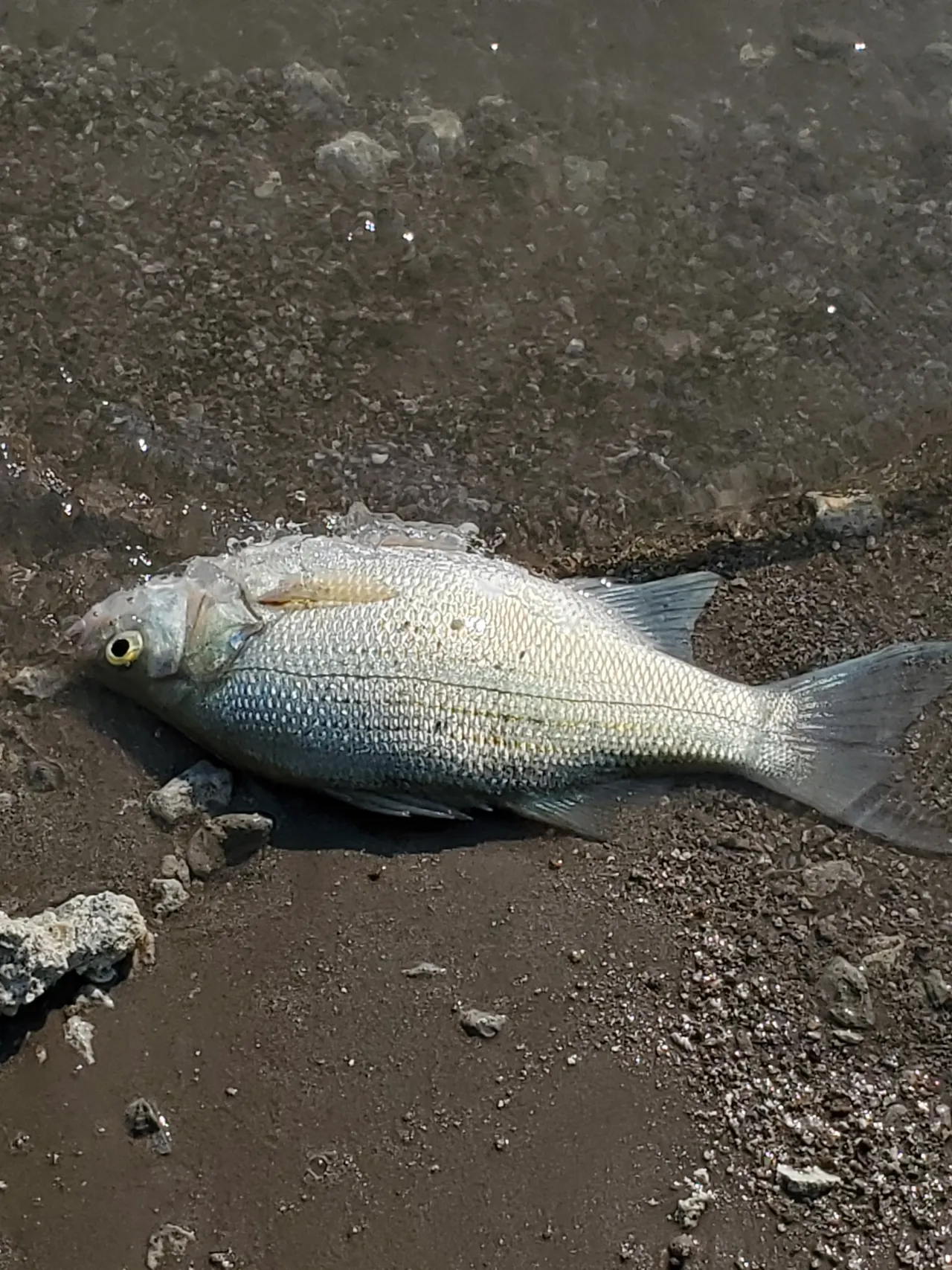
How this was identified, and who took it
Identified by: The record's separating character is legible: the horizontal stripes on the flank are faint and BROKEN rather than the clean unbroken lines of a striped bass, and they fade out entirely above the lateral line. The body is deep and strongly compressed at roughly a third of standard length in depth, which is the white bass proportion rather than the more elongate striper, and the back is arched behind the head.Bennett Grappone — CC BY, via iNaturalist — source, licenceCatching White bass
Everything here on fishing for it. Each entry opens the page behind it.
White bass is the freshwater member of the temperate bass family that most inland anglers actually meet. It is a schooling, open-water predator of large rivers and reservoirs, and it behaves nothing like the black basses it shares a name with — where a largemouth ambushes from cover, a white bass runs down shad in open water in packs.
It is separated from striped bass by proportion and by stripe: deeper-bodied, far smaller at maturity, and with flank stripes that are usually broken and faint rather than the striped bass's seven or eight clean unbroken lines. Where the two occur together, hybrids are stocked deliberately and muddle the picture further.
Its defining behaviour is the surface feeding event — schools driving shad up against the surface, gulls working over the top, and a short window of frantic activity that moves and vanishes.
How it is caught
Gear for this fish
Identification
- Scientific name
- Morone chrysops
- Family
- Moronidae
- Water
- Freshwater
- Conservation status
- Least Concern
- Regions
- North America
- Deep, laterally compressed silver body with faint and usually broken horizontal stripes, unlike the clean unbroken stripes of a striped bass.
- Two dorsal fins clearly separated, the first spiny and the second soft.
- Single tooth patch on the tongue; striped bass carries two parallel patches.
- Much smaller at maturity than striped bass, with a noticeably deeper body for its length.
Size
- Typical
- 0.4–0.9 kg (1–2 lb)
- Large
- 1.2–1.8 kg (2.6–4 lb)
Exceptional: FishBase records a maximum of 45 cm and 3.1 kg
Open water in large rivers and reservoirs, chasing shad
White bass occupy the open water of large rivers, reservoirs and lakes, and they are among the most genuinely pelagic freshwater fish in North America.
OPEN WATER IS THE HABITAT. White bass school in the open pelagic zone rather than relating to cover, following shad and other small schooling fish through the water column. A weed bed holds bass; open water holds white bass.
THEY FOLLOW BAIT VERTICALLY AND HORIZONTALLY, and their distribution within a reservoir at any moment is a function of where the shad are rather than of structure.
SURFACE FEEDING SCHOOLS ARE THE CLASSIC SIGN — white bass drive shad to the surface in fast attacks with birds working above, and the resulting boil is how the fishery locates them.
CURRENT AND STRUCTURE MATTER WHERE THEY CONCENTRATE BAIT: dam tailraces, river confluences, points and channel edges hold fish because they hold shad.
THEY TOLERATE TURBID AND PRODUCTIVE WATER well, thriving in the large impoundments and lowland rivers where they are most abundant.
JUVENILES USE SHALLOWER AND MORE SHELTERED WATER before recruiting to the open-water schools.
AND THEY RUN UP RIVERS IN SPRING, ascending tributaries and tailraces in numbers to spawn, which temporarily converts an open-water fish into a current-oriented river fish — the one time of year when structure and flow matter more to them than bait location does.
Backed by research — why, and the sources (2)
Supported by peer-reviewed research or fisheries science. The sources are listed and can be checked.
- FishBase: a global information system on fishes — Froese, R. and D. Pauly, eds. — FishBase Consortium (Scientific institute)Relied on for: Distribution, habitat association, depth range, size, reproduction and life-history parameters recorded for the species.States this directlyPassage read and verified
- The IUCN Red List of Threatened Species — International Union for Conservation of Nature (Conservation authority)Relied on for: Assessment and range account for the species, including the habitats it depends on, its life history and the pressures acting on it.States this directlyCitation checked — the work exists and is described correctly
A dense spawning run, a full cooler, and the arithmetic nobody does
White bass present no serious hazard and a real problem, and the problem is one of volume rather than of technique.
THE FISHERY IS CONCENTRATED IN TIME AND SPACE. White bass run up tributaries to spawn in spring in enormous, dense concentrations, and during that run they are easy to catch, catchable in numbers, and located in a short stretch of accessible water that everybody knows about. A single angler can take a great many fish in a session without any particular skill, and a great many anglers do, in the same place, on the same few weekends.
THAT IS THE WHOLE ISSUE. The fish being harvested are pre-spawn adults, taken from an aggregation, at the moment they have come together to reproduce, in the only weeks of the year when they are all in one place. There is nothing wrong with taking white bass to eat — they are a good, abundant, fast-growing panfish and a legitimate harvest. What is worth doing is the arithmetic, which nobody does in the moment: a full limit taken repeatedly through a run, by many people, in one short reach, is a much larger removal from a spawning population than the same number of fish taken across a season.
SO THE HANDLING QUESTION FOR THIS SPECIES IS REALLY A DECISION QUESTION: take what will be eaten, and stop. That is a more useful answer than any grip.
FOR THE FISH THAT GO BACK. The dorsal spines and gill covers are sharp and are met by a hand closing over the back — grip across the body from behind with the dorsal folded. Spring water is cool and the fish are robust, but the run is short, the fish are in dense shoals, and one played hard and left on a bank while somebody unhooks the next three is a fish that will not spawn. The rate at which they can be caught is exactly the reason to slow down when returning them.
What experienced anglers do — why, and the sources (4)
Widely and independently recommended by experienced anglers and specialist sources. This is real angling knowledge, not proof: controlled evidence for it is limited, and FishingHQ records it as convention rather than as a demonstrated effect.
- FishBase: a global information system on fishes — Froese, R. and D. Pauly, eds. — FishBase Consortium (Scientific institute)Relied on for: Morphology, dentition, spination, thermal tolerance, reproductive strategy and depth range recorded for the species.States this directlyPassage read and verified
- The IUCN Red List of Threatened Species — International Union for Conservation of Nature (Conservation authority)Relied on for: Assessment, population trend and the life-history traits — longevity, growth rate, sex structure — that determine a population's sensitivity to the removal of large individuals.Background and mechanism onlyCitation checked — the work exists and is described correctly
- Understanding the Complexity of Catch-and-Release in Recreational Fishing — Reviews in Fisheries Science 15:75–167, 2007 (Scientific literature)Relied on for: The determinants of catch-and-release outcome in recreational fisheries, and the gap between angler belief and measured survival.States this directlyCitation checked — the work exists and is described correctly
- Do we need species-specific guidelines for catch-and-release recreational angling? — Biodiversity and Conservation 14:1195–1209, 2005 (Scientific literature)Relied on for: That air exposure, handling duration and water temperature are the dominant modifiable determinants of post-release survival.States this directlyCitation checked — the work exists and is described correctly
Lifecycle and reproduction
Matures at two to three years and rarely lives beyond about eight. Populations are strongly year-class driven; a single strong spawn can dominate a reservoir's fishing for several seasons.
Runs upstream in spring to spawn over gravel and rubble in flowing water, broadcasting eggs with no parental care. The run concentrates enormous numbers of fish into short stretches of river and is the most predictable event in the species' calendar.
Feeding and senses
A pack-hunting piscivore, feeding heavily on shad and other open-water baitfish. Feeding is opportunistic and highly synchronised — a school will drive prey to the surface, feed hard for minutes, and disperse.
Hunts primarily by sight in open water, with feeding concentrated at dawn, dusk and under overcast conditions. Schools locate prey by movement rather than scent.
Through the year
Spring spawning runs into tributaries; summer spent in open water following baitfish; heavy autumn surface feeding as shad school; winter in deeper water off structure.
Distribution
North America: St. Lawrence-Great Lakes, Hudson Bay (Red River) and Mississippi River basins from Quebec in Canada and South Dakota and south to Louisiana in USA; and Mississippi River in Louisiana to Rio Grande in Texas and New Mexico, USA
This is a biological range — where the species occurs, not a prediction that you will catch one. To browse the fishing geography FishingHQ holds, start at fishing places.
Why anglers care
An important reservoir and big-river sport fish, taken on small jigs, spoons, blade baits and topwater lures worked into surfacing schools. Its significance is in accessibility and abundance rather than size — a spring run or an autumn surface feed puts large numbers of willing fish within reach of shore and small-boat anglers, and the fishing is genuinely fast when it happens.
Handling and returning
A hardy fish, but one that schools densely and is easily over-harvested from a concentrated spawning run. Wet hands, support the body, and return fish quickly in warm water where a long fight leaves them slow to recover. The dorsal spines and gill covers are sharp.
Going further
- White bass vs Striped bass — how to tell them apart.
Safety
Injury while handling fish — Minor injury
The spiny dorsal and the rear edge of the gill cover both cut, and a fish thrashing during unhooking can drive a hook into a hand.
What reduces it: Grip across the body with the dorsal folded, use pliers, and keep fingers clear of the gill plate edge.
Where to go next
Where it lives
Told apart from
More fish
Not related to this page — just the rest of the section. There is little else joined to this subject yet, and a short page should still lead somewhere.
Sources and evidence
- FishBase: a global information system on fishes — Froese, R. and D. Pauly, eds. — FishBase Consortium (Scientific institute)Relied on for: Family, maximum size, depth and environment, distribution and the IUCN assessment for Morone chrysops.States this directlyPassage read and verified
- The IUCN Red List of Threatened Species — International Union for Conservation of Nature (Conservation authority)Relied on for: The Least Concern assessment for Morone chrysops, assessed 01 October 2012.States this directlyCitation checked — the work exists and is described correctly
Why the 6 connections on this page are here, and the sources
How it is caught
What experienced anglers do — 2 connections
Widely and independently recommended by experienced anglers and specialist sources. This is real angling knowledge, not proof: controlled evidence for it is limited, and FishingHQ records it as convention rather than as a demonstrated effect.
Jigging
A practitioner claim about how Morone chrysops is commonly fished, following from where and how it feeds.
- General angling website restatements of established technique — Various (Credible secondary source)Relied on for: Widely restated practitioner accounts of fishing for white bass.Citation checked — the work exists and is described correctly
- Sea Angler — Bauer Media (Specialist angling publication)Relied on for: Practitioner treatment of the methods used for white bass and comparable species.Citation checked — the work exists and is described correctly
Spinning
A practitioner claim about how Morone chrysops is commonly fished, following from where and how it feeds.
- General angling website restatements of established technique — Various (Credible secondary source)Relied on for: Widely restated practitioner accounts of fishing for white bass.Citation checked — the work exists and is described correctly
- Sea Angler — Bauer Media (Specialist angling publication)Relied on for: Practitioner treatment of the methods used for white bass and comparable species.Citation checked — the work exists and is described correctly
Gear for this fish
What experienced anglers do — 1 connection
Widely and independently recommended by experienced anglers and specialist sources. This is real angling knowledge, not proof: controlled evidence for it is limited, and FishingHQ records it as convention rather than as a demonstrated effect.
Crankbaits
A practitioner claim about tackle commonly used for Morone chrysops.
- General angling website restatements of established technique — Various (Credible secondary source)Relied on for: Widely restated practitioner accounts of this presentation for white bass.Citation checked — the work exists and is described correctly
- Angling Times — Bauer Media (Specialist angling publication)Relied on for: Practitioner treatment of comparable presentations for the species group.Citation checked — the work exists and is described correctly
Where it lives
Backed by research — 2 connections
Supported by peer-reviewed research or fisheries science. The sources are listed and can be checked.
Lowland rivers
A habitat association for Morone chrysops taken from the environment and distribution data on its FishBase summary.
- FishBase: a global information system on fishes — Froese, R. and D. Pauly, eds. — FishBase Consortium (Scientific institute)Relied on for: The environment, depth range and habitat description recorded for Morone chrysops.States this directlyPassage read and verified
Lowland stillwaters
A habitat association for Morone chrysops taken from the environment and distribution data on its FishBase summary.
- FishBase: a global information system on fishes — Froese, R. and D. Pauly, eds. — FishBase Consortium (Scientific institute)Relied on for: The environment, depth range and habitat description recorded for Morone chrysops.States this directlyPassage read and verified
Told apart from
Backed by research — 1 connection
Supported by peer-reviewed research or fisheries science. The sources are listed and can be checked.
Striped bass
An identification comparison naming both binomials: Morone chrysops and Morone saxatilis.
- FishBase: a global information system on fishes — Froese, R. and D. Pauly, eds. — FishBase Consortium (Scientific institute)Relied on for: Morphological and distributional data for Morone chrysops and for Morone saxatilis.States this directlyPassage read and verified
- The IUCN Red List of Threatened Species — International Union for Conservation of Nature (Conservation authority)Relied on for: Separate assessments treating Morone chrysops and Morone saxatilis as distinct species.States this directlyCitation checked — the work exists and is described correctly
An identification link between two species readers genuinely mistake for one another, resting on published morphological characters rather than on angling lore, and naming the character that separates them.
- FishBase: a global information system on fishes — Froese, R. and D. Pauly, eds. — FishBase Consortium (Scientific institute)Relied on for: Morphological description, meristic counts, family placement, distribution and environment of the species named.States this directlyPassage read and verified
- FAO Species Identification Guides for Fishery Purposes and the FAO Species Catalogues — Food and Agriculture Organization of the United Nations (Scientific institute)Relied on for: Identification characters and distribution for inland and coastal fishes, from regional identification guides prepared for fishery purposes.States this directlyCitation checked — the work exists and is described correctly
How FishingHQ labels evidence is explained in the evidence policy.