Striped bass
Fish · Last reviewed 2026-08-10
A large anadromous predator of the North American Atlantic coast, fished from surf, rock, boat and river, and the subject of one of the better-known fishery recoveries.
Safety: drowning and immersion — can cause serious injury or death. 7 more points apply here.
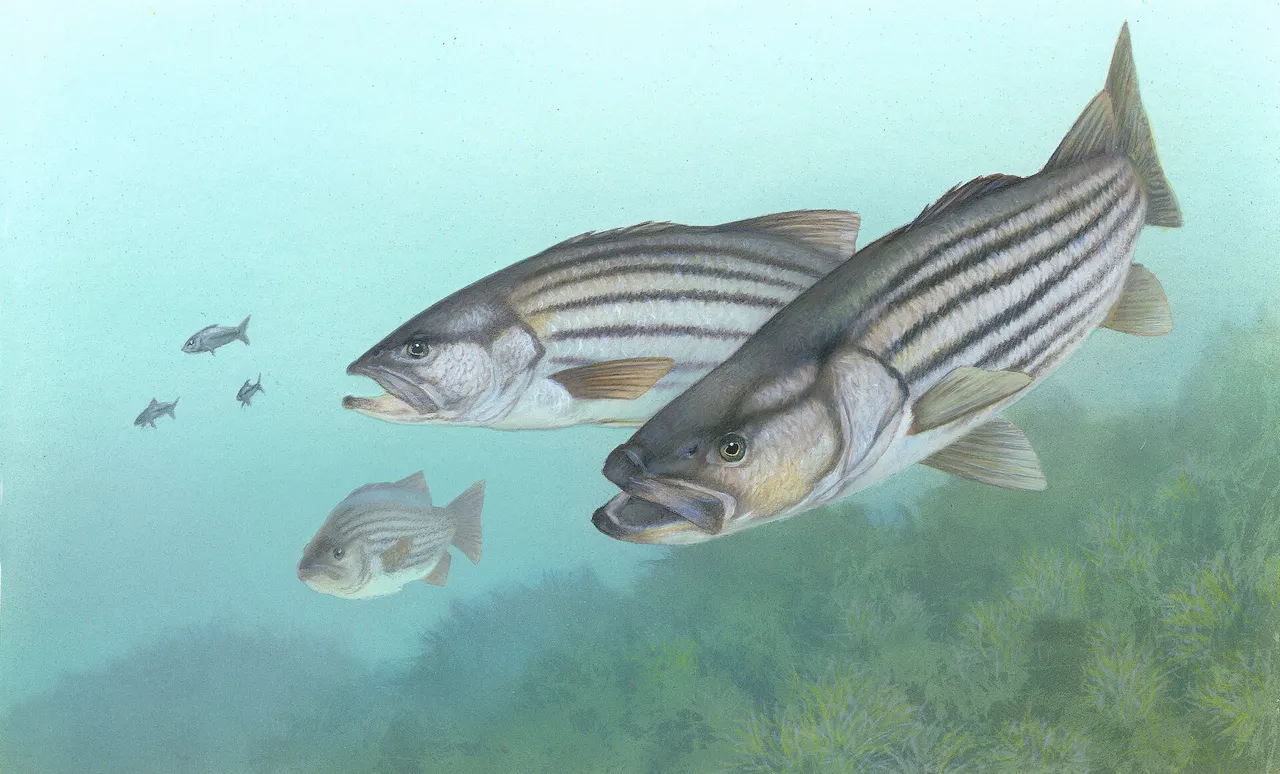
How this was identified, and who took it
Identified by: A scientific illustration, not a photograph, and catalogued as illustrative rather than identification for that reason. The seven horizontal stripes, separate dorsal fins and projecting lower jaw are accurately drawn.Timothy Knepp — Public domain, via Wikimedia Commons — source, licence
Catching Striped bass
Everything here on fishing for it. Each entry opens the page behind it.
- Ground
The striped bass is the defining sport fish of the North American Atlantic seaboard. It runs to a very large size, feeds in water shallow enough to wade, takes bait, lure and fly with equal willingness, and is accessible from a beach — which between them make it the fish an enormous number of people on that coast actually fish for.
It is anadromous: adults live in coastal water and bays and run into rivers to spawn in spring. That life history is the thread running through everything about the species, including its management, because a fish that must reach specific river reaches to reproduce is a fish whose population depends on those rivers remaining passable and clean.
It is also a genuine fishery-management case study. The Atlantic stock collapsed severely in the 1970s and early 1980s, was subjected to strict and unpopular restrictions including moratoria, and recovered — one of the clearer demonstrations that fisheries management can work when it is applied early enough and hard enough. Subsequent management has been contested and the stock has been assessed as overfished again in more recent decades, which is the honest coda rather than a tidy ending.
Gear for this fish
- Soft plasticsA soft plastic on a leadhead covers the whole column and is the standard answer to stripers holding in current around structure, where the fish are stationed facing flow and the lure has to be presented moving with it.
- Surface luresNight and low-light surface fishing for stripers is a distinct tradition, and it works because the fish move shallow after dark to feed against structure they will not approach in daylight.
- SwimbaitsLarge swimbaits answer stripers keyed on big single prey items — herring, menhaden, mackerel — where a small lure in a shoal of large bait is simply not seen.
Identification
- Scientific name
- Morone saxatilis
- Family
- Moronidae
- Water
- Saltwater, Brackish, Freshwater, Moves between fresh and salt water
- Conservation status
- Least Concern
- Regions
- North America
- Seven to eight distinct unbroken dark horizontal stripes along the silver flank — the character the fish is named for and the one that separates it from most confusable species.
- Two clearly separate dorsal fins, the first spiny and the second soft.
- Body elongate and only moderately deep, silver-white below shading to olive or blue-grey above.
- Large mouth with the upper jaw extending past the rear of the eye in adults.
- Note that hybrids with white bass occur where both are present, and these show broken rather than continuous stripes.
Size
- Typical
- 2–7 kg (4–15 lb)
- Large
- 10–18 kg (22–40 lb)
Exceptional: Over 25 kg (55 lb); maximum published weight 57 kg
Striped bass spawning, and a migration that structures a coast
ESTABLISHED. Striped bass are anadromous, spawning in fresh and brackish water in spring and spending the rest of the year in coastal salt water. Spawning requires flowing water: the eggs are semi-buoyant and must remain suspended in the current to survive, which is why particular river systems matter so much to the population and why obstruction and flow alteration have direct consequences.
THE MIGRATION IS THE OTHER STRUCTURAL FACT. Coastal populations move along the seaboard seasonally, which means the same fish support fisheries hundreds of miles apart at different times of year and that management has to be coordinated across many jurisdictions to mean anything.
WHAT ANGLERS RELIABLY REPORT. Feeding concentrated around moving water — tide races, rips, inlets and current edges — and heavy nocturnal feeding in summer. Both are consistent with a predator that hunts by ambushing bait carried on current, and the first in particular is close to universal observation.
WHAT IS UNRESOLVED. How far individual fish show site fidelity within a season, which bears on whether local depletion is a real effect or a redistribution.
Size, slot and season rules for this species change frequently. Check the current position with the relevant state or federal authority.
Backed by research — why, and the sources (2)
Supported by peer-reviewed research or fisheries science. The sources are listed and can be checked.
- FishBase: a global information system on fishes — Froese, R. and D. Pauly, eds. — FishBase Consortium (Scientific institute)Relied on for: Life history, spawning biology, habitat association and feeding ecology for the species.States this directlyPassage read and verified
- Freshwater Fishes of the British Isles — HarperCollins (New Naturalist 75), 1992 (Reference work)Relied on for: Life history and behaviour of European freshwater fishes, independently of the angling literature.Background and mechanism onlyCitation checked — the work exists and is described correctly
A hardy fish with a specific warm-water weakness
Striped bass are strong, robust and generally straightforward to handle, and the fishery's release mortality problem comes from somewhere most anglers do not look.
THE HANDLING PROPER IS SIMPLE. Stiff dorsal spines and a hard-edged gill cover with a spine at the corner — the injuries are grazes and punctures to a hand gripping across the back or behind the head. There are no cutting teeth; the mouth has abrasive pads, and lipping is safe with the body supported. A large striper held vertically by the jaw is being damaged, and this is a heavy-bodied fish where that matters.
THE ACTUAL PROBLEM IS WARM WATER AND EXHAUSTION. Striped bass are a cool-water species fished hard through summer, and release mortality rises sharply with water temperature. A fish that has fought hard in warm water and is then held out of it has a materially reduced chance, and the death happens later and out of sight. Where summer water is warm, fish at night or early, shorten the fight, and keep the fish in the water.
CIRCLE HOOKS ARE NOW REQUIRED IN SOME FISHERIES when fishing bait for this species, because deep hooking with J hooks was a substantial and avoidable source of mortality. That requirement is a handling measure even though it applies before the fish is hooked.
AND THE STOCK CONTEXT MATTERS. This population has collapsed and recovered inside living memory and has been under pressure again since. Release mortality is a real term in its assessment rather than an abstraction, and how carefully a released fish is treated is part of the fishery's arithmetic.
THE ANGLER'S HAZARD IS THE GROUND: night surf, jetties, rocks and waders. That is where this fishery hurts people.
Backed by research — why, and the sources (2)
Supported by peer-reviewed research or fisheries science. The sources are listed and can be checked.
- Do we need species-specific guidelines for catch-and-release recreational angling? — Biodiversity and Conservation 14:1195–1209, 2005 (Scientific literature)Relied on for: That post-release mortality varies with species, capture depth, water temperature, air exposure and handling, and that species-specific guidance outperforms general guidance.States this directlyCitation checked — the work exists and is described correctly
- A review of catch-and-release angling mortality with implications for no-take reserves — Reviews in Fish Biology and Fisheries 15:129–154, 2005 (Scientific literature)Relied on for: Review of hooking and release mortality across fisheries, including the contribution of depth of capture and handling duration.States this directlyCitation checked — the work exists and is described correctly
A coastal migration that is really a bait migration, plus a river run on top
Striped bass have two seasonal patterns running simultaneously, and the confusion between them accounts for most of the disagreement about when the fishing is good.
THE COASTAL MIGRATION IS THE LARGE ONE. Stripers move along the coast with water temperature — poleward and inshore as water warms, back toward the equator and offshore as it cools — and this produces the wave of fish that arrives in successive areas through the year. It is a temperature-driven redistribution of a whole population rather than a journey with a destination.
BUT THE FISH ARE FOLLOWING FOOD, NOT A THERMOMETER READING. What actually decides whether a local area holds fish is whether the bait is there: menhaden, herring, sand eel, squid, whatever the coast produces. Temperature sets the broad envelope; prey sets where within it the fish concentrate. That is why the timing of a local season varies between years, why a mark can be full of fish one week and empty the next with no change in water temperature, and why experienced anglers pay attention to bait sightings rather than dates.
THE SPRING RIVER RUN IS SUPERIMPOSED ON THIS. Stripers are anadromous, ascending coastal rivers to spawn in fresh or nearly fresh water, and that produces a concentrated movement of large fish into estuaries and rivers that is genuinely calendar-linked because it is triggered by warming water and photoperiod. It is a different phenomenon from the coastal migration and it is the one that most affects where big fish are found in spring.
AND THE DAILY FISHING IS TIDAL EVERYWHERE THE GROUND IS TIDAL. Stripers feed on moving water around structure — rips, points, bars, bridge pilings, inlets — because current concentrates and disorients prey and lets an ambush predator work with the flow doing the labour. A mark that is dead at slack is alive an hour into the ebb, all year, and that daily pattern is more reliable than any seasonal one.
Which gives the honest summary: temperature sets the region, bait sets the mark, tide sets the hour, and the calendar is a rough proxy for the first of those only.
Backed by research — why, and the sources (4)
Supported by peer-reviewed research or fisheries science. The sources are listed and can be checked.
- FishBase: a global information system on fishes — Froese, R. and D. Pauly, eds. — FishBase Consortium (Scientific institute)Relied on for: Depth range, migration, spawning season and temperature association recorded for the species.States this directlyPassage read and verified
- ICES Advice on fishing opportunities, catch and effort — International Council for the Exploration of the Sea (Scientific institute)Relied on for: Stock distribution, seasonal movement between spawning and feeding grounds, and the assessment basis for the stock.States this directlyCitation checked — the work exists and is described correctly
- NOAA Ocean Service tides and water levels educational tutorial — National Oceanic and Atmospheric Administration, United States (Government fisheries body)Relied on for: Tidal generation, the spring–neap cycle, and the relationship between tidal range and tidal stream velocity.States this directlyPassage read and verified
- FishBase: a global information system on fishes — Froese, R. and D. Pauly, eds. — FishBase Consortium (Scientific institute)Relied on for: Habitat association and feeding behaviour recorded for the species.Background and mechanism onlyPassage read and verified
An estuary fish that migrates along a coast, and the freshwater river it cannot do without
Striped bass use more distinct habitats than almost any fish on the Atlantic seaboard, and the population's health depends on the one they spend the least time in.
THE SPAWNING HABITAT IS FRESH OR NEARLY FRESH FLOWING RIVER. Striped bass are anadromous: they run into the tidal fresh reaches of large coastal rivers to spawn, and the eggs are semi-buoyant and must stay suspended in the current long enough to hatch. That requires a specific combination of flow, depth and salinity in a particular reach — too little current and the eggs settle and suffocate. It is the narrowest requirement in the species' life and it is why a handful of river systems produce most of the coastal population.
THE NURSERY HABITAT IS THE UPPER AND MIDDLE ESTUARY. Juveniles spend their first years in brackish estuarine water, using shallow shoals, marsh edge and channel margins, and year-class strength is driven heavily by flow and temperature conditions in those reaches during the first months. The connection between a wet spring in one river system and the fishing along hundreds of miles of coast several years later is direct.
THE ADULT HABITAT IS COASTAL, STRUCTURAL AND MOBILE. Mature fish occupy inshore coastal waters, estuaries, rips, reefs, rock, surf beach, harbour structure, bridges and inlets, and they migrate along the coast seasonally with temperature — northward and inshore as water warms, southward and offshore as it cools. Within that, they relate strongly to moving water over structure: an inlet on the ebb, a rip over a bar, a bridge pier in current. Striped bass hunt where hydraulics deliver prey to them, which is why tide state is nearly as important as location.
SOME POPULATIONS NEVER SEE THE SEA. Landlocked striped bass in reservoirs occupy open water, relating to thermal structure, baitfish schools and inflow currents rather than to tide. They are the same fish in a completely different habitat, and much of what is true of coastal fish does not transfer.
TEMPERATURE AND OXYGEN SET SUMMER LIMITS IN ESTUARIES. In warm months, striped bass in stratified estuaries are squeezed between surface water that is too warm and deep water that is too low in oxygen — a habitat squeeze that concentrates fish and stresses them, and one that worsens with nutrient loading.
AND THE FRESHWATER END IS THE FRAGILE END. Dams, water abstraction, flow alteration and pollution in a small number of spawning rivers govern a fishery that operates over an entire coastline.
Backed by research — why, and the sources (2)
Supported by peer-reviewed research or fisheries science. The sources are listed and can be checked.
- NOAA National Ocean Service education on estuaries and the National Estuarine Research Reserve System — National Oceanic and Atmospheric Administration, United States (Government fisheries body)Relied on for: Estuarine structure and function, the salinity gradient, turbidity maxima, and the nursery role of estuarine habitat.States this directlyCitation checked — the work exists and is described correctly
- FishBase: a global information system on fishes — Froese, R. and D. Pauly, eds. — FishBase Consortium (Scientific institute)Relied on for: Salinity tolerance, habitat association and life-stage distribution for the species.States this directlyPassage read and verified
Semi-buoyant eggs in a river current, and why one river's flow decides a coast's fishing
Striped bass reproduction depends on a physical requirement so specific that the entire coastal population rests on a small number of river systems meeting it.
THE EGGS MUST STAY SUSPENDED. Striped bass spawn in the tidal fresh and near-fresh reaches of large coastal rivers, releasing semi-buoyant eggs that are slightly denser than fresh water. They must be held in suspension by turbulence and current for the period before hatching; if they settle onto the bottom they suffocate. So spawning requires a reach with enough flow, enough depth and enough turbulence for long enough.
WHICH MAKES RIVER FLOW A DIRECT DETERMINANT OF YEAR-CLASS STRENGTH. Wet springs with strong flows produce good year classes; low-flow springs produce poor ones. The relationship is direct enough that recruitment indices track spring hydrology, and it is why abstraction, impoundment and flow regulation in a handful of rivers have coastwide consequences.
THE SPAWNING ACT IS CONSPICUOUS. Groups of males surround a female at the surface in violent, splashing activity, and it is one of the few large-fish spawning events readily visible from a riverbank.
TIMING IS TEMPERATURE-CUED AND NARROW. Spawning occurs within a fairly tight temperature window in spring, and a cold snap or an early warm spell shifts it. Because different rivers warm at different rates, the spawning wave moves progressively along the coast.
LARVAE AND JUVENILES DEPEND ON THE UPPER ESTUARY, where salinity, temperature and food must align in the weeks after hatching. Survival in that window drives year-class strength as much as spawning success does, which is why estuarine water quality matters as much as river flow.
MATURITY IS LATE, PARTICULARLY IN FEMALES, and fecundity rises steeply with size — so the largest females, which are the ones a coastal fishery encounters on the autumn migration, carry a disproportionate share of the reproductive capacity. Slot limits in several jurisdictions exist because of that arithmetic.
AND THE MANAGEMENT PICTURE IS COMPLEX AND CHANGES OFTEN, differing between states, between coastal and river waters, and between seasons. Nothing above indicates what any current rule is; the competent authority does.
Backed by research — why, and the sources (2)
Supported by peer-reviewed research or fisheries science. The sources are listed and can be checked.
- FishBase: a global information system on fishes — Froese, R. and D. Pauly, eds. — FishBase Consortium (Scientific institute)Relied on for: Reproductive mode, spawning season, fecundity, size and age at maturity, and larval development recorded for the species.States this directlyPassage read and verified
- The IUCN Red List of Threatened Species — International Union for Conservation of Nature (Conservation authority)Relied on for: Assessment and life-history account, including reproductive biology and the pressures acting on recruitment.Background and mechanism onlyCitation checked — the work exists and is described correctly
Three fisheries, one fish, and a hook choice that decides survival
Striped bass are fished in surf, from boats and around structure, and the tackle for each is decided by the water rather than by the fish — but one decision runs across all three and it matters more than the rest.
THE SURF FISHERY IS A DISTANCE AND HOLDING PROBLEM. A long rod, enough lead to hold in moving water, and line thin enough not to bleed casting energy. As with cod, line diameter drives the amount of weight needed, which drives everything else. The fish that arrives is frequently smaller than the outfit suggests, and the outfit is fighting the sea.
THE STRUCTURE FISHERY IS AN EXTRACTION PROBLEM. Around bridge piers, rips over bars, jetties and rock, a hooked bass must be turned before it reaches something that cuts. That argues for shorter, more powerful rods, heavier leader, and abrasion resistance in the last few metres rather than raw breaking strain in the middle.
THE BOAT AND LIGHT-TACKLE FISHERY IS A PRESENTATION PROBLEM. Trolling, jigging, live-lining and fly fishing over open water all permit far lighter gear because there is nothing to lose the fish on, and the tackle is chosen for the lure or bait weight and the depth.
TIDE AND CURRENT SET THE WEIGHT IN EVERY VERSION. Striped bass hunt where hydraulics deliver prey, so the fishing happens in moving water, and the practical question in every one of these fisheries is how much weight is needed to get the offering where the fish are and keep it there.
AND THE DECISION THAT RUNS ACROSS ALL THREE IS THE HOOK. Striped bass are widely released under slot limits, and deep hooking on bait is the largest single determinant of whether a released fish survives. Circle hooks measurably reduce deep hooking on bait-fished stripers, to the point that their use is required in some fisheries; on lures, single hooks reduce damage and unhooking time relative to trebles.
WHAT MAY BE RETAINED, AT WHAT SIZE AND WITH WHAT GEAR is set by state and interstate authorities, differs along the coast, and changes. FishingHQ does not state what any current rule is.
Official guidance — why, and the sources (2)
Stated by a fisheries authority, scientific institute or recognised angling body. Authoritative, but summarising rather than demonstrating.
- Understanding the Complexity of Catch-and-Release in Recreational Fishing — Reviews in Fisheries Science 15:75–167, 2007 (Scientific literature)Relied on for: Catch-and-release outcomes and the tackle and handling variables that govern post-release survival, including hooking location and fight duration.States this directlyCitation checked — the work exists and is described correctly
- Do we need species-specific guidelines for catch-and-release recreational angling? — Biodiversity and Conservation 14:1195–1209, 2005 (Scientific literature)Relied on for: Physiological consequences of capture and the effect of gear choice on injury, exhaustion and recovery.States this directlyCitation checked — the work exists and is described correctly
Lures fished where the water does the concentrating
Striped bass lure fishing is a reading-water discipline, and the principle behind it is the same one that governs the fish's habitat: stripers position themselves where hydraulics deliver prey, and the lure has to be in that delivery.
RIPS, INLETS AND STRUCTURE IN CURRENT ARE THE GROUND. A tide race over a bar, an inlet on the ebb, the down-current side of a bridge pier, a rip off a point — in each case moving water is concentrating and disorienting bait, and stripers are holding behind or below it. A lure cast up-current and allowed to swing through the seam is presenting the way the fish expects food to arrive.
WHICH MAKES TIDE STATE MORE IMPORTANT THAN LURE CHOICE. A mark works at a particular phase of tide and is largely empty otherwise, and anglers who talk in tide hours rather than clock hours are doing so for this reason.
SURFACE LURES WORK WHEN THE FISH ARE UP AND FEEDING, particularly at dawn, dusk and at night in shallow water, and in a blitz where bass are pushing bait to the surface. They are the most exciting and the least reliable option.
SUB-SURFACE PLUGS AND SOFT PLASTICS ARE THE WORKHORSES because they can be held in current at a controlled depth, which is what the fishery actually requires. A soft plastic on a weighted head is the tool for fishing deeper water, holes and the bottom of a rip.
METALS SOLVE DISTANCE AND WIND from a beach or a jetty when fish are beyond the range of a lighter lure, and they cut a headwind that would kill a plug's flight.
MATCHING THE BAIT IS GENUINELY USEFUL HERE, more so than for many species. Stripers keying on sand eels, on peanut bunker or on herring can be selective about profile, and matching the size and silhouette of whatever is present frequently converts follows into takes.
AND SINGLE HOOKS ARE WORTH THE TRADE. Stripers are widely released under slot limits, treble-hooked plugs produce complex hook holds and slow releases, and a fish being returned deserves the terminal tackle that suits release. What may be retained is a matter for the competent authority and changes.
What experienced anglers do — why, and the sources (2)
Widely and independently recommended by experienced anglers and specialist sources. This is real angling knowledge, not proof: controlled evidence for it is limited, and FishingHQ records it as convention rather than as a demonstrated effect.
- Sea Angler — Bauer Media (Specialist angling publication)Relied on for: Established shore and boat angling practice, including method selection and the reasoning behind it.States this directlyCitation checked — the work exists and is described correctly
- General angling website restatements of established technique — Various (Credible secondary source)Relied on for: The widely restated practice for this species, recorded as a consensus position rather than as an original observation.States this directlyCitation checked — the work exists and is described correctly
Lifecycle and reproduction
Anadromous. Adults live in coastal waters and bays and enter rivers in spring to spawn, with some populations landlocked in reservoirs. Eggs are semi-buoyant and require flowing water to stay suspended until hatching, which ties recruitment tightly to river flow conditions in the spawning window. Growth is fast and the species is long-lived, with the largest fish being old females.
Spawns in fresh or brackish water in spring, broadcasting eggs into the current with no parental care. The eggs' dependence on being kept suspended by flow means that a river's discharge in the spawning weeks materially determines that year's recruitment — which makes year-class strength unusually variable and makes a run of poor years a management problem rather than a statistical fluctuation. Large females produce disproportionately more eggs, which is the argument behind slot limits where they are applied.
Feeding and senses
A voracious and opportunistic predator. Larvae take zooplankton; juveniles take small shrimps, crustaceans, annelid worms and insects; adults take a wide range of fish including alewives, herring, smelt, eels, flounders and silversides, along with squid, crabs, sea worms and amphipods. The breadth is the practical point — striped bass are usually eating whatever is locally abundant, which is why matching the local bait beats matching a lure catalogue.
Feeds effectively in low light, in turbid water and at night, using the lateral line and hearing as much as sight. This is why surf fishing for the species is so often a night activity, why lures that push water work in coloured surf, and why a moving tide with disturbed water outfishes flat calm clarity more often than not.
Through the year
Strongly migratory along the coast, moving north and inshore as water warms and south and offshore as it cools, with the spring river run superimposed on that. Fish follow bait, so the timing of a local season depends on when the bait arrives rather than on a date. Tidal state governs the fishing on any given day, and the species feeds hard on moving water around structure where current concentrates prey.
Distribution
Western Atlantic, from the St Lawrence River in Quebec south to Lake Pontchartrain in Louisiana, and in Florida in the St Johns and Suwannee drainages. Introduced to the Pacific coast of North America and landlocked in many reservoirs.
This is a biological range — where the species occurs, not a prediction that you will catch one. To browse the fishing geography FishingHQ holds, start at fishing places.
Why anglers care
One of the most heavily fished saltwater sport species in North America, taken from surf beaches, rock, jetties, boats and rivers on bait, lures and fly. Accessibility from the shore is central to its importance: it is a very large fish that an angler without a boat can genuinely expect to catch. Both catch-and-release and take-for-the-table cultures are strong, and the tension between them shapes the management debate.
Handling and returning
A large, strong fish best handled in the water where possible. Support horizontally rather than lifting vertically by the jaw, which damages the jaw structure of a heavy fish. The gill covers are sharp. Fish caught in warm water or after a long fight need time to recover before release — hold the fish upright, facing into any current, until it leaves under its own power.
Going further
- What does striped bass eat? — feeding biology, kept separate from what anglers infer from it.
- Striped bass vs White bass — how to tell them apart.
Safety
Drowning and immersion — Can cause serious injury or death
Much of this fishing is done in the surf, from rock jetties and from wave-washed platforms, frequently at night. Being knocked off balance by surf, or swept from rock, is the risk that dominates.
What reduces it: Wear a buoyancy aid where wading or on rock. Never fish rock marks alone or with your back to the sea. Check the tide and identify the exit before starting. Carry a light and a means of calling for help.
Injury while handling fish — Can cause injury needing treatment
Sharp gill covers and a strong, heavy fish that thrashes in the surf or at boatside. Cuts to hands and forearms are routine, and a large fish can injure somebody holding it badly.
What reduces it: Handle in the water, support the body horizontally, keep fingers clear of the gill plates, and use pliers rather than fingers for unhooking.
Precautions that always apply here
- Wear a buoyancy aid or lifejacket. Cold water incapacitates strong swimmers within a minute, long before swimming ability matters.
- Check the tide before you go and know your exit route. Being cut off is the commonest way a shore session becomes a rescue.
- Wet your hands before touching a fish. Dry hands strip the protective mucus layer that keeps infection out.
- Support the fish's weight along its body, keep it out of the water for as short a time as possible, and hold it over something soft.
- Tell somebody where you are going and when you expect to be back.
- Carry a charged phone in a waterproof case, or another means of calling for help.
Check the rules before you fish
Fishing laws, bylaws, access rules, seasons, bait restrictions and permitted methods vary by location and can change. Check the current rules from the relevant authority and the water you intend to fish before fishing.
Check with:
- Current national or regional law for where you are fishing
- Current local bylaws
- The relevant fisheries authority
- The landowner, club or fishery whose water it is
- Any restrictions specific to the species or the method you intend to use
Where to go next
Similar and related fish
- AlewifeRiver herring runs are a major spring feeding opportunity for striped bass in coastal rivers, and landlocked striped bass populations depend on alewife almost entirely.
- Atlantic herringAdult herring are taken by large striped bass in the northern part of the range, particularly at night over structure.
- Atlantic menhadenMenhaden are the principal prey of coastal striped bass, and the autumn bass fishery along the American Atlantic coast is organised entirely around where the menhaden shoals are.
Where it lives
- EstuaryAnadromous, so the estuary is not habitat it uses but the corridor it must pass through — which makes river passability a determinant of the population independent of anything done at sea.
- Surf beachesOne of the few very large fish an angler without a boat can genuinely expect to catch, feeding in water shallow enough to wade — which is why the surf fishery on that coast is what it is.
Where you will find it
Understanding this fish
Told apart from
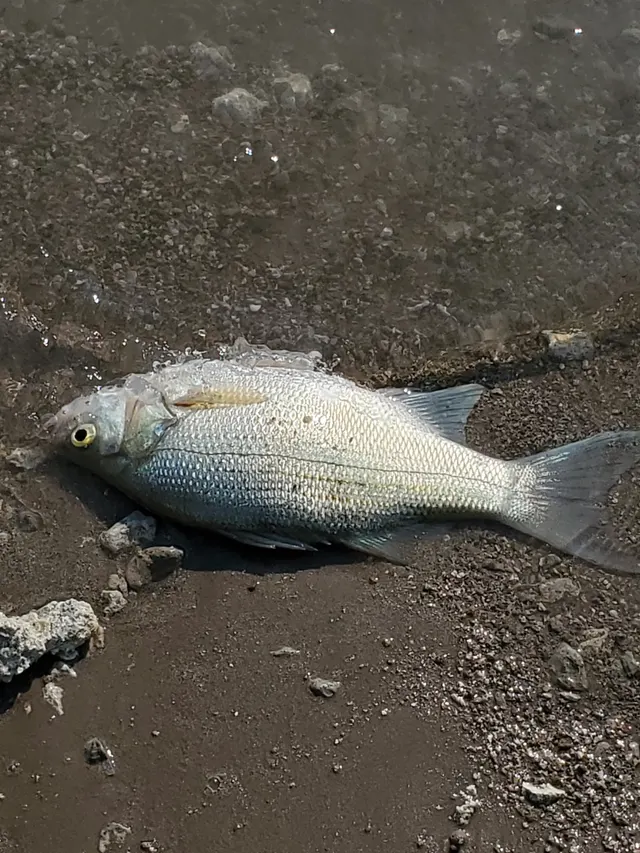 White bassTwo temperate basses plus a deliberate hybrid between them stocked widely across North America, which makes this a three-way problem rather than a two-way one. A striped bass is more elongate with unbroken continuous stripes; a white bass is deeper-bodied with faint and often broken stripes, and only one stripe reaches the tail. The hybrid is intermediate and is the reason a confident field call is frequently wrong.
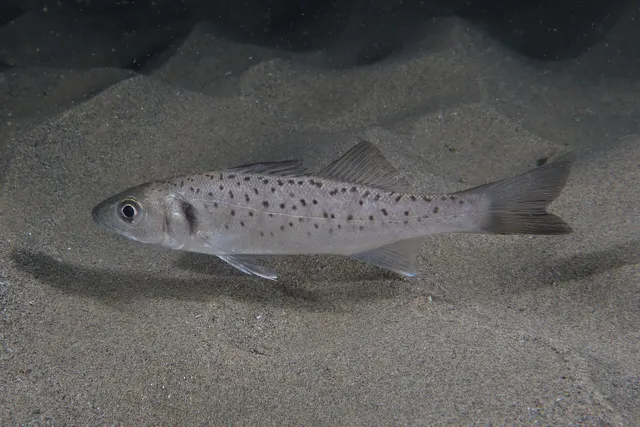 European sea bassDifferent families entirely, and the same fishery: both are silver inshore predators fished from surf and estuary, both depend on estuarine nursery habitat, and both have been through severe management interventions.
Sources and evidence
- FishBase: a global information system on fishes — Froese, R. and D. Pauly, eds. — FishBase Consortium (Scientific institute)Relied on for: Scientific name, family placement in the Moronidae, maximum length of 200 cm and maximum published weight of 57 kg, distribution from the St Lawrence to Lake Pontchartrain with Florida populations, occurrence in marine, fresh and brackish water with adults entering rivers to spawn in spring and some populations landlocked, anadromy, and the diet of larvae.States this directlyPassage read and verified
- FishBase: a global information system on fishes — Froese, R. and D. Pauly, eds. — FishBase Consortium (Scientific institute)Relied on for: The IUCN Red List category — Least Concern, assessed 3 February 2019 — is taken from FishBase's republication.States this directlyPassage read and verified
- RNLI water safety guidance: cold water shock and Float to Live — Royal National Lifeboat Institution (Water-safety or diver-training authority)Relied on for: The nature of the risk from surf, swell and coastal rock to people fishing at the water's edge, and the value of a buoyancy aid and a means of calling for help.FishingHQ's interpretation of what it saysPassage read and verified
Why the 13 connections on this page are here, and the sources
Similar and related fish
Backed by research — 3 connections
Supported by peer-reviewed research or fisheries science. The sources are listed and can be checked.
Alewife
Recorded diet evidence identifies Alosa pseudoharengus as a food item of this predator at species level. The edge is written at that granularity and no further.
- FishBase: a global information system on fishes — Froese, R. and D. Pauly, eds. — FishBase Consortium (Scientific institute)Relied on for: Food items recorded for this predator, including Alosa pseudoharengus.States this directlyPassage read and verified
- FAO Species Identification Guides for Fishery Purposes and the FAO Species Catalogues — Food and Agriculture Organization of the United Nations (Scientific institute)Relied on for: Species account describing the diet of this predator in the region where Alosa pseudoharengus occurs.Background and mechanism onlyCitation checked — the work exists and is described correctly
Atlantic herring
Recorded diet evidence identifies Clupea harengus as a food item of this predator at species level. The edge is written at that granularity and no further.
- FishBase: a global information system on fishes — Froese, R. and D. Pauly, eds. — FishBase Consortium (Scientific institute)Relied on for: Food items recorded for this predator, including Clupea harengus.States this directlyPassage read and verified
- FAO Species Identification Guides for Fishery Purposes and the FAO Species Catalogues — Food and Agriculture Organization of the United Nations (Scientific institute)Relied on for: Species account describing the diet of this predator in the region where Clupea harengus occurs.Background and mechanism onlyCitation checked — the work exists and is described correctly
Atlantic menhaden
Recorded diet evidence identifies Brevoortia tyrannus as a food item of this predator at species level. The edge is written at that granularity and no further.
- FishBase: a global information system on fishes — Froese, R. and D. Pauly, eds. — FishBase Consortium (Scientific institute)Relied on for: Food items recorded for this predator, including Brevoortia tyrannus.States this directlyPassage read and verified
- FAO Species Identification Guides for Fishery Purposes and the FAO Species Catalogues — Food and Agriculture Organization of the United Nations (Scientific institute)Relied on for: Species account describing the diet of this predator in the region where Brevoortia tyrannus occurs.Background and mechanism onlyCitation checked — the work exists and is described correctly
How it is caught
What experienced anglers do — 1 connection
Widely and independently recommended by experienced anglers and specialist sources. This is real angling knowledge, not proof: controlled evidence for it is limited, and FishingHQ records it as convention rather than as a demonstrated effect.
Surfcasting
A practitioner claim about the defining method for the species.
- Sea Angler — Bauer Media (Specialist angling publication)Relied on for: Practitioner treatment of surf and beach technique for large inshore predators.Citation checked — the work exists and is described correctly
- General angling website restatements of established technique — Various (Credible secondary source)Relied on for: Widely restated accounts of striped bass as a surf-fishing species.Citation checked — the work exists and is described correctly
Gear for this fish
What experienced anglers do — 3 connections
Widely and independently recommended by experienced anglers and specialist sources. This is real angling knowledge, not proof: controlled evidence for it is limited, and FishingHQ records it as convention rather than as a demonstrated effect.
Soft plastics
A practitioner claim about which lure family answers this species' feeding or holding behaviour.
- General angling website restatements of established technique — Various (Credible secondary source)Relied on for: Widely restated North American lure practice for this species.Background and mechanism onlyCitation checked — the work exists and is described correctly
- IGFA International Angling Rules and World Record Requirements — International Game Fish Association (Angling or fisheries organisation)Relied on for: Recognition of the species as an established sport fish taken on artificial lures, and the tackle conventions used for it.States this directlyPassage read and verified
Surface lures
A practitioner claim about which lure family answers this species' feeding or holding behaviour.
- General angling website restatements of established technique — Various (Credible secondary source)Relied on for: Widely restated North American lure practice for this species.Background and mechanism onlyCitation checked — the work exists and is described correctly
- IGFA International Angling Rules and World Record Requirements — International Game Fish Association (Angling or fisheries organisation)Relied on for: Recognition of the species as an established sport fish taken on artificial lures, and the tackle conventions used for it.States this directlyPassage read and verified
Swimbaits
A practitioner claim about which lure family answers this species' feeding or holding behaviour.
- General angling website restatements of established technique — Various (Credible secondary source)Relied on for: Widely restated North American lure practice for this species.Background and mechanism onlyCitation checked — the work exists and is described correctly
- IGFA International Angling Rules and World Record Requirements — International Game Fish Association (Angling or fisheries organisation)Relied on for: Recognition of the species as an established sport fish taken on artificial lures, and the tackle conventions used for it.States this directlyPassage read and verified
Where it lives
Backed by research — 2 connections
Supported by peer-reviewed research or fisheries science. The sources are listed and can be checked.
Estuary
A life-history claim with direct management consequences.
- FishBase: a global information system on fishes — Froese, R. and D. Pauly, eds. — FishBase Consortium (Scientific institute)Relied on for: That Morone saxatilis is anadromous, moving into fresh or brackish water to spawn, with adults inhabiting coastal waters and bays and entering rivers during the spring spawning season.States this directlyPassage read and verified
Surf beaches
A habitat claim held to a scientific standard.
- FishBase: a global information system on fishes — Froese, R. and D. Pauly, eds. — FishBase Consortium (Scientific institute)Relied on for: That Morone saxatilis inhabits coastal waters and bays, occurs in marine, fresh and brackish water, and enters rivers to spawn in spring.States this directlyPassage read and verified
Where you will find it
Backed by research — 1 connection
Supported by peer-reviewed research or fisheries science. The sources are listed and can be checked.
North American saltwater fishing
A distributional claim taken from reference sources on the species rather than from angling report. It states presence and asserts nothing about a fishery.
- FishBase: a global information system on fishes — Froese, R. and D. Pauly, eds. — FishBase Consortium (Scientific institute)Relied on for: Distribution, habitat association, depth range and life history recorded for the species concerned.States this directlyPassage read and verified
- The IUCN Red List of Threatened Species — International Union for Conservation of Nature (Conservation authority)Relied on for: Global distribution, population trend and extinction-risk assessment for the species concerned.States this directlyCitation checked — the work exists and is described correctly
Understanding this fish
Backed by research — 1 connection
Supported by peer-reviewed research or fisheries science. The sources are listed and can be checked.
Bass: the same word for unrelated fish
The case that shows the word cuts across families rather than along them.
- FishBase: a global information system on fishes — Froese, R. and D. Pauly, eds. — FishBase Consortium (Scientific institute)Relied on for: Family and genus placement for the unrelated fish that carry the common name bass, establishing that the name has no taxonomic content.States this directlyPassage read and verified
Told apart from
Backed by research — 2 connections
Supported by peer-reviewed research or fisheries science. The sources are listed and can be checked.
White bass
An identification comparison naming both binomials: Morone chrysops and Morone saxatilis.
- FishBase: a global information system on fishes — Froese, R. and D. Pauly, eds. — FishBase Consortium (Scientific institute)Relied on for: Morphological and distributional data for Morone chrysops and for Morone saxatilis.States this directlyPassage read and verified
- The IUCN Red List of Threatened Species — International Union for Conservation of Nature (Conservation authority)Relied on for: Separate assessments treating Morone chrysops and Morone saxatilis as distinct species.States this directlyCitation checked — the work exists and is described correctly
An identification link between two species readers genuinely mistake for one another, resting on published morphological characters rather than on angling lore, and naming the character that separates them.
- FishBase: a global information system on fishes — Froese, R. and D. Pauly, eds. — FishBase Consortium (Scientific institute)Relied on for: Morphological description, meristic counts, family placement, distribution and environment of the species named.States this directlyPassage read and verified
- FAO Species Identification Guides for Fishery Purposes and the FAO Species Catalogues — Food and Agriculture Organization of the United Nations (Scientific institute)Relied on for: Identification characters and distribution for inland and coastal fishes, from regional identification guides prepared for fishery purposes.States this directlyCitation checked — the work exists and is described correctly
European sea bass
A comparison resting on documented life history rather than on the shared word bass, which is precisely the confusion it exists to resolve.
- FishBase: a global information system on fishes — Froese, R. and D. Pauly, eds. — FishBase Consortium (Scientific institute)Relied on for: That Morone saxatilis is a Moronidae, anadromous, entering rivers to spawn, and inhabiting coastal waters and bays.States this directlyPassage read and verified
- Cefas science, advice and data on marine and freshwater environments — Centre for Environment, Fisheries and Aquaculture Science (Government fisheries body)Relied on for: The role of estuarine nursery areas in the life history of European sea bass and the management measures applied to that stock.States this directlyCitation checked — the work exists and is described correctly
How FishingHQ labels evidence is explained in the evidence policy.