What does striped bass eat?
What is established about how striped bass feeds, kept separate from what anglers infer from it.
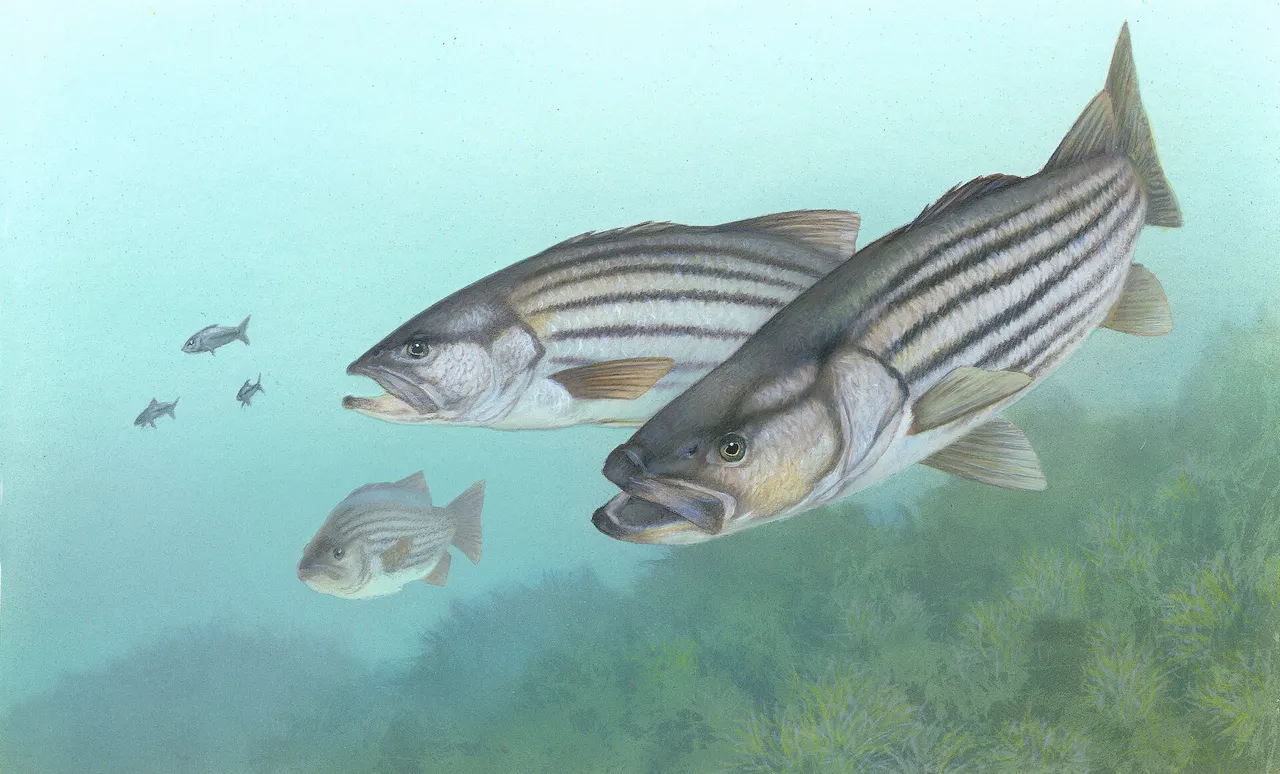
How this was identified, and who took it
Identified by: A scientific illustration, not a photograph, and catalogued as illustrative rather than identification for that reason. The seven horizontal stripes, separate dorsal fins and projecting lower jaw are accurately drawn.Timothy Knepp — Public domain, via Wikimedia Commons — source, licenceWhat is known about how it feeds
The striped bass is the broadest feeder in this file, and the breadth is the point rather than a failure to be specific.
Larvae take zooplankton. Juveniles take small shrimps, crustaceans, worms and insects. Adults take an extremely wide range of fish — alewife, herring, menhaden, smelt, eels, flounders, silversides — along with squid, crabs, sea worms and amphipods. Very little that moves in coastal or estuarine water on that coast is excluded.
The three verified relationships are the ones that matter most in practice. Menhaden are the principal coastal prey and the fish the autumn migration follows. River herring runs are a major spring feeding event in coastal rivers, and landlocked striped bass depend on alewife almost entirely. Adult herring are taken by large fish in the northern part of the range.
What unifies them is that all three are oily, dense-shoaling, high-energy clupeids. A striped bass is not indiscriminate so much as opportunistic within a preference for concentrated calories, and its distribution reflects where those concentrations are rather than where the water is right.
The anadromous life history sits underneath all of it: fish that spawn in fresh water, feed along the coast, and in landlocked reservoirs have had the coastal half of that removed and replaced with alewife.
The food
Prey with a verified dietary link to this fish. Each entry carries its own evidence, and each is written at the precision the source actually used: a named species where the source named one, a group or food category where it said “polychaetes”, “crustaceans” or “detritus” and meant it. That is why this list is shorter than the animal’s real diet rather than longer.
- Atlantic menhaden — Brevoortia tyrannus
Menhaden are the principal prey of coastal striped bass, and the autumn bass fishery along the American Atlantic coast is organised entirely around where the menhaden shoals are.
- Alewife — Alosa pseudoharengus
River herring runs are a major spring feeding opportunity for striped bass in coastal rivers, and landlocked striped bass populations depend on alewife almost entirely.
- Atlantic herring — Clupea harengus
Adult herring are taken by large striped bass in the northern part of the range, particularly at night over structure.
Food with no page of its own here yet
These are real components of the diet, listed as plain text because FishingHQ has no page for them yet. Inventing pages to make the list look fuller would be the fabrication this whole approach exists to prevent.
- Atlantic silversides
- sand eels
- American eels
- blue crabs
- squid
- sea worms
What anglers do with this
Everything below is interpretation, not finding. It is what experienced anglers conclude from the biology above, and the reasoning is usually sound and almost never tested. It is separated from the biology deliberately.
Follow the bait is the whole of the practical reasoning, and on this coast it is unusually literal: the autumn fishery is a menhaden fishery observed from the shore, and anglers locate fish by locating shoals and the birds working them.
The river herring runs convert into a spring pattern in coastal rivers, and the same reasoning applies to landlocked fisheries where alewife movements set where the fish are.
The breadth of the diet is used to argue that presentation and location matter more than matching a specific prey item, which is a reasonable inference from a genuinely catholic diet and is convention rather than a result.
Stock status has swung substantially within living memory and management measures change; retention rules are a question for the relevant fisheries authority.
What this does not establish
Three relationships out of a diet that includes dozens of items. Composition differs completely between the coastal migratory population, resident estuarine fish and landlocked reservoir populations, and between size classes. Nothing here establishes proportions or describes a particular season.
Where this connects
These are the baits, lures, methods and explainers FishingHQ already joins to this fish — which is why the list is sometimes short. They are not chosen for this page, and a link here means an evidenced relationship exists, not that it follows from the diet.
Lures recorded for this species
Methods used for it
Where it lives
The science behind the feeding
This page covers feeding. The Striped bass record covers identification, lifecycle, seasonal behaviour, handling and the sources behind all of it.
Reviewed 2026-08-12.