Atlantic menhaden
Fish · Last reviewed 2026-08-11
A deep-bodied filter-feeding clupeid of the American Atlantic coast, and the forage species that most of the region's inshore sport fisheries are built on.
Background, not a fishing profile
This page is here so FishingHQ can describe a biological relationship accurately — usually because a fish covered elsewhere on the site feeds on this. It covers what it is, where it lives and the evidence behind that relationship, and deliberately nothing about methods, bait or tackle. Its presence here is not a statement that anybody fishes for it.
Menhaden — bunker to most anglers on the American east coast — are oily, deep-bodied clupeids that form dense surface shoals in coastal and estuarine water from Florida to Maine.
They filter-feed on plankton, and in doing so they move an enormous quantity of energy from the base of the food web into a package that striped bass, bluefish, tarpon, red drum, weakfish, cobia and a long list of others feed on directly. A menhaden shoal being attacked from below and by birds from above is the single most recognisable fishing sign on that coast.
Menhaden also support one of the largest fisheries in the United States by volume, taken for fishmeal, oil and bait, and the allocation between that fishery and the forage requirements of predators has been one of the more contested fisheries management questions of recent decades.
The species is here because it is the named prey in the recorded diets of several catalogue species, and because pointing those edges anywhere else would have been a fabrication.
Identification
No photograph of Atlantic menhaden has passed identity review yet, so none is shown. A photograph is published only once somebody has checked the animal in it against the diagnostic features described on this page.
- Scientific name
- Brevoortia tyrannus
- Family
- Clupeidae
- Water
- Saltwater, Brackish
- Conservation status
- Least Concern
- Regions
- North America
- Deep, laterally compressed silver body with a large head making up roughly a third of the total length.
- A distinct dark shoulder spot behind the gill cover, usually followed by a variable line of smaller spots.
- Strongly serrated belly keel that can be felt as a saw edge.
- No teeth in the jaws, and very fine long gill rakers visible when the gill cover is lifted.
Size
- Typical
- 20–30 cm
- Large
- up to about 40 cm
Lifecycle and reproduction
Menhaden mature at two to three years and live to around ten or twelve. Juveniles use estuaries as nurseries in enormous numbers before joining coastal shoals, which ties the species tightly to estuarine water quality.
Spawns at sea over an extended season, with timing varying by latitude, releasing buoyant eggs into coastal water. Larvae are carried into estuaries where they develop, and the estuarine phase is the population bottleneck.
Feeding and senses
An obligate filter feeder as an adult, swimming with the mouth open and straining phytoplankton and zooplankton from the water with fine gill rakers. It does not take particulate prey and cannot be caught on a hook by feeding.
Vision and the lateral line coordinate the very tight shoaling that characterises the species. Because it filter-feeds rather than hunts, its sensory ecology is directed at avoiding predation rather than at finding prey.
Through the year
Migrates north along the coast in spring and summer and south in autumn, with the largest and oldest fish generally furthest north. The autumn southward migration produces the concentrated predator fishing that coast is known for.
Distribution
The western Atlantic from northern Florida to Nova Scotia, in coastal waters and estuaries, generally within a few tens of kilometres of shore.
This is a biological range — where the species occurs, not a prediction that you will catch one. To browse the fishing geography FishingHQ holds, start at fishing places.
Why anglers care
Not caught on rod and line — it filter-feeds and does not take a bait — but taken by anglers with cast nets and snag rigs for use as live and cut bait, where that is permitted. Its importance is as the food source that determines where predators are.
Handling and returning
Extremely fragile and quick to die out of water; menhaden used as live bait need a large, well-aerated container and gentle handling. Netting and snagging methods for baitfish are regulated locally and the rules vary between states.
Where to go next
Similar and related fish
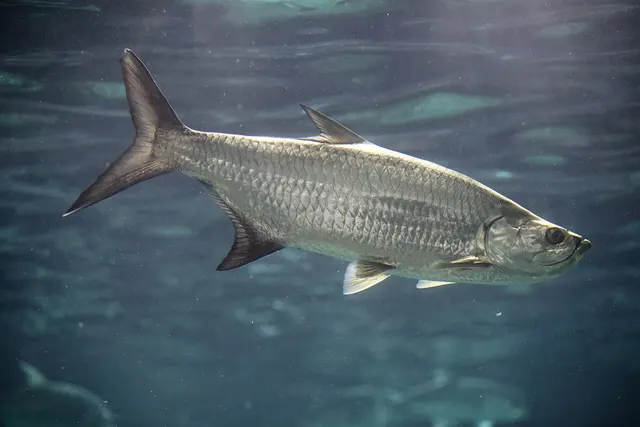 Atlantic tarponTarpon feed on menhaden and other clupeids in coastal water, and migrating tarpon are frequently found where bait shoals concentrate.
- BluefishBluefish attacking menhaden shoals produce the destructive surface feeding the species is known for, and the two are found together through the coastal season.
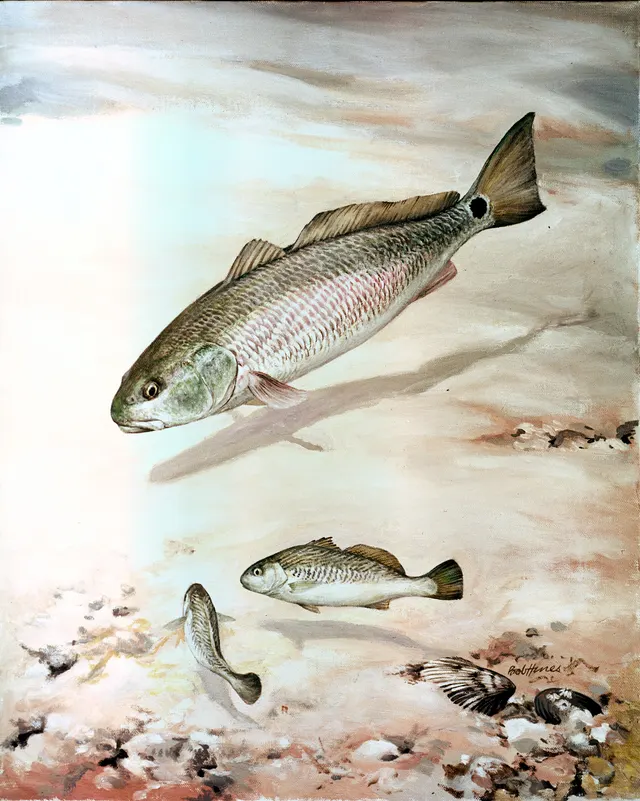 Red drumAdult red drum feed on menhaden in coastal water, and the large autumn schools follow them along the beaches.
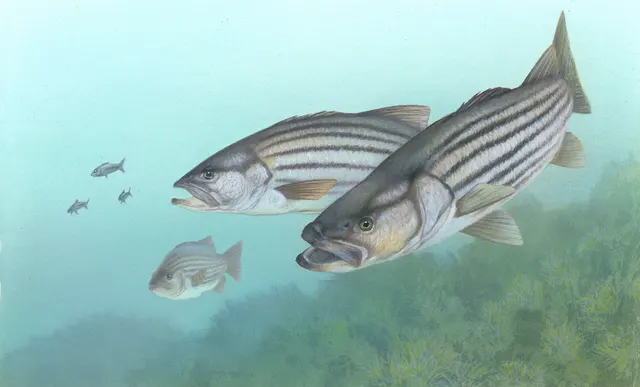 Striped bassMenhaden are the principal prey of coastal striped bass, and the autumn bass fishery along the American Atlantic coast is organised entirely around where the menhaden shoals are.
Sources and evidence
- FishBase: a global information system on fishes — Froese, R. and D. Pauly, eds. — FishBase Consortium (Scientific institute)Relied on for: Species identity, binomial, family placement, size, distribution and recorded biology for this species.States this directlyPassage read and verified
- FAO Species Identification Guides for Fishery Purposes and the FAO Species Catalogues — Food and Agriculture Organization of the United Nations (Scientific institute)Relied on for: The regional species account describing identity, distribution and the role of this species in the fisheries and food webs it belongs to.States this directlyCitation checked — the work exists and is described correctly
Why the 4 connections on this page are here, and the sources
Similar and related fish
Backed by research — 4 connections
Supported by peer-reviewed research or fisheries science. The sources are listed and can be checked.
Atlantic tarpon
Recorded diet evidence identifies Brevoortia tyrannus as a food item of this predator at species level. The edge is written at that granularity and no further.
- FishBase: a global information system on fishes — Froese, R. and D. Pauly, eds. — FishBase Consortium (Scientific institute)Relied on for: Food items recorded for this predator, including Brevoortia tyrannus.States this directlyPassage read and verified
- FAO Species Identification Guides for Fishery Purposes and the FAO Species Catalogues — Food and Agriculture Organization of the United Nations (Scientific institute)Relied on for: Species account describing the diet of this predator in the region where Brevoortia tyrannus occurs.Background and mechanism onlyCitation checked — the work exists and is described correctly
Bluefish
Recorded diet evidence identifies Brevoortia tyrannus as a food item of this predator at species level. The edge is written at that granularity and no further.
- FishBase: a global information system on fishes — Froese, R. and D. Pauly, eds. — FishBase Consortium (Scientific institute)Relied on for: Food items recorded for this predator, including Brevoortia tyrannus.States this directlyPassage read and verified
- FAO Species Identification Guides for Fishery Purposes and the FAO Species Catalogues — Food and Agriculture Organization of the United Nations (Scientific institute)Relied on for: Species account describing the diet of this predator in the region where Brevoortia tyrannus occurs.Background and mechanism onlyCitation checked — the work exists and is described correctly
Red drum
Recorded diet evidence identifies Brevoortia tyrannus as a food item of this predator at species level. The edge is written at that granularity and no further.
- FishBase: a global information system on fishes — Froese, R. and D. Pauly, eds. — FishBase Consortium (Scientific institute)Relied on for: Food items recorded for this predator, including Brevoortia tyrannus.States this directlyPassage read and verified
- FAO Species Identification Guides for Fishery Purposes and the FAO Species Catalogues — Food and Agriculture Organization of the United Nations (Scientific institute)Relied on for: Species account describing the diet of this predator in the region where Brevoortia tyrannus occurs.Background and mechanism onlyCitation checked — the work exists and is described correctly
Striped bass
Recorded diet evidence identifies Brevoortia tyrannus as a food item of this predator at species level. The edge is written at that granularity and no further.
- FishBase: a global information system on fishes — Froese, R. and D. Pauly, eds. — FishBase Consortium (Scientific institute)Relied on for: Food items recorded for this predator, including Brevoortia tyrannus.States this directlyPassage read and verified
- FAO Species Identification Guides for Fishery Purposes and the FAO Species Catalogues — Food and Agriculture Organization of the United Nations (Scientific institute)Relied on for: Species account describing the diet of this predator in the region where Brevoortia tyrannus occurs.Background and mechanism onlyCitation checked — the work exists and is described correctly
How FishingHQ labels evidence is explained in the evidence policy.