Red drum
Fish · Last reviewed 2026-08-10
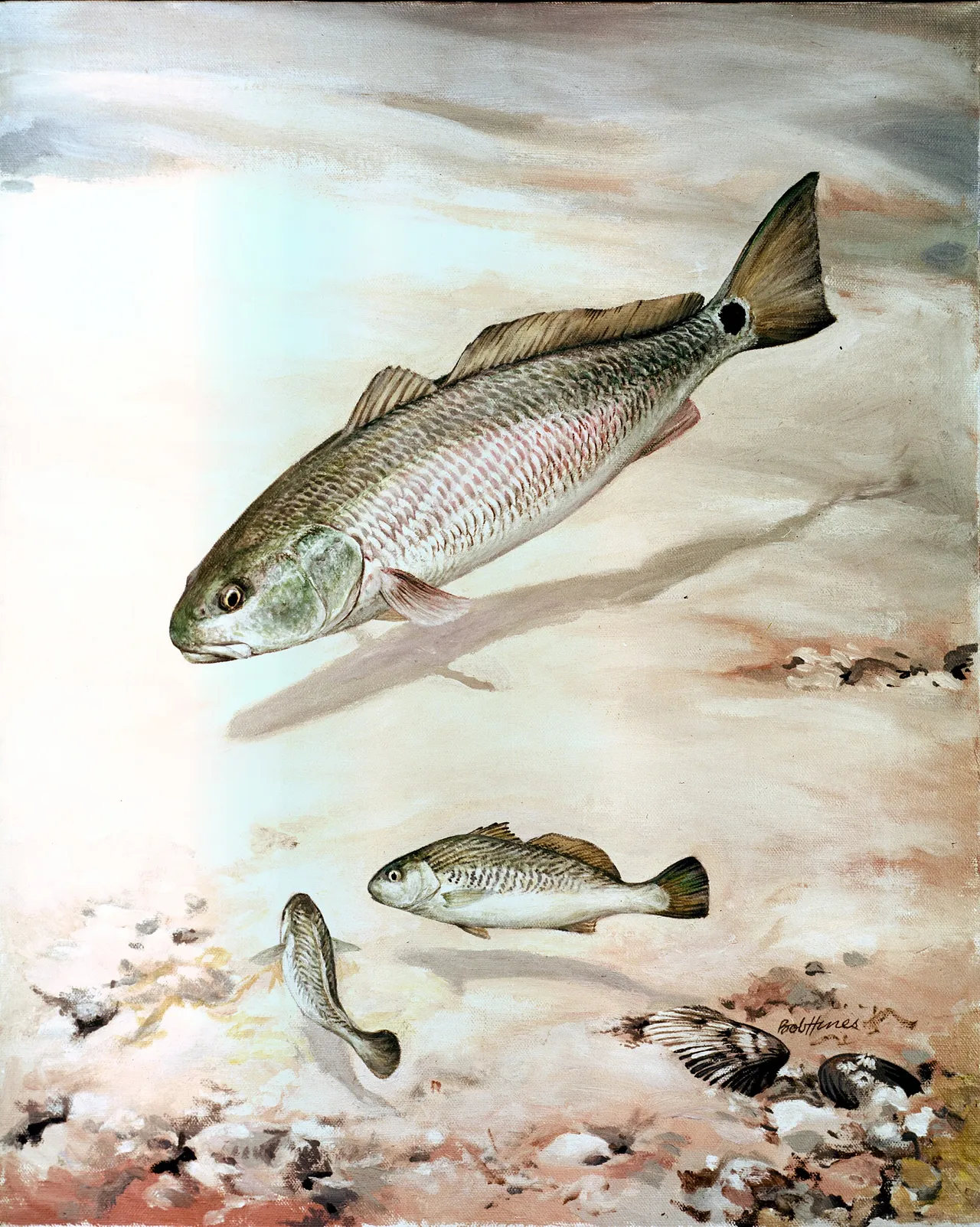
A copper-coloured inshore predator of the American south-east, marked with a false eyespot at the tail, fished on shallow flats where its tail breaks the surface as it feeds.
Safety: injury while handling fish — can cause injury needing treatment. 5 more points apply here.

Catching Red drum
Everything here on fishing for it. Each entry opens the page behind it.
- Ground
- Where
- 1 place FishingHQ documents — strongest claim anywhere: repeatedly reported · From a boat, Fly fishing
The red drum is the fish that made shallow-water sight fishing a mainstream American pursuit. It feeds head-down over sand, mud and grass in water sometimes shallow enough to leave its back exposed, and a feeding fish shows its tail above the surface in a way that is unmistakable and — for an angler — completely addictive.
It is built for that life. The mouth is inferior, set beneath a blunt snout, for rooting crustaceans and molluscs out of the bottom. The body is heavy and copper-bronze, which is close to invisible over turtle grass and marl. And it tolerates a very wide range of salinity, so a single population moves between surf, bay, marsh creek and nearly fresh water according to season and conditions.
The distinctive mark is the ocellus — one or more dark eyespots at the base of the tail. The conventional explanation is that it misdirects a predator's strike towards the tail rather than the head; whether that is actually what it does is less settled than the frequency with which it is asserted, and this page states the mark rather than the explanation.
Its fishery history matters too: heavy commercial demand in the 1980s drove severe declines, and the recovery came through management that made it predominantly a recreational species across much of the range.
How it is caught
Gear for this fish
- Soft plasticsA soft plastic on a light head worked over shallow grass and sand flats is the principal artificial for redfish, taken by a fish feeding head-down on crustaceans.
- Surface luresSurface lures on shallow flats produce a visible and violent take from a fish that has to turn to eat off the top, and this is a mainstream approach rather than a stunt.
Where Red drum is documented
Places where public sources describe this species as fished, with how it is fished and how strongly the evidence supports it. This is not a range map and it is not a recommendation — it is what has been written down about a fishery rather than a record of any individual catch, and being listed is never permission to fish.
What these strengths mean
- Repeatedly reported
- Several independent public accounts. Enough to say it happens more than once; not enough to call it a fishery.
Identification
- Scientific name
- Sciaenops ocellatus
- Family
- Sciaenidae
- Water
- Saltwater, Brackish
- Conservation status
- Least Concern
- Regions
- North America, Caribbean
- One or more black eyespots at the base of the tail — usually one, sometimes several, occasionally none, and the single most recognisable mark on the fish.
- Blunt snout with the mouth set beneath it, adapted for feeding head-down on the bottom.
- Copper-bronze to reddish flanks, paler below; colour varies markedly with habitat, darker over grass and paler over sand.
- Two dorsal fins, the first spiny; no chin barbels, which separates it from black drum.
- Body heavy and slightly humped behind the head in large fish.
Size
- Typical
- 1.5–5 kg (3–11 lb)
- Large
- 10–18 kg (22–40 lb)
Exceptional: Over 25 kg (55 lb); maximum published weight 45 kg
A hardy fish, a hard mouth, and a slot limit that is the handling rule
Red drum are among the more forgiving fish to handle, and the important intelligence is about which fish you are holding rather than about how to hold it.
THE FISH ITSELF. No cutting teeth — a hard, bony mouth with crushing pharyngeal plates for shellfish. Stiff dorsal spines and hard gill covers that will graze a hand. Lipping is safe with body support; a hand across the back finds the dorsal.
THEY ARE ROBUST and survive release well in the temperate and subtropical water they are usually caught in, which is why the fishery supports the pressure it does.
BUT THE LARGE ONES ARE THE POPULATION. Red drum spend their early years inshore and move offshore to join the spawning stock as they mature, so the very large fish — the bull reds — are the breeding adults. Slot limits exist to protect exactly those fish, and this is the clearest example in American saltwater fishing of a rule whose logic is worth understanding rather than merely obeying: keeping the mid-sized fish and releasing the big ones is the opposite of the trophy instinct and it is what keeps the fishery working.
SO A LARGE RED DRUM IS RELEASED, and it should be released properly: horizontal support with two hands, no hanging by the jaw, minimal air time, and revived in the water until it swims off strongly. A forty-inch fish held vertically for a photograph is being damaged.
AND THE WADING HAZARD IS THE ANGLER'S. Red drum are fished on shallow flats holding stingrays. Shuffle rather than step.
What experienced anglers do — why, and the sources (2)
Widely and independently recommended by experienced anglers and specialist sources. This is real angling knowledge, not proof: controlled evidence for it is limited, and FishingHQ records it as convention rather than as a demonstrated effect.
- FishBase: a global information system on fishes — Froese, R. and D. Pauly, eds. — FishBase Consortium (Scientific institute)Relied on for: Dentition, fin and spine morphology, body form, air-breathing capability and distribution for the species, which are the anatomical facts the handling practice below follows from.States this directlyPassage read and verified
- General angling website restatements of established technique — Various (Credible secondary source)Relied on for: Widely restated angling practice for handling this species, recorded as practitioner consensus rather than as tested fact.Background and mechanism onlyCitation checked — the work exists and is described correctly
Drumming in the inlets, and a strategy timed to the tide
Red drum reproduction is organised around getting larvae into the right water, and the species announces the whole process audibly.
THE SOUND IS REAL AND IT IS THE FAMILY'S NAME. Males produce a drumming or croaking noise by contracting specialised muscles against the swim bladder, which acts as a resonating chamber. During the spawning period this is loud enough to be heard by people standing nearby or on a boat above them, and a spawning aggregation of red drum is genuinely audible. It is a courtship signal, and it is one of the few pieces of fish reproductive behaviour a person can perceive without instruments.
THE TIMING IS TIDAL ENGINEERING. Spawning occurs in nearshore water and around inlets, timed so that the buoyant eggs and the larvae that hatch from them are carried by tidal flow into shallow estuarine nursery habitat — marsh edge, seagrass, shallow creek. As with snook, the site is chosen for where the water goes rather than for the comfort of the adults, and the nursery habitat is the part that determines whether any of it works.
AND THE LIFE HISTORY PRODUCES AN UNUSUAL FISHERY STRUCTURE. Red drum spend their early years in estuaries and then, as they mature, move to nearshore and offshore waters — so the population is spatially sorted by age. The small and medium fish are inside; the large breeding adults, the bull reds, are outside. An inshore angler and an offshore angler are fishing different parts of the same population.
THAT IS THE REASONING BEHIND SLOT LIMITS, which are a common instrument for this species. A slot protects the small fish that have not yet spawned AND the large fish that do most of the spawning, permitting harvest only from the middle. It is a management design that follows directly from a population whose reproductive value is concentrated at one end of the size range, and it is worth understanding as a piece of reasoning rather than as an arbitrary rule.
FishingHQ does not state what any slot limit, season or bag limit currently is anywhere. Those are local, they change, and the biology above is the durable part.
Backed by research — why, and the sources (2)
Supported by peer-reviewed research or fisheries science. The sources are listed and can be checked.
- FishBase: a global information system on fishes — Froese, R. and D. Pauly, eds. — FishBase Consortium (Scientific institute)Relied on for: Reproductive mode, spawning season, fecundity, parental care, sex-change pattern and larval development recorded for the species.States this directlyPassage read and verified
- The IUCN Red List of Threatened Species — International Union for Conservation of Nature (Conservation authority)Relied on for: Assessment, population trend, and the life-history traits — age at maturity, longevity, reproductive strategy — that determine sensitivity to exploitation.States this directlyCitation checked — the work exists and is described correctly
An estuary sorted by age, and why the shallows and the ocean are one habitat
Red drum habitat is best understood as a single system that the fish moves through as it grows, which is why the inshore and offshore fisheries for the species look like they are for different animals.
THE JUVENILE HABITAT IS THE SHALLOW ESTUARY. Larvae are carried on tidal flow into estuarine nurseries and settle into the shallowest, most sheltered water available — marsh edge, seagrass, oyster ground, shallow creek and mud flat. Those places offer two things a small fish requires: enormous invertebrate productivity, and water so shallow that most predators cannot follow. Red drum spend their early years there and are the fish an inshore angler catches.
AS THEY GROW THEY MOVE OUT. Larger fish use deeper estuarine channels, passes and nearshore water, and mature adults — the bull reds — occupy nearshore and offshore coastal water, returning toward inlets to spawn. So the population is spatially sorted by age along a gradient from marsh to ocean, and an inshore angler and an offshore angler are working different segments of the same stock.
WITHIN THE ESTUARY THEY FEED HEAD-DOWN ON THE BOTTOM. Red drum have a sub-terminal mouth and take crustaceans and molluscs from sediment and shell, which is why they tail in shallow water — the fish is nose-down on the bottom and its tail comes out of the water — and why the classic sight fishery works at all. That feeding mode ties them to soft and shelled bottom rather than to open water.
SALINITY TOLERANCE IS UNUSUALLY BROAD, which is what allows all of this. Red drum handle nearly fresh water to full seawater, so they use the whole estuarine gradient rather than a band within it, and they move up and down it with rainfall, tide and season.
AND THE OYSTER REEF AND MARSH ARE THE LOAD-BEARING PARTS. Both provide the structure, the invertebrates and the shelter the juvenile stage depends on, and both are lost to dredging, shoreline hardening, subsidence and water-quality decline. A coast can hold plenty of adult red drum offshore and be steadily failing to produce them, and the failure is happening in water too shallow for anybody to be fishing.
Backed by research — why, and the sources (2)
Supported by peer-reviewed research or fisheries science. The sources are listed and can be checked.
- NOAA National Ocean Service education on estuaries and the National Estuarine Research Reserve System — National Oceanic and Atmospheric Administration, United States (Government fisheries body)Relied on for: Estuarine structure and function, the salinity gradient, turbidity maxima, and the nursery role of estuarine habitat.States this directlyCitation checked — the work exists and is described correctly
- FishBase: a global information system on fishes — Froese, R. and D. Pauly, eds. — FishBase Consortium (Scientific institute)Relied on for: Salinity tolerance, habitat association and life-stage distribution for the species.States this directlyPassage read and verified
Two populations in one species: resident juveniles inshore, and the autumn run of big fish
Red drum have one of the clearest split seasonal patterns of any inshore fish, and the split is by size and life stage rather than by month.
THE SMALLER FISH ARE ESTUARINE RESIDENTS AND THEIR YEAR IS A TEMPERATURE CYCLE. Juvenile and sub-adult red drum live in estuaries, marshes, creeks and shallow bays for their first several years. Through the warm months they are spread across flats, marsh edge and shallow shorelines feeding on crustaceans and small fish; as water cools they concentrate in deeper holes, channels and creeks where temperature is stable, and in cold snaps they can be found stacked in remarkable densities in a small amount of deep water. That concentration is a survival response, and it makes them both findable and fragile at the same time.
THE LARGE FISH ARE A DIFFERENT ANIMAL SEASONALLY. Mature red drum leave the estuaries and live in coastal and nearshore waters, and in late summer and autumn they aggregate to spawn — near inlets, passes and the mouths of estuaries, in large schools of big fish. That autumn aggregation is the origin of the entire big-fish fishery, and it is a spawning event rather than a feeding one.
WHICH MATTERS FOR HOW THOSE FISH ARE TREATED. A spawning aggregation of old, highly fecund females is the most valuable and most vulnerable concentration the population produces. Many jurisdictions manage that specifically, often with slot limits that protect large fish. What the rules are on any coast is a matter for the competent authority, and they are not inferable from the biology.
JUVENILES RECRUIT INTO THE MARSH IN AUTUMN AND WINTER. Larvae spawned near the inlets are carried into the estuary and settle into shallow marsh and seagrass, so the year class produced by one autumn's spawning appears in the shallows a few months later. Marsh condition in that window drives recruitment strongly.
AND THE SPECIES TOLERATES A GREAT DEAL, which flattens the seasonal signal in the warm parts of the range. Red drum handle a wide temperature and salinity range, so in the southern part of the range they are catchable year-round and the season is about where they are rather than whether they are there. Further north, cold winters produce genuine seasonal absence and occasional cold-kill events.
Backed by research — why, and the sources (2)
Supported by peer-reviewed research or fisheries science. The sources are listed and can be checked.
- NOAA National Ocean Service education on estuaries and the National Estuarine Research Reserve System — National Oceanic and Atmospheric Administration, United States (Government fisheries body)Relied on for: Estuarine structure and function, the seasonal temperature and salinity regime, and the nursery role of estuarine habitat.States this directlyCitation checked — the work exists and is described correctly
- FishBase: a global information system on fishes — Froese, R. and D. Pauly, eds. — FishBase Consortium (Scientific institute)Relied on for: Spawning season, salinity tolerance, temperature preference and seasonal distribution for the species.States this directlyPassage read and verified
Lifecycle and reproduction
Spawns in late summer and autumn near passes, inlets and the mouths of estuaries, with larvae carried into estuarine nursery habitat on tidal currents. Juveniles and sub-adults live in estuaries and marshes for several years before joining the larger nearshore and offshore spawning population — which is why the accessible fishing is largely for younger fish and the largest fish are found further out.
Broadcast spawning in nearshore water and inlets, timed so that larvae are transported into shallow estuarine nursery habitat. Males produce a drumming sound with the swim bladder during the spawning period, which is where the family name comes from and which is audible to people standing nearby. Slot limits — protecting both small fish and the large breeding adults — are a common management instrument for this species and FishingHQ does not state what any of them currently are.
Feeding and senses
Feeds mainly on crustaceans, molluscs and fishes, rooting head-down in sediment for crabs, shrimp and shellfish. The head-down posture is what produces tailing, the behaviour the sight fishery is built on. In deeper water and in the surf the same fish feed more actively on baitfish, which is why lure and fly selection changes so completely between a shallow flat and a beach gutter.
Well adapted to turbid water: the lateral line and chemical senses carry a great deal of the load, and red drum feed effectively in water where sight-based hunting would be impossible. On clear flats the balance flips and the fish become genuinely spooky, which is why the same species supports both a delicate sight fishery and a bait fishery in coffee-coloured surf.
Through the year
Present year-round through most of the range with movements driven by water temperature and by the autumn spawning aggregation. Cold fronts push fish out of shallow marshes into deeper holes and channels, and a hard freeze can kill fish trapped in shallow water. Tide governs the daily fishing: fish move onto flats and into marsh with the flood to feed and drain off as the water drops.
Distribution
Western Atlantic from Massachusetts to northern Mexico, including southern Florida and the Gulf of Mexico. Occurs over sand and sandy mud in coastal waters and estuaries and is abundant in the surf zone.
This is a biological range — where the species occurs, not a prediction that you will catch one. To browse the fishing geography FishingHQ holds, start at fishing places.
Why anglers care
One of the most important inshore recreational species in the southern United States, fished by sight on shallow flats with fly and light lures, in the surf with bait, and around structure and passes. Its recovery from severe decline through management that curtailed commercial harvest is a well-known case, and the fishery today is predominantly recreational across much of the range.
Handling and returning
Support horizontally with wet hands and minimise time out of the water; a heavy fish lifted by the jaw alone can be damaged. The gill covers are sharp. Large fish caught in warm shallow water need proper revival before release, and where a slot limit protects large breeding fish, returning them promptly and properly is the point of the rule rather than an inconvenience.
Going further
- What does red drum eat? — feeding biology, kept separate from what anglers infer from it.
- Red drum vs Black drum — how to tell them apart.
Safety
Injury while handling fish — Can cause injury needing treatment
Sharp gill covers and dorsal spines, on a heavy and strong fish frequently handled while wading.
What reduces it: Wet hands, support the body horizontally, keep fingers clear of the gill plates, and use pliers for unhooking.
Encounters with marine life — Can cause injury needing treatment
Shallow flats and marsh hold stingrays resting in soft bottom, and a wading angler who steps on one may be barbed in the foot or lower leg. Some parts of the range also hold alligators in brackish marsh.
What reduces it: Shuffle rather than step when wading soft ground, which moves rays aside instead of onto. Wear wading boots. Treat local warnings about large reptiles as authoritative.
Precautions that always apply here
- Wet your hands before touching a fish. Dry hands strip the protective mucus layer that keeps infection out.
- Support the fish's weight along its body, keep it out of the water for as short a time as possible, and hold it over something soft.
- Check the tide before you go and know your exit route. Being cut off is the commonest way a shore session becomes a rescue.
- Do not wade alone. Judge depth and flow from the bank first, and turn back sooner than feels necessary.
Check the rules before you fish
Fishing laws, bylaws, access rules, seasons, bait restrictions and permitted methods vary by location and can change. Check the current rules from the relevant authority and the water you intend to fish before fishing.
Check with:
- Current national or regional law for where you are fishing
- Current local bylaws
- The relevant fisheries authority
- The landowner, club or fishery whose water it is
- Any restrictions specific to the species or the method you intend to use
Where to go next
Similar and related fish
- Atlantic menhadenAdult red drum feed on menhaden in coastal water, and the large autumn schools follow them along the beaches.
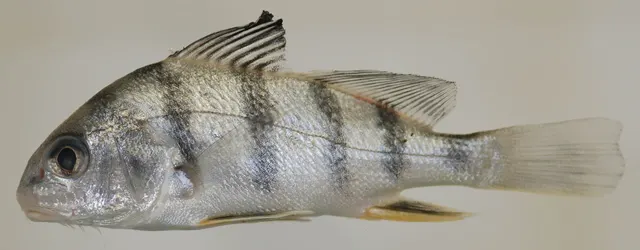 Black drumSciaenids sharing the same estuaries. Black drum have chin barbels and crush shellfish; red drum have none and an eyespot at the tail. Both drum with the swim bladder.
Where it lives
Where you will find it
- North American saltwater fishingThe dominant inshore fish of the south-east and Gulf, and the reason the flats and marsh fishery developed as it did.
- The Gulf of MexicoOccupies the extensive northern marsh and estuary system as juveniles and the nearshore coastal water as adults, aggregating near the passes to spawn.
Understanding this fish
- Decapod crustaceans as preyCrabs are the item most associated with red drum feeding in shallow water, and the tailing behaviour that makes sight fishing possible is crab-directed feeding on the bottom.
- Reading the tideFish move onto flats and into marsh with the flood to feed and drain off as it drops, so the fishing is a window defined by tide rather than a place.
Told apart from
Sources and evidence
- FishBase: a global information system on fishes — Froese, R. and D. Pauly, eds. — FishBase Consortium (Scientific institute)Relied on for: Scientific name, family placement in the Sciaenidae, maximum length of 155 cm and maximum published weight of 45 kg, distribution from Massachusetts to northern Mexico including southern Florida, habitat over sand and sandy mud bottoms in coastal waters and estuaries with abundance in the surf zone, a temperature range of 15 to 26 degrees, a diet mainly of crustaceans, molluscs and fishes.States this directlyPassage read and verified
- FishBase: a global information system on fishes — Froese, R. and D. Pauly, eds. — FishBase Consortium (Scientific institute)Relied on for: The IUCN Red List category — Least Concern, assessed 24 January 2020 — is taken from FishBase's republication.States this directlyPassage read and verified
Why the 13 connections on this page are here, and the sources
Similar and related fish
Backed by research — 2 connections
Supported by peer-reviewed research or fisheries science. The sources are listed and can be checked.
Atlantic menhaden
Recorded diet evidence identifies Brevoortia tyrannus as a food item of this predator at species level. The edge is written at that granularity and no further.
- FishBase: a global information system on fishes — Froese, R. and D. Pauly, eds. — FishBase Consortium (Scientific institute)Relied on for: Food items recorded for this predator, including Brevoortia tyrannus.States this directlyPassage read and verified
- FAO Species Identification Guides for Fishery Purposes and the FAO Species Catalogues — Food and Agriculture Organization of the United Nations (Scientific institute)Relied on for: Species account describing the diet of this predator in the region where Brevoortia tyrannus occurs.Background and mechanism onlyCitation checked — the work exists and is described correctly
Black drum
An identification comparison naming both binomials.
- FishBase: a global information system on fishes — Froese, R. and D. Pauly, eds. — FishBase Consortium (Scientific institute)Relied on for: That Pogonias cromis and Sciaenops ocellatus are both Sciaenidae of the western Atlantic occupying coastal waters and estuaries.States this directlyPassage read and verified
How it is caught
What experienced anglers do — 3 connections
Widely and independently recommended by experienced anglers and specialist sources. This is real angling knowledge, not proof: controlled evidence for it is limited, and FishingHQ records it as convention rather than as a demonstrated effect.
Saltwater fly fishing
The page names sight fishing with fly on shallow flats first, and it is a genuinely distinct fishery from the surf and structure ones: the fish is located visually before anything is presented to it.
- Florida saltwater fishing regulations and Keys sanctuary rules — Florida state wildlife authority and the Florida Keys National Marine Sanctuary (Government fisheries body)Relied on for: Documents which fishery and which technique takes this species.States this directlyCitation checked — the work exists and is described correctly
- General angling website restatements of established technique — Various (Credible secondary source)Relied on for: Independently corroborates the species' recreational capture and range.Background and mechanism onlyCitation checked — the work exists and is described correctly
Spinning
The page names light lures alongside fly for the flats fishery, and around structure and passes where a fly cannot be presented. The two share the water and not the tackle.
- Florida saltwater fishing regulations and Keys sanctuary rules — Florida state wildlife authority and the Florida Keys National Marine Sanctuary (Government fisheries body)Relied on for: Documents which fishery and which technique takes this species.States this directlyCitation checked — the work exists and is described correctly
- General angling website restatements of established technique — Various (Credible secondary source)Relied on for: Independently corroborates the species' recreational capture and range.Background and mechanism onlyCitation checked — the work exists and is described correctly
Surfcasting
The page names the surf bait fishery as one of three, and it is the one that does not require a boat or sighted fish — which makes it the most widely practised of them.
- Florida saltwater fishing regulations and Keys sanctuary rules — Florida state wildlife authority and the Florida Keys National Marine Sanctuary (Government fisheries body)Relied on for: Documents which fishery and which technique takes this species.States this directlyCitation checked — the work exists and is described correctly
- General angling website restatements of established technique — Various (Credible secondary source)Relied on for: Independently corroborates the species' recreational capture and range.Background and mechanism onlyCitation checked — the work exists and is described correctly
Gear for this fish
What experienced anglers do — 2 connections
Widely and independently recommended by experienced anglers and specialist sources. This is real angling knowledge, not proof: controlled evidence for it is limited, and FishingHQ records it as convention rather than as a demonstrated effect.
Soft plastics
A practitioner claim about which lure family answers this species' feeding or holding behaviour.
- General angling website restatements of established technique — Various (Credible secondary source)Relied on for: Widely restated North American lure practice for this species.Background and mechanism onlyCitation checked — the work exists and is described correctly
- IGFA International Angling Rules and World Record Requirements — International Game Fish Association (Angling or fisheries organisation)Relied on for: Recognition of the species as an established sport fish taken on artificial lures, and the tackle conventions used for it.States this directlyPassage read and verified
Surface lures
A practitioner claim about which lure family answers this species' feeding or holding behaviour.
- General angling website restatements of established technique — Various (Credible secondary source)Relied on for: Widely restated North American lure practice for this species.Background and mechanism onlyCitation checked — the work exists and is described correctly
- IGFA International Angling Rules and World Record Requirements — International Game Fish Association (Angling or fisheries organisation)Relied on for: Recognition of the species as an established sport fish taken on artificial lures, and the tackle conventions used for it.States this directlyPassage read and verified
Where it lives
Backed by research — 1 connection
Supported by peer-reviewed research or fisheries science. The sources are listed and can be checked.
Estuary
A habitat claim held to a scientific standard.
- FishBase: a global information system on fishes — Froese, R. and D. Pauly, eds. — FishBase Consortium (Scientific institute)Relied on for: That Sciaenops ocellatus occurs usually over sand and sandy mud bottoms in coastal waters and estuaries and is abundant in the surf zone.States this directlyPassage read and verified
Where you will find it
Backed by research — 2 connections
Supported by peer-reviewed research or fisheries science. The sources are listed and can be checked.
North American saltwater fishing
A distributional claim taken from reference sources on the species rather than from angling report. It states presence and asserts nothing about a fishery.
- FishBase: a global information system on fishes — Froese, R. and D. Pauly, eds. — FishBase Consortium (Scientific institute)Relied on for: Distribution, habitat association, depth range and life history recorded for the species concerned.States this directlyPassage read and verified
- The IUCN Red List of Threatened Species — International Union for Conservation of Nature (Conservation authority)Relied on for: Global distribution, population trend and extinction-risk assessment for the species concerned.States this directlyCitation checked — the work exists and is described correctly
The Gulf of Mexico
A distribution association between an animal and a kind of water, rather than a claim about any named mark.
- FishBase: a global information system on fishes — Froese, R. and D. Pauly, eds. — FishBase Consortium (Scientific institute)Relied on for: Distribution, habitat association and depth range recorded for the species, including its occurrence in the water body concerned.States this directlyPassage read and verified
- The IUCN Red List of Threatened Species — International Union for Conservation of Nature (Conservation authority)Relied on for: Assessment and range account for the species, including the systems and coasts it occupies.Background and mechanism onlyCitation checked — the work exists and is described correctly
Understanding this fish
Backed by research — 2 connections
Supported by peer-reviewed research or fisheries science. The sources are listed and can be checked.
Decapod crustaceans as prey
Recorded diet evidence identifies blue crabs and other decapod crustaceans as a food item of this predator at group level rather than to species. The edge points at the taxon record for that reason, and encoding it as a species-level claim would assert something the source does not.
- FishBase: a global information system on fishes — Froese, R. and D. Pauly, eds. — FishBase Consortium (Scientific institute)Relied on for: Food items recorded for this predator, given as blue crabs and other decapod crustaceans.States this directlyPassage read and verified
- FAO Species Identification Guides for Fishery Purposes and the FAO Species Catalogues — Food and Agriculture Organization of the United Nations (Scientific institute)Relied on for: Species account describing this predator's diet, recorded at the level of blue crabs and other decapod crustaceans.Background and mechanism onlyCitation checked — the work exists and is described correctly
Reading the tide
A behavioural claim driven by a physical mechanism, held on both sides.
- FishBase: a global information system on fishes — Froese, R. and D. Pauly, eds. — FishBase Consortium (Scientific institute)Relied on for: That Sciaenops ocellatus occurs over sand and sandy mud in coastal waters and estuaries and is abundant in the surf zone.States this directlyPassage read and verified
- NOAA Ocean Service tides and water levels educational tutorial — National Oceanic and Atmospheric Administration, United States (Government fisheries body)Relied on for: The tidal cycle that governs when shallow ground floods and drains.States this directlyPassage read and verified
Told apart from
Backed by research — 1 connection
Supported by peer-reviewed research or fisheries science. The sources are listed and can be checked.
Dusky kob
A comparison resting on shared family and shared estuarine dependence, with the divergent status verified on both sides.
- FishBase: a global information system on fishes — Froese, R. and D. Pauly, eds. — FishBase Consortium (Scientific institute)Relied on for: That both Argyrosomus japonicus and Sciaenops ocellatus are Sciaenidae associated with estuaries and the surf zone, with the former assessed as Endangered and the latter as Least Concern.States this directlyPassage read and verified
How FishingHQ labels evidence is explained in the evidence policy.