Black drum
Fish · Last reviewed 2026-08-10
The largest of the drums, reaching over fifty kilograms, with chin barbels, crushing throat teeth and a drumming call audible from a boat.
Safety: injury while handling fish — can cause injury needing treatment. 5 more points apply here.
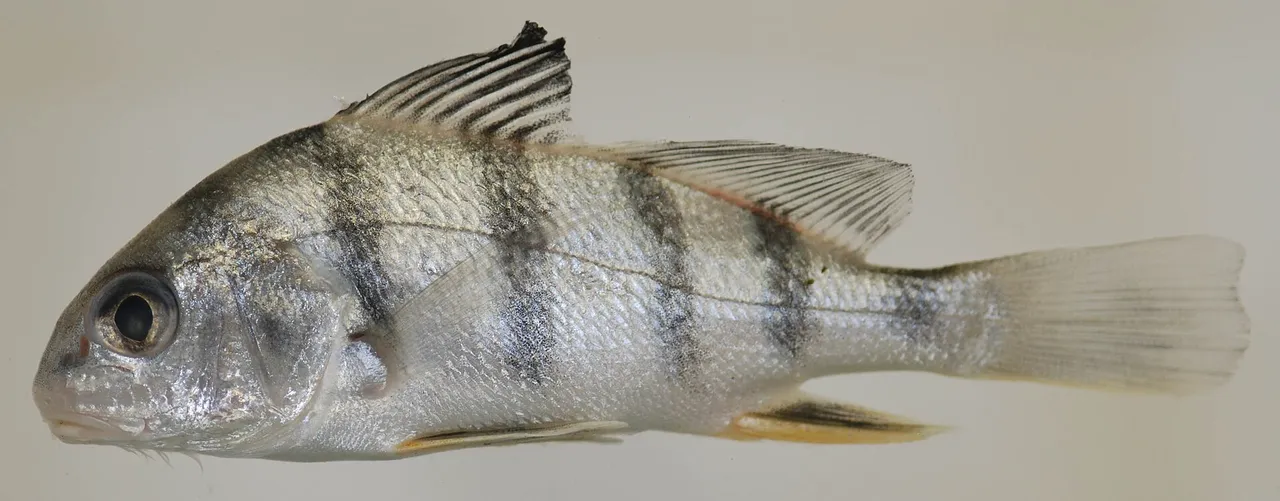
How this was identified, and who took it
Identified by: Complete lateral view of a fresh specimen on a plain ground, with the chin barbels, the deep high-arched body and the juvenile vertical barring all legible. The source records it as a juvenile of 81 mm standard length, and the caption states that plainly because the barring does not persist into adulthood and a reader holding an adult fish would not see it.Smithsonian Environmental Research Center — CC BY 2.0, via Wikimedia Commons — source, licenceCatching Black drum
Everything here on fishing for it. Each entry opens the page behind it.
The black drum is the red drum's larger, heavier, less glamorous relative, and it is a considerably more interesting fish than its reputation suggests.
It is built to eat shellfish. Powerful pharyngeal teeth in the throat crush oysters, clams, mussels and crabs, and the fish locates them using a fringe of chin barbels dragged over the bottom — a combination of detection and demolition that lets it exploit a food source almost nothing else its size can use. Large black drum can be found over oyster beds doing exactly this.
Its other distinctive feature is sound. Drums are named for it: the swim bladder is used to produce a deep resonant drumming, loudest during the spawning period, and it is audible through a boat's hull and sometimes in the air. A large aggregation of spawning black drum is one of the noisier things in inshore water.
It is also long-lived — well over fifty years is documented — and very large fish are old fish. That, combined with the fact that big black drum are generally considered poor eating compared with small ones, has produced an unusual and rather sensible convention in the fishery: keep the small ones, release the large ones.
How it is caught
Identification
- Scientific name
- Pogonias cromis
- Family
- Sciaenidae
- Water
- Saltwater, Brackish
- Conservation status
- Least Concern
- Regions
- North America, Caribbean, Central & South America
- A fringe of short chin barbels beneath the lower jaw — the quickest separation from red drum, which has none.
- High-backed, deep-bodied profile, more humped than a red drum.
- Grey to bronze-black, with strong dark vertical bars in juveniles that fade with age; large adults are often almost uniformly dark.
- No eyespot at the tail base — the red drum's signature mark is absent.
- Powerful crushing teeth in the throat rather than in the jaws; the mouth itself is inferior and unarmed.
Size
- Typical
- 2–8 kg (4.4–18 lb)
- Large
- 15–25 kg (33–55 lb)
Exceptional: Over 35 kg (77 lb); maximum published weight 51 kg
Soft bottoms, brackish water and a fish built to crush shellfish
Black drum occupy shallow, turbid, soft-bottomed coastal water, and their habitat use follows directly from what they eat.
THEY ARE SHELLFISH SPECIALISTS with powerful pharyngeal teeth capable of crushing oysters, clams and crabs. Habitat is therefore wherever those occur in quantity: oyster reef, shell bottom, mud and sand flats, and the margins of bays and estuaries.
TURBIDITY IS NOT A PROBLEM AND IS ARGUABLY AN ADVANTAGE. Black drum hunt by scent, touch and the lateral line rather than by sight, using chin barbels to locate buried prey, so the muddy water of a bay or a river mouth is prime habitat rather than a compromise.
SALINITY TOLERANCE IS BROAD. The species moves freely between full-strength coastal water and distinctly brackish estuary, and juveniles in particular use low-salinity backwaters and marsh as nursery ground.
DEPTH IS SHALLOW FOR MOST OF THE YEAR — bays, channels, passes and surf — with larger fish moving to deeper channels and nearshore Gulf and Atlantic water seasonally.
JUVENILE AND ADULT HABITAT DIFFER SHARPLY. Young fish are marsh and estuary residents; very large old fish are found in deeper channels and around passes and jetties, and the two rarely share ground.
AND STRUCTURE MATTERS LESS THAN BOTTOM TYPE. A black drum is looking for something buried, so the presence of a shell or clam bed predicts them better than a piece of hard structure does.
Backed by research — why, and the sources (2)
Supported by peer-reviewed research or fisheries science. The sources are listed and can be checked.
- FishBase: a global information system on fishes — Froese, R. and D. Pauly, eds. — FishBase Consortium (Scientific institute)Relied on for: Distribution, habitat association, depth range, size, reproduction and life-history parameters recorded for the species.States this directlyPassage read and verified
- The IUCN Red List of Threatened Species — International Union for Conservation of Nature (Conservation authority)Relied on for: Assessment and range account for the species, including the habitats it depends on, its life history and the pressures acting on it.States this directlyCitation checked — the work exists and is described correctly
Drumming to spawn, and a fish that lives for decades
Black drum reproduction combines a distinctive sound-based courtship with extreme longevity, and the combination has real management consequences.
THE NAME IS THE BEHAVIOUR. Males produce a low drumming sound by vibrating muscles against the swim bladder, and the sound is central to spawning aggregation and courtship. It is loud enough to be heard from boats and through hulls, and acoustic surveys of spawning aggregations use it directly.
SPAWNING HAPPENS IN AND AROUND PASSES AND BAY MOUTHS, where fish gather in the cooler part of the year and release eggs into water that will carry the larvae into the estuary. Eggs and larvae are pelagic and recruitment depends on that transport working.
THE TRIGGER IS TEMPERATURE AND PHOTOPERIOD, with spawning concentrated in late winter and spring in the Gulf and south Atlantic, earlier than most of the species sharing that water.
MATURITY COMES EARLY BUT LIFE IS VERY LONG. Black drum are among the longest-lived inshore fishes, with documented ages beyond half a century. A large old drum represents decades of accumulated reproduction, and the biggest fish are disproportionately productive.
WHICH IS WHY THE HANDLING OF LARGE FISH MATTERS MORE THAN THE NUMBERS SUGGEST. Very large black drum are poor eating and highly valuable reproductively, and the practice of releasing them is a stock decision rather than a preference.
THERE IS NO NEST AND NO PARENTAL CARE — the investment is entirely in volume and in the timing that puts larvae where the currents will help them.
Backed by research — why, and the sources (2)
Supported by peer-reviewed research or fisheries science. The sources are listed and can be checked.
- FishBase: a global information system on fishes — Froese, R. and D. Pauly, eds. — FishBase Consortium (Scientific institute)Relied on for: Distribution, habitat association, depth range, size, reproduction and life-history parameters recorded for the species.States this directlyPassage read and verified
- The IUCN Red List of Threatened Species — International Union for Conservation of Nature (Conservation authority)Relied on for: Assessment and range account for the species, including the habitats it depends on, its life history and the pressures acting on it.States this directlyCitation checked — the work exists and is described correctly
A cool-season spawning run and a warm-season bay fishery
Black drum have an unusual seasonal pattern for a warm-water inshore fish: their most concentrated period is the cool one.
THE SPAWNING RUN IS LATE WINTER AND SPRING in the Gulf and south Atlantic, when large fish gather around passes, bay mouths and jetties. That is the period when the biggest fish are most concentrated and most accessible, and it is the aggregation that carries the population's reproduction.
SUMMER DISPERSES THEM INTO THE BAYS AND MARSH, where smaller and medium fish feed over shell and mud on crabs and shellfish, and the fishery becomes a shallow-water one for eating-sized fish.
WINTER PUSHES FISH INTO DEEPER CHANNELS AND HOLES as shallow water cools, and cold snaps in shallow bays can produce local mortality events — a genuine seasonal risk for the species at the northern edge of its range.
THE PRACTICAL EATING SEASONALITY IS SIZE RATHER THAN MONTH. Smaller drum are good eating year-round; very large ones are coarse and frequently carry parasites, and the seasonal concentration of large fish therefore coincides with the fish least worth keeping — which is a fortunate alignment rather than a designed one.
AND THE DRUMMING IS SEASONAL TOO, audible around aggregations in the spawning period and largely absent outside it, which makes the sound itself a seasonal indicator.
Nothing here indicates what any current season, size or bag rule permits.
Backed by research — why, and the sources (2)
Supported by peer-reviewed research or fisheries science. The sources are listed and can be checked.
- FishBase: a global information system on fishes — Froese, R. and D. Pauly, eds. — FishBase Consortium (Scientific institute)Relied on for: Distribution, habitat association, depth range, size, reproduction and life-history parameters recorded for the species.States this directlyPassage read and verified
- The IUCN Red List of Threatened Species — International Union for Conservation of Nature (Conservation authority)Relied on for: Assessment and range account for the species, including the habitats it depends on, its life history and the pressures acting on it.States this directlyCitation checked — the work exists and is described correctly
Crushing plates, sharp covers, and a fish that may be older than you are
Black drum carry no teeth in the jaws worth worrying about and a set of pharyngeal crushing plates deep in the throat that will damage a finger exploring where it should not be. The plates exist to break shellfish and they are entirely capable of it.
The gill covers are sharp, and the fish is heavy. A large black drum is supported horizontally with two hands or handled in the water; lifting one by the jaw puts the whole mass on a joint not built for it.
The fact that changes the handling decision is longevity. Black drum are among the longest-lived inshore fish in the western Atlantic, and a large one may have been alive for decades. Returning it properly is therefore worth disproportionately more than returning a small one, and the same is true of the effort spent reviving it.
The ground carries its own hazard, as it does for most of this fishery: much of it is conducted wading shallow estuarine flats and bars that also hold stingrays buried in soft bottom. Shuffling rather than stepping is the whole of the precaution and it works.
What experienced anglers do — why, and the sources (2)
Widely and independently recommended by experienced anglers and specialist sources. This is real angling knowledge, not proof: controlled evidence for it is limited, and FishingHQ records it as convention rather than as a demonstrated effect.
- Sea Angler — Bauer Media (Specialist angling publication)Relied on for: Inshore and surf practice on handling large heavy fish and wading hazards.Background and mechanism onlyCitation checked — the work exists and is described correctly
- Understanding the Complexity of Catch-and-Release in Recreational Fishing — Reviews in Fisheries Science 15:75–167, 2007 (Scientific literature)Relied on for: Handling, support and revival as determinants of post-release survival.Background and mechanism onlyCitation checked — the work exists and is described correctly
Lifecycle and reproduction
Very long-lived, with documented ages well beyond fifty years, and slow-growing once large. Spawns in late winter and spring near estuary mouths and passes, with pelagic eggs and larvae recruiting into shallow estuarine nursery habitat. The great longevity means that a very large fish represents decades and is not replaced on any useful timescale.
Aggregating spawner in late winter and spring near inlets, passes and estuary mouths, producing pelagic eggs. The drumming call is loudest and most persistent during this period and is used in courtship. The aggregations are predictable in time and place, which makes them both important to recruitment and easy to exploit.
Feeding and senses
Feeds principally on molluscs and crustaceans — oysters, clams, mussels, crabs and shrimp — located with chin barbels dragged across the bottom and crushed with powerful pharyngeal teeth. That specialisation is the practically useful fact: black drum are caught on crab and shellfish baits fished hard on the bottom, and largely ignore the lures and baitfish that take red drum.
Chemical and tactile detection dominate, with the chin barbels carrying dense sensory receptors used to locate buried prey in soft bottom. Hearing is acute — sciaenids are notable for it, which is consistent with a family that communicates by sound. Sight contributes least, and the fish feeds effectively in the turbid estuarine water it prefers.
Through the year
Moves toward inlets and passes to spawn in late winter and spring, then disperses across estuaries, bays and nearshore ground through the warmer months. Cold pushes fish into deeper channels. Tidal flow governs the daily fishing over the shellfish and soft-bottom ground the species feeds on.
Distribution
Western Atlantic from Nova Scotia south through the Gulf of Mexico to Argentina, most abundant in the south-eastern United States and the Gulf. Occurs over sand, mud and shellfish beds in coastal waters, bays and estuaries.
This is a biological range — where the species occurs, not a prediction that you will catch one. To browse the fishing geography FishingHQ holds, start at fishing places.
Why anglers care
A major inshore target in the south-eastern United States and the Gulf, taken on crab and shellfish baits fished on the bottom from boats, piers and the surf. Small fish are highly regarded as food and large ones generally are not, which has produced a sensible convention of retaining small fish and releasing the very large old ones — a rare case of taste and conservation pointing the same way.
Handling and returning
A very large heavy fish with no dangerous teeth in the jaws but powerful crushing plates in the throat and sharp gill covers. Support horizontally with two hands or handle in the water for large fish, keep fingers clear of the gill plates and out of the throat, and revive properly. Given the great longevity, a large fish released properly is worth considerably more than one taken.
Going further
- What does black drum eat? — feeding biology, kept separate from what anglers infer from it.
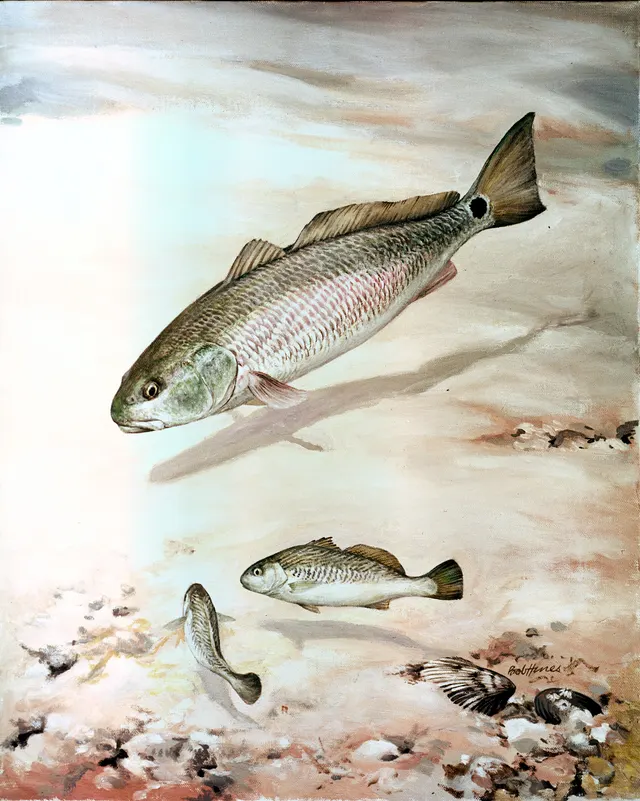
- Black drum vs Red drum — how to tell them apart.
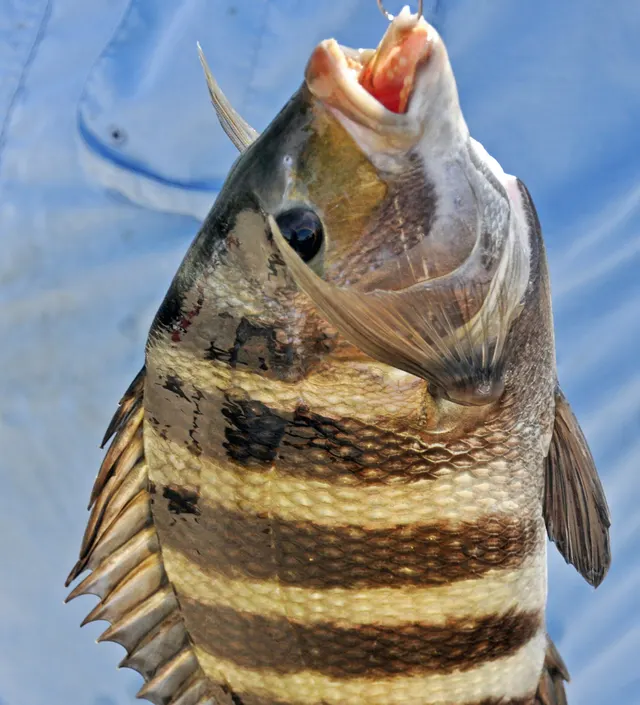
- Black drum vs Sheepshead — how to tell them apart.
Safety
Injury while handling fish — Can cause injury needing treatment
A large heavy fish with sharp gill covers and powerful crushing plates deep in the throat.
What reduces it: Support the body horizontally with two hands or handle in the water. Keep fingers clear of the gill plates and never reach into the throat. Use long pliers for unhooking.
Encounters with marine life — Can cause injury needing treatment
Much of the fishery is conducted while wading shallow estuarine flats and bars that also hold stingrays buried in soft bottom.
What reduces it: Shuffle rather than step when wading soft ground. Wear wading boots. Check tide and exit before going out onto intertidal ground.
Precautions that always apply here
- Wet your hands before touching a fish. Dry hands strip the protective mucus layer that keeps infection out.
- Support the fish's weight along its body, keep it out of the water for as short a time as possible, and hold it over something soft.
- Check the tide before you go and know your exit route. Being cut off is the commonest way a shore session becomes a rescue.
- Do not wade alone. Judge depth and flow from the bank first, and turn back sooner than feels necessary.
Check the rules before you fish
Fishing laws, bylaws, access rules, seasons, bait restrictions and permitted methods vary by location and can change. Check the current rules from the relevant authority and the water you intend to fish before fishing.
Check with:
- Current national or regional law for where you are fishing
- Current local bylaws
- The relevant fisheries authority
- The landowner, club or fishery whose water it is
- Any restrictions specific to the species or the method you intend to use
Where to go next
Similar and related fish
_(12639311174).jpg)
Where you will find it
Understanding this fish
- Bivalve and gastropod molluscs as preyBlack drum crush shellfish with powerful pharyngeal teeth, and their association with oyster and clam beds follows directly from that ability.
- Decapod crustaceans as preyCrabs are taken alongside molluscs and are crushed in the same way, which is why crab baits work so consistently for the species.
Sources and evidence
- FishBase: a global information system on fishes — Froese, R. and D. Pauly, eds. — FishBase Consortium (Scientific institute)Relied on for: Scientific name, family placement in the Sciaenidae, a maximum length of 170 cm TL, a maximum published weight of 51.3 kg, a maximum reported age of 43 years.States this directlyPassage read and verified
- FishBase: a global information system on fishes — Froese, R. and D. Pauly, eds. — FishBase Consortium (Scientific institute)Relied on for: Environment, climate zone and depth range as recorded: Marine; brackish; demersal; oceanodromous ; depth range 10 - ? m. Subtropical; 46°N - 51°SStates this directlyPassage read and verified
- FishBase: a global information system on fishes — Froese, R. and D. Pauly, eds. — FishBase Consortium (Scientific institute)Relied on for: The IUCN Red List category for Pogonias cromis — Least Concern, assessed 30 July 2019 — as republished by FishBase, the Red List itself being unreachable during review.States this directlyPassage read and verified
- Good Fish Guide — Marine Conservation Society (Conservation authority)Relied on for: That longevity and late maturity are material to whether a stock can sustain harvest, which underpins the release convention for large fish.FishingHQ's interpretation of what it saysCitation checked — the work exists and is described correctly
Why the 8 connections on this page are here, and the sources
Similar and related fish
Backed by research — 2 connections
Supported by peer-reviewed research or fisheries science. The sources are listed and can be checked.
Red drum
An identification comparison naming both binomials.
- FishBase: a global information system on fishes — Froese, R. and D. Pauly, eds. — FishBase Consortium (Scientific institute)Relied on for: That Pogonias cromis and Sciaenops ocellatus are both Sciaenidae of the western Atlantic occupying coastal waters and estuaries.States this directlyPassage read and verified
Sheepshead
An identification comparison naming both binomials: Archosargus probatocephalus and Pogonias cromis.
- FishBase: a global information system on fishes — Froese, R. and D. Pauly, eds. — FishBase Consortium (Scientific institute)Relied on for: Morphological and distributional data for Archosargus probatocephalus and for Pogonias cromis.States this directlyPassage read and verified
- The IUCN Red List of Threatened Species — International Union for Conservation of Nature (Conservation authority)Relied on for: Separate assessments treating Archosargus probatocephalus and Pogonias cromis as distinct species.States this directlyCitation checked — the work exists and is described correctly
How it is caught
What experienced anglers do — 2 connections
Widely and independently recommended by experienced anglers and specialist sources. This is real angling knowledge, not proof: controlled evidence for it is limited, and FishingHQ records it as convention rather than as a demonstrated effect.
Ledgering
The page names the bait and the presentation together. Black drum are shellfish specialists with crushing pharyngeal teeth, so the bait choice is the fishery rather than a preference within it.
- Florida saltwater fishing regulations and Keys sanctuary rules — Florida state wildlife authority and the Florida Keys National Marine Sanctuary (Government fisheries body)Relied on for: Documents which fishery and which technique takes this species.States this directlyCitation checked — the work exists and is described correctly
- General angling website restatements of established technique — Various (Credible secondary source)Relied on for: Independently corroborates the species' recreational capture and range.Background and mechanism onlyCitation checked — the work exists and is described correctly
Surfcasting
The page names the surf alongside boats and piers. The convention of retaining small fish and releasing the very large old ones is a shore-fishery convention as much as a boat one.
- Florida saltwater fishing regulations and Keys sanctuary rules — Florida state wildlife authority and the Florida Keys National Marine Sanctuary (Government fisheries body)Relied on for: Documents which fishery and which technique takes this species.States this directlyCitation checked — the work exists and is described correctly
- General angling website restatements of established technique — Various (Credible secondary source)Relied on for: Independently corroborates the species' recreational capture and range.Background and mechanism onlyCitation checked — the work exists and is described correctly
Where you will find it
Backed by research — 2 connections
Supported by peer-reviewed research or fisheries science. The sources are listed and can be checked.
Florida
A distribution association between an animal and a kind of water, rather than a claim about any named mark.
- NOAA National Ocean Service education on estuaries and the National Estuarine Research Reserve System — National Oceanic and Atmospheric Administration, United States (Government fisheries body)Relied on for: Estuarine, seagrass and coastal habitat function in North American waters, and the nursery role of shallow habitat for the species concerned.Background and mechanism onlyCitation checked — the work exists and is described correctly
- FishBase: a global information system on fishes — Froese, R. and D. Pauly, eds. — FishBase Consortium (Scientific institute)Relied on for: Distribution, habitat association, depth range and life history recorded for the species.States this directlyPassage read and verified
The Gulf of Mexico
A distribution association between an animal and a kind of water, rather than a claim about any named mark.
- FishBase: a global information system on fishes — Froese, R. and D. Pauly, eds. — FishBase Consortium (Scientific institute)Relied on for: Distribution, habitat association and depth range recorded for the species, including its occurrence in the water body concerned.States this directlyPassage read and verified
- The IUCN Red List of Threatened Species — International Union for Conservation of Nature (Conservation authority)Relied on for: Assessment and range account for the species, including the systems and coasts it occupies.Background and mechanism onlyCitation checked — the work exists and is described correctly
Understanding this fish
Backed by research — 2 connections
Supported by peer-reviewed research or fisheries science. The sources are listed and can be checked.
Bivalve and gastropod molluscs as prey
Recorded diet evidence identifies bivalve molluscs as a food item of this predator at group level rather than to species. The edge points at the taxon record for that reason, and encoding it as a species-level claim would assert something the source does not.
- FishBase: a global information system on fishes — Froese, R. and D. Pauly, eds. — FishBase Consortium (Scientific institute)Relied on for: Food items recorded for this predator, given as bivalve molluscs.States this directlyPassage read and verified
- FAO Species Identification Guides for Fishery Purposes and the FAO Species Catalogues — Food and Agriculture Organization of the United Nations (Scientific institute)Relied on for: Species account describing this predator's diet, recorded at the level of bivalve molluscs.Background and mechanism onlyCitation checked — the work exists and is described correctly
Decapod crustaceans as prey
Recorded diet evidence identifies decapod crustaceans as a food item of this predator at group level rather than to species. The edge points at the taxon record for that reason, and encoding it as a species-level claim would assert something the source does not.
- FishBase: a global information system on fishes — Froese, R. and D. Pauly, eds. — FishBase Consortium (Scientific institute)Relied on for: Food items recorded for this predator, given as decapod crustaceans.States this directlyPassage read and verified
- FAO Species Identification Guides for Fishery Purposes and the FAO Species Catalogues — Food and Agriculture Organization of the United Nations (Scientific institute)Relied on for: Species account describing this predator's diet, recorded at the level of decapod crustaceans.Background and mechanism onlyCitation checked — the work exists and is described correctly
How FishingHQ labels evidence is explained in the evidence policy.