Sheepshead
Fish · Last reviewed 2026-08-10
A boldly barred inshore sea bream with flattened human-like incisors and heavy molars, built to crush barnacles and shellfish off pilings and structure.
Safety: injury while handling fish — can cause injury needing treatment. One more point applies here.
How this was identified, and who took it
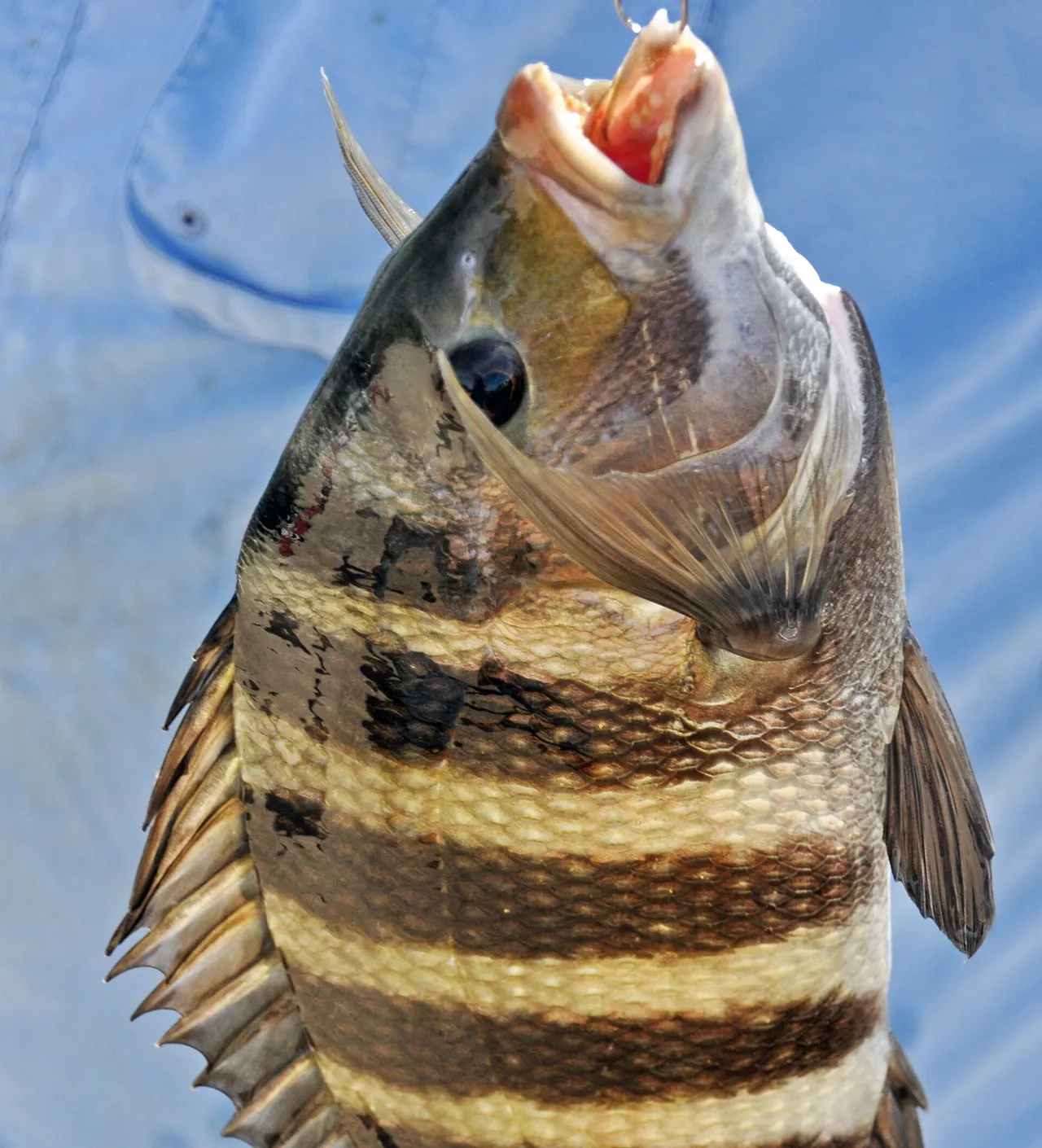
Identified by: Identified on the bar pattern and the dentition together. Five bold dark vertical bars run over a pale flank, the body is deep and strongly compressed with a steep forehead and a small mouth, and heavy sharp spines stand at the front of the dorsal and anal fins. The mouth is open on the broad flattened pale incisors the record calls unlike any other inshore fish of its range. The tail is outside the frame and is not a character here.James St. John — CC BY 2.0, via Wikimedia Commons — source, licence_(Sanibel_Island,_Florida,_USA)_2.jpg)
Catching Sheepshead
Everything here on fishing for it. Each entry opens the page behind it.
Sheepshead is the fish that stops people in a photograph, because its mouth is full of what look unmistakably like human teeth: broad flattened incisors at the front and heavy grinding molars behind. That dentition is not a curiosity. It is a specialised tool for scraping barnacles and mussels off hard structure and crushing them.
Everything about the species follows from it. Sheepshead live where encrusted structure is — bridge and dock pilings, jetties, rock, oyster bar and wreck — and they feed by picking, not by chasing. That makes them notoriously difficult to hook: the bite is a delicate crush rather than a grab, and anglers describe needing to strike before they feel anything.
The bold vertical black bars over a silver-grey body give the fish its other common name.
How it is caught
Gear for this fish
Identification
- Scientific name
- Archosargus probatocephalus
- Family
- Sparidae
- Water
- Saltwater, Brackish
- Conservation status
- Least Concern
- Regions
- North America, Caribbean
- Broad flattened incisor teeth at the front of the jaw with heavy molars behind — unmistakable and unlike any other inshore fish of its range.
- Five to seven bold dark vertical bars over a silver to grey-green body.
- Deep, strongly compressed body with a steep forehead and a small mouth.
- Strong sharp spines at the front of the dorsal and anal fins.
Size
- Typical
- 0.7–2.5 kg (1.5–5.5 lb)
- Large
- 3.5–6 kg (7.7–13 lb)
Exceptional: FishBase records a maximum of 91 cm and 9.6 kg
Teeth that look human, and jaws that break shellfish for a living
Sheepshead have the most disconcerting dentition of any fish on FishingHQ — broad flat incisors at the front that genuinely resemble human teeth, backed by rows of heavy molars — and the disconcerting appearance is not the hazard. The force behind it is.
WHAT THE MOUTH IS FOR. Scraping barnacles from pilings and crushing oysters, crabs and mussels. That requires incisors that can cut a shell free and molars that can break it, driven by heavy jaw musculature. A finger placed inside that apparatus is not cut; it is crushed and can be broken.
SO: NEVER PUT FINGERS IN A SHEEPSHEAD'S MOUTH. Pliers, always, and long ones, because the mouth is small and the hook is usually well inside it.
THE SPINES ARE THE OTHER HALF AND THEY ARE SERIOUS. Sheepshead carry a very stiff spiny dorsal and stout anal spines, sharp enough and rigid enough to produce deep punctures. A fish gripped across the back finds them. Handle from behind with the dorsal folded flat, or hold the fish by the lower jaw from outside with the body supported.
THE GILL COVERS ARE SHARP-EDGED as well, which completes a fish that is armed at every point a hand naturally goes.
AND THE FISH IS ROBUST OTHERWISE. Sheepshead are structure-oriented and hardy, survive release well in the temperate water they are usually caught in, and the main welfare consideration is simply not spending five minutes working a hook out with fingers you should not be using.
What experienced anglers do — why, and the sources (2)
Widely and independently recommended by experienced anglers and specialist sources. This is real angling knowledge, not proof: controlled evidence for it is limited, and FishingHQ records it as convention rather than as a demonstrated effect.
- FishBase: a global information system on fishes — Froese, R. and D. Pauly, eds. — FishBase Consortium (Scientific institute)Relied on for: Dentition, fin and spine morphology, body form, air-breathing capability and distribution for the species, which are the anatomical facts the handling practice below follows from.States this directlyPassage read and verified
- General angling website restatements of established technique — Various (Credible secondary source)Relied on for: Widely restated angling practice for handling this species, recorded as practitioner consensus rather than as tested fact.Background and mechanism onlyCitation checked — the work exists and is described correctly
An inshore fish for most of the year and an offshore spawner for a few weeks
Sheepshead have a seasonal pattern that reverses the usual inshore expectation, and the reversal is the most useful thing to know about them.
MOST OF THE YEAR THEY ARE STRUCTURE FISH IN SHALLOW WATER. Sheepshead occupy piling, jetty, bridge, oyster bar, breakwater and reef structure in estuaries and nearshore waters, feeding on barnacles, oysters, crabs and other hard-shelled prey with the crushing dentition the species is named for. Anywhere with fouling growth on hard structure is sheepshead ground, and they are present through most of the year.
THE EXCEPTION IS THE SPAWNING MOVEMENT, AND IT GOES OUTWARD. In late winter and early spring, mature sheepshead leave the inshore structure and aggregate offshore on reefs and hard bottom to spawn. That is the opposite direction from most inshore species and it produces a genuine inshore lull — the pilings that were crowded in December are quiet in March, and the fish are twenty miles away.
WHICH MAKES THE PRE-SPAWN PERIOD THE CONCENTRATED ONE. As fish stage before moving out, they gather in numbers around nearshore structure, and that late-winter window is when inshore sheepshead fishing is at its best and most predictable. It is also, once again, the period of greatest concentration and greatest vulnerability.
TEMPERATURE MODULATES THE WHOLE CYCLE. Sheepshead tolerate cool water better than many of the fish they share ground with, which is why they remain catchable inshore through winter in areas where snook and seatrout have retreated. At the cooler northern edge of the range they show a more pronounced seasonal absence.
THE FOOD SUPPLY IS SEASONAL TOO AND IT SHAPES BEHAVIOUR. Barnacle and fouling growth on structure builds through the warm months and the invertebrate community on a piling is not the same in February as in August, so the fish's feeding focus shifts with what the structure is carrying.
AND THE FISHERY'S TIMING IS NOT A LEGAL STATEMENT. Sheepshead are managed differently between states and jurisdictions, sometimes with seasonal measures aimed precisely at the spawning aggregation. What applies on any coast is a matter for the competent authority, and the biological pattern above does not indicate it.
Backed by research — why, and the sources (2)
Supported by peer-reviewed research or fisheries science. The sources are listed and can be checked.
- FishBase: a global information system on fishes — Froese, R. and D. Pauly, eds. — FishBase Consortium (Scientific institute)Relied on for: Spawning season, migratory behaviour, temperature preference and seasonal distribution recorded for the species.States this directlyPassage read and verified
- The IUCN Red List of Threatened Species — International Union for Conservation of Nature (Conservation authority)Relied on for: Assessment and life-history account, including reproductive timing and the seasonal pressures on the population.Background and mechanism onlyCitation checked — the work exists and is described correctly
Lifecycle and reproduction
Moderately long-lived, with fish recorded past twenty years. Growth slows markedly with age, so large sheepshead are older than their size suggests and are concentrated around long-established structure.
Spawns offshore in late winter and spring, aggregating away from the inshore structure the species otherwise occupies. Juveniles use seagrass and estuarine habitat before recruiting to hard structure.
Feeding and senses
Crushes barnacles, mussels, oysters, crabs and other hard-shelled invertebrates scraped from pilings, rock and shell. Feeding is a deliberate picking action at close range rather than a pursuit.
A close-range visual feeder working hard structure in daylight, locating individual attached prey by sight and testing it before crushing.
Through the year
Concentrates on inshore structure through the warmer months, moves offshore to spawn in late winter and early spring, and returns as water warms. The pre-spawn concentration is the most productive period for anglers.
Distribution
Western Atlantic: Nova Scotia, Canada and northern Gulf of Mexico to Brazil. Absent in Bermuda, the Bahamas, the West Indies and Grenada
This is a biological range — where the species occurs, not a prediction that you will catch one. To browse the fishing geography FishingHQ holds, start at fishing places.
Why anglers care
A significant inshore target across the American south-east and Gulf, fished with fiddler crab, shrimp and barnacle scraped from the structure itself, presented tight to pilings on light leads. Its reputation rests on difficulty: the crushing bite is famously hard to detect and hook, and among practitioners the consensus is that sheepshead are stolen from rather than caught. Excellent eating, and awkward to fillet because of heavy scales and bones.
Handling and returning
The dorsal and anal spines are stiff and sharp enough to cause deep punctures, and the crushing jaws can injure a finger placed in the mouth. Grip across the body with the spines folded and use pliers. The fish is robust and releases well if handled with wet hands and returned promptly.
Going further
- Sheepshead vs Black drum — how to tell them apart.
Safety
Injury while handling fish — Can cause injury needing treatment
The dorsal and anal spines are rigid and needle-pointed, and cause deep punctures if the fish is gripped carelessly or lands on a hand.
What reduces it: Grip across the body from front to back with the spines folded, wear gloves where possible, and use pliers for unhooking.
Species that bite — Can cause injury needing treatment
The molars are powerful enough to crush shellfish and will injure a finger placed inside the mouth.
What reduces it: Never put fingers in the mouth. Use long-nosed pliers or a dehooker.
Where to go next
Similar and related fish
Where it lives
Where you will find it
Sources and evidence
- FishBase: a global information system on fishes — Froese, R. and D. Pauly, eds. — FishBase Consortium (Scientific institute)Relied on for: Family, maximum size, depth and environment, distribution and the IUCN assessment for Archosargus probatocephalus.States this directlyPassage read and verified
- The IUCN Red List of Threatened Species — International Union for Conservation of Nature (Conservation authority)Relied on for: The Least Concern assessment for Archosargus probatocephalus, assessed 31 March 2011.States this directlyCitation checked — the work exists and is described correctly
Why the 8 connections on this page are here, and the sources
Similar and related fish
Backed by research — 1 connection
Supported by peer-reviewed research or fisheries science. The sources are listed and can be checked.
Black drum
An identification comparison naming both binomials: Archosargus probatocephalus and Pogonias cromis.
- FishBase: a global information system on fishes — Froese, R. and D. Pauly, eds. — FishBase Consortium (Scientific institute)Relied on for: Morphological and distributional data for Archosargus probatocephalus and for Pogonias cromis.States this directlyPassage read and verified
- The IUCN Red List of Threatened Species — International Union for Conservation of Nature (Conservation authority)Relied on for: Separate assessments treating Archosargus probatocephalus and Pogonias cromis as distinct species.States this directlyCitation checked — the work exists and is described correctly
How it is caught
What experienced anglers do — 2 connections
Widely and independently recommended by experienced anglers and specialist sources. This is real angling knowledge, not proof: controlled evidence for it is limited, and FishingHQ records it as convention rather than as a demonstrated effect.
Float fishing
A practitioner claim about how Archosargus probatocephalus is commonly fished, following from where and how it feeds.
- General angling website restatements of established technique — Various (Credible secondary source)Relied on for: Widely restated practitioner accounts of fishing for sheepshead.Citation checked — the work exists and is described correctly
- Sea Angler — Bauer Media (Specialist angling publication)Relied on for: Practitioner treatment of the methods used for sheepshead and comparable species.Citation checked — the work exists and is described correctly
Ledgering
A practitioner claim about how Archosargus probatocephalus is commonly fished, following from where and how it feeds.
- General angling website restatements of established technique — Various (Credible secondary source)Relied on for: Widely restated practitioner accounts of fishing for sheepshead.Citation checked — the work exists and is described correctly
- Sea Angler — Bauer Media (Specialist angling publication)Relied on for: Practitioner treatment of the methods used for sheepshead and comparable species.Citation checked — the work exists and is described correctly
Gear for this fish
What experienced anglers do — 1 connection
Widely and independently recommended by experienced anglers and specialist sources. This is real angling knowledge, not proof: controlled evidence for it is limited, and FishingHQ records it as convention rather than as a demonstrated effect.
Crab and shellfish
A practitioner claim about tackle commonly used for Archosargus probatocephalus.
- General angling website restatements of established technique — Various (Credible secondary source)Relied on for: Widely restated practitioner accounts of this presentation for sheepshead.Citation checked — the work exists and is described correctly
- Angling Times — Bauer Media (Specialist angling publication)Relied on for: Practitioner treatment of comparable presentations for the species group.Citation checked — the work exists and is described correctly
Where it lives
Backed by research — 2 connections
Supported by peer-reviewed research or fisheries science. The sources are listed and can be checked.
Harbours, piers and breakwaters
A habitat association for Archosargus probatocephalus taken from the environment and distribution data on its FishBase summary.
- FishBase: a global information system on fishes — Froese, R. and D. Pauly, eds. — FishBase Consortium (Scientific institute)Relied on for: The environment, depth range and habitat description recorded for Archosargus probatocephalus.States this directlyPassage read and verified
Rocky shores and reefs
A habitat association for Archosargus probatocephalus taken from the environment and distribution data on its FishBase summary.
- FishBase: a global information system on fishes — Froese, R. and D. Pauly, eds. — FishBase Consortium (Scientific institute)Relied on for: The environment, depth range and habitat description recorded for Archosargus probatocephalus.States this directlyPassage read and verified
Where you will find it
Backed by research — 2 connections
Supported by peer-reviewed research or fisheries science. The sources are listed and can be checked.
Florida
A distribution association between an animal and a kind of water, rather than a claim about any named mark.
- NOAA National Ocean Service education on estuaries and the National Estuarine Research Reserve System — National Oceanic and Atmospheric Administration, United States (Government fisheries body)Relied on for: Estuarine, seagrass and coastal habitat function in North American waters, and the nursery role of shallow habitat for the species concerned.Background and mechanism onlyCitation checked — the work exists and is described correctly
- FishBase: a global information system on fishes — Froese, R. and D. Pauly, eds. — FishBase Consortium (Scientific institute)Relied on for: Distribution, habitat association, depth range and life history recorded for the species.States this directlyPassage read and verified
The Gulf of Mexico
A distribution association between an animal and a kind of water, rather than a claim about any named mark.
- FishBase: a global information system on fishes — Froese, R. and D. Pauly, eds. — FishBase Consortium (Scientific institute)Relied on for: Distribution, habitat association and depth range recorded for the species, including its occurrence in the water body concerned.States this directlyPassage read and verified
- The IUCN Red List of Threatened Species — International Union for Conservation of Nature (Conservation authority)Relied on for: Assessment and range account for the species, including the systems and coasts it occupies.Background and mechanism onlyCitation checked — the work exists and is described correctly
How FishingHQ labels evidence is explained in the evidence policy.