Black drum vs Sheepshead
How to tell them apart, and what follows from getting it right.
Why they get confused
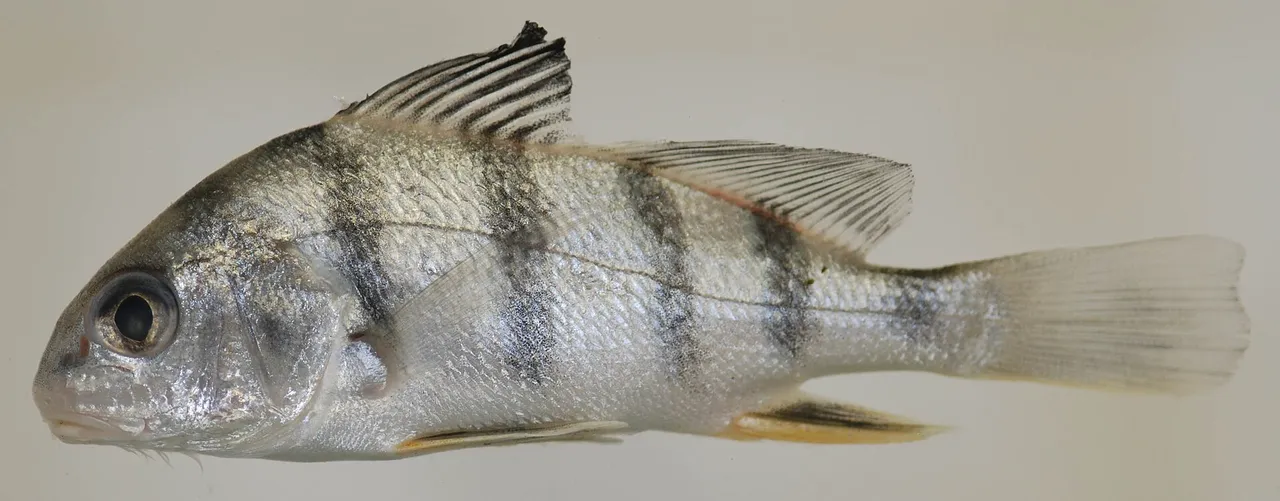
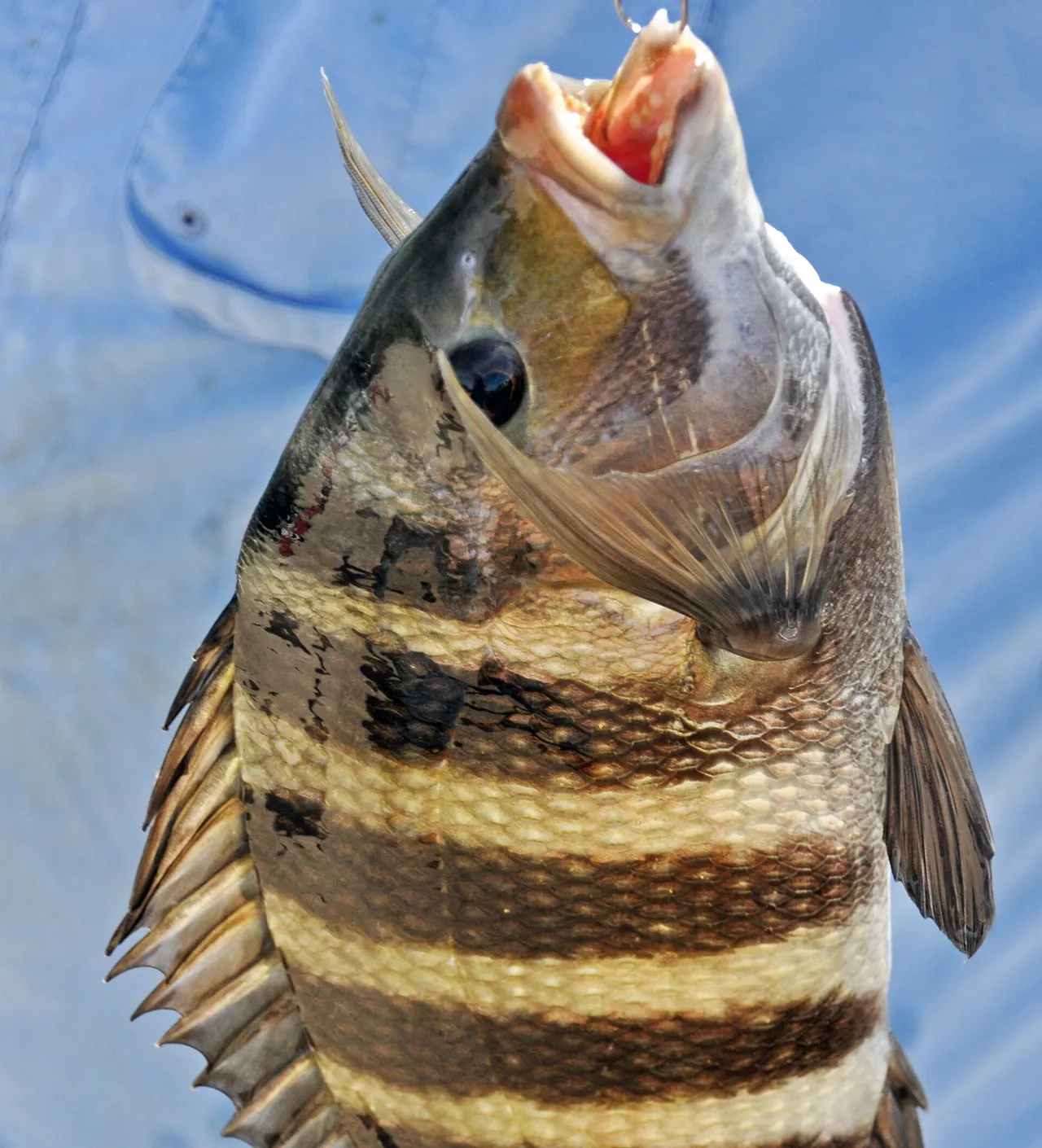
A juvenile black drum carries bold dark vertical bars over a pale flank, and so does a sheepshead at every size. They occupy the same bridges, pilings, jetties and oyster bars along the whole south-eastern and Gulf coast, both feed on shellfish, and both are caught on the same crab and shrimp baits by anglers fishing the same structure. The bars are what people see first and they are the character shared rather than the character that separates.
Black drum
Pogonias cromis — Sciaenidae
Sheepshead
Archosargus probatocephalus — Sparidae
The differences
Each difference is marked with how far it can be trusted on its own. A single diagnostic character settles the identification; suggestive ones only narrow it.
| Character | Black drum | Sheepshead | Reliability |
|---|---|---|---|
| Barbels under the chinIdentification | A fringe of short barbels runs along the underside of the lower jaw. Run a finger there and you cannot miss them. | Nothing at all under the chin. Smooth jaw. | Diagnostic on its own |
| Teeth at the front of the jawIdentification | The mouth is inferior, set under the snout, and unarmed — the crushing teeth are in the throat where you cannot see them. | Broad flattened incisors at the front of the jaw, unnervingly human-looking, with heavy molars behind them. | Diagnostic on its own |
| What happens to the bars with ageIdentification | The bars fade with growth; a large black drum is close to uniformly dark grey or bronze-black. | The bars persist through life, blurring somewhat in very large old fish but remaining recognisable. | Supporting — use with others |
| Body profileIdentification | High-backed and heavily humped behind the head, with the deepest point well forward. | Deep and strongly compressed with a steeply sloping forehead, but not humped in the same way. | Supporting — use with others |
| The size you are likely to be holdingSize | Commonly 2–8 kg, with fish of 15–25 kg regular and exceptional fish past 35 kg. | Commonly under 2.5 kg, with a very good fish 3.5–6 kg. A barred fish over about 10 kg is a black drum. | Supporting — use with others |
| Handling injury riskHandling | Bulk is the problem: a large drum should be supported horizontally and not lifted vertically by the jaw. | Spines and jaws: stiff sharp dorsal and anal spines puncture deeply, and the crushing jaws can injure a finger placed in the mouth. | Supporting — use with others |
Why it matters
Both are size-limited and bag-limited across the Gulf and south-east, and the limits are not the same — several states operate slot limits on black drum specifically to protect the very large old females, and sheepshead carries its own minimum size and bag. Verify the current rules with the responsible state authority before retaining either. There is a table consequence as well: very large black drum are commonly reported to carry parasites in the flesh and are widely regarded as poor eating compared with fish in the slot, while sheepshead of any size is excellent but is awkward to fillet around the heavy ribcage.
The full records
This page compares two species. Each of them has a complete record covering biology, behaviour, handling and the evidence behind all of it.
More about black drum
Where it lives, how it is caught, and what else it is confused with.
Similar and related fish
_(12639311174).jpg)
_(Sanibel_Island,_Florida,_USA)_2.jpg)
How it is caught
Why the 4 connections on this page are here, and the sources
Similar and related fish
Backed by research — 2 connections
Supported by peer-reviewed research or fisheries science. The sources are listed and can be checked.
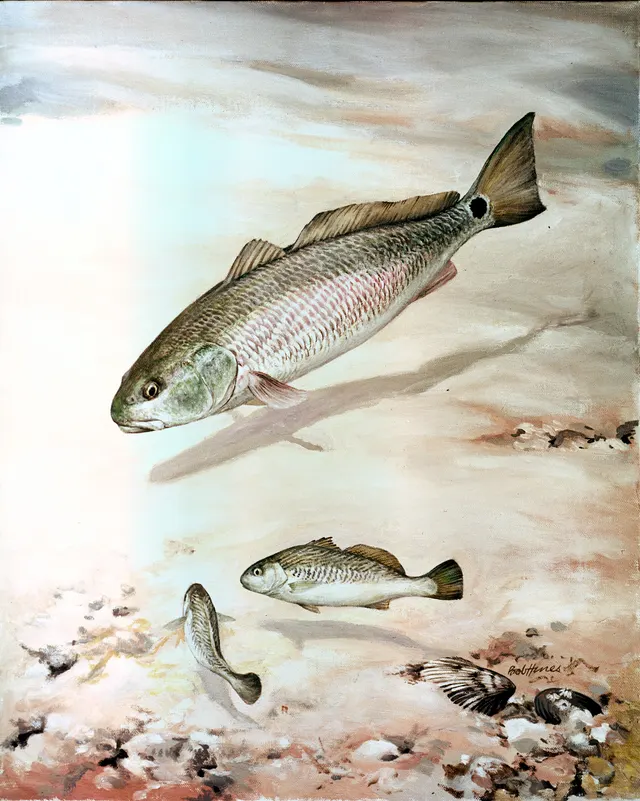
Red drum
An identification comparison naming both binomials.
- FishBase: a global information system on fishes — Froese, R. and D. Pauly, eds. — FishBase Consortium (Scientific institute)Relied on for: That Pogonias cromis and Sciaenops ocellatus are both Sciaenidae of the western Atlantic occupying coastal waters and estuaries.States this directlyPassage read and verified
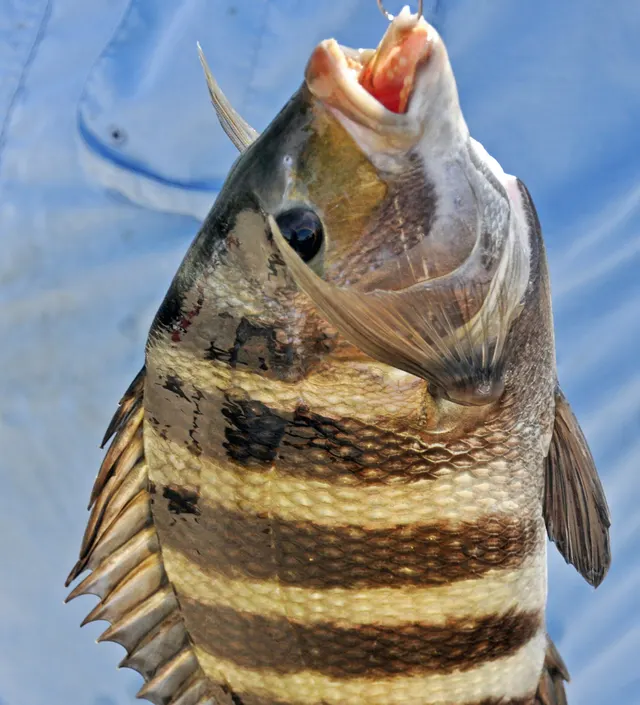
Sheepshead
An identification comparison naming both binomials: Archosargus probatocephalus and Pogonias cromis.
- FishBase: a global information system on fishes — Froese, R. and D. Pauly, eds. — FishBase Consortium (Scientific institute)Relied on for: Morphological and distributional data for Archosargus probatocephalus and for Pogonias cromis.States this directlyPassage read and verified
- The IUCN Red List of Threatened Species — International Union for Conservation of Nature (Conservation authority)Relied on for: Separate assessments treating Archosargus probatocephalus and Pogonias cromis as distinct species.States this directlyCitation checked — the work exists and is described correctly
How it is caught
What experienced anglers do — 2 connections
Widely and independently recommended by experienced anglers and specialist sources. This is real angling knowledge, not proof: controlled evidence for it is limited, and FishingHQ records it as convention rather than as a demonstrated effect.
Ledgering
The page names the bait and the presentation together. Black drum are shellfish specialists with crushing pharyngeal teeth, so the bait choice is the fishery rather than a preference within it.
- Florida saltwater fishing regulations and Keys sanctuary rules — Florida state wildlife authority and the Florida Keys National Marine Sanctuary (Government fisheries body)Relied on for: Documents which fishery and which technique takes this species.States this directlyCitation checked — the work exists and is described correctly
- General angling website restatements of established technique — Various (Credible secondary source)Relied on for: Independently corroborates the species' recreational capture and range.Background and mechanism onlyCitation checked — the work exists and is described correctly
Surfcasting
The page names the surf alongside boats and piers. The convention of retaining small fish and releasing the very large old ones is a shore-fishery convention as much as a boat one.
- Florida saltwater fishing regulations and Keys sanctuary rules — Florida state wildlife authority and the Florida Keys National Marine Sanctuary (Government fisheries body)Relied on for: Documents which fishery and which technique takes this species.States this directlyCitation checked — the work exists and is described correctly
- General angling website restatements of established technique — Various (Credible secondary source)Relied on for: Independently corroborates the species' recreational capture and range.Background and mechanism onlyCitation checked — the work exists and is described correctly
Reviewed 2026-08-15. FishingHQ does not state what any rule is or where any rule applies. Where this page says the two species are managed differently, that is a reason to check the authority for the water you are on — not a statement of what it requires.