How to identify sheepshead
Archosargus probatocephalus · Sparidae
The characters that identify sheepshead, ranked by how far each one can be trusted on its own.
Safety: injury while handling fish — can cause injury needing treatment. One more point applies here.
How this was identified, and who took it
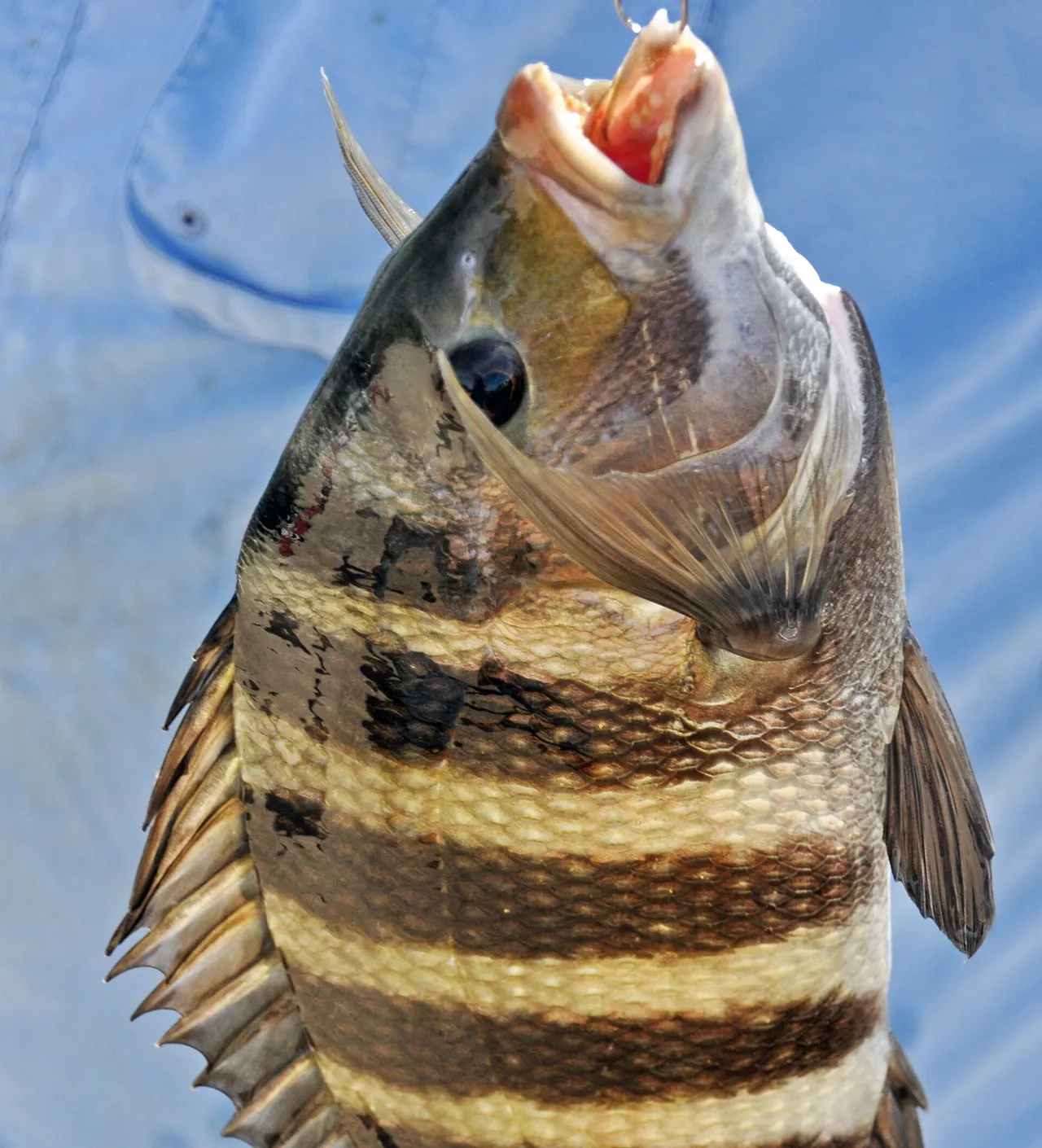
Identified by: Identified on the bar pattern and the dentition together. Five bold dark vertical bars run over a pale flank, the body is deep and strongly compressed with a steep forehead and a small mouth, and heavy sharp spines stand at the front of the dorsal and anal fins. The mouth is open on the broad flattened pale incisors the record calls unlike any other inshore fish of its range. The tail is outside the frame and is not a character here.James St. John — CC BY 2.0, via Wikimedia Commons — source, licenceLook at this first
Open the mouth. A sheepshead has broad flat front teeth that look unnervingly human, backed by heavy grinding molars, and no other inshore fish of the western Atlantic carries them. The bars on the flank will draw your eye first; the teeth are what settle it.
Diagnostic — settles it on its own
Each of these settles the identification on its own. If one is clear, you have your answer.
Flat incisors backed by molars
The front of each jaw carries broad flattened teeth for cropping barnacles and mussels off structure, with rows of heavy molars behind them for crushing. Look with the mouth open and the fish under control. It is the most immediately recognisable dentition of any inshore fish in the range and it does not vary with size, season or condition.
No barbels under the chin
Run a finger along the underside of the lower jaw. A sheepshead has nothing there. A juvenile black drum — the fish most often mistaken for it — carries a row of short barbels, and that single check separates them at any size.
Supporting — use with other characters
Real characters that are not conclusive by themselves. Use two or three together.
Five to seven bold vertical bars
Dark bars run from the back down across a pale flank, evenly spaced and with clean edges. Count them: five to seven is normal. Black drum juveniles also carry bars, and that is exactly the confusion this page exists to resolve, so use the bars to notice the fish and the teeth or the chin to name it.
Heavy sharp spines at the front of the dorsal and anal fins
The leading dorsal and anal spines are stiff and needle-pointed and will puncture a hand deeply. They are worth identifying for handling reasons as much as diagnostic ones: grip across the body with the spines folded down.
What it gets confused with
- Juvenile black drum, which carries similar bold vertical bars — the chin barbels separate them instantly, and black drum loses its bars with age while sheepshead keeps them.
- Atlantic spadefish, also barred and deep-bodied, but with a tiny mouth, no incisors and a much taller, more angular dorsal and anal fin profile.
- Pinfish and other small sparids, which have a similar body shape but conical rather than flattened front teeth.
Side by side: Sheepshead vs Black drum.
Where this stops working
The bars fade and blur in large old fish, and a big sheepshead can look almost plain grey-green — the teeth do not change and remain the way in. Very small sheepshead and small black drum are genuinely similar in the water, and the chin check needs the fish in hand. Colour is no use at all here: the ground colour ranges from silver to olive depending on the ground the fish has been over. The crushing jaws that make the fish identifiable also make it dangerous to inspect carelessly; a finger placed in the mouth of a live sheepshead can be crushed rather than cut.
The full record
This page covers identification only. The Sheepshead record covers behaviour, lifecycle, distribution, handling and the sources behind all of it.
Reviewed 2026-08-15.
More about this fish
Telling it apart is one question. Here are the others.
Similar and related fish
How it is caught
Where it lives
Where you will find it
Why the 7 connections on this page are here, and the sources
Similar and related fish
Backed by research — 1 connection
Supported by peer-reviewed research or fisheries science. The sources are listed and can be checked.
Black drum
An identification comparison naming both binomials: Archosargus probatocephalus and Pogonias cromis.
- FishBase: a global information system on fishes — Froese, R. and D. Pauly, eds. — FishBase Consortium (Scientific institute)Relied on for: Morphological and distributional data for Archosargus probatocephalus and for Pogonias cromis.States this directlyPassage read and verified
- The IUCN Red List of Threatened Species — International Union for Conservation of Nature (Conservation authority)Relied on for: Separate assessments treating Archosargus probatocephalus and Pogonias cromis as distinct species.States this directlyCitation checked — the work exists and is described correctly
How it is caught
What experienced anglers do — 2 connections
Widely and independently recommended by experienced anglers and specialist sources. This is real angling knowledge, not proof: controlled evidence for it is limited, and FishingHQ records it as convention rather than as a demonstrated effect.
Float fishing
A practitioner claim about how Archosargus probatocephalus is commonly fished, following from where and how it feeds.
- General angling website restatements of established technique — Various (Credible secondary source)Relied on for: Widely restated practitioner accounts of fishing for sheepshead.Citation checked — the work exists and is described correctly
- Sea Angler — Bauer Media (Specialist angling publication)Relied on for: Practitioner treatment of the methods used for sheepshead and comparable species.Citation checked — the work exists and is described correctly
Ledgering
A practitioner claim about how Archosargus probatocephalus is commonly fished, following from where and how it feeds.
- General angling website restatements of established technique — Various (Credible secondary source)Relied on for: Widely restated practitioner accounts of fishing for sheepshead.Citation checked — the work exists and is described correctly
- Sea Angler — Bauer Media (Specialist angling publication)Relied on for: Practitioner treatment of the methods used for sheepshead and comparable species.Citation checked — the work exists and is described correctly
Where it lives
Backed by research — 2 connections
Supported by peer-reviewed research or fisheries science. The sources are listed and can be checked.
Harbours, piers and breakwaters
A habitat association for Archosargus probatocephalus taken from the environment and distribution data on its FishBase summary.
- FishBase: a global information system on fishes — Froese, R. and D. Pauly, eds. — FishBase Consortium (Scientific institute)Relied on for: The environment, depth range and habitat description recorded for Archosargus probatocephalus.States this directlyPassage read and verified
Rocky shores and reefs
A habitat association for Archosargus probatocephalus taken from the environment and distribution data on its FishBase summary.
- FishBase: a global information system on fishes — Froese, R. and D. Pauly, eds. — FishBase Consortium (Scientific institute)Relied on for: The environment, depth range and habitat description recorded for Archosargus probatocephalus.States this directlyPassage read and verified
Where you will find it
Backed by research — 2 connections
Supported by peer-reviewed research or fisheries science. The sources are listed and can be checked.
Florida
A distribution association between an animal and a kind of water, rather than a claim about any named mark.
- NOAA National Ocean Service education on estuaries and the National Estuarine Research Reserve System — National Oceanic and Atmospheric Administration, United States (Government fisheries body)Relied on for: Estuarine, seagrass and coastal habitat function in North American waters, and the nursery role of shallow habitat for the species concerned.Background and mechanism onlyCitation checked — the work exists and is described correctly
- FishBase: a global information system on fishes — Froese, R. and D. Pauly, eds. — FishBase Consortium (Scientific institute)Relied on for: Distribution, habitat association, depth range and life history recorded for the species.States this directlyPassage read and verified
The Gulf of Mexico
A distribution association between an animal and a kind of water, rather than a claim about any named mark.
- FishBase: a global information system on fishes — Froese, R. and D. Pauly, eds. — FishBase Consortium (Scientific institute)Relied on for: Distribution, habitat association and depth range recorded for the species, including its occurrence in the water body concerned.States this directlyPassage read and verified
- The IUCN Red List of Threatened Species — International Union for Conservation of Nature (Conservation authority)Relied on for: Assessment and range account for the species, including the systems and coasts it occupies.Background and mechanism onlyCitation checked — the work exists and is described correctly
Safety
Injury while handling fish — Can cause injury needing treatment
The dorsal and anal spines are rigid and needle-pointed, and cause deep punctures if the fish is gripped carelessly or lands on a hand.
What reduces it: Grip across the body from front to back with the spines folded, wear gloves where possible, and use pliers for unhooking.
Species that bite — Can cause injury needing treatment
The molars are powerful enough to crush shellfish and will injure a finger placed inside the mouth.
What reduces it: Never put fingers in the mouth. Use long-nosed pliers or a dehooker.