How to identify black drum
Pogonias cromis · Sciaenidae
The characters that identify black drum, ranked by how far each one can be trusted on its own.
Safety: injury while handling fish — can cause injury needing treatment. One more point applies here.
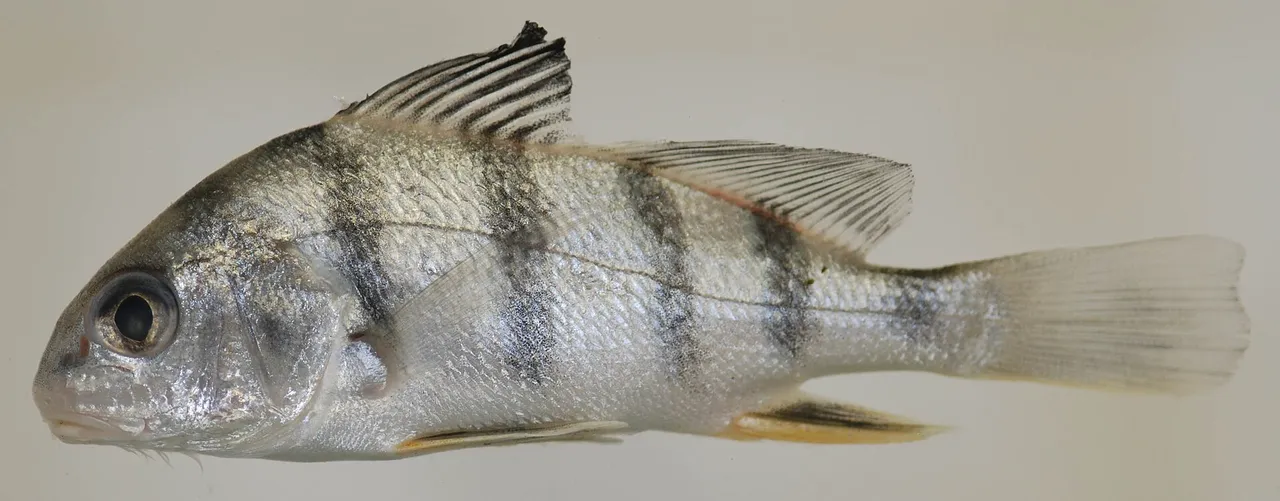
How this was identified, and who took it
Identified by: Complete lateral view of a fresh specimen on a plain ground, with the chin barbels, the deep high-arched body and the juvenile vertical barring all legible. The source records it as a juvenile of 81 mm standard length, and the caption states that plainly because the barring does not persist into adulthood and a reader holding an adult fish would not see it.Smithsonian Environmental Research Center — CC BY 2.0, via Wikimedia Commons — source, licenceAbout the image above: The fish in the photograph is a juvenile of about eighty millimetres, and the bold vertical bars crossing it are a juvenile character that fades with age — a large adult black drum is close to uniform dark grey with no barring at all. The chin barbels shown here do persist, and they are the character this page ranks first.
Look at this first
Run a finger along the underside of the lower jaw. If it catches on a row of short whiskers, you have a black drum. Red drum have none, and the two share every estuary from the Carolinas to Texas.
Diagnostic — settles it on its own
Each of these settles the identification on its own. If one is clear, you have your answer.
Chin barbels
A fringe of short sensory barbels under the lower jaw, used to find buried shellfish. They are present on the fish for its whole life and are the fastest separation from red drum. Feel for them rather than looking — on a big dark fish they are easy to miss by eye.
Supporting — use with other characters
Real characters that are not conclusive by themselves. Use two or three together.
No mark at the tail base
The black drum has no ocellus where a red drum usually carries one. Read this as confirmation rather than as proof, since a small number of red drum also lack the spot — which is why the barbels come first.
A high humped back
Deeper through the body and more arched behind the head than a red drum of the same length, so the outline in profile is noticeably steeper. A proportion that becomes more obvious as the fish grows.
An unarmed mouth over crushing plates
There are no teeth worth the name in the jaws; the grinding apparatus sits back in the throat. Relevant to identification because a reader expecting a predator's mouth on a fish this size will look for the wrong thing.
Suggestive only — varies with condition
Hints only. These vary with condition, season, water and how long the fish has been out of it, and a fish that contradicts them is still the same species.
Broad dark bars on the flank
Strong on young fish and progressively lost with age until a large adult is close to plain. A character that identifies a life stage rather than a species, and it is the reason this page carries a note about its own photograph.
What it gets confused with
- Red drum, which is the whole point of the chin check.
- Sheepshead in the same structure, which has obvious protruding incisor-like teeth and much bolder barring.
- Freshwater drum where ranges approach, separated by habitat and by the absence of barbels.
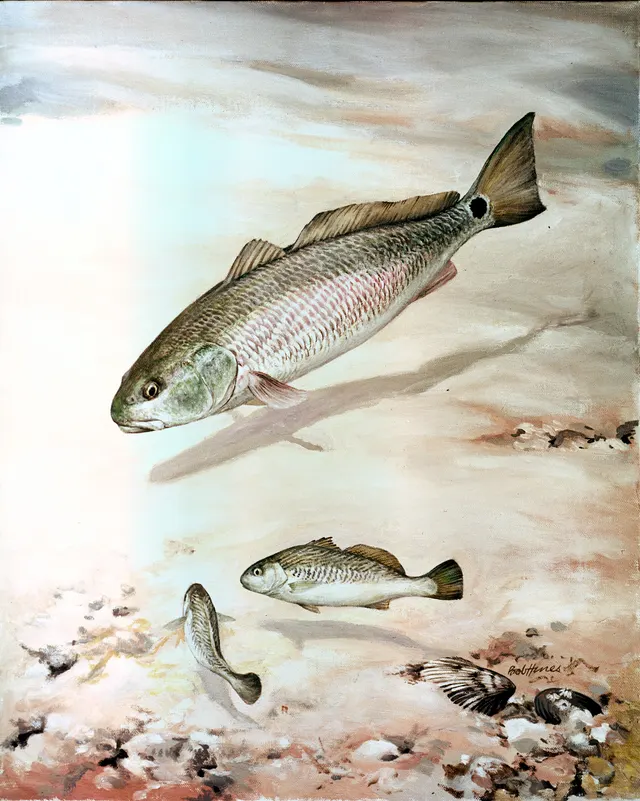
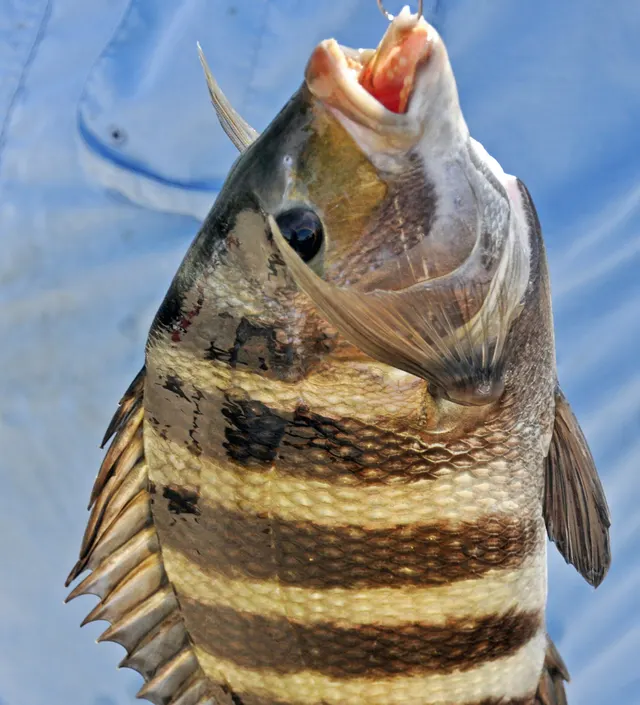
Side by side: Black drum vs Red drum, Black drum vs Sheepshead.
Where this stops working
The banding that makes a small black drum instantly recognisable is gone by the time the fish is large, so the description that fits a hand-sized fish does not fit a fifty-pound one. Very large individuals are extremely old, which is worth knowing before deciding what to do with one. Freshwater drum is a separate species despite the shared name and is not covered by this page.
The full record
This page covers identification only. The Black drum record covers behaviour, lifecycle, distribution, handling and the sources behind all of it.
Reviewed 2026-08-14.
More about this fish
Telling it apart is one question. Here are the others.
Similar and related fish
How it is caught
Where you will find it
Why the 6 connections on this page are here, and the sources
Similar and related fish
Backed by research — 2 connections
Supported by peer-reviewed research or fisheries science. The sources are listed and can be checked.
Red drum
An identification comparison naming both binomials.
- FishBase: a global information system on fishes — Froese, R. and D. Pauly, eds. — FishBase Consortium (Scientific institute)Relied on for: That Pogonias cromis and Sciaenops ocellatus are both Sciaenidae of the western Atlantic occupying coastal waters and estuaries.States this directlyPassage read and verified
Sheepshead
An identification comparison naming both binomials: Archosargus probatocephalus and Pogonias cromis.
- FishBase: a global information system on fishes — Froese, R. and D. Pauly, eds. — FishBase Consortium (Scientific institute)Relied on for: Morphological and distributional data for Archosargus probatocephalus and for Pogonias cromis.States this directlyPassage read and verified
- The IUCN Red List of Threatened Species — International Union for Conservation of Nature (Conservation authority)Relied on for: Separate assessments treating Archosargus probatocephalus and Pogonias cromis as distinct species.States this directlyCitation checked — the work exists and is described correctly
How it is caught
What experienced anglers do — 2 connections
Widely and independently recommended by experienced anglers and specialist sources. This is real angling knowledge, not proof: controlled evidence for it is limited, and FishingHQ records it as convention rather than as a demonstrated effect.
Ledgering
The page names the bait and the presentation together. Black drum are shellfish specialists with crushing pharyngeal teeth, so the bait choice is the fishery rather than a preference within it.
- Florida saltwater fishing regulations and Keys sanctuary rules — Florida state wildlife authority and the Florida Keys National Marine Sanctuary (Government fisheries body)Relied on for: Documents which fishery and which technique takes this species.States this directlyCitation checked — the work exists and is described correctly
- General angling website restatements of established technique — Various (Credible secondary source)Relied on for: Independently corroborates the species' recreational capture and range.Background and mechanism onlyCitation checked — the work exists and is described correctly
Surfcasting
The page names the surf alongside boats and piers. The convention of retaining small fish and releasing the very large old ones is a shore-fishery convention as much as a boat one.
- Florida saltwater fishing regulations and Keys sanctuary rules — Florida state wildlife authority and the Florida Keys National Marine Sanctuary (Government fisheries body)Relied on for: Documents which fishery and which technique takes this species.States this directlyCitation checked — the work exists and is described correctly
- General angling website restatements of established technique — Various (Credible secondary source)Relied on for: Independently corroborates the species' recreational capture and range.Background and mechanism onlyCitation checked — the work exists and is described correctly
Where you will find it
Backed by research — 2 connections
Supported by peer-reviewed research or fisheries science. The sources are listed and can be checked.
Florida
A distribution association between an animal and a kind of water, rather than a claim about any named mark.
- NOAA National Ocean Service education on estuaries and the National Estuarine Research Reserve System — National Oceanic and Atmospheric Administration, United States (Government fisheries body)Relied on for: Estuarine, seagrass and coastal habitat function in North American waters, and the nursery role of shallow habitat for the species concerned.Background and mechanism onlyCitation checked — the work exists and is described correctly
- FishBase: a global information system on fishes — Froese, R. and D. Pauly, eds. — FishBase Consortium (Scientific institute)Relied on for: Distribution, habitat association, depth range and life history recorded for the species.States this directlyPassage read and verified
The Gulf of Mexico
A distribution association between an animal and a kind of water, rather than a claim about any named mark.
- FishBase: a global information system on fishes — Froese, R. and D. Pauly, eds. — FishBase Consortium (Scientific institute)Relied on for: Distribution, habitat association and depth range recorded for the species, including its occurrence in the water body concerned.States this directlyPassage read and verified
- The IUCN Red List of Threatened Species — International Union for Conservation of Nature (Conservation authority)Relied on for: Assessment and range account for the species, including the systems and coasts it occupies.Background and mechanism onlyCitation checked — the work exists and is described correctly
Safety
Injury while handling fish — Can cause injury needing treatment
A large heavy fish with sharp gill covers and powerful crushing plates deep in the throat.
What reduces it: Support the body horizontally with two hands or handle in the water. Keep fingers clear of the gill plates and never reach into the throat. Use long pliers for unhooking.
Encounters with marine life — Can cause injury needing treatment
Much of the fishery is conducted while wading shallow estuarine flats and bars that also hold stingrays buried in soft bottom.
What reduces it: Shuffle rather than step when wading soft ground. Wear wading boots. Check tide and exit before going out onto intertidal ground.