What does black drum eat?
What is established about how black drum feeds, kept separate from what anglers infer from it.
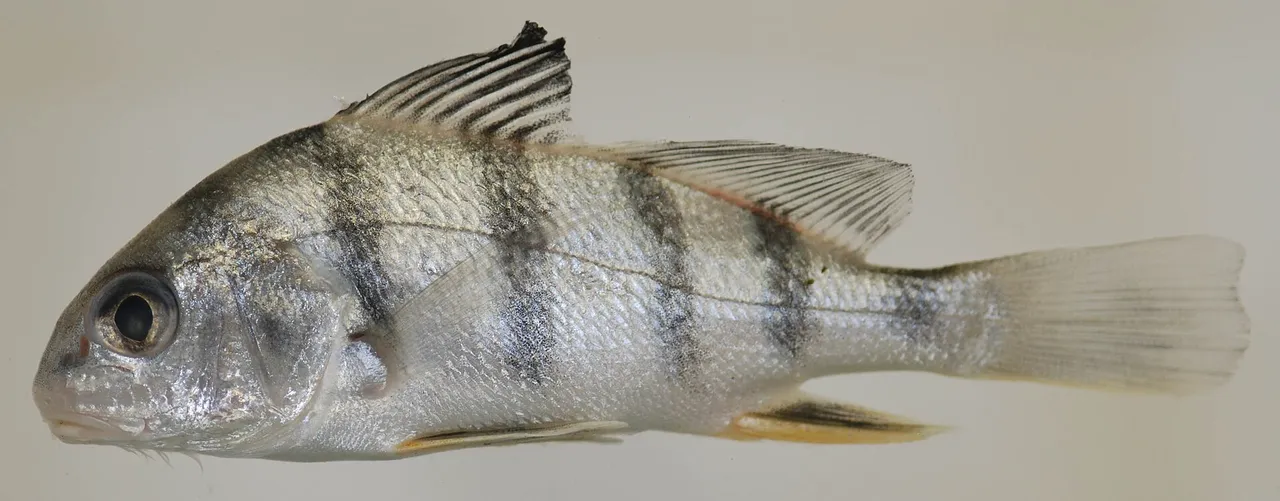
How this was identified, and who took it
Identified by: Complete lateral view of a fresh specimen on a plain ground, with the chin barbels, the deep high-arched body and the juvenile vertical barring all legible. The source records it as a juvenile of 81 mm standard length, and the caption states that plainly because the barring does not persist into adulthood and a reader holding an adult fish would not see it.Smithsonian Environmental Research Center — CC BY 2.0, via Wikimedia Commons — source, licenceWhat is known about how it feeds
The black drum is the specialist that the red drum is not, and the specialisation is in the throat.
Pharyngeal teeth — heavy, flattened crushing plates set behind the mouth — allow the fish to break oysters, clams and mussels outright. Prey is located with chin barbels dragged across the bottom, taken, and crushed. The species is one of the few predators in its range that can exploit a live oyster bed, and the association between large black drum and shellfish grounds is a consequence of that ability rather than a habitat preference.
Both verified relationships describe it: molluscs, crushed, and decapod crustaceans, crushed the same way.
The sensory arrangement is entirely bottom-directed. Barbels for contact chemoreception, and the fish works blind over sediment and shell in water that is frequently turbid.
Size matters more here than in most species because it changes what can be crushed. A small black drum takes shrimp and small crabs; a large one takes adult oysters and clams, and the largest fish are consuming shellfish that nothing else in the system can open.
The drumming the family is named for is produced by muscles against the swim bladder and is associated with spawning aggregations rather than with feeding, which is worth stating because the two are frequently conflated.
The food
Prey with a verified dietary link to this fish. Each entry carries its own evidence, and each is written at the precision the source actually used: a named species where the source named one, a group or food category where it said “polychaetes”, “crustaceans” or “detritus” and meant it. That is why this list is shorter than the animal’s real diet rather than longer.
- Bivalve and gastropod molluscs as prey — a group rather than a species: the evidence names the group
Black drum crush shellfish with powerful pharyngeal teeth, and their association with oyster and clam beds follows directly from that ability.
- Decapod crustaceans as prey — a group rather than a species: the evidence names the group
Crabs are taken alongside molluscs and are crushed in the same way, which is why crab baits work so consistently for the species.
Food with no page of its own here yet
These are real components of the diet, listed as plain text because FishingHQ has no page for them yet. Inventing pages to make the list look fuller would be the fabrication this whole approach exists to prevent.
- oysters
- clams and mussels
- blue crabs
- shrimp
- marine worms
What anglers do with this
Everything below is interpretation, not finding. It is what experienced anglers conclude from the biology above, and the reasoning is usually sound and almost never tested. It is separated from the biology deliberately.
The crushing specialisation is the reasoning behind the near-universal use of crab and shellfish baits fished hard on the bottom, and it is one of the more mechanically obvious inferences on FishingHQ. It remains convention rather than a tested comparison.
The barbel-led sensory profile converts into an expectation that the species is catchable in turbid water and after dark, where a visual feeder would not be.
One consumption point is worth recording because it is a genuine food-quality fact rather than a preference: large black drum are frequently reported as poor eating and are commonly returned, while smaller fish are not, and the practice reflects that.
What this does not establish
Both relationships are group-level. Diet composition changes substantially with fish size, because what a black drum can crush is a function of how big it is. The account describes the western Atlantic and Gulf populations, and nothing here establishes proportions.
Where this connects
These are the baits, lures, methods and explainers FishingHQ already joins to this fish — which is why the list is sometimes short. They are not chosen for this page, and a link here means an evidenced relationship exists, not that it follows from the diet.
Methods used for it
This page covers feeding. The Black drum record covers identification, lifecycle, seasonal behaviour, handling and the sources behind all of it.
Reviewed 2026-08-12.