Dusky kob
Fish · Last reviewed 2026-08-10
A large, long-lived estuarine and surf predator of southern African and Australian coasts, assessed as Endangered, and one of the clearest cases where a popular sport fish is genuinely in trouble.
Safety: drowning and immersion — can cause serious injury or death. 7 more points apply here.
How this was identified, and who took it
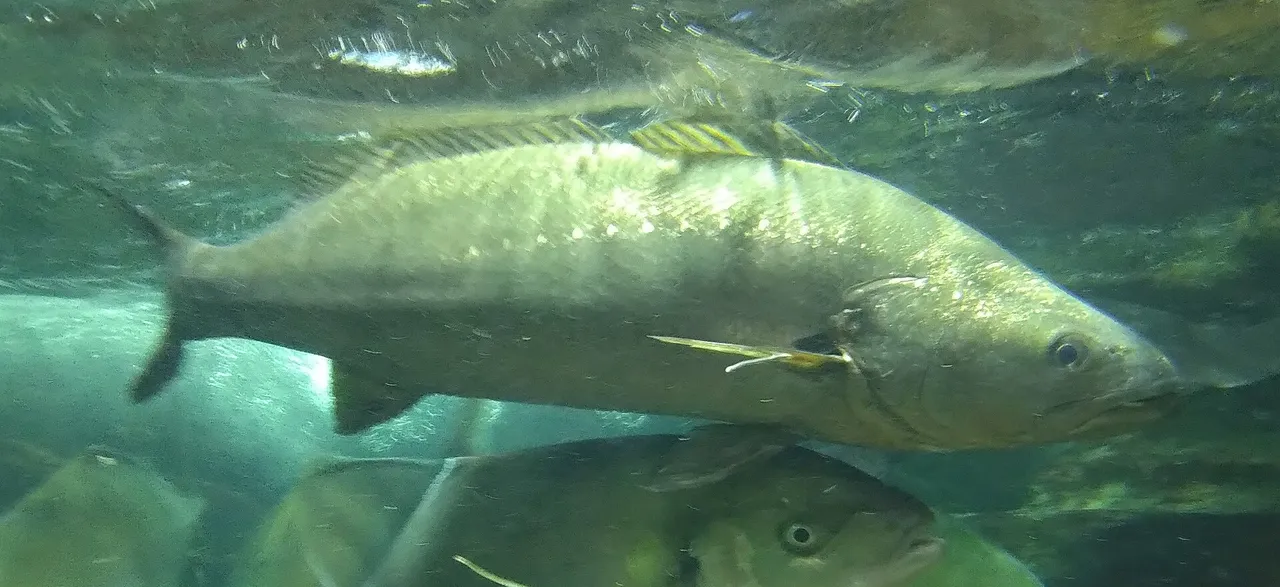
Identified by: Full lateral view showing the elongate body, the two dorsal fins, the pointed snout and the row of pale spots following the lateral line that places it in Argyrosomus. Photographed through aquarium water; colour is green-shifted.タウナギ — CC BY-SA 4.0, via Wikimedia Commons — source, licence
Catching Dusky kob
Everything here on fishing for it. Each entry opens the page behind it.
- Ground
- When
- Oct–Apr — months recorded at the places that document it, not a season for the whole range.
- Where
- 4 places FishingHQ documents — strongest claim anywhere: characteristic of this water · From the shore, From a boat, From a kayak
The dusky kob is a big, slow-growing, estuary-dependent predator that people love to catch and that is assessed by the IUCN as Endangered. Both halves of that sentence are true at once, and there is no comfortable way to write the record.
It goes by three names across its range — kob in southern Africa, mulloway in Australia, jewfish colloquially in both — and in each place it is a premier shore and estuary sport fish. It reaches nearly two metres, feeds in the surf and in estuary channels, takes bait and lure, and can be caught from a beach at night, which is a combination that produces devoted followings.
The biological problem is straightforward. It is long-lived and slow to mature; juveniles recruit into estuaries at around thirty centimetres and depend on them entirely for the first years of life; and adults aggregate predictably. Estuary degradation removes recruitment, and fishing pressure removes the adults, and the two together are what an Endangered assessment records.
FishingHQ includes it because a guide that only covers fish which are doing fine is not describing the world. The useful content here is what a careful angler can actually do — and with a fish in this position, the honest answer includes the possibility of not targeting it.
How it is caught
Where Dusky kob is documented
Places where public sources describe this species as fished, with how it is fished and how strongly the evidence supports it. This is not a range map and it is not a recommendation — it is what has been written down about a fishery rather than a record of any individual catch, and being listed is never permission to fish.
The Eastern Cape and the Wild Coast
3 documented places
Estuary
Regular local target
From the shore · From a boat · From a kayak
Rock mark
Seasonal
From the shore
Around Nov, Dec, Jan, Feb, Mar, Apr
Cliff coast
Characteristic of this water
From the shore
Around Oct
Observed October 2010
The Garden Route
1 documented place
Estuary
Regular local target
From the shore · From a boat · From a kayak
What these strengths mean
- Regular local target
- Fishing sources describe this as a normal local target here, not merely as caught.
- Seasonal
- Well supported, and concentrated in part of the year rather than spread through it.
- Characteristic of this water
- This water is strongly identified with this species by the sources that cover it.
Identification
- Scientific name
- Argyrosomus japonicus
- Family
- Sciaenidae
- Water
- Saltwater, Brackish
- Conservation status
- Endangered
- Regions
- East & Southern Africa, Australia, East Asia, South Asia, Indo-Pacific
- Large elongate silvery body, bronze to dusky above, with a pearly sheen in fresh fish.
- Two dorsal fins, the first short and spiny, the second long and low.
- A distinct row of pale spots along the lateral line in many individuals — a useful field mark on smaller fish.
- Pointed snout with the mouth set slightly below it; the large otoliths give rise to the name jewfish.
- Confusable with related Argyrosomus species where ranges overlap; the lateral line spots and body proportion separate them rather than colour.
Size
- Typical
- 2–8 kg (4–18 lb)
- Large
- 20–35 kg (44–77 lb)
Exceptional: Over 50 kg (110 lb); maximum published weight 75 kg
Estuary nursery, surf and turbid inshore ground
Dusky kob are estuarine-dependent coastal predators, and the dependence is the single most important thing about their habitat use.
JUVENILES ARE ESTUARINE OBLIGATE. Young kob use estuaries as nursery habitat and are heavily concentrated in them, so estuary condition — whether the mouth is open, what the salinity is doing, whether the nursery habitat is intact — drives recruitment for the whole coastal population. On a coast with temporarily open and closed estuaries, a system that stays sealed for a season contributes nothing.
ADULTS OCCUPY TURBID INSHORE WATER: surf zones, deeper channels, reef edges and nearshore ground, generally in coloured water rather than clear.
SOUND AND THE LATERAL LINE DO THE HUNTING. Kob are sciaenids with an enlarged swim bladder and acute hearing, and they hunt by sound and by lateral line in water where sight is useless. That is why turbid water is preferred habitat rather than a handicap, and why they feed heavily at night and in coloured surf.
STRUCTURE MATTERS AS AMBUSH GROUND — reef edges, channel drop-offs, deep holes in estuaries and the scoured ground behind sandbars.
LARGE FISH MOVE OFFSHORE AND ALONG THE COAST, so the very big animals are less estuarine than the mid-sized ones.
AND THE OVERALL PICTURE IS A FISH THAT NEEDS TWO SYSTEMS TO WORK — a productive estuary for its first years and a turbid inshore coast for its adult life — which is why it is one of the more depleted linefish on the coasts where it occurs.
Backed by research — why, and the sources (2)
Supported by peer-reviewed research or fisheries science. The sources are listed and can be checked.
- FishBase: a global information system on fishes — Froese, R. and D. Pauly, eds. — FishBase Consortium (Scientific institute)Relied on for: Distribution, habitat association, depth range, size, reproduction and life-history parameters recorded for the species.States this directlyPassage read and verified
- The IUCN Red List of Threatened Species — International Union for Conservation of Nature (Conservation authority)Relied on for: Assessment and range account for the species, including the habitats it depends on, its life history and the pressures acting on it.States this directlyCitation checked — the work exists and is described correctly
Aggregating in the surf, drumming, and a very late maturity
Kob reproduction combines aggregation, sound and slow maturation, which is close to the worst possible combination for a heavily fished species.
SPAWNING IS IN AGGREGATIONS in inshore coastal water and around estuary mouths, with fish gathering at predictable places in the warmer months. As with other sciaenids, males produce drumming sounds associated with spawning, and the aggregations can be located acoustically.
SPAWNING IS BATCH AND PROTRACTED, with females releasing eggs repeatedly over a season, and eggs and larvae are pelagic and are transported into the estuarine nurseries the juveniles depend on.
MATURITY IS LATE AND THIS IS THE CRUCIAL POINT. Dusky kob mature at a large size and an advanced age relative to the sizes at which they are commonly caught, so a substantial part of the catch in an unmanaged fishery consists of fish that have never spawned. That mismatch between size at capture and size at maturity is the standard mechanism behind linefish collapse, and it is well documented for this species.
THE FISH IS LONG-LIVED and grows large, so a mature adult represents many years.
AND THE POPULATION IS EXPOSED AT BOTH ENDS OF ITS LIFE — as juveniles in estuaries subject to habitat degradation and mouth closure, and as aggregating adults in the surf. Nothing here is a suggestion about when or where to fish; it is the reason the species carries the management attention it does.
Backed by research — why, and the sources (2)
Supported by peer-reviewed research or fisheries science. The sources are listed and can be checked.
- FishBase: a global information system on fishes — Froese, R. and D. Pauly, eds. — FishBase Consortium (Scientific institute)Relied on for: Distribution, habitat association, depth range, size, reproduction and life-history parameters recorded for the species.States this directlyPassage read and verified
- The IUCN Red List of Threatened Species — International Union for Conservation of Nature (Conservation authority)Relied on for: Assessment and range account for the species, including the habitats it depends on, its life history and the pressures acting on it.States this directlyCitation checked — the work exists and is described correctly
Warm-season spawning, dirty water and the state of the estuary mouth
Kob seasonality operates on two cycles that a visiting angler often conflates: the fish's own annual cycle, and the opening and closing of the estuaries they depend on.
THE SPAWNING SEASON IS THE WARM PERIOD, when adults aggregate in inshore water and around estuary mouths. In the southern hemisphere that straddles the turn of the calendar year, which is the point most northern readers get wrong.
ESTUARY MOUTH STATE IS A SEASONAL VARIABLE IN ITS OWN RIGHT. On coasts with temporarily open and closed estuaries, the system breaches in the wet season and seals in the dry. Whether larvae and juveniles can enter, and whether adults can move in and out, is decided by that — so a run of dry years can suppress recruitment independently of anything happening at sea.
WATER COLOUR IS THE SHORT-TERM SEASONALITY THAT MATTERS. Kob feed hardest in turbid, disturbed water, so periods after a blow, on a coloured surf, and at night are when they are most active. Clear calm water is the poor condition, which is the reverse of most sight-hunting species.
TEMPERATURE MOVES FISH ALONG THE COAST, with distribution shifting seasonally and some populations undertaking coastal migrations.
AND THE FISHERY'S SEASON AND THE FISH'S SEASON ARE NOT THE SAME THING. Where seasonal closures exist they are set by the relevant authority, frequently around the spawning aggregation, and this page does not state what any of them currently permit.
Backed by research — why, and the sources (2)
Supported by peer-reviewed research or fisheries science. The sources are listed and can be checked.
- FishBase: a global information system on fishes — Froese, R. and D. Pauly, eds. — FishBase Consortium (Scientific institute)Relied on for: Distribution, habitat association, depth range, size, reproduction and life-history parameters recorded for the species.States this directlyPassage read and verified
- The IUCN Red List of Threatened Species — International Union for Conservation of Nature (Conservation authority)Relied on for: Assessment and range account for the species, including the habitats it depends on, its life history and the pressures acting on it.States this directlyCitation checked — the work exists and is described correctly
The fish is not the danger: a night surf fishery for a species that cannot afford losses
Kob handling has two halves that point in opposite directions. The fish is comparatively easy to handle and very hard to handle WELL, because of where and when it is caught and because of what the population can afford.
THE FISH ITSELF. A large, heavy, deep-bodied sciaenid with no dentition worth avoiding and sharp gill covers that are the only real cutting hazard. What makes it difficult is mass: a big kob is too heavy to lift by the jaw without damaging it, and it must be supported horizontally with both arms or, better, not lifted at all.
THE SETTING IS THE PROBLEM. This is largely a night fishery, from surf beaches, estuary mouths, rock and sandbanks, in the dark, frequently in moving water. Landing a heavy fish in surf means the fish is being dragged through breaking water and up a beach unless somebody wades in to it, and a fish dragged across dry sand has lost its mucus layer along its whole flank. Every element of the situation pushes toward a worse release, and the angler is also managing their own footing in the dark in a surf zone, which is where the genuine danger in this fishery lies.
AND THE POPULATION CANNOT ABSORB IT. Dusky kob are slow-growing, long-lived, late-maturing, aggregate predictably, and are under sustained pressure across their range — the assessment reflects that clearly. A species with those traits has very little margin, and large fish are disproportionately valuable because fecundity scales steeply with size.
SO THE HANDLING THAT MATTERS IS: play the fish as fast as the tackle allows, keep it in the water in the wash rather than bringing it onto dry sand, unhook it with a tool with the fish still wet, support it horizontally if it must be lifted at all, and walk it back out through the wash facing into the water until it goes. In practice that means being willing to get wet, at night, which is exactly the thing people avoid — and it is the thing that decides whether a released kob is a released kob.
Official guidance — why, and the sources (4)
Stated by a fisheries authority, scientific institute or recognised angling body. Authoritative, but summarising rather than demonstrating.
- FishBase: a global information system on fishes — Froese, R. and D. Pauly, eds. — FishBase Consortium (Scientific institute)Relied on for: Morphology, dentition, spination, thermal tolerance, reproductive strategy and depth range recorded for the species.States this directlyPassage read and verified
- The IUCN Red List of Threatened Species — International Union for Conservation of Nature (Conservation authority)Relied on for: Assessment, population trend and the life-history traits — longevity, growth rate, sex structure — that determine a population's sensitivity to the removal of large individuals.Background and mechanism onlyCitation checked — the work exists and is described correctly
- Understanding the Complexity of Catch-and-Release in Recreational Fishing — Reviews in Fisheries Science 15:75–167, 2007 (Scientific literature)Relied on for: The determinants of catch-and-release outcome in recreational fisheries, and the gap between angler belief and measured survival.States this directlyCitation checked — the work exists and is described correctly
- Do we need species-specific guidelines for catch-and-release recreational angling? — Biodiversity and Conservation 14:1195–1209, 2005 (Scientific literature)Relied on for: That air exposure, handling duration and water temperature are the dominant modifiable determinants of post-release survival.States this directlyCitation checked — the work exists and is described correctly
Lifecycle and reproduction
Long-lived and slow to mature. Juveniles occur exclusively inshore and recruit into estuaries at around thirty centimetres, spending their early years there before moving to near-shore coastal areas beyond the surf zone as adults. That obligate estuarine juvenile phase is the species' principal vulnerability: an estuary lost to development, siltation or freshwater abstraction removes a cohort regardless of how the adult fishery is managed.
Spawns in coastal waters, generally near estuary mouths, with aggregation behaviour recorded. Adults are oceanodromous, moving along coasts. High fecundity in large old fish means the breeding contribution is concentrated in exactly the individuals a fishery removes first, which is the standard pattern for long-lived sciaenids and the reason size and bag limits for this species tend to be strict.
Feeding and senses
A higher-level predator with a trophic level recorded at about 4.5, feeding on fish and crustaceans in the surf zone, estuary channels and nearshore ground. Feeds heavily at night and around discoloured water after a sea, and takes live and dead baits readily — the reason surf and estuary bait fishing at night is the traditional approach.
Feeds effectively in turbid water and at night, using hearing and the lateral line as much as sight; sciaenids are notable for well-developed hearing, and the family's drumming communication depends on it. This is why the fishing is a night fishery in coloured water rather than a sight fishery, and why sound-producing and vibration-producing lures work when visual ones do not.
Through the year
Moves along coasts and between estuaries and the surf zone with water temperature and with spawning. In the southern hemisphere the productive months are the reverse of the northern calendar. Discoloured water after a swell, a rising tide at night, and river mouths after rain are the conditions the fishery is organised around rather than any particular season.
Distribution
Indo-West Pacific: the south-east African coast from the Cape of Good Hope to southern Mozambique; the northern Indian Ocean off Pakistan and north-west India; the northern Pacific from southern Korea and Japan along the Chinese coast to Hong Kong; and along the entire southern seaboard of Australia. Adults occur near shore beyond the surf zone, juveniles exclusively inshore and in estuaries.
This is a biological range — where the species occurs, not a prediction that you will catch one. To browse the fishing geography FishingHQ holds, start at fishing places.
Why anglers care
A premier shore, surf and estuary sport fish in southern Africa and Australia, fished mainly with live and dead bait at night and increasingly with soft plastics. Its Endangered assessment sits uncomfortably alongside that popularity, and the honest position for an angler is that this is a species where restraint — including choosing not to target it, or releasing what is caught — is a defensible response rather than an overreaction.
Handling and returning
A large heavy fish; handle in the water where possible and support horizontally rather than lifting by the jaw. Gill covers are sharp. Given the species' assessment, a fish intended for release should be played as quickly as tackle allows, kept in the water, unhooked with a tool and revived properly. Fish taken from depth may need a descending device to return successfully.
Going further
- What does dusky kob eat? — feeding biology, kept separate from what anglers infer from it.
- Dusky kob vs Meagre — how to tell them apart.
Safety
Drowning and immersion — Can cause serious injury or death
This is largely a surf and estuary night fishery, frequently fished from beaches, rock and sandbanks in the dark. Being knocked over by surf or cut off by a rising tide are the dominant risks, and darkness makes both far worse.
What reduces it: Wear a buoyancy aid. Never fish surf or rock alone at night. Check the tide and identify the exit before starting, and leave on a clock time rather than on how the fishing is going. Carry a light and a means of calling for help, and tell somebody where you are.
Injury while handling fish — Can cause injury needing treatment
Sharp gill covers on a large, heavy, strong fish handled in surf or on a bank in the dark.
What reduces it: Support the body horizontally with wet hands, keep fingers clear of the gill plates, and use long pliers and a light.
Precautions that always apply here
- Wear a buoyancy aid or lifejacket. Cold water incapacitates strong swimmers within a minute, long before swimming ability matters.
- Check the tide before you go and know your exit route. Being cut off is the commonest way a shore session becomes a rescue.
- Tell somebody where you are going and when you expect to be back.
- Carry a charged phone in a waterproof case, or another means of calling for help.
- Support the fish's weight along its body, keep it out of the water for as short a time as possible, and hold it over something soft.
- Wet your hands before touching a fish. Dry hands strip the protective mucus layer that keeps infection out.
Check the rules before you fish
Fishing laws, bylaws, access rules, seasons, bait restrictions and permitted methods vary by location and can change. Check the current rules from the relevant authority and the water you intend to fish before fishing.
Check with:
- Current national or regional law for where you are fishing
- Current local bylaws
- The relevant fisheries authority
- The landowner, club or fishery whose water it is
- Any restrictions specific to the species or the method you intend to use
Where to go next
Similar and related fish
- MeagreCongeners of the same genus on different coasts, routinely conflated in international angling writing.
- Pacific sardineAdult kob feed on pilchards and other shoaling fish in coastal water, and the annual sardine run along the southern African east coast is a substantial feeding event for them.
- Silver kobThe character the institute leads with is a SMELL: dusky kob carry a strong characteristic odour and silver kob do not, which is what the name inodorus records. Beyond that, a slightly narrower and longer caudal peduncle and slightly longer pectorals. Size separates nothing — both pass a metre — and the two carry different limits under four different area rules.
Where it lives
Where you will find it
- South AfricaA principal target of shore, estuary and boat angling along the south and east coasts, and a species whose estuarine nursery habitat governs its recruitment.
- Southern African fishingThe most prized shore species on much of the coast, and a species whose depletion is the clearest local example of why linefish management here is strict.
- The Agulhas CurrentOccupies the estuaries and turbid inshore water of the coast the current runs past, using the estuaries as nursery habitat.
- The Indian subcontinent coastsOccupies estuaries and turbid inshore water on this coast as it does on the southern African one, hunting by sound and lateral line.
- The western Indian Ocean coastOccupies the estuaries and river mouths in the south of the range, connecting this coast's fauna to the southern African one.
Understanding this fish
Told apart from
Environment and conservation
Sources and evidence
- FishBase: a global information system on fishes — Froese, R. and D. Pauly, eds. — FishBase Consortium (Scientific institute)Relied on for: Scientific name, family placement in the Sciaenidae, maximum length of 181 cm and maximum published weight of 75 kg, Indo-West Pacific distribution across the African south-east coast from the Cape of Good Hope to southern Mozambique, the northern Indian Ocean off Pakistan and north-west India.States this directlyPassage read and verified
- FishBase: a global information system on fishes — Froese, R. and D. Pauly, eds. — FishBase Consortium (Scientific institute)Relied on for: The IUCN Red List category — Endangered, assessed 26 September 2018 — is taken from FishBase's republication.States this directlyPassage read and verified
- Good Fish Guide — Marine Conservation Society (Conservation authority)Relied on for: That longevity, late maturity and dependence on a restricted nursery habitat are material to whether a stock can sustain harvest.FishingHQ's interpretation of what it saysCitation checked — the work exists and is described correctly
Why the 15 connections on this page are here, and the sources
Similar and related fish
Backed by research — 3 connections
Supported by peer-reviewed research or fisheries science. The sources are listed and can be checked.
Meagre
An identification comparison naming both binomials: Argyrosomus regius and Argyrosomus japonicus.
- FishBase: a global information system on fishes — Froese, R. and D. Pauly, eds. — FishBase Consortium (Scientific institute)Relied on for: Morphological and distributional data for Argyrosomus regius and for Argyrosomus japonicus.States this directlyPassage read and verified
- The IUCN Red List of Threatened Species — International Union for Conservation of Nature (Conservation authority)Relied on for: Separate assessments treating Argyrosomus regius and Argyrosomus japonicus as distinct species.States this directlyCitation checked — the work exists and is described correctly
Pacific sardine
Recorded diet evidence identifies Sardinops sagax as a food item of this predator at species level. The edge is written at that granularity and no further.
- FishBase: a global information system on fishes — Froese, R. and D. Pauly, eds. — FishBase Consortium (Scientific institute)Relied on for: Food items recorded for this predator, including Sardinops sagax.States this directlyPassage read and verified
- FAO Species Identification Guides for Fishery Purposes and the FAO Species Catalogues — Food and Agriculture Organization of the United Nations (Scientific institute)Relied on for: Species account describing the diet of this predator in the region where Sardinops sagax occurs.Background and mechanism onlyCitation checked — the work exists and is described correctly
Silver kob
A relatedness claim made for identification rather than for taxonomy: these are the pairs a reader holding one has to tell apart, and in several cases the rules that apply to them differ. The evidence names the object's binomial because the common names are precisely what collides.
- FishBase: a global information system on fishes — Froese, R. and D. Pauly, eds. — FishBase Consortium (Scientific institute)Relied on for: Identity, family placement, distribution and diagnostic characters of Argyrosomus japonicus, and of the species it is confused with in the hand.States this directlyPassage read and verified
- ORI Fish Fact Sheets: the species accounts of the Oceanographic Research Institute — Oceanographic Research Institute, South African Association for Marine Biological Research (SAAMBR), Durban, 2023 (Scientific institute)Relied on for: The description and distribution the research institute publishes for Argyrosomus japonicus, including the characters that separate it from its neighbours.States this directlyPassage read and verified
How it is caught
What experienced anglers do — 3 connections
Widely and independently recommended by experienced anglers and specialist sources. This is real angling knowledge, not proof: controlled evidence for it is limited, and FishingHQ records it as convention rather than as a demonstrated effect.
Livebaiting at sea
Kob take live bait in preference to dead where both are available, and the species page names live bait first. This is a distinct presentation from a static dead bait rather than a refinement of it.
- Assessment of catches in shore angling competitions from the Border region of the Eastern Cape — Pradervand & Govender, African Zoology 38(1), for the Oceanographic Research Institute, 2003 (Scientific literature)Relied on for: Documents which fishery and which technique takes this species.States this directlyPassage read and verified
- Marine Recreational Fishing Regulations in South Africa — South African Association for Marine Biological Research (SAAMBR), summarising the Marine Living Resources Act and its regulations, 2023 (Scientific institute)Relied on for: Independently corroborates the species' recreational capture and range.Background and mechanism onlyPassage read and verified
Spinning
The lure fishery is recent and growing rather than traditional, and the page says so. It is included because it is now a real way the species is caught and excluded from the bait sections because it is not the same fishing.
- Assessment of catches in shore angling competitions from the Border region of the Eastern Cape — Pradervand & Govender, African Zoology 38(1), for the Oceanographic Research Institute, 2003 (Scientific literature)Relied on for: Documents which fishery and which technique takes this species.States this directlyPassage read and verified
- Marine Recreational Fishing Regulations in South Africa — South African Association for Marine Biological Research (SAAMBR), summarising the Marine Living Resources Act and its regulations, 2023 (Scientific institute)Relied on for: Independently corroborates the species' recreational capture and range.Background and mechanism onlyPassage read and verified
Surfcasting
The page describes a fish that hunts by sound and lateral line in turbid water and is fished from surf beaches at night. Surfcasting is the technique that puts a bait into that water from the shore, and the handling section is written around landing a heavy fish through breaking surf.
- Assessment of catches in shore angling competitions from the Border region of the Eastern Cape — Pradervand & Govender, African Zoology 38(1), for the Oceanographic Research Institute, 2003 (Scientific literature)Relied on for: Documents which fishery and which technique takes this species.States this directlyPassage read and verified
- Marine Recreational Fishing Regulations in South Africa — South African Association for Marine Biological Research (SAAMBR), summarising the Marine Living Resources Act and its regulations, 2023 (Scientific institute)Relied on for: Independently corroborates the species' recreational capture and range.Background and mechanism onlyPassage read and verified
Where it lives
Backed by research — 1 connection
Supported by peer-reviewed research or fisheries science. The sources are listed and can be checked.
Estuary
A life-history claim with direct management consequence, held to a scientific standard.
- FishBase: a global information system on fishes — Froese, R. and D. Pauly, eds. — FishBase Consortium (Scientific institute)Relied on for: That Argyrosomus japonicus has adults inhabiting near-shore areas beyond the surf zone while juveniles are found exclusively inshore and recruit to estuaries at around 30 cm length.States this directlyPassage read and verified
Where you will find it
Backed by research — 5 connections
Supported by peer-reviewed research or fisheries science. The sources are listed and can be checked.
South Africa
A distribution association between an animal and a kind of water, rather than a claim about any named mark.
- FishBase: a global information system on fishes — Froese, R. and D. Pauly, eds. — FishBase Consortium (Scientific institute)Relied on for: Distribution, habitat association and depth range recorded for the species, including its occurrence in the water body concerned.States this directlyPassage read and verified
- The IUCN Red List of Threatened Species — International Union for Conservation of Nature (Conservation authority)Relied on for: Assessment and range account for the species, including the systems and coasts it occupies.Background and mechanism onlyCitation checked — the work exists and is described correctly
Southern African fishing
A distributional claim taken from reference sources on the species rather than from angling report. It states presence and asserts nothing about a fishery.
- FishBase: a global information system on fishes — Froese, R. and D. Pauly, eds. — FishBase Consortium (Scientific institute)Relied on for: Distribution, habitat association, depth range and life history recorded for the species concerned.States this directlyPassage read and verified
- The IUCN Red List of Threatened Species — International Union for Conservation of Nature (Conservation authority)Relied on for: Global distribution, population trend and extinction-risk assessment for the species concerned.States this directlyCitation checked — the work exists and is described correctly
The Agulhas Current
A distribution association between an animal and a kind of water, rather than a claim about any named mark.
- FishBase: a global information system on fishes — Froese, R. and D. Pauly, eds. — FishBase Consortium (Scientific institute)Relied on for: Distribution, habitat association and depth range recorded for the species, including its occurrence in the water body concerned.States this directlyPassage read and verified
- The IUCN Red List of Threatened Species — International Union for Conservation of Nature (Conservation authority)Relied on for: Assessment and range account for the species, including the systems and coasts it occupies.Background and mechanism onlyCitation checked — the work exists and is described correctly
The Indian subcontinent coasts
A distribution association between an animal and a kind of water, rather than a claim about any named mark.
- FAO Species Identification Guides for Fishery Purposes and the FAO Species Catalogues — Food and Agriculture Organization of the United Nations (Scientific institute)Relied on for: Distribution, habitat, depth and fishery accounts for the species in the FAO regional identification guides for the ocean area concerned.States this directlyCitation checked — the work exists and is described correctly
- FishBase: a global information system on fishes — Froese, R. and D. Pauly, eds. — FishBase Consortium (Scientific institute)Relied on for: Distribution, habitat association and depth range recorded for the species.States this directlyPassage read and verified
The western Indian Ocean coast
A distribution association between an animal and a kind of water, rather than a claim about any named mark.
- FishBase: a global information system on fishes — Froese, R. and D. Pauly, eds. — FishBase Consortium (Scientific institute)Relied on for: Distribution, habitat association and depth range recorded for the species, including its occurrence in the water body concerned.States this directlyPassage read and verified
- The IUCN Red List of Threatened Species — International Union for Conservation of Nature (Conservation authority)Relied on for: Assessment and range account for the species, including the systems and coasts it occupies.Background and mechanism onlyCitation checked — the work exists and is described correctly
Understanding this fish
Backed by research — 1 connection
Supported by peer-reviewed research or fisheries science. The sources are listed and can be checked.
Decapod crustaceans as prey
Recorded diet evidence identifies prawns and other decapod crustaceans as a food item of this predator at group level rather than to species. The edge points at the taxon record for that reason, and encoding it as a species-level claim would assert something the source does not.
- FishBase: a global information system on fishes — Froese, R. and D. Pauly, eds. — FishBase Consortium (Scientific institute)Relied on for: Food items recorded for this predator, given as prawns and other decapod crustaceans.States this directlyPassage read and verified
- FAO Species Identification Guides for Fishery Purposes and the FAO Species Catalogues — Food and Agriculture Organization of the United Nations (Scientific institute)Relied on for: Species account describing this predator's diet, recorded at the level of prawns and other decapod crustaceans.Background and mechanism onlyCitation checked — the work exists and is described correctly
Told apart from
Backed by research — 1 connection
Supported by peer-reviewed research or fisheries science. The sources are listed and can be checked.
Red drum
A comparison resting on shared family and shared estuarine dependence, with the divergent status verified on both sides.
- FishBase: a global information system on fishes — Froese, R. and D. Pauly, eds. — FishBase Consortium (Scientific institute)Relied on for: That both Argyrosomus japonicus and Sciaenops ocellatus are Sciaenidae associated with estuaries and the surf zone, with the former assessed as Endangered and the latter as Least Concern.States this directlyPassage read and verified
Environment and conservation
Backed by research — 1 connection
Supported by peer-reviewed research or fisheries science. The sources are listed and can be checked.
Fish stocks and sustainability
A conservation claim resting on a republished assessment and on documented life history, and one FishingHQ states plainly rather than softening.
- FishBase: a global information system on fishes — Froese, R. and D. Pauly, eds. — FishBase Consortium (Scientific institute)Relied on for: The IUCN Red List category for Argyrosomus japonicus — Endangered, assessed 26 September 2018 — as republished by FishBase, with juveniles recruiting exclusively to estuaries and a trophic level of about 4.5.States this directlyPassage read and verified
- Good Fish Guide — Marine Conservation Society (Conservation authority)Relied on for: That longevity, late maturity and dependence on restricted nursery habitat are material to whether a stock can sustain harvest.States this directlyCitation checked — the work exists and is described correctly
How FishingHQ labels evidence is explained in the evidence policy.