Port Alfred and the Kowie
Estuary · Brackish water · in The Eastern Cape and the Wild Coast
A permanently open river mouth on the Eastern Cape coast, trained between two stone piers, with a deep channel running well upriver and rocky coast either side of the entrance. The estuary is narrow and deep rather than wide and shallow, which makes it a channel fishery rather than a flats one.
Safety: cliffs and rock platforms — can cause serious injury or death.
FishingHQ describes what this place is, not whether you may fish it. Access, permits and who to ask.
What you can catch here
Documented at this place, grouped by how you would be fishing, with how strongly the sources support each one. This is what has been written down, not a forecast, and being listed is never permission to fish.
From the shore · 4
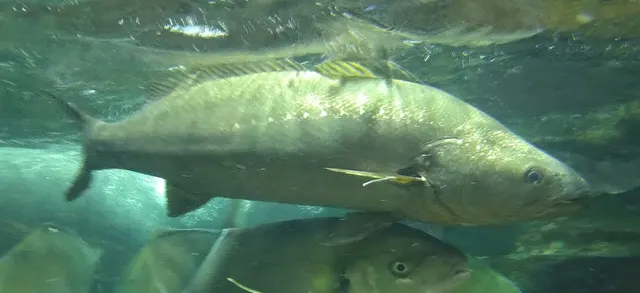 Dusky kobRegular local target1 placePort Alfred and the KowieOver estuary
Photo: タウナギ, via Wikimedia Commons, CC BY-SA 4.0; resized and trimmed to fit
- RiverbreamRegular local target1 placePort Alfred and the KowieOver estuary
- Spotted grunterRegular local target1 placePort Alfred and the KowieOver estuary
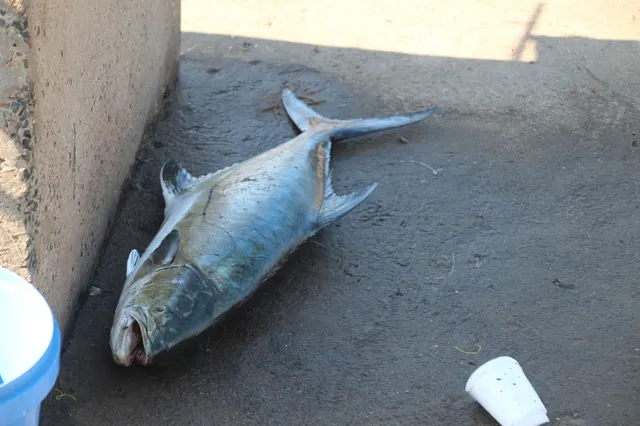 LeerfishSeasonal1 placePort Alfred and the KowieOver estuaryAround Jan–Apr, Nov–Dec
Photo: Erwin Sieben, via iNaturalist, CC0 1.0; resized and trimmed to fit

From a boat · 2
- Dusky kobRegular local target1 placePort Alfred and the KowieOver estuary
Photo: タウナギ, via Wikimedia Commons, CC BY-SA 4.0; resized and trimmed to fit
- Silver kobRecorded here1 place · 1 fishery account · 1 sourcePort Alfred and the KowieOver estuaryObserved in 1996
What these strengths mean
- Regular local target
- Fishing sources describe this as a normal local target here, not merely as caught.
- Seasonal
- Well supported, and concentrated in part of the year rather than spread through it.
- Recorded here
- At least one credible public account of this species being caught here. That is all it means.
- How breadth is counted
- A fish documented at six marks is shown as six marks: breadth never raises the strength on its own. A fishery account describes the fishing; a recorded catch reports one specific catch. How evidence is weighed.
Also associated with this ground
Recorded as present here without a documented method or strength behind them.
How people fish it
Practised here: Sea fishing.
Methods the sources name for this ground. Each one is explained in full on its own page.
- Ledgering
Fishing a bait on the bottom held by a weight, with no float — the simplest way to fish at distance, in depth, or in wind.
- Float fishing
Suspending a bait at a controlled depth beneath a buoyant indicator — the most visual, most controllable and most widely applicable method in angling.
- Spinning
Casting an artificial lure and retrieving it so that it moves like something alive — the most direct form of lure fishing.
Baits and lures for these fish
The baits and lures each of the fish above is commonly taken on, from that fish’s own page. This is what works for the fish, not a report of what people use on this particular water — local knowledge and the conditions on the day still decide.
Baits
- Prawns and shrimp — for Spotted grunter
Lures
- Surface lures — for Leerfish
The ground and the water
- The ground
- A permanently open river mouth on the Eastern Cape coast, trained between two stone piers, with a deep channel running well upriver and rocky coast either side of the entrance. The estuary is narrow and deep rather than wide and shallow, which makes it a channel fishery rather than a flats one.
- Exposure
- The estuary itself is sheltered along its length. The piers at the mouth are exposed to the south-easterly swell and the entrance can be dangerous in a running sea.
- Depth
- Deep and channelised rather than shallow — this is a river mouth rather than a lagoon, and the depth is what holds the kob.
- Tide and flow
- Strongly tidal through a trained entrance, with a fast flow in the channel and a substantial exchange upriver. Fish move up and down the channel with the tide rather than onto flats.
Through the year
Summer for kob, garrick and grunter. Riverbream through the year for anyone patient enough. The mouth fishes on a moving tide.
Safety
Cliffs and rock platforms — Can cause serious injury or death
The fish that South African rock-and-surf angling is built around — galjoen, both musselcrackers, red steenbras — live where the water is most disturbed, which means the productive stances are low wave-washed ledges and gullies on a high-energy ocean coast. Being swept from rock is the leading cause of death in South African shore angling, and it happens to people who are fishing rather than to people who are careless.
What reduces it: Watch a mark through several full wave sets before committing to a position, and identify the exit before you fish rather than when you need it. Never fish a low ledge on a building swell or a making tide. Fish with a companion. Footwear that grips wet rock, and a flotation aid on exposed marks.
Worse when:
- Long-period south-westerly ground swell, where the dangerous set arrives minutes apart out of a sea that looked manageable
- Kelp and algal growth on the ledge, which is as slippery as anything on a fishing mark anywhere
- Working a heavy fish out of a gully, which is exactly when nobody is watching the water
Rules and access
FishingHQ does not know the current access position here. South Africa licenses recreational sea angling nationally — a permit is required from the age of twelve — and layers over it a minimum size and daily bag limit set SPECIES BY SPECIES, a cumulative daily cap across all species, closed seasons on some fish, a prohibited list of species that may not be caught at all, and separate rules again for spearfishing, which is prohibited outright in estuaries. Much of the accessible coast additionally sits inside a marine protected area zoned into no-take and controlled areas, administered by a park, provincial or conservation authority rather than by the fisheries department. All of it changes, and the department's own guidance says adjustments may be forthcoming. Check the current position with the Department of Forestry, Fisheries and the Environment and with the authority that manages the protected area before going. This water is tidal and transitional, so the freshwater regime may also apply above the tidal limit: FishingHQ does not know the current access position here. Inland fishing in South Africa is administered provincially rather than nationally, and the arrangements differ substantially between provinces; many waters are additionally on private land or inside a reserve, where the permission of the landowner or the reserve authority is what actually governs access. Several endemic freshwater species are threatened and carry their own protection. Check with the relevant provincial conservation authority and with the landowner or reserve before going.
Particular to this water: Spearfishing is prohibited outright in estuaries under the national regulations. The applicable kob rules here are the EASTERN shore-and-estuary ones — 60 cm and one fish. The mouth is a working entrance with boat traffic.
Who holds the answer:
- The Department of Forestry, Fisheries and the Environment, which issues the recreational fishing permit and sets the species, size, bag and closed-season measures.
- The authority managing the marine protected area — SANParks, CapeNature, Ezemvelo KZN Wildlife or the relevant provincial body — for whether this particular stretch of coast is open and on what terms.
- The harbour, municipality or landowner, for physical access to structures, beaches and rock.
- The provincial conservation authority, which administers inland angling in that province.
- The landowner, reserve or angling association holding the rights on the water.
- The Department of Forestry, Fisheries and the Environment, which issues the recreational fishing permit and sets the species, size, bag and closed-season measures
- The authority managing the marine protected area — SANParks, CapeNature, Ezemvelo KZN Wildlife or the relevant provincial body — for whether a particular stretch of coast is open and on what terms
- The harbour authority, municipality or landowner, for physical access to structures, beaches and rock
- The South African Post Office, which is where the recreational permit is actually bought
Sources for this place
- Sea Angler — Bauer Media (Specialist angling publication)Relied on for: Long-running published description of British sea angling practice by region, ground type and named mark.FishingHQ's interpretation of what it saysCitation checked — the work exists and is described correctly
- General angling website restatements of established technique — Various (Credible secondary source)Relied on for: Widely restated public descriptions of which places are conventionally fished and how, recorded as practitioner consensus rather than as scholarship, and not relied on for access, permission or any current rule.Background and mechanism onlyCitation checked — the work exists and is described correctly
How FishingHQ labels evidence is explained in the evidence policy. Last reviewed 2026-08-16.