Leerfish
Fish · Last reviewed 2026-08-10
A large, fast, laterally compressed jack of Mediterranean and African coasts, known as garrick in South Africa, and a prime surf and lure target.
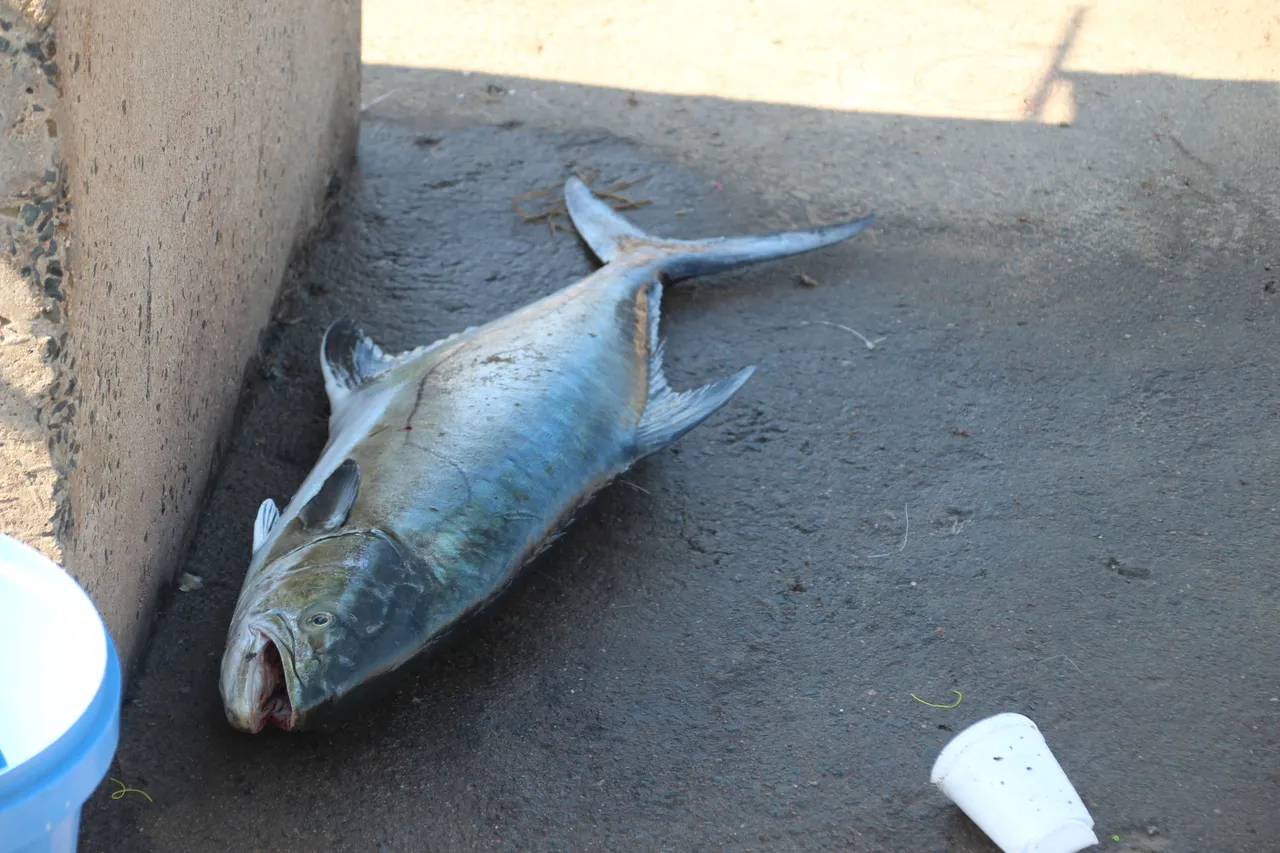
How this was identified, and who took it
Identified by: A deep, strongly compressed body carrying a row of short separate dorsal spinelets ahead of the second dorsal, and a deeply forked tail with dark lobes. The lateral line can be traced from behind the operculum with a discernible wave over the pectoral region — described as discernible rather than emphatic, because on a dulled post-mortem flank it is not the bold undulation a live fish shows.Erwin Sieben — CC0, via iNaturalist — source, licenceCatching Leerfish
Everything here on fishing for it. Each entry opens the page behind it.
- When
- Somewhere documents it in almost every month, so there is no season for the species as a whole — the season is a property of the ground, and each place states its own.
- Where
- 7 places FishingHQ documents — strongest claim anywhere: seasonal · From the shore, From a kayak, From a boat
Leerfish is a big jack built like a blade: extremely compressed laterally, deep-bodied, with a curiously wavy lateral line and a scythe-like turn of speed. It hunts mullet and other baitfish in the surf, in estuaries and along rocky coasts from the Mediterranean down the length of the African Atlantic and Indian Ocean coasts.
In South Africa, where it is one of the most sought-after shore species, it is called garrick or leervis. In the Mediterranean it is leccia or glaucus. It is the same fish, and the naming difference is a good example of why FishingHQ records regional terminology rather than creating separate records.
It is a strong, fast, visually hunting predator, and it is taken most characteristically on live mullet or on fast-worked surface lures.
How it is caught
- Popping and stickbaitingLive mullet and fast surface lures, the two approaches practitioners agree on in both regions.
- SpinningLive mullet and fast surface lures, the two approaches practitioners agree on in both regions.
- SurfcastingLive mullet and fast surface lures, the two approaches practitioners agree on in both regions.
Where Leerfish is documented
Places where public sources describe this species as fished, with how it is fished and how strongly the evidence supports it. This is not a range map and it is not a recommendation — it is what has been written down about a fishery rather than a record of any individual catch, and being listed is never permission to fish.
The Garden Route
2 documented places
Estuary
Seasonal
From the shore · From a kayak · From a boat
Around Nov, Dec, Jan, Feb, Mar, Apr
Headland
Seasonal
From the shore
Around Nov, Dec, Jan, Feb, Mar, Apr
The KwaZulu-Natal coast
2 documented places
Harbour wall
Seasonal
From the shore
Around Apr, May, Jun, Jul, Aug, Sept
Rock mark
Seasonal
From the shore
Around Apr, May, Jun, Jul, Aug, Sept
The Cape west coast
1 documented place
Estuary
Seasonal
From the shore · From a kayak
Around Nov, Dec, Jan, Feb, Mar
The Cape Peninsula and False Bay
1 documented place
Harbour wall
Seasonal
From the shore
Around Nov, Dec, Jan, Feb, Mar
The Eastern Cape and the Wild Coast
1 documented place
Estuary
Seasonal
From the shore · From a kayak
Around Nov, Dec, Jan, Feb, Mar, Apr
What these strengths mean
- Seasonal
- Well supported, and concentrated in part of the year rather than spread through it.
When to fish for leerfish
Where the places here state a season for leerfish, it clusters in Nov–Apr. This is a count of how many documented places name each month — evidence about when people fish for it, not a prediction of what any particular day will produce.
| Jan | Feb | Mar | Apr | May | Jun | Jul | Aug | Sep | Oct | Nov | Dec |
|---|---|---|---|---|---|---|---|---|---|---|---|
| January: 5 places name this month — most places. | February: 5 places name this month — most places. | March: 5 places name this month — most places. | April: 5 places name this month — most places. | May: 2 places name this month — some places. | June: 2 places name this month — some places. | July: 2 places name this month — some places. | August: 2 places name this month — some places. | September: 2 places name this month — some places. | October: no place here names this month — no place names it. | November: 5 places name this month — most places. | December: 5 places name this month — most places. |
7 of the 7 places that record catches of leerfish state which months. The dated records span 5 separate areas.
Identification
- Scientific name
- Lichia amia
- Family
- Carangidae
- Water
- Saltwater, Brackish
- Conservation status
- Least Concern
- Regions
- Mediterranean, West Africa, East & Southern Africa, Western Europe
- Very deep, strongly laterally compressed body — noticeably thin when viewed head-on.
- A distinctly wavy or undulating lateral line along the flank.
- Long sickle-shaped second dorsal and anal fins, and no scutes on the caudal peduncle.
- Silver-blue back over bright silver flanks, sometimes with faint dusky bars in young fish.
Size
- Typical
- 3–10 kg (6.6–22 lb)
- Large
- 15–25 kg (33–55 lb)
Exceptional: FishBase records a maximum of 200 cm and 50 kg
How leerfish are fished, and why
A large, fast, surf-zone predator that hunts mullet and other baitfish in broken water along rocky and sandy coasts, and every method is about intercepting a hunting fish rather than finding a holding one.
SURFCASTING with live or dead bait works because the fish patrols the surf and gutters, and a bait in the wash reaches it where it is already hunting.
SPINNING and POPPING are the specialist approaches, and they work for a specific reason: leerfish hunt visually in white water and will take a large surface lure worked fast across broken water. It is one of the few Mediterranean and eastern Atlantic species that reliably produces surface strikes from the shore.
THE TIMING IS THE HARD PART. The fish moves through, feeds briefly and leaves, so the method matters less than being present at dawn, dusk or in a building sea when the mullet shoals are pushed against the rocks.
What experienced anglers do — why, and the sources (2)
Widely and independently recommended by experienced anglers and specialist sources. This is real angling knowledge, not proof: controlled evidence for it is limited, and FishingHQ records it as convention rather than as a demonstrated effect.
- FishBase: a global information system on fishes — Froese, R. and D. Pauly, eds. — FishBase Consortium (Scientific institute)Relied on for: Habitat association, depth range, feeding ecology and prey of the species, from which the method association follows.Background and mechanism onlyPassage read and verified
- IGFA International Angling Rules and World Record Requirements — International Game Fish Association (Angling or fisheries organisation)Relied on for: Recognised angling methods and the tackle classes used for them internationally.Background and mechanism onlyPassage read and verified
Lifecycle and reproduction
Fast-growing and long-lived, with adults ranging widely along coastlines. Juveniles use estuaries and sheltered bays, moving to open coast as they grow.
Spawns in coastal waters in the warmer months, broadcasting eggs. Juveniles are estuary-dependent, which ties recruitment to estuarine condition.
Feeding and senses
A fast pursuit predator taking mullet, sardine and other schooling baitfish, driving them against surf, structure and the surface.
A daylight visual hunter of clear moving water, keying on schooling baitfish. The species is often located by the disturbance of prey rather than by seeing the predator.
Through the year
Follows baitfish along coasts seasonally, with well-known runs in southern Africa timed to mullet movements. Availability is driven by prey rather than by temperature alone.
Distribution
Eastern Atlantic: southern Bay of Biscay to South Africa, including the Mediterranean. Western Indian Ocean: South Africa to Maputo Bay, Maputo (Mozambique)
This is a biological range — where the species occurs, not a prediction that you will catch one. To browse the fishing geography FishingHQ holds, start at fishing places.
Why anglers care
A prime shore and light-boat target across the Mediterranean and southern Africa, taken on live mullet, large surface lures, spoons and fly. Its significance in South African shore angling is particularly high — garrick is among the most prized surf species there — and it is also a significant Mediterranean lure target. Practitioner consensus in both regions favours live bait for large fish and fast surface lures for active hunting fish.
Handling and returning
A powerful, deep-bodied fish that fights to exhaustion. Support horizontally with both hands, keep out of dry sand, minimise air time, and revive fully in moving water before release. Widely released by shore anglers in southern Africa.
Where to go next
Where it lives
Where you will find it
- South AfricaKnown locally as garrick, a fast coastal predator of the south and east coasts and a prized shore and ski-boat target.
- The Agulhas CurrentA fast surf and inshore predator of the coast beside the current, following the small pelagic shoals along it.
- The West African coastA fast surf predator of the same coast, following the small pelagic shoals into the wash.
Sources and evidence
- FishBase: a global information system on fishes — Froese, R. and D. Pauly, eds. — FishBase Consortium (Scientific institute)Relied on for: Family, maximum size, depth and environment, distribution and the IUCN assessment for Lichia amia.States this directlyPassage read and verified
- The IUCN Red List of Threatened Species — International Union for Conservation of Nature (Conservation authority)Relied on for: The Least Concern assessment for Lichia amia, assessed 19 May 2014.States this directlyCitation checked — the work exists and is described correctly
Why the 9 connections on this page are here, and the sources
How it is caught
What experienced anglers do — 3 connections
Widely and independently recommended by experienced anglers and specialist sources. This is real angling knowledge, not proof: controlled evidence for it is limited, and FishingHQ records it as convention rather than as a demonstrated effect.
Popping and stickbaiting
A practitioner claim about how Lichia amia is commonly fished, following from where and how it feeds.
- General angling website restatements of established technique — Various (Credible secondary source)Relied on for: Widely restated practitioner accounts of fishing for leerfish.Citation checked — the work exists and is described correctly
- Sea Angler — Bauer Media (Specialist angling publication)Relied on for: Practitioner treatment of the methods used for leerfish and comparable species.Citation checked — the work exists and is described correctly
Spinning
A practitioner claim about how Lichia amia is commonly fished, following from where and how it feeds.
- General angling website restatements of established technique — Various (Credible secondary source)Relied on for: Widely restated practitioner accounts of fishing for leerfish.Citation checked — the work exists and is described correctly
- Sea Angler — Bauer Media (Specialist angling publication)Relied on for: Practitioner treatment of the methods used for leerfish and comparable species.Citation checked — the work exists and is described correctly
Surfcasting
A practitioner claim about how Lichia amia is commonly fished, following from where and how it feeds.
- General angling website restatements of established technique — Various (Credible secondary source)Relied on for: Widely restated practitioner accounts of fishing for leerfish.Citation checked — the work exists and is described correctly
- Sea Angler — Bauer Media (Specialist angling publication)Relied on for: Practitioner treatment of the methods used for leerfish and comparable species.Citation checked — the work exists and is described correctly
Gear for this fish
What experienced anglers do — 1 connection
Widely and independently recommended by experienced anglers and specialist sources. This is real angling knowledge, not proof: controlled evidence for it is limited, and FishingHQ records it as convention rather than as a demonstrated effect.
Surface lures
A practitioner claim about which lure family answers this species' feeding or holding behaviour.
- Sea Angler — Bauer Media (Specialist angling publication)Relied on for: Established shore and boat lure practice for the species in north-west European seas.States this directlyCitation checked — the work exists and is described correctly
- General angling website restatements of established technique — Various (Credible secondary source)Relied on for: Widely restated lure selection for this species, recorded as practitioner consensus rather than as tested fact.Background and mechanism onlyCitation checked — the work exists and is described correctly
Where it lives
Backed by research — 2 connections
Supported by peer-reviewed research or fisheries science. The sources are listed and can be checked.
Rocky shores and reefs
A habitat association for Lichia amia taken from the environment and distribution data on its FishBase summary.
- FishBase: a global information system on fishes — Froese, R. and D. Pauly, eds. — FishBase Consortium (Scientific institute)Relied on for: The environment, depth range and habitat description recorded for Lichia amia.States this directlyPassage read and verified
Surf beaches
A habitat association for Lichia amia taken from the environment and distribution data on its FishBase summary.
- FishBase: a global information system on fishes — Froese, R. and D. Pauly, eds. — FishBase Consortium (Scientific institute)Relied on for: The environment, depth range and habitat description recorded for Lichia amia.States this directlyPassage read and verified
Where you will find it
Backed by research — 3 connections
Supported by peer-reviewed research or fisheries science. The sources are listed and can be checked.
South Africa
A distribution association between an animal and a kind of water, rather than a claim about any named mark.
- FishBase: a global information system on fishes — Froese, R. and D. Pauly, eds. — FishBase Consortium (Scientific institute)Relied on for: Distribution, habitat association and depth range recorded for the species, including its occurrence in the water body concerned.States this directlyPassage read and verified
- The IUCN Red List of Threatened Species — International Union for Conservation of Nature (Conservation authority)Relied on for: Assessment and range account for the species, including the systems and coasts it occupies.Background and mechanism onlyCitation checked — the work exists and is described correctly
The Agulhas Current
A distribution association between an animal and a kind of water, rather than a claim about any named mark.
- FishBase: a global information system on fishes — Froese, R. and D. Pauly, eds. — FishBase Consortium (Scientific institute)Relied on for: Distribution, habitat association and depth range recorded for the species, including its occurrence in the water body concerned.States this directlyPassage read and verified
- The IUCN Red List of Threatened Species — International Union for Conservation of Nature (Conservation authority)Relied on for: Assessment and range account for the species, including the systems and coasts it occupies.Background and mechanism onlyCitation checked — the work exists and is described correctly
The West African coast
A distribution association between an animal and a kind of water, rather than a claim about any named mark.
- FishBase: a global information system on fishes — Froese, R. and D. Pauly, eds. — FishBase Consortium (Scientific institute)Relied on for: Distribution, habitat association and depth range recorded for the species, including its occurrence in the water body concerned.States this directlyPassage read and verified
- The IUCN Red List of Threatened Species — International Union for Conservation of Nature (Conservation authority)Relied on for: Assessment and range account for the species, including the systems and coasts it occupies.Background and mechanism onlyCitation checked — the work exists and is described correctly
How FishingHQ labels evidence is explained in the evidence policy.