The Cape west coast
Fishing regions · Last reviewed 2026-08-27
The cold Atlantic side: Benguela upwelling, kelp forest, snoek and hottentot, and water that is colder in midsummer than in midwinter because the summer wind is what drives the upwelling.
Safety: cold water shock — can cause serious injury or death. 5 more points apply here.
Fishing here at a glance
- Ways to fish
- From the shore · From a boat · On a charter · Spearfishing
- Plan a trip
- When is best · Baits and lures to bring · Open the trip planner
- Rules and access
- Who sets the rules here — being listed is never permission to fish.
Not documented here yet: tackle shops, charters or guides.
Being listed here is not permission to fish. What that meansClose
Access, fishing rights, seasons, licences, local bylaws and permitted methods vary and can change. Check current access, permission, local regulations, closures and restrictions before you travel or fish. FishingHQ describes what the ground is and names who holds the answer; it does not hold the answer itself.
Find the authority for a jurisdiction · What FishingHQ does and does not cover
The Cape west coast is where South African fishing stops being warm.
THE BENGUELA IS THE WHOLE EXPLANATION. A cold, northward-flowing Atlantic current with wind-driven upwelling on top of it: a hard south-easterly in summer pushes surface water offshore and pulls cold nutrient-rich water up from depth to replace it. The result is inshore water that is often COLDER IN JANUARY THAN IN JULY, and that can reach single figures in the middle of a heatwave.
WHICH MAKES IT ENORMOUSLY PRODUCTIVE AND GENUINELY DANGEROUS. Cold nutrient-rich water supports the kelp forest, the kelp supports everything else, and this coast carries one of the world's great sardine and anchovy systems along with the fishery that lives on them. It also means an angler swept in off a ledge on a hot day is in water cold enough to cause immediate loss of breathing control.
THE FISHING IS KELP AND SAND. Hottentot off rock and harbour wall, west coast steenbras and white steenbras out of the surf gutters, white stumpnose over the bay sandbanks, snoek from small boats in winter, and galjoen where the ground is right. It is a different species list from the south and east coasts and a visitor arriving from Durban would not recognise it.
SALDANHA AND LANGEBAAN ARE THE STRUCTURAL FEATURES. A large natural harbour and a long shallow lagoon behind it, forming the most important sheltered system on the coast and a nursery for white stumpnose and several other species. The lagoon sits inside the West Coast National Park.
AND THE WIND SETS THE FISHING YEAR. The summer south-easter is what drives the upwelling and is also what makes the coast unfishable; winter north-westerlies bring the swell that closes the ledges. The gaps between are when people fish.
What fishing here is like
A cold-water Atlantic coast dominated by the Benguela upwelling and by kelp. The inshore is rock, kelp forest and clean sand; the shore fishing is hottentot and the steenbrasses; the small-boat fishery is snoek in winter and mixed ground fish through the year. It is markedly less species-rich than the south and east coasts and markedly more productive in biomass, which is what an upwelling system is.
The defining practical fact is that summer is the cold season inshore. A hard south-easter drops the water temperature within a day, and the coldest inshore water of the year is frequently in January or February.
What you can target here
One entry per fish, grouped by how you would be fishing — because the answer is a different one from the rocks and from a boat. Each entry says how strongly the sources support it and how much evidence sits behind it. These are documented catches, not a forecast, and none of it is a statement that you may fish any particular ground.
From the shore · 8
- HottentotCharacteristic of this water3 placesSaldanha Bay, Jacobsbaai, YzerfonteinOver bay, beach, rock platform
- White stumpnoseCharacteristic of this water2 placesLangebaan Lagoon, Saldanha BayOver bay, estuary
- Silver kobRegular local target3 placesJacobsbaai, Langebaan Lagoon, YzerfonteinOver beach, estuary, rock platformAround Jan–Apr, Oct–Dec
- West coast steenbrasRegular local target2 placesYzerfontein, JacobsbaaiOver beach, rock platform
- BlacktailRegular local target1 placeJacobsbaaiOver rock platform
- Cape stumpnoseRegular local target1 placeLangebaan LagoonOver estuary
From a boat · 6
- White stumpnoseCharacteristic of this water2 placesLangebaan Lagoon, Saldanha BayOver bay, estuary
- HottentotCharacteristic of this water1 placeSaldanha BayOver bay
- Yellowtail kingfishRegular local target2 placesSt Helena Bay, Saldanha BayOver bayAround Jan–Apr, Nov–Dec
- GeelbekRegular local target1 placeSt Helena BayOver bay
- Silver kobSeasonal2 placesLangebaan Lagoon, St Helena BayOver bay, estuaryAround Jan–Apr, Oct–Dec
- BarracoutaSeasonal1 placeSaldanha BayOver bayAround May–Sept
On a charter · 3
Spearfishing · 2
- HottentotCharacteristic of this water1 placeSaldanha BayOver bay
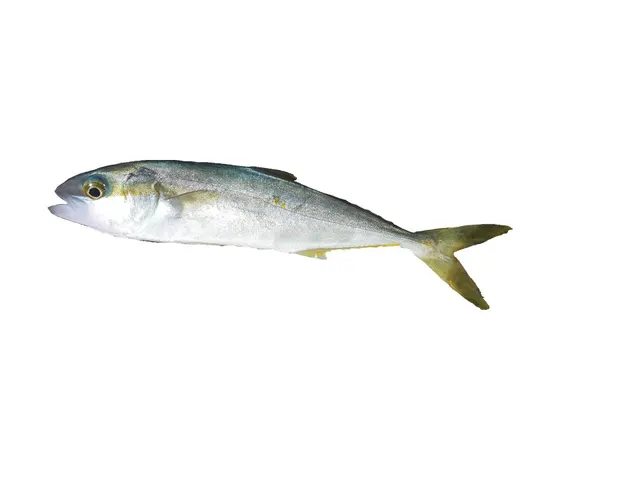 Yellowtail kingfishSeasonal1 placeSaldanha BayOver bayAround Jan–Apr, Nov–Dec
Photo: Hugues Evano (IFREMER, Délégation océan Indien (DOI), Département Ressources Biologiques et Environnement (RBE), F-97420 Le Port, France), via Wikimedia Commons, CC BY 4.0; resized
_(Ifremer_00762-87437).jpg)
What these strengths mean
- Characteristic of this water
- This water is strongly identified with this species by the sources that cover it.
- Regular local target
- Fishing sources describe this as a normal local target here, not merely as caught.
- Seasonal
- Well supported, and concentrated in part of the year rather than spread through it.
- Occasional
- Caught here, and described as unusual rather than normal. Do not plan a session around it.
- How breadth is counted
- A fish documented at six marks is shown as six marks: breadth never raises the strength on its own. A fishery account describes the fishing; a recorded catch reports one specific catch. How evidence is weighed.
How people fish here
10 methods are recorded on the places documented here, counted from those places themselves rather than from what is practised in the country. Each opens a full guide to the technique.
Ledgering
Recorded at 4 places here, over bay, beach, estuary, rock platform.
Fishing a bait on the bottom held by a weight, with no float — the simplest way to fish at distance, in depth, or in wind.
Documented on the same ground: Hottentot, White stumpnose, Blacktail, Cape stumpnose, Silver kob, West coast steenbras.
Jigging
Recorded at 2 places here, over bay.
Working a weighted lure with a rising-and-falling motion, usually vertically, so it behaves like a wounded or fleeing baitfish.
Documented on the same ground: Hottentot, Geelbek, White stumpnose, Yellowtail kingfish, Barracouta, Silver kob.
Light rock fishing
Recorded at 2 places here, over beach, rock platform.
Ultralight lure fishing from the shore with tackle rated in single grams — a discipline that catches the fish everybody else steps over, and one FishingHQ held every component of and had never named.
Documented on the same ground: Hottentot, Blacktail, Silver kob, West coast steenbras, Galjoen.
Spinning
Recorded at 2 places here, over bay, estuary.
Casting an artificial lure and retrieving it so that it moves like something alive — the most direct form of lure fishing.
Documented on the same ground: Hottentot, White stumpnose, Cape stumpnose, Barracouta, Leerfish, Silver kob.
Surfcasting
Recorded at 2 places here, over beach, rock platform.
Casting heavy baited tackle from a beach into surf — a method defined by distance, by tide, and by reading water that all looks the same.
Documented on the same ground: Hottentot, Blacktail, Silver kob, West coast steenbras, Galjoen.
Boat diving
Recorded at 1 place here, over bay.
Spearfishing from a vessel, which removes the swim and adds the two things most likely to kill a diver: propellers and drift.
Documented on the same ground: Hottentot, White stumpnose, Barracouta, Yellowtail kingfish.
Drift fishing
Recorded at 1 place here, over bay.
Letting the boat move with tide and wind while fishing, so the tackle searches ground instead of waiting on it — and the decision that determines whether a boat session works at all.
Documented on the same ground: Geelbek, Yellowtail kingfish, Silver kob.
Float fishing
Recorded at 1 place here, over estuary.
Suspending a bait at a controlled depth beneath a buoyant indicator — the most visual, most controllable and most widely applicable method in angling.
Documented on the same ground: White stumpnose, Cape stumpnose, Leerfish, Silver kob.
Shore diving
Recorded at 1 place here, over bay.
Entering and leaving the water from land under your own power — the most accessible spearfishing and the one where the entry and exit are the dangerous part.
Documented on the same ground: Hottentot, White stumpnose, Barracouta, Yellowtail kingfish.
1 further method is recorded at one or two places each: Trolling.
These are the methods documented at the places FishingHQ holds here. A species listed beside a method is documented on the same ground, which is not the same as being taken that way — where a source establishes the method a fish was caught on, it is stated on that place’s own page. All fishing methods.
Baits and lures for these fish
The methods, baits and lures each of the fish above is commonly taken on, from that fish’s own page. This is what works for the fish, not a report of what people use on this particular water — local knowledge and the conditions on the day still decide.
Methods
- Kayak fishing — for Yellowtail kingfish
- Livebaiting at sea — for Yellowtail kingfish
- Popping and stickbaiting — for Leerfish
Lures
- Surface lures — for Yellowtail kingfish, Leerfish
- Metal jigs — for Yellowtail kingfish
The fishing year here
The months the places and accounts under this area actually name, tightest season first. This is “observed in these months” rather than a season: a species whose months nobody recorded is not listed, because a gap in the evidence is not a year-round fishery.
- BarracoutaMay to September
- LeerfishNovember to March
- Yellowtail kingfishNovember to April
- Silver kobOctober to April
- GaljoenMarch to October
What dominates
Shore fishing from rock, harbour wall and open surf beach, with hottentot on light tackle over kelp and the steenbrasses on heavier gear out of sand gutters. Small-boat fishing for snoek in winter, which is a genuine seasonal event on this coast. Bay and sandbank fishing for white stumpnose. Spearfishing in cold water demanding serious thermal protection, and with its own species — hottentot, white stumpnose, kob. Kayak fishing on the sheltered bays. Shore-based shark angling is present but less prominent than on the east coast.
The water available
Cold upwelled Atlantic water with extensive kelp forest on the inshore rock. Long high-energy surf beaches with sand gutters and banks. Granite and sandstone headlands and low rock platforms. Saldanha Bay, a large natural harbour, and the Langebaan lagoon behind it — a long shallow sheltered system inside the West Coast National Park and one of the most important nursery areas on the coast. Working commercial fishing harbours at Saldanha, St Helena Bay and Lambert's Bay. Offshore, the Cape Canyon and the shelf ground that supports the pelagic fishery.
How the rules are structured
National sea fishing rules apply as elsewhere: a permit from the age of twelve, per-species minimum sizes and bag limits, a cumulative ten-fish daily cap, and the galjoen and elf closed seasons. This coast carries a specific area rule of its own — the kob regulations differ WEST of Cape Agulhas from east of it, and this whole coast is on the western side. The Langebaan lagoon sits inside the West Coast National Park with its own zonation administered by SANParks, and several other protected areas overlay the coast. FishingHQ does not state what any current rule is: the department's own guidance says adjustments may be forthcoming, and the answer differs by species, by area and by whether you were standing on the shore or sitting in a boat.
Who to ask
- The Department of Forestry, Fisheries and the Environment, which issues the recreational fishing permit and sets the species, size, bag and closed-season measures
- The authority managing the marine protected area — SANParks, CapeNature, Ezemvelo KZN Wildlife or the relevant provincial body — for whether a particular stretch of coast is open and on what terms
- The harbour authority, municipality or landowner, for physical access to structures, beaches and rock
- The South African Post Office, which is where the recreational permit is actually bought
Words you will meet
- Weskus
- The west coast, in Afrikaans, and the name the region is known by locally. It carries a cultural weight the English translation does not — the weskus is a place with its own food, its own pace and its own fishing.
- Snoek
- Thyrsites atun, the barracouta of the southern ocean, and the winter fish of this coast. A toothy snake mackerel that destroys tackle and is the backbone of the local food fishery, smoked and salted as much as eaten fresh.
- Upwelling
- Wind-driven replacement of warm surface water by cold water from depth. On this coast it is what makes the fishery productive, and it is why the water is coldest in the middle of summer.
- Bokkom
- Salted, air-dried mullet, a west-coast preparation. Not a fishing term, and included because it is what half the harbour smells of and visitors ask.
Conditions and hazards
Cold water is the defining hazard here and it is at its worst in summer. Benguela upwelling drops inshore temperature to single figures during a hard south-easter, and immersion at that temperature produces involuntary gasping and loss of breathing control within seconds. An angler dressed for a thirty-degree February day is beside water that will incapacitate them in under a minute, and this is the specific reason cold-water shock rather than hypothermia is what kills people here.
The rock is the other half. Low granite and sandstone platforms with kelp on them are as slippery as anything on a fishing mark, and the Atlantic swell arrives on this coast independently of the local wind. Distances between towns are long, and stretches of the coast north of Lambert's Bay have very little between an angler and help.
Great white sharks are present on this coast and are a real consideration for spearfishers and for people in the water, though for a shore angler the sea itself is a far greater risk than anything in it.
Places within this area
Publicly documented fishing geography. FishingHQ describes what the ground is; it does not say whether you may fish it, and every one of these sends that question to the body that holds the answer. Browse every place in this part of the world.
Who to ask before fishing any of these
FishingHQ does not know the current access position here. South Africa licenses recreational sea angling nationally — a permit is required from the age of twelve — and layers over it a minimum size and daily bag limit set SPECIES BY SPECIES, a cumulative daily cap across all species, closed seasons on some fish, a prohibited list of species that may not be caught at all, and separate rules again for spearfishing, which is prohibited outright in estuaries. Much of the accessible coast additionally sits inside a marine protected area zoned into no-take and controlled areas, administered by a park, provincial or conservation authority rather than by the fisheries department. All of it changes, and the department's own guidance says adjustments may be forthcoming. Check the current position with the Department of Forestry, Fisheries and the Environment and with the authority that manages the protected area before going.
Langebaan Lagoon
Estuary · Salt water
A sixteen-kilometre shallow marine lagoon behind Saldanha Bay, floored with clean sand and eelgrass and fed by tidal exchange rather than by a river — so it is fully saline rather than brackish, which is unusual for a system of this shape. Sand banks dry over large areas at low water and the channels between them are what hold fish.
Almost completely sheltered. The lagoon lies behind the Saldanha peninsula and the prevailing south-easter blows along it rather than into it, which makes this one of very few pieces of the Cape west coast fishable in a hard summer wind.
Severe hazards of The Cape west coast apply here: cold water shock, cliffs and rock platforms.
Particular to this water: The lagoon lies within the West Coast National Park, which is administered by SANParks and is zoned. A national recreational fishing permit does not establish that fishing is permitted in a particular part of the park, and some zones are closed to extraction entirely. Check with SANParks before fishing.
Saldanha Bay
Bay · Salt water
The largest natural harbour on the South African coast: a deep, sheltered, granite-shored bay with a working iron-ore port at its head and clean sand and kelp-fringed rock around its margins. Deep water lies close to the shore on the northern side, which is unusual for a bay of this shelter.
Sheltered from the prevailing south-easter and from most of the Atlantic swell by the peninsula and by Marcus Island, which is what made it a natural harbour. Open to the north-west, and a winter north-wester puts sea into it.
Severe hazards of The Cape west coast apply here: cold water shock, cliffs and rock platforms.
Particular to this water: Saldanha is a working commercial and naval port with substantial restricted areas, and the bay carries mariculture leases. Physical access to structures and to parts of the shore is controlled by the port authority rather than by any fishing rule.
Yzerfontein
Beach · Salt water
A small west-coast village on a granite-and-sand shore, with a short rocky point at the harbour and a long open surf beach — the sixteen-mile beach — running south from it towards the Bokbaai. The rock is granite boulder with kelp on it and the beach is clean steep sand with defined gutters.
Fully open to the Atlantic west and north-west. Winter north-westerly swell closes the beach and the rock alike, and the summer south-easter blows offshore here, which is one of the few pieces of good news the wind gives on this coast.
Severe hazards of The Cape west coast apply here: cold water shock, cliffs and rock platforms.
Jacobsbaai
Rock platform · Salt water
A small bay village north of Saldanha built along a low granite coast, where flat rock shelves — platklip, in the local word — run out from the shore between short sandy beaches and rock pools. The rock is the fishing: the shelves give a dry stance over water that deepens quickly off their outer edge, and the sand between them holds the surf ground. It is a quieter, smaller-scale version of the ground the big bay south of it has, and it fishes for a different set of species.
Open to the Atlantic west and north-west, on a coast where the winter north-westerly swell is the thing that decides whether anybody fishes at all. The rock shelves are low and wash over in any size of sea.
Severe hazards of The Cape west coast apply here: cold water shock, cliffs and rock platforms.
Particular to this water: A recreational fishing permit endorsed for the type of fishing is required everywhere in South Africa, and it is obtained from the Department of Forestry, Fisheries and the Environment or an office it authorises. Bag limits, size limits and closed seasons apply by species and are revised; check the department's current permit conditions rather than this page. Nothing here states that any ground may be fished.
St Helena Bay
Bay · Salt water
A large north-facing bay on the Cape west coast, sheltered from the prevailing south and south-easterly wind by the land behind it, and calm enough in settled weather that regional sources describe it as fishing like a large lake. That shelter is the whole point of the place: it is the working harbour end of this coast and the base from which the offshore fishing is reached. The water outside the bay is deep and productive, driven by the Benguela upwelling, and the species taken there are pelagic rather than the surf and rock catch the rest of this coast holds.
The bay faces north and the land shelters it from the prevailing southerly and south-easterly wind, which is why it is calm when the open coast either side is not. It is exposed to any northerly component, and the water outside its mouth is fully open Atlantic.
Severe hazards of The Cape west coast apply here: cold water shock, cliffs and rock platforms.
Particular to this water: A recreational fishing permit endorsed for the type of fishing is required, from the Department of Forestry, Fisheries and the Environment or an office it authorises, and a further per-vessel fee is payable by the skipper where fishing is from a boat. Bag and size limits apply by species and are revised. Charter operators working from this bay are described by regional sources as supplying bait and tackle; that is their arrangement to confirm, not this page's. Nothing here states that any ground may be fished.
Safety
Cold water shock — Can cause serious injury or death
Benguela water on the Atlantic side of the Cape is upwelled and genuinely cold — frequently colder in a summer south-easter than in midwinter, and capable of single figures in January. Immersion causes involuntary gasping and loss of breathing control within seconds, which is the mechanism that drowns people in the first minute, and it happens to anglers in shorts on a warm day.
What reduces it: Treat the west and south-west coast as cold water regardless of the air temperature or the month. Know that the coldest water of the year is often in summer. Do not fish low exposed ledges alone. A flotation aid buys back the minute that cold-water shock takes away.
Worse when:
- A hard summer south-easter, which drives the upwelling and drops inshore temperature sharply within a day
- Dressing for the air rather than for the water
- Rock-hopping to a stance at low water with a rising tide behind you
Cliffs and rock platforms — Can cause serious injury or death
The fish that South African rock-and-surf angling is built around — galjoen, both musselcrackers, red steenbras — live where the water is most disturbed, which means the productive stances are low wave-washed ledges and gullies on a high-energy ocean coast. Being swept from rock is the leading cause of death in South African shore angling, and it happens to people who are fishing rather than to people who are careless.
What reduces it: Watch a mark through several full wave sets before committing to a position, and identify the exit before you fish rather than when you need it. Never fish a low ledge on a building swell or a making tide. Fish with a companion. Footwear that grips wet rock, and a flotation aid on exposed marks.
Worse when:
- Long-period south-westerly ground swell, where the dangerous set arrives minutes apart out of a sea that looked manageable
- Kelp and algal growth on the ledge, which is as slippery as anything on a fishing mark anywhere
- Working a heavy fish out of a gully, which is exactly when nobody is watching the water
Precautions that always apply here
- Tell somebody where you are going and when you expect to be back.
- Carry a charged phone in a waterproof case, or another means of calling for help.
- Check the tide before you go and know your exit route. Being cut off is the commonest way a shore session becomes a rescue.
- Wear a buoyancy aid or lifejacket. Cold water incapacitates strong swimmers within a minute, long before swimming ability matters.
Check the rules before you fish
Fishing laws, bylaws, access rules, seasons, bait restrictions and permitted methods vary by location and can change. Check the current rules from the relevant authority and the water you intend to fish before fishing.
Check with:
- Current national or regional law for where you are fishing
- Current local bylaws
- The relevant fisheries authority
- The landowner, club or fishery whose water it is
- Any restrictions specific to the species or the method you intend to use
Where to go next
What swims here
- Cape gurnardDemersal over sand and mixed ground from ten metres down, from Namibia to Mozambique. It walks on three free pectoral rays and tastes the bottom with them, which is why it is a bottom-bait capture rather than a lure one.
- HottentotThe everyday fish of the cold Benguela inshore: rock and kelp from Angola south around to the west coast of South Africa. It is the species most Western Cape anglers first catch and the one this coast is associated with.
- West coast steenbrasBenguela sand and mixed ground from about a metre of water outward. Aged to fifty years — the greatest recorded age of any bony fish FishingHQ describes — and Endangered on the July 2024 assessment.
- White stumpnoseThe Saldanha and Langebaan system is the species' principal nursery and fishery on this coast, over the bay sandbanks rather than on reef.
Sources and evidence
- Marine Recreational Fishing Regulations in South Africa — South African Association for Marine Biological Research (SAAMBR), summarising the Marine Living Resources Act and its regulations, 2023 (Scientific institute)Relied on for: The structure of South African recreational sea fishing regulation: the per-species size and bag limits, the closed seasons, the cumulative daily cap, the ten-hook limit, the estuary spearfishing prohibition and the prohibited species list.States this directlyPassage read and verified
- Marine Recreational Fishing: Regulations for Linefishing, under the Marine Living Resources Act — Department of Forestry, Fisheries and the Environment, South Africa (published as issued under Act 18 of 1998), 2000 (Government fisheries body)Relied on for: The permit requirement and its age threshold, the no-sale rule, the measurement convention, and the closed seasons named in the regulations themselves.States this directlyPassage read and verified
- ORI Fish Fact Sheets: the species accounts of the Oceanographic Research Institute — Oceanographic Research Institute, South African Association for Marine Biological Research (SAAMBR), Durban, 2023 (Scientific institute)Relied on for: The distribution, habitat, movement and measured stock status of the linefish that characterise this coast, from the institute that did the tagging and the ageing.States this directlyPassage read and verified
Why the 4 connections on this page are here, and the sources
What swims here
Backed by research — 4 connections
Supported by peer-reviewed research or fisheries science. The sources are listed and can be checked.
Cape gurnard
A claim that a coast or region contains the ground and conditions this species is associated with. It is a distributional statement about the world, it rests on the reference literature and on the institute that surveyed it, and it deliberately asserts nothing about access, permission or catch.
- ORI Fish Fact Sheets: the species accounts of the Oceanographic Research Institute — Oceanographic Research Institute, South African Association for Marine Biological Research (SAAMBR), Durban, 2023 (Scientific institute)Relied on for: Distribution, habitat, movement and residency for South African linefish, from the institute that did the tagging and the ageing.States this directlyPassage read and verified
- FishBase: a global information system on fishes — Froese, R. and D. Pauly, eds. — FishBase Consortium (Scientific institute)Relied on for: Recorded distribution, depth range and habitat association for the species named.States this directlyPassage read and verified
Hottentot
A claim that a coast or region contains the ground and conditions this species is associated with. It is a distributional statement about the world, it rests on the reference literature and on the institute that surveyed it, and it deliberately asserts nothing about access, permission or catch.
- ORI Fish Fact Sheets: the species accounts of the Oceanographic Research Institute — Oceanographic Research Institute, South African Association for Marine Biological Research (SAAMBR), Durban, 2023 (Scientific institute)Relied on for: Distribution, habitat, movement and residency for South African linefish, from the institute that did the tagging and the ageing.States this directlyPassage read and verified
- FishBase: a global information system on fishes — Froese, R. and D. Pauly, eds. — FishBase Consortium (Scientific institute)Relied on for: Recorded distribution, depth range and habitat association for the species named.States this directlyPassage read and verified
West coast steenbras
A claim that a coast or region contains the ground and conditions this species is associated with. It is a distributional statement about the world, it rests on the reference literature and on the institute that surveyed it, and it deliberately asserts nothing about access, permission or catch.
- ORI Fish Fact Sheets: the species accounts of the Oceanographic Research Institute — Oceanographic Research Institute, South African Association for Marine Biological Research (SAAMBR), Durban, 2023 (Scientific institute)Relied on for: Distribution, habitat, movement and residency for South African linefish, from the institute that did the tagging and the ageing.States this directlyPassage read and verified
- FishBase: a global information system on fishes — Froese, R. and D. Pauly, eds. — FishBase Consortium (Scientific institute)Relied on for: Recorded distribution, depth range and habitat association for the species named.States this directlyPassage read and verified
White stumpnose
A claim that a coast or region contains the ground and conditions this species is associated with. It is a distributional statement about the world, it rests on the reference literature and on the institute that surveyed it, and it deliberately asserts nothing about access, permission or catch.
- ORI Fish Fact Sheets: the species accounts of the Oceanographic Research Institute — Oceanographic Research Institute, South African Association for Marine Biological Research (SAAMBR), Durban, 2023 (Scientific institute)Relied on for: Distribution, habitat, movement and residency for South African linefish, from the institute that did the tagging and the ageing.States this directlyPassage read and verified
- FishBase: a global information system on fishes — Froese, R. and D. Pauly, eds. — FishBase Consortium (Scientific institute)Relied on for: Recorded distribution, depth range and habitat association for the species named.States this directlyPassage read and verified
How FishingHQ labels evidence is explained in the evidence policy.