Yellowtail kingfish
Fish · Last reviewed 2026-08-10
A circumglobal subtropical jack of kelp edges and rocky reef that fights harder than almost anything of its size and heads straight for structure.
Safety: line under tension — can cause serious injury or death. 6 more points apply here.
How this was identified, and who took it
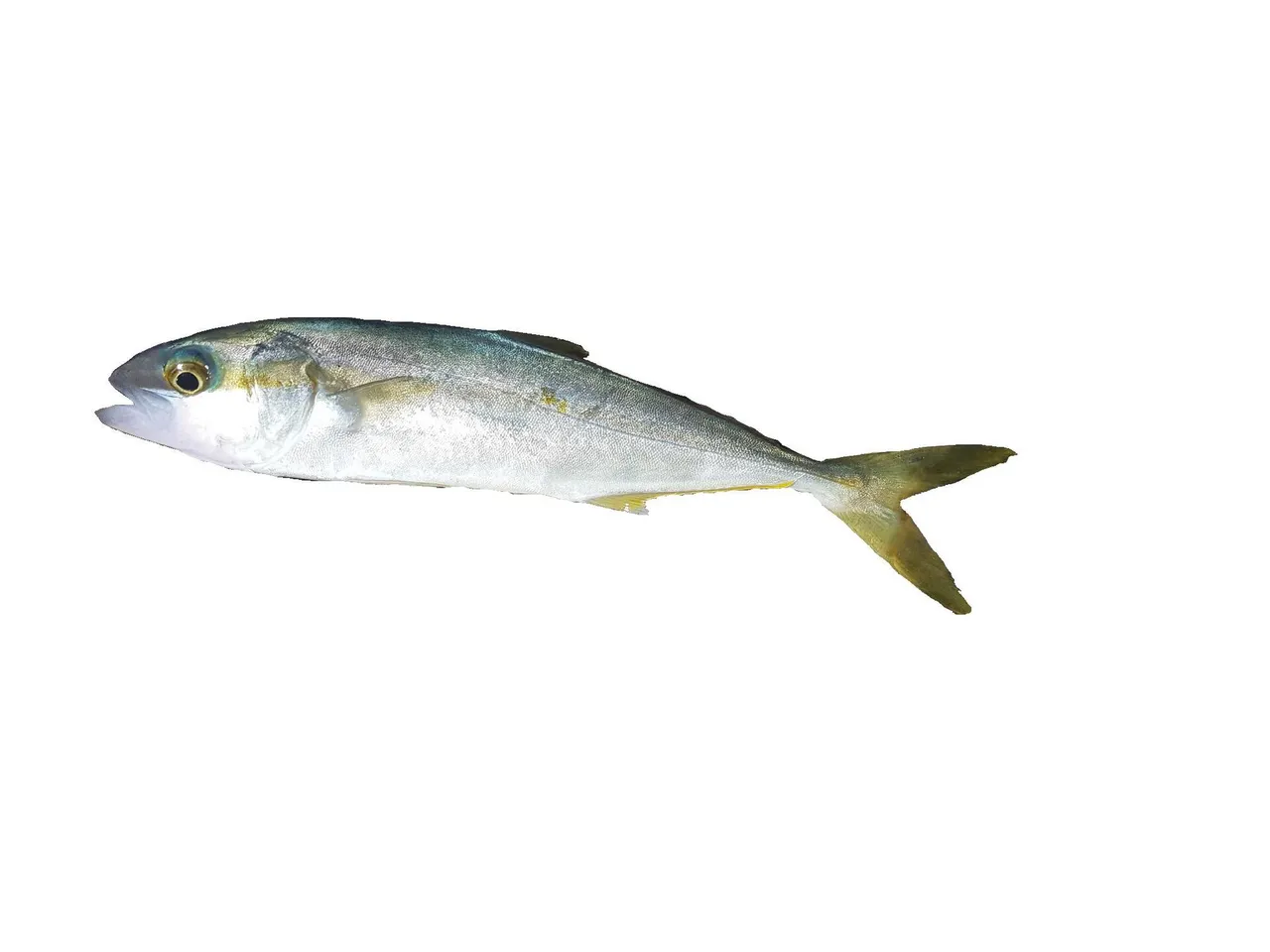
Identified by: Cut-out specimen photograph in full lateral view. Yellow caudal fin, brassy lateral band and the low soft dorsal are the characters that matter and all three are clear.Hugues Evano (IFREMER, Délégation océan Indien (DOI), Département Ressources Biologiques et Environnement (RBE), F-97420 Le Port, France) — CC BY 4.0, via Wikimedia Commons — source, licence_(Ifremer_00762-87437).jpg)
Catching Yellowtail kingfish
Everything here on fishing for it. Each entry opens the page behind it.
- Ground
- When
- Nov–Apr — months recorded at the places that document it, not a season for the whole range.
- Where
- 3 places FishingHQ documents — strongest claim anywhere: regular local target · From a boat, Spearfishing, From the shore, On a charter
The yellowtail kingfish is the same fish under half a dozen names across the southern and temperate world: kingi in New Zealand, kingfish in Australia, yellowtail in South Africa and California, hiramasa in Japan. That spread is itself the interesting fact — a single species that is a headline sport fish on four continents, in every case fished off rocky reef and kelp.
As a target it is defined by one behaviour: when hooked, it goes down and it goes for structure. A kingfish over a reef pinnacle is a race between the angler's drag and the fish's knowledge of the ground, and the ground usually wins. Everything about the tackle used for it — heavy leaders, locked drags, short powerful rods — follows from the need to stop a fish rather than play it.
It occupies a genuinely wide depth range, recorded from three metres to over eight hundred, and it moves between them. The same population can be caught by a shore angler off rocks, by a spearfisher on a shallow reef, by a jigger over a deep pinnacle, and by a trolling boat in open water — which makes it one of the few species that connects nearly every sea-fishing method on FishingHQ.
How it is caught
- JiggingOne of the few species reachable by nearly every sea method here — jigged over pinnacles, live-baited on reef, trolled, cast to from rock and speared in the shallows.
- Kayak fishingKayak fishing for kingfish is well established in Australia and New Zealand, and it is the clearest example of the platform's limits mattering: a fish that runs hard and deep is being fought from something it can tow.
- Livebaiting at seaNotoriously fussy: a kingfish will follow and refuse a lure repeatedly and take a live bait without hesitation, which is a sight-based evaluation happening at close range.
Gear for this fish
- Metal jigsSpeed jigging is the principal artificial method for kingfish over deep structure, because the fish holds down current of a pinnacle and will chase a fast vertical lure it will not chase horizontally.
- Surface luresStickbaits and poppers take kingfish that have pushed bait to the surface, and this is the shallow-water and inshore-structure counterpart to the deep jigging fishery.
Where Yellowtail kingfish is documented
Places where public sources describe this species as fished, with how it is fished and how strongly the evidence supports it. This is not a range map and it is not a recommendation — it is what has been written down about a fishery rather than a record of any individual catch, and being listed is never permission to fish.
The Cape west coast
2 documented places
Bay
Seasonal
From a boat · Spearfishing
Around Nov, Dec, Jan, Feb, Mar, Apr
Bay
Regular local target
From a boat · On a charter
The Cape Peninsula and False Bay
1 documented place
Headland
Seasonal
From the shore · From a boat · Spearfishing
Around Nov, Dec, Jan, Feb, Mar, Apr
Observed December 2018
What these strengths mean
- Seasonal
- Well supported, and concentrated in part of the year rather than spread through it.
- Regular local target
- Fishing sources describe this as a normal local target here, not merely as caught.
Identification
- Scientific name
- Seriola lalandi
- Family
- Carangidae
- Water
- Saltwater
- Conservation status
- Least Concern
- Regions
- Australia, New Zealand, East & Southern Africa, East Asia, North America, Central & South America, Indo-Pacific, Global
- A distinct yellow to bronze stripe running the length of the flank from eye to tail, with bright yellow tail and finlets.
- Body elongate and torpedo-shaped, more streamlined than a trevally of similar length.
- A dark diagonal band running through the eye in most individuals.
- Two dorsal fins, the second long and low; deeply forked bright yellow tail.
- Separated from other Seriola species by body proportion and the position of the flank stripe rather than by colour alone; several congeners overlap in range.
Size
- Typical
- 3–10 kg (6.5–22 lb)
- Large
- 20–35 kg (44–77 lb)
Exceptional: Over 50 kg (110 lb); maximum published weight 96.8 kg
Spring and summer spawning offshore, and juveniles under the weed
Yellowtail kingfish spawn in the warmer months in offshore and shelf waters, and their early life is spent somewhere completely different from their adult habitat.
SPAWNING IS IN SPRING AND SUMMER, in warm shelf and offshore water, triggered by rising temperature. It is batch spawning over an extended period with high fecundity, and eggs and larvae are pelagic.
JUVENILES ASSOCIATE WITH FLOATING OBJECTS. Young kingfish live under drifting weed rafts, debris and floating structure in open water, which shelters them and concentrates the small prey they need. That drifting phase determines the year class and is invisible to any survey of the reefs and pinnacles adults occupy.
THEY RECRUIT TO STRUCTURE AS THEY GROW, moving to reefs, pinnacles, islands and wrecks.
MATURITY COMES AT A FEW YEARS and growth is fast, but the species is long-lived and reaches large sizes, so the biggest fish are considerably older than maturity.
POPULATIONS ARE REGIONALLY STRUCTURED, with movement studies showing both resident fish and individuals travelling very long distances, so a local population is not necessarily a closed one.
AND THE AQUACULTURE CONNECTION IS WORTH NOTING: the species is farmed in several countries, and escapes and interactions between farmed and wild fish are a recognised management consideration in those regions.
Backed by research — why, and the sources (2)
Supported by peer-reviewed research or fisheries science. The sources are listed and can be checked.
- FishBase: a global information system on fishes — Froese, R. and D. Pauly, eds. — FishBase Consortium (Scientific institute)Relied on for: Distribution, habitat association, depth range, size, reproduction and life-history parameters recorded for the species.States this directlyPassage read and verified
- The IUCN Red List of Threatened Species — International Union for Conservation of Nature (Conservation authority)Relied on for: Assessment and range account for the species, including the habitats it depends on, its life history and the pressures acting on it.States this directlyCitation checked — the work exists and is described correctly
A warm-season arrival that follows temperature up and down a coast
Yellowtail kingfish seasonality is a temperature-driven coastal movement, and at the cool end of the range it produces a sharply defined season.
WARMING WATER BRINGS THEM. Kingfish move poleward and inshore as surface temperature rises, arriving on temperate coasts in the warm months and thinning as water cools. At the cool margins this is a genuine presence-and-absence season; in warmer parts of the range fish are available year-round.
SO THE SEASON MOVES WITH THE WATER. Warm-water intrusions — an eddy, a current pushing further along a coast than usual — can bring kingfish early, late or to places they are not normally caught, and the fishery follows sea surface temperature rather than the calendar.
BAIT CONCENTRATIONS SET THE LOCAL PEAKS. Kingfish follow schooling baitfish and squid, and a headland, pinnacle or island fishes when the bait is holding there.
CURRENT IS THE DAILY VARIABLE. Kingfish hold on the up-current side of structure and feed on what the flow delivers, so a mark works on a tide and dies at slack.
SPAWNING IN THE WARM MONTHS overlaps the peak fishing season, which is a biological fact rather than a suggestion.
AND THE SOUTHERN HEMISPHERE TIMING IS THE USUAL TRAP: the warm season straddles the turn of the calendar year, so northern month references are six months wrong.
Backed by research — why, and the sources (2)
Supported by peer-reviewed research or fisheries science. The sources are listed and can be checked.
- FishBase: a global information system on fishes — Froese, R. and D. Pauly, eds. — FishBase Consortium (Scientific institute)Relied on for: Distribution, habitat association, depth range, size, reproduction and life-history parameters recorded for the species.States this directlyPassage read and verified
- The IUCN Red List of Threatened Species — International Union for Conservation of Nature (Conservation authority)Relied on for: Assessment and range account for the species, including the habitats it depends on, its life history and the pressures acting on it.States this directlyCitation checked — the work exists and is described correctly
A fish that fights to destruction, on ground that is worse than the fish
Yellowtail kingfish handling is dominated by the sheer intensity of the fight and by where the fishing happens.
THE FISH DOES NOT QUIT. Kingfish run hard, repeatedly, and continue to the point of physiological collapse. A fish landed on light tackle after a long fight is severely lactate-loaded and will frequently die after release even if it swims off. The single most effective welfare measure in this fishery is heavier tackle and a shorter fight, which is precisely the opposite of the sporting instinct.
THE FISH IS NOT DANGEROUS to hold — no cutting teeth, a rasping pad in a strong jaw. The caudal scutes are sharp and the gill covers are hard-edged. It is a heavy, muscular animal and it thrashes powerfully, so support it properly and expect to be beaten about the legs.
RELEASE IT IN THE WATER. Unhook boat-side, or in the shallows, and revive by holding the fish upright and moving it forward until it drives away. Expect it to take time.
AND THE ROCK-FISHING CONTEXT IS THE REAL DANGER. A very large proportion of land-based kingfish fishing happens from exposed rock platforms on coasts taking ocean swell, and the combination of a fish that pulls extremely hard, an angler braced at the edge, and a sea that does not warn is the mechanism behind fatalities in this fishery. No fish justifies the position that makes it landable. Being prepared to lose a fish is part of the handling procedure here, and it is the part that matters most.
Official guidance — why, and the sources (3)
Stated by a fisheries authority, scientific institute or recognised angling body. Authoritative, but summarising rather than demonstrating.
- Rock fishing safety and the declared lifejacket areas of New South Wales — NSW Department of Primary Industries and Surf Life Saving NSW (Water-safety or diver-training authority)Relied on for: Rock fishing safety guidance for exposed ocean platforms, including the role of swell and the practice of not committing to a position in order to land a fish.States this directlyCitation checked — the work exists and is described correctly
- Do we need species-specific guidelines for catch-and-release recreational angling? — Biodiversity and Conservation 14:1195–1209, 2005 (Scientific literature)Relied on for: That post-release mortality varies with species, capture depth, water temperature, air exposure and handling, and that species-specific guidance outperforms general guidance.States this directlyCitation checked — the work exists and is described correctly
- A review of catch-and-release angling mortality with implications for no-take reserves — Reviews in Fish Biology and Fisheries 15:129–154, 2005 (Scientific literature)Relied on for: Review of hooking and release mortality across fisheries, including the contribution of depth of capture and handling duration.States this directlyCitation checked — the work exists and is described correctly
Structure in blue water: pinnacles, reef edges and the current that feeds them
Yellowtail kingfish are a pelagic predator that behaves like a structure fish, and reconciling those two things is the whole of their habitat description.
THE ASSOCIATION IS WITH HARD STRUCTURE STANDING IN MOVING WATER. Kingfish occupy temperate and subtropical coastal and offshore waters and concentrate on pinnacles, reefs, drop-offs, islands, headlands, wrecks, buoys, pontoons, aquaculture structures and current lines. What each of those has in common is that it disrupts flow and concentrates bait. A featureless piece of open ocean at the same depth and temperature holds nothing; the pinnacle a hundred metres away holds a school.
CURRENT IS THE ACTIVATING VARIABLE. Kingfish sit on the up-current or down-current side of structure depending on conditions and feed on what the flow delivers. A mark that fishes well on a running tide is dead on slack water, and that is a habitat statement rather than a mood: the animal's feeding strategy depends on hydraulics, so the habitat only exists when the water is moving.
TEMPERATURE SETS THE SEASONAL AND LATITUDINAL DISTRIBUTION. Kingfish are a warm-temperate species that moves poleward and inshore as water warms and retreats as it cools, so at the cool edge of the range the fish are a summer proposition and at the warm end they are resident. Currents that carry warm water along a coast extend the habitat as a moving feature rather than a fixed one.
DEPTH USE IS BROAD AND SIZE-SORTED. Small kingfish school heavily in shallow inshore water, around harbours, moorings and shallow reef; large fish are more often deep, solitary or in small groups on offshore pinnacles and wrecks. So the same species provides a light-tackle inshore fishery and a heavy deep-jigging fishery, and the ground is different for each.
AQUACULTURE AND ARTIFICIAL STRUCTURE ARE GENUINE HABITAT for this fish, not an anomaly. Kingfish aggregate around sea cages, moorings and offshore installations for the same reason they aggregate on a pinnacle, and in several regions the artificial structure supports a substantial part of the accessible fishery.
AND JUVENILES USE FLOATING OBJECTS, which is a different habitat again — young kingfish associate with drifting weed and flotsam in open water, a nursery strategy that puts them somewhere entirely unlike the adult ground.
Backed by research — why, and the sources (2)
Supported by peer-reviewed research or fisheries science. The sources are listed and can be checked.
- FishBase: a global information system on fishes — Froese, R. and D. Pauly, eds. — FishBase Consortium (Scientific institute)Relied on for: Habitat association, depth range, substrate preference, salinity tolerance and temperature range recorded for the species.States this directlyPassage read and verified
- The IUCN Red List of Threatened Species — International Union for Conservation of Nature (Conservation authority)Relied on for: Assessment and habitat account, including the habitats on which the species depends and the threats to them.Background and mechanism onlyCitation checked — the work exists and is described correctly
Jigging, casting and live bait on structure, and the current that switches it on
Yellowtail kingfish methods all rest on one condition, and without it none of them work: there has to be current running over the structure.
THE FISH FEEDS ON WHAT THE FLOW DELIVERS PAST A PINNACLE, REEF OR WRECK. The record's habitat section explains this — kingfish hold on hard structure in moving water and take what is disoriented past it. A mark that produces on a running tide is dead on slack water, and anglers who fish the slack conclude the fish have gone.
MECHANICAL AND SLOW-PITCH JIGGING ARE THE DEEP-WATER METHODS. A metal jig worked vertically over structure reaches fish holding deep on pinnacles and wrecks, and it is efficient, physically demanding and extremely effective. Slow-pitch technique — letting the jig flutter on the drop rather than driving it — takes fish that will not chase a fast retrieve, and is the more productive of the two in cooler water.
STICKBAITING AND POPPING WORK WHEN FISH ARE HIGH IN THE WATER, over shallow reef, around islands and on bait schools, and produce the surface takes the species is known for.
LIVE BAIT IS THE MOST RELIABLE METHOD FOR LARGE FISH and is honest to say so. A live squid, yellowtail scad or slimy mackerel fished near structure in current takes bigger kingfish more consistently than any lure, which is why the serious fisheries invest so much effort in catching bait first.
BERLEY AND BAIT PRESENTATION BRING FISH UP in some fisheries, particularly around moorings, cages and shallow reef, converting a deep structure fishery into a surface one.
THE FISH RUNS FOR THE STRUCTURE IMMEDIATELY AND THAT DECIDES THE TACKLE, exactly as it does for pollack and giant trevally: the first seconds are the fight, and heavy drag and lifting power are what land fish rather than what tires them.
AND SIZE AND BAG LIMITS APPLY IN THE RELEVANT JURISDICTIONS and differ; kingfish are also a species where large individuals are frequently released, and a short fight in warm water is what makes that release worth anything.
What experienced anglers do — why, and the sources (2)
Widely and independently recommended by experienced anglers and specialist sources. This is real angling knowledge, not proof: controlled evidence for it is limited, and FishingHQ records it as convention rather than as a demonstrated effect.
- Sea Angler — Bauer Media (Specialist angling publication)Relied on for: Established shore and boat angling practice, including method selection and the reasoning behind it.States this directlyCitation checked — the work exists and is described correctly
- General angling website restatements of established technique — Various (Credible secondary source)Relied on for: The widely restated practice for this species, recorded as a consensus position rather than as an original observation.States this directlyCitation checked — the work exists and is described correctly
Lifecycle and reproduction
Fast-growing and long-lived, reaching very large size. Juveniles associate with floating weed and debris in open water before recruiting to reef and kelp habitat, which is a pattern shared with several other carangids and is why small kingfish turn up under drifting material a long way from any reef.
Broadcast spawning in open water during the warmer months, with pelagic eggs and larvae and no parental care. Juveniles associate with floating structure. The species is farmed in several countries, which means a good deal is known about its early life history relative to most wild sport fish.
Feeding and senses
Adults take small fish, squid and crustaceans, hunting in packs at speed around structure and in current. Kingfish drive bait against reef and against the surface, and the pack behaviour is why a hooked fish is frequently followed by others — which is the basis of the standard technique of keeping one fish in the water to hold the school.
Sight-dominant in the clear temperate and subtropical water it prefers, hunting visually at speed. It is also notoriously fussy: a kingfish will follow a lure or bait and refuse it repeatedly, which is a sight-based evaluation happening at close range. This is why live bait so often outfishes everything else for the species.
Through the year
Moves with water temperature, preferring roughly 18 to 24 degrees, so the fishery advances and retreats along coasts seasonally. In the southern hemisphere that means summer and autumn; in the northern hemisphere the opposite months — the same fish, opposite calendar, which is exactly why FishingHQ describes the driver rather than the season. Current and tide govern the daily fishing around structure.
Distribution
Circumglobal in subtropical waters, across the Indo-Pacific and eastern Pacific, including South Africa, Japan, Australia, New Zealand and Hawaii, and from British Columbia to Chile. Found in coastal and oceanic waters off kelp beds and rocky areas, at depths from about 3 to 825 m and in water of roughly 18 to 24 degrees.
This is a biological range — where the species occurs, not a prediction that you will catch one. To browse the fishing geography FishingHQ holds, start at fishing places.
Why anglers care
A headline sport species in Australia, New Zealand, southern Africa, Japan and California, taken by jigging, live-baiting, trolling, casting from rock and by spearfishing. One of the very few species on FishingHQ targeted by nearly every sea method it contains, which makes it a natural starting point rather than a dead end.
Handling and returning
A heavy, extremely powerful fish. Support horizontally and do not lift a large one vertically by the tail or jaw. Handle in the water where possible. The lateral scutes and gill covers will cut. Fish brought up quickly from deep water suffer barotrauma, so a fish intended for release is better hooked shallow. Where retained, bleeding and chilling immediately makes a substantial difference to the flesh.
Going further
- What does yellowtail kingfish eat? — feeding biology, kept separate from what anglers infer from it.
- Yellowtail kingfish vs Greater amberjack — how to tell them apart.
Safety
Line under tension — Can cause serious injury or death
Heavy tackle with locked drags fishing tight to structure. When something parts under that load — leader, knot, split ring — it returns toward the angler at speed, and a hand in the line path during a run is seriously injured.
What reduces it: Keep hands clear of running line and of the leader while a fish is on. Nobody stands in line with a loaded rod. Gloves for leader work. Inspect connections regularly and replace rather than hoping.
Cliffs and rock platforms — Can cause serious injury or death
Much of the shore fishery for this species is from ocean rock platforms, where anglers are swept off by unexpected swell while connected to a hard-pulling fish.
What reduces it: Never fish rock platforms alone. Watch a mark for a full set cycle before going onto it. Wear a lifejacket — mandatory in some jurisdictions for exactly this fishing. Plan the escape route first and never turn your back on the sea.
Precautions that always apply here
- Wear a buoyancy aid or lifejacket. Cold water incapacitates strong swimmers within a minute, long before swimming ability matters.
- Support the fish's weight along its body, keep it out of the water for as short a time as possible, and hold it over something soft.
- Wet your hands before touching a fish. Dry hands strip the protective mucus layer that keeps infection out.
- Tell somebody where you are going and when you expect to be back.
- Carry a charged phone in a waterproof case, or another means of calling for help.
Check the rules before you fish
Fishing laws, bylaws, access rules, seasons, bait restrictions and permitted methods vary by location and can change. Check the current rules from the relevant authority and the water you intend to fish before fishing.
Check with:
- Current national or regional law for where you are fishing
- Current local bylaws
- The relevant fisheries authority
- The landowner, club or fishery whose water it is
- Any restrictions specific to the species or the method you intend to use
Where to go next
Similar and related fish
- Greater amberjackCongeners in Seriola, both structure-oriented and both diving hard for cover when hooked. Separated by the angle of the eye band and body proportion rather than by colour.
- Japanese amberjackCongeners separated by range and fin-ray counts rather than by any obvious field character.
- Pacific sardineSardines are taken heavily where the shoals occur, and kingfish concentrations frequently coincide with sardine movements along the coast.
- Yellowtail scadYellowtail scad are a principal prey of kingfish in Australian and New Zealand waters, which is the ecological basis of the live-bait fishery that dominates kingfish angling there.
Where it lives
Where you will find it
Sources and evidence
- FishBase: a global information system on fishes — Froese, R. and D. Pauly, eds. — FishBase Consortium (Scientific institute)Relied on for: Scientific name, family placement in the Carangidae, maximum length of 250 cm and maximum published weight of 96.8 kg, circumglobal subtropical distribution across the Indo-Pacific and eastern Pacific including South Africa, Japan, Australia, New Zealand and Hawaii and from British Columbia to Chile.States this directlyPassage read and verified
- FishBase: a global information system on fishes — Froese, R. and D. Pauly, eds. — FishBase Consortium (Scientific institute)Relied on for: The IUCN Red List category — Least Concern, assessed 9 March 2015 — is taken from FishBase's republication.States this directlyPassage read and verified
- RNLI water safety guidance: cold water shock and Float to Live — Royal National Lifeboat Institution (Water-safety or diver-training authority)Relied on for: The mechanism by which people are swept from coastal rock platforms and the value of a buoyancy aid and an escape plan.FishingHQ's interpretation of what it saysPassage read and verified
Why the 11 connections on this page are here, and the sources
Similar and related fish
Backed by research — 4 connections
Supported by peer-reviewed research or fisheries science. The sources are listed and can be checked.
Greater amberjack
A taxonomic and identification comparison naming both binomials.
- FishBase: a global information system on fishes — Froese, R. and D. Pauly, eds. — FishBase Consortium (Scientific institute)Relied on for: That Seriola dumerili and Seriola lalandi are congeners in the genus Seriola associated with deep reef, wreck and rocky habitat.States this directlyPassage read and verified
Japanese amberjack
An identification comparison naming both binomials: Seriola quinqueradiata and Seriola lalandi.
- FishBase: a global information system on fishes — Froese, R. and D. Pauly, eds. — FishBase Consortium (Scientific institute)Relied on for: Morphological and distributional data for Seriola quinqueradiata and for Seriola lalandi.States this directlyPassage read and verified
- The IUCN Red List of Threatened Species — International Union for Conservation of Nature (Conservation authority)Relied on for: Separate assessments treating Seriola quinqueradiata and Seriola lalandi as distinct species.States this directlyCitation checked — the work exists and is described correctly
Pacific sardine
Recorded diet evidence identifies Sardinops sagax as a food item of this predator at species level. The edge is written at that granularity and no further.
- FishBase: a global information system on fishes — Froese, R. and D. Pauly, eds. — FishBase Consortium (Scientific institute)Relied on for: Food items recorded for this predator, including Sardinops sagax.States this directlyPassage read and verified
- FAO Species Identification Guides for Fishery Purposes and the FAO Species Catalogues — Food and Agriculture Organization of the United Nations (Scientific institute)Relied on for: Species account describing the diet of this predator in the region where Sardinops sagax occurs.Background and mechanism onlyCitation checked — the work exists and is described correctly
Yellowtail scad
Recorded diet evidence identifies Trachurus novaezelandiae as a food item of this predator at species level. The edge is written at that granularity and no further.
- FishBase: a global information system on fishes — Froese, R. and D. Pauly, eds. — FishBase Consortium (Scientific institute)Relied on for: Food items recorded for this predator, including Trachurus novaezelandiae.States this directlyPassage read and verified
- FAO Species Identification Guides for Fishery Purposes and the FAO Species Catalogues — Food and Agriculture Organization of the United Nations (Scientific institute)Relied on for: Species account describing the diet of this predator in the region where Trachurus novaezelandiae occurs.Background and mechanism onlyCitation checked — the work exists and is described correctly
How it is caught
What experienced anglers do — 3 connections
Widely and independently recommended by experienced anglers and specialist sources. This is real angling knowledge, not proof: controlled evidence for it is limited, and FishingHQ records it as convention rather than as a demonstrated effect.
Jigging
A practitioner claim about a species that genuinely spans the methods.
- Sea Angler — Bauer Media (Specialist angling publication)Relied on for: Practitioner treatment of vertical jigging for reef and pinnacle predators.Citation checked — the work exists and is described correctly
- IGFA International Angling Rules and World Record Requirements — International Game Fish Association (Angling or fisheries organisation)Relied on for: The tackle classes used for large marine predators fished vertically and on the troll.Passage read and verified
Kayak fishing
Established angling practice for this species, recorded as convention. The note states the property of the animal or its water that makes the method the answer.
- IGFA International Angling Rules and World Record Requirements — International Game Fish Association (Angling or fisheries organisation)Relied on for: Recognition of the species as an established sport fish and the angling methods and tackle classes conventionally used for it.States this directlyPassage read and verified
- General angling website restatements of established technique — Various (Credible secondary source)Relied on for: Widely restated practice connecting this species and method.Background and mechanism onlyCitation checked — the work exists and is described correctly
Livebaiting at sea
A practitioner claim about why live bait is generally reported to be more effective than lures for this species, labelled as convention because no controlled comparison supports it.
- Sea Angler — Bauer Media (Specialist angling publication)Relied on for: Practitioner treatment of live bait presentation for reef and pinnacle predators.Citation checked — the work exists and is described correctly
- General angling website restatements of established technique — Various (Credible secondary source)Relied on for: Widely restated practitioner accounts of kingfish refusing artificial lures and taking live baits.Citation checked — the work exists and is described correctly
Gear for this fish
What experienced anglers do — 2 connections
Widely and independently recommended by experienced anglers and specialist sources. This is real angling knowledge, not proof: controlled evidence for it is limited, and FishingHQ records it as convention rather than as a demonstrated effect.
Metal jigs
A practitioner claim about which lure family answers this species' feeding or holding behaviour.
- IGFA International Angling Rules and World Record Requirements — International Game Fish Association (Angling or fisheries organisation)Relied on for: Recognition of the species as an established sport fish taken on artificial lures, and the line and tackle classes used for it.States this directlyPassage read and verified
- General angling website restatements of established technique — Various (Credible secondary source)Relied on for: Widely restated lure practice for this species.Background and mechanism onlyCitation checked — the work exists and is described correctly
Surface lures
A practitioner claim about which lure family answers this species' feeding or holding behaviour.
- IGFA International Angling Rules and World Record Requirements — International Game Fish Association (Angling or fisheries organisation)Relied on for: Recognition of the species as an established sport fish taken on artificial lures, and the line and tackle classes used for it.States this directlyPassage read and verified
- General angling website restatements of established technique — Various (Credible secondary source)Relied on for: Widely restated lure practice for this species.Background and mechanism onlyCitation checked — the work exists and is described correctly
Where it lives
Backed by research — 1 connection
Supported by peer-reviewed research or fisheries science. The sources are listed and can be checked.
Kelp forest
A habitat claim held to a scientific standard.
- FishBase: a global information system on fishes — Froese, R. and D. Pauly, eds. — FishBase Consortium (Scientific institute)Relied on for: That Seriola lalandi is found in coastal and oceanic waters off kelp beds and rocky areas at depths from 3 to 825 m in water of 18 to 24 degrees.States this directlyPassage read and verified
Where you will find it
Backed by research — 1 connection
Supported by peer-reviewed research or fisheries science. The sources are listed and can be checked.
New Zealand
A distribution claim held to a scientific standard.
- FishBase: a global information system on fishes — Froese, R. and D. Pauly, eds. — FishBase Consortium (Scientific institute)Relied on for: That Seriola lalandi is circumglobal in subtropical waters including South Africa, Japan, Australia, New Zealand and Hawaii and from British Columbia to Chile.States this directlyPassage read and verified
How FishingHQ labels evidence is explained in the evidence policy.