What does yellowtail kingfish eat?
What is established about how yellowtail kingfish feeds, kept separate from what anglers infer from it.
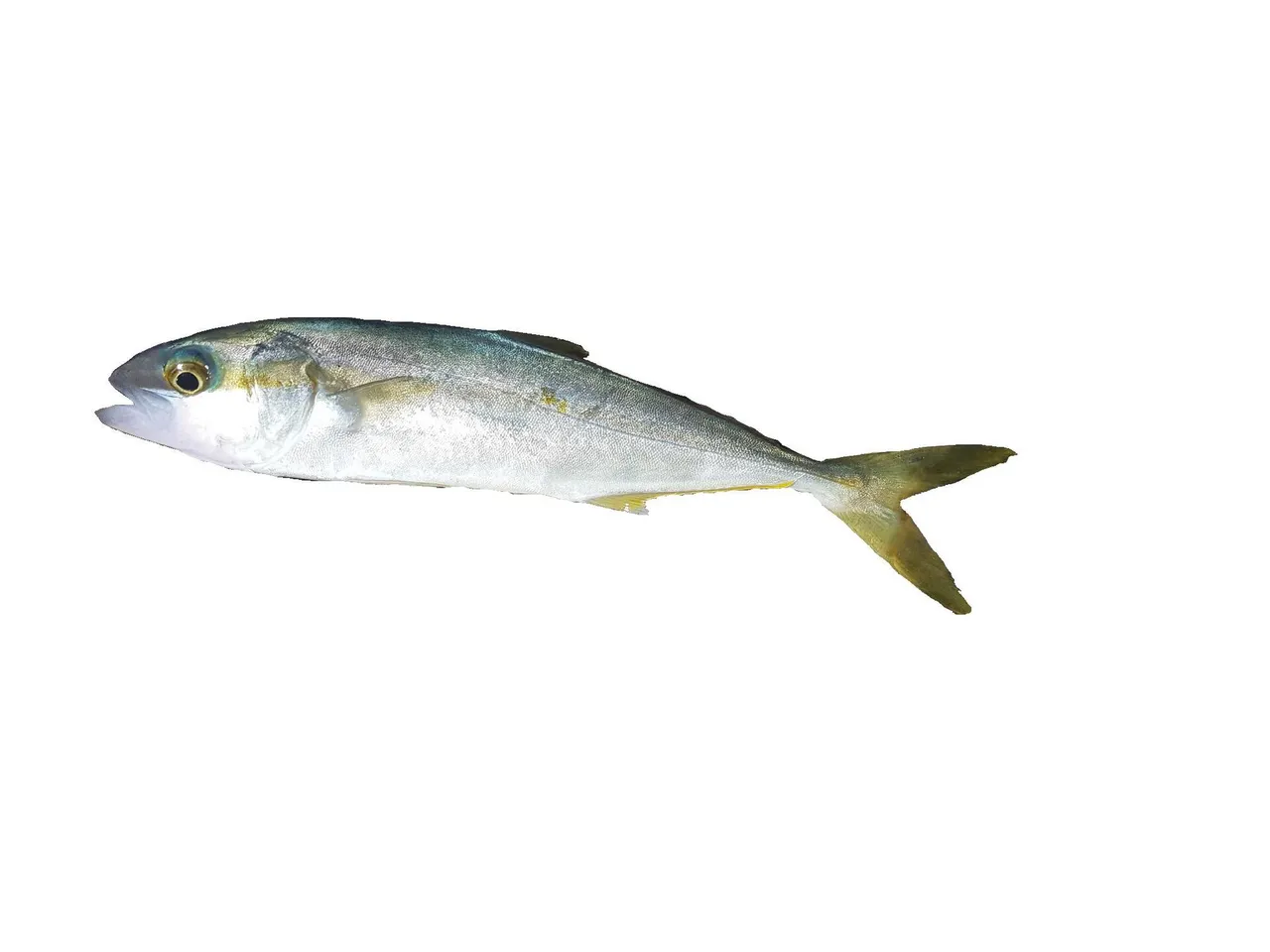
How this was identified, and who took it
Identified by: Cut-out specimen photograph in full lateral view. Yellow caudal fin, brassy lateral band and the low soft dorsal are the characters that matter and all three are clear.Hugues Evano (IFREMER, Délégation océan Indien (DOI), Département Ressources Biologiques et Environnement (RBE), F-97420 Le Port, France) — CC BY 4.0, via Wikimedia Commons — source, licenceWhat is known about how it feeds
Kingfish hunt in packs and use structure as a wall.
The fish work in groups at speed around reef, pinnacles and current lines, driving bait shoals against the structure or against the surface until the shoal loses coherence. It is a cooperative, high-speed strategy that has more in common with the amberjacks it is related to than with anything else in Australasian waters.
The two verified relationships are the two principal targets. Yellowtail scad — the fish Australians call yakka — are a staple, and the reason the live-bait fishery for kingfish is built on them. Pilchards standing for the sardine shoals that move along the coast are the second.
Squid and crustaceans feature too, and larger kingfish take substantial prey.
The pack behaviour has a consequence anglers observe constantly and which is genuinely biological: a hooked kingfish is frequently followed by others from the same group, so a fish on the line indicates a shoal rather than an individual.
Structure is the constant. Kingfish are associated with pinnacles, reef edges, current lines and, in some places, with moored objects and aquaculture pens — anywhere flow and structure combine to concentrate bait.
Growth is fast and the species reaches substantial size, and the largest fish tend to hold deeper over more significant structure.
The food
Prey with a verified dietary link to this fish. Each entry carries its own evidence, and each is written at the precision the source actually used: a named species where the source named one, a group or food category where it said “polychaetes”, “crustaceans” or “detritus” and meant it. That is why this list is shorter than the animal’s real diet rather than longer.
- Yellowtail scad — Trachurus novaezelandiae
Yellowtail scad are a principal prey of kingfish in Australian and New Zealand waters, which is the ecological basis of the live-bait fishery that dominates kingfish angling there.
- Pacific sardine — Sardinops sagax
Sardines are taken heavily where the shoals occur, and kingfish concentrations frequently coincide with sardine movements along the coast.
Food with no page of its own here yet
These are real components of the diet, listed as plain text because FishingHQ has no page for them yet. Inventing pages to make the list look fuller would be the fabrication this whole approach exists to prevent.
- squid
- garfish
- mackerel
- crustaceans, in smaller fish
- small tuna
What anglers do with this
Everything below is interpretation, not finding. It is what experienced anglers conclude from the biology above, and the reasoning is usually sound and almost never tested. It is separated from the biology deliberately.
The scad relationship is the ecological basis of the live-bait fishery, which is one of the clearer diet-to-practice connections on FishingHQ — anglers gather yakka first and fish for kingfish second, and the sequence follows from what the predator eats.
The pack behaviour converts into an expectation that a hooked fish means more fish, and into the practice of keeping a second presentation ready.
The structure association is the location method, and the same fact produces the practical difficulty: a hooked kingfish runs for the structure it was taken over, and the fight is decided in the first seconds.
Retention rules and size limits vary by jurisdiction and are a question for the relevant authority.
What this does not establish
Two relationships for a broad predatory diet that includes squid and other fish not represented. Composition varies between Australian, New Zealand and other populations and with fish size. Nothing here establishes proportions.
Where this connects
These are the baits, lures, methods and explainers FishingHQ already joins to this fish — which is why the list is sometimes short. They are not chosen for this page, and a link here means an evidenced relationship exists, not that it follows from the diet.
Lures recorded for this species
Methods used for it
Where it lives
This page covers feeding. The Yellowtail kingfish record covers identification, lifecycle, seasonal behaviour, handling and the sources behind all of it.
Reviewed 2026-08-12.