Yellowtail scad
Fish · Last reviewed 2026-08-11
A small shoaling jack of Australian and New Zealand coastal waters, known as yakka to anglers and a principal prey of kingfish and snapper.
Background, not a fishing profile
This page is here so FishingHQ can describe a biological relationship accurately — usually because a fish covered elsewhere on the site feeds on this. It covers what it is, where it lives and the evidence behind that relationship, and deliberately nothing about methods, bait or tackle. Its presence here is not a statement that anybody fishes for it.
The yellowtail scad is a small carangid — a jack — that shoals in coastal water, around structure, over reefs and in harbours throughout south-eastern Australia and New Zealand.
Anglers know it as the yakka in Australia, and it occupies a distinctive position: it is caught deliberately, in quantity, and almost entirely in order to be used as live bait for something larger. Yellowtail kingfish in particular are pursued with live yakka more than with anything else, and the reason is that kingfish feed on them naturally.
As an ecological actor it is a mid-water planktivore and small-prey feeder, shoaling densely and forming a link between plankton production and the region's larger predators — kingfish, snapper, mulloway and mackerel among them.
The record supports diet edges for yellowtail kingfish, Australasian snapper and kahawai, all of which have this species named in their recorded diets.
Identification
No photograph of Yellowtail scad has passed identity review yet, so none is shown. A photograph is published only once somebody has checked the animal in it against the diagnostic features described on this page.
- Scientific name
- Trachurus novaezelandiae
- Family
- Carangidae
- Water
- Saltwater
- Conservation status
- Least Concern
- Regions
- Australia, New Zealand
- Slender, streamlined jack with a series of enlarged bony scutes along the rear of the lateral line.
- Yellowish tail fin, which gives the species its name, against a greenish-blue back and silver flanks.
- A distinct dark spot on the upper edge of the gill cover.
- Two separate dorsal fins and a deeply forked tail, typical of the carangid family.
Size
- Typical
- 15–25 cm
- Large
- up to about 50 cm
Lifecycle and reproduction
Matures at around two years and lives to about twenty-five in some populations, though the shoals anglers encounter are dominated by much younger fish.
Spawns in coastal and shelf water over an extended warm-season period, releasing buoyant eggs. Juveniles frequently shelter around floating objects and jellyfish.
Feeding and senses
Feeds in mid-water on zooplankton, small crustaceans, larvae and small fish, shoaling densely and feeding actively in daylight and at dusk.
Vision for feeding in clear coastal water, with strong lateral-line-mediated schooling. The species is readily drawn to berley and to light at night, which is how anglers gather it.
Through the year
Present year-round in much of the range, with shoals moving between harbours, reef edges and open coast seasonally. Kingfish activity tracks scad availability closely.
Distribution
Coastal waters of southern and eastern Australia and around New Zealand, over reefs, in harbours and in open coastal water to moderate depths.
This is a biological range — where the species occurs, not a prediction that you will catch one. To browse the fishing geography FishingHQ holds, start at fishing places.
Why anglers care
Caught deliberately and in quantity, almost entirely for use as live bait rather than as a target in its own right, and taken on small baited hooks over berley. Its ecological importance as forage for kingfish and snapper is the reason it is held here.
Handling and returning
Kept alive in a large aerated tank; scad bruise easily and a damaged fish will not swim properly on a bait rig. Handle with wet hands and unhook without gripping the body.
Where to go next
Similar and related fish
- Australasian snapperLarger snapper take small shoaling fish including scad, alongside the benthic invertebrates that dominate their diet at smaller sizes.
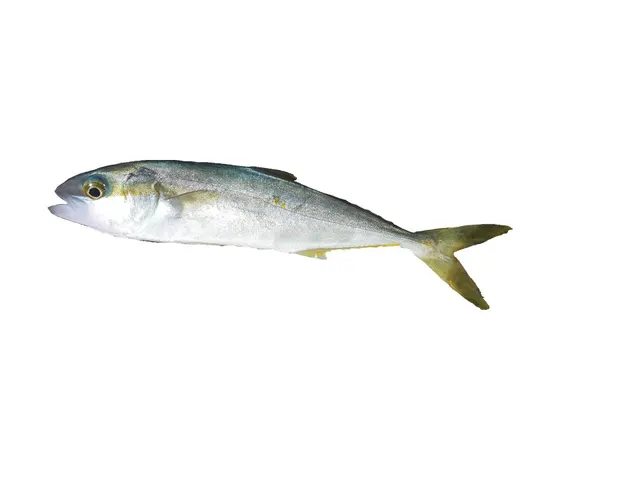 Yellowtail kingfishYellowtail scad are a principal prey of kingfish in Australian and New Zealand waters, which is the ecological basis of the live-bait fishery that dominates kingfish angling there.
More fish
Not related to this page — just the rest of the section. There is little else joined to this subject yet, and a short page should still lead somewhere.
Sources and evidence
- FishBase: a global information system on fishes — Froese, R. and D. Pauly, eds. — FishBase Consortium (Scientific institute)Relied on for: Species identity, binomial, family placement, size, distribution and recorded biology for this species.States this directlyPassage read and verified
- FAO Species Identification Guides for Fishery Purposes and the FAO Species Catalogues — Food and Agriculture Organization of the United Nations (Scientific institute)Relied on for: The regional species account describing identity, distribution and the role of this species in the fisheries and food webs it belongs to.States this directlyCitation checked — the work exists and is described correctly
Why the 2 connections on this page are here, and the sources
Similar and related fish
Backed by research — 2 connections
Supported by peer-reviewed research or fisheries science. The sources are listed and can be checked.
Australasian snapper
Recorded diet evidence identifies Trachurus novaezelandiae as a food item of this predator at species level. The edge is written at that granularity and no further.
- FishBase: a global information system on fishes — Froese, R. and D. Pauly, eds. — FishBase Consortium (Scientific institute)Relied on for: Food items recorded for this predator, including Trachurus novaezelandiae.States this directlyPassage read and verified
- FAO Species Identification Guides for Fishery Purposes and the FAO Species Catalogues — Food and Agriculture Organization of the United Nations (Scientific institute)Relied on for: Species account describing the diet of this predator in the region where Trachurus novaezelandiae occurs.Background and mechanism onlyCitation checked — the work exists and is described correctly
Yellowtail kingfish
Recorded diet evidence identifies Trachurus novaezelandiae as a food item of this predator at species level. The edge is written at that granularity and no further.
- FishBase: a global information system on fishes — Froese, R. and D. Pauly, eds. — FishBase Consortium (Scientific institute)Relied on for: Food items recorded for this predator, including Trachurus novaezelandiae.States this directlyPassage read and verified
- FAO Species Identification Guides for Fishery Purposes and the FAO Species Catalogues — Food and Agriculture Organization of the United Nations (Scientific institute)Relied on for: Species account describing the diet of this predator in the region where Trachurus novaezelandiae occurs.Background and mechanism onlyCitation checked — the work exists and is described correctly
How FishingHQ labels evidence is explained in the evidence policy.