Pacific sardine
Fish · Last reviewed 2026-08-11
One shoaling sardine found around most of the Pacific and southern oceans under half a dozen different names, and a dominant forage species in every one of them.
Background, not a fishing profile
This page is here so FishingHQ can describe a biological relationship accurately — usually because a fish covered elsewhere on the site feeds on this. It covers what it is, where it lives and the evidence behind that relationship, and deliberately nothing about methods, bait or tackle. Its presence here is not a statement that anybody fishes for it.
Sardinops sagax is a single species with an unusually wide distribution and an unusually large number of names. It is the Pacific sardine in California, the South American pilchard off Peru and Chile, the Southern African pilchard off South Africa and Namibia, the Australian pilchard or mulie in Australia, and the Japanese pilchard in the north-west Pacific.
Wherever it occurs it does the same thing: forms very large shoals in productive coastal water, feeds on plankton, and supports both an enormous commercial fishery and the predator community above it.
Its abundance swings on decadal cycles in several of those systems, most famously in the California Current where sardine and anchovy alternate, and off southern Africa where the annual sardine run along the KwaZulu-Natal coast is one of the largest aggregations of animal biomass anywhere.
The species is included here so that predators across several regions of FishingHQ — yellowtail kingfish, kahawai, kob and others — can have their prey named accurately rather than described as "small baitfish".
Identification
No photograph of Pacific sardine has passed identity review yet, so none is shown. A photograph is published only once somebody has checked the animal in it against the diagnostic features described on this page.
- Scientific name
- Sardinops sagax
- Family
- Clupeidae
- Water
- Saltwater
- Conservation status
- Least Concern
- Regions
- North America, Central & South America, East & Southern Africa, Australia, New Zealand, East Asia
- Elongate silver body with a distinctive row of dark spots along the upper flank, usually one to three rows.
- Radiating bony ridges on the gill cover, visible as fine lines fanning backwards.
- Belly keel present but only weakly serrated compared with a sprat.
- Blue-green back with a sharply defined boundary to the silver flanks.
Size
- Typical
- 15–25 cm
- Large
- up to about 40 cm
Lifecycle and reproduction
Matures at one to two years and lives to about thirteen at most, though the population is dominated by younger fish. Abundance varies over decadal cycles tied to ocean temperature regimes.
Spawns in batches over an extended season in coastal and shelf water, releasing buoyant eggs. Spawning location shifts with water temperature between years, sometimes by hundreds of kilometres.
Feeding and senses
Feeds on plankton by both filter feeding and particulate feeding, taking copepods, euphausiids and phytoplankton depending on what is dense enough to be worth straining.
Vision and the lateral line, with schooling behaviour tight enough that shoals are treated as single objects by echo sounders and by the predators working them.
Through the year
Undertakes substantial seasonal migrations in most of its range, including the southern African sardine run northward along the east coast in winter, which draws predators, seabirds and dolphins in enormous concentrations.
Distribution
Temperate and subtropical coastal waters of the Pacific and southern oceans: the eastern Pacific from Canada to Chile, southern Africa, southern Australia and New Zealand, and the north-west Pacific off Japan.
This is a biological range — where the species occurs, not a prediction that you will catch one. To browse the fishing geography FishingHQ holds, start at fishing places.
Why anglers care
Not a rod-and-line species, though sardines are taken on small feathers where shoals are dense. They are widely used as bait, frozen and fresh, and their ecological role as the food that concentrates predators is by far the more important of the two.
Handling and returning
Soft, oily and quick to spoil; used as bait fresh or frozen and rarely kept alive. Where sardines are gathered locally, seasonal restrictions may apply.
Where to go next
Similar and related fish
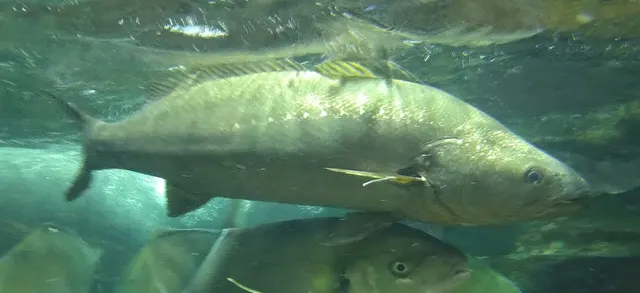 Dusky kobAdult kob feed on pilchards and other shoaling fish in coastal water, and the annual sardine run along the southern African east coast is a substantial feeding event for them.
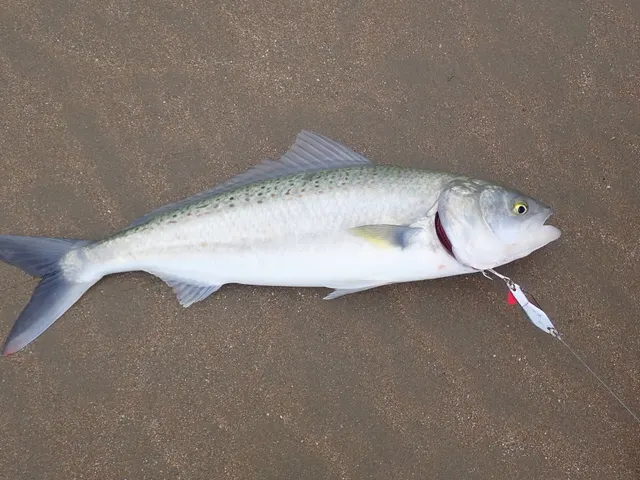 KahawaiPilchards are a principal fish prey, and kahawai working a pilchard shoal at the surface is the classic sign the species is known by.
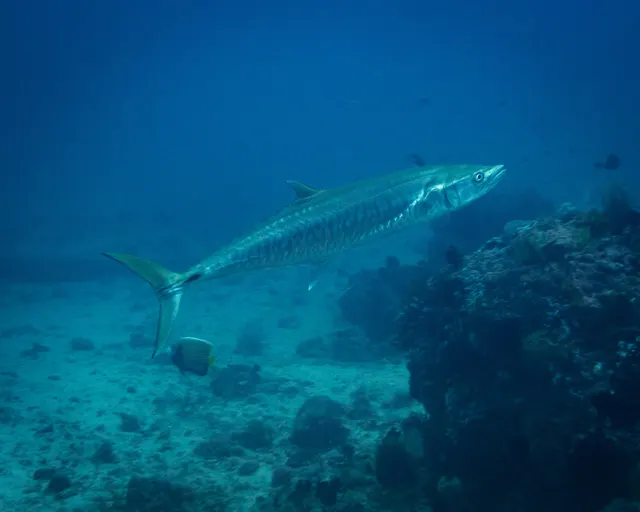 Narrow-barred Spanish mackerelSmall clupeids including sardines are the principal prey across the range, and the mackerel's movements follow the bait shoals.
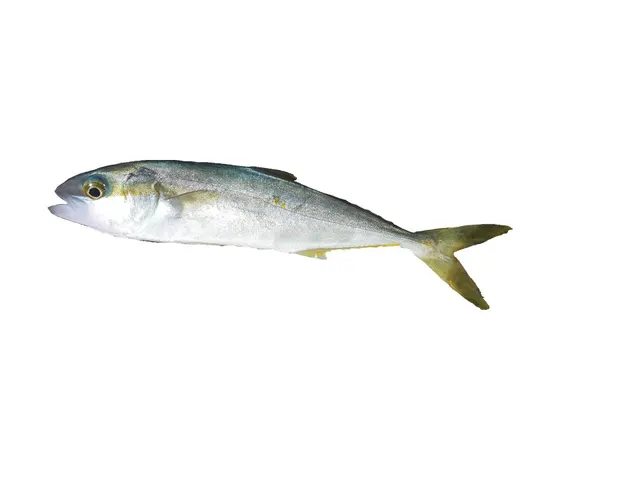 Yellowtail kingfishSardines are taken heavily where the shoals occur, and kingfish concentrations frequently coincide with sardine movements along the coast.
Where you will find it
- The Agulhas CurrentThe cold-water shoaling species whose winter movement north-eastward inside a wedge of cool water is the sardine run, and which fails to appear when the cool water does not push far enough.
- The Humboldt CurrentThe species that alternates in dominance with anchovy across multi-decadal ocean regime shifts in this system, and a substantial fishery in its own right.
- The Pacific Northwest coastA principal small pelagic of the upwelling system, whose abundance swings enormously between decades with consequences that run through the whole food web.
Sources and evidence
- FishBase: a global information system on fishes — Froese, R. and D. Pauly, eds. — FishBase Consortium (Scientific institute)Relied on for: Species identity, binomial, family placement, size, distribution and recorded biology for this species.States this directlyPassage read and verified
- FAO Species Identification Guides for Fishery Purposes and the FAO Species Catalogues — Food and Agriculture Organization of the United Nations (Scientific institute)Relied on for: The regional species account describing identity, distribution and the role of this species in the fisheries and food webs it belongs to.States this directlyCitation checked — the work exists and is described correctly
Why the 7 connections on this page are here, and the sources
Similar and related fish
Backed by research — 4 connections
Supported by peer-reviewed research or fisheries science. The sources are listed and can be checked.
Dusky kob
Recorded diet evidence identifies Sardinops sagax as a food item of this predator at species level. The edge is written at that granularity and no further.
- FishBase: a global information system on fishes — Froese, R. and D. Pauly, eds. — FishBase Consortium (Scientific institute)Relied on for: Food items recorded for this predator, including Sardinops sagax.States this directlyPassage read and verified
- FAO Species Identification Guides for Fishery Purposes and the FAO Species Catalogues — Food and Agriculture Organization of the United Nations (Scientific institute)Relied on for: Species account describing the diet of this predator in the region where Sardinops sagax occurs.Background and mechanism onlyCitation checked — the work exists and is described correctly
Kahawai
Recorded diet evidence identifies Sardinops sagax as a food item of this predator at species level. The edge is written at that granularity and no further.
- FishBase: a global information system on fishes — Froese, R. and D. Pauly, eds. — FishBase Consortium (Scientific institute)Relied on for: Food items recorded for this predator, including Sardinops sagax.States this directlyPassage read and verified
- FAO Species Identification Guides for Fishery Purposes and the FAO Species Catalogues — Food and Agriculture Organization of the United Nations (Scientific institute)Relied on for: Species account describing the diet of this predator in the region where Sardinops sagax occurs.Background and mechanism onlyCitation checked — the work exists and is described correctly
Narrow-barred Spanish mackerel
Recorded diet evidence identifies Sardinops sagax as a food item of this predator at species level. The edge is written at that granularity and no further.
- FishBase: a global information system on fishes — Froese, R. and D. Pauly, eds. — FishBase Consortium (Scientific institute)Relied on for: Food items recorded for this predator, including Sardinops sagax.States this directlyPassage read and verified
- FAO Species Identification Guides for Fishery Purposes and the FAO Species Catalogues — Food and Agriculture Organization of the United Nations (Scientific institute)Relied on for: Species account describing the diet of this predator in the region where Sardinops sagax occurs.Background and mechanism onlyCitation checked — the work exists and is described correctly
Yellowtail kingfish
Recorded diet evidence identifies Sardinops sagax as a food item of this predator at species level. The edge is written at that granularity and no further.
- FishBase: a global information system on fishes — Froese, R. and D. Pauly, eds. — FishBase Consortium (Scientific institute)Relied on for: Food items recorded for this predator, including Sardinops sagax.States this directlyPassage read and verified
- FAO Species Identification Guides for Fishery Purposes and the FAO Species Catalogues — Food and Agriculture Organization of the United Nations (Scientific institute)Relied on for: Species account describing the diet of this predator in the region where Sardinops sagax occurs.Background and mechanism onlyCitation checked — the work exists and is described correctly
Where you will find it
Backed by research — 3 connections
Supported by peer-reviewed research or fisheries science. The sources are listed and can be checked.
The Agulhas Current
A distribution association between an animal and a kind of water, rather than a claim about any named mark.
- FishBase: a global information system on fishes — Froese, R. and D. Pauly, eds. — FishBase Consortium (Scientific institute)Relied on for: Distribution, habitat association and depth range recorded for the species, including its occurrence in the water body concerned.States this directlyPassage read and verified
- The IUCN Red List of Threatened Species — International Union for Conservation of Nature (Conservation authority)Relied on for: Assessment and range account for the species, including the systems and coasts it occupies.Background and mechanism onlyCitation checked — the work exists and is described correctly
The Humboldt Current
A distribution association between an animal and a kind of water, rather than a claim about any named mark.
- FishBase: a global information system on fishes — Froese, R. and D. Pauly, eds. — FishBase Consortium (Scientific institute)Relied on for: Distribution, habitat association and depth range recorded for the species, including its occurrence in the water body concerned.States this directlyPassage read and verified
- The IUCN Red List of Threatened Species — International Union for Conservation of Nature (Conservation authority)Relied on for: Assessment and range account for the species, including the systems and coasts it occupies.Background and mechanism onlyCitation checked — the work exists and is described correctly
The Pacific Northwest coast
Occurrence of the species in this system or along this coast: a statement about the animal's distribution, not a venue recommendation.
- FishBase: a global information system on fishes — Froese, R. and D. Pauly, eds. — FishBase Consortium (Scientific institute)Relied on for: Distribution, salinity tolerance and habitat association recorded for the species, including its occurrence in this system.States this directlyPassage read and verified
- The IUCN Red List of Threatened Species — International Union for Conservation of Nature (Conservation authority)Relied on for: Assessment and range description for the species, including the waters in which it occurs.Background and mechanism onlyCitation checked — the work exists and is described correctly
How FishingHQ labels evidence is explained in the evidence policy.