The Humboldt Current
Fishing regions · Last reviewed 2026-08-14
The most productive marine ecosystem on earth by catch, where cold water rising off Peru and Chile supports a single fishery that has been the largest in the world — and collapses when the wind stops.
Safety: cold water shock — can cause serious injury or death. 2 more points apply here.
Being listed here is not permission to fish. What that meansClose
Access, fishing rights, seasons, licences, local bylaws and permitted methods vary and can change. Check current access, permission, local regulations, closures and restrictions before you travel or fish. FishingHQ describes what the ground is and names who holds the answer; it does not hold the answer itself.
Find the authority for a jurisdiction · What FishingHQ does and does not cover
The Humboldt is a system record because a single physical process explains an entire coast's fishery across two countries, and because that process is one of the clearest and most consequential in oceanography.
IT IS AN EASTERN BOUNDARY UPWELLING SYSTEM. Cold water flows north along the coast of Chile and Peru, and persistent southerly winds drive surface water offshore. Deep, cold, nutrient-rich water rises to replace it, and the resulting production is extraordinary — a small fraction of the world's ocean area supporting a very large share of its fish catch.
THE PRODUCTION GOES INTO ANCHOVETA. Almost all of it goes into one small fish. The Peruvian anchoveta fishery has repeatedly been the largest single-species fishery in the world by tonnage, most of it reduced to fishmeal and fish oil for animal feed and aquaculture. This is the clearest case anywhere of a whole ecosystem's productivity concentrated in one species and one industry.
EL NIÑO IS THE SYSTEM FAILING, AND IT WAS NAMED HERE. Periodically the trade winds weaken, warm water spreads east across the Pacific, the thermocline deepens, and the upwelling stops delivering nutrients even where the wind still blows. The anchoveta fishery collapses, seabirds and marine mammals die in large numbers, and the effects reach worldwide weather. Peruvian fishers named the phenomenon after the Christ child because it appeared around Christmas.
THE COAST IS COLD, DRY AND STEEP. The same cold water that makes the sea productive makes the land beside it one of the driest deserts on earth, and the Andes come down close to the shore.
AND THE VARIABILITY IS THE DEFINING MANAGEMENT PROBLEM. A fishery whose stock can change by an order of magnitude between years cannot be managed with a fixed quota, and the response — in-season assessment and closure — is genuinely unusual.
What fishing here is like
A cold, wind-driven upwelling system along the Pacific coast of South America that produces more fish than any comparable area of ocean. The fishery is dominated overwhelmingly by anchoveta taken by industrial purse seiners for reduction to fishmeal, with an artisanal sector supplying fresh fish for consumption. The coast beside it is desert and the water is cold enough to be a serious immersion risk at tropical latitudes. Recreational fishing is a small layer working the same productive water for corvina, jacks and, offshore, billfish and tuna.
What dominates
Industrial purse seining for anchoveta, the dominant fishery by volume anywhere in the world. Artisanal small-boat fishing with gillnets, lines and pots for corvina, jacks, hake, octopus and shellfish, supplying fresh consumption. Shore and rock angling from the desert coast for corvina and jacks. Offshore trolling and live-baiting for billfish, tuna and dorado, particularly at the warmer northern end of the system. Diving for shellfish and for the loco and other high-value invertebrates, a substantial and regulated fishery in Chile. Kelp harvesting and gathering along the rocky shore.
The water available
A narrow, steep coast with the Andes close inshore and a shelf that varies from narrow to very narrow; cold, nutrient-rich upwelled water within a short distance of the beach; extensive oxygen minimum zone at depth, which limits the vertical distribution of fish sharply; long exposed surf beaches and rocky headlands with heavy Pacific swell; kelp along the rocky shore in the cooler south; a small number of large bays that give shelter; and, at the southern end, the transition into the fjord and channel coast of southern Chile, which is a different system again.
How the rules are structured
The two principal coastal states each administer their own fisheries through a national authority with substantial scientific institutes attached, and the management of the dominant small pelagic fishery is unusual and worth understanding structurally. Because anchoveta abundance varies enormously between years and within a season, management is based on frequent acoustic survey and in-season decisions: total allowable catch is set from survey results rather than from a fixed annual figure, and fishing is closed at short notice when juveniles dominate the catch or when the survey indicates the stock cannot support continued effort. Individual vessel quotas apply in both countries. An inshore band is reserved for artisanal fishing in both, excluding industrial vessels. Chile operates territorial user rights for benthic resources, allocating defined areas of seabed to artisanal fishing organisations for shellfish and invertebrate harvesting, which is one of the better-known rights-based systems in world fisheries. A regional organisation manages the shared and straddling stocks of the wider South Pacific. FishingHQ does not state what any current rule is.
Who to ask
- The national fisheries authority of the coastal state concerned, for quotas, closures, licensing and the artisanal-industrial boundary.
- The national marine research institute, whose acoustic surveys and in-season assessments determine when the fishery opens and closes.
- The artisanal fishers' organisation holding the territorial user rights over a given area of benthic ground, where such a system applies.
- The regional fisheries management organisation for the South Pacific, for shared and straddling stocks beyond national waters.
- The maritime authority, for small-craft safety requirements and port closure decisions in heavy swell.
Words you will meet
- Anchoveta
- The Peruvian anchovy, the small pelagic fish that the entire system's productivity concentrates in. Repeatedly the largest single-species fishery in the world by weight, and almost all of it reduced to fishmeal and oil rather than eaten directly.
- El Niño
- The warm phase of the Pacific climate oscillation, named by Peruvian fishers for its appearance around Christmas. Warm water deepens the thermocline so that upwelling no longer delivers nutrients, and the fishery collapses.
- Oxygen minimum zone
- A layer of very low oxygen water at depth, unusually shallow and intense in this system. It compresses the habitable water column, concentrating fish near the surface, which is part of why they are so catchable.
- Territorial user rights
- Defined areas of seabed allocated to artisanal fishing organisations for the harvest of shellfish and other benthic resources, with the group responsible for management of its own area. One of the better-known rights-based fisheries systems anywhere.
- Veda
- A closure. Used both for scheduled closed seasons and for the short-notice in-season closures that are the characteristic management tool of the anchoveta fishery.
Conditions and hazards
The water is cold — genuinely cold, at latitudes where a visitor expects warm — and cold water shock is the immediate risk after any immersion, which is a hazard people at these latitudes routinely underestimate. Pacific swell arrives on this coast with a very long fetch and breaks heavily on exposed rock and beach; being swept from rock is the characteristic shore fishing accident. Ports on parts of this coast close for swell rather than for wind, which is an indication of how large the swell gets. The coast is arid, exposed and frequently remote, with long distances between towns and limited rescue capacity in places. Sun exposure at altitude and at low latitude is severe despite the cool air. Earthquakes and tsunami are a real hazard on this coast, and the local warning behaviour — leaving the shore immediately after a strong shake rather than waiting for an official warning — is genuine safety knowledge.
Wind, upwelling and an oxygen floor close to the surface
The Humboldt's productivity comes from a simple mechanism operating unusually well, and one additional feature that makes the fish unusually catchable.
THE MECHANISM IS EKMAN TRANSPORT. Persistent southerly winds blow along the coast; the rotation of the earth deflects the wind-driven surface flow offshore; and water rises from depth to replace it. Because the water below is cold and rich in nitrate, phosphate and silicate, bringing it into the sunlit layer produces an enormous bloom of phytoplankton.
THE GEOMETRY IS FAVOURABLE. The coast runs roughly north-south, the prevailing wind runs along it, and the shelf is narrow so the upwelled water reaches the surface close inshore. Those three conditions together are what make this system more productive than the other three great eastern boundary upwellings.
THE FOOD CHAIN IS SHORT, WHICH IS THE SECOND REASON FOR THE YIELD. Anchoveta feed directly on phytoplankton and large zooplankton, so there are very few steps between primary production and a harvestable fish. Each step in a food chain loses most of the energy, so a short chain converts far more of the bloom into fish.
THE OXYGEN MINIMUM ZONE IS THE THIRD FACTOR AND IT IS UNDERRATED. A layer of extremely low-oxygen water sits unusually shallow and unusually intense here, and fish will not live in it. That compresses the habitable water column into a thin surface layer, concentrating the anchoveta where a purse seine can reach them. The system is productive and its product is unusually accessible, which is a combination.
THE COAST IS DESERT BECAUSE OF THE SAME COLD WATER. Cold surface water suppresses convection and rainfall, which is why some of the driest land on earth sits beside some of the richest sea. It also means very little river input, so the nutrients come entirely from below.
AND THE SOUTHERN END TRANSITIONS INTO SOMETHING ELSE. Towards southern Chile the coast breaks into fjords, channels and islands with high rainfall and freshwater influence, and the upwelling logic no longer applies.
Backed by research — why, and the sources (2)
Supported by peer-reviewed research or fisheries science. The sources are listed and can be checked.
- ICES Advice on fishing opportunities, catch and effort — International Council for the Exploration of the Sea (Scientific institute)Relied on for: Stock assessment method, the environmental drivers of stock distribution and abundance, and the scientific basis for advice on small pelagic and shared stocks.Background and mechanism onlyCitation checked — the work exists and is described correctly
- Code of Conduct for Responsible Fisheries — Food and Agriculture Organization of the United Nations, Rome, 1995 (Standards body)Relied on for: Principles for responsible fisheries management, precaution and the treatment of highly variable stocks.States this directlyCitation checked — the work exists and is described correctly
One small fish, and everything that eats it
The species picture in this system is dominated by a single fish to a degree that has no parallel anywhere.
ANCHOVETA IS THE SYSTEM. The Peruvian anchovy has repeatedly supported the largest single-species fishery in the world by weight. Its biomass fluctuates enormously with ocean conditions, and in good years it is measured in many millions of tonnes. Almost all of it is reduced to fishmeal and fish oil for animal feed and aquaculture rather than eaten directly, which is one of the more consequential facts in global food systems.
SARDINE ALTERNATES WITH IT ON A LONGER CYCLE. Across the eastern Pacific and elsewhere, sardine and anchovy populations have historically alternated in dominance over multi-decadal periods tied to ocean regime shifts. FishingHQ's Pacific sardine record belongs to this pattern.
JACK MACKEREL AND HORSE MACKEREL occupy the water offshore of the anchoveta and support their own large fishery, and the South Pacific jack mackerel stock has been a significant international management case.
HAKE IS THE DEMERSAL FISHERY, worked on the shelf and heavily fished.
CORVINA, JACKS AND SEA BASS OCCUPY THE INSHORE GROUND and are what the artisanal fishery and the shore angler actually catch. These are the fish that reach a plate as fish rather than as feed.
OFFSHORE AND TO THE NORTH IT TURNS TROPICAL. Where the cold system meets warmer equatorial water at the northern end, billfish, tuna and dorado appear, and the boundary between the two water masses is a fishing feature in the same way the Agulhas front is.
THE INVERTEBRATE FISHERY IS LARGE AND HIGH-VALUE. Chilean abalone, sea urchin, mussels, scallops, squid and giant squid are all substantial fisheries, and the benthic invertebrate sector is the one managed through territorial user rights.
AND THE PREDATOR ASSEMBLAGE IS THE VISIBLE CONSEQUENCE. Enormous seabird colonies, sea lions and cetaceans all depend on anchoveta, and their mass mortality during El Niño events is the most visible signal that the system has failed.
Backed by research — why, and the sources (2)
Supported by peer-reviewed research or fisheries science. The sources are listed and can be checked.
- FishBase: a global information system on fishes — Froese, R. and D. Pauly, eds. — FishBase Consortium (Scientific institute)Relied on for: Distribution, habitat association, depth range and life history recorded for the species occurring in the area.States this directlyPassage read and verified
- The IUCN Red List of Threatened Species — International Union for Conservation of Nature (Conservation authority)Relied on for: Assessment and range account for the species of the region, including the habitats they depend on and the pressures acting on them.States this directlyCitation checked — the work exists and is described correctly
Purse seines, dive boats and a rock coast in the desert
The disciplines here span an industrial fishery of global scale and a small-boat sector working the same water for quite different fish.
INDUSTRIAL PURSE SEINING IS THE DOMINANT PRACTICE BY VOLUME. Large seiners locate anchoveta shoals acoustically, encircle them and pump the catch aboard, delivering to reduction plants ashore. It is a highly capitalised, highly regulated fishery operating in short intense openings decided by survey results.
ARTISANAL SMALL-BOAT FISHING IS THE OTHER SECTOR AND IT FEEDS PEOPLE. Gillnets, lines, traps and pots worked from small boats within the inshore band reserved for them, targeting corvina, jacks, hake, octopus and shellfish for fresh consumption. This is the fishery a visitor sees at a harbour.
DIVING FOR BENTHIC INVERTEBRATES IS A MAJOR DISCIPLINE, particularly in Chile. Divers working from small boats harvest abalone-like gastropods, urchins and other high-value invertebrates from defined areas of seabed under territorial user rights. It is skilled, physically demanding and dangerous work, and decompression injury among these divers is a documented occupational health problem.
SHORE ANGLING WORKS THE ROCK AND SURF of a desert coastline, for corvina and jacks, in conditions where Pacific swell is the governing variable.
OFFSHORE SPORT FISHING CONCENTRATES AT THE NORTHERN END where the cold system meets tropical water, for billfish, tuna and dorado. This is a small fishery with a serious historical reputation.
KELP HARVESTING is a genuine coastal industry along the rocky shore, and it interacts with the invertebrate fisheries that depend on kelp habitat.
AND THE SEPARATION BETWEEN INDUSTRIAL AND ARTISANAL IS SPATIAL AND LEGALLY DEFINED, which is a comparatively rare degree of clarity in world fisheries and is the reason the two sectors coexist as directly as they do.
What experienced anglers do — why, and the sources (2)
Widely and independently recommended by experienced anglers and specialist sources. This is real angling knowledge, not proof: controlled evidence for it is limited, and FishingHQ records it as convention rather than as a demonstrated effect.
- FAO fishing gear types and fishing technology information — Food and Agriculture Organization of the United Nations (Scientific institute)Relied on for: Descriptions of fishing gear types and their operation, including the small-scale gears used in the region.States this directlyCitation checked — the work exists and is described correctly
- IGFA International Angling Rules and World Record Requirements — International Game Fish Association (Angling or fisheries organisation)Relied on for: International recreational angling practice, tackle categories and the conventions applied to recognised catches.Background and mechanism onlyPassage read and verified
A fishery with no season, and a cycle that overrides every calendar
Seasonality here works on three timescales at once, and the longest one matters most.
THE ANNUAL CYCLE IS UPWELLING-DRIVEN. Southerly winds strengthen and weaken seasonally, and the upwelling with them, so production has an annual rhythm. But it is a modest signal compared with what sits on top of it.
THE FISHING SEASONS ARE ADMINISTRATIVE RATHER THAN NATURAL. The anchoveta fishery operates in openings — typically two main ones a year — whose start dates, lengths and quotas are decided from acoustic surveys rather than fixed in advance. Within an opening, the fishery can be closed at short notice if juveniles dominate the catch. The season is therefore a management output rather than a calendar fact, which is a genuinely unusual situation.
SPAWNING CLOSURES PROTECT THE MAIN SPAWNING PERIODS, and the timing is assessed rather than assumed.
EL NIÑO OVERRIDES EVERYTHING ON A TIMESCALE OF YEARS. When the warm phase arrives, the thermocline deepens, upwelled water is no longer nutrient-rich, production collapses, anchoveta biomass falls dramatically and the fishery may be closed entirely. Recovery follows the return of cool conditions. This is not a bad season; it is the system switching off.
LA NIÑA IS THE OPPOSITE PHASE and generally produces cold, strongly upwelled, highly productive conditions.
REGIME SHIFTS OPERATE ON DECADES. Longer-period changes in Pacific ocean state have historically flipped dominance between sardine and anchovy across the eastern Pacific, and a fishery built entirely on one of them is exposed to that.
AND THE PRACTICAL LESSON IS THE MANAGEMENT ONE. A stock that can change by an order of magnitude between years cannot be managed by a fixed annual quota set in advance, and the in-season survey-and-close approach used here is a direct response to that variability. It is one of the more instructive fisheries management stories anywhere.
Backed by research — why, and the sources (2)
Supported by peer-reviewed research or fisheries science. The sources are listed and can be checked.
- ICES Advice on fishing opportunities, catch and effort — International Council for the Exploration of the Sea (Scientific institute)Relied on for: Stock assessment method, the environmental drivers of stock distribution and abundance, and the scientific basis for advice on small pelagic and shared stocks.Background and mechanism onlyCitation checked — the work exists and is described correctly
- Code of Conduct for Responsible Fisheries — Food and Agriculture Organization of the United Nations, Rome, 1995 (Standards body)Relied on for: Principles for responsible fisheries management, precaution and the treatment of highly variable stocks.States this directlyCitation checked — the work exists and is described correctly
In-season closure, vessel quotas and rights to a piece of seabed
Fisheries governance in this system contains two arrangements that are genuinely instructive and worth explaining rather than listing.
MANAGEMENT IS IN-SEASON AND SURVEY-DRIVEN. Rather than setting an annual catch limit in advance, the authorities run acoustic surveys, set a catch limit for a defined opening from the survey result, monitor the composition of the catch during it, and close the fishery at short notice if juveniles dominate. That is an adaptive system built for a stock whose abundance is genuinely unpredictable, and it is the structural response to El Niño.
INDIVIDUAL VESSEL QUOTAS REPLACED A RACE. Before quota allocation, the fishery was a competitive scramble within a season, which produced overcapacity, waste and unsafe operation. Allocating shares to vessels changed the incentive from speed to value, and the effects on capacity and safety are a documented case study.
TERRITORIAL USER RIGHTS FOR BENTHIC RESOURCES ARE THE OTHER NOTABLE SYSTEM. Defined areas of seabed are allocated to artisanal fishing organisations, which hold exclusive harvesting rights and management responsibility for their own area for shellfish and invertebrates. The theory is that a group with secure rights to a specific patch has reason to look after it, and the evidence from this coast is broadly supportive.
AN INSHORE BAND IS RESERVED FOR ARTISANAL FISHING in both countries, excluding industrial vessels, which is the spatial separation that lets the two sectors coexist.
SHARED AND STRADDLING STOCKS SIT WITH A REGIONAL ORGANISATION for the wider South Pacific, which was established in part because jack mackerel stocks straddle national and high-seas waters.
RECREATIONAL FISHING IS A SMALL CONSIDERATION IN THIS FRAMEWORK, generally subject to national rules on species and gear and, where it happens from a boat, to maritime requirements.
AND FISHINGHQ DOES NOT STATE WHAT ANY OF THIS CURRENTLY PERMITS. In a fishery whose openings are decided within a season, that would be a claim with a shelf life of days.
Official guidance — why, and the sources (2)
Stated by a fisheries authority, scientific institute or recognised angling body. Authoritative, but summarising rather than demonstrating.
- Good Fish Guide — Marine Conservation Society (Conservation authority)Relied on for: Assessment of fisheries and the management measures applied to them, including gear selectivity and spatial protection.Background and mechanism onlyCitation checked — the work exists and is described correctly
- Code of Conduct for Responsible Fisheries — Food and Agriculture Organization of the United Nations, Rome, 1995 (Standards body)Relied on for: Principles for responsible fisheries management, precaution and the treatment of small-scale, shared and highly variable stocks.States this directlyCitation checked — the work exists and is described correctly
Anchoveta, veda and a word for a warm current that went global
This system gave the world one of its most-used environmental terms, and its working vocabulary explains its management.
EL NIÑO IS A PERUVIAN FISHING WORD THAT BECAME A GLOBAL SCIENTIFIC TERM. Fishers on this coast named the periodic appearance of warm water around Christmas after the Christ child. The name was later attached to the whole Pacific-wide climate oscillation, which is now one of the most studied phenomena in earth science. Very few pieces of fishing vocabulary have travelled that far.
ANCHOVETA NAMES THE FISH AND, IN PRACTICE, THE FISHERY. When people on this coast talk about the fishery without qualification, this is what they mean.
VEDA MEANS CLOSURE and it covers both scheduled closed seasons and the short-notice in-season closures that are the characteristic instrument here. A reader following this fishery will meet the word constantly and should understand it as an active management decision rather than a fixed date.
OXYGEN MINIMUM ZONE IS A TECHNICAL TERM WORTH CARRYING because it explains why the fish are concentrated near the surface. Without it, the catchability of the anchoveta fishery is hard to account for.
TERRITORIAL USER RIGHTS IS A FISHERIES-POLICY TERM that this coast has made concrete. Reading about rights-based management anywhere in the world will bring a reader back to the benthic areas allocated along this shore.
AND REDUCTION IS THE INDUSTRIAL TERM THAT MATTERS ETHICALLY. It names the conversion of whole fish into meal and oil, and understanding that most of the world's largest fishery is a reduction fishery rather than a food fishery is the single most important thing to grasp about what this system's productivity is used for.
What experienced anglers do — why, and the sources (2)
Widely and independently recommended by experienced anglers and specialist sources. This is real angling knowledge, not proof: controlled evidence for it is limited, and FishingHQ records it as convention rather than as a demonstrated effect.
- ICES Advice on fishing opportunities, catch and effort — International Council for the Exploration of the Sea (Scientific institute)Relied on for: Stock assessment method, the environmental drivers of stock distribution and abundance, and the scientific basis for advice on small pelagic and shared stocks.Background and mechanism onlyCitation checked — the work exists and is described correctly
- Code of Conduct for Responsible Fisheries — Food and Agriculture Organization of the United Nations, Rome, 1995 (Standards body)Relied on for: Principles for responsible fisheries management, precaution and the treatment of highly variable stocks.States this directlyCitation checked — the work exists and is described correctly
Guano, collapse and the fishery that learned from it
The history of this system is a sequence of booms built on the same production, and one of the most instructive collapses in fisheries science.
GUANO CAME FIRST. Seabird colonies fed by anchoveta deposited guano on the offshore islands over millennia, and in the nineteenth century it became an internationally traded fertiliser of enormous value. It was the first industry built on this system's productivity, and it was extracted faster than it accumulated.
THE ANCHOVETA FISHERY GREW EXPLOSIVELY IN THE MID-TWENTIETH CENTURY. Within two decades, Peru went from a minor fishing nation to the largest by tonnage in the world, on one species, mostly for fishmeal.
THE 1970s COLLAPSE IS A FOUNDATIONAL CASE IN FISHERIES SCIENCE. Heavy fishing coincided with a strong El Niño, and the stock collapsed dramatically. The fishery took many years to recover and the episode became one of the standard illustrations of what happens when a fishery is managed as though a variable stock were a stable one.
THE MANAGEMENT RESPONSE IS THE INTERESTING PART. Rather than concluding that the fishery was unmanageable, the response over subsequent decades built the in-season survey-and-close system, vessel quotas and juvenile-protection rules that now govern it. The fishery is still enormous, still volatile, and considerably better managed than it was.
CHILE'S BENTHIC FISHERIES WENT THROUGH A PARALLEL CYCLE. Serial depletion of high-value shellfish under open access led to the development of the territorial user rights system, which is now studied internationally.
EL NIÑO SCIENCE GREW OUT OF THIS COAST. What began as a local fishers' name for a warm current became, through the twentieth century, a central object of climate science, and its global teleconnections are now standard.
AND THE ETHICAL QUESTION HAS ARRIVED RECENTLY. Whether the world's largest fishery should be reducing edible fish to animal feed, on a coast where food security is not universal, is a live public argument rather than a settled matter.
Official guidance — why, and the sources (2)
Stated by a fisheries authority, scientific institute or recognised angling body. Authoritative, but summarising rather than demonstrating.
- Good Fish Guide — Marine Conservation Society (Conservation authority)Relied on for: Assessment of fisheries and the management measures applied to them, including gear selectivity and spatial protection.Background and mechanism onlyCitation checked — the work exists and is described correctly
- Code of Conduct for Responsible Fisheries — Food and Agriculture Organization of the United Nations, Rome, 1995 (Standards body)Relied on for: Principles for responsible fisheries management, precaution and the treatment of small-scale, shared and highly variable stocks.States this directlyCitation checked — the work exists and is described correctly
Caleta, cebiche and a coast that eats what it catches inshore
The fishing culture of this coast has two quite separate halves, and only one of them is visible from the fishmeal statistics.
THE CALETA IS THE SOCIAL UNIT. Small fishing coves and landing places along the coast, with their boats, their sheds, their unions and their market stalls, are where the artisanal fishery lives. The organisations attached to them are also the bodies that hold benthic harvesting rights in Chile, so a caleta is an economic and a legal entity as well as a place.
THE FOOD CULTURE IS FISH-CENTRED AND SPECIFIC. Cebiche — raw fish cured in citrus — is a national dish on this coast, and it is built on exactly the inshore species the artisanal fishery lands. That gives fresh fish a cultural status quite separate from the industrial fishery's product, and it is one reason the artisanal sector's protected inshore band is politically durable.
THE TWO FISHERIES BARELY MEET. The industrial anchoveta fleet supplies a global feed industry; the artisanal fleet supplies a domestic food culture. They fish the same water and have almost no shared social world.
DIVING IS A DANGEROUS OCCUPATION HERE AND IS TREATED AS ONE. The invertebrate diving fishery has a documented record of decompression injury, and occupational safety in that sector is a real and continuing concern rather than a theoretical one.
RECREATIONAL ANGLING IS MODEST AND SHORE-BASED IN THE MAIN, with an offshore billfish fishery at the northern end that has a longer reputation than its current size suggests.
SEABIRDS AND SEA LIONS ARE PART OF THE DAILY EXPERIENCE of fishing here, in numbers that a visitor from a depleted coast finds startling, and their fluctuations are the most visible index of what the ocean is doing.
AND THE SEA IS TREATED WITH RESPECT FOR TWO REASONS: the swell, and the earthquakes. Leaving the shore immediately after a strong shake, without waiting for a warning, is ordinary coastal knowledge on this coast and is worth stating as such.
What experienced anglers do — why, and the sources (2)
Widely and independently recommended by experienced anglers and specialist sources. This is real angling knowledge, not proof: controlled evidence for it is limited, and FishingHQ records it as convention rather than as a demonstrated effect.
- FAO fishing gear types and fishing technology information — Food and Agriculture Organization of the United Nations (Scientific institute)Relied on for: Descriptions of fishing gear types and their operation, including the small-scale gears used in the region.States this directlyCitation checked — the work exists and is described correctly
- IGFA International Angling Rules and World Record Requirements — International Game Fish Association (Angling or fisheries organisation)Relied on for: International recreational angling practice, tackle categories and the conventions applied to recognised catches.Background and mechanism onlyPassage read and verified
Cold water at a tropical latitude, and a shake that means leave
This coast breaks the single strongest correlation most people carry about the sea — that latitude predicts temperature — and it does so at exactly the latitudes where the assumption is most confident.
THE WATER IS COLD AND THE MAP SAYS IT SHOULD NOT BE. Upwelling drags deep water to the surface along this entire coast, so a sea at subtropical and tropical latitudes runs at temperatures a northern European would recognise. A visitor who has flown to a warm country and stands on a warm beach has no cue whatever that immersion will produce an involuntary gasp and loss of breathing control in the first seconds. That first minute is where cold-water drownings happen, and being a strong swimmer does not address it, because the failure is of breathing rather than of swimming.
THE SWELL HAS THE LONGEST FETCH ON EARTH BEHIND IT. Waves reaching this coast have crossed the open Pacific, so they arrive as long-period energy, in irregular sets, breaking heavily on exposed rock and steep beach. The clearest available evidence of the scale is operational rather than anecdotal: ports along parts of this coast close for SWELL rather than for wind. When a working port shuts because of waves on a calm day, that is the whole argument about ground swell made by people with money at stake.
WHICH MAKES THE SHORE MECHANISM THE FAMILIAR ONE. A platform that has been comfortable for an hour receives a wave substantially larger than everything preceding it, and the angler goes into cold, deep, moving water beside rock. Watch a mark for several full set cycles before committing. Choose a position with a way up. Wear flotation. Do not fish exposed rock alone.
THE SUN IS THE SECOND INVERSION. Low latitude, high altitude in places, clear desert air and a cool sea breeze produce severe ultraviolet exposure with none of the heat that normally prompts anybody to do something about it. Burning and dehydration develop quickly on a coast that does not feel hot, and dehydration degrades judgement before it produces symptoms a person notices.
AND THERE IS A HAZARD HERE THAT APPEARS NOWHERE ELSE AS SAFETY ADVICE. This is a seismically active coast, and a strong earthquake near it can generate a tsunami with very little travel time. The local rule — and it is genuine local safety knowledge rather than folklore — is that a strong shake felt at the coast is itself the warning: move inland and uphill immediately, and do not wait for an official alert, because on a near-field event the alert may arrive after the wave. Anybody fishing this coast should know where the high ground behind them is, in the same way they would know where the exit from a platform is.
AND THE COAST IS ARID, EXPOSED AND IN PLACES REMOTE, with long distances between towns and limited rescue capacity. Check current marine forecasts and local warnings, tell somebody the plan, and treat the cold water as a fact rather than a surprise.
Official guidance — why, and the sources (3)
Stated by a fisheries authority, scientific institute or recognised angling body. Authoritative, but summarising rather than demonstrating.
- RNLI water safety guidance: cold water shock and Float to Live — Royal National Lifeboat Institution (Water-safety or diver-training authority)Relied on for: Cold water shock and the immersion response, and water-safety guidance for shore anglers and small-craft users.States this directlyPassage read and verified
- Rock fishing safety and the declared lifejacket areas of New South Wales — NSW Department of Primary Industries and Surf Life Saving NSW (Water-safety or diver-training authority)Relied on for: Rock-platform fishing hazards, the mechanism by which anglers are swept from platforms by sets rather than by average conditions, the fatality record that produced the response, and the measures that address it including mandatory lifejacket areas.States this directlyCitation checked — the work exists and is described correctly
- NOAA National Weather Service marine forecasts and marine weather services — National Oceanic and Atmospheric Administration, United States (Government fisheries body)Relied on for: Marine forecasting, warning products, sea state and swell information, and the coastal and offshore zones at which those forecasts are issued.States this directlyCitation checked — the work exists and is described correctly
Some of what lives here
Fish recorded here that FishingHQ holds a reviewed photograph of. It is not a complete list of what The Humboldt Current holds, and it is not a prediction that you will catch any of them — it is a way in to the ones we can show you.
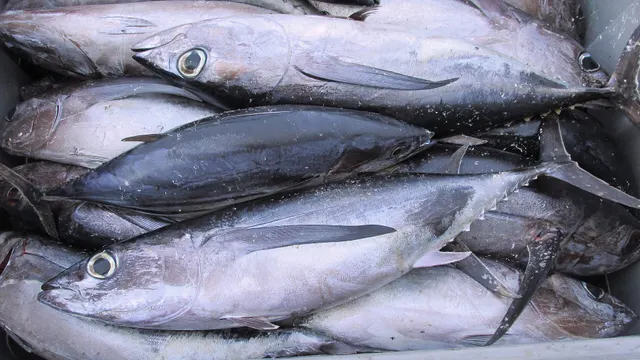 AlbacoreThe long-finned tuna of temperate open ocean — smaller and cooler-water than its relatives, with pectoral fins so long they are the identification.
Joachim Langeneck — CC BY-SA 4.0, via Wikimedia Commons
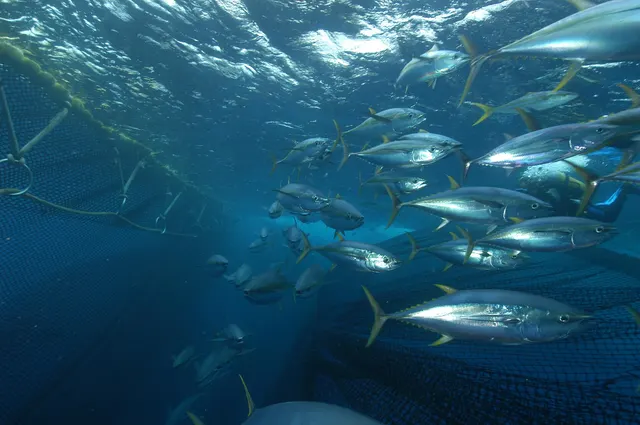 Yellowfin tunaA warm-blooded, high-speed oceanic predator that schools with dolphins and under floating debris, and one of the most commercially important fish in the world.
Marc Taquet — CC BY 4.0, via Wikimedia Commons
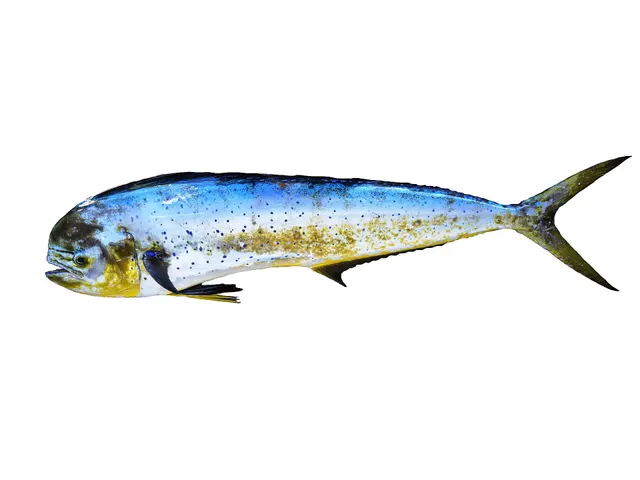 Mahi-mahiThe fastest-growing large fish an angler is likely to meet — brilliantly coloured, mature within months, and gathered around anything floating in the open ocean.
Hugues Evano (IFREMER, Délégation océan Indien (DOI), Département Ressources Biologiques et Environnement (RBE), F-97420 Le Port, France) — CC BY 4.0, via Wikimedia Commons
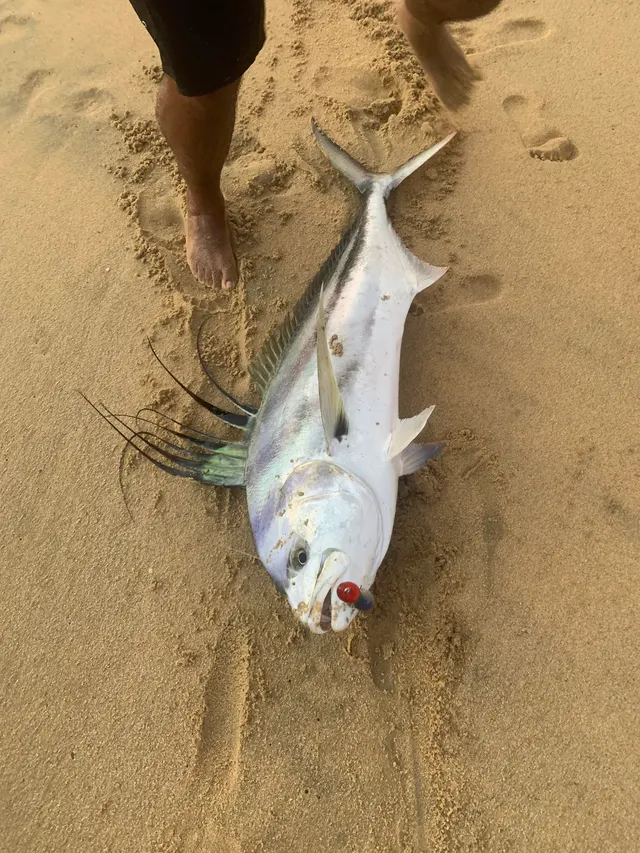 RoosterfishAn eastern Pacific surf predator with a seven-rayed dorsal comb it raises when hunting — the only member of its family, and one of the great shore sport fish.
CH Hemphill — CC BY, via iNaturalist
Safety
Cold water shock — Can cause serious injury or death
The water here is cold at latitudes where a visitor expects warmth, because the upwelling brings deep water to the surface. Sudden immersion triggers an involuntary gasp and hyperventilation, and the ability to swim or hold breath is lost in the first minute — which is when most cold-water drownings happen.
What reduces it: Treat the water temperature rather than the air temperature as the risk, wear a buoyancy aid, and if immersed, float and control breathing before attempting to swim. Do not assume a tropical latitude means a survivable swim.
Worse when:
- During strong upwelling, when surface temperature is at its lowest.
- On an exposed shore where getting out is difficult even after the initial shock passes.
- Fishing alone, which removes the only realistic rescue.
Cliffs and rock platforms — Can cause serious injury or death
Pacific swell reaching this coast has an extremely long fetch and arrives in irregular sets on exposed rock and steep beach. Anglers are swept from platforms by a wave substantially larger than those preceding it, into cold, deep, moving water.
What reduces it: Read swell height, period and direction rather than wind, watch a full set before committing to a platform, stand higher than feels necessary, wear a buoyancy aid, and note that ports on this coast close for swell rather than wind — which tells you what the swell can do.
Sun, dehydration and fatigue — Can cause injury needing treatment
Low latitude, high altitude in places, clear desert air and cool sea breezes combine to produce severe ultraviolet exposure without the heat cue that normally prompts caution. Sunburn and dehydration develop quickly on a coast that does not feel hot.
What reduces it: Cover up and use high-factor protection regardless of how cool the air feels, carry water, and treat the absence of heat as the reason to be more careful rather than less.
Further safety reading
- Cold water shock and immersion — Upwelling makes the water genuinely cold at latitudes where a visitor expects warmth, which removes the instinctive caution that cold usually produces.
- Rock platform and cliff safety — Pacific swell reaching this coast has an extremely long fetch and arrives in irregular sets on exposed rock; ports here close for swell rather than for wind.
- Sun, dehydration and fatigue — Low latitude, clear desert air and a cool sea breeze produce severe ultraviolet exposure without the heat cue that normally prompts caution.
Check the rules before you fish
Fishing laws, bylaws, access rules, seasons, bait restrictions and permitted methods vary by location and can change. Check the current rules from the relevant authority and the water you intend to fish before fishing.
Check with:
- Current national or regional law for where you are fishing
- Current local bylaws
- The relevant fisheries authority
- The landowner, club or fishery whose water it is
- Any restrictions specific to the species or the method you intend to use
Where to go next
What swims here
- AlbacoreOccurs on the offshore side of the system, where the cold productive water meets warmer oceanic water.
- Mahi-mahiOccurs at the warm northern margin of the system and is taken by both artisanal and sport fisheries there.
- Pacific sardineThe species that alternates in dominance with anchovy across multi-decadal ocean regime shifts in this system, and a substantial fishery in its own right.
- RoosterfishOccupies the inshore sand and rock at the tropical northern end of the system, where the cold water gives way to warm.
- Yellowfin tunaWorks the warmer northern end of the system, where the cold current meets equatorial water and the boundary concentrates bait.
How people fish here
- HandliningArtisanal small-boat line fishing supplies fresh fish for consumption and is a completely separate world from the reduction fishery it shares the water with.
- LongliningLonglining takes the larger demersal and pelagic species of the system alongside the small pelagic fishery.
- Purse seiningIndustrial purse seining for anchoveta is the dominant fishery by volume anywhere in the world, operating in short intense openings decided by acoustic survey.
- Sea fishingShore and small-boat angling for corvina and jacks along a desert coast is a modest recreational layer on an industrial fishery.
Local knowledge
How this compares
Rules and access
- Close seasonsOpenings and short-notice closures decided from acoustic survey results, rather than fixed dates, are the characteristic management instrument in this system.
- Size limits and retentionClosing a fishery when juveniles dominate the catch, and allocating individual vessel quotas, are the two measures that changed this fishery's incentives most.
Environment and conservation
- Bycatch and discardsThe 1970s collapse of the anchoveta fishery, under heavy fishing coinciding with a strong El Niño, is one of the foundational cases in fisheries science.
- Fish stocks and sustainabilityA stock whose abundance can change by an order of magnitude between years cannot be managed by a fixed annual quota, and the in-season survey-and-close system here is the response to that.
Sources and evidence
- ICES Advice on fishing opportunities, catch and effort — International Council for the Exploration of the Sea (Scientific institute)Relied on for: Stock assessment method, the environmental drivers of stock distribution and abundance, and the scientific basis for advice on small pelagic and shared stocks.Background and mechanism onlyCitation checked — the work exists and is described correctly
- Code of Conduct for Responsible Fisheries — Food and Agriculture Organization of the United Nations, Rome, 1995 (Standards body)Relied on for: Principles for responsible fisheries management, precaution and the treatment of highly variable stocks.States this directlyCitation checked — the work exists and is described correctly
- FishBase: a global information system on fishes — Froese, R. and D. Pauly, eds. — FishBase Consortium (Scientific institute)Relied on for: Distribution, habitat association, depth range and life history recorded for the species occurring in the area.States this directlyPassage read and verified
- The IUCN Red List of Threatened Species — International Union for Conservation of Nature (Conservation authority)Relied on for: Assessment and range account for the species of the region, including the habitats they depend on and the pressures acting on them.States this directlyCitation checked — the work exists and is described correctly
- Rock fishing safety and the declared lifejacket areas of New South Wales — NSW Department of Primary Industries and Surf Life Saving NSW (Water-safety or diver-training authority)Relied on for: Rock and ledge fishing hazards, the mechanism by which anglers are swept from exposed platforms, and the measures that reduce it.States this directlyCitation checked — the work exists and is described correctly
- United States Lifesaving Association public education on rip currents and the surf zone — United States Lifesaving Association (Water-safety or diver-training authority)Relied on for: Surf zone hazards, rip current formation and behaviour, and the circumstances in which people are carried offshore.States this directlyCitation checked — the work exists and is described correctly
Why the 18 connections on this page are here, and the sources
What swims here
Backed by research — 5 connections
Supported by peer-reviewed research or fisheries science. The sources are listed and can be checked.
Albacore
A distribution association between an animal and a kind of water, rather than a claim about any named mark.
- FishBase: a global information system on fishes — Froese, R. and D. Pauly, eds. — FishBase Consortium (Scientific institute)Relied on for: Distribution, habitat association and depth range recorded for the species, including its occurrence in the water body concerned.States this directlyPassage read and verified
- The IUCN Red List of Threatened Species — International Union for Conservation of Nature (Conservation authority)Relied on for: Assessment and range account for the species, including the systems and coasts it occupies.Background and mechanism onlyCitation checked — the work exists and is described correctly
Mahi-mahi
A distribution association between an animal and a kind of water, rather than a claim about any named mark.
- FishBase: a global information system on fishes — Froese, R. and D. Pauly, eds. — FishBase Consortium (Scientific institute)Relied on for: Distribution, habitat association and depth range recorded for the species, including its occurrence in the water body concerned.States this directlyPassage read and verified
- The IUCN Red List of Threatened Species — International Union for Conservation of Nature (Conservation authority)Relied on for: Assessment and range account for the species, including the systems and coasts it occupies.Background and mechanism onlyCitation checked — the work exists and is described correctly
Pacific sardine
A distribution association between an animal and a kind of water, rather than a claim about any named mark.
- FishBase: a global information system on fishes — Froese, R. and D. Pauly, eds. — FishBase Consortium (Scientific institute)Relied on for: Distribution, habitat association and depth range recorded for the species, including its occurrence in the water body concerned.States this directlyPassage read and verified
- The IUCN Red List of Threatened Species — International Union for Conservation of Nature (Conservation authority)Relied on for: Assessment and range account for the species, including the systems and coasts it occupies.Background and mechanism onlyCitation checked — the work exists and is described correctly
Roosterfish
A distribution association between an animal and a kind of water, rather than a claim about any named mark.
- FishBase: a global information system on fishes — Froese, R. and D. Pauly, eds. — FishBase Consortium (Scientific institute)Relied on for: Distribution, habitat association and depth range recorded for the species, including its occurrence in the water body concerned.States this directlyPassage read and verified
- The IUCN Red List of Threatened Species — International Union for Conservation of Nature (Conservation authority)Relied on for: Assessment and range account for the species, including the systems and coasts it occupies.Background and mechanism onlyCitation checked — the work exists and is described correctly
Yellowfin tuna
A distribution association between an animal and a kind of water, rather than a claim about any named mark.
- FishBase: a global information system on fishes — Froese, R. and D. Pauly, eds. — FishBase Consortium (Scientific institute)Relied on for: Distribution, habitat association and depth range recorded for the species, including its occurrence in the water body concerned.States this directlyPassage read and verified
- The IUCN Red List of Threatened Species — International Union for Conservation of Nature (Conservation authority)Relied on for: Assessment and range account for the species, including the systems and coasts it occupies.Background and mechanism onlyCitation checked — the work exists and is described correctly
How people fish here
What experienced anglers do — 4 connections
Widely and independently recommended by experienced anglers and specialist sources. This is real angling knowledge, not proof: controlled evidence for it is limited, and FishingHQ records it as convention rather than as a demonstrated effect.
Handlining
A discipline that is characteristic of the place rather than merely possible there, joined so a reader can move between the place and the practice.
- General angling website restatements of established technique — Various (Credible secondary source)Relied on for: Widely restated practice associating this discipline with this place, recorded as practitioner consensus rather than as tested fact.Background and mechanism onlyCitation checked — the work exists and is described correctly
- Fishers' Craft and Lettered Art: Tracts on Fishing from the End of the Middle Ages — University of Toronto Press, 1997 (Scientific literature)Relied on for: That fishing traditions develop around the water and fish available to them, and the historical method of reading such traditions.States this directlyCitation checked — the work exists and is described correctly
Longlining
A discipline that is characteristic of the place rather than merely possible there, joined so a reader can move between the place and the practice.
- General angling website restatements of established technique — Various (Credible secondary source)Relied on for: Widely restated practice associating this discipline with this place, recorded as practitioner consensus rather than as tested fact.Background and mechanism onlyCitation checked — the work exists and is described correctly
- Fishers' Craft and Lettered Art: Tracts on Fishing from the End of the Middle Ages — University of Toronto Press, 1997 (Scientific literature)Relied on for: That fishing traditions develop around the water and fish available to them, and the historical method of reading such traditions.States this directlyCitation checked — the work exists and is described correctly
Purse seining
A discipline that is characteristic of the place rather than merely possible there, joined so a reader can move between the place and the practice.
- General angling website restatements of established technique — Various (Credible secondary source)Relied on for: Widely restated practice associating this discipline with this place, recorded as practitioner consensus rather than as tested fact.Background and mechanism onlyCitation checked — the work exists and is described correctly
- Fishers' Craft and Lettered Art: Tracts on Fishing from the End of the Middle Ages — University of Toronto Press, 1997 (Scientific literature)Relied on for: That fishing traditions develop around the water and fish available to them, and the historical method of reading such traditions.States this directlyCitation checked — the work exists and is described correctly
Sea fishing
A discipline that is characteristic of the place rather than merely possible there, joined so a reader can move between the place and the practice.
- General angling website restatements of established technique — Various (Credible secondary source)Relied on for: Widely restated practice associating this discipline with this place, recorded as practitioner consensus rather than as tested fact.Background and mechanism onlyCitation checked — the work exists and is described correctly
- Fishers' Craft and Lettered Art: Tracts on Fishing from the End of the Middle Ages — University of Toronto Press, 1997 (Scientific literature)Relied on for: That fishing traditions develop around the water and fish available to them, and the historical method of reading such traditions.States this directlyCitation checked — the work exists and is described correctly
Local knowledge
Backed by research — 1 connection
Supported by peer-reviewed research or fisheries science. The sources are listed and can be checked.
Upwelling, and the coasts it makes
A place that describes a physical process in prose and cannot point at it is restating something FishingHQ should explain once. This is the link that turns the restatement into a reference.
- ICES Advice on fishing opportunities, catch and effort — International Council for the Exploration of the Sea (Scientific institute)Relied on for: Stock assessment and advice for north-east Atlantic stocks, including the environmental drivers of small pelagic productivity and recruitment.States this directlyCitation checked — the work exists and is described correctly
- Cefas science, advice and data on marine and freshwater environments — Centre for Environment, Fisheries and Aquaculture Science (Government fisheries body)Relied on for: Marine environmental science including coastal physical processes, productivity and the monitoring behind them.States this directlyCitation checked — the work exists and is described correctly
How this compares
What experienced anglers do — 1 connection
Widely and independently recommended by experienced anglers and specialist sources. This is real angling knowledge, not proof: controlled evidence for it is limited, and FishingHQ records it as convention rather than as a demonstrated effect.
The Moroccan Atlantic coast
Two places a reader would reasonably weigh against one another, joined where the comparison teaches something about both. It is also how the larger geography is linked to what sits inside it.
- General angling website restatements of established technique — Various (Credible secondary source)Relied on for: Widely restated practice associating this discipline with this place, recorded as practitioner consensus rather than as tested fact.Background and mechanism onlyCitation checked — the work exists and is described correctly
- Fishers' Craft and Lettered Art: Tracts on Fishing from the End of the Middle Ages — University of Toronto Press, 1997 (Scientific literature)Relied on for: That fishing traditions develop around the water and fish available to them, and the historical method of reading such traditions.States this directlyCitation checked — the work exists and is described correctly
Safety reading
Official guidance — 3 connections
Stated by a fisheries authority, scientific institute or recognised angling body. Authoritative, but summarising rather than demonstrating.
Cold water shock and immersion
A place is joined to the safety topic that explains a hazard genuinely characteristic of it, so the mechanism is reachable rather than restated as a weak warning.
- RNLI water safety guidance: cold water shock and Float to Live — Royal National Lifeboat Institution (Water-safety or diver-training authority)Relied on for: Cold water shock and the immersion response, shore angling hazards, small-craft guidance and the circumstances in which water users are most often killed.States this directlyPassage read and verified
- RoSPA water safety information and UK accidental drowning statistics — Royal Society for the Prevention of Accidents (Water-safety or diver-training authority)Relied on for: Accidental drowning statistics and the circumstances in which recreational water users are most often killed.Background and mechanism onlyPassage read and verified
Rock platform and cliff safety
A place is joined to the safety topic that explains a hazard genuinely characteristic of it, so the mechanism is reachable rather than restated as a weak warning.
- Rock fishing safety and the declared lifejacket areas of New South Wales — NSW Department of Primary Industries and Surf Life Saving NSW (Water-safety or diver-training authority)Relied on for: Rock and ledge fishing hazards, the mechanism by which anglers are swept from exposed platforms, and the measures that reduce it.States this directlyCitation checked — the work exists and is described correctly
- United States Lifesaving Association public education on rip currents and the surf zone — United States Lifesaving Association (Water-safety or diver-training authority)Relied on for: Surf zone hazards, rip current formation and behaviour, and the circumstances in which people are carried offshore.States this directlyCitation checked — the work exists and is described correctly
Sun, dehydration and fatigue
A place is joined to the safety topic that explains a hazard genuinely characteristic of it, so the mechanism is reachable rather than restated as a weak warning.
- Rock fishing safety and the declared lifejacket areas of New South Wales — NSW Department of Primary Industries and Surf Life Saving NSW (Water-safety or diver-training authority)Relied on for: Rock and ledge fishing hazards, the mechanism by which anglers are swept from exposed platforms, and the measures that reduce it.States this directlyCitation checked — the work exists and is described correctly
- United States Lifesaving Association public education on rip currents and the surf zone — United States Lifesaving Association (Water-safety or diver-training authority)Relied on for: Surf zone hazards, rip current formation and behaviour, and the circumstances in which people are carried offshore.States this directlyCitation checked — the work exists and is described correctly
Rules and access
Official guidance — 2 connections
Stated by a fisheries authority, scientific institute or recognised angling body. Authoritative, but summarising rather than demonstrating.
Close seasons
A place joined to the regulatory concept whose structure it illustrates. The edge asserts that the concept applies here, never what any current rule says.
- Code of Conduct for Responsible Fisheries — Food and Agriculture Organization of the United Nations, Rome, 1995 (Standards body)Relied on for: Principles for the management of fisheries, including licensing, closed seasons, size limits and the treatment of small-scale and shared stocks.States this directlyCitation checked — the work exists and is described correctly
- Good Fish Guide — Marine Conservation Society (Conservation authority)Relied on for: Assessment of fisheries and the management measures applied to them, including the instruments used and their purpose.Background and mechanism onlyCitation checked — the work exists and is described correctly
Size limits and retention
A place joined to the regulatory concept whose structure it illustrates. The edge asserts that the concept applies here, never what any current rule says.
- Code of Conduct for Responsible Fisheries — Food and Agriculture Organization of the United Nations, Rome, 1995 (Standards body)Relied on for: Principles for the management of fisheries, including licensing, closed seasons, size limits and the treatment of small-scale and shared stocks.States this directlyCitation checked — the work exists and is described correctly
- Good Fish Guide — Marine Conservation Society (Conservation authority)Relied on for: Assessment of fisheries and the management measures applied to them, including the instruments used and their purpose.Background and mechanism onlyCitation checked — the work exists and is described correctly
Environment and conservation
Backed by research — 2 connections
Supported by peer-reviewed research or fisheries science. The sources are listed and can be checked.
Bycatch and discards
An environmental pressure that is specific to this place rather than general to fishing, joined so the issue is anchored to a real example.
- The IUCN Red List of Threatened Species — International Union for Conservation of Nature (Conservation authority)Relied on for: Assessment of the species and habitats affected, and the pressures acting on them, including habitat change and exploitation.States this directlyCitation checked — the work exists and is described correctly
- Code of Conduct for Responsible Fisheries — Food and Agriculture Organization of the United Nations, Rome, 1995 (Standards body)Relied on for: Principles for responsible fisheries management, precaution, gear selectivity and the treatment of shared and small-scale fisheries.Background and mechanism onlyCitation checked — the work exists and is described correctly
Fish stocks and sustainability
An environmental pressure that is specific to this place rather than general to fishing, joined so the issue is anchored to a real example.
- The IUCN Red List of Threatened Species — International Union for Conservation of Nature (Conservation authority)Relied on for: Assessment of the species and habitats affected, and the pressures acting on them, including habitat change and exploitation.States this directlyCitation checked — the work exists and is described correctly
- Code of Conduct for Responsible Fisheries — Food and Agriculture Organization of the United Nations, Rome, 1995 (Standards body)Relied on for: Principles for responsible fisheries management, precaution, gear selectivity and the treatment of shared and small-scale fisheries.Background and mechanism onlyCitation checked — the work exists and is described correctly
How FishingHQ labels evidence is explained in the evidence policy.