Roosterfish
Fish · Last reviewed 2026-08-10
An eastern Pacific surf predator with a seven-rayed dorsal comb it raises when hunting — the only member of its family, and one of the great shore sport fish.
Safety: drowning and immersion — can cause serious injury or death. 6 more points apply here.
How this was identified, and who took it
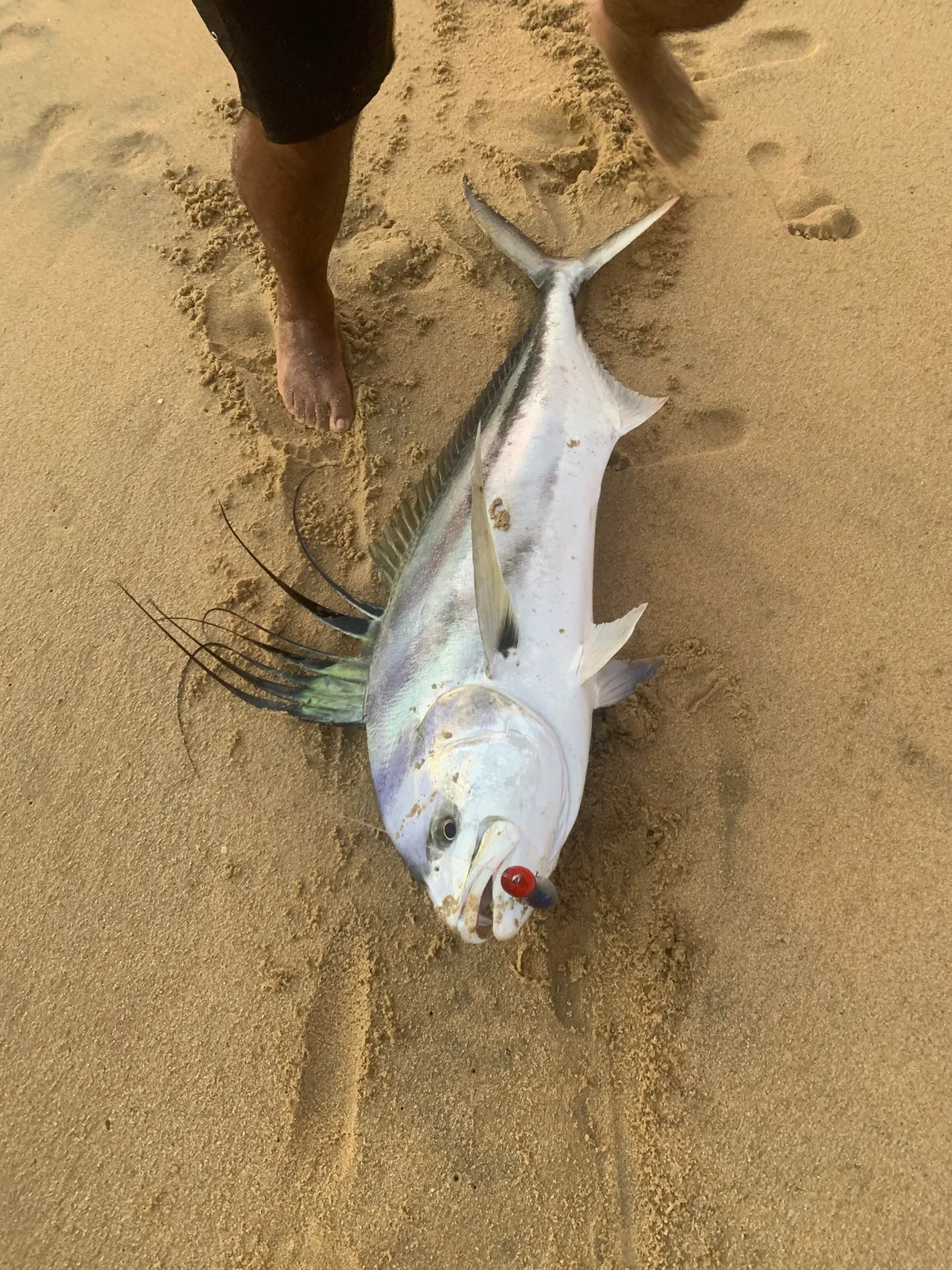
Identified by: The character the species is named for, fully displayed: the greatly elongated first dorsal rays standing clear of the back, separated from one another and individually countable. Nothing else carries this structure. The record's second character, the dark curved stripes sweeping back across the flank, has faded on this dead pale fish to faint shadows and did not carry the identification.CH Hemphill — CC BY, via iNaturalist — source, licenceCatching Roosterfish
Everything here on fishing for it. Each entry opens the page behind it.
- Ground
The roosterfish is a genuine one-off. It is the sole member of the family Nematistiidae, with no close relatives anywhere, and it carries a structure no other fish has: a first dorsal fin of seven greatly elongated rays that lie in a groove along the back and are raised into a fan when the fish is excited or hunting. That comb, breaking the surface behind a fleeing baitfish in the shallows, is one of the most striking sights in fishing.
It lives along the eastern Pacific from southern California to Peru, in the surf and shallow inshore water off sandy beaches, and juveniles occur in tide pools. That distribution — a large, powerful, high-profile sport fish available from a beach — is what makes it so significant to angling in Central America and Baja California.
As a target it is fished predominantly with live bait, by trolling and by casting from the shore, and it fights with speed and stamina in shallow water where there is nowhere for it to go but out. Its trophic level of 4.5 places it firmly as a top predator.
It is poorly regarded as food, and the recreational fishery is overwhelmingly catch-and-release — a pattern FishingHQ has now met several times, and one that consistently produces better outcomes for the fish than any regulation does.
Identification
- Scientific name
- Nematistius pectoralis
- Family
- Nematistiidae
- Water
- Saltwater
- Conservation status
- Least Concern
- Regions
- Central & South America, North America
- Seven greatly elongated first dorsal rays forming a comb that lies in a groove along the back and is raised into a fan — unique, and unmistakable when raised.
- Two dark curved stripes sweeping back and down across the silver flank, plus a third through the pectoral region.
- Body deep and compressed with a blunt head profile.
- Silver to blue-grey above, white below; deeply forked tail.
- No other fish shares the dorsal comb, so identification is unambiguous once it is seen.
Size
- Typical
- 4–10 kg (9–22 lb)
- Large
- 18–30 kg (40–66 lb)
Exceptional: Over 40 kg (88 lb); maximum published weight 51.7 kg
Sand, surf and the very edge of the beach
Roosterfish are inshore predators of the tropical eastern Pacific, and they occupy shallower water than a fish of their size normally would.
SANDY SHORELINES AND SURF ARE THE CORE HABITAT. Roosterfish hunt along beaches, over sand and around rocky points immediately adjacent to sand, frequently in water only a metre or two deep, chasing prey into the wash.
THEY ARE A SHORE-ACCESSIBLE LARGE PREDATOR, which is rare, and it is why the species supports both a beach fishery and a small-boat fishery working the same first hundred metres of water.
ROCKY POINTS AND STRUCTURE ADJACENT TO SAND concentrate them, as do river mouths and any feature that holds bait against the beach.
THEY FOLLOW BAIT AND ARE HIGHLY MOBILE ALONG A COAST, so a beach holds them when the bait is there and not otherwise.
JUVENILES USE SHALLOW SHELTERED INSHORE HABITAT including estuaries and protected bays.
DEPTH IS LIMITED — the species is not a deep or offshore fish, and it is comparatively rarely taken far from the coast.
AND THE HABITAT MAKES THE CONSERVATION POSITION UNUSUAL. A large, slow-growing, shore-accessible predator concentrated in a narrow strip of coast is exposed to both netting and angling in the same water, which is why release practice has become the norm in the sport fishery and why coastal netting is the species' main pressure.
Backed by research — why, and the sources (2)
Supported by peer-reviewed research or fisheries science. The sources are listed and can be checked.
- FishBase: a global information system on fishes — Froese, R. and D. Pauly, eds. — FishBase Consortium (Scientific institute)Relied on for: Distribution, habitat association, depth range, size, reproduction and life-history parameters recorded for the species.States this directlyPassage read and verified
- The IUCN Red List of Threatened Species — International Union for Conservation of Nature (Conservation authority)Relied on for: Assessment and range account for the species, including the habitats it depends on, its life history and the pressures acting on it.States this directlyCitation checked — the work exists and is described correctly
A season made by bait and by water temperature along one coast
Roosterfish are present year-round through much of their range and their seasonality is about concentration and comfort rather than migration.
WATER TEMPERATURE SETS THE PATTERN AT THE MARGINS. At the cooler northern and southern ends of the range roosterfish are a warm-season fish, appearing as inshore water warms and thinning as it cools; in the tropical core they are present throughout.
BAIT MOVEMENTS DRIVE THE PEAKS. Roosterfish follow schooling baitfish along the coast, so a beach or a point produces when the bait is there. Seasonal bait migrations are therefore the practical calendar, and they vary between years.
UPWELLING AND WIND CHANGE THE INSHORE PICTURE. Periods of strong upwelling cool the inshore water and can push roosterfish out or along the coast; periods of calm warm it and bring them close.
SPAWNING APPEARS TO OCCUR IN THE WARM MONTHS but the reproductive biology of this species is less well documented than its popularity would suggest, and an honest page says so rather than filling the gap.
THE LARGEST FISH ARE FREQUENTLY SEASONAL VISITORS to particular stretches, which is a well-attested pattern among guides and a poorly quantified one in the literature.
AND THE FISHERY'S SEASON IS ALSO A WEATHER SEASON, because a shore and small-boat fishery on an open Pacific coast is governed by swell and wind as much as by fish.
Backed by research — why, and the sources (2)
Supported by peer-reviewed research or fisheries science. The sources are listed and can be checked.
- FishBase: a global information system on fishes — Froese, R. and D. Pauly, eds. — FishBase Consortium (Scientific institute)Relied on for: Distribution, habitat association, depth range, size, reproduction and life-history parameters recorded for the species.States this directlyPassage read and verified
- The IUCN Red List of Threatened Species — International Union for Conservation of Nature (Conservation authority)Relied on for: Assessment and range account for the species, including the habitats it depends on, its life history and the pressures acting on it.States this directlyCitation checked — the work exists and is described correctly
A release-only fishery in tropical heat, where the photograph is the risk
Roosterfish are almost entirely released — the flesh is poor, the fish is prized as a sight-fishing target, and the fishery's whole culture is built on returning them. That makes handling the only conservation tool the fishery has, and it locates the risk in a very specific place.
THE CONDITIONS STACK BADLY. A roosterfish is fought in warm tropical water, which supplies less oxygen than cold water while the fish demands more, and it is a powerful, fast, sustained fighter that goes deep into oxygen debt. It is then frequently landed in shallow water on a beach or alongside a panga, in full sun, with an air temperature well above the water temperature. Every element of that pushes in the same direction.
AND THE PHOTOGRAPH IS THE POINT OF FAILURE. This is a spectacular-looking fish with an unmistakable dorsal comb, caught by people who have travelled a long way to catch one, and the resulting impulse is entirely understandable and entirely at odds with the fish's situation. Air exposure is the single most modifiable determinant of post-release survival, and its effect is multiplied by exactly the conditions this fishery takes place in. Thirty seconds out of the water in the tropics is not equivalent to thirty seconds out of the water in a Scottish river.
WHAT WORKS. The fish stays in the water. It is held upright in the wash, facing into the water movement, with a hand under the belly and one at the wrist of the tail, and it is given time — a big roosterfish may need several minutes and the temptation to let go early is the thing to resist. If a photograph is taken it is taken with the fish in the water and the camera above it, which is now the norm in well-run operations. And the fish leaves when it decides to, not when it is released.
The fish itself presents little hazard: no dentition worth avoiding, sharp gill covers to keep fingers clear of, and a body that must be supported horizontally rather than lifted vertically.
Official guidance — why, and the sources (2)
Stated by a fisheries authority, scientific institute or recognised angling body. Authoritative, but summarising rather than demonstrating.
- Understanding the Complexity of Catch-and-Release in Recreational Fishing — Reviews in Fisheries Science 15:75–167, 2007 (Scientific literature)Relied on for: The determinants of catch-and-release outcome in recreational fisheries, and the gap between angler belief and measured survival.States this directlyCitation checked — the work exists and is described correctly
- Do we need species-specific guidelines for catch-and-release recreational angling? — Biodiversity and Conservation 14:1195–1209, 2005 (Scientific literature)Relied on for: That air exposure, handling duration and water temperature are the dominant modifiable determinants of post-release survival.States this directlyCitation checked — the work exists and is described correctly
Inshore spawning in the surf zone, and a fish nobody knows enough about
Roosterfish reproduction is worth writing precisely because so little of it is established, and saying so is more useful than filling the gap with plausible-sounding material.
WHAT IS REASONABLY WELL ESTABLISHED is that roosterfish spawn in warm inshore waters of the eastern Pacific, in the warmer part of the year, releasing pelagic eggs; that they are broadcast spawners with no parental care; and that juveniles use very shallow inshore habitat including surf zones and beaches, where small roosterfish are commonly encountered.
WHAT IS NOT WELL ESTABLISHED IS ALMOST EVERYTHING ELSE. Age and size at maturity, whether spawning is aggregating or dispersed, whether there are discrete spawning locations, batch fecundity, the length of the spawning season in different parts of the range, and stock structure across the eastern Pacific are all either poorly documented or actively uncertain. FishingHQ records that as unresolved rather than borrowing figures from related species.
WHICH IS ITSELF THE MOST IMPORTANT THING TO KNOW, because it has a direct management consequence. A species with an uncertain reproductive profile cannot be assessed properly, and roosterfish are targeted by a substantial and economically significant recreational fishery across several countries without the biological basis that would let anybody say what level of removal is sustainable.
THE INSHORE HABIT COMPOUNDS THE EXPOSURE. Both juveniles and adults use shallow inshore water and surf beaches — the record's habitat material describes it — which means the population is accessible from shore and from small boats throughout, rather than being buffered by depth or distance as an offshore pelagic would be.
THE FISHERY IS OVERWHELMINGLY CATCH-AND-RELEASE in its sport form, which is a genuine mitigation, and the survival of released fish is consequently the variable that matters most — the record's handling considerations apply directly.
AND WHERE THE SPECIES IS TAKEN COMMERCIALLY OR ARTISANALLY the position differs by country. What may be retained anywhere is a matter for the competent authority, and the honest overall position is that the biology needed to set those rules well is incomplete.
An open question — why, and the sources (2)
FishingHQ looked into this and could not settle it. The open question is recorded here rather than being papered over.
- IGFA International Angling Rules and World Record Requirements — International Game Fish Association (Angling or fisheries organisation)Relied on for: Recognition of the species as a recognised game fish and the seasonal pattern of the recreational fisheries that target it.Background and mechanism onlyPassage read and verified
- FishBase: a global information system on fishes — Froese, R. and D. Pauly, eds. — FishBase Consortium (Scientific institute)Relied on for: Spawning season, temperature preference, migratory behaviour and seasonal distribution for the species.States this directlyPassage read and verified
Lifecycle and reproduction
Juveniles occur in tide pools and shallow inshore water, moving to surf and nearshore habitat as they grow. Adults reach a large size and are long-lived. The species is uncommon north of Baja California, so the core of both its range and its fishery lies in Central American and Mexican Pacific waters.
Broadcast spawning in inshore waters with pelagic eggs and no parental care, generally in the warmer months. The occurrence of juveniles in tide pools indicates dependence on shallow sheltered inshore habitat during early life, which ties the species to coastal condition as well as to fishing pressure.
Feeding and senses
A top predator with a recorded trophic level of 4.5, feeding on fish in shallow inshore water and in the surf. Hunting frequently occurs in very shallow water where roosterfish drive baitfish against the beach, and the raised dorsal comb is characteristic of a fish in pursuit — which is what makes the fishery so visual.
Sight-dominant, hunting visually in clear inshore water and in the surf. Roosterfish are notably responsive to live bait and considerably less so to dead bait, which is consistent with a predator keyed to movement, and this is why the traditional method throughout the range is live bait rather than anything static.
Through the year
Present year-round through much of the core range with abundance following water temperature and bait. Northern-hemisphere tropics, so the calendar is not inverted, but the drivers are bait and temperature rather than season. Surf state and tide govern the shore fishing, as they do for every surf species on FishingHQ.
Distribution
Eastern Pacific from southern California to Peru, including the Galápagos Islands, and uncommon north of Baja California. Inhabits shallow inshore areas and frequents sandy shores along beaches, with juveniles occurring in tide pools.
This is a biological range — where the species occurs, not a prediction that you will catch one. To browse the fishing geography FishingHQ holds, start at fishing places.
Why anglers care
One of the premier inshore sport species of the eastern Pacific and a major draw for angling travel to Mexico, Costa Rica, Panama and Nicaragua. Fished with live bait, by trolling and by casting lures and fly from beaches and small boats. Poorly regarded as food, and the recreational fishery is predominantly catch-and-release as a result.
Handling and returning
A powerful fish best handled in the water. Support horizontally rather than lifting vertically, keep fingers clear of the gill covers, and revive properly — a fish played out in warm shallow water needs time. Given that almost the entire fishery is release-based, handling technique is doing more work here than any rule, and holding a fish out of the water for photographs in tropical heat is where that goes wrong.
Safety
Drowning and immersion — Can cause serious injury or death
Much of the shore fishery is in the surf on steep Pacific beaches with strong rips, frequently while wading and playing a powerful fish.
What reduces it: Wade shallow and no deeper than necessary. Face the sea. Know that a rip appears as a darker, calmer-looking channel through breaking water. Wear a buoyancy aid where wading, and never wade alone on unfamiliar beaches.
Sun, dehydration and fatigue — Can cause injury needing treatment
Tropical Pacific beaches and small boats combine strong sun, glare and heat, and dehydration degrades judgement before it produces symptoms.
What reduces it: Cover up rather than relying on sunscreen, wear polarised glasses, and drink steadily through the day.
Precautions that always apply here
- Wear a buoyancy aid or lifejacket. Cold water incapacitates strong swimmers within a minute, long before swimming ability matters.
- Do not wade alone. Judge depth and flow from the bank first, and turn back sooner than feels necessary.
- Support the fish's weight along its body, keep it out of the water for as short a time as possible, and hold it over something soft.
- Wet your hands before touching a fish. Dry hands strip the protective mucus layer that keeps infection out.
- Tell somebody where you are going and when you expect to be back.
Where to go next
Where it lives
Where you will find it
Understanding this fish
More fish
Not related to this page — just the rest of the section. There is little else joined to this subject yet, and a short page should still lead somewhere.
Sources and evidence
- FishBase: a global information system on fishes — Froese, R. and D. Pauly, eds. — FishBase Consortium (Scientific institute)Relied on for: Scientific name, family placement in the Nematistiidae, maximum length of 163 cm fork length with common length around 60 cm and maximum published weight of 51.7 kg, eastern Pacific distribution from southern California to Peru including the Galápagos and uncommon north of Baja California, habitat in shallow inshore areas frequenting sandy shores along beaches with juveniles in tide pools.States this directlyPassage read and verified
- FishBase: a global information system on fishes — Froese, R. and D. Pauly, eds. — FishBase Consortium (Scientific institute)Relied on for: The IUCN Red List category — Least Concern, assessed 23 February 2024 — is taken from FishBase's republication.States this directlyPassage read and verified
Why the 5 connections on this page are here, and the sources
How it is caught
What experienced anglers do — 1 connection
Widely and independently recommended by experienced anglers and specialist sources. This is real angling knowledge, not proof: controlled evidence for it is limited, and FishingHQ records it as convention rather than as a demonstrated effect.
Livebaiting at sea
A practitioner claim consistent with the species' verified trophic position.
- Sea Angler — Bauer Media (Specialist angling publication)Relied on for: Practitioner treatment of live bait presentation for inshore predators.Citation checked — the work exists and is described correctly
- General angling website restatements of established technique — Various (Credible secondary source)Relied on for: Widely restated practitioner accounts of roosterfish taking live bait in preference to dead.Citation checked — the work exists and is described correctly
Gear for this fish
What experienced anglers do — 1 connection
Widely and independently recommended by experienced anglers and specialist sources. This is real angling knowledge, not proof: controlled evidence for it is limited, and FishingHQ records it as convention rather than as a demonstrated effect.
Surface lures
A practitioner claim about which lure family answers this species' feeding or holding behaviour.
- IGFA International Angling Rules and World Record Requirements — International Game Fish Association (Angling or fisheries organisation)Relied on for: Recognition of the species as an established sport fish taken on artificial lures, and the line and tackle classes used for it.States this directlyPassage read and verified
- General angling website restatements of established technique — Various (Credible secondary source)Relied on for: Widely restated lure practice for this species.Background and mechanism onlyCitation checked — the work exists and is described correctly
Where it lives
Backed by research — 1 connection
Supported by peer-reviewed research or fisheries science. The sources are listed and can be checked.
Surf beaches
A habitat claim held to a scientific standard.
- FishBase: a global information system on fishes — Froese, R. and D. Pauly, eds. — FishBase Consortium (Scientific institute)Relied on for: That Nematistius pectoralis inhabits shallow inshore areas and frequents sandy shores along beaches, with juveniles occurring in tide pools, and has a trophic level of 4.5.States this directlyPassage read and verified
Where you will find it
Backed by research — 1 connection
Supported by peer-reviewed research or fisheries science. The sources are listed and can be checked.
The Humboldt Current
A distribution association between an animal and a kind of water, rather than a claim about any named mark.
- FishBase: a global information system on fishes — Froese, R. and D. Pauly, eds. — FishBase Consortium (Scientific institute)Relied on for: Distribution, habitat association and depth range recorded for the species, including its occurrence in the water body concerned.States this directlyPassage read and verified
- The IUCN Red List of Threatened Species — International Union for Conservation of Nature (Conservation authority)Relied on for: Assessment and range account for the species, including the systems and coasts it occupies.Background and mechanism onlyCitation checked — the work exists and is described correctly
Understanding this fish
What experienced anglers do — 1 connection
Widely and independently recommended by experienced anglers and specialist sources. This is real angling knowledge, not proof: controlled evidence for it is limited, and FishingHQ records it as convention rather than as a demonstrated effect.
Fly fishing for warm-water and tropical species
A fish or a water joined to the fly-fishing mechanism it is a worked example of, written only where the subject's own behaviour or physical character is what this page explains. The direction is the one FishingHQ writes this kind of connection in, and the one it already uses 176 times, and it is also the semantically correct one: the mechanism explains the fish, not the reverse.
- FAO Species Identification Guides for Fishery Purposes and the FAO Species Catalogues — Food and Agriculture Organization of the United Nations (Scientific institute)Relied on for: Distribution, habitat association and feeding biology of tropical inshore and reef species, from regional identification guides prepared for fishery purposes.States this directlyCitation checked — the work exists and is described correctly
- FishBase: a global information system on fishes — Froese, R. and D. Pauly, eds. — FishBase Consortium (Scientific institute)Relied on for: Recorded environment, depth range, feeding biology and distribution of the tropical species named.States this directlyPassage read and verified
How FishingHQ labels evidence is explained in the evidence policy.